Showing posts with label Animal conciousness. Show all posts

Tuesday, February 10, 2026

3674. Interview: Michael Pollan on Human Consciousness

By David Marchese, The New York Time, February 7, 2025 

Devin Oktar Yalkin for The New York Times

For as long as I can remember, I’ve wrestled with my own thoughts and feelings about identity. Why am I, David, the person I am? How changeable is that? Where do those thoughts and feelings come from anyway, and what purposes do they ultimately serve? I suppose it’s no coincidence then that I’ve also always been so curious about the subject of human consciousness. That’s the area of science and philosophy — of human thinking generally! — that burrows most deeply into similar questions and, to varying degrees of satisfaction, offers a plethora of possible answers. The best-selling author Michael Pollan has been thinking about these things, too. Throughout his work — which includes classic books like “The Omnivore’s Dilemma” (2006), about why we eat the way we do, and “How to Change Your Mind” (2018), about the science and uses of psychedelic drugs — Pollan has waded into ideas about the inner workings of the mind. Now, with his forthcoming book, “A World Appears: A Journey Into Consciousness,” which will arrive this month, he has jumped into the deep end. The book is both a highly personal and expansive multidisciplinary survey of questions around human consciousness — what it is, what causes it, what it’s for and what the possible answers might mean for how we choose to live. And as Pollan explained, with the rise of artificial intelligence as well as the relentless political pressure on our attention (that is, our minds), those questions, already profound, are becoming only more urgent.

I want to get some basics: How do you define consciousness? The simplest way to define consciousness is as subjective experience. Another one-word definition is “awareness.” Thomas Nagel, the N.Y.U. philosopher, wrote a piece back in the ’70s called “What Is It Like to Be a Bat?” His idea is: If we can imagine it is like anything to be a bat, then a bat is conscious, because that means it has some sort of subjective experience. Why did he choose bats? Well, they’re very different than we are. Instead of using eyesight, they use echolocation. They bounce signals off of objects to move through space. We can vaguely imagine going through the world with echolocation. Whereas my toaster, I can’t do that. I don’t have a sense of what it’s like to be my toaster.

A big question of consciousness is what the philosopher David Chalmers has referred to as the “hard problem.” Can you tell people what that is? Basically how you get from matter to mind, how you cross that huge gulf from neurons to subjective experience — a gulf no one has managed to cross. Related questions are: Why don’t all these things we do go on automatically? Why do we have to be aware of anything? We could be completely automated and perhaps get along just fine. Your brain is monitoring your body and making fine adjustments in the blood gasses, in the heart rate, in digestion. There’s a lot going on that we don’t have to think about. So why do we have to think about any of it? Some interesting theories have been proposed. One is that some of the issues that we deal with have to be decided in a conscious way. When you have two competing needs — you’re hungry and you’re tired — which should take precedence? So consciousness opens up this space of decision-making. The other argument is that we live in a very complex social world where I have to predict what you’re going to say; I have to imagine my way into your head. You can’t automate human social interaction. It has too many elements. So consciousness is very helpful in navigating that world.

It seems likely to me that regardless of the source of consciousness, it’s probably a result of evolutionary processes — that consciousness evolved to make information available to certain parts of the brain, or to help us recognize patterns, or perceive threats, or maintain homeostasis. But are any non-evolutionary arguments for consciousness plausible to you? Oh, yeah. One is panpsychism.

Which could sound bonkers. It can sound bonkers. Panpsychism is the idea that everything, every particle, the ink on the page, the atoms, all have some infinitesimal degree of psyche or consciousness, and somehow this consciousness is combined in some way from our cells and the rest of our bodies to create this kind of superconsciousness. It sounds crazy. There are some very serious people who believe in it. You have to expand your sense of the plausible when you’re looking at consciousness. But we’ve done that before. How long ago was it that we discovered electromagnetism? This crazy idea that there are all these waves passing through us that can carry information. That’s just as mind-blowing, right?

I could happily talk about consciousness all day, but often when I do talk about it with people, I can tell that they view thinking about consciousness as almost akin to navel gazing. Like, it’s an interesting thing to think about, but really what difference does it make? What is your response to that? I’ve thought a lot about what good is it to think about consciousness, and I came to think that it’s more important than ever. Scientists are now learning that more and more animals and creatures — going all the way down possibly to insects — are conscious. So that’s one interesting issue: We’re sharing consciousness with more creatures. And then the big threat is artificial intelligence and the effort to create a conscious A.I., which is going to be an enormous challenge to this question of what does it mean to be human. Is consciousness something that a machine can possess? Are we more like intelligent machines or conscious, feeling animals? Who are we? So I think we’re approaching this kind of Copernican moment of redefinition.


What do you think we should do with the increasing awareness that more animals might be conscious than we previously thought? I guess the argument would be that we should have a greater amount of respect for them, but we know human beings are conscious and we exploit the hell out of other humans all the time. That’s a great question. There’s this whole conversation, very active here where I live in Silicon Valley, that if A.I. is conscious, then we’re going to have to give it moral consideration. Well, really? Have we given moral consideration to one another? Have we given moral consideration to the chickens and the cattle that we eat? The answer is no. It doesn’t automatically follow. So we’re going to have to sort out the ethics. Maybe it’s around the ability to suffer. Maybe that’s where you draw the line. I don’t know. I’m not an ethicist, but it’s not as easy as: You’re conscious, therefore you have all these rights. A.I. is really going to complicate this. Who we grant personhood to is a very subjective human decision. We give it to corporations, oddly enough, which are not conscious, but there are all sorts of creatures we don’t give it to. I don’t think we’re entirely rational or consistent in our granting of moral consideration.


You are skeptical that A.I. can achieve consciousness. Why? I’m convinced by some of the researchers, including Antonio Damasio and Mark Solms, who made a really compelling case that the origin of consciousness is with feelings, not thoughts. Feelings are the language in which the body talks to the brain. We forget that brains exist to keep bodies alive, and the way the body gets the brain’s attention is with feelings. So if you think feelings are at the center of consciousness, it’s very hard to imagine how a machine could rise to that level to have feelings. The other reason I think we’re not close to it is that everything that machines know, the data set on which they’re trained, is information on the internet. They don’t have friction with nature. They don’t have friction with us. Some of the most important things we know are about person-to-person contact, about contact with nature — this friction that really makes us human.

Despite how it may seem, the internet is not actually the whole of the world. But to a computer, it’s all you got.

How would we know if an A.I. is conscious or not? How do I know you’re conscious?

I promise I am! Your promise is what’s called reportability in philosophy. You can ask something if it’s conscious, and with humans, we kind of know.


But if an A.I. says: “Michael, I’m conscious. I promise,” how do we know? We don’t, and that is exactly why people are falling deep into these relationships with A.I. We can’t say it’s not conscious when it tells us it is. But we can test it in various ways. It all goes back to this idea of the Turing test — that the test of machine intelligence would be when they can fool us.

If the Turing test is the criteria for machine consciousness, then that test has already been passed. Exactly, it has fooled many, many people. Whether it can fool an expert, too, I don’t know, but probably. So we’re in a very weird place where the machines we’re living with are telling us they’re conscious. We can’t dispute it, but we can look at how they’re made and draw the kind of conclusions I’ve drawn. But is that going to persuade everybody? No. We want them to be conscious in some way. Or some of us do. It’s easier to have a relationship with a chatbot than another human. Going back to that friction point, they offer no friction. They just suck up to us and convince us how brilliant we are, and we fall for it.


What do you think religion has to offer to questions about consciousness? Buddhism has been thinking about consciousness for a very long time. It has been raising these questions about the self and giving people tools to transcend the self, which in itself is a desire that is surprising. We cling to this ego so firmly; at the same time, we do a lot of things to get away from it, whether it’s extreme sports or psychedelics or meditation.

Or watching a movie or having sex or any number of things. Some of the highest experiences of life are these moments where we transcend the self, and that’s curious.


What do you think that’s about? Why, if we cling to the self, are we also so hungry to lose ourselves? The self isolates us, the ego builds walls around it, it’s constantly evaluating, it ruminates. There’s a lot of crappy stuff about the self.


Yeah, it’s constantly yammering away. Yes, there is that voice in our head, and it embodies critical voices, very often inherited from parents or other people. I mean, the ego is very useful. It gets a lot done. It got my book done. It gets your podcast done. So we shouldn’t be too critical of it. On the other hand, when we transcend the self, we connect to things larger than ourselves. And this is one of the beautiful things about psychedelics — when they work, there is this sense of dissolution of self. The walls come down, and you feel part of nature. You feel love. I had an experience I describe in the book of self-dissolution where I merged with this piece of music, this Bach cello suite, and it was such a profound experience because the subject-object split went away and I was identical to this music. The interesting thing, though, is that consciousness doesn’t go away when the ego goes away. We protect our ego because we’re afraid if we lose it, we’re dead. But we’re not. It’s just one voice. There’s a lot else going on, as you learn when you meditate and use psychedelics.


How often do you do psychedelics? Not very often at all. It’s hard to find time. It’s a big day with a lot of preparation and everything. If I can do it once a year, I’m happy. What I’m talking about is ideally a guided experience. You can let yourself go when someone’s watching your body. So when I can put myself in that situation — which isn’t easy to do, and it’s expensive — I find that very valuable. I’m still learning things.


What are you learning? Oh, every psychedelic experience is different. You never go back to the same place. That’s why I think it’s a great thing to do on or around your birthday, to sort of take stock of your reality and what the issues are. I had an experience not too long ago that kind of rocked me.

What was it? It was a guided trip on — it doesn’t matter what it was on. I had these powerful emotions that had no name. They were like these giant blimps crashing into me, crashing into each other, and I was straining and so frustrated that I didn’t know what they were, and the answer never came clear during the experience. Oddly enough, the answer to what they were came two weeks later when I happened to be at a meditation retreat. The links between psychedelics and meditation are very fruitful and interesting. I was doing a walking meditation after a couple days of complete silence, 12-hour-a-day meditating, and there were the blimps. In sans serif letters, right on the blimp, was the word “fear.” I quickly realized what it was. It was fear of losing something very close to you. So the combination of two experiences ended up being very productive. But on its own, the psychedelic experience raised more questions than gave answers.

Questions of consciousness, which are really questions about what makes us us, are some of the most important questions that can be asked. But at the same time, they can lead into other questions like: Is there some David — some stable “I” — that exists or not? Or what is the relationship between free will and consciousness? Sometimes thinking about those questions can be destabilizing. Is that just me? Do you have similar apprehensions? It can be destabilizing, absolutely. One of the reasons people are happy to be less conscious and fill their attention with distractions and drugs is because the mind can be a scary place to visit. We often want to be less aware of what’s going on. There are reasons people avoid going down these rabbit holes. It takes a willingness to risk something.


I apologize if this seems like a woo-woo question, but do you think the absence of something like a stable “self” also means the absence of something like a soul? Do you believe in a soul? Well, if a soul is something that is indestructible and survives our death, no. But I can’t say anything about the afterlife with confidence. Consciousness has become our secular substitute for the soul; we talk about consciousness the way people in the 16th or 17th century talked about souls. Some people’s interest in it is the fact that it floats free of these mortal bodies and maybe gets folded into a collective consciousness after we’re gone. So I think there is a hidden religiosity or spirituality in the whole conversation around consciousness. Somebody asked me recently, Do you think as people get older, they are more interested in consciousness? And I would say yes, and probably for that reason.


It does seem that many of us have consistencies to ourselves that are a little hard to explain in the absence of something like a stable identity or a soul. In the new book, you mention a period in your teenage years when you were reading Hermann Hesse, writing bad poetry and thinking about the big questions. I don’t know if you still write bad poetry, but the other two things don’t seem that far away from what you’re now doing in your 70s. So what might explain what seem like intrinsic core qualities that are constant for you through time if not a stable self-identity or a soul? Even though I talk a lot about this idea that maybe the self is an illusion, it still has a conventional reality. The fact that I’m using myself to talk to yourself makes this very easy. If neither of us had selves right now, it would be a very loosey-goosey conversation. I can’t even imagine what it would be like. Matthieu Ricard said: It’s like a river has a name, and that conventional name is very useful, but there’s nothing consistent there. It’s just water passing.

I brought something like this up earlier, but I want to ask another version of it. This morning I was reading the news and thinking, Gosh, right now, is talking to Michael Pollan about consciousness a kind of “how many angels can dance on the head of a pin” conversation? I decided the answer is no, but do you ever have those doubts? I did at various points when I was starting on this book and the world was starting to fall apart. Like, is this how I should be using my energy? But I think that consciousness is at stake in a lot of what’s going on. One of the things Trump has done is occupy a significant chunk of our attention every single day. Our consciousness is being polluted, and protecting ourselves against that at the same time we preserve the ability to act politically is a difficult balancing act. Consciousness is a very precious realm. It’s the realm of our privacy and our freedom to think. So I think we need some kind of consciousness hygiene, particularly at this moment, where this one politician has figured out ways to command our attention. Consciousness is more relevant now than it even was 10 or 20 years ago, as something to think about, protect and nurture.

Tuesday, June 14, 2022

3594. How Nonhuman Animals Perceive the World

 By Ed Yong, The Atlantic, June 13, 2022

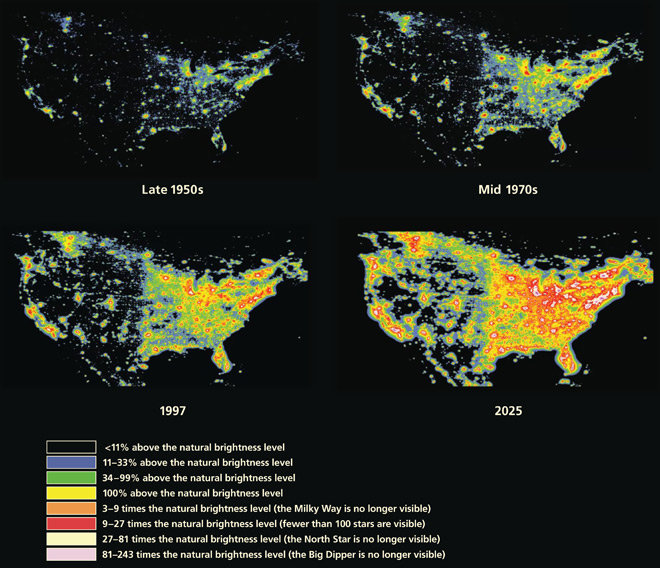
Increasing light pollution in the U.S.


Within the 310,000 acres of Wyoming’s Grand Teton National Park, one of the largest parking lots is in the village of Colter Bay. Beyond the lot’s far edge, nestled among some trees, is a foul-smelling sewage-pumping station that Jesse Barber, a sensory ecologist at Boise State University, calls the Shiterator. On this particular night, sitting quietly within a crevice beneath the building’s metal awning and illuminated by Barber’s flashlight, is a little brown bat. A white device the size of a rice grain is attached to the bat’s back. “That’s the radio tag,” Barber tells me. He’d previously affixed it to the bat so that he could track its movements, and tonight he has returned to tag a few more.

From inside the Shiterator, I can hear the chirps of other roosting bats. As the sun sets, they start to emerge. A few become entangled in the large net Barber has strung between two trees. He frees a bat, and Hunter Cole, one of his students, carefully examines it to check that it’s healthy and heavy enough to carry a tag. Once satisfied, Cole daubs a spot of surgical cement between its shoulder blades and attaches the tiny device. “It’s a little bit of an art project, the tagging of a bat,” Barber tells me. After a few minutes, Cole places the bat on the trunk of the nearest tree. It crawls upward and takes off, carrying $175 worth of radio equipment into the woods.

I watch as the team examines another bat, which opens its mouth and exposes its surprisingly long teeth. This isn’t an aggressive display; it only looks like one. The bat is unleashing a stream of short, ultrasonic pulses from its mouth, which are too high-pitched for me to hear. Bats, however, can hear ultrasound, and by listening for the returning echoes, they can detect and locate objects around them.

Echolocation is the primary means through which most bats navigate and hunt. Only two animal groups are known to have perfected the ability: toothed whales (such as dolphins, orcas, and sperm whales) and bats. Echolocation differs from human senses because it involves putting energy into the environment. Eyes scan, noses sniff, and fingers press, but these sense organs are always picking up stimuli that already exist in the wider world. By contrast, an echolocating bat creates the stimulus that it later detects. Echolocation is a way of tricking your surroundings into revealing themselves. A bat says “Marco,” and its surroundings can’t help but say “Polo.”

The basic process seems straightforward, but its details are extraordinary. High-pitched sounds quickly lose energy in air, so bats must scream to make calls that are strong enough to return audible echoes. To avoid deafening themselves, bats contract the muscles in their ears in time with their calls, desensitizing their hearing with every shout and restoring it in time for the echo. Each echo provides a snapshot in time, so bats must update their calls quickly to track fast-moving insects; fortunately, their vocal muscles are the fastest known muscles in any mammal, releasing up to 200 pulses a second. A bat’s nervous system is so sensitive that it can detect differences in echo delay of just one- or two-millionths of a second, which translates to a physical distance of less than a millimeter. A bat thus gauges the distance to an insect with far more precision than humans can.

Echolocation’s main weakness is its short range: Some bats can detect small moths from about six to nine yards away. But they can do so in darkness so total that vision simply doesn’t work. Even in pitch-blackness, bats can skirt around branches and pluck minuscule insects from the sky. Of course, bats are not the only animals that hunt nocturnally. In the Tetons, as I watch Barber tagging bats, mosquitoes bite me through my shirt, attracted by the smell of the carbon dioxide on my breath. While I itch, an owl flies overhead, tracking its prey using a radar dish of stiff facial feathers that funnel sound toward its ears. These creatures have all evolved senses that allow them to thrive in the dark. But the dark is disappearing.

Barber is one of a growing number of sensory biologists who fear that humans are polluting the world with too much light, to the detriment of other species. Even here, in the middle of a national park, light from human technology intrudes upon the darkness. It spews forth from the headlights of passing vehicles, from the fluorescent bulbs of the visitor center, and from the lampposts encircling the parked cars. “The parking lot is lit up like a Walmart because no one thought about the implications for wildlife,” Barber says.

Many flying insects are fatally attracted to streetlights, mistaking them for celestial lights and hovering below them until they succumb to exhaustion. Some bats exploit their confusion, feasting on the disoriented swarms. Other, slower-moving species, including the little brown bats that Barber tagged, stay clear of the light, perhaps because it makes them easier prey for owls. Lights reshape animal communities, drawing some in and pushing others away, with consequences that are hard to predict.

To determine the effect of light on the bats of Grand Teton, Barber persuaded the National Park Service to let him try an unusual experiment. In 2019, he refitted all 32 streetlights in the Colter Bay parking lot with special bulbs that can change color. They can produce either white light, which strongly affects the behavior of insects and bats, or red light, which doesn’t seem to. Every few days during my visit, Barber’s team flips their color. Funnel-shaped traps hanging below the lamps collect the gathering insects, while radio transponders pick up the signals from the tagged bats. These data should reveal how normal white lights affect the local animals, and whether red lights can help rewild the night sky.

Cole gives me a little demonstration by flipping the lights to red. At first, the parking lot looks disquietingly infernal, as if we have stepped into a horror movie. But as my eyes adjust, the red hues feel less dramatic and become almost pleasant. It is amazing how much we can still see. The cars and the surrounding foliage are all visible. I look up and notice that fewer insects seem to be gathered beneath the lamps. I look up even farther and see the stripe of the Milky Way cutting across the sky. It’s an achingly beautiful sight, one I have never seen before in the Northern Hemisphere.

Every animal is enclosed within its own sensory bubble, perceiving but a tiny sliver of an immense world. There is a wonderful word for this sensory bubble—Umwelt. It was defined and popularized by the Baltic German zoologist Jakob von Uexküll in 1909. Umwelt comes from the German word for “environment,” but Uexküll didn’t use it to refer to an animal’s surroundings. Instead, an Umwelt is specifically the part of those surroundings that an animal can sense and experience—its perceptual world. A tick, questing for mammalian blood, cares about body heat, the touch of hair, and the odor of butyric acid that emanates from skin. It doesn’t care about other stimuli, and probably doesn’t know that they exist. Every Umwelt is limited; it just doesn’t feel that way. Each one feels all-encompassing to those who experience it. Our Umwelt is all we know, and so we easily mistake it for all there is to know. This is an illusion that every creature shares.

Humans, however, possess the unique capacity to appreciate the Umwelten of other species, and through centuries of effort, we have learned much about those sensory worlds. But in the time it took us to accumulate that knowledge, we have radically remolded those worlds. Much of the devastation that we have wrought is by now familiar. We have changed the climate and acidified the oceans. We have shuffled wildlife across continents, replacing indigenous species with invasive ones. We have instigated what some scientists have called an era of “biological annihilation,” comparable to the five great mass-extinction events of prehistory. But we have also filled the silence with noise and the night with light. This often ignored phenomenon is called sensory pollution—human-made stimuli that interfere with the senses of other species. By barraging different animals with stimuli of our own making, we have forced them to live in our Umwelt. We have distracted them from what they actually need to sense, drowned out the cues they depend upon, and lured them into sensory traps. All of this is capable of doing catastrophic damage.


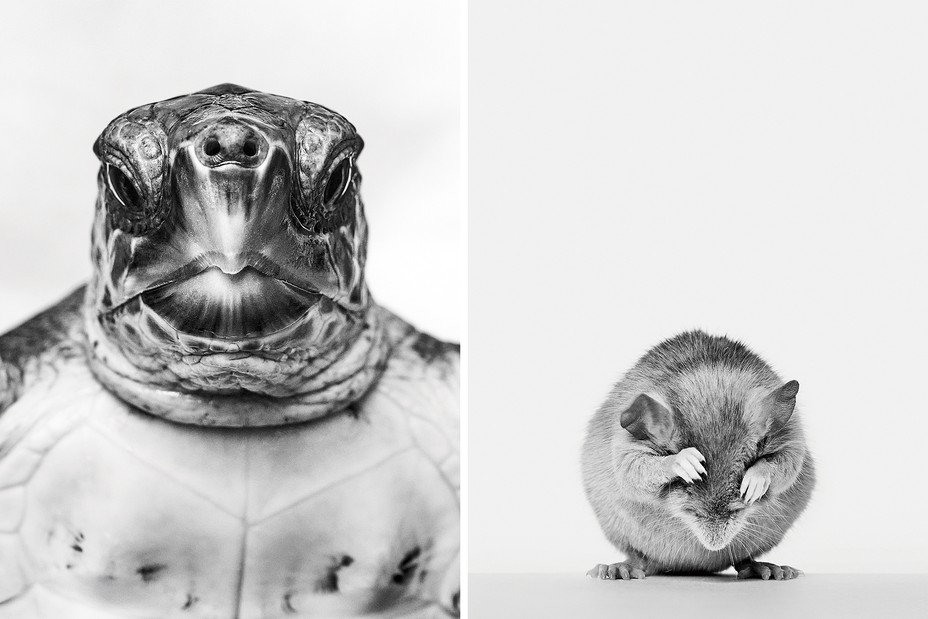
2 black and white photos: a close-up view of a sea turtle's head; a titmouse with head bowed and paws over eyes
A sea turtle’s hatchlings can be diverted away from the sea by artificial lights. For mice, human-made noise
can mask the sounds of predators. (Shayan Asgharnia for The Atlantic)

In 2001, astronomer Pierantonio Cinzano and his colleagues created the first global atlas of light pollution. They calculated that two-thirds of the world’s population lived in light-polluted areas, where the nights were at least 10 percent brighter than natural darkness. About 40 percent of humankind is permanently bathed in the equivalent of perpetual moonlight, and about 25 percent constantly experiences an artificial twilight that exceeds the illumination of a full moon. “‘Night’ never really comes for them,” the researchers wrote. In 2016, when the team updated the atlas, it found that the problem had become even worse. By then, about 83 percent of people—including more than 99 percent of Americans and Europeans—were under light-polluted skies. More than a third of humanity, and almost 80 percent of North Americans, can no longer see the Milky Way. “The thought of light traveling billions of years from distant galaxies only to be washed out in the last billionth of a second by the glow from the nearest strip mall depresses me to no end,” the visual ecologist Sönke Johnsen once wrote.

At Colter Bay, Cole flips the lights from red back to white and I wince. The extra illumination feels harsh and unpleasant. The stars seem fainter now. Sensory pollution is the pollution of disconnection. It detaches us from the cosmos. It drowns out the stimuli that link animals to their surroundings and to one another. In making the planet brighter and louder, we have endangered sensory environments for countless species in ways that are less viscerally galling than clear-cut rain forests and bleached coral reefs but no less tragic. That must now change. We can still save the quiet and preserve the dark.

Every year on September 11, the sky above New York City is pierced by two columns of intense blue light. This annual art installation, known as Tribute in Light, commemorates the terrorist attacks of 2001, with the ascending beams standing in for the fallen Twin Towers. Each is produced by 44 xenon bulbs with 7,000-watt intensities. Their light can be seen from 60 miles away. From closer up, onlookers often notice small flecks, dancing amid the beams like gentle flurries of snow. Those flecks are birds. Thousands of them.

This annual ritual, unfortunately, occurs during the autumn migratory season, when billions of small songbirds undertake long flights through North American skies. Navigating under the cover of darkness, they fly in such large numbers that they show up on radar. By analyzing meteorological radar images, Benjamin Van Doren showed that Tribute in Light, across seven nights of operation, waylaid about 1.1 million birds. The beams reach so high that even at altitudes of several miles, passing birds are drawn into them. Warblers and other small species congregate within the light at up to 150 times their normal density levels. They circle slowly, as if trapped in an incorporeal cage. They call frequently and intensely. They occasionally crash into nearby buildings.

Migrations are grueling affairs that push small birds to their physiological limit. Even a night-long detour can sap their energy reserves to fatal effect. So whenever 1,000 or more birds are caught within Tribute in Light, the bulbs are turned off for 20 minutes to let the birds regain their bearing. But that’s just one source of light among many, and though intense and vertical, it shines only once a year. At other times, light pours out of sports stadiums and tourist attractions, oil rigs and office buildings. It pushes back the dark and pulls in migrating birds.

In 1886, shortly after Thomas Edison commercialized the electric light bulb, about 1,000 birds died after colliding with illuminated towers in Decatur, Illinois. More than a century later, the environmental scientist Travis Longcore and his colleagues calculated that almost 7 million birds die each year in the United States and Canada after flying into communication towers. The lights of those towers are meant to warn aircraft pilots, but they also disrupt the orientation of nocturnal avian fliers, which then veer into wires or each other. Many of these deaths could be avoided simply by replacing steady lights with blinking ones.

We too quickly forget that we don’t perceive the world in the same way as other species, and consequently, we ignore impacts that we shouldn’t,” Longcore tells me in his Los Angeles office. Our eyes are among the sharpest in the animal kingdom, but their high resolution comes with the cost of low sensitivity. Unlike most other mammals, our vision fails us at night, so we crave more nocturnal illumination, not less.

The idea of light as a pollutant is jarring to us, but it becomes one when it creeps into places where it doesn’t belong. Widespread light at night is a uniquely anthropogenic force. The daily and seasonal rhythms of bright and dark remained largely inviolate throughout all of evolutionary time—a 4-billion-year streak that began to falter in the 19th century.

When sea-turtle hatchlings emerge from their nests, they crawl away from the dark shapes of dune vegetation toward the brighter oceanic horizon. But lit roads and beach resorts can steer them in the wrong direction, where they are easily picked off by predators or squashed by vehicles. In Florida alone, artificial lights kill baby turtles in the thousands every year. They’ve wandered into a baseball game and, more horrifying, abandoned beach fires. The caretaker of one property in Melbourne Beach found hundreds of dead hatchlings piled beneath a single mercury-vapor lamp.


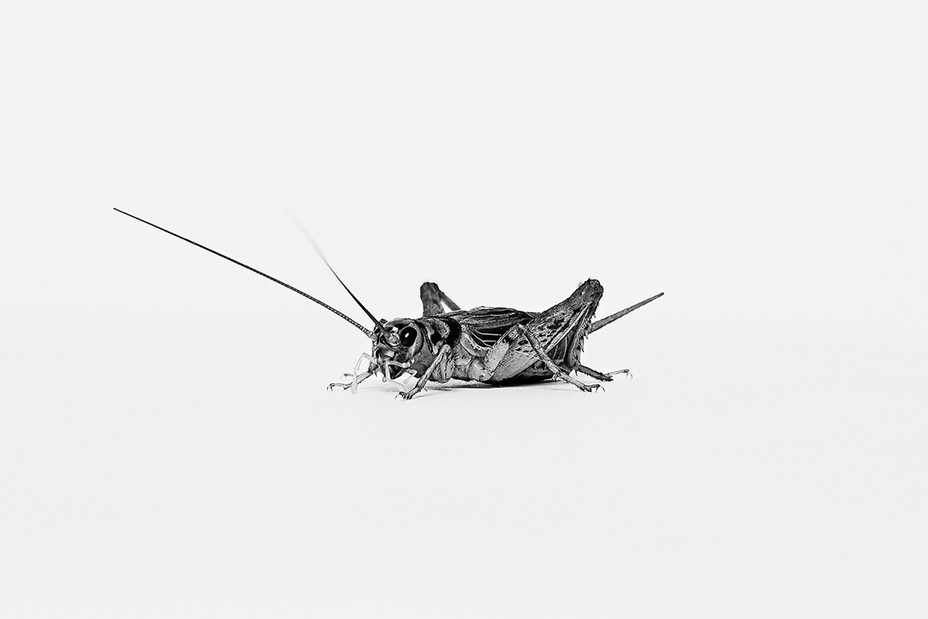
black and white photo of cricket
Female crickets struggle to find the best mates when noise pollution masks the males’ songs. (Shayan Asgharnia for The Atlantic)

Artificial lights can also fatally attract insects, contributing to their alarming global declines. A single streetlamp can lure moths from 25 yards away, and a well-lit road might as well be a prison. Many of the insects that gather around streetlamps will likely be eaten or dead from exhaustion by sunrise. Those that zoom toward vehicle headlights will probably be gone even sooner. The consequences of these losses can ripple across ecosystems. In 2014, as part of an experiment, the ecologist Eva Knop installed streetlamps in seven Swiss meadows. After sunset, she prowled these fields with night-vision goggles, peering into flowers to search for moths and other pollinators. By comparing these sites to others that had been kept dark, Knop showed that the illuminated flowers received 62 percent fewer visits from pollinating insects. One plant produced 13 percent less fruit even though it was visited by a day shift of bees and butterflies.

The presence of light isn’t the only factor that matters; so does its nature. Insects with aquatic larvae, such as mayflies and dragonflies, will fruitlessly lay their eggs on wet roads, windows, and car roofs, because these reflect horizontally polarized light in the same way bodies of water do. Rapidly flickering light bulbs can cause headaches and other neurological problems in humans, even though our eyes are usually too slow to detect these changes; what, then, do they do to animals with faster vision, like insects and small birds?

Colors matter, too. Red is better for bats and insects but can waylay migrating birds. Yellow doesn’t bother turtles or most insects but can disrupt salamanders. No wavelength is perfect, Longcore says, but blue and white are the worst of all. Blue light interferes with body clocks and strongly attracts insects. It is also easily scattered, increasing the spread of light pollution. It is, however, cheap and efficient to produce. The new generation of energy-efficient white LEDs contain a lot of blue light, and the world might switch to them from traditional yellow-orange sodium lights. In energy terms, that would be an environmental win. But it would also increase the amount of global light pollution by two or three times.