By Irma Allen, Ecologist, April 27, 2016
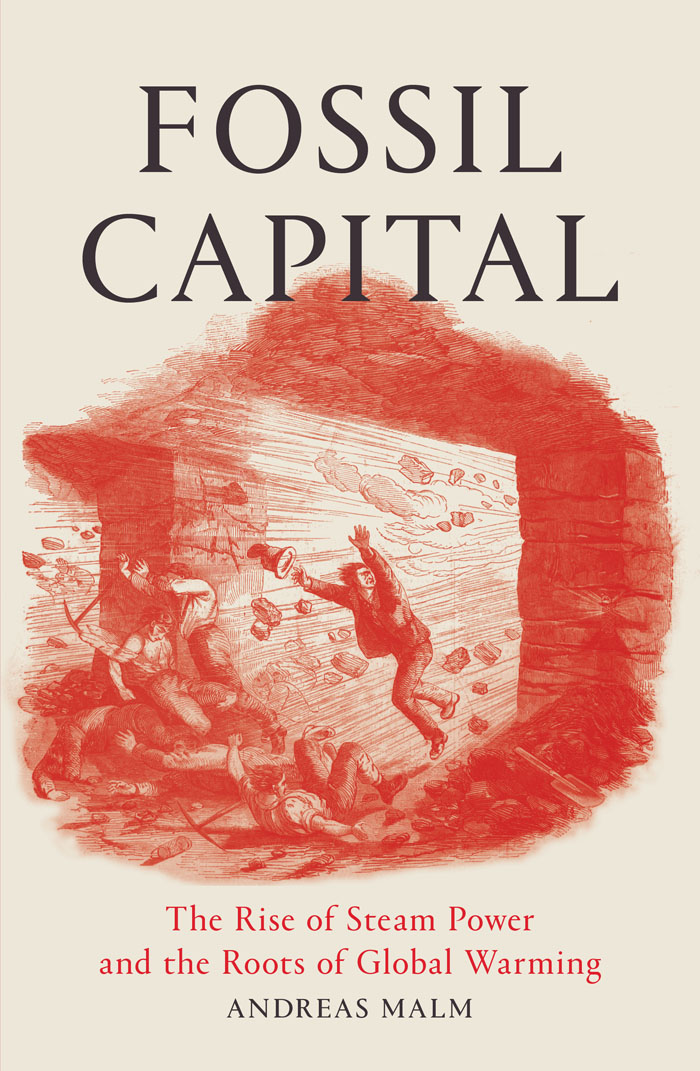
We all know that coal and steam vanquished over water power in Britain's - and the world's - industrial revolution, writes Irma Allen. But as Andreas Malm sets out in his fascinating new book, the deciding factors in that victory were the unconstrained mastery over people and nature that coal provided mill owners. And so the model was set for the fossil age that may only now be coming to an end.
Coal-fired steam was divisible, privately operable and amenable to concentration. It did not rely on the vagaries of natural cycles, such as weather. It was a prime mover that could be 'whipped up by its master' taming both nature and bodies.
If global warming is the "unintended by-product par excellence", as the opening of Andreas Malm's potent new book states, what is it a by-product of?
The obvious answer is the burning of fossil fuels. But, why do we burn them at all and how did reliance on these substances come about?
Understanding the emergence of the 'fossil economy' - one in which economic expansion and fossil fuel consumption are united, resulting in an accelerating quantity of atmospheric CO2 - demands a return to history 'eyes wide open'. As the book asks, "how did we get caught up in this mess?”
According to his thesis, British industry's switch from waterwheels to coal-fired steam engines in the 19th century is the fundamental turning point upon which the climate crisis hinges. Understanding why this occurred goes to the "roots of global warming" as it reveals the vested interests of 'business-as-usual' today.
The canary in the coal mine warns of unseen danger - Malm's warning is that a false understanding of climate change history is leading to flawed diagnosis, so failed remedies. Echoing her approach, it is no wonder Naomi Klein endorses the book as "essential reading”.
Dismantling of two main theories
Malm builds his argument gradually in quasi-detective fashion, applying Marxist critique to received wisdom. In doing so, he persuasively dismantles two theories, or 'storylines' as he tellingly calls them, which currently dominate on-going political and public reckoning of fossil economics.
The first is the 'Ricardo-Malthusian paradigm'. According to this story, steam arose as a response to scarcity of good watering holes at which to quench the thirst of continued industrial expansion of Britain's cotton mills. Rational actors, so this line of thinking goes, saw the logic and economic competitiveness of the steam engine straight away and set about installing the new technology to the benefit of society.
An intrinsic human pyromania - a love affair with fire - perhaps further spurred our fossil addiction. Malm, however, finds that the transition from water to steam actually "took the form of a protracted contest" without a clear winner over a number of decades. Contrary to wide-held belief, James Watt's patenting of the steam engine in 1784 was not the inevitable start of the industrial revolution.
Early trials with steam engines in manufacturing ended badly, and most mill owners were uninterested years after its invention. This was because water was free and abundant, coal was expensive, while steam engines had frequent technical malfunctions and could even explode. Furthermore, water power was often more efficient than steam.
All this flies in the face of classical economic thinking. What, then, forced the leap?
In answering this, Malm critiques a second, increasingly dominating, storyline - that of the 'anthropocene narrative'. This holds that humankind as a unified category has become a geological agent of environmental change, ushering in a new geologic epoch we must simply now manage, adapt to, or even make the most of, as some 'eco-modernists' insist.
The anthropocene camp blames the human species as a whole for global warming. Yet Malm shows that inequality and differentiated responsibility are central to its history, and it is time to confront that.
Industrial capitalism and the revolution
The early 1820s saw the first structural crisis of industrial capitalism. This was repeated in 1837 and again in the hyper-depression of 1841-2, creating waves of social unrest. In 1824 the Combination Laws, which made strikes and unionization illegal, were repealed.
The "mighty energies of the masses" were awakened. Large-scale protests over poor pay and working conditions were the result over the following two decades, just as industrial capital was struggling. The Chartist movement, seeking rights and a voice for workers, emerged in 1836. Britain was brought to the brink of "all-out revolution", in Malms's words. Industry was petrified. It was during this struggle between workers and capitalists that steam power was adopted.
Colonialism as a backdrop is not touched upon, although its machinations on distant shores would have fed into these tensions and vice versa. Malm's theory, however, is that steam arose out of very specific social relations in Britain "as a form of power exercised by some people against others." It offered a way to subordinate and control unruly labour that was refusing to cooperate.
In the cotton industry, striking spinners could bring factories to a standstill. In Preston, for example, all thirty factories came to a grinding halt when 650 spinners walked out in November 1836. Weavers, although home-based, also contributed to the malaise. Under conditions of worsening pay, due to rising urbanization and the low-skilled nature of the work, weavers were resorting to embezzlement - retaining a portion of the stock to sell on the black market.
Whereas in the industrial heyday this was an annoyance, under crisis conditions this was intolerable for capital. The solution to both was to install Iron Men (self-acting machines) and Power Looms in the factories - run on steam. This was further resisted by workers who feared knock-on implications for employment leading to a general strike in 1842 and 'Plug Riots' that literally 'pulled the plug' on steam engines.
Proletarian "steam demonology" battled the "steam fetishism" that increasingly preoccupied bourgeois fantasies. Yet by 1850 both steam - and capitalists - had won. Chartism had collapsed, and capitalism entered a period of "sustained renaissance". Natural and social power became fused.
The lure of coal
Still the choice of coal, rather than water, as a source of fuel was not inevitable. At one point, large-scale engineering projects to construct artificial waterpower through levees and reservoirs were proposed. But this required coordination and inter-reliance between mill owners - something competitive industrialists were not keen on.
Coal-fired steam was divisible, privately operable and amenable to concentration. It suited capitalist desires well. A number of additional aspects contributed to coal's pull. It offered spatial and temporal benefits over water. Freed from location by rivers, factories could be sited more centrally in cities, where urbanizing population growth offered cheap workers "trained to industrious habits”.
Steam powered by coal did not need to rely on the vagaries of natural cycles, such as weather, either. It was a prime mover that could be "whipped up by its master" taming both nature and bodies. The invention of high-pressure steam was the last nail in the coffin for waterpower - the steady expansion of coal-fired steam the result.
All these were accumulating "moment(s) in the emergence of the fossil economy". Whilst it would have been useful to have a greater analysis of how these aspects intersected, each chapter provides a compelling overview of these eye-opening trends.
The quest for wealth caused climate change
The fossil economy was never a 'species-wide project' nor a democratic endeavor. The root of climate change is shown to lie with the power of some to put the private accumulation of wealth above all else. In particular, Malm argues that historical blame for climate change points at Britain.
More accurately, and more in line with a differentiated class analysis, he ought to say blame lies with Britain's capitalists (and their supporters). Even more specifically - a handful of white British men appear to have pulled the levers. So, is climate change a man? as an article in this paper once asked, or a white British capitalist male? Malm does not speculate, but the implication is there.
In 1850, the year which marked the near complete shift from hand looms to power looms and thus the birth of the fossil economy, Britain "emitted nearly twice as much carbon dioxide as the US, France, Germany, Belgium combined. It emitted a thousand times more than Russia and two thousand times more than Canada.”
Sweden's footprint was on a par with the latter. Today, the US and China, which gets its own later chapter, are of course competing for the title of total contributions to global warming, but Britain still ranks fifth in the world.
There is a sense of future reckoning ominously looming when he states that "the more coming generations are forced to upgrade the significance of matters of carbon, the more sharply will the British exception stand out and its history attract interest." He reveals his own cards perhaps too much when he says that Britain should be smeared "in the soot it has bequeathed to humanity.”
Yet if environmental justice is to be taken seriously - and climate negotiations have been careful to avoid just that - he has a loaded point. His tract serves to blow open the myth that the human species are but one equal category. In the early twenty-first century, the poorest 45% of humanity generated 7% of current CO2 emissions, while the richest 7% produced 50%.
How can we declare the 'anthropocene' a neutral concept in light of this? Its politics of distributing equal blame are both laid bare and dismantled. In this human climate-change farm we are all equal, we are led to believe. But Malm shows that some are more responsible than others. How to resolve this is something he does not venture to tackle.
Future steps
What next? The book's lessons for how we consider current discourse around the diffusion of renewable energy technologies today is striking. As is pointed out, we often hear that renewables are not competitive enough - that the market must decide. Yet if the fossil capital theory is correct, this is not how technological change occurs.
Technology serves social ends. To force the transition, we must challenge the power structures preventing this shift from happening. Malm rounds off the book with a look at how a renewable economy will only occur if it is planned and implemented against private interests whose investments are sunk in fossil capital.
Equally, to meet emissions reductions targets we'd need a "planned economic recession" tantamount to a "war on capital". This is not about waiting for socialism, but a pragmatic, though uncomfortable, proposal to solve our present day mess.
Reworking a familiar refrain, Malm concedes "it has become easier to imagine large-scale intervention in the climate system" - by which he refers to business-as-usual attempts at geo-engineering - "than in capitalism”.
Resolving this paradox would be the work of a miracle, he says - but humans are the only ones capable of conjuring it up. With our eyes now wide open, we better get on with it.

