Showing posts with label Heat waves. Show all posts

Wednesday, May 18, 2022

3590. The World Has No Choice but to Care About India’s Heat Wave

By Bill Spindle, The Atlantic, May 8, 2022


The CHANDIGARH, India—Soon after I arrived in the eastern megacity of Kolkata in February, temperatures began climbing. They always do when India’s short winter turns into an early spring. But then they kept rising

After the hottest March in 122 years of record keeping, the scorching temperatures continued through April, with the nationwide high averaging more than 95 degrees Fahrenheit. During my recent stop in New Delhi, the mercury topped 110 degrees for two consecutive days, overwhelming the air conditioner in my rental apartment. The maximum temperature last month in the capital, home to more than 30 million people across the metro area, averaged more than 104 degrees. Even higher temperatures have been reported elsewhere: 111 in other regions of India, and to the west, in parts of Pakistan, above 120.

The I was fortunate to have any air-conditioning at all. Most of India’s 1.4 billion people would consider themselves lucky to have a fan and the electricity to run one. A ride in a three-wheel tuk-tuk feels like having a blow-dryer directed straight at your face. The inside of a slum dweller’s windowless room, often housing an entire family, can become a lethal hotbox. Health authorities have reported hundreds of deaths across the country from heatstroke, but the actual number is likely to be far higher.

The only saving grace, as I write now from the northern state of Punjab, is that the unseasonable spring heat has come before the monsoon rains. Although that’s led to drought conditions in some places, it has also kept humidity levels low enough for India to largely avoid a national spike in deaths from heatstroke. For the country’s health and climate experts trying to plan for global warming, the “wet bulb” temperature is the danger they fear most. This deadly combination of heat and humidity, which prevents a human body from cooling itself by sweating, is a huge looming threat for South Asia’s wet season, experts say. Although climate scientists are still puzzling out the precise details of global warming’s role in India’s current heat wave, the correlation is clear enough: Spells of blistering heat such as this are becoming a regular feature of South Asia’s weather, rather than a once-in-a-decade-or-more crisis.

The heat wave has been severe enough to make international headlines, but it is far from the only impact of climate change I’ve witnessed in the first half of my six-month journey through the country to research and report on climate change and the energy transition India is undertaking in an attempt to mitigate it. India is at the sharp end of this predicament. A recent report by Standard & Poor’s concluded that South Asia’s economies are the world’s most vulnerable—10 times more exposed to global-warming threats over the coming decades, the consultants estimated, than the least vulnerable countries, mostly in Europe.


During a visit to the sprawling Sundarbans mangrove swamp, part of the world’s largest tidal estuary, where several great rivers meet the Bay of Bengal, I saw for myself how rising sea levels and more frequent and intense cyclones are helping destroy what is not only a complex and sensitive ecosystem but also a major carbon sink. One island in the estuary, Ghoramara—pounded by four major cyclones from 2019 to 2021—has lost about half its landmass and more than half its population in recent decades. A tropical storm last year submerged the entire island under several feet of churning water. Thousands of residents were forced to take refuge in a school shelter. Though inches above the floodwaters, they escaped with their lives but lost practically everything else, including personal effects and the school’s textbooks.

Nearly a year on from the disaster, I met Ajiman Bibi, a 60-year-old mother of five who was born on the island. As we talked, she spread out grain to dry on a blanket in front of her makeshift shelter. “If the government didn’t give this to us, we would have nothing,” she told me.

Continuing my journey, mostly by train, to the tea-producing slopes of Darjeeling in the foothills of the Himalayas, I saw the damage from last October’s shattering rainfall—a phenomenon associated with a warming climate. The autumn “rain bomb,” in which a month’s worth of precipitation fell in a single day, caused landslides that cut a path down the mountainside still visible from across the valley. Tea producers told me how irregular rains and higher temperatures, especially at night, have severely challenged the delicate crop in recent years, threatening the entire industry.

Here in Punjab, India’s breadbasket, wheat farmers who were looking forward to a bumper harvest in a year when prices have been boosted ahead of reduced yields from Ukraine have seen crop losses amid the searing heat. This is not just disappointing for them but, as The Atlantic’s Weekly Planet newsletter recently noted, deeply concerning for countries facing worldwide food shortages in coming months. The state’s power minister said electricity demand had jumped 40 percent, year on year, as people ran fans and AC units at home and industrial production picked up after COVID. Railways canceled dozens of passenger trains in order to rush coal shipments to power plants trying to avoid blackouts.

Wherever I go, I expect to encounter more signs of climate change. In the northern Himalayas, rapidly rising winter temperatures have thrown snowfall patterns into disarray and are causing glaciers to melt. Down south, cities such as Chennai are plagued by both drought and flooding, depending on the season.

In the face of these mounting challenges, Indians are scrambling to adapt. Cities have implemented “heat action plans,” halting some outdoor work and prompting special measures to distribute water. In Darjeeling, tea growers have turned to organic-farming techniques, partly to make their estates more resilient against the gyrating weather patterns.

“Everybody now is trying to work to mitigate the climate challenges,” Kaushik Das, an experienced manager for the Ambootia Group, told me as we drove through the Chongtong estate he oversees.

And in the Sundarbans, I met researchers who were studying how to restore the degraded mangrove habitats—as a crucial natural barrier against the rising sea level and tidal surges that accompany cyclones. Still, even if such strategies have further room to run, there are limits to adaptation. Solutions to climate change are also needed.

India has committed publicly to generating half of its energy from renewable resources by 2030 and aims to install 500 gigawatts of renewable capacity by then. That’s a huge undertaking, building from a capacity of about 150 gigawatts today. India has added renewable energy at a faster clip than any other large country in the world, including an 11-fold increase in solar-generating capacity over the past five years, but it is playing a seemingly perpetual game of catch-up.

ccording to the International Energy Agency, as a developing nation, with large swaths of its population still living in poverty, India will account for more energy-consumption growth than any other country from now until 2040. To make that happen while scaling back on coal, the country will need to grow renewables much faster still to meet its pledge to reach “net-zero” emissions by 2070. This will require major foreign investment, which is becoming more active in India, but meeting the net-zero target is a daunting task.

On top of the heat wave, India’s energy industry has been rattled by Russia’s invasion of Ukraine. India imports more than 80 percent of its oil, so the cost of meeting demand is creating a yawning current account deficit. The prices of gas shipments from abroad—a vital input in manufacturing fertilizer—have similarly shot up. That, too, is hammering the federal budget as the government boosts subsidies to keep prices stable for struggling farmers.

All of this casts a pall over pressing global climate negotiations. This fall, national delegates will assemble in Egypt for the 27th United Nations climate-change gathering known as the Conference of the Parties. Last year’s COP26, held in Glasgow, Scotland, ended on a sour note when India, cheered on by China, forced a watering-down of the conference’s ambitions to cut the use of coal (China and India are the world’s top two users). The move came after India’s and other developing countries’ acute frustration over the abject failure, yet again, of the world’s wealthier, industrialized nations to make good on a promise to deliver $100 billion annually to help them deal with climate change.

Those tensions were already likely to resurface at COP27. This spring’s heat wave in India is already ratcheting up the pressure. As Indian officials are quick to note, the country may be the world’s third-largest greenhouse-gas emitter now, but it is a latecomer, and its share of the warming gases accumulated in the atmosphere is just 3.4 percent, compared with the U.S.’s 20 percent and fast-growing China’s 11.4 percent. Although the developing world played little part in causing global warming, this is where the toll will be the worst.

A thundershower this week brought a welcome break in the weather here in Punjab, at least for now. But without new commitment from the developed world to bear more of the costs of climate change, India’s spring heat wave will still be felt in the fall.


Tuesday, December 9, 2014

1677. By 2040 Europe to Face Very Hot Summers Every Five Year, A Study Finds

By David Jolly, The New York Times, December 8, 2014 
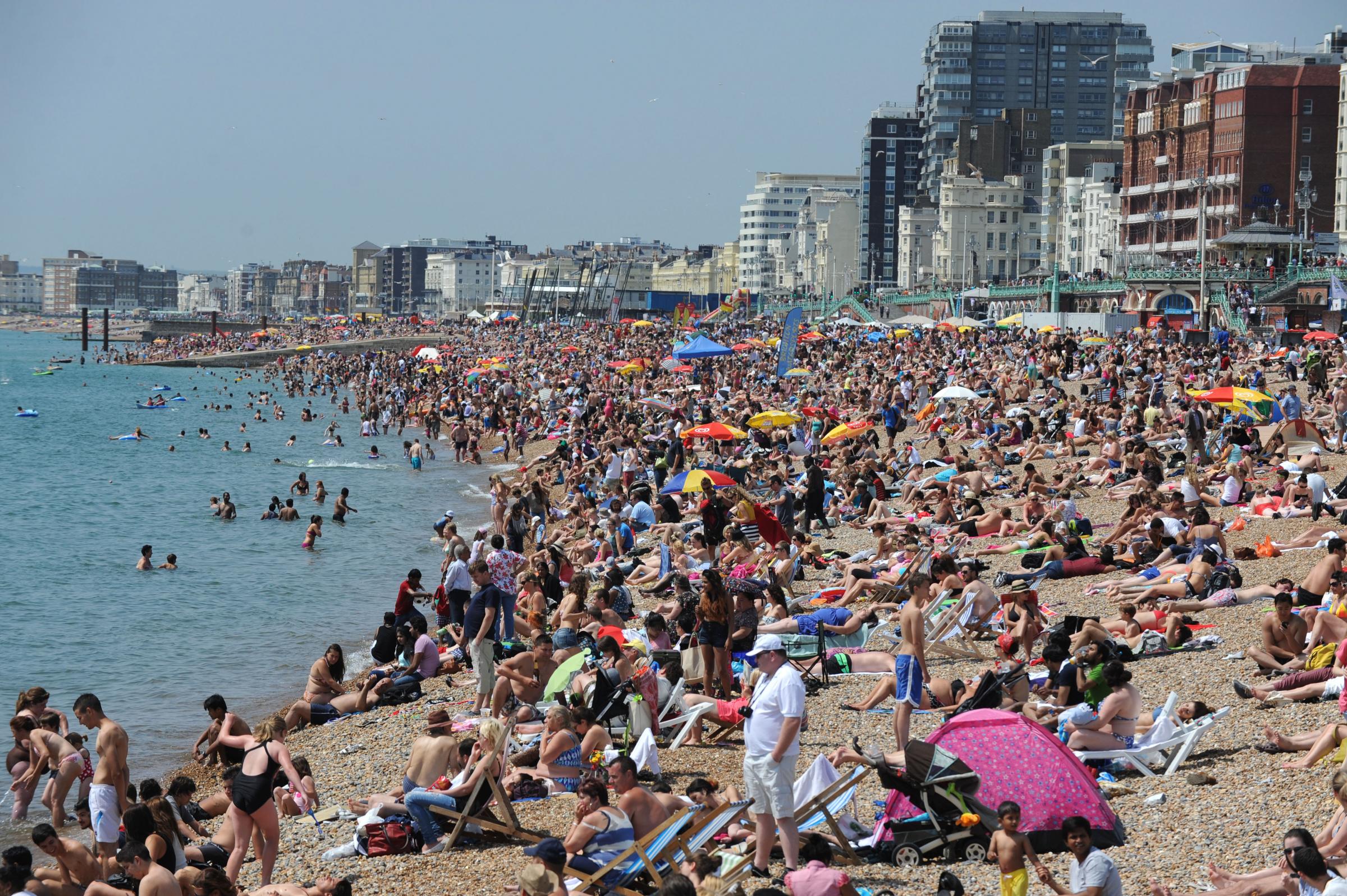
The 2003 summer heat wave forced many to the beaches and killed perhaps 70,000 persons.

PARIS — In June 2003, a high-pressure weather system took hold over Western Europe and hovered there for weeks, bringing warm tropical air to the region and making that summer the hottest since at least 1540, the year King Henry VIII discarded his fourth wife, Anne of Cleves.

Temperatures were about 2.3 degrees Celsius, or 4.1 degrees Fahrenheit, above average that summer, contributing to perhaps 70,000 additional deaths and hitting the elderly particularly hard. The heat was a factor in the outbreak of forest fires and in lower than usual crop yields. It caused Alpine glaciers to shrink at a rate double that seen in the previous record summer, five years earlier.
Now, three scientists from the Met Office, the British weather agency, have concluded that human-caused global warming is going to make European summer heat waves “commonplace” by the 2040s.

Their findings, published Monday in the online journal Nature Climate Change, suggest that once every five years, Europe is likely to experience “a very hot summer,” in which temperatures are about 1.6 degrees Celsius, or 2.9 degrees Fahrenheit, above the 1961-90 average. This is up from a probability, just a decade ago, that such events would occur only once every 52 years, a 10-fold increase.

To predict how global warming will play out in Europe in the years ahead, Nikolaos Christidis and two of his Met Office colleagues first looked back with a statistical tool called optimal fingerprinting. Their method, in which they entered observed data into complex mathematical models, allowed them to assign responsibility for weather events to natural or human-made factors, an approach that scientists call “climate attribution.”
Dr. Christidis and his colleagues, Gareth S. Jones and Peter A. Stott, studied historical data for an area encompassing most of Western Europe and the Mediterranean. They found a striking rise in the probability of extreme summer temperature events over just two decades, 1990-99 and 2003-12.

The study also found that the probability of a temperature increase of the magnitude experienced in the 2003 heat wave has gone from less than one every 1,000 years to about one every 127 years. That is because average temperatures have increased over the past two decades and are expected to keep rising.

“In the space of one decade, the frequency of these kinds of events changed quite a lot,” Dr. Christidis said in a telephone interview.
European summer temperatures “have increased a lot over the last 10 or 15 years,” he said. “And as the climate becomes warmer, you have more of a chance of exceeding these temperature thresholds.”

Dr. Christidis said the vulnerability of Europeans became evident during the 2003 heat wave, but he added that scientists should only report their findings, not suggest policies for adaptation. He said it was impossible to estimate what the human toll from future heat waves would be, “as this very much depends on changes that people may make to better adapt.”

Michael Oppenheimer, the Albert G. Milbank professor of geosciences and international affairs at Princeton, who was not involved in the study, said the researchers’ conclusions appeared to be plausible, as “events of extreme heat, which were previously highly unlikely to occur, have become much more likely,” even if such events are unlikely in any given year.

If carbon emissions, the main human contributor to climate change, continue to rise, he added, events that are currently rare will “become the norm by 2100.”

Dr. Oppenheimer said the specific numbers produced by the study needed “to be interpreted with caution,” because of the complexity involved in modeling the atmosphere and ensuring that the data accurately reflect what is happening in the real world.

“Nevertheless, this paper probably represents the best that can be done right now,” he said.

Tuesday, September 30, 2014

1564. Scientists Trace Extreme Heat in Australia to Climate Change

By Justin Gillis, The New York Times, September 29, 2014
Australia's 2013 heat wave had no precedents
The savage heat waves that struck Australia last year were almost certainly a direct consequence of greenhouse gases released by human activity, researchers said Monday. It is perhaps the most definitive statement climate scientists have made tying a specific weather event to global warming.
Five groups of researchers, using distinct methods, analyzed the heat that baked Australia for much of 2013 and continued into 2014, briefly shutting down the Australian Open tennis tournament in January when the temperature climbed to 111 degrees Fahrenheit.
All five research groups came to the conclusion that last year’s heat waves could not have been as severe without the long-term climatic warming caused by human emissions.
“When we look at the heat across the whole of Australia and the whole 12 months of 2013, we can say that this was virtually impossible without climate change,” said David Karoly, a climate scientist at the University of Melbourne who led some of the research.
The findings relied on computer analyses of what the climate would have been like in the absence of human-caused greenhouse emissions, a type of research widely acknowledged to be imperfect, and which often produces conflicting findings from different groups. But scientists said the results in this case were strengthened by the unanimity of the papers, written by veteran research teams scattered around the world.
“The evidence in those papers is very strong,” said Martin P. Hoerling, an American scientist with the National Oceanic and Atmospheric Administration who has often been skeptical of claimed links between weather events and global warming.
In other results published Monday, three research groups analyzed the drought afflicting California but could not come to a unanimous conclusion about whether the odds had been increased by human activity. One paper found that they had been; the two others found no clear evidence of that.
Researchers generally agreed, however, that regardless of the causes, the effects of the California drought had been worsened by global warming. That is because whatever rain does fall in California tends to evaporate faster in the hotter climate, leading to drier conditions.
Two dozen papers analyzing weather extremes from 2013 were published on Monday in the Bulletin of the American Meteorological Society. This look back at the prior year has become an annual event, as scientists increasingly try to answer the question many people ask after every extreme weather event: Did climate change have anything to do with it?
For several events in 2013, they were able to rule out such a link. Even though the overall global warming trend has been definitively linked to human emissions in scores of papers, the new reports show that the frequent impulse to attribute specific weather events to human activity is not always well grounded.
For instance, one research group found that the type of extreme rainfall that struck parts of Colorado last September had become less likely, not more likely, in the warming climate. Another group, analyzing the heavy rains and floods that struck parts of Central Europe in June 2013, found no evidence that these could be attributed to global warming, even though such claims were made at the time.
Myles R. Allen, a researcher at Oxford whose group conducted the study on the European rains, noted in an interview that the science of attributing specific events to human emissions was still contentious and difficult, so any answers given today must be regarded as provisional.
His group has found a measure of human influence on several weather events over the years. But with the science still emerging, he cautioned against the tendency to cite global warming as a cause of almost any kind of severe weather.
“If we don’t have evidence, I don’t think we should hint darkly all the time that human influence must be to blame somehow,” Dr. Allen said.
The new batch of reports analyzed extreme heat in 2013 not only in Australia, but also in Europe, China, Japan and the Korean Peninsula, with the researchers concluding in every case that global warming had made the occurrence of the heat extremes In the Australian case, computer analyses of a hypothetical climate without human-caused emissions were simply unable to produce a year as extreme as 2013, and other analytical methods yielded similar answers.
But computer simulations that factored in those emissions and the warming they are causing showed an increasing likelihood of extraordinary heat waves in Australia.
The Australia finding is likely to add to an intense political debate in that country. The newly elected prime minister, Tony Abbott, has repealed a law intended to reduce emissions, and his government appointed a climate skeptic to lead a separate review of the country’s renewable energy targets.
Yet scientists say that Australia, an arid land to begin with, may be among the primary victims if global warming is allowed to continue unchecked.
In addition to the Colorado and Central European rains, the 2013 events for which scientists were able to rule out a human contribution included a blizzard in South Dakota, heavy snowfall in the Pyrenees in Europe and a cyclone that swept across northwestern Europe in late October.
The new reports come as scientists, responding to popular demand, are trying to speed up their analysis of extreme weather events and the role of greenhouse gases.
It used to take them years to come to a clear view of any particular event; now, papers are being published within several months. By sometime next year, researchers hope to reduce that to a matter of days, with three groups of researchers around the world training their sights on extreme events as soon as they occur, then putting out reports while the public is still discussing the aftermath.

“We want to get to this place where we can answer the question when the media are asking it,” said Heidi Cullen, a scientist with Climate Central, a news and research organization in Princeton, N.J., who is helping to lead the effort. “We want to give the first, best answer we can possibly give.”

Saturday, June 21, 2014

1457. Climate Change Induced Heat Wave Causes Riots in India

By Eric Holthaus, Climate Connections, June 14, 2014
Temperatures reached 43.2 degree Celsius (109.9 degree Fahrenheit) in New Delhi  
As Slate’s Joshua Keating reported recently, a study this year by Lakshmi Iyer of the Harvard Business School and Petia Topalova of the International Monetary Fund found a connection between extreme weather (particularly lack of rainfall) and increased crime in India.
Meanwhile, the heat continues. On Wednesday, New Delhi enters day 10 of a blistering heat wave that’s broken at least one long-standing record, with part of the city peaking at 118 degrees Fahrenheit (47.8 degrees Celsius) on Sunday. During that stretch, the average high temperature at the airport in New Delhi has been 109.9  Fahrenheit (43.2 Celsius), with the average low an astonishing 84  Fahrenheit (28.9 Celsius). Days upon days with nighttime low temperatures above 80  Fahrenheit can be deadly, especially for those without a way to keep cool.
If there’s any consolation, at least that’s a dry heat. The dewpoint—the amount of moisture in the air—has been low all week across northern India, with dry air helping to boost the effectiveness of built-in human air conditioning (evaporation of sweat) and making the temperature feel somewhat cooler in the shade.
Areas farther south, near where the monsoon was advancing, were even more unbearable. Just after midnight Wednesday local time, the heat index was still 110 Fahrenheit (43.3 Celsius) in Mumbai. Yep, 110 degrees. At nearly 1 in the morning. I simply can’t fathom existence in those kinds of conditions. Hindu priests there performed special prayers for rain to relieve the sweltering country of its misery.
The good news: The end of this scorcher is in sight as the monsoon continues to advance northward. The bad news: In some of the hardest-hit places, like Delhi, that end is still a week away. High temperatures there are expected to stay above normal until next Tuesday.
developing tropical cyclone is helping to surge monsoon moisture northward along India’s West Coast this week, though it’s still going to be quite some time before the cooling monsoon breezes break this heat wave for good. India’s monsoon was five days late and is expected to bring below normal rainfall this season, in part because of a building El Niño.
Since the forecast of a weak monsoon, India’s government has initiated a contingency plan designed to relieve pressure on its overtaxed power grid, reported the Times of India on Tuesday. Two years ago, India suffered the worst blackout in world history, putting some 600 million residents in the dark. Much of India’s electricity generation comes via hydroelectric power. The monsoon season in 2012 was also below average, and demand for electricity is soaring as a burgeoning middle class buys more and more air conditioners.
As the New York Times’ Elisabeth Rosenthal wrote at that time, “We can’t live with air-conditioning, but we can’t live without it.” In a more temperate climate, Americans use more electricity on air conditioning than the rest of the world combined. Rapidly expanding use of air conditioning in tropical countries will further boost global warming through the release of heat trapping gases. It’s a Catch-22.
India, for one, is warming to air conditioning. In 2007, only 2 percent of India had air conditioning, but that number is rapidly increasing. The hot weather of the past few weeks has boosted sales of air conditioners by 15 to 20 percent compared with last year.
This month’s oppressive heat wave already bears the fingerprint of global warming. Over the last 100 years, India’s average temperature has warmed by about half a degree Celsius (PDF), and monsoons are getting more extreme. The warmest time of the year is typically just before the monsoon hits, when temperatures routinely top the triple digit mark in the otherwise semi-arid north.

This year, though, has been anything but routine.