Showing posts with label Globalization. Show all posts

Thursday, October 30, 2014

1615. Deadly Fungal Disease Threatening Salamanders May Spread Through Pet Trade

By James Gorman, The New York Times, October 30, 2014

A fire salamander showing signs of fungal infection through skin lesions. A study suggests that the fungus, called Batrachochytrium salamandrivorans, may have reached Europe through the pet trade from Asia. Photo: Frank Pasmans/Ghent University.

An emerging infection similar to one that has caused the extinction of hundreds of frog and toad species around the world is now killing salamanders in Europe and could easily spread to the United States, with disastrous effects, scientists reported Thursday.
Writing in the journal Science, an international team of 27 researchers blamed the spread of the disease on “globalization and a lack of biosecurity” and said the importation of the fire-bellied newt in the pet trade with Asia was the likely cause.
The lead researcher, An Martel of Ghent University in Belgium, said in an interview that both Europe and the United States needed to start screening amphibians in the pet trade. “When animals are traded they should be screened,” Dr. Martel said. “It should involve the world.”

Other scientists agreed. “We need to pay attention to this paper,” said Vance T. Vredenburg of San Francisco State University, one of the scientists who has sounded the alarm about the extinction of hundreds of frog and toad species worldwide over the last four decades.

“We need to think about biosecurity not just in terms of humans and food that we eat and crops that we grow,” he said. “We need to think about functioning ecosystems.”
Dr. Vredenburg is a co-author of a 2008 paper that described the disappearance of frog species as a prime example of what some scientists call the sixth extinction, a mass death of species going on now and caused by humans.

In the case of the frog disappearances, the culprit, a fungus called Batrachochytrium dendrobatidis, was not identified until decades after the extinctions had begun. Where it originated is still not known.

The effects of that fungus, Dr. Vredenburg said, represent “the worst case in recorded history of a single pathogen affecting vertebrates,” causing an “extinction rate 40,000 times higher than in the last 350 million years for amphibians.”

The fungus killing salamanders and newts, Batrachochytrium salamandrivorans, is in the same genus, and also kills animals by infecting the skin. But this time, said Dr. Vredenburg, “We found it early enough to have a chance. The Titanic knows there’s an iceberg out there.”

The United States, as yet untouched by the infection, has the greatest biodiversity of salamanders in the world, and many of the species are already threatened or endangered. The animals are seldom noticed, but are an integral part of forest and aquatic ecosystems, as predators and prey.

One recent study suggested that their decline could affect climate change because the proliferation of some of the creatures they eat could cause greater release of carbon into the atmosphere.

Dr. Martel and other scientists first identified the fungus a year ago, and described its role in the deaths of fire salamanders in Europe. In the new paper, they investigated its origin, presence around the world and the susceptibility of different species to it.
In the lab, the researchers experimentally infected 44 species of salamanders and newts (salamanders live on land, newts in the water). Forty-one, they wrote, “rapidly died.” It did not affect frogs and toads.

Several Asian species were resistant, and molecular biology studies of DNA suggested that there may be a reservoir of the fungus in Asian newts popular in the aquarium trade.

The study found evidence of the fungus in amphibians in Vietnam, Thailand and Japan, where the animals were not affected, and in the Netherlands and Belgium, where it killed numerous populations. Dr. Martel identified the shipping of live newts for the aquarium trade as the way the fungus spread.

James Collins, at Arizona State University, who has studied the spread of fungal disease in frogs, said that further study was needed to prove that the pet trade was the culprit in the disease’s spread, since it was possible that the fungus was wind-borne, or spread by migrating birds.

But, Dr. Collins said, it was clear that the fungus and the lack of screening in the shipping of live animals posed a major threat to salamanders in the United States and Europe. Disease screening exists for threats to agriculture, he said, but not for animals in the pet or aquarium trade.

“When something like Ebola emerges,” he said, international and federal agencies like the World Health Organization or the Centers for Disease Control and Prevention can act. “Something like that is needed,” he said.

Karen R. Lips at the University of Maryland, one of the co-authors of the Science paper, met Thursday with Fish and Wildlife Officials to talk about the new fungus. She said that there were now bills in Congress that could enable the Fish and Wildlife Service to screen for infected wildlife.


“If Congress wanted to, they could take action,” she said.

Friday, October 3, 2014

1571. Half the World Non-Human Animals Have Been Killed Since 1970

By Christopher Ingraham, The Washington Post, September 30, 2014
Golden frog is one of frog species that went extinct
The new Living Planet Index report from the World Wildlife Fund opens with a jaw-dropping statistic: we've killed roughly half of the world's non-human vertebrate animal population since 1970.
The main culprits? Exploitation (i.e., overfishing and overhunting), and habitat degradation.
The WWF data show that the species declines vary by habitat and geographic area. Tropical areas saw greater declines, while temperate regions - like North America - saw lesser drops. Habitat-wise, land and saltwater species saw declines of roughly 39 percent. But freshwater animals - frogs, fish, salamanders and the like - saw a considerably sharper 76 percent drop. Habitat fragmentation and pollution (think algae blooms) were the main killers of freshwater species.
The declines are almost exclusively caused by humans' ever-increasing footprint on planet earth. "Humanity currently needs the regenerative capacity of 1.5 Earths to provide the ecological goods and services we use each year," according to the report. The only reason we're able to run above max capacity - for now - is that we're stripping away resources faster than we can replenish them.
Carbon consumption - the burning of fossil fuels - represents a huge and growing chunk of the demand we put on the earth. "In 1961, carbon was 36 per cent of our total footprint, but by 2010 (the year for which the most complete dataset is available), it comprised 53 per cent."
At the country level, China is now the leading drain on the earth's resources. China accounts for nearly 20 percent of the overall demand, with the U.S. a distant second at 13.7 percent.
There are compelling reasons why we should consider the fate of the world's non-human species an urgent issue. For starters, many are economically valuable in their own right. Bees, for instance, are crucial to agriculture in the U.S.
We're also set to add another 2.4 billion humans to the world's population by 2050. Those people are all going to need water to drink, places to live and food to eat. Many of them will be born in poorer, more rural regions of the world, regions where people are more dependent on the land and its resources to survive.
Closer to home, we're already starting to see the effects of water shortages out West. Smarter water use will lead to less freshwater habitat degradation, which in turn will hopefully lead to a slowing of the decreases in freshwater species populations.
In short, you may be inclined to see species loss as a problem worth addressing on its own merits. Or, you may prefer to consider it as a symptom of larger environmental problems that are already starting to affect our lifestyles and our pocketbooks. Regardless, the WWF report presents a compelling case that it's something we should be paying closer attention to.

Wednesday, June 18, 2014

1453. Globalization: Cuba Confirms First 6 Cases of Mosquito-Borne Chikungunya Virus

By Peter Orsi, U.S. News, June 17, 2014
Countries with confirmed cases of Chikungunya virus 2004-2011

HAVANA (AP) — Cuban health authorities on Wednesday confirmed the country's first six cases of chikungunya fever, a debilitating, mosquito-borne virus that is suspected of afflicting tens of thousands across the Caribbean since its arrival in the region last year.
In a statement published by Communist Party newspaper Granma and other official media, the Health Ministry said those sickened were islanders who traveled recently to Haiti and the Dominican Republic. Their condition was "evolving favorably."
Some Cubans make regular trips to those and other countries to import clothing and other goods for resale. Havana has also sent large contingents of medical workers to treat the poor in Haiti and elsewhere.

Chikungunya, which has long been present in Africa and Asia, was first detected in the Caribbean in December.
Deriving its name from an African word that loosely translates as "contorted with pain," chikungunya is rarely fatal, but those who have contracted the virus call it a miserable experience.
Its symptoms have been described as a combination of a terrible flu and a sudden case of arthritis, with searing headaches, a high fever and intense muscle and joint pain.
Cuba is in the early part of its summer monsoon season, when mosquito-borne diseases typically spike.
As in other years, in recent weeks Cuban authorities have ramped up a campaign to send brigades of workers door-to-door fumigating houses, offices and government buildings nationwide.
"The Health System ratifies the need to intensify the vector-control fight that is being carried out in the country, for which it is essential that in every home and workplace the necessary actions are guaranteed to eliminate possible (mosquito) breeding grounds," the Ministry said in its statement.
It advised islanders traveling to other parts of the Caribbean to see a doctor upon their return and to seek immediate medical care if they experience symptoms typical of the virus.

According to a report by the Pan American Health Organization, there have been about 166,000 suspected and 4,600 confirmed cases of Chikungunya in the Caribbean as of mid-June.

1451. Shipping Needs Radical Rethink Warn Climate Experts

By Science Daily, June 17, 2014


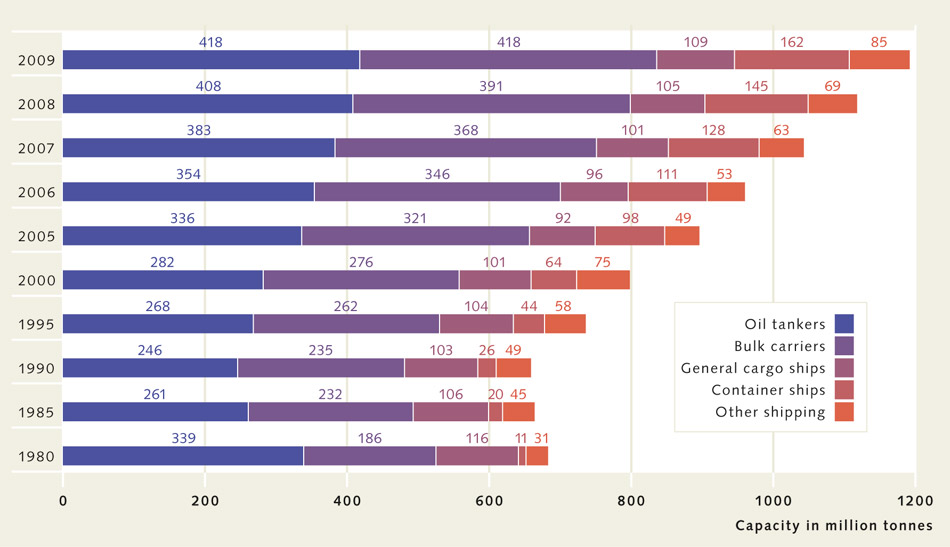
Avoiding dangerous levels of climate change requires a radical rethink of the shipping system, according to a new report 'High Seas: High Stakes' released today by scientists at the Tyndall Centre for Climate Change Research based at The University of Manchester.
If global shipping is to make its fair contribution to avoiding the 2°C of warming associated with dangerous climate change, CO2 emissions need to be cut within the next decade and fall by at least 80% by 2050 compared to 1990 levels, say the authors.

The report's findings highlight that much more needs to be done even to just curb the rate of growth in emissions, with slow-steaming -- where ships run at lower speeds during their voyages in order to reduce fuel burn -- an essential part of the push towards cutting CO2. It also highlights the importance of looking at the bigger picture: one high profile policy area currently in the minds of the shipping industry is how to cut the sulphur content of fuels. New regulations that encourage the uptake of fuels that are lower in sulphur, such as low sulphur diesel, may ultimately release higher levels of CO2. Wind-assisted propulsion, in conjunction with other technologies, is one option that offers scope for addressing both CO2 and sulphur, but that has little traction in the current debate.

This new report covers research completed under the Engineering and Physical Sciences Research Council (EPSRC) project entitled 'High Seas', led by Dr Alice Bows-Larkin in the School of Mechanical, Aerospace and Civil Engineering at The University of Manchester. The project aimed to devise new methods and models for quantifying the CO2 emissions from the shipping sector, with a focus on UK imports and exports. It also had within its remit to identify technical, operational and demand-side changes necessary to decarbonise the shipping system, as well as investigate practical barriers to implementation.


"What was most striking when doing this research, particularly when compared with previous studies on decarbonising other sectors like aviation, is the wealth of opportunities available for reducing CO2 from shipping," said Dr Bows-Larkin. "The problem with cutting CO2 in the shipping sector is that the system is so complex that influencing change becomes the greatest challenge, even if the political will were there."