Showing posts with label Emissions tax. Show all posts

Wednesday, February 8, 2017

2550. A Conservative Case for Climate Action

By Martain S. Feldstein, Ted Halstead, and N. Gregory Mankiw, The New York Times, February 8, 2017


CRAZY as it may sound, this is the perfect time to enact a sensible policy to address the dangerous threat of climate change. Before you call us nuts, hear us out.

During his eight years in office, President Obama regularly warned of the very real dangers of global warming, but he did not sign any meaningful domestic legislation to address the problem, largely because he and Congress did not see eye to eye. Instead, Mr. Obama left us with a grab bag of regulations aimed at reducing carbon emissions, often established by executive order.

In comes President Trump, who seems much less concerned about the risks of climate change, and more worried about how excessive regulation impedes economic growth and depresses living standards. As Democrats are learning the hard way, it is all too easy for a new administration to reverse the executive orders of its predecessors.

On-again-off-again regulation is a poor way to protect the environment. And by creating needless uncertainty for businesses that are planning long-term capital investments, it is also a poor way to promote robust economic growth.

By contrast, an ideal climate policy would reduce carbon emissions, limit regulatory intrusion, promote economic growth, help working-class Americans and prove durable when the political winds change. We have laid out such a plan in a paper to be released Wednesday by the Climate Leadership Council.

Our co-authors include James A. Baker III, Treasury secretary for President Ronald Reagan and secretary of state for President George H. W. Bush; Henry M. Paulson Jr., Treasury secretary for President George W. Bush; George P. Shultz, Treasury secretary for President Richard Nixon and secretary of state for Mr. Reagan; Thomas Stephenson, a partner at Sequoia Capital, a venture-capital firm; and Rob Walton, who recently completed 23 years as chairman of Walmart.

Our plan is built on four pillars.

First, the federal government would impose a gradually increasing tax on carbon dioxide emissions. It might begin at $40 per ton and increase steadily. This tax would send a powerful signal to businesses and consumers to reduce their carbon footprints.

Second, the proceeds would be returned to the American people on an equal basis via quarterly dividend checks. With a carbon tax of $40 per ton, a family of four would receive about $2,000 in the first year. As the tax rate rose over time to further reduce emissions, so would the dividend payments.

Third, American companies exporting to countries without comparable carbon pricing would receive rebates on the carbon taxes they’ve paid on those products, while imports from such countries would face fees on the carbon content of their products. This would protect American competitiveness and punish free-riding by other nations, encouraging them to adopt their own carbon pricing.

Finally, regulations made unnecessary by the carbon tax would be eliminated, including an outright repeal of the Clean Power Plan.

Our own analysis finds that a carbon dividends program starting at $40 per ton would achieve nearly twice the emissions reductions of all Obama-era climate regulations combined. Provided all four elements are put in force in unison, this plan could meet America’s commitment under the Paris climate agreement, all by itself. Democrats and environmentalists may bemoan the accompanying regulatory rollback. But they should pause to consider the environmental value proposition.

These four pillars, combined, invite novel coalitions. Environmentalists should like the long-overdue commitment to carbon pricing. Growth advocates should embrace the reduced regulation and increased policy certainty, which would encourage long-term investments, especially in clean technologies. Libertarians should applaud a plan premised on getting the incentives right and government out of the way. Populists should welcome the distributive impact.

According to a recent Treasury Department study, the bottom 70 percent of Americans would come out ahead under a carbon dividends plan. Some 223 million Americans stand to benefit.

The idea of using taxes to correct a problem like pollution is an old one with wide support among economists. But it is our unique political moment, combined with the populist appeal of dividends, that may turn the concept into reality.

Republicans are in charge of both Congress and the White House. If they do nothing other than reverse regulations from the Obama administration, they will squander the opportunity to show the full power of the conservative canon, and its core principles of free markets, limited government and stewardship.

A repeal-only climate strategy would prove quite unpopular. Recent polls show that 64 percent of Americans are concerned about climate change, 71 percent want America to remain in the Paris agreement, and an even larger share favor clean energy. If the Republican Party fails to exercise leadership on our climate challenge, they risk a return to heavy-handed regulation when Democrats return to power.

Much better would be a strategy of “repeal and replace.” This would be pro-growth, pro-competitiveness and pro-working class, which aligns perfectly with President Trump’s stated agenda.

Martin S. Feldstein was the chairman of the Council of Economic Advisers under President Ronald Reagan and N. Gregory Mankiw was the chairman under President George W. Bush. Ted Halstead is the founder and chief executive of the Climate Leadership Council.

Tuesday, December 20, 2016

2516. Donald Trump Should Know: This Is What Climate Change Costs Us

By Michael Greenstone and Cass R. Sunstein, The New York Times, December 15, 2016


Last week, Donald J. Trump’s transition team sent a startling questionnaire to the Department of Energy. Among other things, the questionnaire asked for the names of all employees and contractors who attended meetings of the Interagency Working Group on the Social Cost of Carbon, as well as all emails associated with those meetings, and the department’s “opinion” on the underlying issues — a request it essentially refused.
Though Mr. Trump’s transition team later said that the questionnaire was sent in error, it should be understood in tandem with a memorandum, leaked last week, from Thomas Pyle, the leader of the transition’s energy team and president of the American Energy Alliance, which promotes “free market” policies. Mr. Pyle described the steps the Trump administration will probably take to reduce environmental regulations, including “ending the use of the social cost of carbon in federal rule makings.”

If that happens, it will defy law, science and economics.

In 2009, the two of us — one from the Council of Economic Advisers and the other from the Office of Management and Budget — convened the first meetings of the working group to which the questionnaire referred. Our aim was to quantify the social cost of carbon for the United States government by drawing from the latest research in science and economics. This comprehensive measure would reflect the monetary cost of the damage caused by the release of an additional ton of carbon dioxide into the atmosphere, accounting for the destruction of property from storms and floods, declining agricultural and labor productivity, elevated mortality rates and more.

The working group, which consists of officials from agencies throughout the federal government, now estimates that cost at about $36 per ton of carbon dioxide. This figure plays a central role in the cost-benefit analyses that agencies use in deciding whether to issue regulations to limit greenhouse gas emissions, and how stringent such regulations should be. Thus far, it has been used for 79 regulations, including energy-efficiency rules for refrigerators and washing machines, fuel-economy rules for cars and trucks, and the Clean Power Plan, which requires reductions in greenhouse gas emissions from existing power plants.
Without it, such regulations would have no quantifiable benefits. For this reason, the social cost of carbon can be seen as the linchpin of national climate policy.

And yet not everyone is a fan of this concept. Those who think that climate change is a hoax, or who oppose regulation as a rule, have a major problem with the social cost of carbon, because it indicates that limits on emissions can deliver significant benefits. Others believe that the $36 per ton figure is too high, overstating the benefits of regulations.

But the working group’s process and output have been validated by the courts. In August, a federal court of appeals rejected a legal challenge to the social cost of carbon by a trade association of refrigerator companies. The association contended that the government lacked the legal authority to consider the social cost of carbon and that its judgments were arbitrary.

The court responded that it had “no doubt that Congress intended” to allow consideration of the social cost of carbon and that the government’s judgments were reasonable.

In fact, in 2008, a federal court of appeals ruled that the government essentially had to specify a social cost of carbon: It was not permitted to ignore harms from climate change, the court said, when setting regulatory policy.

The federal government is also required to quantify environmental damages under prevailing executive orders. President Ronald Reagan started the practice in 1981, when he required federal agencies to analyze the benefits and costs of their regulations; his Democratic and Republican successors have followed his lead.

New scientific and economic evidence suggests that climate change probably poses an even greater risk than the $36 figure reflects. For example, the West Antarctica ice sheet appears to be retreating faster than we thought, raising the specter of multimeter sea level rise in the next century. Recent research also found that climate change will lead to shorter and sicker lives, primarily because of the harmful effect of more extremely hot days on health. Extreme heat is also projected to reduce worker productivity and increase energy consumption, while changes in temperature and precipitation globally are expected to increase food prices and violence. Thus, there is a strong case that if anything, the government’s estimate of the social cost of carbon should be higher than it is.

To be sure, the exact number is uncertain, and the Trump administration will make its own judgment. But a credible assessment must be based on the best science and economics, not politics. And there is no justification for a chilling investigation of civil servants who are just doing their jobs.

Ultimately, the social cost of carbon provides a necessary guidepost in decisions about how to balance costs to our economy today with the coming climate damages. Wishing that we did not face this trade-off will not make it go away.

Any effort to eliminate the social cost of carbon would reflect a neglect of science and economics — and it would be quickly struck down in court.

Michael Greenstone is a professor of economics at the University of Chicago. Cass R. Sunstein is a professor at Harvard Law School.

Thursday, September 15, 2016

2443. Americans Appear Willing to Pay for a Carbon Tax Policy

By Michael Greenstone, The New York Times, September 15, 2016
Climate march in Sydney, Australia
The stumbling block in Congress for confronting climate change has perpetually been the economic challenge. There has been little support for paying to reduce greenhouse gas emissions.

But now, there is some evidence of a quiet undercurrent of support for a carbon policy, whether it be a tax, cap-and-trade or regulations.

The Energy Policy Institute at the University of Chicago (EPIC) — which, in full disclosure, I direct — and The Associated Press-NORC Center for Public Affairs Research released a poll Wednesday on how Americans feel about various issues related to climate and energy.

One of the questions looked at willingness to pay for a carbon policy. The results, on the surface, are not very encouraging to any of its advocates: 43 percent of Americans aren’t willing to pay anything to fund such a policy.

Most people would infer from this that putting a price on carbon is challenging. And, politically, it is. But buried in the polling data is a striking revelation: Many people are willing to pay real money for a carbon policy. In fact, on average, Americans appear willing to pay more than a robust climate policy is projected to cost.

Let’s take a look at the results of the poll. Respondents were asked if they would support a fee on their monthly electricity bill to combat climate change, and they were offered fees at various levels: $1, $10, $20, $30, $40 and $50. (Each household was asked about only one of these levels.) The responses were that 57 percent would pay at least $1; 39 percent would pay at least $10; 29 percent would pay $20; 24 percent would pay $30; 17 percent would pay $40; and 20 percent would pay $50.

Yes, 43 percent of the people surveyed said they were unwilling to pay even $1 per month, and that tells us something about the political challenges facing adoption of a climate policy. But the intensity of preferences of the other 57 percent also tells us something important.

Specifically, these responses can be used to infer how much people value addressing climate change. To give you a flavor of the approach, take the 39 percent of households that are in favor of at least a $10 fee and the 29 percent that are in favor of at least a $20 fee. Doing some back-of-the-envelope calculations, I find that 10 percent (39 percent minus 29 percent) of households would favor a fee between $10 and $20. I then assign the midpoint — $15 — to this 10 percent of the population. I carry this approach through for the rest of the responses.

The net result is that, on average, American households are willing to pay $15 to $20 per month more on their electricity bill. The $15 is a lower bound because it assumes that the entire 20 percent of respondents who accept at least $50 are willing to pay $50, while the $20 figure assumes that this group is willing to pay $75 on average.

The resulting average willingness to pay is higher than what the Congressional Budget Office estimated the Waxman-Markey cap-and-trade bill for greenhouse gas emissions would have cost households (economywide, not just for electricity) had it passed the Senate back in 2009.

There are some limitations to this exercise that are worth noting. It’s a hypothetical question, so people might like to think they might pay more than they really would. Even if this poll has accurately caught a measure of societal willingness to pay, it is not the same thing as how people or their elected representatives will vote.

What this finding does mean is that the possibility of a robust climate policy may not be as remote as the conventional wisdom suggests. The foundation for paying for such a climate policy appears quite strong — much stronger than I thought when we designed the survey.

The question that remains unanswered: If the economics are not as big a problem as we thought, then will the politics follow?

Friday, February 5, 2016

2186. Obama to Propose $10-a-Barrel Oil tax to Fund Rail and Highway Projects

By Steven Mufsen, The Washington Post, February 4, 2016
Petrol Prices and Taxes in OECD Countries
September Quarter 2015.
Source: 
Australian Petroleum Statistics, Bureau of Resource & Energy Economics
President Obama is proposing a $10-a-barrel oil tax, phased in over five years, to pay for a variety of transportation initiatives, including new rail corridors, highway projects, pilot projects for self-driving cars and other technologies it said fall under the goal of a “clean transportation” system.
Republican congressional leaders, however, were quick to condemn it.
The White House announced Thursday that the budget presented to Congress next week would include an “oil fee” that would raise “the funding necessary to make these new investments, while also providing for the long-term solvency of the Highway Trust Fund to ensure we maintain the infrastructure we have.”
Such fuel taxes have generally been hailed by economists and energy experts as economically sensible — but politically toxic. The fee would reduce oil consumption, reinforcing Obama’s efforts to limit greenhouse gas emissions.
“Once again, the president expects hardworking consumers to pay for his out of touch climate agenda,” House Speaker Paul Ryan said in a statement. He said it was “little more than an election-year distraction” and that it would be “dead on arrival in Congress.”
Senate Finance Committee Chairman Orrin Hatch (R-Utah) said in an email “this is a backdoor gas tax hike and it’ll be hard-working American families that will have to foot the bill every time they go to the pump.”
The oil tax, which would work out to about 24 cents a gallon when fully in place, would create an incentive for the private sector to use oil products more efficiently, thus reducing the amount of climate-changing carbon dioxide released into the atmosphere. Such a tax has even been supported by a handful of oil industry executives.
“Gasoline taxes haven’t been raised in 25 years, so actually rather than being radical, this proposal is simply returning to standard practice in place since the Eisenhower years of funding of transport infrastructure through small fuel taxes,” said Paul Bledsoe, an independent energy consultant in Washington who worked as a climate aide in the Clinton White House.
Jeff Zients, director of the White House National Economic Council, said oil companies would pay the tax, but the companies would inevitably pass some of the tax to consumers of gasoline, diesel and heating oil. Zients said that the fee would apply to imported crude and petroleum products, but not to U.S. petroleum exports — to prevent U.S. producers and refiners from being put at a competitive disadvantage in foreign markets.
The timing of the proposal, coinciding with one of the steepest drops in oil prices in the past decade and a half, could make it easier for consumers to digest. The administration also said that it would provide assistance to families to ease energy cost burdens, focusing on households in the Northeast where many still use fuel oil for winter heating.
Oil companies, however, have just reported lackluster earnings and are cutting back on capital spending projects in the face of low crude prices
Zients did not say how much revenue the new tax would generate, but at the current rate of oil consumption, about 19 million barrels a day, the tax would raise about $65 billion a year when fully phased in.
Zients said that while at least part of the tax would be passed on to consumers, they would save money from the upgraded roads and highways. Current transportation infrastructure is imposing costs on people who wasted time and burned extra fuel while stuck in traffic, he said. He added that new transportation infrastructure projects would generate jobs.
The White House said it would also again propose business tax reform. As part of that reform, lower corporate tax rates would encourage a one-time surge in federal revenues from previously untaxed profits currently being held overseas. Those funds would help pay for the infrastructure program.
The administration said it would devote $20 billion of the money raised to expand transit systems in cities, suburbs and rural areas; make high-speed rail a viable alternative to flying in major regional corridors and invest in new rail technologies like maglev; modernize the nation’s freight system; and expand the Transportation Investment Generating Economic Recovery program launched in the 2009 economic stimulus bill to support local projects.
The budget would also use roughly $10 billion per year in revenues for shifting how local and state governments design regional transportation projects.
Obama would also propose investing just over $2 billion per year in “smart, clean vehicles” and aircraft by expanding research and development into such technologies.
The transportation tax and spending package is just one of a stream of budget initiatives being rolled out in advance of the Feb. 9 release of the president’s proposed 2017 fiscal year budget.
The Obama administration on Wednesday also unveiled a $5.5 billion proposal to create summer and first-time jobs for youths over a four-year period and a $2 billion scheme to create apprenticeships over five years.
The proposals — part of a $12.5 billion package of new spending over five years — includes $3 billion to train people to lure firms to the United States from abroad or to keep them from leaving.
The administration also plans to ask Congress to approve $2 billion in competitive grants that would be jointly administered by the Labor and Education departments.
Last year, Obama put forward a similar proposal, asking for just $3 billion. Congress, however, did not provide any of those funds.
Zients said that 1 in 7 young people ages 16 to 24 are neither in school nor in the workforce. He said that people “who endure a spell of unemployment between the ages of 16 and 24 earn $400,000 less over their careers than those who do not.”

Tuesday, January 19, 2016

2161. Proof That a Price on Carbon Works

By The Editorial Board, The New York Times, Janauary 19, 2016


Lawmakers who oppose taking action to lower greenhouse gas emissions by putting a price on carbon often argue that doing so would hurt businesses and consumers. But the energy policies adopted by some American states and Canadian provinces demonstrate that those arguments are simply unfounded.

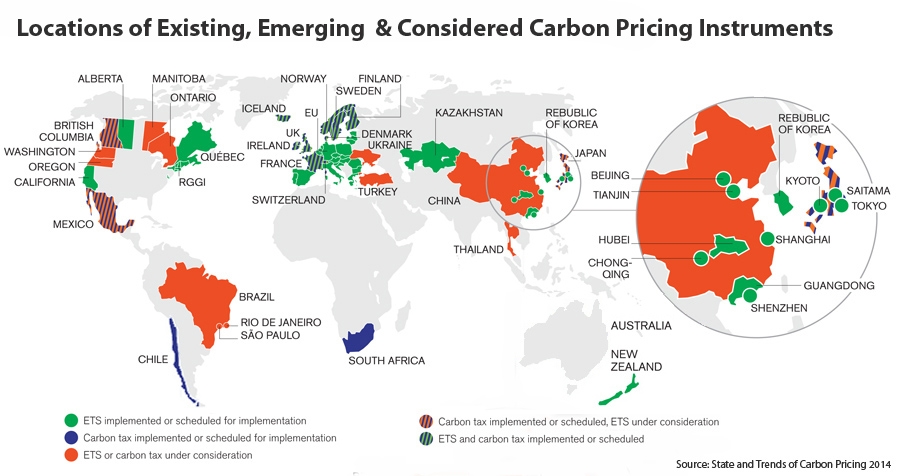
Around the world, nearly 40 nations, including the 28-member European Union, and many smaller jurisdictions are engaged in some form of carbon pricing. In this hemisphere, British Columbia, Quebec, California and nine Northeastern states have raised the cost of burning fossil fuels without damaging the economy. Alberta, Canada’s biggest oil and gas producer, and Ontario have said they will adopt similar policies.

Carbon pricing comes in two forms: a direct tax on emissions or a cap on emissions. British Columbia, for instance, has levied a tax on emissions from fuels like gasoline, natural gas and heating oil. California and Quebec, which are working together, place a ceiling on overall emissions and allow utilities, manufacturing plants, fuel distributors and others to buy and sell permits that entitle them to emit greenhouse gases. Like the cap itself, the number of permits decline over time, becoming more expensive.

Many economists regard carbon taxes as the simpler and more elegant solution, and cap-and-trade systems like the one that failed in the United States Congress as complex and hard to explain. But both systems effectively raise the price of using fossil fuels, which encourages utilities and other producers to generate more energy from low-carbon sources like solar, wind and nuclear power.

British Columbia, which is home to 4.7 million people, has placed the highest price on emissions in North America, taxing a ton of carbon emitted at 30 Canadian dollars, or about $21. By comparison, emission permits in California and Quebec are trading at about $13 a ton. And permits sold for $7.50 a ton in a December auction in the Northeastern trading system known as the Regional Greenhouse Gas Initiative. That system covers emissions from power plants in nine states that include Connecticut, New York and Massachusetts.

British Columbia started taxing emissions in 2008. One big appeal of its system is that it is essentially revenue-neutral. People pay more for energy (the price of gasoline is up by about 17 cents a gallon) but pay less in personal income and corporate taxes. And low-income and rural residents get special tax credits. The tax has raised about $4.3 billion while other taxes have been cut by about $5 billion. Researchers have found that the tax helped cut emissions but has had no negative impact on the province’s growth rate, which has been about the same or slightly faster than the country as a whole in recent years.

Meanwhile, jurisdictions using the cap-and-trade approach like California, the nine Northeastern states and Quebec are investing the revenue generated by auctioning emission permits in mass transit, energy efficiency, renewable energy and other strategies to reduce carbon emissions. Some of the revenue is also dedicated to helping low-income families cope with higher energy costs.

In recent months, the leaders of Ontario and Manitoba said they would join the California-Quebec cap-and-trade system. In October, Gov. Andrew Cuomo of New York said he was interested in linking the Northeastern system to the California-Quebec trading platform.

In Alberta, a new government announced in November that it would impose a tax of 30 Canadian dollars on most greenhouse gas emissions by the start of 2018. The province’s leaders also said they would phase out the use of coal power plants and impose caps on carbon and methane emissions from Alberta’s oil and gas industry.

These actions deserve applause. But their real value may lie in providing a template for the rest of the world. Broad participation is essential to keeping warming below a point of no return; as a practical matter, it is also essential to keep companies from moving their operations to nations that do not impose a cost on carbon emissions.

In that context, China’s announcement last year that it would set up a national cap-and-trade system was hugely encouraging — the world’s largest emitter agreeing to tax itself to help solve a problem that, only a few years ago, it barely acknowledged. Yet Congress has refused to act even as it becomes clear that putting a price on greenhouse gas emissions is the most direct and cost-effective way to address climate change.

Wednesday, December 16, 2015

2121. Thomas L. Friedman: To Fight Climate Catastrophe Put a Price on Carbon

By Thomas L. Friedman, The New York Times, December 15, 2015


PARIS — I had low expectations for the U.N. climate meeting here and it met all of them — beautifully. I say that without cynicism.

Any global conference that includes so many countries can’t be expected to agree on much more than the lowest common denominator. But the fact that the lowest common denominator is now so high — a willingness by 188 countries to offer plans to steadily and verifiably reduce their carbon emissions — means we still have a chance to meet what scientists say is our key challenge: to avoid the worst impacts of global warming that we cannot possibly manage and to manage those impacts that we can no longer avoid. That is a big, big deal.

Many leaders had a hand in it, but it would not have happened without the diplomacy of President Obama and John Kerry.

Hat’s off, because this keeps alive the hope of capping the earth’s warming to 2 degrees Celsius, or 3.6 Fahrenheit, above the level that existed at the dawn of the Industrial Revolution — the rough redline scientists have drawn beyond which “global weirding” will set in and the weather will most likely get really weird and unstable. We’re already almost halfway to passing that redline.

The only important holdout in the world to this deal is the U.S. Republican Party. I wouldn’t care about such cave men — as one sign borne by a Paris demonstrator said, “Dinosaurs didn’t believe in climate change either,” and it didn’t end well for them — except that one of these knuckleheads could be our next president and mess this up.

The G.O.P. should take the wise counsel of Andy Karsner, who was George W. Bush’s assistant energy secretary and one of his climate negotiators, and use the Paris deal to build a bridge back to constructive engagement on the subject. The G.O.P. can plausibly argue, said Karsner, that it was Bush who, in 2007, created the “major economies” strategy to address climate change through precisely the kind of market-enabled, voluntary national targets adopted in Paris.

“The price of getting this issue behind us may never again be this cheap,” Karsner said of the G.O.P. “Congressional leaders need to evaluate the opportunity they have to reconnect with mainstream voters, scientific, civic and business leaders, geopolitical strategists and most anyone under 35 years old who’s completed eighth-grade science.”

With the earth on pace to add two billion more people by 2050, who will all want cars and homes, and with scientists saying the only way to stay below the 2 degrees C redline is to phase out all fossil fuels by roughly the same date, there is only one force big enough to do that — to take on Mother Nature at scale — and that’s Father Greed, a.k.a., the market.

What will make this deal epochal is if the U.S. and China now lead the world in imposing a price on carbon, because only that will take to scale the already significant technology breakthroughs that have happened with wind, solar, batteries, energy efficiency and nuclear power.
Some in the November 21 climate rally and march in Oakland. California, called for putting a price on carbon.

“In the last six years,” said Hal Harvey, C.E.O. of Energy Innovation, a policy research group, “solar prices have dropped by more than 80 percent, and now cost less than a new coal plant. Wind is down 60 percent, and LED lights more than 90 percent.” With other new technologies near at hand “it becomes clear that a clean future costs no more than a dirty one,” he said. “Texas now has the most wind installed of any U.S. state. Texas!”

Harvey’s team has built a computer model to see which policies can decarbonize the economy at the lowest price. It lets a user test varying policy options on climate, pollution and the economy. If you pick the right blend, the results will have you grinning. Go online, at www.energypolicy.solutions, and try it for yourself.

The point, said Harvey, is that today’s chief executive doesn’t “have to be a hero anymore” to invest in clean power.

Indeed, José Manuel Entrecanales, chairman of Acciona, the giant Spanish renewables company, told me that he used to be sprinting alone in the race to install renewables “with the wind in my face.” But now he finds the wind is at his back, and some of the biggest oil companies are trying to muscle into the race. That is not an accident, he said, considering that recent deals from Morocco to South Africa to Chile were struck for around 2.8 cents a kilowatt-hour of wind and 4.2 cents a kW-h for solar, making them highly competitive with fossil fuel.

“In Chile,” said Entrecanales, “there was [just] an auction which was technology agnostic, so the government was offering big bunches of energy to be supplied over the next 10 years, 20 years, and all the energy awarded was renewable. Not one single megawatt hour of conventional energy was supplied.”

But, he stressed, leveraging the Paris consensus to get a price on carbon in the big emitting countries is the “Holy Grail,” the thing that tips everything. Because while renewables can win against new fossil fuel plants, old fossil fuel plants built without any pollution control, and with all their capital expense amortized and still enjoying subsidies, can still run very cheaply — if you don’t count their massive carbon impacts.

A price on carbon, said Entrecanales, “would drive technology, it would drive R&D, it would drive investment, it would drive consumer habits.” So Paris was necessary. A price on carbon will make it sufficient.