Showing posts with label Ecological Anarchism. Show all posts

Monday, April 13, 2015

1802. The Case for Simplicity

By Ted Trainer, Simplicity Institute, April 2015


Why try to life more simply.  I think there are two main lines of argument. The first is that global sustainability and justice cannot be achieved unless we live much more simply than the average person does in rich countries today. The second reason is that living simply enables a richer personal life.

“Simplicity” here refers to material “living standards”, i.e., to the amount we buy and consume.  The fundamental assumption in consumer-capitalist society is that he more e are able to purchase and use and have, he higher our wealth and welfare and quality of life will be.  That's why constantly increasing the GDP is claimed to be the supreme goal.  However it is increasingly being recognised that this assumption is literally catastrophically wrong.  The pursuit of greater material wealth is now the basic cause of the ecological and other global problems now threatening our survival. The main reason for transition to The Simpler Way is that it must be carried out if we are to achieve a sustainable and just world. However following discussion will deal firstly with the second point, to do with why living more simply can enable more meaning and satisfaction to be enjoyed.

THE PERSOAL BENEFITS: ENRICHING THE QUALITY OF LIFE.

In a society obsessed with possessions and wealth it might seem silly to suggest that living in materially simpler ways can enable the achievement of a higher quality of life than most people have in consumer-capitalist society.  Following are some of the reasons supporting this claim.

Liberation!  Not having to earn and pay out so much.
A “normal” lifestyle in consumer-capitalist society is not possible unless one does far more working, earning and buying than we should have to. All that work is taking precious life time that could be going into more fulfilling pursuits. Consider for instance the enormous cost in time, money, and worry involved in acquiring a “normal” house, not including land. 


If we assume the cost of building the house is $150,000 then the sum to be repaid to the bank will be about $300,000. But to be able to pay that much after tax is taken from earnings around $400,000 will have to be earned. The cost of a medium sized house (e.g., 160 m2 excluding land) per square metre would be around $2,500.

In my Transition to a Sustainable and Just World (Trainer 2010) I detail the probable cost to build my ideal tiny mud brick house, which I believe would be suitable for a young couple.  The floor area would be c. 40 square metres. If additional storage is needed it could be provided by a simple workshop and other sheds nearby, adding to rainwater collection area. Lifetime heating and cooling costs (in Sydney region, 34 degrees south) would be minimal, and there need be no cost for water supply and sewage removal. The estimated $4,500 cost includes water tanks and solar panels, and averages $113 per square metre, around 5% of the above sum for a normal house. ( Compared with the recent Australian average new house area the figure is 3%.)  If we assume that a small family might be comfortable in a house four times as big as this example the total cost might be $18,000 compared with $400,000, assuming no borrowing is needed and that income is too low to tax significantly. 

Much cheaper houses than this example can be built from cob.  (See Bee, 1997.) Earth-built vault or dome dwellings are cheaper still, as curved roofs can be built from mud, surfaced by a waterproof skin.

No cost has been included for labour, because I would build the house myself with assistance from friends and a local builder, and count the time as enjoyable leisure.

About 100,000 Australians want a house but can’t afford one.  Another 100,000 are homeless and must live in friends’ houses, or on the streets.  In a market economy profits are maximised building big and luxurious houses, so no small, cheap and sufficient houses are built. 


That’s a lot of money and time that could be saved and put into interesting and rewarding activities.  How long does it take to earn $395,000?  How much worry about losing ones job and being unable to meet the next payment could be avoided?

Now add the time and money savings that could come from using old, repaired and hand-made clothing, furniture, bikes, toys.  Add the savings that might be made via a backyard vegetable garden and chicken pen, and via leisure interests that do not involve purchasing much commercially provided entertainment.  Many arts and crafts produce useful things.

The huge amount of time all this would make available for enjoyable and fulfilling pursuits is only one of the benefits. There would also be enjoyment from the alternative activities involved, for instance in building your own beautiful and unique and ecologically admirable little house (with assistance from friends and experienced local builders), in repairing and keeping clothes and equipment in use, in developing a thriving and inspiring garden, and in finding and accumulating dollar-cheap local sources of leisure activity, (e.g. places to cycle to for a picnic.)

 The trap that is status and respectability.
Much purchasing, especially buying housing, is driven by obsession with status.  This is an absurdly competitive society in which there is much concern to impress by appearances and readiness to judge by appearances.  There is great pressure to appear to be at least normal and respectable, certainly not odd or inferior, and if possible to be seen to be a success, prestigious, superior…and wealthy.  “Look at me…I can afford a Rolex watch and a Ferrari…I must be pretty good eh?”  One consequence is the enormous amount of time and money and resources going into the “fashion”, car and “beauty” industries.

Long ago Thoreau saw this trap, and avoided it, and badgered people to stop wasting all that time and energy.  By living simply he gained a lot of time to devote to his writing and thinking and enjoying his garden and the woods at Walden Pond.

I wear tattered and patched clothes around my homestead, enjoy repairing them, and have the same old almost-passably normal set to wear when I go out in public, including my one pair of shoes, I think I have a suit somewhere, but haven’t worn it for several decades and wouldn’t know where to look for it.  It would be interesting to calculate how much working-for-money time my wardrobe has saved me.

Less worry about “success” and “achievement”..
Consumer-capitalist society makes people discontented, not just with their income, property and wealth. Even more important is the insistance that we must strive ceaselessly for “success”. We are taught from the earliest years, especially at school, to work hard, do our best, improve, develop our talents, get on, achieve more, rise in the world, be successful. This connects with the mania with competing, beating others, being more successful than they are, being the best. Hence this society’s obsession with gold medalists, superstars and celebrities, winners and record breaking.

But I don’t want to be the best painter, or an excellent one, or even a good one.  I just want to be a contented painter, one who is good enough to enjoy painting. Of course improving my technique might lead to more enjoyment but that’s not very important to me. Similarly I only want to be good enough at tennis, gardening, carpentry and chess to enjoy these activities. I am not driven by any sense of obligation to improve.  There are of course areas where it is important to try to be as good as possible, such as where a doctor’s skill level affects the welfare of others. And being good enough does not necessarily mean mediocre or shoddy; it can be very satisfying to have “mastered” a craft and to be able to do beautiful work, without fretting about constantly improving.

Essential in The Simpler Way is being content with what’s good enough, not wanting to have the best or to be the best. This connects with appreciation, being more able to recognize one’s own good fortune, one’s worth and the value of what one has done, imperfect though they may all be.  It also connects with the fact that in consumer-capitalist society people do far too much doing and far too little being.  They strive constantly to perform, produce, achieve and improve, and they are not very good at just sitting and appreciating what they have and who they are. Again to be more able to derive satisfaction from simpler things and from what one has and what one is brings at lease some degree of liberation.  The simpler Way will make this easier to do because it involves a much more relaxed situation, enabling most people to work for money only a couple o days a week, and immersing us in a context where much life satisfaction comes mostly from just being in a beautiful landscape and community.

What makes you rich?
For many years now it has been clearly established that as a country’s average income increases measures of the quality of life rise but after a quite low level of income is reached the measures do not rise much if at all.  In fact for the very richest countries, especially the US, indices of the quality of life seem to be in a long term decline even though the GNP continues to rise. Surveys find that the factors people see as being most important for their life satisfaction are to do with having good friends, good health, a good family, and satisfying work.  The amount of property owned or monetary income or wealth they have are way down the list.

As I see it the most important factor in a rich life is having purposes, things you are interested in and want to do.  This is the main thing lacking for people who are suffering depression or are dumped into unemployment.  It is a glaring problem in many Aboriginal settlements and it is a major cause of addiction to alcohol and drugs. It is tragic that many people can find nothing more interesting to do than get high.  

Many people are forced to live in circumstances which leave them with little to do and observe and think about, and many have to struggle with low incomes and worry, making it unlikely that much of their attention will given to spirit-lifting pursuits. Most consumption must basically due to the fact that in consumer-capitalist society there is not that much else to do. Neighbourhoods are boring dormitories, there is little or no community and little incentive for citizenship in the sense of involvement in public affairs let alone in running local social systems. The Simpler Way immerses the individual in many interests, activities, roles, interactions and contributions to make.

Debauchery…blunting sensitivity.
Australia’s richest man once bet $4 million at a casino in one sitting.  Anyone who can afford that much is very rich.  Anyone who needs to spend that much to get a thrill is very, very poor … spiritually impoverished.  If you can derive interest, enjoyment and satisfaction from simple things you have access to many more life-enriching experiences than someone who can only be satisfied if he gets big and expensive things.  Consumer society puts a massive effort into enticing you to spend on ever-more expensive, luxurious, rare, exclusive, extreme, spectacular, thrilling products and experiences.  What is sufficient is not sufficient.  The result is debauchery, the deadening of sensitivity, the raising of thresholds needed for satisfaction. Films must have at least two chain-saw murders and a train wreck or they are boring.  But I once knew a little old lady who would delight in flowering weeds growing along the path.

In other words it is very important to work at acquiring simple sources of interest, meaning and inspiration. The “spiritual” quality of one’s life is what matters most of all, the extent to which one can be inspired, cheered up, delighted interested.  There are immensely powerful forces at work in consumer society producing the opposite, depression, boredom, anxiety, worry, and despair. Depression is probably the most widespread illness today. Many plod on in a grey world of more or less mindless dull routine most of the time. Those who can avoid this fate by finding interest, delight, meaning and inspiration in the simple things around them have a key to a much richer life; they are spiritually wealthy.

Much of the planet-destroying consuming going on must be due many people lacking interesting things to do.  Bored?  Go shopping. Hobbies are a powerful antidote, especially creative activities such as arts, crafts and gardening.  They provide daydreaming material available anywhere anytime.


I was a student within the formal “education” system for about twenty-seven years. Among the things I learned was a lot of Shakespeare, Latin and Ancient Greek.  I think all that remains from that is a detestation of Shakespeare in particular and languages in general.  But once when I was about nine years old two big kids came around to our classroom with a couple of boxes in which they had built dioramas, little farm scenes.  That made such an impression.  I have been a model builder ever since and that is one of the best things in my life, providing hours of enjoyable creative activity and spirit-lifting daydreaming. Especially blessed are the gardeners, for wherever we are we have abundant things to observe, think about, do, learn about and/or delight in. In a sane world a high priority of Education would be to equip everyone with hobbies.


So it is important to work at finding interest in simple things, in noticing things and being curious, in looking for connections, significance, puzzles, meaning, explanations. The more able one is to do this, the richer one’s world is. The more things that catch your attention and interest and prod questions and connections as you go about, the more meaningful everyday experience is.  If only big, expensive, spectacular things grab your interest you will be much less often interested in anything.  This can be put in terms of openness, awareness, sensitivity and the capacity to be observant.  Some people notice things that might have gone unseen, or realize there is significance and meaning in things others might miss.  We adult humans have a strong tendency to get bogged down in a normal, every-day, routinized, take-it-for-granted consciousness that makes us oblivious to the wonders and miracles all around us. “That is only an ant.”  “That is only a daisy.” But some people are struck by what they run into and see in in them interesting aspects to mull over.  


Today I came across a little cone in the sand, and ant lion’s trap.  I know a bit about them but it struck me for the first time that the condition of the sand in the cone must be crucial, because if the slope is not steep enough the ants could climb out after falling in.  The slope will be set by the laws of physics operating on grains sliding down, and the kind of soil at the site, so this probably determines where ant lions can and can’t live.  Wet or clay soils wouldn’t do. Is the slope always the same? Why does it form at that angle? Maybe different soils have different shaped sand grains and some slide more readily and would form more shallow cones.  Could sand form at a slope I couldn’t climb? Is there a size limit here, so that big ant lions couldn’t evolve? Must look this up tonight.

This connects directly with John Dewey’s conception of Education.  He saw the point of Education as becoming more able to make meaning out of the things one encounters.  This is the point of gaining knowledge.  The more I know about the world the more able I am to interpret it, to make sense of what I see or experience.  Compare what I see when I walk through the bush with what an Aboriginal hunter sees.  He knows that the broken twig there, and that mark in the sand mean that an animal went this way not long ago.  His knowledge enables him to literally see things I do not see.  The geologist sees far more than I do when we both look at the same landscape, because he understands the significance of what we are looking at, and his knowledge enables him to make connections and interpretations.  Thus he is more sensitive, open to interesting observations and ideas than I am. His world is richer and his life is richer by virtue of his greater capacity to see and be interested.

So the more I accumulate knowledge about, and interest in, the ordinary and everyday things I encounter in the world, the more sources of meaning I have access to, the richer and more awe inspiring is the world I live in.  One of the most important goals of Education should be developing the readiness and desire to observe, question, look for connections, explain, find out about, and be awed and inspired by every day things. To Dewey, Bertrand Russell and the Progressive educators the supreme goals of Education are to do with creating and harnessing interest.  As Socrates said, ”Wisdom begins in wonder.”

Mindfulness”.
I think there are important connections with “mindfulness” here, but I am not sure I understand them well. This discussion is about attention, what we attend to, think about, focus on, in the present moment.  We can choose what we attend to, although most of the time most of us plod along thinking about whatever comes into our heads, and spending a lot of time dwelling on tasks, problems and worries.  But we have the capacity to flip the switch and stop thinking about that and start thinking about something nice, calming and inspiring, if only for a moment. I’m not much good at this but sometimes when I’m grinding along a bit bogged down I have the wit to stop and look up at the trees or the garden or the sunlight and look for and attend to something nice. The effect can be an instantaneous mental house cleaning, a switch of consciousness to the new vision and the nice feelings that come with it and a sudden sweeping away of all the rubbish I was stumbling through an instant before.  Is this what the Zen master can do anytime, anywhere? My mantra is “Count ‘em boyo” … count your blessings you lucky little fellow.

Nothing matters more than feeling good, now, in the present moment.  If I could give you a magic wand that enabled you to feel good, calm, contented, appreciative, at any moment you chose, would you want a Ferrari, or a trip to Bali or a chateau in the South of France? Why would you if you could feel good without all that bother?  The debauched mind of the over-consumer can’t feel contented without buying a bigger, more luxurious or exciting or expensive item.  The person who can feel good by a simple act of mind or will, by choosing to set aside negative concerns and to attend to nice, simple, everyday things that inspire, is very very rich. 

This is a matter of attention, mood, how we think or react, and what’s in our minds, not a matter of our actual circumstances.  You can be in lousy circumstances and something flips you into feeling OK for a moment, and sometimes you don’t feel so good even though there’s no particular problem bugging you at that moment. To a considerable extent it is our mind not our situation that determines our condition or experience.  That expectations can be powerful determinants of mental and physical outcomes is evident in the effect placebos can have in medicine. Our mind perceives and interprets and sets the tone. Some of us are blessed with a tendency to optimism or cheerfulness, and so they tend to see things and events as better, nicer than those of us in the habit of seeing the glass half empty. A person who has this tendency, whether by nature or via years of discipline in a monastery, is rich in his capacity to go through life feeling good, and is unlikely to owe much if any of this form of wealth to the amount of possessions he has.  Mark Burch puts it this way; “How we think about our lives, and that we reflect on them at all, plays a greater role in determining our wellbeing than do our material circumstances.”   “What can most deprive us of a good life is not so much material scarcity as it is a host of psychological and emotional habits, delusions and logical mistakes.” (Burch, 2014, p. 227.) Was this what the bard had in mind when he said, “Nothing is either good or bad but thinking makes it so.”

The aspect of mindfulness that seems important here is not to do with thinking about what comes into mind or attention in a non-judgmental way, but about realizing that what one focuses on, attends to, thinks about, or notices can profoundly affect one’s sense of calmness, appreciation and well-being.  We can work at being more able to shift attention to and dwell on things that lift our spirits.

Material affluence is likely to contradict all this.  At least it can be expected to distract and interfere with an effort to derive at least some degree of contentment through habits of mind.  Someone once suggested that to get to paradise you first have to give all your possessions to the poor, and related this to camels having difficulty getting through the eye of a needle. Diogenes  said “…perfect indifference to wealth is the root of all virtue and happiness.” (Alexander and McLeod, 2014, p.12.) 

Education in a satisfactory society would be primarily about helping us to develop these kinds of skills, along with helping us to appreciate the abundant materially simple sources of interest and enjoyment.  It would help us to find and accumulate our personal stock of simple spirit-lifting devices, images, places, thoughts and activities.

The connection with self-sufficiency.
Because living simply means not purchasing much it means producing as much as you reasonably can for yourself, in other words self-sufficiency.  This opens up a universe of interesting activities, knowledge, traditions and skills.  I can sew, weld, solder, do basic woodwork and metal work, build a chicken shed or a windmill or a house, draw, paint pictures, sculpt, make candles and paper and mud bricks, do pottery, wood turning, plumbing, blacksmithing, make lead-light windows, do 12 volt wiring, grow vegetables and fruit and flowers, make mosaics and ornamental garden pots, cook a tolerable meal, build in rammed earth, cob and mud brick, model in clay and plaster, keep chickens, compost, make model ships, … none of them very well but all of them enjoyably and usefully.  There are many more things I want to learn how to do, including grow fish, play beginner’s violin, make electronic gadgets, preserve fruit…   These capacities enrich my life, they fill it with interesting things to think about and do, and with chicken sheds in use and models built and jobs done well to feel good about. The ultimate consumer who just buys everything and makes nothing for himself does not have access to the good feelings that come from having some degree of self-sufficiency. Among the best of these are to do with “oikos”, running a good household economy … the well stocked pantry full of home-made preserves, the vege garden organised to provide a steady flow of crops throughout the year, the neat firewood stacks ready for winter, the sound chicken pen fences ready for Reynard’s examination, the job list with some items crossed off today.

In sustainable local communities we would be among people expert in many skills and so we would learn them easily, and much of the time we would be discussing arts and crafts and technologies and projects we and others were working on.

Earth bonding.
In the new settlements of post consumer-capitalist society we will live very close to nature.  Our quality of life will depend heavily on our local ecosystems surrounding and throughout our small local economies.  We will be acutely aware that we can enjoy our perfect food and water and landscape because of Gaia’s generosity and our readiness to treat her well. This will generate humility, respect and appreciation for Gaia’s gifts.  We will delight in our many necessary interactions with nature, digging potatoes, composting, picking fruit, smelling rich soil, welcoming the rain, watching the forest gardens thrive.  Over time we will become wiser about Gaia’s ways, about the best varieties for our soils, what to plant where, the fire danger direction, where the frosts occur. 

In this situation of dependence the human/nature gap diminishes, as does any sense of superiority or mastery over nature.  We are more likely to see ourselves as part of nature and to be sensitive to her ways and to see her other creatures as colleagues cooperating in our ecosystem. When I come across a black snake I wish him a good day and watch him go about his business; he has as much right to be here as I have … and he does less damage.  I thank the bees and apologise when I steal their hard-won honey. When you live close to the ground you are constantly confronted with things to think about, attend to, be grateful for and be sensitive to.

Work.
One of the greatest tragedies wrought by consumer-capitalist society has been the destruction of work.  Hunter gathering societies don’t do any.  They just play all day, including the fun that is going on the hunt and the community ramble that is finding plant foods. ()  Even for many of those in consumer-capitalist society lucky to have “good” jobs, and lucky enough to be “satisfied” with them, work is not fulfilling.  In post consumer-capitalist Simper Way settlements we will be able to work in order to enjoy a) the activity, mostly exercising creative skills, and b) contributing to our admirable community. Most production will be at a leisurely pace and via craft activity. We will have the time to do the job well, to experiment, to learn about different techniques and materials and about the history of the craft, and to “work beautifully”.  Ruskin and William Morris saw this long ago.  When you watch an experienced crafts person you are struck by the ability to do the job with a minimum of effort and materials use, to use just the right amount of wood or nails or hammer blows, and to avoid mistakes.  Ruskin and Morris wanted almost all production to be a beautiful performance creating beautiful objects. Morris insisted that man is Homo Artis, not Homo Faber.

Community.
In my view the Eco-village movement’s most important contribution to this revolution is in demonstrating the value of community.  Members of a village are very secure from adversity, isolation or loneliness and more importantly they have access to the satisfaction that comes from sharing, cooperating and working with others, giving, and helping others to thrive.  These benefits and delights have nothing whatsoever to do with material wealth.  Indeed they tend to be found among poorer rather than richer people. This is another realm where we have much to learn from tribes and peasants.

Living in a thriving community means being exposed to interesting activities, ideas, projects, artists and craftsmen and people to talk to.  This will make it easy for us to find and develop interests that do not involve much material consumption. The above discussion of topics such as mindfulness can give the impression that to move from the consumer way to being content with simpler things requires a lot of arduous self discipline.  When the individual is trying to make the transition alone this might be so, but it is not likely to be the case in an Eco-village.

THE GLOBAL BENEFITS -- SAVING THE PLANET. 
The case for simplicity is not primarily to do with the personal or lifestyle benefits it can bring to the individual. It is to do with the fact that unless simpler material lifestyles become the norm there can be no solution to the many alarming global problems now threatening our survival.

For decades it has been obvious that rich world per capita levels of resource use are far higher than could be sustained, or extended to all the world’s people. “Footprint” analyses and various other measures indicate that rich world consumption rates are probably around ten times those that all people could have sustainably. We few could not have these rates if we were not taking most of the world’s resource output, thus condemning most people to living on far less than their fair share. This situation cannot be remedied without scrapping and replacing the present economic system, building highly self-sufficient and self governing local communities, and adopting very different values. The most important of these would have to be to do with moving to much more simple material simple living standards. (This perspective is detailed in TSW; The Simpler Way.)

However simplifying our lifestyles is far from sufficient if the transition to a sustainable and just society is to be achieved.  Eventually we must face up to huge and radical structural and cultural change, especially at the level of national an international government.  For instance national economies must abandon growth and must prevent the market from determining our fate. What we must work on here and now is the raising of the critical awareness in people in general that these changes must be pushed through some day. 

Will this case succeed?
The forces against us are gargantuan. More than $500,000,000,000 is spent every year on trying to get us to buy more, the hours worked to get money are increasing, alarmingly rising debt levels represent more money borrowed to spend, national treasurers constantly wear themselves out trying to increase purchasing, progress is seen as moving towards greater complexity and pace, no one has enough time, and getting richer without limit is the almost never questioned supreme goal of virtually all countries and people  But there is increasing disenchantment, evident in things like the Voluntary Simplicity movement, the slow food movement, and downshifting. At present these moves are small and optional. But before long they will not be. Our task is to increase the chances that when the time of troubles begins to impact seriously in rich countries many will at least have been acquainted with the possibility that simpler ways might make more sense.

References:
Alexander, S and a. McLeod, Eds., (2014), Simple Living in History: Pioneers of the Deep Future, Melbourne, Simplicity Institute.

Burch, M., (2014), Mindfulness, in Alexander, S and a. McLeod, Eds., (2014), Simple Living in History: Pioneers of the Deep Future, Melbourne, Simplicity Institute.

Tuesday, March 10, 2015

1761. Book Review: Entropia: Life Beyond Industrial Civilization

By Peter D. Burdon, The Simplicity Collective, May 30, 2014


Slovenian philosopher Slavoj Zizek has commented that it is easier to imagine the end of the world than to imagine the end of capitalism or a radically different social formation. While there are many reasons for this, I think it is important to highlight the failure of alternative state-formations during the twentieth century. The enormity of suffering that was endured in the USSR or in Mao’s China paved the way for neoliberal stalwarts such as Margaret Thatcher to pronounce that ‘there is no alternative’ to industrial civilisation and Francis Fukuyama to suggest that history had reached its zenith with the liberal democratic state. A second explanation is that existing social formations have historically been very successful. Capitalism has been around for 500 years and continues to reproduce itself year after year (despite not working very well for the majority of the worlds people). It is not easy to see how a modern globalised economy and corresponding social life could operate on different terms.

Beyond these points is a more general problem. It is very easy to imagine the annihilation of the Earth. In this thought experiment, you are just imagining the absence of something (a task greatly assisted by the explosion of films and books on the subject of Armageddon). It is much easier to imagine the absence of something than to imagine something particular. Indeed, if one were to ask a 15th century monk what contemporary industrial civilisation would look like he would not have the slightest idea what to say!

And yet, if human society is to transition to a sustainable and mutually enhancing form of human organisation, it is clear that we must have some vision of an alternative. Something that animates our imagination, gives us hope and which will bring people together to work collaboratively. Arguably, one of the great shortcomings of radical or progressive politics today has been its inability to move beyond critique and toward imagining and building a positive alternative.

It is these two practices that Samuel Alexander takes up in his book Entropia. Many readers will have already encountered Alexander’s writing through the reports, papers and books that he has produced as part of the ‘Simplicity Collective’ or perhaps through his memorable paper ‘deconstructing the shed’ where he describes how he thrived in an inner-Melbourne suburb whilst only earning AU$6,792PA. In these more technical writings Alexander has challenged us to think about consumption, ecology, economics, activism, democracy and the human spirit.

However, in my view, what makes Entropia so compelling is that it is both inspired by and a continuation of a project of sustainable transition that Alexander has been engaged in for almost a decade. Put otherwise, he offers not abstract insight but knowledge derived from practice and experience. In this respect, Entropia is reminiscent of other classic utopian novels like William Morris’s ‘News From Nowhere’, Starhawk’s ‘The Fifth Sacred Thing’ and Ursula Le Guin’s ‘The Dispossessed’.

Entropia is set in the 2030s on a fictional island located in the South Pacific Ocean. A billionaire, Mortimer Flynn, establishes an alternative sustainable community after undergoing a crisis of conscience in his work. Flynn is obviously in a more privileged situation than most people, however his metamorphosis from oil magnate to change agent reflects the view that everyone (even those at the vanguard of the fossil fuel industry) need to play a part in transitioning society onto a sustainable footing. In his own words, Flynn’s motivation for establishing the intentional community was to test ‘whether human beings under…ideal conditions, could live free and flourishing lives in harmony with each other and with nature, without human relations tending towards domination and deconstruction.’ This test provides the backdrop for many deep discussions on human nature, the coercive force of our current growth economic system and the plausibility of living sustainable and sufficient lives.

Life on the island has a glorious beginning, but is shaken after an event called the ‘Great Disruption’, which signals the collapse of industrial civilisation. Inhabitants on the island describe the psychological impact of that collapse in the following terms: ‘It was as if out parent civilisation had committed suicide.’ However, psychological trauma gives way to physical reality, as inhabitants are cut off from food and energy supplies form the outside world. They must learn to either work collaboratively in the ethic of sufficiency or their experiments will also come to an end.

Far from fancy, the events described in Entropia mirror a future scenario that many scientists have been warning humanity about since the 1992 World Scientists Warning to Humanity (note also that countries like Cuba have already undergone their own version of Peak Oil). In describing how the island navigates the collapse of industrial civilisation, Entropia provides valuable insights on simple living (including discussion on water, food, clothing, housing energy etc), participatory democracy, the economy and human happiness. For this reason alone, Entropia should be read and re-read as a source of inspiration and wisdom for those of us living in these most precarious of times.

Sunday, June 29, 2014

1465. Interview: A Conversation with John P. Clark About the Revolutionary Eco-Anarchism of Elisée Reclus

By Alyce Santoro, Truthout, March 4, 2014


Social geography is the study of how landscape, climate, and other features of a place shape the livelihoods, values, and cultural traditions of its inhabitants (and vice versa). Frenchman Elisée Reclus (1830 – 1905), a progenitor of the discipline, believed strongly in the rights and abilities of people to manage themselves in relation to their local bioregion, free from rule by a remote, centralized government. His approach to anarchy was unique in its emphasis on the environment – Reclus understood that a mindset that encourages one person or people’s domination over another must, in the race to profit from natural “resources”, also foster domination over nature. Like the social ecologists who have succeeded him, Reclus believed that solutions to ecological crises must involve restoring balance, equality, and a sense of interrelationship between humans and other humans, and between humans and the biosphere.

The first half of the recently-published Anarchy, Geography, Modernity: Selected Writings of Elisée Reclus, edited and translated by John Clark and Camille Martin, forms a comprehensive critical survey of Reclus’ philosophy and political theory,including biographical information and historical context. The “modern” manifestations of oppression (including the concentration of wealth and power, surveillance, racism, sexism, and ecological degradation) that concerned Reclus in late-1800s Europe, the United States, and Central and South America are indeed still strikingly – infuriatingly – present. The second half of the book consists of translations of several pieces from Reclus’ extensive oeuvre, some of which have never before appeared in English translation.

AS: Can you describe how anarchy – specifically the kind based in mutual aid and environmental responsibility in service to a greater good illuminated here by Reclus, and by you in your book The Impossible Community, differs from other conceptions (or misconceptions) of anarchy, and how it might (as contrasted with other ideologies) be useful to us now?

John P. Clark: The world is rife with misconceptions about anarchism.

The most historically and theoretically grounded definition – the one that goes back to classical figures like Elisée Reclus – is quite simple: anarchy consists of the critique of all systems of domination and the struggle to abolish those systems, in concert with the practice of free, non-dominating community, which is the real alternative to these systems. Anarchy is the entire sphere of human life that takes place outside the boundaries of arche, or domination, in all its forms – statism, nationalism, capitalism, patriarchy, racial oppression, heterosexism, technological domination, the domination of nature, etc. It rejects the hegemony of the centralized state, the capitalist market, and any hybrid of the two, and seeks to create a society free of all systematic forms of domination of humanity and nature. It envisions a society in which power remains decentralized at the base, decision-making is carried out through voluntary association and participatory democracy, and larger social purposes are pursued through the free federation of communities, affinity groups, and associations.

Anarchism is not merely about a transformation of social institutional structures, however. As further discussed in my book The Impossible Community, it also encompasses a fundamental transformation of the social imaginary, the social ideology, and the social ethos. Communitarian anarchism assumes that social transformation, to be successful, must encompass all major spheres of social determination. It recognizes that there are ontological, ethical, aesthetic, psychological, and spiritual dimensions of anarchy or non-domination. According to Reclus and other communitarian anarchists, these are not just vague ideals to be achieved in some future utopia; rather, such a transformation is immediately realized here and nowwherever love and solidarity are embodied in existing human relationships and social practice. Anarchism is strongly committed to “prefigurative” forms of association, and to the idea of “creating the new society within the shell of the old.” In fact, the communities of liberation that we create here and now do more than “prefigure” the ultimate goal; they are actual “figurations” of our ideals, actually giving a form, or a face, to them in the present.

By demonstrating that the most deeply rooted social order arises not out of coercion, oppression, and domination, but out of mutual aid and cooperation, communitarian anarchism is a truly revolutionary project. In working to regenerate community at the most fundamental level, it seeks to reverse the course of thousands of years of history in which relations of solidarity have been progressively replaced by market relations, commodity relations, bureaucratic relations, technical relations, instrumental relations, and relations of coercion and domination. The ecocidal and genocidal effects of such relations compel us to consider whether we will remain on history’s present catastrophic course, or seize the opportunity to rededicate ourselves to the flourishing of both humanity and the whole of life in the biospheric community. In the work of Reclus we find universally accessible, immediately implementable alternatives.

Reclus cites some of the anarchic forms of human community that have made up much of world history, and remarks that “the names of the Spanish comuñeros, of the French communes, of the English yeomen, of the free cities in Germany, of the Republic of Novgorod and of the marvelous communities of Italy must be, with us Anarchists, household words: never was civilized humanity nearer to real Anarchy than it was in certain phases of the communal history of Florence and Nürnberg.” Today we can add the names of many movements that span the century since Reclus: the collectives in the Spanish Revolution; the Gandhian Sarvodaya Movement; the global cooperative movement; the rich history of libertarian intentional communities; the Zapatista Movement; radical indigenous movements throughout the world; the global justice movement; and recently, the “horizontalist” practice of the Occupy Movement.

AS: In his 1898 essay “Evolution, Revolution, and the Anarchist Ideal” Reclus reflects on “the spirit of the strike” and various kinds of cooperative associations (such as bartering of goods and services, collaborative communities, and consumers’ associations) as effective ways to build solidarity. He claims that it is “in struggling for a common cause” together that we form the bonds necessary for the ongoing project of social revolution. In an 1895 letter to Clara Koettlitz he advises the aspiring anarchist to “work to free himself personally from all preconceived or imposed ideas, and gradually gather around himself friends who live and act in the same way. It is step by step, through small, loving, and intelligent associations that the great fraternal society will be formed.” Can you speak on the transformative power of the process itself? Can you recommend some constructive immediate steps for today’s revolutionaries?

JPC: The spirit of the strike, which means essentially the spirit of active and creative resistance, has enormous significance in the everyday life of any person who is committed to liberatory social transformation. In our present epoch of looming ecocidal and genocidal catastrophe, each person must make a basic decision. It is a “living, forced, momentous option,” to use William James's famous terms. Each must answer the question, “Am I a resister or am I collaborator?” This is as true for us today as it was for anyone living in Vichy France in the early 40s. We must decide either for solidarity with humanity and nature or for betrayal of both in the struggle against domination. For this reason we might say that authentic anarchists are not merely an-archists but anti-archists. To be an “an-archist,” one who is “not an archist,” might imply something like “domination just isn’t my thing,” or “I’m not comfortable with domination.”  But the true spirit of anarchism, that is, anti-archism, implies that “domination is an intolerable thing,” that “when I see domination in any form I become indignant.”

I agree with Reclus’ contention that “small, loving and intelligent associations” are thekey to breaking out of the cycle of social determination and regenerating free community on the larger social level. Such micro-communities are “small” in the sense that they are the locus of primary, intimate, face-to-face relationships, they are “loving” in that they are founded on the practice of solidarity, mutual aid, compassion, and cooperation, and they are “intelligent” in that they are self-consciously transformative, awakened to their own meaning and purpose, the primary social space in which theory and practice converge. As primary communities of solidarity they are the only basis on which a solidarity economy and a larger solidarity society can be created. Reclus believed that these “small, loving and intelligent associations” should not isolate themselves, but on the contrary should develop their lives together in close relationship to their larger communities, always considering their role in the evolution of the whole society toward “the great fraternal society” of the future.

While ambivalent towards, and even skeptical of, the role of small cooperatives and intentional "communes" or "colonies" separate from the local community, Reclus believed that an indispensable part of the process of social transformation is the creation of institutions that embody a growing spirit and practice of solidarity at the most basic levels of society.He stressed the importance of the development of a “spirit of full association” in which local communities collectively take on many cooperative projects. He looked to already-existing practices of mutual aid and cooperation as a kind of material basis on which further developments could be grounded.The Reclus family’s life, which was pervaded by love and cooperation, was described by Elisée’s nephew and biographer Paul Reclus as “putting communism into practice.” Thus, Reclus’ own family was in effect a libertarian communist or communitarian anarchist affinity group, his most immediate evidence of what is possible in a future society. 

In The Impossible Community, I refer to “communities of liberation and solidarity,” but these have gone under many names, notably, the “affinity group” in the anarchist movement, the “base community” in Latin American social justice movements, and the “ashram” in the Gandhian Sarvodaya Movement. In all of these cases, the fact that they have been integral parts of transformative social movements has helped protect them from the pitfalls of self-obsession and self-marginalization that Reclus saw in some intentional communities. Rather than one-sidedly turning inward, they turn both inward and outward simultaneously, and act as the foundation for larger federative activity. We might call them the material and spiritual base for social evolution and social revolution.

Reclus’ insights into the “spirit of full association” are desperately needed by today’s anarchists, anti-authoritarians, and all those who are concerned with liberatory social transformation.  On the one hand, many of those who have the most far-reaching visions of social change remain trapped in marginal projects and relatively isolated subcultures. On the other hand, almost all those who are most actively engaged with local communities are in the end co-opted into single-issue politics and innocuous reformism. Reclus urges activists, (who must be, he says, at once “evolutionists” and “revolutionists”) to become deeply engaged in the struggles of actually-existing communities, focusing on the needs and aspirations of ordinary people, while at the same time helping to create new expressions of communal solidarity that are a revolutionary challenge to the existing system of domination.

AS: The caption to an illustration of the globe being held up by two hands that appears in the preface to Reclus’ 3,500-page masterwork L’Homme et la Terre (reproduced in this edition of Anarchy, Geography, Modernity) contains one of his best-known maxims: “L’homme est la nature prenant conscience d’elle-même” – translated here as “humanity is nature becoming self-conscious.” Do you think (or might Reclus have thought) that humans are the only biological creature that is an artifact of nature becoming conscious of itself?

JPC: Human beings are certainly not the only form of nature’s consciousness. Of course, all consciousness is nature’s consciousness, and since the objects of this consciousness are also nature, there is a sense in which all consciousness is nature’s self-consciousness, as I’m sure Reclus would agree. But the idea that humans are self-conscious nature in a strong sense means that not only do we possess consciousness,we are capable of knowing that we have this quality and guiding our actions accordingly. There is a degree of self-consciousness that makes possible a sense of wonder at the natural world and a sense of responsibility concerning it. It is this self-consciousness that makes possible a narrative understanding of our place in the natural world. 

We are only now beginning to see the way in which Reclus’ thought made a major contribution to the dawning awareness of humanity’s place within a larger story of the earth. His conviction that “humanity is nature becoming self-conscious” belongs to certain wide-ranging tendencies in Nineteenth Century thought. On the one hand, German idealist philosophy (Hegel, Schelling) and Romantic literature (Wordsworth, the transcendentalists) reinterpreted all of reality as aspects of a Universal Spirit that encompasses humanity and nature, and was becoming conscious of itself in history. But these insights stayed largely on an idealist and aesthetic level, and Spirit remained largely divorced from scientific and material realities. Marx’s historical materialism contributed much of what was lacking in such idealist accounts, in that it interpreted history as the story of the alienation of humanity from its own life activity and productive processes, and of the overcoming of this split and the ideologies that mystify it. This account was in many ways a great advance, in that it was grounded in material reality and took seriously the insights of modern science. Yet it tended toward a reductionism that ignored many of the dimensions of nature and spirit that idealism and Romanticism uncovered. Reclus’ thought was the first attempt at a real synthesis and transcendence of these two perspectives. In his work, Hegel’s story of “Spirit” and Marx’s story of “Man” are raised up (aufgehoben) to the level of the “Earth Story”, a narrative in which humanity is seen as developing in dialectical relation to nature, and in which the opposition between spirit and matter is overcome...or, minimally, that the project of overcoming it is posed seriously.

Prior to the late twentieth century,broad, encompassing, synthesizing conceptions of the global and of “globalization” had not pervaded the general consciousness. Yet, well before the end of the Nineteenth Century, Reclus had already begun developing a theoretically sophisticated historical and geographical conception of globalization, one that encompasses the geological, geographical, ecological, political, economic, and cultural spheres. Reclus is thus a crucial figure in the emergence of a conception of globalization that remains more advanced than the ones that predominate even today. He urged us, long before this language even existed, to overcome the “centrisms” that have doomed us. He attacked the egocentrism that raises one individual above others and the anthropocentrism that subordinates the natural world to humanity. But not least of all he challenged his age to overcome Eurocentrism and adopt a truly global perspective. He asks, “Hasn’t it become obvious to members of the great human family that the center of civilization is already everywhere?” [AGM, p.  222]. In the end, Reclus is a visionary and prophet of earth-consciousness and world-consciousness in their deepest senses, senses that are still only beginning to dawn on humanity.

Reclus summarizes his project in his two great works, The New Universal Geography and Humanity and the Earth (which together run to nearly 20,000 pages) as “the attempt to follow the evolution of humanity in relation to forms of life on earth, and the evolution of forms of life on earth in relation to humanity.” [Élisée Reclus, Leçon d’ouverture du cours de Géographie comparée dans l’espace et dans le temps. Extrait de la REVUE UNIVERSITAIRE, Bruxelles, 1894, p. 5, my translation]. It is for this reason that he deserves recognition as a founder not only of social geography but also of social ecology. In fact, his rich, detailed development of social ecological analysis makes most of what has gone under that rubric since his time seem amateurish in comparison. We need to reinvigorate social ecology today with the kind of scientific and historical grounding found in Reclus but with a theoretical rigor that goes far beyond his efforts.


Reclus’ announcement that “humanity is nature becoming self-conscious” is a quite momentous one, and is certain to become even more fateful as global climate catastrophe accelerates and as we move more deeply into the Sixth Mass Extinction of life on Earth.We need to ponder what is at stake today in the question of whether humanity can actively assume its role as self-conscious nature. Reclus was confident that it would succeed in doing so, and in the process demonstrate that another world is possible beyond the limits of domination. Today, in our much less optimistic age, it is much more difficult for many to believe that such an “other world” is at all possible, despite the fact there are ever stronger indications that the present one is becoming less possible day by day. This world’s ultimate impossibility, even if it is inevitable, remains implausible. For its productive powers, imaginary powers and ideological powers are all seeming testimony to its insuperable reality, and these powerscontinue to expand.  In reality, we have good reason to ask whether, if another world does not rapidly become possible, any world at all will remain actual. The impossible community, the Reclusian community of love and solidarity, is a practical and dialectical answer to this more than theoretical, more than rhetorical question. In the midst of a world-destroying epoch, the impossible community presents itself as a world-making and world-preserving community. In the midst of egocentric cynicism and moral paralysis, it is a charismatic community of gifts and of the gift. It is an ethos that inspires and reawakens the person, sweeping him or her into a new realm of deeper reality and more compelling truth. It is our ultimate hope for the world.

Wednesday, February 26, 2014

1332. Limits of the Limits to Growth Perspective: A Discussion of Saral Sarkar's Explanation of the Great Recession

By Kamran Nayeri, February 26, 2014
Source: Meadows, D.H., Meadows, D.L., Randers, J. and Behrens III, W.W. (1972) (Linda Eckstein)

1. Introduction

In his “Understanding the Present-Day World Economic Crisis—An Eco-Socialist Approach,” Section III, Saral Sarkar aims to provide “The Deeper Causes of the Crisis.”  

The title of the article is somewhat misleading as it is about what has come to be called the Great Recession in the United States that began in December 2007 and by some accounts continues to this day. It is an argument for natural limits to growth as the cause for the Great Recession. 

It is my good fortune to have come to know Saral. Reading his 1999 book Eco-Socialism or Eco-Capitalism: A Critical Analysis of Humanity’s Fundamental Choices was an immensely educational experience for me. He has contributed to Our Place in the World (that I founded and edit), including through sharing his writings. Although we use different frameworks for analyzing and understanding the crisis of our time (for my own view see Economics, Socialism and Ecology: A Critical Outline Part 1 and Part 2 ), I believe we share a common vision of a future that can bring about harmony in society and with the rest of nature. 

It is in this context that I find Saral’s argument for the causes of the Great Recession unconvincing.  In what follows, I will first outline Saral’s argument. Next, I will offer a criticism of it. Finally, I will note what insight the limits to growth offers and delineate some of its limits in understanding and challenging problems posed by the capitalist civilization. I hope this criticism would be an occasion for an enriching discussion for all those who wish to make a difference in making a better world.

2. Saral’s Reasoning

In essence, Saral’s argument is that existing explanations of the crisis are inadequate or “superficial” because the Great Recession is really caused by natural limits to growth not economic or social ones. Below is a summary of Saral’s reasoning broken into three separate claims. I will add key sentences from Saral’s essay motivating each claim for ease of reference but the reader may wish to review the short section in Saral’s essay:

FIRST CLAIM. A SECULAR, LASTING RISE IN PRIMARY COMMODITY PRICES INITIATED THE CRISIS

In the period leading to the crisis, prices of oil and “the energy resources coal, gas and uranium as well as industrial metals like copper, zinc, iron and steel, tantalum etc.” rose sharply.
The price increases were secular and lasting rather than cyclical. “These price rises must not be mixed up with the usual inflations of the past, which were triggered mainly by excessively high wage demands of the working people (the so-called wage-price spiral).” 
“…[T]he main cause of the said price rises is the rise in the extraction costs of the most important raw materials.” (emphasis in original).
“Also the environmental services provided by nature for us are important resources for any kind of society…The costs of maintaining such resources in an industrial society have also increased along with the costs of extracting important resources like the ones mentioned above.” 

SECOND CLAIM.   HIGH PRIMARY COMMODITY PRICES RESULTED IN DECLINE IN PURCHASING POWER OF MOST PEOPLE

“The rising costs of extracting or conserving these resources mean that less and less of them are available to most people.”
“…[I]f one says that a person’s real income is going down, then it is tantamount to saying that this person is getting less and less resources…” “This exactly is happening today in most of the world.”  
“Moreover, a large and growing number of workers are finding only temporary and part time jobs.” 

THIRD CLAIM: DECLINE IN PURCHASING POWER RESULTED IN MORTGAGE DEFAULT, HOUSING CRISIS, THUS THE GREAT RECESSION 

“It should not, therefore, surprise anyone that in 2007, in the USA, the housing boom came to an end and home-owners began defaulting. It began with the subprime mortgages, but soon also the established working class and then the middle class started losing their ownership homes.” 
“Trade unionists and all kinds of leftists may blame the current misery of the working people on brutal capitalist exploitation, on the weakness of the working class, on speculators without conscience, on greedy bankers, on globalization that has caused relocation of many production units to cheap-wage countries, etc. Of course, at first sight, all these explanations are partly correct. But on closer look one cannot but realize that when, on the whole, there are less and less resources to distribute because it is getting more and more difficult to extract them from nature….then, even in a better capitalist world with a strong working class, at best a fairer distribution could be achieved, not more property for all.” (emphasis in the original).
SARAL’S OWN SUMMARY: Saral summarizes his argument as follows: 
“Workers in the broadest sense produce goods and services by using resources (including energy resources), tools and machines, which are also produced by using resources. If due to diminishing availability of affordable resources a growing number of workers lose their jobs or are forced to work only part-time, then they are producing no goods and services or less of them than before. Now, since most goods and services are, in the ultimate analysis, paid for by (exchanged with) goods and services, it is unavoidable that these workers can get less goods and services from other people.” (emphasis in the original).

3. Criticism

Each of the three claims outlined above is essential for the overall thesis of the essay. However, each claim is problematic as I will discuss below. 

PROBLEMS WITH THE FIRST CLAIM: THERE IS NO EVIDENCE FOR A SECULAR, LASTING RISE FOR PRIMARY COMMODITY PRICES.

Let’s begin with noting that (1) Saral does not offers any time series data to support his claim for a secular rise in primary commodity prices, and, (2) he does not cite any references to the literature that establish such claim.  

Thus, an undue burden is on his reader to verify this claim.  I am not a natural resource economist who studies primary commodity prices. However, I took it upon myself to conduct a “first look” at the literature to help me think through Saral’s reasoning. I came away with the opposite of what he claims. 

For Saral a secular, lasting rise of primary commodity prices is the cause of the Great Recession. However, the literature on primary commodity prices supports (1) that the shape rise in some primary commodity prices in the earlier part of the 2000s was the result of rapid industrialization in China and other “emerging economies,”and, (2) that this was a cyclical phenomenon not a secular and permanent change. In fact, soon after the crisis started primary commodity prices dropped.

Let’s take a look at some evidence from the literature on primary commodity prices. The investment bank and wealth manager Credit Suisse’s report (July 27, 2011) entitled “Long Run Commodity Prices: Where Do We Stand” (July 27, 2011) offers a detailed account. Exhibit 2 of this report shows a sharp rise of 210% in the Credit Suisse Commodities Benchmark since 2000.  However, in the bank’s opinion this was a cyclical rise in the index due to rapid and large demand

“In our 13 January 2011 report, A Macroeconomic Proxy for Basic Materials Demand, we argue that much of the increase in commodity prices has been due to very strong commodity demand. As a complement to that analysis, this note assess prices against very long-run patterns, in an effort to establish where current prices are relative to the historical experience.

While many economists and commentators have suggested that despite short-run volatility, over time commodity prices tend to fall, our analysis suggests that other than for agricultural products, most commodities do not have a clear long-run trend (up or down) with most effectively moving around a relatively consistent average over the past 110 years. Given the differences, to understand how recent movements fit within longer-run dynamics it is necessary to analyze each of the individual commodities.” (my emphases)

The rest of the report examines individual primary commodity prices. While some primary commodity prices, this report cites oil, iron ore and gold, were at their highest level in the past 110 years, others, like like grain prices are lower than historical average going back to 1850. Copper prices that Saral cites showed a sharp rise before the onset of the crisis in 2008 but they have dived down since and historical data shows a stable secular price (Appendix 1, Martin Stuermer, November 2013) . Prices of other metals, like Aluminum, have actually fallen during this entire period. For other studies that confirm the same the reader can consult Hirochi Yamada, March 2013, Steven McCorriston, June 2012. 

Based on this evidence, I must conclude that (1) there is no secular and permanent rise in prices of the primary commodity prices taken as a group leading to the Great Recession, and (2) that the cyclical rise in the overall index was by driven mostly by oil and some metals as the consequences of increasingly industrialization demand from China and other “emerging economies,” and (3) that this cyclical rise in some primary commodity price was not a significant causal factor in the Great Recession. In fact, I know of no study study that makes such a claim.

How about the supposed rise in the costs of environmental/ecological “services” that Saral claims? Saral offers no data or references to back up this claim. In a subsequent section given to a discussion of the GDP, Saral raises the problems of “defensive and compensatory costs” but there is no attempt to document them and link them empirically to the Great Recession.  

While I entirely agree with the proposition that overtime production of some primary commodities will entail greater harm to nature and society, I feel unease with the notion of linking this phenomenon with the bourgeois economic doctrine as “defensive and compensatory costs.” The basic idea is that stock of physical, human and natural capital has to be replenished.  To view humans and nature as “stock of capital” is an exercise in bourgeois alienation.  In my view, such approach takes the discussion into the dominant economics (bourgeois) paradigm and undermines an alternative ecological socialist paradigm. The radical societal change will come only with a break with the economic (bourgeois) paradigm not in continuity with it. I will return to this in the last part of this commentary. 

Since there was no secular rise in primary commodity prices and there is no evidence that a similar rise is the costs of environmental/ecological “services” hit the working masses purchasing power then these cannot be the cause of the massive mortgage default and the housing crisis in the U.S. as Saral claims.  I have no choice but to conclude that Saral’s case for a “limits to growth” explanation of the Great Recession fails to get off the ground.

PROBLEMS WITH THE SECOND AND THIRD CLAIMS:  WHY PURCHASING POWER OF THE WORKING PEOLLE FELL IN THE UNITED STATES?

But perhaps the rise in the cyclical prices of some commodity prices such as oil, iron ore and gold (that Credit Suisse report cites) or energy and metals as Saral claims squeezed the budget of working people and caused the housing crisis? 

As I noted earlier, I know of no such a claim that is empirically supported. Still, it is an interesting hypothesis. However, even if one can show that a cyclical rise in price of some primary commodities contributed to the onset of the Great Recession it would not support a natural limits to growth argument.  For that, one needs to establish a secular, long-term rise of primary commodities that form a significant portion of costs of mass production and consumption. 

Further, how can any analysis ignore the economic and financial context of the mortgage default and the housing crisis, financial crisis when a firm like Lehman Brothers failed, AIG and the three giant automakers had to be rescued, and trillions of dollars were given to the biggest U.S. banks to remain solvent?


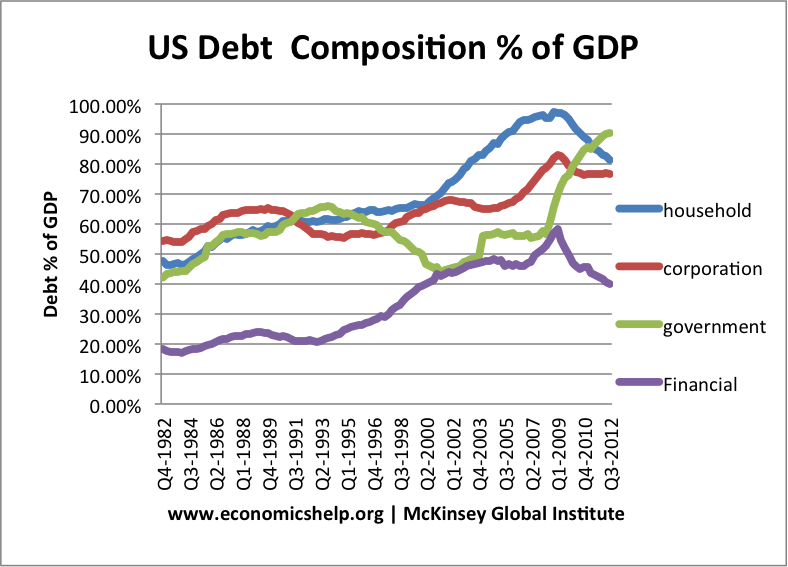
As the above figure from the McKinsey Global Institute shows, household debt, corporate debt and financial debt grew unsustainably from early 1980s to 2008. household debt was a staggering $12.68 trillion (100% of GDP), corporate debt about 85% of GDP and financial debt about %60 of GDP. The government debt fell through the Clinton years in part due to the fast growing economy (tax revenues increases) and in part due to austerity measure such as his signature “welfare reform” (cut in spendings). Given these data, it was not a question whether there will be a deep crisis but when and how it would break out.

Could anyone suggest that this long term exponential growth in debt was because of natural limits to growth? Or should we look elsewhere? 

This commentary is not a place to discuss the causes of the Great Recession (there is never a single cause for a crisis of this proportion and there are many studies to cite and discuss). But we need to consider the financial conditions of the U.S. working class because of how Saral singles them out in his argument.  The key fact to recall is the much studied and well understood phenomenon of declining real wage of workers and rising income inequality since the 1970s (for a journalist review of this see, for example, this 2012 Washington Post article) and this 2014 New York Times article).

Why have real wages fallen and income inequality risen? Because of a concentrated attack on the working class by the employers and their state. Why? To restore capitalist profitability. 

As a number of Marxist economists established in a series of published academic articles in the 1980s and early 1990s (see various issues of Review for Radical Political Economics; also see references below for the explanation of the Great Recession that cover this period as well), the average rate of profit in the U.S. did decline from the end of World War II to the mid-1970s (marked by the world recession of 1973-75). A stagnation ensued. Keynesian policies added high inflation resulting in stagflation. 

The capitalist class went of a neoliberal offensive marked by Thatcher and Reagan anti-labor offensive that targeted the miners union in Britain and the air traffic controllers union in the U.S. respectively. The assault also targeted the social wage resulting in Clinton’s “welfare reform” but has continued to targeting social security (retirement insurance), medicare (old age medical insurance) and medicaid (health insure for the very poor), food stamps, child nutrition program, etc. The assault has been comprehensive, targeting all earlier social gains from women’s right to safe abortion to environmental regulations to citizens’ right. And it has been internationalized.

Saral slights unionists, socialists and others for pointing out this frontal assault that has lasted now for well over three decades as “superficial” explanation for the crisis.  However, with almost all productivity gains going to the top 1% of the population and continued use of fiscal and monetary policies to support various asset inflation schemes to combat stagnation of the U.S. economy (see, Laurence Summers's December 15, 2013 article), it is hard no to believe that bursting of the housing bubble had a non-economic, nonsocial cause.  Seven years later, despite of lower primary commodity prices, historically low interest rate brought about by massive monetary policy intervention (basically a gift to the employer class), with corporations awash in cash, the U.S. economy is still dormant, Europe is toying with deflation, and China and the “emerging economies” facing a crisis.  The key feature of the capitalist world economy in the past 40 years had been the dominance of financial capital; that is, those who Lenin called the coupon clippers. 

Given all these facts, why not take a look at what the Marxists economists can provide as explanation for the Great Recession? Interested readers may consult Anwar Shaikh's, “The First Depression of the 21st Century” 2010; Fred Moseley’s, “The U.S. Economic Crisis” 2011; Duménil's and Levy’s The Crisis of Neoliberalism 2011; and Robert Brenner's “Reasons for the Great Recession” for a sample of such views. 

So, why does Saral call Marx’s theory of the tendency of the rate of profit “unsatisfactory” and Marxist explanations of the Great Recession “superficial?” What alternative theory of the capitalist system would Saral propose or endorse? After all, anyone who wants to analyze any aspect of the functioning of the capitalist system should begin with some theory of the beast and how it lives. 

In fact, Saral’s own essay reveal this necessity.  For example, he attribute the “usual inflations of the past” to mainly “high wage demands of the working people (the so-called wage-price spiral).”  But what does constitute “high wage demand by the working people?” High by whose standard? Further if real wages have been falling for 40 years what accounts for the stagflation in the U.S.  in the 1970s? It could not have been high wage demands, or could it? Is not “wage-price spiral” argument part of the mainstream (bourgeois) macroeconomic theory that blames workers for capitalist inflation (the other is “demand spiral,” commodity demand)? Why should an ecological socialist subscribe to such an anti-labor “theory”? What is wrong, for example, with Marx’s argument in Wage, Price and Profit (1865)? 

Similarly, in the summary of his argument quoted above Saral argues that due to “diminishing availability of affordable resources a growing number of workers lose their jobs or are forced to work only part-time, then they are producing no goods and services or less of them than before.” Again, the problem of unemployment and falling standards of living, including increasing nutritional deficiency, homelessness, lack of health insurance, and misery of the working people in the United States is blamed not on the capitalist anti-labor policies but on the nature law of diminishing returns.  

4. Limits to the Limits to Growth Perspective

To conclude this commentary, it is necessary to place the limits to growth argument in context. 

A. The Historical Context

Limits to Growth (1972) was the title of the first report commissioned by the international think-tank Club of Rome.  The report has been updated every 10 years since. The 1972 report’s authors, Donella H. Meadows, Dennis L. Meadows, Jørgen Randers, and William W. Behrens III of Massachusetts Institute of Technology, used a computer model they built and named World3 to simulate the consequence of interactions between the Earth's and human systems focusing on the exponential economic and population growth dynamics in the face of finite resources.  

A key finding was that

"If the present growth trends in world population, industrialization, pollution, food production, and resource depletion continue unchanged, the limits to growth on this planet will be reached sometime within the next one hundred years. The most probable result will be a rather sudden and uncontrollable decline in both population and industrial capacity.” (Limits to Growth, p. 23, 1972)
The publication of Limits to Growth stirred much interest and debate but also much hostility that eventually derailed the healthy discussion that ensued.  The hostility to Limits to Growth came largely from the free marketeers on the right whose ideology is wedded to the 250 years capitalist growth and industrialization.  

The socialist critique of the Limits to Growth also included an ideological bias for growth perceived as progress (in Marxist ideology growth of “forces of production” is desirable). The bias is most visible in socialist hostility to all criticism of exponential human population growth as “Malthusian,” that is reactionary and anti-working class. However, the socialist critique included a valid point. Limits to Growth model incorporates many assumptions based on mainstream socio-economic theories. That is, Limits to Growth proponents sidelined, if not entirely denied, economic, social and ideological criticism of the capitalist system in favor of arguing for natural limits to growth. It was argued that if these natural limits are not respected the population and the economy will go into a sudden and precipitous decline. Of course, the reality of the present day world includes all such limits, economic, social, and natural, to the capitalist civilization.  

B. Limits to Growth and Green Capitalism

Thus, the authors of the report and Club of Rome have not rule out socially and ecologically “sustainable capitalism” or “sustainable growth” if “appropriate measures” are taken in time.  In 1972, they wrote:
"It is possible to alter these growth trends and to establish a condition of ecological and economic stability that is sustainable far into the future. The state of global equilibrium could be designed so that the basic material needs of each person on earth are satisfied and each person has an equal opportunity to realize his individual human potential.” (Ibid, p. 24)
As a result Limits to Growth has largely served as an intellectual platform for the Green Capitalism ideology.  One of the original authors of the 1972 report, Jørgen Randers, has recently published 2052: A Global Forecast for the Next Forty Years (2012) that scales back some of the earlier more alarmist predications (e.g. in case of energy), avoids making predictions and offers proposals for individual action (not systemic proposals). 
At the fringe are small number of ecological socialists and anarchists who subscribe to the general notion that there are natural limits to growth but retain a critical attitude towards the exiting capitalist order and Green Capitalism. We should value Eco-socialism or Eco-Capitalism (1999) where Saral devotes the bulk of the book to  refute Green Capitalism.  At the same time, he correctly criticizes the productivist vision of socialism. Both these contributions make the book a must read for anyone interested in ecological socialism. 
Thus, to adopt a natural limits to growth perspective it is necessary to link it to a critical social theory that can explain how we have arrived at the current critical juncture  in history and how to overcome the existing globalized capitalist system that has generated and perpetuates the conditions causing the crisis. 
C. Limits to Growth and Externalities
In his essay, Saral devote a section to a criticism of the GDP using K. William Kapp's criticism of the GDP accounting for not addressing “defensive” and “compensatory” costs defined as costs to replenish physical, human and natural capital. Kapp is considered the founder of ecological economics, a discipline dedicated to integrating environmental and ecological aspect of the economy into the mainstream theory. 
“Defensive” and “compensatory” costs are externalities defined as cost or benefit of economic activities to third parties or society at large. The negative externality is pervasive and well known such as industrial pollution.  The positive externalities also exists. A bee keeper’s price of honey does not reflect the gain from pollination in the almond orchard next door. Market failure refers to the failure of the price mechanism to capture such costs or benefits. It should surprise no one that these costs and benefits are not included in the GDP. One could, as Kapp and ecological economists have tried, attempt to do so. However, it is not a prudent approach and that it cannot possibly succeed. How does one go about economic account for all types of ecocide, pain and suffering of farm animals, mass extinction of species, melting of the Earth’s ice caps?  Arguments for amending the GDP to account for various externalities are made within the economics (bourgeois) paradigm regardless of anyone’s intent. Concerns for the species going extinct is made from an ecocentric paradigm even if those who make it don’t realize it. The two paradigms are not reconcilable.  
On the other hand, the limit to growth argument offers a powerful argument for a rise in negative externalities and decline of the positive externalities (witness the plight of the honey bee or bats, both are major pollinators). Whereas cost of production of natural resources will increase given enough time due to diminishing returns it is quite possible that prices decline in intermediate terms using new technologies. But negative externalities are likely to increase. Thus, from an ecological point of view, the costs outstrip the benefits while from an economic point of view it is the other way around. Just consider fracking for natural gas, shale oil and mountain top mining for coal.  
Thus, it is more fruitful to use limits to growth perspective as a way to discuss increasing environmental and ecological costs than to try to use it as the exclusive or “deeper” cause for the Great Recession.
D. Limits to Growth as a Paradigm
Saral and others have talked about natural limits to growth as paradigm shift. In a sense it is. Socialist and most other radical traditions have focused on social and economic issues.  The growth paradigm has become part of these traditions as critical as they are of the capitalist system.  Natural limits to growth offers a new way to think about contradictions of class societies.  I say this being fully aware that Saral and other supporters of limits to growth perspective mostly or exclusively focus of industrial societies. But if one accepts the fact of ecological/environmental cause for the decline and disappearance of pre-industrial civilizations then it becomes clear the limits to growth has operated throughout human history and, in some instances, even prehistory.   It’s impact in the earlier times was local or regional. Under industrial globalized capitalist system it’s impact is planetary. 
Therefore, without denying the specificity of natural limits to growth in an industrial global capitalist economy, it is clear that the problem is common to all civilizations since the dawn of agriculture.  At issue is nothing less than our species relation with the rest of nature.  But limits to growth does not provide us with a philosophy of nature or anything about who we are, where we come from and where we are going. Thus, Limits to Growth of the Club of Rome, if taken as a paradigm, may offer a technical approach to nature as provider of “resources" and “services” but not an ethical perspective for a good society.  
For all who argue for a scaled back “sustainable” communal human society, the key question is how scaled back and what such sustainability entails for the lives of other species?  Would that be defined simply by technical requirements to maintain a sustainable stock of other species and some balance in ecosystems to meet our needs for food, shelter, and fun or by adhering to a philosophy of nature that affords similar rights to all species to live their full natural potential?  
In Economics, Socialism and Ecology, Part 2, I have argued that the crisis we face is really a crisis of the anthropocentric civilization that has manifested itself as the crisis of the industrial capitalist system.  Civilization has been built on farming that requires alienation from nature. Our species that has viewed itself an integral part of the nature and practiced ecocentric cultures for millions of years has come to institutionalize an anthropocentric culture that aims to control and dominate nature.  Social alienation, manifested by social segmentation of all kinds, including through class and state formation as well as markets (especially under the capitalist system) have rested on alienation from nature.  All different modes of production and social formations since the Agricultural Revolution have been built towards the goal of controlling and exploiting nature. That, of course, included exploitation of other human beings.  

I submit that ecological socialism and anarchism or any other emancipatory movement should be based not on any natural, social or economic limits to growth but on a positive world movement to reintegrate ourselves with the rest of nature that includes embracing all of humanity in its many creative and enriching potentials. 

Notes:


1. Saral’s essay is dated August 28, 2010 but was sent for publication in Our Place in the World a few weeks ago. The essay contains other issues that need critical discussion. However, I am focusing on the section that argues for a limits to growth cause of the Great Recession.
2. There is a table on page 269 of Saral’s book The Crises of Capitalism (2012) that show these costs rise somewhat in Federal Republic of Germany during the 1970-1988 period. While this is suggestive that the same may have been happening in the U.S. it is necessary to document these and show their causal connection to the Great Recession. 
3. The Club of Rome was founded in 1968 “as an informal association of independent leading personalities from politics, business and science, men and women who are long-term thinkers interested in contributing in a systemic interdisciplinary and holistic manner to a better world. The Club of Rome members share a common concern for the future of humanity and the planet.” (from Club of Rome website)


Related posts:

1311. Understanding the present-day World Economic Crisis: An Ecosocialist Approach