Showing posts with label Culture. Show all posts

Sunday, June 2, 2024

3645. New Research on Animal Communication Shows Their Cultures Are Often Complex and Cumulative

 By Björn Ólafsson, Sentient Science, May 1, 2024


Agapornis

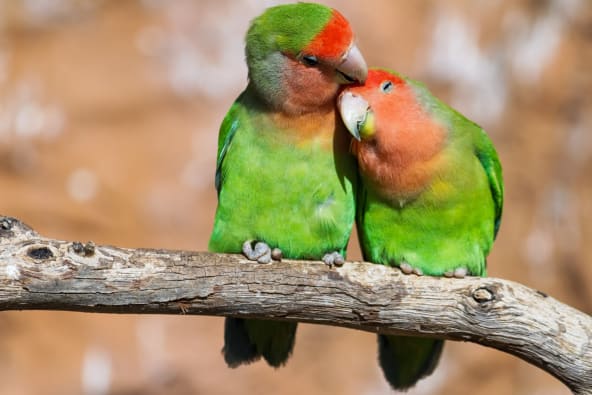
I have two lovebirds. Literal lovebirds, mind you, the bright orange-green parrots whose genus name is Agapornis. When we adopted them, the feathered pair quickly started using human forms of communication — mimicking the sound of a kiss to express affection and giving a heads’ up to greet us. In the wild, lovebirds communicate all the time in various ways — chirping, whistling, preening — but they don’t blow kisses. 

Because my two birds behaved differently than a wild pair, their expression could be considered a form of culturePsychologists define culture as behaviors passed down through generations, but it’s more than just holidays, music and recipes. One subset of culture — called cumulative culture by researchers — describes the phenomenon of a group learning a skill too complicated to master alone, often over multiple generations. Until recently, many scientists believed only humans were capable of cumulative culture, but two new studies are upending this belief.

In March, scientists at Queen Mary University published a study of their experiment with bumblebees, demonstrating these winged insects were capable of training each other to solve a puzzle too complicated for one bee to solve alone. That same month, another group of researchers published the results of a different puzzle experiment, this time with chimpanzees. These two studies challenge the idea that cumulative culture is inherently human.

“People used to think [bees] were automatons,” says Dr. Alice Bridges, lead researcher on the bee culture study in a conversation with Sentient, “But these are clearly animals that can learn new things.” Scientists like Bridges have come to believe that many animals can learn from each other, even to master quite complicated tasks.

Culture: Not Just for Homo Sapiens

For centuries, most Western philosophers — from Aristotle to Descartes — believed animals weren’t capable of conscious thought at all, never mind capable of creating culture. But then in 1952, a Japanese anthropologist named Kinji Imanishi wrote an essay — a dialogue between a monkey, a human and a bee — defending the possibility of animal culture.

One year later, new evidence emerged: a young macaque monkey in Japan named Imo started taking sweet potatoes to a nearby stream and washing them before eating. Imo’s idea spread like wildfire, and soon the entire group was scrubbing their tasty taters before taking a bite.

Today we know that examples of animal culture abound, and all across the animal kingdom. Orcas wear dead salmon as hats. Songbirds teach each other melodies. Groups of female fruit flies prefer mates with specific colors. Female bottlenose dolphins use sponges to hunt. In a particularly cute example, one group of chimps in Uganda were known to rub their backs against vines, which they learned from their disabled chimp friend Tinka, who used this technique to scratch his back after an injury sustained from local hunting traps.

Yet scientists still believed cumulative culturean advanced, often multi-generational form of social learning, to be unique to humans. Social learning in humans looks like what happens when we learn differential math equations in school — the task might be too difficult to solve alone, but possible with teachers or with support from peers. Even though scientists observed learning in animals — apes creating tools to use for instance — the tools were relatively simple, not enough evidence of true social learning, scientists seemed to agree.

As recently as a decade ago, scientists hadn’t yet seen any evidence of cumulative culture in non-humans, with some even saying it was categorically impossible. But in the 2010s, researchers began noticing that the food-washing behaviors of Japanese monkeys were growing incredibly complicated over time. First, the sweet potatoes were simply washed in a stream, then the monkeys began using salt water for added flavor, and digging their own pools for solitary enjoyment of their treat. This added complexity was thought to show evidence for cumulative culture. And now, we have even more evidence of this type of social learning, in bees and chimpanzees.

Training the Bees to Be Puzzle Trainers

In the Queen Mary experiment, bees who were placed in a box needed to solve a puzzle to receive a reward — in this case, sugar. The puzzle is a bit tricky, and none of the bees were able to learn the two-step solution on their own, even when left in the box for nearly a month. In fact, they seemingly became frustrated by the puzzle, “like a toddler throwing a tantrum,” says Bridges.

Next, the researchers trained a new set of bees, which they dubbed the “demonstrators.” These fuzzy influencers were taught by humans to solve the puzzle step-by-step, with syrup given as a reward each time they learned a new part of the answer. After two days of puzzle bootcamp, the demonstrator bees were paired with the untrained bees. A few minutes later, a third of the untrained bees were able to learn the complicated task and earn the sugar. And after the demonstrator bees were removed, the “untrained” bees were still able to solve the puzzle.

In an independently organized study in chimpanzees, the researchers offered peanuts instead of sugar as a reward for completing a slightly more complicated task: pulling a two-step lever with a more complex three-step mechanism.

In both experiments, the finding was the same.  On their own, the animals couldn’t solve it, but a trained animal could successfully teach it to others.

In other words, these experiments showed that chimps, like bees and like humans, have the capacity for cumulative culture.

Animal Culture Should Change How We Interact With Them

Animal culture, much like the animal personality, is rarely discussed in conversations about animal welfare, that is, how we treat animals — whether it’s wild animals affected by human conservation efforts or farm animals raised for food, to say nothing of animals in laboratorieszoos, or those used to entertain humans. But ignoring these sociological factors might end up causing more harm to animals than good.

Understanding animal culture could help humans improve our human-animal interactions. After all, knowledge is shared within herds and flocks — that is, it’s shared culturally. Bighorn sheep and other large mammals don’t travel migration routes instinctively, but learn them from each other. Historically, when animals have been relocated by humans, it has taken several decades and in some cases a century to adapt to the new winter migration route.

The Queen Mary researcher, Bridges, raises a hypothetical: what if conservationists find two groups of chimpanzees in a habitat at risk of destruction, each group with its own unique culture. Do the conservationists need to preserve both groups, not just to save more animals, but to conserve both unique culturesMost people see the value in preserving human cultures at risk of disappearing. Why should animal culture be any different?

Conservationists are already confronting these questions. The regent honeyeater, a beautiful glossy black songbird with speckles of yellow from southern Australia, has become critically endangered. As the population has declined, so too has their culture — males’ songs no longer have the complexity of their ancestors, to the point that many of the regent honeyeaters can no longer even learn their own culture, forced to mimic the sounds of other species. Should we endeavor to save the honeyeaters’ cultural heritage, in addition to just paying attention to raw population numbers?

It’s not just wild animals. Most mammals and birds on the planet are found on industrial-scale factory farms, where it may be more difficult to create unique culture given the unnatural conditions — small and packed living quarters. Yet according to researchers, most farm animals like cowspigs, and chickens have demonstrated awareness and an ability to learn.

Bridges hopes findings like these may help people think more open-mindedly about animals, both the human and non-human kind. “We’re not a pinnacle of evolution above them,” she says, “Not everything we do is complex, not everything they do is simple.”

Whether bees pulling levers, chimps solving puzzles or lovebirds blowing kisses, scientists are still scratching the surface of the culture and learning of which animals are capable.

Saturday, November 7, 2020

3444. Adult Literacy in the United States

By National Center for Education Statistics, July 2019

Using the data from the Program for the International Assessment of Adult Competencies (PIAAC), this Data Point summarizes the number of U.S. adults with low levels of English literacy and describes how they differ by nativity status1 and race/ethnicity.

FIGURE 1. Number of U.S. adults age 16 to 65 at each level of proficiency on the PIAAC literacy scale and those who could not participate: 2012 and 2014

Click the figure to expandFIGURE 1. Number of U.S. adults age 16 to 65 at each level of proficiency on the PIAAC literacy scale and those who could not participate: 2012 and 2014

NOTE: Standard error tables are available at https://nces.ed.gov/pubsearch/pubsinfo.asp?pubid=2019179. Percentages of U.S. adults age 16 to 65 at each level of proficiency on PIAAC literacy scale appear in parentheses. Low English literacy is defined as those performing at PIAAC literacy proficiency level 1 or below or who could not participate due to a language barrier or a cognitive or physical inability to be interviewed. The “Mid or High English literacy” label refers to those performing at PIAAC literacy proficiency level 2 or above.
SOURCE: U.S. Department of Education, National Center for Education Statistics, Program for the International Assessment of Adult Competencies (PIAAC), U.S. PIAAC 2012/2014.

PIAAC is a large-scale international2 study of working-age adults (ages 16–65) that assesses adult skills in three domains (literacy, numeracy, and digital problem solving) and collects information on adults’ education, work experience, and other background characteristics. In the United States, when the study was conducted in 2011–12 and 2013–14, respondents were first asked questions about their background, with an option to be interviewed in English or Spanish, followed by a skills assessment in English. Because the skills assessment was conducted only in English, all U.S. PIAAC literacy results are for English literacy.

PIAAC defines literacy as “the ability to understand, evaluate, use and engage with written texts to participate in society, to achieve one’s goals, and to develop one’s knowledge and potential” (p. 61, OECD 2013). Results in this Data Point are presented as the number of adults at literacy proficiency levels that are described in terms of the types of tasks the adults are likely to complete successfully at a particular level. PIAAC reports out five literacy proficiency levels: from below level 1 to level 4/5.3 Adults with low levels of literacy are defined, consistent with international reports (OECD 2013), as those performing on PIAAC’s literacy assessment at “level 1 or below” or those who could not participate in the survey,4 as explained below.

What are the rates of literacy in the United States?

Four in five U.S. adults (79 percent) have English literacy skills sufficient to complete tasks that require comparing and contrasting information, paraphrasing, or making low-level inferences—literacy skills at level 2 or above in PIAAC (OECD 2013). In contrast, one in five U.S. adults (21 percent) has difficulty completing these tasks (figure 1). This translates into 43.0 million U.S. adults who possess low literacy skills: 26.5 million at level 1 and 8.4 million below level 1, while 8.2 million could not participate in PIAAC’s background survey either because of a language barrier or a cognitive or physical inability to be interviewed. These adults who were unable to participate are categorized as having low English literacy skills, as is done in international reports (OECD 2013), although no direct assessment of their skills is available.

Adults classified as below level 1 may be considered functionally illiterate in English: i.e., unable to successfully determine the meaning of sentences, read relatively short texts to locate a single piece of information, or complete simple forms (OECD 2013).

FIGURE 2. Percentage of all and low-skilled adults age 16 to 65, by nativity status: 2012 and 2014

Click the figure to expandFIGURE 2. Percentage of all and low-skilled adults
age 16 to 65, by nativity status: 2012 and 2014

NOTE: Standard error tables are available at https://nces.ed.gov/pubsearch/pubsinfo.asp?pubid=2019179. Low English literacy adults are defined as those performing at PIAAC literacy proficiency level 1 or below. Adults who could not participate are excluded.
SOURCE: U.S. Department of Education, National Center for Education Statistics, Program for the International Assessment of Adult Competencies (PIAAC), U.S. PIAAC 2012/2014.

What is the make-up of adults with low English literacy skills by nativity status and race/ethnicity?

U.S.-born adults make up two-thirds of adults with low levels of English literacy skills in the United States.5 However, the non-U.S. born are over-represented among such low-skilled adults. Non-U.S.-born adults comprise 34 percent of the population with low literacy skills, compared to 15 percent of the total population (figure 2).

FIGURE 3. Percentage of low-skilled adults age 16 to 65, by nativity status and race/ethnicity: 2012 and 2014

Click the figure to expandFIGURE 3. Percentage of low-skilled adults age 16 to
65, by nativity status and race/ethnicity: 2012 and 2014

NOTE: Standard error tables are available at https://nces.ed.gov/pubsearch/pubsinfo.asp?pubid=2019179. Low English literacy adults are defined as those performing at PIAAC literacy proficiency level 1 or below. Adults who could not participate are excluded. Detail may not sum to totals because of rounding.
SOURCE: U.S. Department of Education, National Center for Education Statistics, Program for the International Assessment of Adult Competencies (PIAAC), U.S. PIAAC 2012/2014.

White and Hispanic adults make up the largest percentage of U.S. adults with low levels of English literacy, 35 percent and 34 percent respectively (figure 3).

By race/ethnicity and nativity status, the largest percentage of those with low literacy skills are White U.S.-born adults, who represent one third of such low-skilled population. Hispanic adults born outside the United States make up about a quarter of such low-skilled adults in the United States (figure 3).

Endnotes

1 Nativity status refers to whether the respondent was born in the United States or born outside the United States.
2 This international study is coordinated by the Organization for Economic Cooperation and Development (OECD) and developed by participating countries with the support of the OECD.
3 This analysis combines the top two proficiency levels (Levels 4 and 5), following the OECD’s reporting convention OECD 2013), because across all participating countries, no more than 2 percent of adults reached Level 5.
4 Unlike in the U.S. PIAAC 2012/2014 First Look (Rampey et al. 2016), those who could not participate are included in the literacy proficiency distribution shown here. Referred to as “literacy-related nonresponse cases,” these adults who could not participate are typically not shown because virtually all nformation about them is missing.
5 Adults who could not participate in PIAAC because of a language barrier or a cognitive or physical inability to be interviewed are excluded from analyses of nativity status and race/ethnicity as this information is unavailable for nonparticipants.

References

Organization for Economic Cooperation and Development (OECD) (2013). OECD Skills Outlook 2013: First Results From the Survey of Adult Skills. Paris: OECD Publishing. Retrieved from http://dx.doi.org/10.1787/9789264204256-en.
Rampey, B.D., Finnegan, R., Goodman, M., Mohadjer, L., Krenzke, T., Hogan, J., and Provasnik, S. (2016). Skills of U.S. Unemployed, Young, and Older Adults in Sharper Focus: Results From the Program for the International Assessment of Adult Competencies (PIAAC) 2012/2014: First Look (NCES 2016-039rev). U.S. Department of Education. Washington, DC: National Center for Education Statistics. Retrieved from https://nces.ed.gov/pubsearch.

Data in this report are from the Program for the International Assessment of Adult Competencies (PIAAC). To learn more, visit https://nces.ed.gov/surveys/piaac. For questions about content or to view this report online, go to https://nces.ed.gov/pubsearch/pubsinfo.asp?pubid=2019179.

3443. Who Doesn’t Read Books in America?

By Andrew Perrin, The Pew Research Center, September 26, 2019


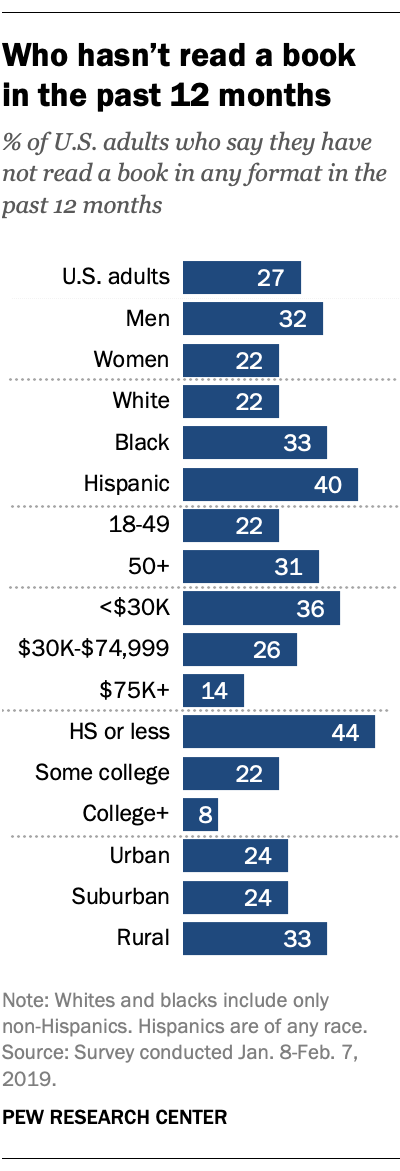
Roughly a quarter of U.S. adults (27%) say they haven’t read a book in whole or in part in the past year, whether in print, electronic or audio form, according to a Pew Research Center survey conducted Jan. 8 to Feb. 7. Who are these non-book readers?

Several demographic traits correlate with non-book reading, Pew Research Center surveys have found. For instance, adults with a high school diploma or less are far more likely than those with a bachelor’s or advanced degree to report not reading books in any format in the 12 months before the survey (44% vs. 8%). Adults with lower levels of educational attainment are also among the least likely to own smartphones, a device that saw a substantial increase in usage for reading e-books from 2011 to 2016. (College-educated adults are more likely to own these devices and use them to read e-books.)

Adults whose annual household income is $30,000 or less are more likely than those living in households earning $75,000 or more a year to be non-book readers (36% vs. 14%). Hispanic (40%) and black (33%) adults are more likely than whites (22%) to report not having read a book in the past 12 months. But there are differences between Hispanics born inside and outside the United States: 56% of foreign-born Hispanics report not having read a book, compared with 27% of Hispanics born in the U.S.

Although the differences are less pronounced, non-book reading does vary by gender, age and community type.

The share of Americans who report not reading any books in the past 12 months is higher today than it was nearly a decade ago – though there has been some fluctuation over this time period. Today, 27% of adults say they have not read any books in the past year, up from 19% in 2011, but identical to the share who said this in 2015.

The same demographic traits that characterize non-book readers also often apply to those who have never been to a library. In a 2016 survey, we found that Hispanics, older adults, those living in households earning less than $30,000 and those who have a high school diploma or did not graduate from high school are the most likely to report they have never been to a public library.

However, a 2015 survey found that some of these same demographic groups acknowledged the importance of libraries in their communities and for their families: Black and Hispanic adults, those in lower-income households and adults ages 30 and older were more likely to say that their local libraries serve them and their families “very well.”

Note: See full topline results and methodology here. This is an update of a post originally published Nov. 23, 2016.

Friday, May 19, 2017

2614. There's No Such Thing as a 'Pure' European—or Anyone Else

By Ann Gibbons, Science, May 15, 2017

When the first busloads of migrants from Syria and Iraq rolled into Germany 2 years ago, some small towns were overwhelmed. The village of Sumte, population 102, had to take in 750 asylum seekers. Most villagers swung into action, in keeping with Germany’s strong Willkommenskultur, or “welcome culture.” But one self-described neo-Nazi on the district council told The New York Times that by allowing the influx, the German people faced “the destruction of our genetic heritage” and risked becoming “a gray mishmash.”

In fact, the German people have no unique genetic heritage to protect. They—and all other Europeans—are already a mishmash, the children of repeated ancient migrations, according to scientists who study ancient human origins. New studies show that almost all indigenous Europeans descend from at least three major migrations in the past 15,000 years, including two from the Middle East. Those migrants swept across Europe, mingled with previous immigrants, and then remixed to create the peoples of today.

Using revolutionary new methods to analyze DNA and the isotopes found in bones and teeth, scientists are exposing the tangled roots of peoples around the world, as varied as Germans, ancient Philistines, and Kashmiris. Few of us are actually the direct descendants of the ancient skeletons found in our backyards or historic homelands. Only a handful of groups today, such as Australian Aborigines, have deep bloodlines untainted by mixing with immigrants. 

“We can falsify this notion that anyone is pure,” says population geneticist Lynn Jorde of the University of Utah in Salt Lake City. Instead, almost all modern humans “have this incredibly complex history of mixing and mating and migration.”

Wind back the clock more than a thousand years—a trivial slice of time compared with the 200,000 years or so since our species emerged—and stories of exclusive heritage or territory crumble. “Basically, everybody’s myth is wrong, even the indigenous groups’,” says population geneticist David Reich of Harvard University.

Tacitus, the Roman historian, reports that in 9 C.E. a member of the Germanic Cherusci tribe called Arminius led a rebellion against the Romans near the village of Kalkriese in northern Germany. Against all odds, the tribes slaughtered three Roman legions in what became known as the Battle of the Teutoburg Forest.

After Tacitus’s account resurfaced in the 15th century, German nationalists resurrected the myth of Arminius, who is often depicted as a blond, muscular young chieftain and known as Hermann. Hailed as the first “German” hero, he was said to have united the Germanic tribes and driven the Romans from their territory. That was considered the start of a period when fearsome Germanic tribes such as the Vandals swept around Europe, wresting territory from Romans and others.

In the 20th century, the Nazis added their own dark spin to that origin story, citing Arminius as part of an ancient pedigree of a “master race” from Germany and northern Europe that they called Aryans. They used their view of prehistory and archaeology to justify claims to the tribes’ ancient homelands in Poland and Austria.

Scholars agree that there was indeed a real battle that sent shock waves through the Roman Empire, which then stretched from the island of Britain to Egypt. But much of the rest of Arminius’s story is myth: The Romans persisted deep in Germania until at least the third century C.E., as shown by the recent discovery of a third-century Roman battlefield in Harzhorn, Germany. And Arminius by no means united the more than 50 Germanic tribes of the time. He persuaded five tribes to join him in battle, but members of his own tribe soon killed him.

Moreover, Arminius and his kin were not pure “Aryan,” if that term means a person whose ancestors lived solely in what is now Germany or Scandinavia. The Cherusci tribe, like all Europeans of their day and later, were themselves composites, built from serial migrations into the heart of Europe and then repeatedly remixed. “The whole concept of an ethnic German … it’s ludicrous when you look at the longue durée [long time] scale,” says archaeologist Aren Maeir of Bar-Ilan University in Ramat Gan, Israel. 

After World War II, many scholars recoiled from studying migrations, in reaction to the Nazi misuse of history and archaeology. The Nazis had invoked migrations of “foreign” groups to German territory to justify genocide. “The whole field of migration studies was ideologically tainted,” says archaeologist Kristian Kristiansen of the University of Gothenburg in Sweden. Some researchers also resisted the idea that migration helped spread key innovations such as farming, partly because that might imply that certain groups were superior.

Nor did researchers have a reliable method to trace prehistoric migrations. “Most of the archaeological evidence for movement is based on artifacts, but artifacts can be stolen or copied, so they are not a real good proxy for actual human movement,” says archaeologist Doug Price of the University of Wisconsin in Madison, who tracks ancient migration by analyzing isotopes. “When I started doing this in 1990, I thought people were very sedentary and didn’t move around much.”

Today, however, new methods yield more definitive evidence of migration, sparking an explosion of studies. The isotopes Price and others study are specific to local water and food and thus can reveal where people grew up and whether they later migrated. DNA from ancient skeletons and living people offers the “gold standard” in proving who was related to whom.

The new data confirm that humans have always had wanderlust, plus a yen to mix with all manner of strangers. After the first Homo sapiens arose in Africa, several bands walked out of the continent about 60,000 years ago and into the arms of Neandertals and other archaic humans. Today, almost all humans outside Africa carry traces of archaic DNA. 

That was just one of many episodes of migration and mixing. The first Europeans came from Africa via the Middle East and settled there about 43,000 years ago. But some of those pioneers, such as a 40,000-year-old individual from Romania, have little connection to today’s Europeans, Reich says. 

His team studied DNA from 51 Europeans and Asians who lived 7000 to 45,000 years ago. They found that most of the DNA in living Europeans originated in three major migrations, starting with hunter-gatherers who came from the Middle East as the glaciers retreated 19,000 to 14,000 years ago. In a second migration about 9000 years ago, farmers from northwestern Anatolia, in what is now Greece and Turkey, moved in.

That massive wave of farmers washed across the continent. Ancient DNA records their arrival in Germany, where they are linked with the Linear Pottery culture, 6900 to 7500 years ago. A 7000-year-old woman from Stuttgart, Germany, for example, has the farmers’ genetic signatures, setting her apart from eight hunter-gatherers who lived just 1000 years earlier in Luxembourg and Sweden. Among people living today, Sardinians retain the most DNA from those early farmers, whose genes suggest that they had brown eyes and dark hair.
The farmers moved in family groups and stuck to themselves awhile before mixing with local hunter-gatherers, according to a study in 2015 that used ancient DNA to calculate the ratio of men to women in the farming groups. That’s a stark contrast to the third major migration, which began about 5000 years ago when herders swept in from the steppe north of the Black Sea in what is now Russia. Those Yamnaya pastoralists herded cattle and sheep, and some rode newly domesticated horses, says archaeologist David Anthony of Hartwick College in Oneonta, New York.

In the journal Antiquity last month, Kristiansen and paleogeneticist Eske Willerslev at the University of Copenhagen reported that the sex ratios of the earliest Yamnaya burials in central Europe suggest that the new arrivals were mostly men. Arriving with few women, those tall strangers were apparently eager to woo or abduct the local farmers’ daughters. Not long after the Yamnaya invasion, their skeletons were buried with those of women who had lived on farms as children, according to the strontium and nitrogen isotopes in their bones, says Price, who analyzed them.

The unions between the Yamnaya and the descendants of Anatolian farmers catalyzed the creation of the famous Corded Ware culture, known for its distinctive pottery impressed with cordlike patterns, Kristiansen says. According to DNA analysis, those people may have inherited Yamnaya genes that made them taller; they may also have had a then-rare mutation that enabled them to digest lactose in milk, which quickly spread.

It was a winning combination. The Corded Ware people had many offspring who spread rapidly across Europe. They were among the ancestors of the Bell Beaker culture of central Europe, known by the vessels they used to drink wine, according to a study by Kristiansen and Reich published this month. “This big wave of Yamnaya migration washed all the way to the shores of Ireland,” says population geneticist Dan Bradley of Trinity College in Dublin. Bell Beaker pots and DNA appeared about 4000 years ago in burials on Rathlin Island, off the coast of Northern Ireland, his group reported this year.

This new picture means that the Hermann of lore was himself a composite of post–ice age hunter-gatherers, Anatolian farmers, and Yamnaya herders. So are most other Europeans—including the ancient Romans whose empire Arminius fought.

The three-part European mixture varies across the continent, with different ratios of each migration and trace amounts of other lineages. But those quirks rarely match the tales people tell about their ancestry. For example, the Basques of northern Spain, who have a distinct language, have long thought themselves a people apart. But last year, population geneticist Mattias Jakobsson of Uppsala University in Sweden reported that the DNA of modern Basques is most like that of the ancient farmers who populated northern Spain before the Yamnaya migration. In other words, Basques are part of the usual European mix, although they carry less Yamnaya DNA than other Europeans.

Farther north, the Irish Book of Invasions, written by an anonymous author in the 11th century, recounts that the “Sons of Míl Espáine … after many wanderings in Scythia and Egypt” eventually reached Spain and Ireland, creating a modern Irish people distinct from the British—and linked to the Spanish. That telling resonates with a later yarn about ships from the Spanish Armada, wrecked on the shores of Ireland and the Scottish Orkney Islands in 1588, Bradley says: “Good-looking, dark-haired Spaniards washed ashore” and had children with Gaelic and Orkney Islands women, creating a strain of Black Irish with dark hair, eyes, and skin.

Although it’s a great story, Bradley says, it “just didn’t happen.” In two studies, researchers have found only “a very small ancient Spanish contribution” to British and Irish DNA, says human geneticist Walter Bodmer of the University of Oxford in the United Kingdom, co-leader of a landmark 2015 study of British genetics.

The Irish also cherish another origin story, of the Celtic roots they are said to share with the Scots and Welsh. In the Celtic Revival of the 19th and 20th centuries, writers such as William Butler Yeats drew from stories in the Book of Invasions and medieval texts. Those writings described a migration of Gaels, or groups of Celts from the mainland who clung to their identity in the face of later waves of Roman, Germanic, and Nordic peoples.
But try as they might, researchers so far haven’t found anyone, living or dead, with a distinct Celtic genome. The ancient Celts got their name from Greeks who used “Celt” as a label for barbarian outsiders—the diverse Celtic-speaking tribes who, starting in the late Bronze Age, occupied territory from Portugal to Turkey. “It’s a hard question who the Celts are,” says population geneticist Stephan Schiffels of the Max Planck Institute for the Science of Human History in Jena, Germany.

Bodmer’s team traced the ancestry of 2039 people whose families have lived in the same parts of Scotland, Northern Ireland, and Wales since the 19th century. These people form at least nine genetic and geographic clusters, showing that after their ancestors arrived in those regions, they put down roots and married their neighbors. But the clusters themselves are of diverse origin, with close ties to people now in Germany, Belgium, and France. “‘Celtic’ is a cultural definition,” Bodmer says. “It has nothing to do with hordes of people coming from somewhere else and replacing people.”

English myths fare no better. The Anglo-Saxon Chronicle recounts that in 449 C.E., two Germanic tribespeople, Hengist and Horsa, sailed from what is now the Netherlands to southeast England, starting a fierce conflict. As more Angles, Saxons, and Jutes arrived, violence broke out with the local Britons and ended in “rivers of blood,” according to accounts by medieval monks. Scholars have debated just how bloody that invasion was, and whether it was a mass migration or a small delegation of elite kings and their warriors.
An answer came in 2016 from a study of the ancient DNA of Anglo-Saxons and indigenous Britons, who were buried side by side in the fifth and sixth centuries in a cemetery near Cambridge, U.K. They lived and died together and even interbred, as shown by one person who had a mix of DNA from both Britons and Anglo-Saxons, and a genetic Briton who was buried with a large cruciform Anglo-Saxon brooch. Although the stories stress violence, the groups “were mixing very quickly,” says Duncan Sayer, an archaeologist at the University of Central Lancashire in Preston, U.K., who co-wrote the study.

The team went on to show that 25% to 40% of the ancestry of modern Britons is Anglo-Saxon. Even people in Wales and Scotland—thought to be Celtic strongholds—get about 30% of their DNA from Anglo-Saxons, says co-author Chris Tyler-Smith of the Wellcome Trust’s Sanger Institute in Hinxton, U.K.

The boom in studies of migration is centered on Europe, where access to ancient remains is relatively easy and cold climates can help preserve DNA. But geneticists are beginning to probe the makeup of ancient people elsewhere. For example, findings from recent excavations in Israel are close to solving a long-standing mystery from the Bible: the identity of the ancient Philistines.

In biblical texts, those “uncircumcised” people are known as the bitter enemies of the Israelites; the name “Philistine” is still a slur in English. They’re said to have lived in Canaan, between present-day Tel Aviv and Gaza in Israel. They ate pork, battled Samson’s armies, and stole the Ark of the Covenant. Goliath, whom David slew with a sling, was a Philistine. But after Old Testament times, the group disappears from both scripture and historical accounts.

To find the Philistines’ origins, researchers have studied artifacts and remains from ancient Philistine cities in Israel. The evidence, including isotopic analysis, shows that the Philistines were a motley crew of immigrants, possibly pirates, who hailed from many ports, bringing pigs from Europe and donkeys in caravans from Egypt. “The Philistines are an entangled culture from western Anatolia, Cyprus, Greece, the Balkans, you name it,” says Maeir, who has directed excavations at the Philistine city of Gath for 2 decades.

Maeir says he thinks that the Philistines soon intermarried with people already living in Canaan instead of going extinct. If so, the loathsome Philistines are part of the ancestral stock for both Palestinian Muslims and Israeli Jews. Those groups, so full of enmity today, are genetically closely related, according to a study in 2000 of the paternally inherited Y chromosomes of 119 Ashkenazi and Sephardic Jews and 143 Israeli and Palestinian Arabs. Seventy percent of the Jewish men and half of the Arab men inherited their Y chromosomes from the same set of paternal ancestors who lived in the Middle East within the last few thousand years.

As techniques for probing ethnic origins spread, nearly every week brings a new paper testing and often falsifying lore about one ancient culture or another. The Kashmiri of northern India do not seem to be related to Alexander the Great or the lost tribes of Israel. Parsis in Iran and India are not solely of ancient Iranian heritage, having mixed with local Indian women, although Parsi priests do descend chiefly from just two men. 
“Ethnic groups in the past and present create an ‘imagined past’ of the longtime and ‘pure’ origins of their group,” Maeir says. But that created past often has “little true relation to the historical processes” that actually created the group, he says. 

So far, the origin stories that appear to hew most closely to reality belong to indigenous peoples around the world. For example, the Tlingit and Tsimshian tribes of British Columbia in Canada and Alaska claim to have lived along the west coast of North America from “time immemorial.” Living tribespeople do descend in part from three ancient Native Americans who lived in the region 2500 to 6000 years ago, according to DNA analyses published last month. Even so, most modern Native Americans are not directly related to the ancient people who lived in the same areas because their offspring moved, were displaced, or went extinct over the millennia, Reich says.

In Australia, aboriginal stories recall even longer connections to their lands, even seeming to refer to times when sea levels rose and fell more than 15,000 years ago. Those claims are among the few that genome studies support. DNA evidence puts aboriginal ancestors on the continent 40,000 to 60,000 years ago. Once the first Australians arrived, they settled in three regions and remained in those discrete homelands for tens of thousands of years, a DNA study published in March suggests. 

But the Aborigines are rare among the peoples of Earth, where migrations have been the norm. Almost always, Reich says, “the idea that the ancestors of any one population have lived in the same place for tens of thousands of years with no substantial immigration is wrong.” 

Back in Sumte in the fall of 2015, the 750 refugees from Syria arrived on schedule. The adults mostly kept to themselves, learning German and taking occasional construction jobs. But their children sang “O Tannenbaum” in a local church at Christmas and their teens ventured out often, seeking cellphone signals in the quiet town.

In the following months, almost all the refugees dispersed to larger towns throughout Germany. In time, some of the young immigrants will contribute their DNA to the next generation of Germans, re-enacting on a small scale the process of migration and assimilation that once played out repeatedly on this same land—and far beyond.

Tuesday, April 26, 2016

2291. Culture and Socialism

By Terry Eagleton, International Socialism, March 31, 2009

All human beings are prematurely born, helpless and dependent, unable to look after themselves. This applies not just to Oxbridge dons but to the whole of the human species. Later on, if all goes well, we will achieve a degree of autonomy—but only on the basis of a continuing dependency, this time on culture rather than nature. Only through the form of dependence on others we call culture can we come to be self-sufficient, which is no doubt one reason why the word “monster” in classical antiquity meant among other things one who sees himself as self-dependent and to that extent is in conflict with his or her creaturely nature. Sophocles’s Oedipus is a case in point—that canny entrepreneur of himself whose suppressed parentage will return to destroy him. We all like to fantasise that we have a posher pedigree than we actually do or (even more deludedly) that we have no pedigree at all—that we sprang from our own heads or loins. Since that which was never born can never die, this yields us the comforting illusion of immortality.
This is certainly the case with what we might call bourgeois man, or Faustian Man, whose desire is infinite and whose will is unconfined. He must therefore secretly regard himself as wholly immaterial, since materiality is a constraint. This is a creature who recognises no end, origin, ground or goal but himself. When his phallic tower is demolished by terrorist aircraft he instantly resolves to build an even bigger one in its place. A case of slow learning if ever there was one…
Since we are all born prematurely, with a donnish inability to cope, we will all die very quickly unless culture moves in on us right away. I don’t mean by this that Stendhal or Shostakovich are essential for our survival. I mean culture in the sense of a system of nurture, “nurture” being a word which for Shakespeare mediates between nature and culture. The playwright Edward Bond speaks of the so-called “biological expectations” with which we are born—the expectation, he writes, that “the baby’s unpreparedness will be cared for, that it will be given not only food but emotional reassurance, that its vulnerability will be shielded, that it will be born into a world wanting to receive it, and that knows how to receive it”. Unless one of those faces around the cradle actually speaks to the infant it will never become a person at all. It will be human, of course, since this is a matter of the sort of body it has, but becoming a person is a project, not a given. Measuring contemporary capitalism by this single criterion, Bond refuses to grace it with the title of a culture.
Culture, one might note, is here a descriptive and a normative term at the same time. It describes in a neutral way what must actually happen for us to survive, but it also refers to a kind of loving and is thus a value term as well. Without some culture of caring geared up to greet us we simply won’t flourish. In this sense, the word “culture” leaps the gap between fact and value—between what is the case and what is desirably the case. Far from just rising shakily on our paws and licking ourselves down, we are born with an enormous hole in our natures, which culture must instantly plug if we are not to die. It is natural to us to be lacking. And since our premature birth results in an unusually long period of dependency on those human beings immediately to hand it gives rise to an unusually intense intimacy with them. This in turn results in a particularly traumatic severance from them at a later point, which is what gives rise to that curious human invention known as psychoanalysis. Psychoanalysis is a science concerned among other things with how the fact of our interaction with other bodies breeds certain conditions relevant to value: fantasy, neurosis, psychosis, denying that the grey-haired old codger who arrives at the school gates is your father rather than grandfather, pretending he’s just a wrinkled old family retainer and so on.
All of which is to say that culture is of our nature. A very different proposition, note, from the postmodern claim that culture is our nature. For the postmodern ideology we might dub culturalism, culture goes all the way down. It is, so to speak, wall to wall. You can’t ask what is being culturally constructed, since the answer to that must also be a cultural construction. This fashionable brand of culturalism, one which is rife all the way from Al Qaida to the Institute of Contemporary Arts, is among other things a disavowal of our fragility and mortality. Al Qaida is culturalist because it believes that values, religious ones in particular, are what matters, more so than material matters. For both Al Qaida and the American Dream, materiality is constraining rather than enabling, which is no doubt one reason why both parties have a somewhat casual way with human flesh and blood. Neither the ICA nor the American Dream (I haven’t consulted Al Qaida on this point) would agree that, whatever else we may be, we are in the first place natural material objects. Anything more glamorous, sexy and fascinating we can get up to has to be got up to on this basis. For the anti-culturalist view I’m proposing here culture is required by our peculiar kind of creatureliness, by the sort of species-being we share, by the kind of material bodies we have.
Only a linguistic animal—that is to say, one which moves within a world of meaning—can be said to have a culture. To live in a world of meaning is to share a sensory world with others of one’s kind in a way that transcends mere bodily contact. It isn’t just to add something extra to a sensory world but to transform it at a stroke. It is to extend the body outwards into a complex set of networks and institutions, and this in turn extends the body inwards, lending it its spiritual depth and interiority. The whole of civilisation is an extension of our bodies. Technology is a kind of prosthesis. And this is made possible by the kind of labouring, linguistic, conceptual, self-transformative, self-transcending bodies we have (or are). (Whether we “have” bodies or “are” bodies is a fascinating issue we must leave aside here.) As Ludwig Wittgenstein remarks, if you want an image of the soul, look at the human body.
Now this is both our delight and our disaster. The linguistic, culture building creature has the edge over its fellow animals in all sorts of ways. Indeed, it is hard to suppress a shudder of humanistic contempt when one thinks about all that we can do and they can’t. We can stockpile nuclear weapons, torture Muslims and blow the heads off small children, for example, none of which are within the capacity of moles or badgers (unless they’re being remarkably furtive about it). Language or conceptual thought allows us to sit loose to our own bodies, as well as to the bodies of others, unhinging us to some extent from our constraining sensuous responses. It is hard to strangle someone with your bare hands since the intra-specific inhibitions on killing a member of one’s own species would kick in and succeed in making us sick. And though it is unpleasant to have someone throw up over you, it is a great deal more agreeable than being strangled.
We can, however, override these sensuous inhibitions by killing each other at long range, an ingenious strategy which squirrels and earthworms have so far disastrously failed to come up with. (Why? Because a non-linguistic being can’t invent a rifle.) Language, and the cultural or conceptual world of which it is the medium, is the catastrophic triumph we have over our fellow animals. If this dangerously two-edged sword permits us to torture, it also allows us to perform major surgery without just throwing up over the patient’s body all the time. It does this because it helps to objectify the world, set it over against us, which is a source of alienation andachievement. Unlike aardvarks and alligators, we can be ironic and play the trombone, write Little Dorrit and care for the sick. Linguistic culture also means that we can enter into relations with others more intimate and intense than just bodily interaction, which is what we mean by spirit, soul or consciousness. 
Consciousness is more something between us than within us, more like dancing than a rumble of the gut. Because of this unique form of communication, we can dissolve the walls of our bodies and get closer to each other than touching. Sexual relationships, for example, are mostly a matter of talking (or am I missing out on something?). For sign-making animals like ourselves, physical action isn’t a way of getting closer to each other than words. In fact, actions like hugs or handshakes only make sense within a world of meaning. Sharing signs isn’t a substitute for sharing things; it is a way of sharing them more deeply.
Entering into language was certainly a fall. But like all the best falls it was one up and not down. It was a fall up from sheer innocent animality into the guilt laden domain of culture and history. It was, as the theologians say, felix culpa—a fortunate fall. To live in a world of meaning is both our glory and our terror. Language, or conceptuality, sets us free from the dull constraints of a biological routine into that form of collective self-determination we known as history. I don’t want to be odiously patronising here: I’m sure moles and badgers are splendid little chaps in their own way, and no doubt slugs and tapeworms make marvellous companions once you get to know them. It is just that their existence looks from the outside just a trifle boring, which is the last thing one can say of the flamboyant career of a species apparently set on destroying itself.
Because we live culturally and historically, our existence is at once enthralling and spectacularly precarious, whereas the lives of our fellow creatures are for the most part tedious but secure. Or rather they are insecure only because we are around. Being eaten by a tiger is not in the least tedious for us, but it is routine for the tiger. Having history means that we are never able to be fully identical with ourselves. Like language itself we are constitutively unfinished—and this means that death is always arbitrary and gratuitous even when we see it coming. As Lady Macbeth recognises but her husband does not, it belongs to our natures to transgress our natures. Living in a world of meaning also allows us to reflect on the grounds and validity of our meanings—in other words to do theory—which is another way in which we are not self-identical. In reflecting on ourselves, we divide ourselves into two, becoming both subject and object of our thought.
A creature doomed to meaning is one constantly at risk. It would seem, for example, to have no solid ground to its existence, since there is always more meaning where that came from, and meaning is in any case inherently unstable. There can be no such thing as a final interpretation, in the sense of an interpretation which does not itself need to be interpreted. There could be no final word because a word only has meaning in terms of other words. We are able to live historically because the kind of bodies we have are self-transcending, which is to say that they allow us within certain limits to determine the way in which we are determined. We are determined in such a way as to be able to make something creative and unpredictable of what makes us. Language offers a model of this, because it is a regular, fairly predictable system of conventions but one which all the time allows us to generate strikingly original speech acts which no one has ever heard before. A poem is the best example of such utterances.
Language allows us to make present what is absent. It punches a hole in the indicative mood and ushers in the subjunctive—the sphere of imagination and possibility. With language both futurity and negation are born. A dog may be vaguely expecting its master to return, but it can’t be expecting him to return at precisely 3.57pm next Tuesday. As for negation, it is language which allows us to do this as there is no negativity in reality. Speech introduces nothingness into the world.
The problem with this constant negating and transcending of the present (which is what we mean by history) is that linguistic creatures can develop too fast. Evolution, by contrast, is mind-blowingly slow and boring but safe.
Linguistic animals are perpetually in danger of overreaching themselves and bringing themselves to nothing. Their chronic condition is what the ancient Greeks knew as hubris or which modernity knows as the myth of Faust. We are always likely to be undone by our desire. In fact there is something perversely self-doing about it: a self-delighting, self-squandering, demonic recklessness which Freud called the death drive. When it comes to taking a gratuitous delight or obscene pleasure in the destruction of others simply for the hell of it, this recklessness is traditionally known as evil.
So what has all this got to do with Gordon Brown? Let me try to sidle my way from culture to politics by way of King Lear. Shakespeare, in Lear but also elsewhere, sees culture as a kind of surplus or excess, a superfluity over and above strict necessity. But he also sees that this superfluity is necessary to us as well. Superfluity belongs to our natures. Culture is a supplement—but it is one which is built into our being. Shakespeare sees that to overflow the measure, as he writes in Antony and Cleopatra, is somehow part of our measure, that transgressing the norm belongs to what we are. This is why Lear cries, “O reason not the need!” when he is asked by his brutally utilitarian daughters why he needs even one knight in his retinue.
At one point in the play Shakespeare seems to be arguing his way from the idea of surplus and the senses to the idea of socialism. Struck by the unfamiliar sight of the naked, defenceless poor, Lear exclaims, “O, I have ta’en Too little care of this! Take physic, pomp; Expose thyself to feel what wretches feel, That thou mayst shake the superflux to them, And show the heavens more just.” What Lear means is that power is without a body. Power is fleshless. If only it had a body, if it had senses, it would feel the misery it inflicts, and thus might stop doing so. What blunts the senses of power is a surplus of material property, which provides it with a kind of surrogate body, a fat-like swaddling of material possessions. And this is what insulates it against compassion. So the point is for power to shuck off its surplus fat to the poor (“shake the superflux to them”), which will then both improve the conditions of naked wretches and allow power itself (Lear himself) to feel, to re-appropriate its body, to be rehumanised. (The nearest thing to the play on this score, incidentally, is Marx’s Economic and Philosophical Manuscripts of 1844, a document which similarly seeks to argue its way up from the material body to communism, from the somatic to the socialistic. Marx, too, sees that socialism is essential if we are going to start feeling our bodies again.)
As Lear goes on: “Let the superfluous and lust-dieted man That slaves your ordinance, that does not see Because he does not feel, feel your power quickly, So distribution should undo excess, And each man have enough.” If the senses of the rich and powerful weren’t so swaddled and pampered, the rich might be moved by the deprivations of the poor to share with them the very goods which currently prevent them from feeling their misery. The rich are quarantined from compassion by an excess of property, whereas the poor are impoverished by too little of it. The renewal of the body and a radical redistribution of wealth are closely allied. Communism and corporeality, here as elsewhere in Shakespeare, are closely related ideas.
“O reason not the need!” Gift, gratuity, lavishness, non-necessity, superabundance: these things are constitutive of what we are, or rather, of what we could become in politically transformed conditions. This, surely, is one reason why artistic culture is so vital all the way from the romantics to Oscar Wilde. It represents a form of production which is radically for its own sake, done just for the hell of it. As such, it is an implicit critique of utility simply by the miracles of its existence, a living rebuke to the Benthamites and avatars of exchange-value. 
Art becomes that mysterious thing which, like the God from which it tries to take over, is its own ground, end and origin, which keeps conjuring itself spontaneously up from its own unfathomable depths for the sheer delight of it, which stoops to no external law and refuses to be judged by any grim faced tribunal of history, Geist, production, benevolence or utility, but which lives only by the law of its own autonomous being (auto-nomus)—and which in doing so resembles nothing quite so much as us, as men and women, or at least what men and women might be in a society in which we, too, would be treated as ends in ourselves, in which human existence might no longer be bent to the imperatives of a bloodlessly instrumental reason but could become, as Marx puts it in the Grundrisse, a matter of “the absolute working out of creative potentialities…with the development of all human powers as such as an end in itself”, which is to say, in his idiom, the realm of freedom rather than the domain of necessity. 
Astonishingly, then, from romanticism and aestheticism to modernism, art is most profoundly political when it’s least functional. It is most politically engaged and instructive when it broods over the miracle of its own being in a civilisation where, strictly speaking, it ought to be well-nigh impossible. Ours is a culture where the commodity, whose reason for being lies entirely outside its sensuous being, is the norm for what defines an object and where the work of art thereby becomes the very opposite of the commodity, even if it is now in fact for the first time part of general commodity production.
In the battle between nature and culture, nature always finally has the upper hand. It’s known as death. In the shorter term, however, the aim of socialism is for culture and self-delight to be where labour and necessity once were. There’s an important conflict within the socialist tradition over how this is to be best accomplished: do you try to make work creative in the manner of a William Morris, so that artistic culture becomes a paradigm of non-alienated labour, or do you try to abolish work altogether, in the style of Marx and Wilde? Is the best possible reason for being a socialist the fact that you object to having to work? For Wilde this is certainly the case. In his view, once the realm of necessity has been automated, we will simply lie around the place all day in loose crimson garments in various interesting postures of jouissance, reciting Homer, sipping absinthe and being our own communist society. Indolence is a sign of the coming socialist kingdom. It’s absolutely nothing to feel guilty about. The aristocrat is the forerunner of the communist, rather as the landowner has a sneaking affection for the poacher as opposed to the petty bourgeois gamekeeper. The culture which is at present the preserve of the privileged few is also a utopian image of a future beyond the commodity, on the other side of iron necessity.
This, however, involves a shift in the very meaning of culture, from the more restricted sense of the term, roughly, art, to the broader sense of a whole way of life. Art defines certain qualities of living which it’s the task of a radical politics to generalise to social existence as a whole: this, I take it, is a key insight of Raymond Williams, who died twenty years ago last year. Let me put these points in rather baldly propositional form:
(1) Culture in the broad sense—culture as language, symbol, kinship, community, tradition, roots, identity and so on—can be summarily defined as that which men and women are prepared to kill for, or die for. This isn’t true, as you may have noticed, of culture in the sense of Stendhal and Shostakovich, except perhaps for a few seriously weird types hiding out in caves somewhere too shamefaced to come out and confront the rest of us. As capitalist civilisation develops, this gemeinschaftlich idea of culture grows more and not less powerful, as an abstract globalism breeds a myopic particularism.
(2) This means that culture has on the whole ceased to be part of the solution, as it was in the heyday of liberal capitalism, and has instead in advanced capitalism become part of the problem. The generous, utterly well-meaning, hopelessly idealist view that culture could provide the common or universal ground on which we could all ultimately meet, regardless of our social, sexual, ethnic and other differences, and could thus offer a much needed form of spiritual cohesion in a fragmentary society, has ceased to be viable even for most liberal bourgeois critics. 
At the same time, however, culture as a radical utopian image of the kind I’ve discussed has ceased to be current too. Instead culture speaks the language of conflict and antagonism rather than consensus and universality. The three movements which have dominated the political agenda from the mid-20th century onwards—revolutionary nationalism, feminism and ethnic struggles—all see culture as the very idiom in which their demands are articulated, in a way that was not so true of the traditional industrial struggle.
(3) Finally, we are shifting from an opposition between civilisation and barbarism to one between civilisation and culture. The political left has always insisted that civilisation and barbarism are synchronous, not sequential—not just that civilisation was dredged laboriously from barbarism but that the two are secretly sides of the same coin. No cathedral without a pit of bones; no high culture without wretchedness and exploitation. Nowadays, however, civilisation means individuality, universality, autonomy, irony, reflection, modernity and prosperity, whereas culture signifies spontaneity, conviction, collectivity, specificity, tradition and (generally speaking) impoverishment. 
It isn’t hard to map this opposition on a geographical axis. Whereas there used to be parts of the globe which were civilised and others which were barbaric, there are now bits which have civilisation and other bits which have culture. Who said there was no progress in our thinking? The only problem for the left, before it rushes to dismantle this flagrantly ideological contrast, is that there are, of course, aspects of so-called civilisation which are precious and progressive, and aspects of so-called culture which are bigoted and benighted. And on that I impeccably even-handed note, I leave the question as one for you to ponder…