Showing posts with label Commodity fetishism. Show all posts

Friday, January 6, 2017

2533. On Commodity Fetishism: The Gift of Death

By George Monbiot, monbiot.com, December 10, 2012
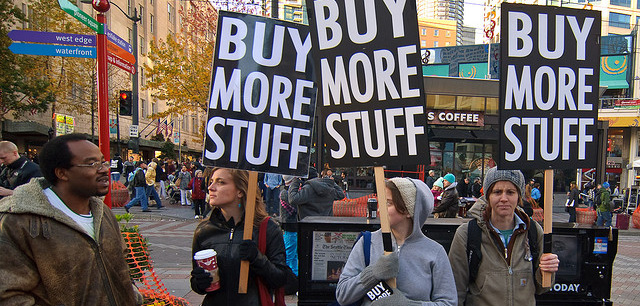
There’s nothing they need, nothing they don’t own already, nothing they even want. So you buy them a solar-powered waving queen; a belly button brush; a silver-plated ice cream tub holder; a “hilarious” inflatable zimmer frame; a confection of plastic and electronics called Terry the Swearing Turtle; or – and somehow I find this significant – a Scratch Off World wall map.

They seem amusing on the first day of Christmas, daft on the second, embarrassing on the third. By the twelfth they’re in landfill. For thirty seconds of dubious entertainment, or a hedonic stimulus that lasts no longer than a nicotine hit, we commission the use of materials whose impacts will ramify for generations.

Researching her film The Story of Stuff, Annie Leonard discovered that of the materials flowing through the consumer economy, only 1% remain in use six months after sale(1). Even the goods we might have expected to hold onto are soon condemned to destruction through either planned obsolescence (breaking quickly) or perceived obsolesence (becoming unfashionable).

But many of the products we buy, especially for Christmas, cannot become obsolescent. The term implies a loss of utility, but they had no utility in the first place. An electronic drum-machine t-shirt; a Darth Vader talking piggy bank; an ear-shaped i-phone case; an individual beer can chiller; an electronic wine breather; a sonic screwdriver remote control; bacon toothpaste; a dancing dog: no one is expected to use them, or even look at them, after Christmas Day. They are designed to elicit thanks, perhaps a snigger or two, and then be thrown away.

The fatuity of the products is matched by the profundity of the impacts. Rare materials, complex electronics, the energy needed for manufacture and transport are extracted and refined and combined into compounds of utter pointlessness. When you take account of the fossil fuels whose use we commission in other countries, manufacturing and consumption are responsible for more than half of our carbon dioxide production(2). We are screwing the planet to make solar-powered bath thermometers and desktop crazy golfers.

People in eastern Congo are massacred to facilitate smart phone upgrades of ever diminishing marginal utility(3). Forests are felled to make “personalised heart-shaped wooden cheese board sets”. Rivers are poisoned to manufacture talking fish. This is pathological consumption: a world-consuming epidemic of collective madness, rendered so normal by advertising and the media that we scarcely notice what has happened to us.

In 2007, the journalist Adam Welz records, 13 rhinos were killed by poachers in South Africa. This year, so far, 585 have been shot(4). No one is entirely sure why. But one answer is that very rich people in Vietnam are now sprinkling ground rhino horn on their food or snorting it like cocaine to display their wealth. It’s grotesque, but it scarcely differs from what almost everyone in industrialised nations is doing: trashing the living world through pointless consumption.

This boom has not happened by accident. Our lives have been corralled and shaped in order to encourage it. World trade rules force countries to participate in the festival of junk. Governments cut taxes, deregulate business, manipulate interest rates to stimulate spending. But seldom do the engineers of these policies stop and ask “spending on what?”. When every conceivable want and need has been met (among those who have disposable money), growth depends on selling the utterly useless. The solemnity of the state, its might and majesty, are harnessed to the task of delivering Terry the Swearing Turtle to our doors.

Grown men and women devote their lives to manufacturing and marketing this rubbish, and dissing the idea of living without it. “I always knit my gifts”, says a woman in a television ad for an electronics outlet. “Well you shouldn’t,” replies the narrator(5). An advertisement for Google’s latest tablet shows a father and son camping in the woods. Their enjoyment depends on the Nexus 7’s special features(6). The best things in life are free, but we’ve found a way of selling them to you.

The growth of inequality that has accompanied the consumer boom ensures that the rising economic tide no longer lifts all boats. In the US in 2010 a remarkable 93% of the growth in incomes accrued to the top 1% of the population(7). The old excuse, that we must trash the planet to help the poor, simply does not wash. For a few decades of extra enrichment for those who already possess more money than they know how to spend, the prospects of everyone else who will live on this earth are diminished.

So effectively have governments, the media and advertisers associated consumption with prosperity and happiness that to say these things is to expose yourself to opprobrium and ridicule. Witness last week’s Moral Maze programme, in which most of the panel lined up to decry the idea of consuming less, and to associate it, somehow, with authoritarianism(8). When the world goes mad, those who resist are denounced as lunatics.

Bake them a cake, write them a poem, give them a kiss, tell them a joke, but for god’s sake stop trashing the planet to tell someone you care. All it shows is that you don’t.

3. See the film Blood in the Mobile. http://bloodinthemobile.org/
7. Emmanuel Saez, 2nd March 2012. Striking it Richer: the Evolution of Top Incomes in the United States (Updated with 2009 and 2010 estimates). http://elsa.berkeley.edu/~saez/saez-UStopincomes-2010.pdf
8. http://www.bbc.co.uk/programmes/b01p424r

Tuesday, June 23, 2015

1895. The Lies of Happiness: Living With Affluenza But Without Fulfillment

By Clive Hamilton, The Conversation, June 22, 2015


In a short story, Grief, Anton Chekhov tells of a wood-turner named Grigory Petrov, a drunkard and bully who for 40 years regularly beat his wife. One night he arrives home drunk and brandishing his fists. This time, instead of shrinking from him, his wife gazes at him sternly, “as saints do from their icons”, wrote Chekhov.

It was her first and last act of defiance.

Now driving a sled through a blizzard, Petrov is taking his dying wife to the doctor. He curses and whips the horse. He is seized by grief for a life wasted, and wonders how he will live without this woman who has sustained him for so long.

I may have been a drunkard and ne’er-do-well, he mutters to himself, but that was never the true man, and now my wife is dying on me, she will never know my better nature. I beat her, it’s true, but never out of spite. Am I not rushing her to the doctor because I feel sorry for her?

In Chekhov’s story, Petrov engages in grotesque rationalisations. His dignity will not allow him to face the truth of the sort of man he is. He engages in a litany of self-deceptions, even though the truth threatens to overwhelm him.

The myriad ways humans lie to themselves is a recurring theme of literature. Because we all engage in self-deception, we recognise ourselves in the characters. We are forever composing stories about ourselves and our world so as to smooth a path through life.

Benign fictions and the loss of freedom
The psychologist Shelley Taylor calls them “benign fictions”: the lies we deploy to defend our happiness. For a long time I have believed that if we deceive ourselves about our strengths and weaknesses, creating a veil that distorts our vision of the world so as to render it more agreeable, we may actually be sacrificing the opportunity to find a more authentic self from which to live.

But is that chasing a phantom? Does it really matter if we find contentment by deploying benign fictions?

The philosophers have always told us that happiness should be discounted if it floats on a mirage of lies. But maybe the thinkers are deceiving themselves, rationalising away their melancholy and inflating the value of their solemnity.

Perhaps. Yet there is another reason to question happiness built on self-deception. It opens us up to manipulation.

When we are not truthful with ourselves, we are driven by forces of which we are unconscious, but our real motives and desires can be discerned by others – advertisers, for instance. They can smell weaknesses to be exploited.

So, I am willing to argue, those whose happiness rests on fabrications risk surrendering their freedom. Happiness at the price of freedom is not worth it, unless the limits to one’s freedom are freely chosen after careful reflection.

But is the truth always to be preferred?

The Trade Practices Act outlaws deceptive and misleading conduct by companies making claims about their products. But what if we want to believe the lies? The essence of branding is that by identifying ourselves deeply with a brand – an Apple computer, Diesel clothing, a Volvo car – we take on the image associated with it.

We accept these commercially provided identities because our societies no longer offer other means of creating a sense of self that satisfies. And we are bored.
Increasingly, our attention is seen as a scarce commodity. As always, anything that is scarce has a value, and some are willing to pay for it.

There is even a new branch of economics called attention economics. When others thrust information upon us it can be regarded as a form of pollution. We sometimes try to stop this pollution harming us with devices like spam blockers, television mute buttons, “Do not call” registers and “No junk mail” stickers.

However, I think many of us watch television and listen to iPods to avoid paying attention to aspects of our lives that are uncomfortable. And we want our attention to be captured because we have developed a strong aversion to boredom.

It seems to me that the flight from boredom means our society as a whole is suffering from a form of Attention Deficit Hyperactivity Disorder. Movies and television programs have shorter scenes and more action to keep us “glued to the set”. Yet in order to transcend boredom it is necessary to get beneath the superficial self that is entertained by television and a thousand other distractions.

Is a more authentic life possible?
It is one thing to recognise that money and the consumer life are in some way shallow; it is quite another to find out what a more “authentic” life would be. Sometimes I doubt whether there can be such a thing in our secular societies. Are we destined to live out selves wholly given to us by the social conditions in which we find ourselves?
Still, there must be some identity more authentic than those constructed for us by the clever manipulators who make brands and produce popular culture. At a minimum, we must fight hard against those influences, for if we do not we will end up as mere cyphers.

Creating the illusion of independence is the most potent tool of the contemporary advertisers’ trade, but the irony is generally lost because most people are too busy congratulating themselves on “being their own person”. The essential ideology of modern consumerism is that we can all live freely and independently.

This is an idea that emerged from the marriage of modern consumerism and the ideology of the liberation movements of the 1960s and 1970s. We now hear it expressed in inane phrases such as “be true to yourself” and “you are responsible for your own happiness”. So instead of pledging allegiance to God, nowadays a Girl Guide promises to be “true to myself”, a vapid pledge that nevertheless resonates with the inherent nihilism of individualised societies.

In Australia over the past 13 or 14 years we have engaged in a national conversation about happiness and how to get it. This was in large part stimulated by the work of my former colleagues and I at the Australia Institute, building on the work of Richard Eckersley.

From the early 2000s we asked whether national wellbeing was rising along with rates of  economic growth. We found that the answer was “no”. We built the Genuine Progress Indicator as a substitute for GDP.

We showed how advertisers were persuading us to go into debt and how they were increasingly targeting children. We pointed to an epidemic of overwork and estimated that one-third of Sydney fathers spend more time in their cars commuting than at home playing with their children. We measured the value of stuff that we buy and then throw out unused (billions of dollars worth).

We discovered a deep vein of discontent with oppressive levels of debt, marriages under stress, overwork leading to illness and depression, children being neglected and a pervasive anomie. And then we uncovered the reaction against it all by describing the remarkably large numbers who had decided to downshift – that is, to voluntarily reduce their incomes and consumption in order to take back some control over their lives.

We discovered a deep vein of discontent, with oppressive levels of debt, marriages under stress, overwork leading to illness and depression, children being neglected and a pervasive anomie. And then we uncovered the reaction against it all by describing the remarkably large numbers who had decided to downshift – that is, to voluntarily reduce their incomes and consumption in order to take back some control over their lives.
For a time we had some success, but then something happened. The 2008 global financial crisis brought to a sudden end the zeitgeist and the happiness debate that was part of it. The crash was the direct result of excessive consumption, unsustainable debt and the industries that made them possible; in other words, everything we had criticised.

I always saw the happiness debate we triggered as no more than a prelude to the real task of opening people to an examination of some deeper sense of meaning in their lives, and to precipitate reflection on the moral basis and behavioural structure of our society.

Yet here we are, in the embryonic stages of the next consumer boom, with no collective lessons learned from the last one.

Clive Hamilton is Professor of Public Ethics, Centre For Applied Philosophy & Public Ethics (CAPPE) at Charles Sturt University.