Showing posts with label Capitalism and science. Show all posts

Sunday, January 23, 2022

3563. U.S. Science No Longer Leads the World

By Jeffrey Mervis, Science, January 21, 2022


A new data-rich report by the National Science Foundation (NSF) confirms China has overtaken the United States as the world’s leader in several key scientific metrics, including the overall number of papers published and patents awarded. U.S. scientists also have serious competition from foreign researchers in certain fields, it finds.

That loss of hegemony raises an important question for U.S. policymakers and the country’s research community, according to NSF’s oversight body, the National Science Board (NSB). “Since across-the-board leadership in [science and engineering] is no longer a possibility, what then should our goals be?” NSB asks in a policy brief that accompanies this year’s Science and Engineering Indicators, NSF’s biennial assessment of global research, which was released this week. (NSF has converted a single gargantuan volume into nine thematic reports, summarized in The State of U.S. Science and Engineering 2022.)

NSB’s white paper hints at an answer by highlighting several factors it considers essential for maintaining a healthy U.S. research environment. The nation, it says, must sustain excellence in basic research; foster a scientific workforce more diverse in race, gender, and geography; and support high-quality precollege science and math education. The board also calls for forging closer ties between academia and industry, keeping borders open to promote international partnerships, and promoting ethical research practices.

Achieving those goals won’t be easy, says Julia Phillips, an applied physicist who chairs the NSB committee that oversees Indicators. Now retired after a long career at AT&T Bell Laboratories and the Department of Energy’s Sandia National Laboratories, Phillips spoke with ScienceInsider about obstacles posed by an uncertain budget climate and a roiling debate over how to protect research from foreign influence.

No “appetite” for more spending

“It would be the height of hubris to think that [the United States] would lead in everything,” says Phillips, who is also home secretary of the U.S. National Academy of Engineering. “So, I think the most important thing is for the United States to decide where it cannot be No. 2.”

At the top of her priorities is sustaining the federal government’s financial support of fundamental science. “If we lead in basic research, then we’re still in a really good position,” she says. But the government’s “record over the last decades does not give me a lot of cause for hope.” For example, Phillips says she is not optimistic that Congress will approve pending legislation that envisions a much larger NSF over the next 5 years, or a 2022 appropriations bill that would give NSF a lot more money right away.

“How much is the U.S. willing to spend on [basic research]?” she asks. “It’s now a really small fraction of the GDP [gross domestic product]. Increasing that could be on the table. And I appreciate that Congress has consistently been more generous than [what presidents have requested]. But I see no evidence that there’s an appetite for raising that share significantly, which is what it would take.”

Falling behind

The United States trailed China in contributing to the growth in global research spending over the past 2 decades.

China 29%UnitedStates 23%South Korea& Japan 9%Other Asia 7%Other 14%EuropeanUnion 17%Contributionto globalR&D growth
K. FRANKLIN/SCIENCE

Distrust on research security

Phillips thinks a lack of trust between academic leaders and the U.S. intelligence community is aggravating tensions over the potential threat posed by foreign students and scientists who study and work at U.S. universities.

Members of Congress and federal security agencies have accused China of building up its research capacity by enticing U.S.-based scientists to share their discoveries. Some have blamed U.S. university administrators for lax enforcement of rules that require researchers to disclose foreign funding and are calling for tighter oversight. Universities have pushed back, saying law enforcement officials often withhold information about potential threats on their campuses and that the government’s 3-year-old China Initiative has engaged in unfair racial profiling of researchers of Chinese descent.

Talent from abroad

A majority of computer scientists and engineers with Ph.D.s working in the United States were born overseas.

Social andbehavioral sciences20.6Physical and earthsciences42.4Life and agriculturalsciences50Engineering57.1Computer sciencesand math60.3015304560Ph.D. scientists born overseas (%)
K. FRANKLIN/SCIENCE

The friction hasn’t been helpful, Phillips says. “Some of the people that I’ve heard making those [assertions] do not fully appreciate the seriousness of the [security] issue,” she says. “I knew the director of counterintelligence at Sandia very well. And every now and then, he would come visit me and say, ‘OK, you are hiring this postdoc. And I need to tell you, there are certain things about their pedigree that gives us some concerns. And here’s what they are, here’s why.’ And because I had a [security] clearance, he could tell me that.”

“But in order for them to tell you that, there has to be a certain level of trust,” she adds. “And some of the people who are especially alarmed and making those comments [criticizing the China Initiative] have not gained the trust of individuals in the intelligence community.”

The “appalling” state of science education

The latest Indicators highlights serious—and persistent—inequities in elementary and secondary school education, such as poor students of color scoring lower than white and Asian students on standardized tests and being more likely to have inexperienced science and math teachers. Those disparities emphasize the need for NSF to continue supporting efforts to improve science teaching, Phillips says. But she concedes the federal government has limited ability to shape precollege schooling.

“The levers [of decision-making] are mainly at the local and state levels,” she says. “However, NSF has funded a lot of research on what works in the [kindergarten] through grade 12 curriculum, so there is potential for some impact.”

She adds, “This is an area in which the [National Science] Board is speaking more in its role as an adviser … and calling attention to this problem. And, in my opinion, if we do nothing more than get national attention on what I think is just an appalling situation, we will have done our job.”

A gap in math

Asian and white eighth-grade students far outperform Black and Latino students in math, and poverty widens the disparity.

294275264254323299280273Students eligible forfree or reduced lunchesBasic level scoresProficientlevel scoresStudentsnot eligibleAverage NAEP* scores* National Assessment of Educational ProgressAsianWhiteHispanic or LatinoBlack
K. FRANKLIN/SCIENCE

Spreading the wealth

NSF has spent decades tinkering with a grantmaking process that now results in most of its dollars going to a relative handful of institutions along the nation’s East and West coasts. For example, its 40-year-old Established Program to Stimulate Competitive Research tries to build research capacity at institutions elsewhere and now serves half the states. This year, NSF has asked Congress to fund a network of geographically distributed innovation hubs to boost the research infrastructure available to scientists in have-not states, and the Senate has approved a bill that would funnel 20% of NSF’s overall research budget to institutions in those states.

But even as NSF seeks ways to create a larger pool of grantees, Phillips says, the agency has wrestled with how to measure the effectiveness of such efforts. “If you’re going to pour money at a problem, you also want to know if it’s having an impact,” she says.

“One possibility is to see how patenting activity has changed in different parts of the country,” she continues. “And how much of that can you trace back to an innovation hub? [Another metric could be] how the number of [science and engineering] jobs has increased in a particular region, or the flow of talent between academia and the private sector. You see that flow all the time in Silicon Valley and in the Route 128 area [surrounding Boston]. But you don’t necessarily see it happening in other areas of the country.”

image.png


Friday, March 30, 2018

2861. Ecological Destruction in the Name of Science

By Michelle Munjanattu, Left Voice, March 23, 2018

“They dazzle me with the tonnage of cotton or cocoa that has been exported, the acreage that has been planted with olive trees or grapevines.“I am talking about natural economies that have been disrupted — harmonious and viable economies adapted to the indigenous population — about food crops destroyed, malnutrition permanently introduced, agricultural development oriented solely toward the benefit of the metropolitan countries; about the looting of products, the looting of raw materials.”
From Discourse on Colonialism, Aime Cesaire
In his Discourse on Colonialism, Aime Cesaire describes how colonialism facilitated the whole-scale destruction of entire societies whose peoples and cultures offered insights into how we may live peacefully alongside nature and create a new world. He revealed how colonialism’s fixation with what is produced, without regard to the process of production, obscured the poverty, malnutrition, displacement, and environmental destruction necessitated by an increase in the export of raw materials.
Colonial endeavors far and wide were justified by their description as an effort to civilize barbaric natives, with the ultimate goal of replacing native models of agriculture, industry, and cuisine, among others, with preferred Western models, to facilitate the growth of markets for Western goods. To encourage this shift, traditional knowledge was cast as imprecise, deficient, and unreliable. These perceived gaps in indigenous knowledge could be solved by the adoption of scientific and western methods.
The effect of this deification of scientific knowledge means that alternative models based in tradition and indigenous knowledge are not viewed as complementary practices, but as competition for existing scientific models. It behooves us to view science as one of several methods of discerning realities about nature and our relationship to each other. An uncritical adoption of scientific knowledge obscures how colonial and profit motives often impact the integrity of such discoveries, as demonstrated below. And when the primacy of scientific and western models results in the removal of communities’ control over their own land and food, it deprives them of self-determination and cultural vibrancy.

The Origins of Scientific Forestry

James Scott’s Seeing Like a State opens with a fascinating case study of the origins of scientific forestry in the 18th century, relevant today because it became the basis of forest management techniques in Europe, the United States, and throughout the global South. Scott describes the early European state’s view of forests primarily as a source of revenue generation from timber. Using such a narrow lens, the state obscured other considerations in forest management: the trees, bushes, and plants that couldn’t be sold commercially as fodder, fruit, branches, roots, and more. The aim of the forest scientists was to “deliver the greatest possible constant volume of wood.”
To this end, scientists carefully counted and measured sample plots of trees, coming up with precise calculations of tree size and age under normal growth conditions. Scott reveals that state power utilized forest science and geometry to transform the living, diverse, old-growth woodlands into a new, more uniform forest. In pursuit of the ideal forest formed by scientific principles, underbrush was cleared, the number of species was reduced, and plantings were done in straight rows on large tracts. The archetypal German forest was seen as a victory of scientific control and management, and German forest science became the standard at the end of the 19th century.
However, within a century of adoption of this new forest model, the negative biological and commercial consequences of this anesthetized woodland became clear. The second generation of conifers were retrograde in quality, creating a considerable loss in timber available for sale. In examining the causes of this forest regression, it became clear that the first generation of trees had thrived off the incredibly nutrient-rich soil of the previous old-growth forest that it replaced. Once this soil was depleted, it resulted in a steep decline in growth rates. In the pursuit of an organized, manageable, and aesthetically pleasing forest, this German experiment disrupted a complex process of soil building, nutrient uptake, and an interdependent ecosystem of fungi, insects, mammals and flora.

Can Pine Trees Survive in Palestine?

Connected to this European forest legacy is the prevalence of pine trees in historic Palestine. In November 2016, 60,000 people had to evacuate their homes in the city of Haifa as forest fires threatened the city’s outskirts. A dozen smaller fires raged in forests throughout the country for over a week before Israeli firefighters were finally able to control them. Unsurprisingly, the Israeli government was quick to blame Palestinians, but a critical cause of these fires was the prevalence of pine trees in Israel’s forests, which are highly flammable, especially in Palestine’s very dry climate.
The reason behind the existence of pine trees in Palestine is part and parcel of Israel’s settler-colonialist project. As is well-documented, around 800,000 Palestinians were ethnically cleansed from their homeland by Zionist paramilitary groups, and a majority of them before the official declaration of Israel’s independence (the Nakba) on May 15, 1948. Israel’s plan to ensure these Palestinian refugees could not return necessitated erasure of the violent process of ethnic cleansing that had birthed the state. So Israel undertook the minimizing of Palestinians’ historic presence, thereby demolishing the ruins of evicted and destroyed Palestinian villages in the 1950s.
Part of this sinister project utilized the forces of the Jewish National Fund, which from the beginning of the 20th century had been collecting money to plant and maintain forests in Palestine. Pine trees were chosen to provide a visual representation of Israeli exceptionalism and have the land appear as an extension of Europe.
Eager as the Israeli state was to erase Palestinians’ claims to the land, their haste to establish this through the construction of pine forests reveals the short-sightedness of the settler-colonial project. Palestinians, like other indigenous communities, know that their survival is intimately tied to the land and its fruits. Instead of approaching the terrain through the lens of control and subservience, there is an ethos of stewardship and an intimate knowledge of the land and seasons. In Palestine’s desert climate, its inhabitants sought to make the best use of rainfall to the region, whether through terracing of olive groves to protect against soil erosion and retain water, or through use of traditional methods to preserve soil moisture ahead of the summer growing season.
The Israeli project in Palestine has been absolutely devastating to its indigenous inhabitants, who are additionally impacted by the demise of Palestine’s indigenous flora and fauna. As the pine tree example demonstrates, there is a clear desire to depict Israel’s ability to transform the existing desert landscape as a victory of science and European standards. This manifests itself in nearly every sector of Israeli society. Specifically in terms of agriculture, the Israeli mythology about making the desert bloom obscures the fact that the state monopolizes the use of water resources (including in its own settlements) to create an export market for its agricultural products in Europe. This market for Israeli produce is artificially sustained by depriving Palestinians of water resources.
And what are the impacts of this artificially-sustained and resource-intensive Israeli agriculture? By creating a situation in which traditional Palestinian methods of sustainable agriculture cannot be followed, Israel continues to decimate ecological resources, from the soil to the water aquifers below ground. By enforcing “modern” methods of agriculture, there are few incentives for Palestinians to learn and preserve traditional agriculture, creating a dependency on chemical companies which supply seeds and fertilizers.
As the Palestinian agronomist Saad Dagher observes, an effect of Israeli agriculture in Palestine has been a decrease in the number of farmers and a concurrent loss of indigenous farming practices. Palestinians are struggling to meet their own food needs, and agricultural biodiversity has significantly decreased — Dagher states that more than 98 to 99 percent of Palestine’s figs and almonds have disappeared.

Preserving Indigenous Knowledge and Creating Possibilities for our Shared Survival

For those seeking answers to the question of how it is possible to materialize a post-capitalist, liberated society, part of this inquiry requires a willingness to scrutinize what is considered to be scientific “truth.” Another part of this inquiry will require respecting indigenous knowledge and practices, specifically those that highlight how people live in harmony with the land, and not in control over it.
There is a tendency for scientific and modern practices to be marketed as the only “valid” form of knowledge. When these practices are used to support colonial and capitalistic ventures, the intention is to depict native practices as deficient, thereby setting the stage for wholesale adoption of the “ideal” methods.
The error in forgetting or neglecting indigenous knowledge is that we will interpret our futures as completely delimited by capitalism’s demands. The reality is, capitalism and settler-colonialism cause a false crises of resources, rendering very few people (and flora and fauna) capable of survival. Indigenous approaches to agriculture are rooted in people living in harmony with the land and what it can offer, and exemplify more equitable and loving treatment of the earth and its inhabitants.

Resources and Further Reading

Lambert, Léopold. “Make the Desert Bloom”: Manufacturing the Israeli Territory Narrative.” April 7, 2015. https://thefunambulist.net/architectural-projects/palestine-make-the-desert-bloom-manufacturing-the-israeli-territorynarrative
Oberender, Svenja. “Traditional Farming in Palestine.” May 12, 2015.https://ps.boell.org/en/2015/05/12/traditional-farming-palestine
Scott, James C. Seeing Like a State. New Haven: Yale University Press, 1999.

Saturday, July 29, 2017

2672. American Scientists in Competition with the Chinese Edit Human Embryo

By Kelly Servick, Science Magazine, July 27, 2017
A U.S. research team has reportedly edited the DNA of a human embryo just as a sperm fertilizes an egg, well before its eight-cell stage.
Since Chinese researchers announced the first gene editing of a human embryo 2 years ago, many expected that similar work in the United States was inevitable. Last night, the MIT Technology Review broke the news that such experiments have happened. The research, led by embryologist Shoukhrat Mitalipov of Oregon Health and Science University in Portland, also reportedly sidestepped problems of incomplete and off-target editing that plagued previous attempts, though details could not be confirmed since the work is not yet published and Mitalipov has so far declined to comment.
If a peer-reviewed paper bears out the news story, “It’s one more step on the path to potential clinical application,” says bioethicist Jeffrey Kahn of Johns Hopkins University in Baltimore, Maryland, who served on a committee convened by the U.S. National Academy of Sciences (NAS) and the National Academy of Medicine in Washington, D.C., to address gene editing. The panel’s report earlier this year concluded that a clinical trial involving embryo editing would be ethically allowable under narrow circumstances.
The first published human embryo–editing work, in 2015, used nonviable embryos and targeted a gene mutated in the heritable blood disorder beta thalassemia. But it revealed major shortcomings in applying the increasingly popular CRISPR gene-editing technology. The few embryos that took up the change made by CRISPR were a patchwork of edited and unchanged cells, and they bore unintended edits outside the targeted gene.
Another Chinese team, from Guangzhou Medical University, in March became the first to report repairing disease-causing mutations in viable embryos, but some still contained a patchy mix of edited cells—a phenomenon called mosaicism. In none of the Chinese efforts did the researchers go on to implant the manipulated embryos in women.
Sources familiar with the new work from Mitalipov’s group told the MIT Technology Review that they had produced tens of successfully edited embryos, and had avoided the issue of mosaicism by injecting eggs with CRISPR right as they were fertilized with donor sperm. The Guangzhou team injected its CRISPR system into single-celled human embryos—it’s not yet clear how much their timing differed from Mitalipov’s. (The new research presumably relied on nonfederal government funding, since Congress prohibits the use of taxpayer funds on research that destroys human embryos.)
Concerns about mosaicism and off-target effects after the published work by the Chinese teams led some to conclude that CRISPR wasn’t safe as a strategy for preventing a disease in a baby, much less adding some “enhancement.” But even with the apparent advance by the Oregon team, a U.S. clinical trial probably isn’t imminent. “It’s noteworthy that … they’ve been able to make some of these claims,” offers Michael Werner, executive director of the Alliance for Regenerative Medicine in Washington, D.C., who argued in a 2015 Nature commentary that ethical and safety issues should put germline editing research off limits. “It’s still a little premature to say that we’ve resolved all these safety issues now.”
The NAS report notes that many inherited diseases can be prevented by selecting healthy embryos for in vitro fertilization, and that embryo editing might only be justified if it presents the only option for a couple to have a healthy biological child. Congress has meanwhile prohibited the U.S. Food and Drug Administration from reviewing applications for clinical trials involving embryo editing. 

Monday, February 20, 2017

2565. 'Science for the people': Researchers Challenge Trump Outside US Conference

By Hannah Delvin and Alan Yuhas, The Guardian, February 19, 2017
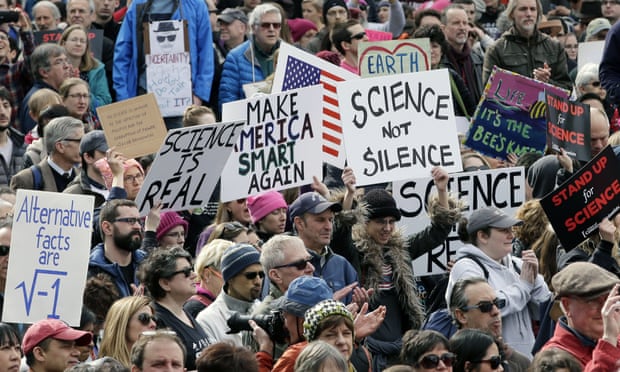
Members of the scientific community, environmental advocates, and supporters demonstrate on Sunday in Boston. Photograph: Steven Senne/AP

Hundreds of scientists rallied in Boston on Sunday to protest what they call the “direct attack” of Donald Trump and Republicans on research, scientific institutions and facts themselves, as a community reckons, and argues, with a new era of American politics.

Gathering in Boston’s Copley Square, outside the annual meeting of the American Association for the Advancement of Science (AAAS), several scientists gave speeches to a crowd holding signs shaped like beakers and reading “Stand up for science”. The speeches reflected a sea change in the culture of many labs and universities, where many researchers long maintained that good scientific work could speak for itself.

At the AAAS conference, scientists this week have discussed political activism, the psychology of “fake news” , and how to protect climate science from hostile governments. But a rift has opened up in the community between those in favor and those opposed to rallies focused on science, including a March for Science planned across multiple cities in April.

Professor Jim Gates, the eminent string theorist and former adviser to Barack Obama, told journalists that the march appeared to lack an end goal – a prerequisite for political action – and would simply be perceived as “science against Trump”.

“At least as far as I can detect, there is no theory of action behind this,” he said. “This bothers me tremendously.

“I don’t understand how the organisers of this march can guard against provocateurs, quite frankly,” he added. “I don’t think they’re ready for that, I don’t think they’re considering that kind of danger. To have science represented as this political force I think is just extraordinarily dangerous.”

Others urged the protesters on, including Rush Holt, the CEO of AAAS, said that his organization would work with other US societies to “make the march a success”.

“It’s the first time in my 50-year career that I have seen people speaking up for science at large,” he said. “I’ve seen for or against nuclear power or whatever. This is an unusual phenomenon.”

Astrid Caldas, a climate scientist and member of the Union of Concerned Scientists, said that the rally showed that “scientists who are usually happy in the corner of their labs are speaking”.

“I think that scientists are realizing that they have to use their voice, as scientists, in self-defense.”

Dr Jacquelyn Gill, an ecologist at the University of Maine, was one of the speakers Sunday, and is tentatively considering whether to run for Congress in 2018.

“A lot of scientists are realizing that the institutions that fund and support and science in this country – science for everyone, publicly funded and transparent – those institutions are under direct attack,” she told the Guardian.

Trump, she said, “not only doesn’t value our institutions, he doesn’t seem to value evidence-based decision making at all. That is alarming to us.”

The president’s views about science – he has variously called global warming a “hoax” and pledged to “unlock the mysteries of space” – is not the only concern on the scientists’ minds. “I’m concerned that we’re going to lose the EPA. I’m concerned that we’re going to lose regulations that have a direct impact on human health, like automobile emissions,” Gill said. “People will get sicker. People will die because of a lack of environmental regulation and medical research.”

 Activists in Boston call attention to what they say are the increasing threats to science and scientific research under the administration of Donald Trump.

Beka Economopoulos, one of the rally’s organizers and a co-founder of the Natural History Museum, a mobile exhibition, said that scientists could no longer truly avoid politics. “That ship has sailed,” she said, noting that researchers have a long history protesting, for instance against nuclear proliferation in the 1970s.

“It’s not just about scientists, it’s about science,” she said. “Communities are going to bear the brunt of the impacts of these attacks on science in the public interest.”

Gill also stressed that the nascent movement wanted to stress “science for the people, by the people and for the people”.

Arguments about “trimming the fat” of budgets, she said, did not stand up to scrutiny, considering that the government’s science and medical research funding makes up a tiny percentage of the federal budget.

“That money has got one of the best returns on investment you could possibly hope for,” she said. “The real stakeholders are the citizens that stand to gain or lose the most if the institutions are weakened.”

Another organizer, Emily Southard, said that the rally and the march in Washington, were meant to help “demystify what scientists do”.

She defended “science that delivers clean, safe drinking water to our faucets, science that’s being taken for granted – and that’s the science that’s being taken under attack.”

Economopoulos used the Environmental Protection Agency as an example, criticizing its newly confirmed head, who repeatedly sued the agency in favor of corporations as Oklahoma attorney general . “We have a sort of fox in the henhouse situation here with Scott Pruitt as head of the EPA, an agency that he has sued 14 times,” she said.

Gill also said that researchers needed to do more to take control of their image, noting the ways scientists had been politicized by lawmakers in debates over climate science. “Throwing more information or more data doesn’t really change minds, whether it’s climate change or vaccines,” she said. “Empathy trumps fact when it comes to people’s minds.”

Such disputes were nothing new, she said: “Science and religion clashes go back to Darwin and Galileo and Copernicus.”

Caldas said that she hoped scientists would continue organize at local levels. “The federal government may not be on board, but local government works hardest with people who see these problems at their doorsteps, and they cannot deny it.”

Members of Congress facing re-election, she said, were already starting to feel pressure from constituents about climate change. “The stakes are really high but there is a light at the end of the tunnel.”