Showing posts with label California. Show all posts

Tuesday, September 15, 2020

3426. California's Apocalyptic Second Nature

By Mike Davis, Portside, September 14, 2020

En route to Vegas and 20 minutes away from the state line, there is an exit from I-15 to a two-lane blacktop called Cima Road. It’s the unassuming portal to one of North America’s most magical forests: countless miles of old-growth Joshua trees mantling a field of small Pleistocene volcanoes known as Cima Dome. The monarchs of the forest are 45 feet high and 1,000 years old. In mid-August an estimated 1.3 million of these astonishing giant yuccas perished in the lightning-ignited Dome Fire.  
This is not the first time that the Eastern Mojave Desert has burned, a megafire in 2005 scorched 1 million acres of desert, but it spared the Dome, the heart of the forest. Desert plants, unlike California oaks and chaparral, are not fire-adapted, so their recovery is an open question. The invasion of an alien bunch grass, known as Red Brome, has created a flammable understory to the Joshuas and transformed the Mojave into a fire ecology. (Invasive cheatgrass has played this role in the Great Basin for decades.) More frequent fires will accelerate vegetation change and ultimately threaten the existence of the trees.
Our burning deserts are regional expressions of a global trend. A world set on fire by climate change has unleashed a dangerous transformation of plant ecology, and thus faunal populations, from the Arctic to Patagonia, Montana to Mongolia.  California is a paradigmatic example of such a vicious circle, where extreme heat leads to extreme fires that prevent natural rejuvenation and accelerate the conversion of iconic landscapes into depauperate grasslands and treeless mountain slopes.
At the beginning of this century, water planners and fire authorities were primarily focused on the threat of multi-year droughts caused by intensified La NiƱa episodes and stubbornly persistent high pressure domes—both of which could be attributed to anthropogenic warming.
Their worst fears were realized in the great drought of the last decade, the biggest in perhaps 500 years, which led to the death of millions of oaks and pines, which then provided fuel for the fire-storms in 2018 and 2019.
These recent catastrophes, however, have forced scientists to recognize a new phenomenon, the  “hot drought.” Even in years with average 20th-century rainfall, extreme summer heat—our new normal—is producing massive water loss through evaporation in reservoirs and plant communities. A wet winter and early spring may mesmerize us with extravagant displays of flowering plants, but they also produce bumper crops of grasses and weeds that are then baked in our furnace summers to become fire starter when the devil winds return.
Residential development in high and extreme fire-danger areas, where a majority of new housing in the state has been constructed over the past twenty years, has also promoted the botanical counter-revolution as the thinning of forests and the clearing of chapparal opens new pathways for pyromaniacal black mustards and bromes. Weeds plus dead or drought-stressed trees is the shorthand formula for megafire.
Mediterranean vegetation (California west of the Sierras and south of Klamaths) has co-evolved with fire, and indeed oaks and most chaparral plants require episodic fire to reproduce. But routine extreme fire in Greece, Spain, Australia and California is now over-riding Holocene adaptations and producing irreversible changes in the biota. The only real constraint on future wildfire is available fuel mass. More areas will become like the Malibu Coast where fire burns in the same sector every decade or two as dictated by the 8-12 years required for coastal sage scrub to mature.
In the late 1940s the ruins of Berlin became a laboratory where natural scientists studied plant succession in the wake of three years of incessant fire bombing. The expectation was that the original vegetation of the region—oak woodlands and their shrubs—would soon reestablish itself. To their horror this was not the case. Instead escaped exotics, most of them alien to Germany, established themselves as the new dominants.
The botanists continued their studies until the last bomb sites were cleared in the 1980s. The persistence of this dead-zone vegetation and the failure of the plants of the Pomeranian woodlands to reestablish themselves prompted a debate about “Nature II.” The contention was that the extreme heat of incendiaries and the pulverization of brick structures had created a new soil type that invited colonization by plants such as the “tree of heaven” (Ailanthus) that had evolved on the moraines of Pleistocene ice sheets. An all-out nuclear war, they warned, might reproduce these conditions on a vast scale.
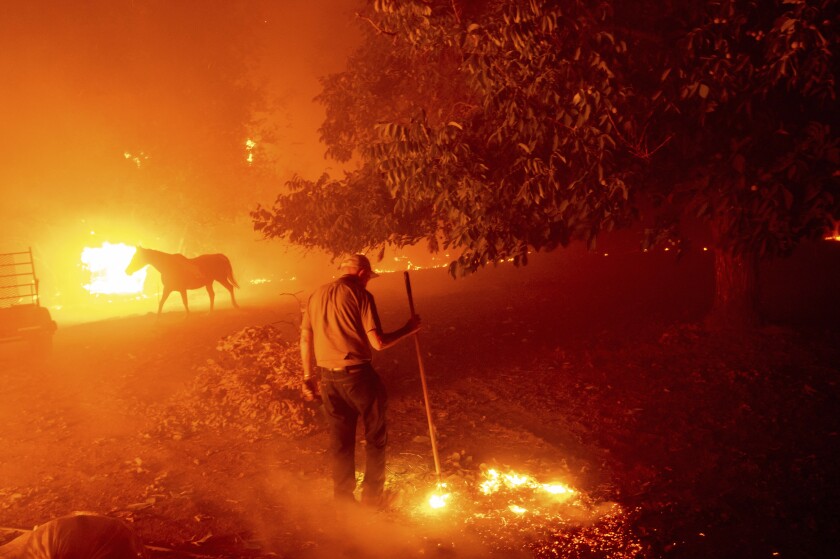
Fire in the Anthropocene has become the physical equivalent of endless nuclear war. In the aftermath of Victoria’s Black Saturday fires in early 2009, Australian scientists calculated that their released energy equaled the explosion of 1,500 Hiroshima-sized bombs. The current firestorms in the Pacific states are many times larger, and we should compare their destructive power to the mega-tonnage of hundreds of hydrogen bombs.
A new, profoundly sinister nature is rapidly emerging from our fire rubble at the expense of landscapes we once considered sacred. Our imaginations can barely encompass the speed or scale of the catastrophe. Gone California, gone.

Tuesday, February 27, 2018

2840. California Court Ruling Ends Decades of State Pesticide Spraying

By Center for Biological Diversity, February 26, 2018
171 million ponds of pesticides was used in crop agriculture in California in 2013. This is a breakdown by type.

A judge has ordered the California Department of Food and Agriculture to stop using chemical pesticides in its statewide program until the agency complies with state environmental laws.

The injunction, issued late last week, is a sweeping victory for 11 public-health, conservation, citizen and food-safety groups and the city of Berkeley. The coalition sued the state after unsuccessfully attempting for years to persuade the agency to shift to a sustainable approach to pest control that protects human health and the environment.

Despite thousands of comment letters urging the department to take a safer approach, officials in 2014 approved a program that gave them broad license to spray 79 pesticides, some known to cause cancer and birth defects, anywhere in the state, including schools, organic farms, public parks and residential yards.

Spraying was allowed indefinitely and required no analysis of the health and environmental impacts of the chemicals at the specific application sites and no public notice or scrutiny of treatment decisions. Many of the pesticides are also highly toxic to bees, butterflies, fish and birds.

This injunction follows a Jan. 8 ruling by Judge Timothy M. Frawley voiding approval of the agency's statewide program for numerous violations of state environmental laws, including relying on "unsupported assumptions and speculation" to conclude that pesticides would not contaminate water bodies. The ruling also cited the state's "woefully deficient" analysis of the cumulative danger of increasing the more than 150 million pounds of pesticides already being used in California each year.

The court process culminating revealed not only far-reaching flaws in the state's analysis of the environmental harm caused by the department's pesticide use but also the agency's decades-long history of evading disclosure of the human health and environmental impacts of its activities by granting itself repeated "emergency" exemptions from environmental laws.

"After more than 30 years of disregard for state environmental laws, the agency's chemical weapons have finally been taken off the table," said Nan Wishner of the California Environmental Health Initiative. "We hope the department will take this opportunity to shift course and apply sound science, partner with the public, and develop a more sustainable, transparent approach."

The court also held that the agency had to give public notice of its activities, which officials had insisted was not required.

"The court rejected the agency's blank check to spray people's yards, exposing children and pets to a range of pesticides that can cause serious long-term problems, including cancer, asthma and IQ loss," said Debbie Friedman, founder of MOMS Advocating Sustainability. "If only the $4.5 million in taxpayer dollars used to develop this outdated program had been spent to develop a modern, sustainable approach that does not rely on toxic chemicals, just imagine what progress we could have made toward a healthier environment for everyone."

"Now California must ensure these pesticides aren't harming our water supplies and imperiled species like salmon," said Jonathan Evans, environmental health legal director at the Center for Biological Diversity. "This ruling affirms that people should have a voice in pesticide use in their neighborhoods."

The state's attorney told the court that the Department of Food and Agriculture had already carried out more than 1,000 pesticide treatments since the program was approved in 2014. Program pesticides include these dangerous chemicals:

• Chlorpyrifos, known to cause brain damage in children and to threaten 97 percent of endangered wildlife;
• Neonicotinoid pesticides that are highly toxic to pollinators like bees and aquatic invertebrates like crustaceans and mollusks;
• The toxic fumigant methyl bromide, which depletes the protective ozone layer;
• The chemical warfare agent chloropicrin, which causes genetic damage.

"The judge has told the state that harmful pesticides simply can't be sprayed indiscriminately, without robust consideration of impacts on people, animals and water," said Bill Allayaud, California director of government affairs for the Environmental Working Group. "The ruling also affirms that Californians have the right to know about pesticides being sprayed around them and the ability to challenge spraying that endangers public health and natural resources."

The suit was brought by the city of Berkeley, the Center for Biological Diversity, Environmental Working Group, California Environmental Health Initiative, MOMS Advocating Sustainability, Center for Food Safety, Pesticide Action Network North America, Center for Environmental Health, Environmental Action Committee of West Marin, Beyond Pesticides, Californians for Pesticide Reform, and Safe Alternatives for Our Forest Environment.

The plaintiffs are represented by Arthur Friedman of Sheppard, Mullin, Richter & Hampton, along with Jason Flanders of ATA Law Group.