By Kamran Nayeri, September 4, 2026
 |
Anthropogenic crisis of the Colorado River
The anthropocentric industrial capitalist civilization has created existential crises: catastrophic global warming and catastrophic climate change, the Sixth Extinction, recurrent pandemics, and the nuclear holocaust.
In this essay, I will show how beavers, as social mammals
that alter the environment to suit their lives, enhance or improve ecosystems.
To support this claim, I will examine the anthropogenic crisis of the Colorado
River. The Colorado River, which is five million years old, has been running
with less and less water over the last few decades. Originating in the Rocky
Mountains of Colorado, the river is an important water source for seven U.S.
states and two Mexican states before it eventually pours into the Gulf of
California in Mexico.
Below are the major interventions in the Colorado River and
how the crisis developed.
·
1922: The Colorado River Agreement is signed,
which sets the amount of water taken from the river for the neighboring states:
Arizona, California, Colorado, Nevada, New Mexico, Utah, and Wyoming. Under a
1944 treaty between the United States and Mexico, the United States pledged
that 1,837 million acre-feet of water from the Colorado River would be Mexico's
share.
·
1930s:
Major dam construction projects, including the Hoover Dam, were completed,
which significantly altered river flow and water distribution.
·
2000s:
Prolonged drought due to global warming and climate change led to a drop in
water levels in Lake Mead and Lake Powell, both created after the river dams
were built. Currently, Lake Mead is at 28.5% capacity, and Lake Powell is at
26.2% capacity.
·
2012:
The U.S. Bureau of Reclamation reported that the Colorado River is running
short of water.
·
2021:
The U.S. government declared water shortages for the first time, prompting
forced water cuts in Arizona and Nevada.
·
2023:
Heavy rainfall is forecast, providing temporary relief, but experts warn that
several more rainy years are needed for the water shortage crisis to fully
recover.
·
2026:
Water scarcity continues, as the ongoing negotiations between states to share
water and protect it in the current dire situation continue. Phoenix, a city of
1.6 million people built in the heart of the Arizona desert, is on a short list
of cities that may be deprived of Colorado River water.
The anthropogenic crisis of the oceans
Of course, the crises caused by anthropocentric industrial
capitalist civilization threaten life on the planet everywhere. Take, for example, the oceans' crisis. Human
activities have now altered 66% of the marine environment. 35.5% of
assessed marine fish stocks are overfished. Eleven million tons of
plastic enter the oceans each year, almost one million tons per
month. Industrial fishing,
greenhouse gas emissions from fossil fuels, industrial agro-runoff carrying
fertilizer, organic matter containing phosphorus and nitrogen, plastics,
transportation, coastal development, mining, and chemical pollution all
interact and cause cumulative population and ecological losses. One particularly
striking historical indicator is the decline of global fisheries: the
proportion of fish stocks considered biologically sustainable has fallen from
90% in 1974 to about 64.5% in 2021.
Compare this behavior of humans, who consider themselves god’s
greatest creation, with the life of beavers in relation to the rest of nature.
Who are the Beavers?
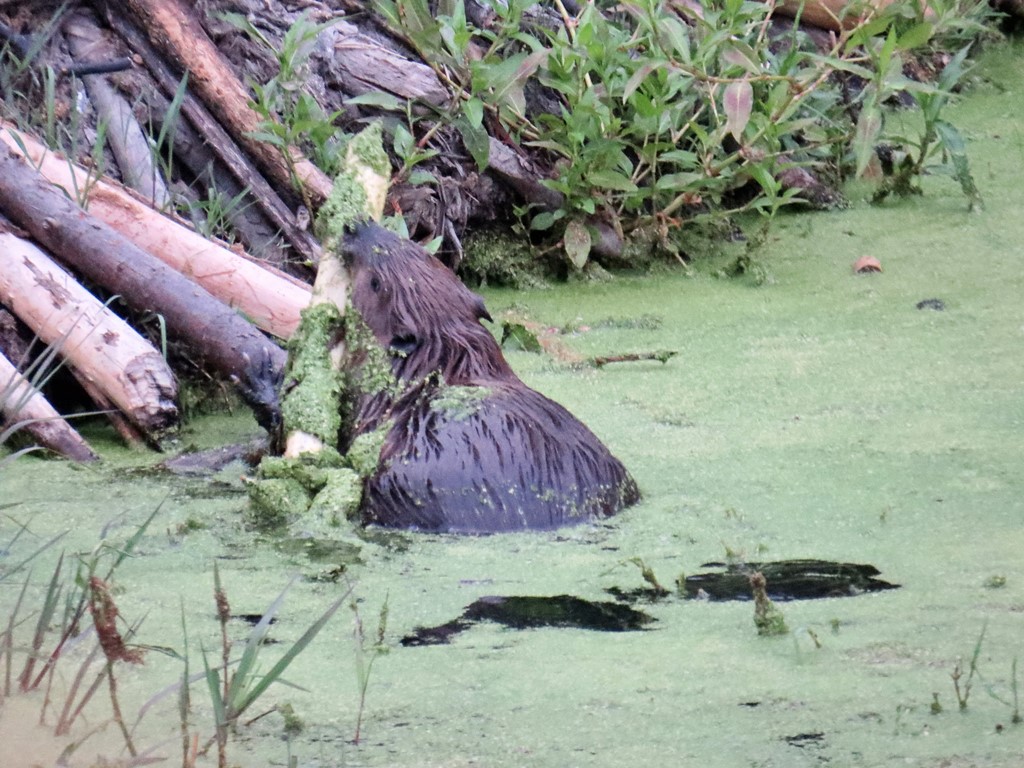
North American beavers have a stout body, a yellow-brown to
almost black coat, and a wide, smooth, scaly tail. They have curtained hind
legs and forefinger paws. The beaver’s stout body allows it to retain heat.
North American beavers are the largest rodents in North
America and the second largest in the world (South American capybaras are the
heaviest). They weigh between 16 and 30 kilograms, and the heaviest beaver on
record weighed 50 kilograms. They are 1 to 1.2 meters long and 0.3 to 0.5
meters high. The shape of the beaver's tail varies, but it is generally about 5
centimeters thick at the base and narrows to about 0.6 centimeters at the tip.
Beavers have long, orange front teeth. These teeth grow
continuously throughout their life and wear down with daily use. These teeth
sharpen on their own and can cut off a part of a tree the size of a person's
finger with a bite. If the front teeth are too long, they can prevent the beaver's
mouth from closing, which can lead to starvation and death. Beavers' front
teeth look dark orange due to the large amount of iron in the enamel, which is
the hard outer layer of teeth. Iron strengthens tooth enamel and helps prevent
teeth from breaking or cracking when a beaver chews.
Beavers move regularly between aquatic and terrestrial
environments. Their small, agile front legs are well adapted for working on
land. They walk on five toes, grasp wood with their front paws, and their claws are suitable for digging. The
hind legs are larger, with fur that is suitable for swimming, and are fur-free
except for the dorsal surface.
The hind legs also have a finger to clean, the second toe on
the inside, with a unique double nail. Beavers are very meticulous groomers.
They use the sorting finger as a comb to prevent their soft, thin fur from knotting
and to maintain its waterproof, insulating properties. These flexible toes also
kill thorns and parasites.
On land, the beaver moves very slowly, making it vulnerable to
predators. But in the water, the beaver swims up to 10 kilometers per hour. Its
large lungs allow it to stay underwater for up to 15 minutes while swimming
more than half a kilometer.
Their whiskers help to distinguish objects around the beaver's
face and head, which are especially useful in narrow passages and dark waters.
The blue dog's eyes have a thin, transparent membrane called the nictitating
membrane, which covers the eyeball
underwater. Beavers' vision is only good at close range. His outer ears are small, round, and have valves
that close when immersed, and the beaver has a developed sense of hearing.
The shape of the tail is an individual and family feature,
ranging from short and wide to long and slender. It is almost hairless and is
covered with black scales. There is a clear border between fur and scales. The tail acts as a rudder in swimming,
supports balance when working on the ground, and warns of danger by frequently
crossing the water's surface when it hits the water. Beavers also store fat in
their tail and eat more fat in the fall so that they can survive on the fat
stored in their tail if food is not available in the winter. The vertebrae on
the back of the beaver extend to the tail and almost to the end.
Beavers are found throughout North America except for the
deserts of California and Nevada, and parts of Utah and Arizona. They live in
nearby ponds, lakes, rivers, swamps, streams, and wetlands.
Beavers are one of the few animals that change their habitat
as needed; they build wooden dams woven with reeds, branches, and saplings,
then cover them with mud. These dams reduce
river erosion by creating ponds where water flows slowly. These ponds support a
wide range of small aquatic organisms and provide water and food for much
larger animals. By building these dams, beavers create new habitats that
support a diverse ecosystem.
Beavers also build dome-shaped huts known as lodges, which are 2
meters or more high and can reach 12 meters in width. A cabin can have one or
more underwater entrances, and Beavers live in a lodge above the waterline. These
lodges are often built off the coast, forming islands. The lodge chamber may be 1.2 meters wide and
0.6 meters high, with walls about one-third of a meter thick that are insulated and ventilated by a small hole
in the ceiling called a "chimney." They usually cover the floor with
wood chips to absorb excess moisture and provide a suitable substrate. Beavers
spend the summer and autumn building dams and collecting and storing food for
the winter.
North American beavers typically live 10 to 12 years. The
oldest recorded beaver has lived to be 30 years.
Beavers communicate with each other by wagging their tails
on the surface of the water.
Beavers scent-mark the boundaries of their enclosures by
spreading castoreum secreted from their anus. This pungent, concentrated liquid
is produced for olfactory marking and leaves a lasting odor. This fat sac is
also secreted to keep the beaver's fur dry. The oil varies slightly between the
sexes and is used in reproductive communication.
Inside the lodge, beavers use a variety of sounds (although
their voice boxes are rudimentary) and body postures to communicate with family
members. At the Smithsonian National Zoo, beavers can be heard barking when they are
upset
Beavers are herbivores that eat leaves, woody stems, and
aquatic plants. Their main building materials are also their favorite foods:
spruce, willow, birch, and maple.
In cold climates, beavers spend the winter in the cabin of
their hut, feeding on the branches they store on the muddy bottom of the pond.
The water acts like a refrigerator, keeping the stems cool and maintaining their
nutritional value. Beavers hold their food with their front paws and eat like
corn on the cob.
Beavers are mainly nocturnal. However, in areas where ponds
freeze during the winter season, beavers may stay in their habitats or under
the ice and feed on their fat reserves.
In the residence and underwater, light radiation remains
constant and low for 24 hours, so sunrise and sunset are not visible. In the
absence of "solar signs," the beaver's activity is not in sync with
the solar day. The circadian rhythm, or regular cycle of the day, is disrupted,
and the beaver's "days" become longer, ranging in length from 26 to
29 hours. At the zoo, the beaver wakes up around 4 p.m.
Social structure
Beavers form strong family bonds. They are social animals,
and each group includes a couple, this year's young, and offspring from the
previous year. There may be one or more new adults who are 2 years old or older
from previous breeding seasons. These new adults usually do not reproduce.
In the winter, these family groups live together in their
hut and share a food pantry. Their family life is very stable and is based on a
hierarchy with one-year-old and newborn children following their parents.
Physical violence is rare, and sounds, gestures, and postures are used inside
the lodge to express their place in the group hierarchy.
It is generally believed that beavers mate for a lifetime. They breed in the winter, from January to late
February, and females give birth in the spring.
The babies are born weighing about half a kilogram; their
eyes open, and their bodies are completely covered in fur. They go into the
water inside their residence within half an hour after birth. Within a week, they
become skilled swimmers.
Babies usually suckle and suckle with their mother for the
first few weeks, and their weight increases
significantly. Females have four nipples and sometimes sit upright to breastfeed
the offspring. Evidence suggests the nipples are divided equally among the
babies, which may explain the high survival rate. All babies are breastfed for
about six weeks, and then the whole family brings them solid food.
On land, mothers often carry the cubs on their broad tails,
sometimes even walking upright and holding them in their paws. In the water,
the cubs may rest on the mother's back. The cubs help maintain the lodge and
raise the next generation.
The role of beavers in the ecosystem
Beavers are one of the most powerful freshwater
ecosystem-shaping agents in North America and Europe. By building dams, digging
canals, and cutting down trees, they turn streams into meandering wetlands that
store water, filter pollutants, protect wildlife, and even prevent wildfire
from spreading.
Before European colonization, an estimated 60 to 400 million
beavers lived in North American waterways (Young, November 2025). Intensive fur
trapping by European American mountain men and settlers in the 19th century
drastically reduced the beaver population in the Colorado River basin, driven
by the high demand for fur in the global fur trade (Young, December 2025).
Hunters in the 1820s and 1830s targeted tributary streams such as the Little
Colorado River and exploited abundant beaver colonies to produce waterproof
fur that fueled hat production in Europe and the eastern United States. This
commercial exploitation, which culminated in the mid-19th century, pushed many
of the Southwest's watersheds to the brink of extinction, as populations could
not recover from incessant harvesting. Habitat changes intensified trapping
pressure, as expanding agriculture, mining, and settlement in the arid
Southwest disrupted marginal ecosystems essential to beaver survival. Land-use
changes, including river canalization, clearing vegetation for agriculture and
resource extraction, habitat fragmentation, and the decline of food sources
such as willow and aspen, exacerbated the effects of over-trapping. This
combined influx caused widespread wetland loss and destroyed river areas,
turning vibrant water systems into dug canals and dry floodplains that lasted
into the 20th century. Without beavers engineering ponds and slowing water flow, soil erosion intensified, biodiversity declined sharply, and the basin's water-holding capacity shrank, leaving a legacy of ecological
simplification.
Today, only 9 to 12
million beavers remain, representing an 80 to 98 percent decline from their
historical populations. This decline has had a chain effect on ecosystems
across the continent.
How beavers shape waterways
Beavers are often called "ecosystem engineers"
because they physically regenerate the environments in which they live. A
family of beavers can dam a stream, flood a canyon, and create a whole new
wetland that didn't exist before. These dams slow water flow, spread it across
the plain, and raise surrounding groundwater levels. At the source of the
streams to which the beavers have been transported, about 243 cubic meters of
water were stored in the first year due to the construction of dams 100 meters
from the river. This is enough to visibly
change the hydrology of a small valley.
But what is happening underground is less visible. Beavers' dams
direct water deep into the soil and regenerate groundwater. In a scientific
study, the displaced beavers raised groundwater levels by up to one-third of a
cubic meter and stored almost 2.4 times the groundwater of each dam. This is
especially important in arid regions that rely on groundwater from wells because it maintains vegetation in the
summer and prevents rivers from drying out. Dams also lower river temperatures,
which helps cold-water fish species and slows evaporation in the warmer months.
Water treatment
Beavers’ ponds act like slow treatment systems for polluted
water. When a stream accumulates behind a dam, sediments settle, and calm,
low-oxygen conditions at the bottom of the pond create natural chemical
processes that break down excess organic matter. This is especially valuable in
agricultural areas where runoff carries nitrate and phosphate from fertilizers.
Research on beaver ponds in agricultural watersheds shows
they can remove 5% to 45% of the nitrate load, depending on the season and pond
conditions. In a study comparing upstream and downstream water quality in the beaver
enclosure, nitrate concentrations decreased by 43% and phosphate concentrations
by 51%. In the summer, when biological activity peaked, these reductions were
even greater: 47% for nitrate and 61% for phosphate. Even in winter, ponds
removed 37% nitrate and 38% phosphate. Compared with a nearby agricultural
stream without a water dog, reductions were dramatic: 64% less nitrate and 86%
less phosphate.
This treatment capacity is essentially free while municipalities
spend millions of dollars to treat built wetlands.
Enhancing ecosystem diversity
Beavers create wetlands for far more species than streams
and forests that are replaced. Open beaver ponds combine muddy edges, standing
dead trees, and dense growth, forming a series of microhabitats that attract
everything from insects to large mammals
(Larsen et al., 2021; Wu et al., 2019).
Recent comparisons between beaver-built wetlands and
man-made ponds found that beaver ponds attracted more than twice as many
floating flies and 45% more butterflies than nearby artificial ponds. On a
typical night, beaver ponds hosted an average of 5 species of bats versus 4
species in other parts of the same river, showing a 22% increase in diversity.
These differences likely stem from the structural complexity of beaver
wetlands. The combination of standing dead wood, live shrubs, aquatic plants,
and varied water depths creates feeding and nesting opportunities that a simple
pond cannot match.
Beaver ponds also provide vital habitat for amphibians,
waterfowl, and songbirds. Flooded trees create nesting holes for woodpeckers
and owls. The warm, calm shallow waters are ideal for frogs and salamanders to
mate. The lush vegetation on the edges of the ponds also attracts deer,
reindeer, and other herbivores to drink and feed.
A complicated relationship with salmon
The relationship between beavers and fish is one of the more
complex parts of their ecological story. In many environments, beaver ponds
increase fish populations. The slow, deep water provides shelter from
predators, and the organic matter that accumulates in the ponds feeds the
insect larvae that the young fish eat. Studies have documented higher fish
densities, faster growth rates, and better survival of juvenile salmon in beaver-pond
habitats than in open streams.
But this relationship is not always positive. In large river
floodplains with extensive tributary channels, beavers' dams can fragment
habitat by blocking fish passage between the ponds and the main river. Research
on two rivers in Alaska showed this clearly. In one river where beavers built
many dams in tributary channels, juvenile salmon density in beaver-created
ponds was 3 to 12 times lower than in habitats connected to the spring stream
and the main channel. The researchers estimated that without dams, the
floodplain of that river could raise nearly three times as much salmon and
produce almost twice as much fish biomass.
Context matters. In small, degraded streams with limited
habitat complexity, beaver activity usually helps fish by deepening ponds,
cooling the water, and adding structure. In floodplains that are already well
connected, a large number of dams can fragment the system and reduce total fish
production. This is why fisheries managers sometimes evaluate waterfowl and
salmon interactions on a river-to-river basis and do not enforce general rules.
Fire resistance
In the western United States, which is prone to wildfires, beavers
have been known to be unexpected agents
of preventing wildfires. By raising groundwater levels, moistening soil in floodplains,
and preserving green vegetation in dry summers, beaver dams create bands of
moisture in arid landscapes (Murray, 2025;
Studies of wildfires in the western United States showed
that in the Rocky Mountains region, Beaver Ponds reduced
the intensity of burning in areas around floodplains of large fires. The mechanism is simple: moist soil and lush vegetation, such as dry grass and dead shrubs, don't burn. Beaver wetlands
essentially create fire barriers along river paths.
This effect has practical implications for the community.
Networks of moist, fire-resistant habitats created by beavers can slow the
spread of flames and give firefighters more time to arrive. Some fire
prevention managers in the western U.S. are now considering relocating the beavers
or constructing similar dams (man-made
structures that resemble water dog dams) as a low-cost strategy to increase
fire resistance in landscapes.
Why beaver population decline matters
The loss of 80 to 98 percent of North America's beaver population
means the disappearance of millions of dams, ponds, and small wetlands that had shaped the continent's hydrology for
thousands of years. Streams that once ran through vast, humid floodplains.
Wetlands dried up. Groundwater levels dropped.
The ecological transformations that beavers offered for free, from water
storage to nutrient treatment and habitat creation, disappeared along with
them.
Restoring the beaver population won't solve all of the
watershed's problems, but evidence suggests that even a small number of beavers
can tangibly improve water storage, water quality, biodiversity, and fire
resistance within a year of human-assisted reintroduction
Human-assisted restoration efforts in the Colorado River
basin include relocation programs that relocate beavers from areas that
generate conflict or have been relocated to areas that are less occupied and
suitable for regeneration (Sadiq, 2025). These initiatives aim to leverage beavers'
natural dam-building to improve riparian habitats, conserve water in
drought-prone areas, and support ecosystem recovery throughout the arid
watershed. A notable example is the 2019 transfer project led by Utah State
University researchers, which relocated beavers to tributaries such as the
Price River to restore degraded waterways by promoting wetland formation and
sediment absorption. In Colorado, the Colorado Parks and Wildlife
Administration has pursued strategies to strengthen populations in strategic
areas, moving from lethal control to relocation where possible to maximize
habitat benefits. These programs often involve collaboration between state
wildlife agencies such as Colorado Parks and Wildlife and conservation
organizations such as the Colorado Beaver Working Group, which coordinates
efforts to expand the Blue Dog's presence in the basin's historically
appropriate but currently uninhabited areas. By targeting places where blue dog
engineering can improve water infiltration and biodiversity, these restorations
complement broader restoration goals amid ongoing water scarcity.
Conclusion
The key difference between human activity in human-centered industrial capitalist civilization and beaver activity is that while human activities tend to destroy ecosystems, the beaver community builds its environment in ways that enhance ecosystems and biodiversity. Both behaviors are the result of species evolution. For 2.5 million years, the genus Homo, our ancestors, interacted with the rest of nature largely like hunter-gatherers. Even our species, Homo sapiens, which appeared about 300,000 years ago, behaved similarly because we were also hunter-gatherers who saw ourselves as inseparable from nature and lived by a culture of ecocentrism. However, with the advent of agriculture in the Holocene, groups of early farmers emerged and began to domesticate plants and animals to create an artificial ecosystem called the farm. This required a radical cultural shift from ecocentrism to anthropocentrism. The farm required farmers to dominate and control plants and animals for their benefit, and it also saw wild nature as a threat that had to be cleaned up when needed. Mother Nature became a source of wealth that could be exploited whenever it wanted. The Beavers Society teaches us that it is possible and better to return to ecocentrism and love of nature and culture versus having a culture.
References:
Clements, Charlie D. and Dan N. Harmon. “Beavers
and Riparian Habitats.” The Progressive Rancher. March 8, 2023.
Ebbs, Stephenie. “How Beavers Could Help the
Colorado River Survive Future Droughts.” ABC News. April 20, 2023.
Larsen, Annegret, Joshua
R. Larsen, Stuart N. Lane. “Dam Builders and Their Works:
Beaver Influences on the Structure and Function of River Corridor Hydrology,
Geomorphology, Biogeochemistry and Ecosystems.” Earth-Science Reviews. July 2021.
Murray, James. “How Did the Loss of Beavers Affect
the Environment?”
The Institute for Environmental Research and Education. August 27, 2025.
Pobis, Madison. “How
Reintroducing Beavers Can Build Watershed Resilience.” Woods Institute of
Environment, Stanford University.
Sadiq, Muhammad. “The
Story of a Town Saved by Beavers.” Animals Around the Globe. April 16,
2025.
Singhai, Swasti. “As the Second-Largest Reservoir
in the Nation Drops, So Does Tourism.” USA Today. August 31, 2026.
Wan, Luwen. “How Reintroducing Beavers Can Enhance
Ecological Health.”
Stanford Report. August 11, 2025.
Wu, Haipeng, Jin Chen, Jijun Xu, Guangming Zeng, Lianhai
Sang, Qiang Liu, Zhengjie Yin, Juan Dai,
Dacong Yin, Jie Liang, and Shujing Ye. “Effects of Dam Construction on
Biodiversity: A Review.”
ScienceDirect. June 2019.
Young, Laura. “Was There a Prehistoric Beaver?” The Institute for
Environmental Research and Education. November 8, 2025.
___________. “Why did the beaver population
decrease?” The
Institute for Environmental Research and Education. December 6, 2025.