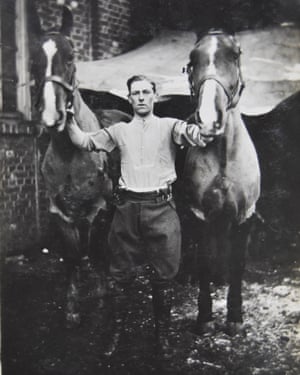
A military stable hand at a hospital in Netley during the first world war. Photo: Philip Hoare
They are the truly forgotten dead. Sixteen million animals “served” in the first world war – and the RSPCA estimates that 484,143 horses, mules, camels and bullocks werekilledin Britishservicebetween 1914 and 1918.
Some died before they reached the western front: of 94,000 horses sent from North America in 1917, 2,700 drownedwhen their vesselswere sunk by submarines. Trench dogs huntedfor ratsin the trenches. Others carried messages. The German army alone employed 30,000dogs. In a canine echo of WarHorse, dogs were recruited from animal shelters, and when that supply ran out, from the general public. “I have given my husband and my sons,” wroteone Englishwoman, “and now that he too is required, I give my dog.”
In no man’s land, dogs did jobs humans could not, such as taking supplies to the wounded so that they could treat themselves; and “mercy dogs” would stay with dying soldiers to keep them company. Such stories bear witness to the loyalty of animals. Dick, a black retriever messenger dog, was wounded in action but recovered enough to resume his duties. He developed a limp, grew weaker, and had to be put down. A postmortem showed that he’d been working with a bullet lodged in his chest and a shell splinter close to his spine.
Other animals acted as canaries in the mine. One South African unit had a baboon called Jackie with sharp hearing, who would tug at men’s sleeves if he detected enemy advances.Slugswereused when it was discovered they would visibly demonstrate their discomfort in the presence of mustard gas in smaller quantities than humans could sense, allowing soldiers to don their gas masks in time.
Some animals may have been grateful for more placid roles. At the vast military hospital at Netley on Southampton Water, where thousands of shell-shocked troops were treated – including the poet WilfredOwen – donkeys were employed to calm men suffering from PTSD. On ships, dogs, pigs and even magpies became animal spirits to deflect the stressof war.
Around 100,000 pigeons served, too. One delivered a message from a US battalion trapped behind enemy lines: “Our artillery is dropping a barrage directly on us. For heaven’s sake stop it”. The birds’ work was so important that they were protected by the Defence of the Realm Act, which criminalised any attempt to kill or maltreat them. It was an ironic implementation of animal rights to mirror the first conservation law in Britain, introduced by the 8th century saint, Cuthbert, who declared that the eider ducks of the Farne Islands should be protected; ironic because during the war, huge rafts of eiders at rest in the North Sea were used by the RAF for target practice.
Whales were used for the same purpose. It was the first time cetaceans had been seen and photographed from the air. One account noted, “In the half-lights, these huge monsters bore a strong resemblance to a submerged U-boat, and, as the rule in war was, ‘When in doubt, bomb’, a good many of them were killed by our aircraft.” Meanwhile, 175,000 whales died in the South Atlantic to furnish rifle oil, fuel for trench stoves and oil to protect againsttrench foot. Germany culled dolphinsand seals for their oil.
Whales were also co-opted to deal with food shortages: as Michael Freemantle notes in his book The Chemists’War, Lever Brothers had worked out how to hydrogenate whale oil to make it fit for human consumption. Most terribly, these placidanimalswere processed into munitions themselves as their bodies yielded glycerine for bombs.
It wouldn’t be until later in the century that humans employed cetaceansin war, but even in the postwar period, consciences were stirring. In a 1924 essay entitled The Impudence of Flags: Our Power Resources and My Elephants, Whales and Gorillas, HG Wells, prophetic author of The War of the Worlds, wrote: “The dwindling world fauna of this planet is in urgent need of international game laws and a supernational game-keeper. Species of whales are being exterminated because the ocean is no man’s land.” In the fitful periods of peace in the last century, there was no armistice for animals, and monuments to their efforts are few, London’s Park Lanememorial being a noble exception. One hundred years after the first war of the anthropocene, itself a perversion of nature and fought for theEarth’s resources, these non-human casualties remain as an indelible stain on our conscience.
Andre Bauma, a park ranger, Democratic Republic of Congo struggles to protect gorillas from a brutal civil war.
PLEASE take a moment to watch the videoby the New York Times as well. KN
* * *
In a national park in the Democratic Republic of Congo, a caretaker struggles to save gorillas from the violence of a brutal civil war.
This Op-Doc video profiles Andre Bauma, who takes care of the orphaned mountain gorillas of Virunga National Park in the Democratic Republic of Congo. In two decades of civil war, more than 140 of his fellow rangers have been killed while protecting their park, which has been home to armed rebels. They risk their lives for Virunga’s gorillas not only because they believe it is right, but because they know that the forest and its animals are the key to the region’s stability.
The threats facing the park are tremendously complicated. Dueling military forces, who have been fighting in the surrounding areas, and sometimes within the park, have used Virunga as their pawn. An oil company, SOCO International, has searched for oil in the park. Violence, poaching and human encroachment have pushed the gorillas to the edge of extinction. Accordingly, the logistics of filming this documentary were daunting: We were working in an active conflict zone with an ever-shifting front line, managing the opposition of a major oil company and its arsenal of lawyers, and of course trying to keep our equipment from being carried away by a crew of curious mountain gorillas.
For us, the gorillas lay at the heart of this story. Not only are they a mirror in which we can view ourselves, but they also represent a better future for Congo and the hopes of the thousands of people living around Virunga National Park. Through tourism to visit the gorillas (now welcomed in a period of relative stability) and other development projects, hundreds of millions of dollars can be generated from the park, as happens next door in Rwanda. Yet the mountain gorillas’ future remains in question.
While the battle to protect Virunga will be long and hard, I believe that in the rangers of the park, we can see glimpses of the best of humanity. They are true African heroes and their courage and integrity should give us all hope.
This video is part of a series by independent filmmakers who have received grants from the Britdoc Foundation.
Orlando von Einsiedel is a filmmaker who lives in London. This Op-Doc is adapted from “Virunga,” his first feature documentary, which is being released in theaters and on Netflix.