By Cliff Conner, Socialist Action, January 2018

Who is James McGill Buchanan? He was a Nobel laureate in “economic sciences,” but if his name is unfamiliar to you, you are not alone. He was not a publicity hound. He didn’t broadcast his views far and wide because he never wanted them to be widely known. Buchanan (who died in 2013) believed that certain vital truths about the political world we inhabit should be hidden from public view.
Buchanan’s secret truth was that democracy and liberty are incompatible and that therefore democracy must be suppressed. After his death, his private papers revealed warnings to co-thinkers that “conspiratorial secrecy is at all times essential.”[i]
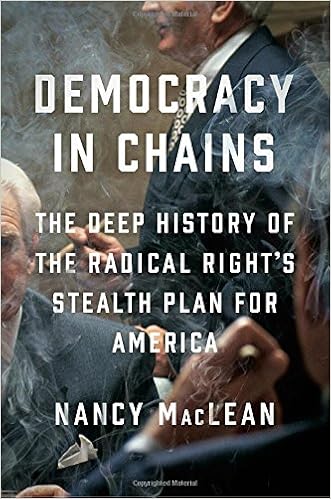
We know about those private papers and their contents thanks to historian Nancy MacLean, whose “Democracy in Chains” has exposed them to the world and alerted us to the danger they represent. This remarkable book is based on a large trove of documents discovered among James M. Buchanan’s private papers after his death in 2013. It is evident from their contents that Buchanan never intended for these documents to be made public.
Buchanan was a key figure in the development of today’s powerful libertarian movement. Be advised: This is not your grandfather’s libertarianism. If you still think of libertarianism as the quaintly eccentric blend of laissez faire economics with concerns such as privacy rights, civil liberties, and antimilitarism, you are behind the times. That old-time libertarianism has been marginalized by a hardcore, right-wing, enemy-of-humanity libertarianism fashioned by Buchanan and the Koch Brothers.
What the “Liberty” in libertarianism has come to mean
The well-funded libertarian movement today is the creation of self-interested billionaires, led by Charles and David Koch, who want above all else to decrease their taxes and minimize government regulation of their businesses. They disparage old-time “conventional libertarians” as impotent, and flaunt the hegemony of their own right-wing agenda.
When the hard-right libertarians trumpet their devotion to individual rights, it is code for individual property rights and has nothing to do with the human rights of the vast majority of individuals. In the new libertarian worldview, an individual without property has no rights.
Today’s libertarians are single-mindedly devoted to “dismantling the administrative state.” As anti-tax crusader Grover Norquist famously exclaimed, “I don’t want to abolish government. I simply want to reduce it to the size where I can drag it into the bathroom and drown it in the bathtub.”
If there is any lingering confusion regarding libertarian commitment to genuine individual freedom, it should be laid to rest by their interpretation of the 1973 Pinochet coup in Chile. To this day libertarian polemicists continue to hail that abominable crime against humanity as an “economic miracle” confirming the wisdom of the free-market economic policy.
They claim that an economic revival following Augusto Pinochet’s seizure of power was due to the guidance of Los Chicago Boys, Chilean economists who had been educated in free-market principles at the University of Chicago. The “miracle” they wrought was built upon the destruction of a vital labor movement requiring the murder and torture of tens of thousands of trade-unionists and their supporters. It was liberty for wealthy investors and property owners at the expense of the life, liberty, and happiness of the majority of the Chilean people.

“Los Chicago Boys,” Chilean economists who studied at the University of Chicago in the 1950s. Left to right: Luis Arturo Fuenzalida, Alberto Valdés, Larry Sjaastad, Pedro Jeftanovic, and Sergio de Castro.
As for the vaunted economic revival, its benefits flowed mainly to foreign investors and the Chilean upper classes. A United Nations report cites “a virtual explosion of poverty in both urban and rural areas” in Chile between 1970 and 1980, and attributes it in part to the “policy reforms under the authoritarian rule of the Pinochet regime.”[ii]
Libertarian apologists sometimes deny that they or Los Chicago Boys endorsed Pinochet’s tyranny or his oppressive methods. But even if their denials were to be accepted at face value, the “Chilean miracle” dramatically refutes their ideological claim that free-market economics is synonymous with democracy and freedom.
The libertarians’ love affair with the Pinochet dictatorship also exposes their greatest paradox. While denouncing “statism” and all governmental influence on the economy, they allow one enormous exception: They depend on the power of the state—in the Chilean example, a police state—to defend the property rights upon which their notion of “liberty” is based. American right-wing politicians are no less hypocritical in demanding the total destruction of governmental power while nurturing the most powerful military state—or “national security state”—the world has ever seen.
Makers versus takers
In 1980 Buchanan, who was also educated at the University of Chicago, was invited to Chile by the Pinochet regime to participate in drafting a new constitution for the country.
Buchanan’s hardcore libertarian definition of liberty—the absolute freedom of entrepreneurs to run their businesses in any way they please—is not one most people would find satisfying. He knew that most Chileans would not be attracted to his profoundly anti-democratic program so it would be a waste of time trying to achieve it openly, via the will of the majority.

Chilean dictator Augusto Pinochet
“Despotism,” Buchanan once wrote, “may be the only organizational alternative to the political structure that we observe.”[iii] By “the political structure that we observe,” he meant the system defined by the American constitution.
His service to the Pinochet regime demonstrated a willingness to embrace despotism that was not merely hypothetical. Buchanan helped the Chilean “alliance of capital and the armed forces” create a legal framework to eliminate the trade unions, privatize the social security and healthcare systems, constrain governmental regulatory power, and destroy the public education system.[iv]
The extremism of Buchanan’s views might be more astonishing if they had not already become part of the national discourse in the United States. Mitt Romney created a stir during his 2012 campaign for the U.S. presidency when remarks he thought would remain private were leaked to the public. In those comments, Romney complained that 47 percent of the American people “pay no income tax,” are “dependent on government,” “believe the government has a responsibility to care for them,” and “believe that they are entitled to health care, to food, to housing, to you-name-it.”[v]
Romney’s views were in perfect harmony with Buchanan’s, although the latter would surely have put the percentage way higher than 47. In Buchanan’s worldview, the population is divided into makers and takers. The makers are the productive classes—owners of capital whose profit-making activities expand the national economy—and the takers are the indolent masses. To Buchanan, any taxation that redistributes wealth from the makers to the takers is a downright immoral form of robbery, and any governmental attempt to regulate the makers’ businesses is a criminal violation of their liberty.
The economic history of the world is indeed a story of takers robbing makers, but Buchanan’s odious interpretation has the relationship upside-down and backward. The great wealth of the United States was founded first of all on agricultural production created by the unpaid labor of African slaves, and secondarily on the industrial production of the underpaid labor of industrial workers. A small number of Southern plantation owners and Northern manufacturers amassed fabulous fortunes by appropriating the profits those laborers produced. Who, then, were really the makers and who were the takers?
The ill-gotten wealth of the exploiters of labor allowed them to gain political control, limit the franchise of the laborers, and create a legal system to consolidate their system of economic injustice. Adding insult to injury, the slaveholders and Robber Barons justified their conquest by propagating ideologies, from Social Darwinism to libertarianism, that denied and devalued the laborers’ role in creating the modern economy.
To appreciate the sheer audacity of Buchanan’s perversion of history, consider the plight of the former slaves after the U.S. Civil War. Having been forcibly taken from their homelands, having had their labor violently taken from them for decades, and being left in dire poverty in the post-war South, many were dependent on barebones federal assistance for survival. That made them, in Buchanan’s eyes, contemptible “takers.”
The Lenin of libertarianism?
What places Buchanan among the most dangerous of the right-wing ideologues is that he not only professed anti-democratic ideas; he devised strategies to successfully implement them. He was a social engineer who found ways to turn libertarian theory into public policy. It has been suggested that as the movement’s key cadre-builder, Buchanan was to libertarianism what Lenin was to Marxist socialism.
Buchanan took the ideas he learned from his Chicago School mentors to the University of Virginia and created a more extreme Virginia School of economics. Its institutional expression was the Thomas Jefferson Center for Studies in Political Economy, which he founded in 1957 to develop “a line of new thinkers” to challenge the “increasing role of government in economic and social life.”[vi] That was to be accomplished by a “constitutional revolution” that would covertly rewrite the rules of the American economy to enrich the few at the expense of the many. Among its primary ambitions were the total elimination of the social security, public health, and public school systems.
Buchanan stated privately that the study center was named after Thomas Jefferson to deflect attention from the “extreme views” that were “the real purpose of the program.” This was the embryo of the modern libertarian intellectual movement. He envisioned the creation of a “counter-intelligentsia” backed by a “vast network of political power” to replace the existing establishment intellectuals.[vii] He thus provided the blueprint for today’s powerful array of libertarian think tanks and their army of paid academics, lobbyists, and politicians.
Buchanan was fully aware, however, that his plans would have languished on the drawing board without the material support necessary to put them into practice. Attracting that support was part of his master plan. In 1983, he reconstituted his academic institute at George Mason University, renaming it the Center for Study of Public Choice. George Mason University, identified in the Wall Street Journal as “the Pentagon of conservative academia,”[viii] was the ideal venue for Buchanan’s operation.
GMU has sometimes been referred to as Koch U. due to its position “at the center of the Koch college universe.”[ix] When Buchanan’s strategy for totally annihilating the government’s influence over the economy gained the support of Charles and David Koch, the counter-intelligentsia of their shared dreams began to become a reality.
The Koch brothers have donated tens of millions of dollars to George Mason University and to Buchanan’s Center for the Study of Public Choice, which trained the young intellectuals who would fill the Koch think tanks and become speechwriters for Koch-financed congressmen. Eventually, tactical disagreements led the impatient billionaire brothers to force Buchanan out and take direct control of the research center. If Buchanan had been the movement’s Lenin, the Kochs became its Stalin (all proportions guarded, of course).
White supremacist roots of Buchanan’s antigovernment crusade
Buchanan’s first research institute was created in the mid-1950s to provide ideological cover for the defiance of federal orders to desegregate the public schools. Two years after the landmark Brown v. Board of Education Supreme Court decision in 1954 declared segregationist state laws unconstitutional, Buchanan presented the University of Virginia with a plan to mobilize its intellectual resources in defense of the state’s white supremacist institutions. University officials agreed, and in 1957 the Thomas Jefferson Center for Studies in Political Economy was born.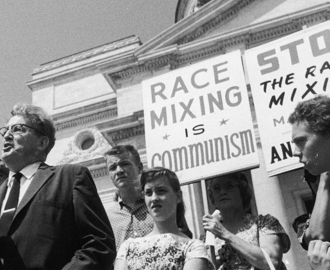
Buchanan was careful not to frame the Center’s mission in explicitly racial terms. Instead, it threw the weight of “economic science” behind the familiar States Rights argument that the federal government had no right to usurp the authority of Virginia’s legislature and assert dictatorial control over Virginia institutions. When it became obvious that the States Rights position would not prevail, Buchanan proposed that Virginia should privatize its school system and do away with public education altogether.
De jure segregation eventually ended in Virginia and the rest of the United States, but, as economist Marshall Steinbaum has observed, “the racist stench attached to Buchanan’s intellectual projects and that of his heirs” endured.[x] And destroying the public school system, which taxes “makers” to benefit “takers,” remained a central plank of Buchanan’s ideological platform to the end of his days.
As I was writing this account of Buchanan’s words and deeds, a headline popped up on my computer’s news feed: “219 Republican House Members Just Voted to Cut Medicaid, Medicare, and Public Education to Give Tax Breaks to Millionaires and Corporations.”[xi]
The U.S. House of representatives had voted 219 to 208 to approve a national budget proposal that would cut more than five trillion dollars—$5,800,000,000,000—from healthcare, education, environmental protection, services for children and the disabled, scientific research, the arts, and other federal programs that are essential to human wellbeing.
This was a timely reminder of the real-world consequences of Buchanan’s abominable “makers and takers” ideology and the misery it has already inflicted on American society. While the draconian budget cuts had not at that time achieved the force of law, they provided a clear indication of how deeply the libertarian cancer had already pervaded the body politic. Although Buchanan’s full program of completely eliminating all beneficial social programs has not yet been accomplished, its partial fulfillment has already damaged or destroyed millions of human lives.
Buchanan’s antipathy to public education was not only due to its cost but to its function as an essential pillar of a democratic, self-governing society. That a majority of elected representatives in the U.S. Congress could vote to transfer trillions of dollars from the social majority to a relative handful of super-wealthy individuals further indicates how successful Buchanan’s well-funded strategy to undermine American democracy has been.
How scientific is Buchanan’s “economic science?”
The official name of the honor Buchanan received in 1986 is “The Nobel Memorial Prize in Economic Sciences,” but his practice of the discipline made a mockery of the very notion of economics as a science.
Buchanan’s economics research centers have long been recognized not as institutes of independent thought but as partisan propaganda mills. The “science” they promote is not founded on objective premises but on the moral judgment that the vast majority of human beings are economic parasites on the capitalist class. The notion that the world’s poor are stealing the billionaires’ lunch money is so contrary to reason that without the funding of self-interested billionaires it would be unlikely to attract many followers.
Beyond its fundamental irrationality, Buchanan’s economic ideology is unscientific in its a priorismand reductionism. A priorism is the method characteristic of Aristotelian science, the rejection of which was the central achievement of the Scientific Revolution of the 16th and 17th centuries.
When, for example, Buchanan was confronted with empirical evidence that raising the minimum wage does not create unemployment, he rejected it out of hand on the basis that it contradicts laissez-faire theory. To allow such a possibility, he angrily responded, is “equivalent to a denial that there is even minimal scientific content in economics.”[xii] On the latter point I find myself in agreement with him.
As for reductionism, Buchanan’s “Public Choice Theory” reduces real-world economic decision-making to the sterile abstractions of mathematical game theory. In a universe where human beings always act like purely self-interested automatons, game theory could perhaps offer some useful insights into economic behavior. But Buchanan applies mathematical models based on misanthropic assumptions about human nature to complex social interactions.
Nancy MacLean describes the hypothetical social order from which Public Choice theorists deduced their axioms as one in which “individuals always acted to advance their personal economic self-interest rather than collective goals for the common good.” Buchanan and his fellow theorists, she writes, were simply conducting “thought experiments, or hypothetical scenarios with no true research—no facts—to support them, while the very terms of their analysis denied such motives as compassion, fairness, solidarity, generosity, justice, and sustainability.”[xiii]
In brief, Buchanan’s method is of no scientific value at all. It is designed not to attain new knowledge about economics, but to justify an economic system of vast material inequality.
“Democracy in Chains” is a must-read for all people engaged in the struggle for social justice. No matter how well you think you already know thine enemy, I predict—based on my own experience—that you have much more to learn from this book.
[A note about the footnotes: Traditionally, I would have included page numbers in citations from Democracy in Chains, but that is no longer necessary in today’s world of digital books and search functions.]
Endnotes: