|
| Overlap between future population distribution and extreme heat demographic projections to ∼2070. The shaded areas depict regions where minimum average temperature exceeds 29 °C, while the colored topography details the spread of population density. |
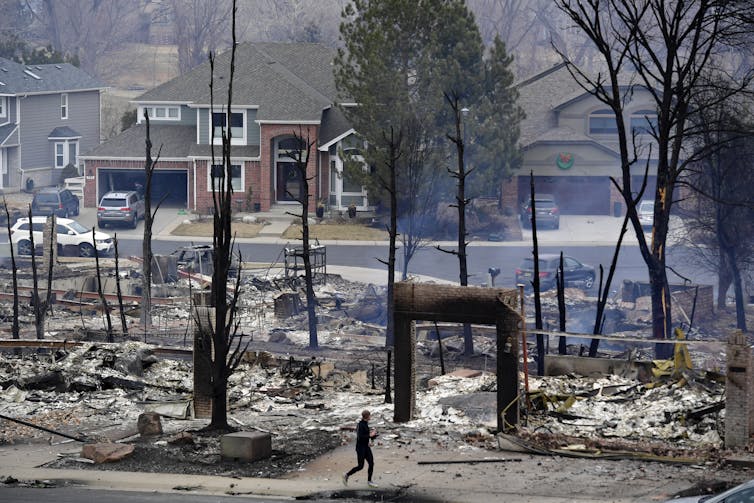
As I am writing this essay on July 31, 2026, Canada, France,
and Spain are all experiencing catastrophic wildfire seasons, but the fires
have somewhat different characteristics. The striking common denominator is
extreme heat and dryness associated with climate change, interacting with local
vegetation, drought, wind, and human ignition sources. As I am writing, the
region I live in in northern California is covered with smoke from the Woodside
Fire near the Pacific Ocean, which ignited yesterday at 1:30 in the afternoon
and is still burning.
In this essay, I will provide basic information from
authoritative sources about the catastrophic global warming and climate change these
fires exemplify and point to the policies needed to address them. To understand
global warming and catastrophic climate change and how to stop them is not an
option but a necessity for the survival of humanity and much of life on Earth.
What Is Global Warming and What
Causes It?
The atmosphere is currently more than 1 degree Celsius (1.8
degrees Fahrenheit) warmer than preindustrial times.
Scientists attribute the global warming trend to the human
expansion of the "greenhouse effect" (Intergovernmental Panel on
Climate Change-IPCC, 2022), a warming that results when the atmosphere traps
heat radiating from Earth toward space.
Life on Earth depends on energy coming from the Sun. About
half the light energy reaching Earth's atmosphere passes through the air and
clouds to the surface, where it is absorbed and radiated in the form of
infrared heat. About 90% of this heat is then absorbed by greenhouse gases (GHGs)
and re-radiated, slowing heat loss to space and causing the atmosphere to warm.
What Are Greenhouse Gases?
Greenhouse gases are a category of gases that absorb heat
energy emitted from the planet's surface, and they remain in Earth's atmosphere
for a long time (from decades to centuries). Though they make up less than 1%
of all air molecules in the atmosphere, GHGs absorb a significant amount of
heat energy and re-radiate some of it back toward the surface. They're called
"greenhouse gases" because they trap heat near the Earth's surface in
a manner somewhat like how a greenhouse allows in the sun’s rays and then holds
in the resulting heat
By adding more GHGs, chief among them carbon dioxide and
methane, to the atmosphere, humans are causing average global temperature to
rise at an unprecedented rate. Earth has warmed up by an average of 0.11°F
(0.06°C) per decade since 1850, or about 2°F (1.1°C) in total. Let’s recall
this process began with the English Industrial Revolution 1760–1840 and has
continued ever since with the spread of industrialization worldwide.
The most important greenhouse gases, listed in order of
their impact on the greenhouse effect, are:Water vapor (H₂O), carbon dioxide
(CO₂), methane (CH₄), nitrous oxide (N₂O), and ozone (O₃).
Water vapor is the most abundant greenhouse gas, while
carbon dioxide is the most significant in terms of human activities and climate
change mitigation efforts. While water vapor emissions have been relatively
stable over the long term, studies show they have been increasing in recent
decades due to global warming and climate change (Allen et al. al, 2022; Dong
et al., 2022).
In its Sixth Assessment Report, the Intergovernmental Panel
on Climate Change, composed of scientific experts from countries all over
the world, concluded that it is unequivocal that the increase of CO2, methane,
and nitrous oxide in the atmosphere over the industrial era is the result of
human activities and that human influence is the principal driver of many
changes observed across the atmosphere, ocean, cryosphere and biosphere.
In recent decades, the average atmospheric concentration of
carbon dioxide (CO₂) has been increasing from around 330 parts per million
(ppm) in the 1970s to 340 ppm in the 1980s, to 360 ppm in the 1990s, to 380 ppm
in the 2000s, to 400 ppm in the 2010, and 420 ppm in the 2020s, with a record high of 442.7 ppm in 2024. Methane (CH₄) and nitrous
oxide (N₂O) have also been showing substantial increases.
If annual emissions continue to increase as rapidly as they
have since 2000, climate models project that by the end of this century global
temperature will be between 2.7°F (1.5°C) warmer than the 1901-1960 average,
and possibly as much as 7.9°F (4.4°C) warmer, which would be catastrophic to
humanity and much of life on Earth.
Sources of carbon dioxide emissions are:
- Fossil Fuel
Combustion: This includes burning coal, oil, and natural gas for electricity,
heat, and transportation, which is the largest contributor to greenhouse
gas emissions globally.
- Agriculture: Agricultural
practices, particularly livestock production, release significant amounts
of methane (CH₄) and nitrous oxide (N₂O) due to enteric fermentation and
fertilizer use.
- Deforestation: The clearing
of forests for agriculture or urban development reduces the number of
trees that can absorb CO₂, contributing to increased atmospheric carbon
levels.
- Industrial
Processes: Manufacturing and chemical production release various greenhouse
gases, including CO₂ and fluorinated gases, which have a high global
warming potential.
- Waste
Management: Landfills produce methane as organic waste decomposes
anaerobically, while waste treatment processes can also emit greenhouse
gases.
The most basic reason is
that fossil fuels, the equivalent of millions of years of plant growth, are the
only source of carbon dioxide large enough to raise atmospheric carbon dioxide
amounts as high and as quickly as they have risen.
How Does Global Warming Cause Climate
Change?
Global warming causes catastrophic climate change by altering
weather patterns characteristic of the Holocene geological epoch. This epoch began approximately 11,700 years
ago, following the last glacial period known as the Pleistocene. The Holocene
is characterized by a relatively stable climate that has allowed farming and
the development of human civilizations. Catastrophic climate change is
undermining the stable weather patterns of the Holocene. Some geologists have
argued that the Earth has entered the epoch of the Anthropocene (The Age of
Humans). Climate change is primarily driven by the greenhouse effect, where
gases like carbon dioxide (CO₂) and methane trap heat in the atmosphere. This
process enhances the natural greenhouse effect, leading to higher temperatures.
As temperatures rise, certain feedback mechanisms, such as reduced ice cover
and increased water vapor, further amplify warming. For instance, melting ice
reduces the Earth's albedo (reflectivity), causing more solar energy to be
absorbed.
Consequences of Global Warming and
Climate Change
Global warming and
climate change affect virtually every aspect of the Earth system: the
atmosphere, oceans, ecosystems, economies, and societies. They cause extreme
weather, such as higher temperatures, leading to more frequent and severe
hurricanes, droughts, and heavy rainfall. They cause ecosystem disruption:
Changes in climate affect biodiversity, leading to shifts in species
distribution and habitat loss. This feeds another existential ecological
crisis, the Sixth Extinction: Current extinction rates are estimated at 100 to
1,000 times higher than natural background extinction (Ceballos et al., 2018;
Cowie et al., 2022; De Vos et.al., 2014). They also cause sea Level rise:
Melting polar ice and thermal expansion of seawater contribute to rising sea
levels, threatening coastal communities.
Many consequences reinforce one another through feedback
loops. Below is a systematic overview with examples.
1. Rising temperatures
Average global surface temperature has risen by about
1.3–1.5°C above pre-industrial levels, although warming varies by region. Examples
include record-breaking heat waves in Europe (2022–2025), temperatures above
49°C (120°F) in parts of western North America, and longer and hotter summers
in southern Europe and the Middle East. Consequences
include heat-related deaths, lower labor productivity, and greater electricity
demand for cooling (causing more GHG emissions).
2. More frequent and
intense heat waves
Heat waves are becoming longer, more
frequent, and more severe. Examples include India’s recurring spring
heat waves, the U.S. Pacific Northwest “heat dome” (2021), Mediterranean heat waves. Consequences
include heat stroke, crop damage, infrastructure failures
(roads buckling, rail tracks deforming
3. Melting glaciers
Nearly all mountain glaciers are
shrinking. Examples include the Alps, Himalayas, Andes, and Alaska. Consequences
include reduced freshwater supplies, increased glacier lake outburst floods,
and loss of tourism.
4. Greenland and
Antarctic ice loss
Massive ice sheets are losing hundreds
of billions of tons annually. Consequences include sea level rise
lasting centuries and permanent loss of coastal land. Sea level has risen
roughly 20–25 cm (8–10 inches) since 1900 and is accelerating. Examples
include Miami flooding during high tides, Pacific island nations threatened, and
coastal inundation in Bangladesh. Consequences include coastal erosion, saltwater
intrusion into groundwater, and displacement of millions.
5. Sea level rise
Sea level has risen roughly 20–25 cm (8–10 inches) since
1900 and is accelerating. Examples: Miami flooding during high tides, Pacific
island nations threatened, Bangladesh coastal inundation. Consequences: Coastal erosion, saltwater
intrusion into groundwater, displacement of millions. Sea level has risen
roughly 20–25 cm (8–10 inches) since 1900 and is accelerating. Examples:
Miami flooding during high tides, Pacific island nations threatened, Bangladesh
coastal inundation. Consequences: Coastal erosion, saltwater intrusion
into groundwater, displacement of millions.
6. Stronger storms
Warmer oceans provide more energy for
tropical cyclones. Examples include Hurricane Harvey, Hurricane
Ian, and Typhoon Haiyan. Consequences include greater rainfall, larger
storm surges, and more infrastructure damage
7. More extreme rainfall:
A
warmer atmosphere holds more water vapor. Examples include Germany
floods (2021), Pakistan floods (2022), Vermont flooding (2023), Afghanistan
flood 2026. Consequences include
flash floods, landslides, and urban flooding
8. More severe droughts
Some regions experience prolonged drying. Examples
include the Western United States megadrought, Horn of Africa drought, and Mediterranean
drying. Consequences: Crop failures, water shortages, hydroelectric
power losses
9. Larger wildfires
Hotter, drier conditions increase wildfire risk. Examples
include Canada (2023), Australia's Black Summer (2019–20), and California fires.
Consequences: Loss of forests, air pollution, and property destruction.
10. Ocean warming
More than 90% of excess heat enters the oceans. Examples include heat waves and warmer
North Atlantic temperatures. Consequences include Coral bleaching, fish
migration, and stronger hurricanes.
11. Ocean acidification
Oceans absorb carbon dioxide, making seawater more acidic. Examples
include coral reef acidification and bleaching, and oyster hatcheries in the
Pacific Northwest. Consequences include weakened shells, reduced reef
growth, and food web disruption.
12. Coral reef collapse
Repeated marine heat waves kill corals. Examples
include Great Barrier Reef bleaching and Caribbean reef decline. Consequences:
Loss of biodiversity, reduced fisheries, and lower tourism revenue.
13. Permafrost thaw
Frozen soils are thawing across the Arctic. Examples
include Siberia, Alaska, and Northern. Consequences include Methane
release, infrastructure collapse, and ecosystem changes.
14. Biodiversity loss
Many species cannot adapt quickly enough and die off. Examples:
Amphibian declines, Arctic species under stress, and Alpine plants disappearing.
Consequences: Local extinctions, simplified ecosystems, reduced
resilience.
15. Species migration
Species move toward the poles or higher elevations. Examples
include fish moving northward, birds changing migration timing, and insects
expanding ranges. Consequences: New ecological competition. Altered food
webs.
16. Agricultural impacts
Climate affects yields differently across regions. Examples
include wheat losses during heat waves, coffee production moving uphill, and vineyard
relocation. Consequences: Lower yields, food price increases, and greater
volatility.
17. Water insecurity
Changing precipitation alters water availability. Examples
include Colorado River shortages, Himalayan glacier-fed rivers, Cape Town water
crisis. Consequences: Competition among agriculture, cities, and
ecosystems.
18. Food insecurity
Climate stresses global food systems. Examples
include crop failures in East Africa, fisheries decline, and livestock heat
stress. Consequences: Higher food prices, increased malnutrition, humanitarian
crises.
19. Human health impacts
Climate affects health through multiple pathways. Examples
include heat deaths, smoke inhalation, and spread of infectious diseases. Consequences:
More cardiovascular illness, respiratory disease, mental health impacts
20. Spread of infectious
diseases
Changing climates alter habitats for
disease vectors. Examples include Dengue fever expanding, malaria
reaching higher elevations, and Lyme disease moving north.
21. Air quality
deterioration
Higher temperatures worsen ozone formation and wildfire
smoke. Examples include smoke from Canadian wildfires affecting eastern
North America, and increased urban ozone episodes.
22. Economic losses
Climate damages infrastructure and reduces productivity. Examples
include billion-dollar disasters in the United States, insurance losses, and agricultural
losses.
23. Climate migration
People relocate because of environmental change. Examples
include Pacific islands, Bangladesh, and the Sahel region.
24. Increased conflict
risks
Climate does not usually cause wars directly, but it can
intensify existing tensions. Examples include water disputes, farmer–herder
conflicts, and resource competition
25. Infrastructure
damage
Climate affects transportation, utilities, and buildings. Examples
include rail buckling, airport runway damage, and flooded subway systems.
26. Energy system
disruption
Climate influences both energy demand and supply. Examples
include higher summer electricity demand, reduced hydropower during drought,
and transmission failures during heat.
27. Loss of benefits
from ecosystems
Natural ecosystems provide benefits
that support human well-being. Examples include pollination, water
purification, and flood protection by wetlands
28. Cultural losses
Climate threatens places and traditions tied to particular
environments. Examples include Arctic Indigenous environmental cultural
practices, Pacific island cultural heritage, and historic coastal communities.
29. Financial
instability
Climate risks increasingly affect financial systems. Examples
include rising insurance premiums or insurer withdrawals from high-risk regions,
and declining property values in flood-prone areas.
30. Positive feedback loops
Some climate changes accelerate further warming. Examples
include Arctic sea ice loss reducing Earth’s reflectivity (albedo), leading to
more heat absorption; thawing permafrost releasing methane and carbon dioxide;
and forest dieback reducing carbon storage.
Who Is Responsible?
To stop global warming and
catastrophic climate change, let us ask who is most responsible for the
emission of greenhouse gases.
The top ten countries responsible for greenhouse gas
emissions are as follows:
- China -
The largest emitter, contributing approximately 30% of global carbon
dioxide emissions, with around 11.4 billion metric tons in 2022.
- United
States - The second-largest contributor, emitting about 6.3 billion
metric tons of carbon dioxide equivalent in 2021.
- India -
Responsible for roughly 3.9 billion metric tons of carbon dioxide
equivalent, accounting for about 7% of global emissions in 2021.
- European Union
(EU) - As a collective, the EU member states contribute
significantly, though individual country emissions vary widely.
- Russia - A
major emitter to global greenhouse gases.
- Japan -
Known for high emissions due to industrial activities.
- Germany -
One of the largest economies in Europe, contributing notably to emissions.
- Iran - A
significant emitter, largely due to its oil and gas industry.
- South
Korea - High emissions from industrial and energy sectors.
- Indonesia -
Notable emissions primarily from deforestation and land-use changes.
While China is the top polluter, it also has the largest
population in the world, 1.4 billion people.
Another way to look at which countries
are most responsible for greenhouse gas emissions is to look at the top five
countries on a per capita basis. They are Qatar, Kuwait, United Arab
Emirates, Bahrain, and Saudi Arabia; all are also major exporters of oil and
gas.
Thus, if two dozen countries of the
world are held accountable for greenhouse gas emissions and they stop such
emissions, it goes a long way toward stopping global warming.
Why Have World
Governments Proved Unable to Stop Greenhouse Gas Emissions?
There is a clear correlation and
causation between industrialization and burning fossil fuels, beginning with
the English Industrial Revolution 1760–1840, as the following graph shows.

Fossil fuels have been essential for
capitalist industrialization due to their role as a primary energy source. Fossil fuels, including coal, oil, and natural gas,
have powered industrialization worldwide. Their accessibility and energy
density made them the backbone of economic development, facilitating mass
production and transportation. Despite being the world leader in the
production of renewable technologies, China is still the largest producer and
consumer of coal and coal power in the world. China produces approximately 4.8
billion tons of coal per year, over half of the global total.
Governments subsidize fossil fuels. In 2024, globally, explicit (or fiscal) subsidies were $725 billion (0.6 percent of GDP). Implicit subsidies, primarily underpricing of environmental costs, were $6.7 trillion (5.8 percent of GDP), with three-quarters from underpriced air pollution and climate change (Black et al. al, 2025).
Now, if we consider capitalist competition, once some group of capitalists began utilizing these high-energy sources, others had to follow to remain viable in the market. This has created a cycle of dependency that reinforced their use across industries and countries worldwide.
Thus, fossil fuels have been a fundamental building block of the anthropocentric industrial capitalist civilization, which includes the bourgeois idea of a good life even among the working people. To replace them will require a radical questioning of capitalist modernity and the anthropocentric industrial culture, and the present bourgeois idea of a good life based on consumerism.
Two economic forces deepen capitalist firms' addiction to fossil fuels. The first is the negative externalities of burning fossil fuels because emissions of greenhouse gases (GHGs) do not factor in the cost of production. Second is moral hazard, which occurs when a firm or government is protected from the full costs of burning fossil fuels, so firms and governments have an incentive to behave more recklessly or irresponsibly than they otherwise would.
A case in point is the Paris Agreement negotiated by 196 parties at the 2015 United Nations Climate Change Conference near Paris, France. Each government pledged to devise ways to reduce greenhouse gas emissions voluntarily. There was no enforcement mechanism. Thus, every government had an incentive to let others take steps to reduce greenhouse gas emissions while it continued to pollute. As a result, greenhouse gas emissions increased 9% between 2015 and 2024, driven by rising energy demand from data centers and industrialization, as reported by McKinsey & Company.
What Is to Be Done?
The worldwide spread of capitalism and industrialization required
the ever-increasing use of fossil fuels. human population has exploded 800
percent since the start of the use of fossil fuels. Capitalist development requires
ever more production and consumption of commodities, increasing global per
capita energy usage over time. Life today in a typical city looks profoundly
different from daily life in 1820. Modernity
would never have happened without an unprecedented abundance of energy.
Capitalist societies are dependent on evermore economic growth because production is for profit and evermore growth provide ever more mass of profits. However, ever more production will require evermore consumption, regardless of whether it is for human needs. Thus, capitalist economies are dependent on population growth to provide workers (producers) who are also the bulk of the consumers. That is why capitalist politicians promise economic growth and prosperity.
All this make for evermore consumption of fossil fuels and emission of greenhouse gases.
That is why some the U.S. war on Iran is a war for control of the Middle Eastern oil and gas. Even the establishment of Israel was to secure Western imperialism's domination of the Middle East.
Unless
greenhouse gas emissions stop, climate science tells us it can become
self-sustaining once one or more tipping points are reached. A tipping point is
a critical threshold that, when crossed, leads to large, accelerating, and
often irreversible changes in the climate system. If tipping points are
crossed, they are likely to have severe impacts on human society and accelerate
global warming.
Key climate tipping points include: Greenland Ice Sheet
Collapse, West Antarctic Ice Sheet Collapse, as significant melting could lead
to accelerated sea-level rise; coral Reef Die-Off, as warming oceans and
acidification threaten coral ecosystems, impacting marine biodiversity; Boreal permafrost
thaw, which releases methane, a potent greenhouse gas, exacerbating climate
change; Monsoon system changes that cause alterations in monsoon patterns can
affect water supply and agriculture in many regions.
The
only effective method is to force governments to enact enforceable legislation
to reduce greenhouse gas emissions and transition to a post-carbon economy and
society, and to change our lifestyle in ways to reduce and eliminate greenhouse
gas emissions. This is only possible if a politically independent mass movement
of working people forces the government’s hand.
However, this has not happened anywhere in the world yet.
In the U.S., a main polluter, on September 21, 2014, the People’s Climate March
in New York City, with more than 310,000 people and hundreds of contingents,
was a great success. The organizers report that 2,807 similar actions took
place in 166 countries during that weekend (Nayeri, October 1, 2014). However,
the leadership of the movement fell to Bill McKibben, a journalist by
profession, who helped organize 350.org, the main organization in the movement
to stop global warming. However, McKibben originally believed he could convince
the fossil fuel companies to cease production. Later, he offered self-criticism
and argued the movement should instead focus on electing politicians who
support the transition to renewable energy, which happens to be largely
Democratic politicians, to lobby nationally and locally for the same end. He
combined this with “direct action” like chaining himself to the gates of a
refinery.
Margaret
Klein Salamon and Ezra Silk organized The Climate Mobilization, who believed
the U.S. needs an emergency mobilization like the effort organized by Franklin
D. Roosevelt (FDR) in World War II to transform the U.S. economy. The problem
again was that to do so they wanted to rely on capitalist politicians (Nayeri,
September 3, 2016). In 2018, Alexandra Ocasio-Cortez was elected to the House
of Representatives, and she campaigned for what she called a Green New Deal
(GND) to stop global warming and climate change. At the time, she managed to
get a large following among the left Democratic Party supporters as well as
socialists and ecosocialists. Her GND was built on a left-liberal bourgeois
vision and political platform, as I analyzed in detail (Nayeri, March 25,
2019).
Without
an independent politically minded working people’s movement, it remains up to individuals
to adopt lifestyles that avoid emissions of greenhouse gases. Currently, about
5%-7% of households have rooftop solar photovoltaic systems. In 2026, renewables
supply roughly 27-30% of U.S. electricity generation, so the average
household’s electricity mix contains about that proportion of renewable energy,
although it varies widely state by state, which amounts to about 5% of home
energy use. However, the “renewable” sources for this type of energy generation
include burning wood, which releases greenhouse gases.
In
brief, the U.S. falls very short of any serious effort to stop catastrophic
global warming and climate change.
Ecocentric Socialist Proposal for Fighting Climate Catastrophe
Currently, mass consciousness about
the causes of catastrophic global warming and climate change, and what, if
anything, to do about it, is low. We
need to help educate, organize, and mobilize the working people as an
independent political force to stop this catastrophe.
Currently, most of the world's greenhouse gases are emitted by the following countries and the European Union in the order of total emissions: China 27-30%, United States 11-13%, European Union 6-8%, Russia 5%, India 7%, Indonesia 3%, Brazil 3%, Japan 2-3%, Iran 2%.
Annual snapshots can be misleading
because CO₂ lingers in the atmosphere for centuries. If we add up all
emissions since the start of the English Industrial Revolution in the mid-1700s, the
United States has contributed more cumulative CO₂ than any other nation. The EU
(as a 27-country bloc) ranks second, with China in third place. The United
Kingdom and India round out the top five.
Global CO₂ emissions average just
under five metric tons per person per year. However, per capita emissions of oil-producing Gulf
states and high-income countries far exceed that average. The United States,
Canada, and Australia typically emit between 14 and 18 tons per person
annually. China, despite its massive national total, sits closer to 8 tons per
person. India remains well below the global average at roughly 2 tons per
capita.
Clearly, stopping catastrophic global warming and climate change requires a worldwide mobilization of the working people, especially in most countries, to transcend the anthropocentric industrial capitalist civilization in the direction of an Ecocentric Socialist future (see Nayeri, July 4, 2021, May 1, 2022). Here is an outline of an action program for the climate movement in the U.S. which I proposed in 2015 (Nayeri, June 26, 2015).
For an emissions tax with
subsidies to low-income people
The climate movement can enhance
its effectiveness by focusing its campaigns on the key countries and the European
Union that are responsible for more than 70% of greenhouse gases. Climate
Club
Early industrializers in the West
and Japan, as well as China, should take the lead because of the former's
historic responsibility and the fact that China’s pollution is largely driven
by industrial production for the West, which makes China the leading emitter
today. The climate movement should demand that they honor and exceed these
intentions by creating a Climate Club through adopting meaningful emissions (or,
if appropriate, carbon, as in the case of Indonesia because of its forest
clearing) taxes with subsidies to low-income people.
Emissions tariff and Climate
Change Assistance Fund
Key to the international success of
emissions taxes is that Climate Club countries impose import tariffs on leading
emitters who are not yet in compliance. The combination of emissions, tax and
import tariffs will benefit any country that joins the Climate Club and make it
unfeasible economically not to join it.
All such tariffs should go to a Climate Change Assistance Fund that
gives assistance to the countries most affected by climate change and least
able to face it alone and to help them transition to a post-carbon
economy.
How to proceed
In sum, I believe it is high time
for each organization in the climate movement to discuss this and other policy
proposals in their general meetings. What to do about climate change is too
important to leave to politicians, bureaucrats, technocrats and business
interests who routinely place corporate and economic interests before the
health of the planet and all who live on it.
Whenever we plan for protest
actions, various participating groups propose demands or slogans close to their
own vision. There is usually harmony with the directions and goals of the
climate movement. However, it is time to
strive for greater unity by adopting a clear and concise policy of our own on
how to combat climate change.
The policy proposals here will run
into opposition by many politicians, bureaucrats, and corporate leaders.
However, the climate movement is a political movement precisely because we must
overcome such opposition with our ever-more powerful mobilizations and unity in
action. Who else will design and
implement solutions to the climate crisis if not the climate movement? Some of us, including this author, will argue
that to resolve the climate and other existential ecological crises, we must transcend
the anthropocentric industrial capitalist civilization in the direction of an
ecological socialist society.
However, nobody subscribes to the
idea that effective policy to combat climate change must wait for the downfall
of capitalism. In fact, it is the reverse.
Only through building a mass climate movement can forge and force an
effective climate policy in the womb of the existing capitalist world order can
we take genuine steps to transcend it.
We can win the fight to reverse 250
years of greenhouse gas emissions if enough social forces are organized and
mobilized in key countries and across the world. It requires a clear understanding of
policies, strategies, and tactics that can achieve our goal. Of course, we will continue with campaigns to
end fracking, tar sands oil, exploration in particularly dangerous locations,
coal trains and bomb trains. But
emission taxes with subsidies to low-income people and formation of a Climate
Club that imposes import tariffs on major emitting countries and provides
assistance to the countries of the Global South to cope with climate change and
transition to a post-carbon economy will be a powerful complement that will
unify the movement across the world and point the way forward.
References:
Allen, Richard P., Kate M. Willett, Viju O. John, Tim
Trent. “Global Changes in Water Vapor 1979–2020.” JGR Atmospheres. June 2022.
Black, Simon, Weronika Celniak, Alberto Garcia Huitron, Ian W.H. Parry, Paulina Schulz Antipa, and Nate Vernon-Lin. "Underpriced
and Overused: Fossil Fuel Subsidies Data 2025: Update." International
Monetary Fund. 2025.
Ceballos, Gerardo; Ehrlich, Paul R. "The Misunderstood Sixth Mass Extinction". Science. 360
(6393): 1080–1081. June 8, 2018.
Cowie, Robert H., Philippe Bouchet, Benoît Fontaine. “The Sixth Mass Extinction: Fact, Fiction or Speculation?” Biol Rev Camb Philo
Soc. 2022 Jan 10;97(2):640–663.
De Vos, Jurriaan M.; Joppa, Lucas N.; Gittleman, John L.;
Stephens, Patrick R.; Pimm, Stuart L. (2014-08-26). "Estimating the Normal Background Rate of Species Extinction" (PDF).
Conservation Biology (in Spanish). 29 (2): 452–462.
Dong Ren, Yong Wang, Guocheng Wang, Lintao Liu. “Rising trends of global precipitable water vapor and its
correlation with flood frequency.” Geodesy and Geodynamics, Volume 14,
Issue 4, July 2023, Pages 355-367.
Nayeri, Kamran. “People’s Climate March Was a Huge Success; What to Do Next?” Our Place in the
World: A Journal of Ecosocialism. October 1, 2014.
_____________. "The Climate Movement Should Demand: 'Tax Greenhouse Emissions with Subsidies for Low-Income People." Our Place in the World: A Journal of Ecosocialism. June 26, 2015.
_____________. “Making Progress: A Critical Assessment of Climate Action
Plans by Bill McKibben and The Climate Mobilization.” Our Place in the
World: A Journal of Ecosocialism. September 3, 2016.
_____________. “A Future for American Capitalism or The
Future of Life on Earth?: An Ecosocialist Critique of the "Green New Deal."
Our Place in the World: A Journal of Ecosocialism. March 25, 2019.
_____________. “The
Case for Ecocentric Socialism.” Our Place in the World: A Journal of
Ecosocialism. July 4, 2021.
_____________. “On Degrowth.” Our Place in the World: A Journal
of Ecosocialism. July 22, 2021.
_____________. "Socialism in the 21st Century: Why It Is Needed and Some of Its Salient Features." Our Place in the World: A Journal of Ecosocialism. July 22, 2021.
The Intergovernmental Panel on Climate Change (IPCC). WG1, Summary for Policy Makers, Section A, “The Current State of the Climate;” IPCC 6th Assessment Report, WG1, Technical Summary, Sections TS.1.2, TS.2.1 and TS.3.1.