Monday, August 24, 2015

1991. The Critical Art of Steve Cutts

By Martynas Klimas, Bored Panda, August 20, 2015
modern-world-caricature-illustrations-steve-cutts-7

Art isn’t all fairytale photoshoots and landscape shots – it can also act as catalyst of change. And Steve Cutts thinks that many things in the world should be different. Work shouldn’t be a grinding, soul-crushing rat race for the almighty dollar. Consumerism shouldn’t hold a vice-like grip on our lives. And social media, well, we need to throw-off the shackles we so eagerly put on ourselves. Wouldn’t life be better then?
Steve Cutts is an illustrator and animator from London. Faced with the choice of working at McDonalds or studying Fine Arts, he chose the latter. He worked at Glueisobar as the main storyboard concept artist before making the leap to freelance work. Cutts makes videos and images that criticize modern life – he states that insanity of humanity is an endless pool of inspiration.
More info: stevecutts.com | facebook | twitter

Sunday, August 23, 2015

1990. A Year After Israeli War, Gaza Strip Remains a Ruin

By Jodi Rudoren and Majd Al  Waheidi, The New York Times, August 22, 2015


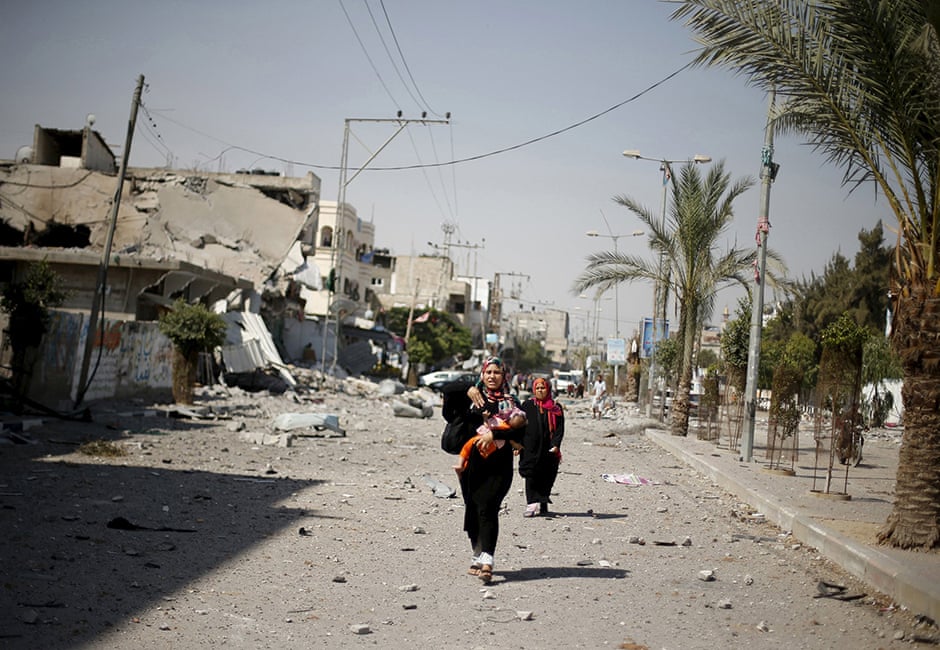
GAZA CITY — The men of Shejaiya still come daily to sit vigil in the desolate ruins of their neighborhood, drinking tea and playing chess. But these days, there are also clusters of construction workers on Shejaiya’s dirt paths, finally pouring a few cement foundations and hammering together wood planks.

Fouad Harara, 56, arrives at his house on Montar Street before 6 a.m. to check the previous day’s work against his thick wad of engineering blueprints. He returns at midday with chicken and rice for the 10 men who have, over the past four weeks, completed the cinder-block ground floor where Mr. Harara plans to revive his electrical-services business and erected pylons for the second of seven sketched stories.

“Exactly the way it was,” Mr. Harara said of what would replace the home he built in 1993, one of hundreds flattened by Israeli attacks on Shejaiya, the Gaza City neighborhood that abuts the border fence, during the war last summer. “I was comfortable in this place,” he added. “We lost everything, but it’s still in my memory.”

A year after the halt to hostilities between Israel and Palestinian militants in the Gaza Strip on Aug. 26, 2014, not a single one of the nearly 18,000 homes destroyed or severely damaged in Gaza is habitable. About 12 percent of their owners have been approved to rebuild through the complex Gaza Reconstruction Mechanism created by the United Nations, Israel and the Palestinian Authority, but just under 4 percent — 719 families as of Saturday — have actually purchased cement or other materials.

Those involved in the process, and advocacy groups, attribute the slow pace to Palestinian political infighting, Israel’s involvement in approving projects and participants, and a lack of funds. International donors have sent about $340 million of the $2.5 billion they pledged for Gaza’s reconstruction last fall, and much of that was spent on removing rubble, on temporary housing for 100,000 displaced residents or on minor repairs.

Israeli, Palestinian and United Nations officials acknowledge that cement has flooded Gaza’s black market, with some undoubtedly ending up in the militants’ underground tunnel network — the very thing the monitoring system was set up to prevent.

“We know and believe that some of it goes to the wrong places,” said Maj. Adam Avidan, Israel’s point person on the mechanism. At one point, 18 of 30 beneficiaries bought their full allotment of cement and “went the same day and sold it on the black market,” he said. “They didn’t build their houses.”

About 37,000 tons of cement sits unused in Gaza warehouses, nearing or past its expiration date for load-bearing projects.

Mofeed M. Al Hassaina, the Gaza-based minister of housing and public works, was in Shejaiya on July 23, when Mr. Harara was among the first four owners to start rebuilding, surrounded by clicking cameras. But Mr. Hassaina said he was afraid to return to the neighborhood, and had turned down an invitation to a school opening there after three days of demonstrations by residents outside his office.

“I cannot go there, because they are angry,” he said. “Maybe they’re cursing us and they’re shouting at me because they’re frustrated about their life.”

Palestinian civil-society groups pushed forward a petition this month calling for an end to the reconstruction mechanism, saying that Israel’s access to a database of destroyed homes and its role in reviewing applications only entrenched its control over Gaza, a position echoed in a report published this week by Gisha, an Israeli group that promotes freedom of movement for Palestinians.

But Mr. Hassaina, other Palestinian leaders and United Nations representatives all said that Israel had done its part in reasonable time and had allowed cement into Gaza. Empty coffers, they said, are the primary problem.

“Now we have 2,000 names that have been approved by Israel, Israel sends the material, but where is the money?” Mr. Hassaina asked. Qatar has provided $6 million of a pledged $50 million to rebuild 1,000 homes, he said, and “Kuwait promised $75 million, but we don’t have anything yet.”

The International Crisis Group, in a report scheduled to be released this week, says international donors have not paid up because of the worsening rift between the Palestinian Authority and Hamas, the Islamist movement that controls Gaza, and the lack of a long-term truce between Hamas and Israel, which it says makes another round of violence likely.

Others complain that reconstruction is being pursued piecemeal, without an overall development plan including infrastructure for neighborhoods like Shejaiya or any structural economic change to address unemployment in Gaza, which is over 40 percent. The reconstruction mechanism imagines going beyond rebuilding the homes destroyed last year to address Gaza’s prewar shortage of 85,000 housing units.

“Restoring the situation to June 2014 isn’t O.K. — far from it, that would be condemning Gaza to more misery,” said Robert Piper, the United Nations’ deputy special coordinator for the peace process. “The potential disaster is that we not move fast enough on the software — planning and coordination, for example — rather than the hardware.”

Mr. Piper and Bashir Rayyes, the Palestinian Authority’s coordinator for Gaza reconstruction, said the focus on destroyed homes was too narrow. About 78,000 Gaza families received money to repair homes with minor or moderate damage (though many of them resold some cement for up to triple the mechanism’s prescribed 520 shekels, about $135, per ton).

Mr. Hassaina, the public works minister, said 455,000 tons of rubble had been cleared; 1.5 million tons remain. According to the mechanism’s website, 115 larger projects, like schools, hospitals and roads, are in progress, 15 have been completed, and 237 are in the approval pipeline. Mr. Rayyes said 95 percent of Gaza’s electric grid and water supply had been restored.

“Things are not great, but things are moving, and guys, guess what, we need more money,” Mr. Rayyes said. “Everybody is looking at the empty half of the cup, and honestly, that is not helping.”

The people of Shejaiya cannot live on a repaved road or in a restored power plant. They await a text message like the one Hussein Sukkar, owner of building No. G-10-80-1040, received last week ordering him to bring “original copies of land ownership” to the ministry of public works. He had been approved to rebuild.

A typical new home is allocated $50,000. Owners can withdraw money in installments from the Bank of Palestine, then buy materials from the mechanism’s 100 approved vendors, whose facilities are under 24-hour surveillance, and hire one of its 260 contractors (10 vendors and 55 contractors have been suspended for unspecified violations). Inspectors from the United Nations or the housing ministry are supposed to visit each site to ensure that the work is complete before releasing the next batch of money and material.

Mr. Sukkar’s is one of two homes on Karama Street where work is underway; at least 15 more were destroyed. On Nazaz Street, where almost all of the homes remain in ruins, six men sat on plastic chairs under a tree one recent afternoon.

“The real war is now,” Kayed al Zaza, 45, said, complaining that the rebuilding process was unfair and based on money and personal connections. “It’s worse than Zionists’ wars, as it is launched against us by our own divided politicians.”

Abdel Hadi al Ejla, 56, lamented, “Tell me what kind of homeland this is, which lacks homes for its inhabitants.”

A relative, Nemer al Ejla, has been working from 6 a.m. to 6 p.m. on the home of another family member — a bittersweet task because his own application is still pending. “I reconstruct this place, but I have no home, and I live in a small tent with my 13 children,” he said bitterly. “I want to explode.”

The Harara family, too, is split: Four of their 19 buildings, which housed 250 people and surrounded a patch used for picnics before the war, are under construction.
Mr. Harara has a photograph of his former and future home affixed to the tent he put up after the fighting stopped last August, where has spent virtually every day since. It shows a flourishing nut tree, which he said was felled by Israeli bombs.

A few yards away, green branches sprout from the ground, some part of the tree apparently having revived itself.

“We are the same — our homes and ourselves,” said Mr. Harara’s brother Abed, 53. “We will not die. Our roots are like this tree.”

1989. How Changeable Is Gender?

By Richard A. Friedman, The New York Times, August 22, 2015


Thanks to Caitlyn Jenner, and the military’s changing policies, transgender people are gaining acceptance — and living in a bigger, more understanding spotlight than at any previous time.

We’re learning to be more accepting of transgender individuals. And we’re learning more about gender identity, too.

The prevailing narrative seems to be that gender is a social construct and that people can move between genders to arrive at their true identity.

But if gender were nothing more than a social convention, why was it necessary for Caitlyn Jenner to undergo facial surgeries, take hormones and remove her body hair? The fact that some transgender individuals use hormone treatment and surgery to switch gender speaks to the inescapable biology at the heart of gender identity.

This is not to suggest that gender identity is simply binary — male or female — or that gender identity is inflexible for everyone. Nor does it mean that conventional gender roles always feel right; the sheer number of people who experience varying degrees of mismatch between their preferred gender and their body makes this very clear.

In fact, recent neuroscience research suggests that gender identity may exist on a spectrum and that gender dysphoria fits well within the range of human biological variation. For example, Georg S. Kranz at the Medical University of Vienna and colleagues elsewhere reported in a 2014 study in The Journal of Neuroscience that individuals who identified as transsexuals — those who wanted sex reassignment — had structural differences in their brains that were between their desired gender and their genetic sex.

Dr. Kranz studied four different groups: female-to-male transsexuals; male-to-female transsexuals; and controls who were born female or male and identify as such. Since hormones can have a direct effect on the brain, both transsexual groups were studied before they took any sex hormones, so observed differences in brain function and structure would not be affected by the treatment. He used a high-resolution technique called diffusion tensor imaging, a special type of M.R.I., to examine the white matter microstructure of subjects’ brains.

What Dr. Kranz found was intriguing: In several brain regions, people born female with a female gender identity had the highest level of something called mean diffusivity, followed by female-to-male transsexuals. Next came male-to-female transsexuals, and then the males with a male gender identity, who had the lowest levels.

In other words, it seems that Dr. Kranz may have found a neural signature of the transgender experience: a mismatch between one’s gender identity and physical sex. Transgender people have a brain that is structurally different than the brain of a nontransgender male or female — someplace in between men and women.

This gradient of structural brain differences, from females to males, with transgender people in between, suggests that gender identity has a neural basis and that it exists on a spectrum, like so much of human behavior.

Some theorize that the transgender experience might arise, in part, from a quirk of brain development. It turns out that the sexual differentiation of the brain happens during the second half of pregnancy, later than sexual differentiation of the genitals and body, which begins during the first two months of pregnancy. And since these two processes can be influenced independently of each other, it may be possible to have a mismatch between gender-specific brain development and that of the body.

Is it really so surprising that gender identity might, like sexual orientation, be on a spectrum? After all, one can be exclusively straight or exclusively gay — or anything in between. But variability in a behavior shouldn’t be confused with its malleability. There is little evidence, for example, that you really can change your sexual orientation. Sure, you can change your sexual behavior, but your inner sexual fantasies endure.

In fact, attempts to change a person’s sexual orientation, through so-called reparative therapy, have been debunked as quackery and rightly condemned by the psychiatric profession as potentially harmful.

Of course, people should have the freedom to assume whatever gender role makes them comfortable and refer to themselves with whatever pronoun they choose; we should encourage people to be who they really feel they are, not who or what society would like them to be. I wonder, if we were a more tolerant society that welcomed all types of gender identity, what the impact might be on gender dysphoria. How many transgender individuals would feel the need to physically change gender, if they truly felt accepted with whatever gender role they choose?

At the same time, we have to acknowledge that gender identity is a complex phenomenon, involving a mix of genes, hormones and social influence. And there is no getting around the fact that biology places constraints on our capacity to reimagine ourselves and to change, and it’s important to understand those limitations.

The critical question is not whether there is a range of gender identity — it seems clear that there is. Rather, it is to what extent and in which populations gender identity is malleable, and to what extent various strategies to change one’s body and behavior to match a preferred gender will give people the psychological satisfaction they seek.

Although transsexualism (defined as those who want to change or do change their body) is very rare — a recent meta-analysis estimated the prevalence at about 5 per 100,000 — it garners much media attention. What do we really know about how these individuals feel and function in their new role?

The data are all over the map. One meta-analysis published in 2010 of follow-up studies suggested that about 80 percent of transgender individuals reported subjective improvement in terms of gender dysphoria and quality of life. But the review emphasized that many of the studies were suboptimal: All of them were observational and most lacked controls.

Dr. Cecilia Dhejne and colleagues at the Karolinska Institute in Sweden have done one of the largest follow-up studies of transsexuals, published in PLOS One in 2011. They compared a group of 324 Swedish transsexuals for an average of more than 10 years after gender reassignment with controls and found that transsexuals had 19 times the rate of suicide and about three times the mortality rate compared with controls. When the researchers controlled for baseline rates of depression and suicide, which are known to be higher in transsexuals, they still found elevated rates of depression and suicide after sex reassignment.

This study doesn’t prove that gender reassignment per se was the cause of the excess morbidity and mortality in transsexual people; to answer that, you would have to compare transgender people who were randomly assigned to reassignment to those who were not. Still, even if hormone replacement and surgery relieve gender dysphoria, the overall outcome with gender reassignment doesn’t look so good — a fact that only underscores the need for better medical treatments in general for transgender individuals and better psychiatric care after reassignment.

Alarmingly, 41 percent of transgender and gender nonconforming individuals attempt suicide at some point in their lifetime compared with 4.6 percent of the general public, according to a joint study by the American Foundation for Suicide Prevention and the Williams Institute. The disturbingly high rate of suicide attempts among transgender people likely reflects a complex interaction of mental health factors and experiences of harassment, discrimination and violence. The study analyzed data from the National Transgender Discrimination Survey, which documents the bullying, harassment, rejection by family and other assorted horrors.

On a broader level, the outcome studies suggest that gender reassignment doesn’t necessarily give everyone what they really want or make them happier.

Nowhere is this issue more contentious than in children and adolescents who experience gender dysphoria or the sense that their desired gender mismatches their body. In fact, there are few areas of medicine or psychiatry where the debate has become so heated. I was surprised to discover how many professional colleagues in this area either warned me to be careful about what I wrote or were reluctant to talk with me on the record for fear of reprisal from the transgender community.

If gender identity were a fixed and stable phenomenon in all young people, there would be little to argue about. But we have learned over the past two decades that, like so much else in child and adolescent behavior, the experience of gender dysphoria is itself often characterized by flux.

Several studies have tracked the persistence of gender dysphoria in children as they grow. For example, Dr. Richard Green’s study of young boys with gender dysphoria in the 1980s found that only one of the 44 boys was gender dysphoric by adolescence or adulthood. And a 2008 study by Madeleine S. C. Wallein, at the VU University Medical Center in the Netherlands, reported that in a group of 77 young people, ages 5 to 12, who all had gender dysphoria at the start of the study, 70 percent of the boys and 36 percent of the girls were no longer gender dysphoric after an average of 10 years’ follow-up.

This strongly suggests that gender dysphoria in young children is highly unstable and likely to change. Whether the loss of gender dysphoria is spontaneous or the result of parental or social influence is anyone’s guess. Moreover, we can’t predict reliably which gender dysphoric children will be “persisters” and which will be “desisters.”

So if you were a parent of, say, an 8-year-old boy who said he really wanted to be a girl, you might not immediately accede to your child’s wish, knowing that there is a high probability — 80 percent, in some studies — that that desire will disappear with time.

The counterargument is that to delay treatment is to consign this child to psychological suffering of potentially unknown duration. This is a disturbing possibility, though much can be done to help alleviate depression or anxiety without necessarily embarking on gender change. But rather than managing these psychological symptoms and watchfully waiting, some groups recommend pharmacologically delaying the onset of puberty in gender dysphoric children until age 16, before proceeding to reassignment. Puberty suppression is presumed reversible, and can be stopped if the adolescent’s gender dysphoria desists. But the risks of this treatment are not fully understood. Even more troubling, some doctors appear to be starting reassignment earlier. Some argue that the medical and psychiatric professions have a responsibility to respond to the child as he or she really is.

But if anything marks what a child really is, it is experimentation and flux. Why, then, would one subject a child to hormones and gender reassignment if there is a high likelihood that the gender dysphoria will resolve?

With adolescents, the story is very different: About three quarters of gender dysphoric teens may be “persisters,” which makes decisions about gender reassignment at this age more secure.

Clinicians who take an agnostic watch-and-wait approach in children with gender dysphoria have been accused by some in the transgender community of imposing societal values — that boys should remain boys and girls remain girls — on their patients and have compared them to clinicians who practice reparative therapy for gays.

I think that criticism is misguided. First, there is abundant evidence that reparative therapy is both ineffective and often harmful, while there is no comparable data in the area of gender dysphoria. Second, unlike sexual orientation, which tends to be stable, gender dysphoria in many young people clearly isn’t. Finally, when it comes to gender dysphoria, the evidence for therapeutics are simply poor to start with: There are no randomized clinical trials and very few comparative studies examining different approaches for this population.

Given the absence of good treatment-outcome data, how can anyone — whether transgender activist, parent or clinician — be sure of the best course of action?

There is obviously a huge gap between rapidly shifting cultural attitudes about gender identity and our scientific understanding of them. Until we have better data, what’s wrong with a little skepticism? After all, medical and psychological treatments should be driven by the best available scientific evidence — not political pressure or cherished beliefs.

Richard A. Friedman is a professor of clinical psychiatry at Weill Cornell Medical College and a contributing opinion writer.

Saturday, August 22, 2015

1988. Why Is Israel's Nuclear Arsenal Not Mentioned in Iran Deal Debate?

By Jonathan S. Landay, Truthout, August 20, 2015

There's one major issue that President Barack Obama, his supporters and his critics assiduously have avoided as they battle over the deal designed to prevent Iran from obtaining nuclear weapons: Israel's own nuclear arsenal.
An open secret for decades, the Israeli stockpile is estimated at some 80-100 warheads, though Israel refuses to confirm or deny its existence under a policy of deliberate ambiguity. The arsenal was developed as the ultimate guarantor of the Jewish state's survival against threats from its hostile neighborhood.
Yet as the sides joust over the Iran deal's impact on Israel's security, Obama has been silent on the Israeli arsenal as a potential deterrent against Iranian cheating on the accord. Opponents, led by Israeli Prime Minister Benjamin Netanyahu, haven't touched the issue, either. And it hasn't figured in the public hearings that Congress is holding as part of a 60-day review that will culminate in a Republican-led bid to kill the Iran accord next month.
To some experts, the fierce debate over whether the Iran deal endangers Israel or makes it safer will be incomplete and misleading as long as it skirts the Middle East's only nuclear arms stockpile.
"I refer to it (Israel's arsenal) as the 800-pound gorilla in the room," said Avner Cohen, an Israeli-American academic who's written several ground-breaking histories of the Israeli nuclear program. "In all the discussion about Iran and Israel, one must keep in mind that Israel has been a well-established nuclear weapons state for 40 years. It has a very strong, credible deterrent that Iran doesn't have."
Cohen, an Iran deal supporter, also believes that it's difficult to understand Israeli leaders' fervent opposition to the accord - especially Netanyahu's unprecedented interference in domestic US politics - without understanding that they're worried about maintaining an undeclared nuclear monopoly they've enjoyed for decades.
"Part of the 800-pound gorilla missing in the debate is an indication of Israel's true interest," said Cohen, a professor of nonproliferation studies at the Middlebury Institute of International Studies at Monterey, Calif. "Israel's primary but unstated interest is to keep its own nuclear monopoly, in other words, not to allow anyone else (in the region) to have the bomb, not to allow anyone else to even get close to the bomb. The Israelis are concerned that the nuclear deal with Iran effectively provides Iran certain international legitimacy for being a special nuclear status, and the Israelis dont like it."
"You can't talk about the overall security environment in the Middle East unless you address the reality of Israel's own nuclear status," he said.
Others oppose injecting Israel's arsenal into the debate as an unnecessary distraction.
"I don't think it makes sense to factor it in," said Gary Samore, a deal supporter who served as Obama's first senior arms control adviser and recently resigned as head of an advocacy group that opposes the accord. "Nobody involved in this debate ... is saying that it's OK if Iran gets nukes because Israel can deter their use."
Samore, director of research at Harvard University's Belfer Center for Science and International Affairs, believes the discussion needs to stay focused on the purpose of the deal. "The question is: 'Does this deal prevent Iran from getting nuclear weapons?"' he said. He believes it does.
The White House declined to respond to questions about why the Obama administration hasn't made Israel's nuclear deterrent part of the most contentious US foreign policy debate since the 2003 US-led invasion of Iraq. Questions emailed to the Republican chairmen and the senior Democrats on the Senate and House foreign affairs committees went unanswered.
The silence reflects US adherence to a 1969 arrangement - a senior CIA official concluded a year earlier that Israel was capable of building warheads - in which the United States and Israel agreed that both would keep mum about the Israeli weapons program, which is centered at the Dimona nuclear complex in the Negev Desert.
But it also has become a political taboo - Cohen refers to a "code of political silence" - for most serving and former American officials to publicly discuss the Israeli stockpile, which is the target of a longstanding proposal for a UN-recognized weapons-of-mass-destruction-free zone in the Middle East.
Pushed by Iran, Arab nations and others, the proposal is supported by the Obama administration. But the White House doesn't believe that the current conditions in the region are conducive to proceeding with the plan.
Some experts said that discussing the Israeli arsenal could give credence to assertions by Iran that the threat posed by Israel was the reason it concealed what it claims was a peaceful nuclear program from the UN nuclear watchdog for 18 years, until 2002. Most experts believe the real motivation for the program - and an alleged warhead research effort - was the 1980-88 war with Iraq, in which Iran was hit with chemical weapons.
"It would be a mistake to bring Israel's nuclear capability into the Iran debate. Iranians spoke from time to time about shouldn't it (the deal) bring in Israel? But that was for rhetorical purposes," said Robert Einhorn, a retired veteran US diplomat who was on Obama's Iran negotiating team. "When the negotiations got serious, there was never any mention of that. I took their public comments about Israel's capability to be a kind of smokescreen, a diversion."
Israel's nuclear program began in the 1950s. Public disclosure first came in 1986 from a disgruntled Israeli technician, Mordechai Vanunu, who was jailed for 18 years and is barred from traveling abroad.
Numerous details have since emerged in books, academic research, media reports, occasional comments by US and Israeli officials and declassified US diplomatic and top-secret intelligence reports. These reports include a 1974 Special National Intelligence Estimate that declared, "We believe that Israel already has produced nuclear weapons."
The Israeli program was built with foreign aid, especially from France, which helped Israel build its reactor and a plant at Dimona that separates plutonium from spent fuel. Israel also relied on extensive subterfuge, including deceiving American inspectors who visited Dimona, the alleged theft of bomb-grade uranium from the United States and a suspected clandestine test blast off the South African coast in 1979.
Yet as part of the 1969 arrangement to remain silent about Israel's arsenal, the United States reportedly agreed to stop pushing Israel to join the Non-Proliferation Treaty, the keystone of the global system to halt the spread of nuclear weapons. Israel remains outside the treaty - along with nuclear weapons states India, Pakistan and North Korea - while Iran joined in 1968.
Israel's arsenal "would certainly" comprise warheads for mobile missiles and aircraft-deliverable bombs, according to the Federation of Atomic Scientists.
Israel also has taken delivery of five of six advanced German-made submarines reportedly capable of launching nuclear-tipped cruise missiles, which would significantly boost the Jewish state's ability to deter potential existential threats with devastating retribution.
Those capabilities, some experts said, should be part of the Iran deal debate. That's because they raise the question of whether MAD - the theory of mutually assured destruction that many experts believe averted nuclear war between the United States and the former Soviet Union - would apply to Israel and Iran should Tehran secretly develop warheads.
"Israel lives in a dangerous neighborhood, but Israel is well-equipped to deter any nuclear threat that might come from its neighborhood," said Daryl Kimball, a deal supporter who heads the Arms Control Association, a policy institute. "If the Iranians two of three or four decades from now, or another country in the region, were to develop nuclear weapons, it would be extremely dangerous. Yet Israel would retain a mutually assured destruction capability that could potentially deter such a threat."
Samore disagrees. From Israel's perspective, he said, its arsenal didn't dissuade Iran, Iraq, Libya and Syria from pursuing covert nuclear programs. Israeli warplanes destroyed Iraq's reactor in 1981 and Syria's reactor in 2007. The late Libyan dictator Moammar Gadhafi renounced his nuclear weapons program in 2003.
"The whole point of Israel's nuclear arsenal . . . is to deter threats to the country. Except you have to say that from Israel's standpoint, the pressure for proliferation in the Arab Middle East has been steady," Samore said. "From Israel's standpoint, it's hard to argue that having that extra security blanket worked."
Some experts think that the Israeli arsenal could dissuade Iran from secretly developing a nuclear arsenal in violation of its deal with the United States, Russia, China, France, Britain and Germany.
"It's a legitimate discussion point on whether it (the Israeli arsenal) is a check on Iranian cheating (on the nuclear deal). I think it is," said Peter Huessy, a deal critic and president of Geostrategic Analysis, a national security consultancy. "The Israeli nuclear deterrent has absolutely no bearing on whether Iran should have nukes. Iran should not and Israel's deterrent is its own business."
Cohen takes a different tact, arguing that Israel's stockpile outgrew its original role of being Israel's ultimate security guarantor when the Jewish state's conventional military strength surpassed that of any other country in the region decades ago.
Instead, he contended, Israel now relies on its nuclear arsenal, whether deliberate or not, "as a political way to project power and national determination."
"Nuclear weapons, especially for a right-wing-oriented Israel, is no longer a matter of existential survival. It is a way to project Israel as the most powerful, the unchallenged, the strongest factor in the region that can project a sense of strength, confidence and will," said Cohen. "The rise of Iran questions that."

1987. An Ecovillage Survives as a Haven for Deep Ecology in Mexico’s Central Mountains

By Christy Rogers, Upside Down World, June 5, 2015 

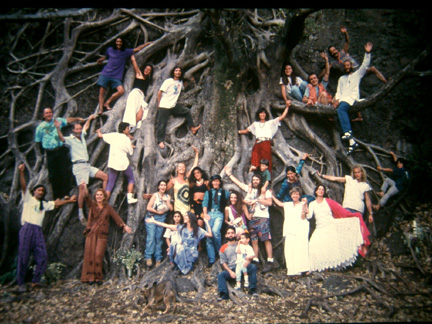
About an hour south of Mexico City, nestled in an extraordinary range of mountains called the Sierra del Tepozteco, whose fantastical rock formations studded with forest resemble those in ancient Chinese painted scrolls, an experiment in alternative living has been unfolding for more than 30 years now. The self-described "ecovillage" of Huehuecoyotl, where a group of itinerant artists from Mexico and elsewhere came to rest after traveling the world together for 15 years, has become a kind of seedbed for visionary and transformative projects, particularly ecological ones. The multitude of such efforts, their persistence and success, is one of the stories buried under the avalanche of horror that characterizes the mainstream news from Mexico.
Huehuecoyotl (pronounced "way-way-KOY-ott") is a Nahuatl word that means the Very Old Coyote, patron deity of creativity and sensuality to the pre-Hispanic Mexica people. Its story begins with two radical students, Alberto Ruz Buenfil (son of a prominent Mexican archaeologist) and Andres King Cobos, fleeing impending repression of the Mexican student movement in 1968. They went to Europe to pay their respects to the Danish Situationist Jørgen Nash, and ended up collecting an eclectic group of followers (including one of the Situationist's daughters, who became Cobos' first wife). Together they formed a street performance troupe, traveling Europe, Asia, and North America in the 1970s as a kind of rainbow tribe, without passports, with only the money they could raise dancing, drumming, miming in the streets of cities and remote villages, having children, switching partners, attending or participating in many of the radical social experiments of the time on three continents.
At the end of the decade the two Mexican founders felt the call to return to their home country. A group of 26 accompanied them, including Europeans, US Americans and other Mexicans, most parents with growing children now. They began to travel to different parts of Mexico, looking to be "called" by some place in particular. The place they found in the Sierra del Tepozteco in 1982 became their final and enduring home as a group.
They spent the early years living rustically on the undeveloped land in the brightly painted school buses and vans in which they had traveled the roads of North America at the end of the '70s. For their own children and the locals, they started an alternative low-cost primary school in Tepoztlán, the nearest major town. It was collectively run, and lasted for 16 years, involving over a hundred children and their families.
As they began to build infrastructure on their land, the "Huehues" studied and mimicked the integrated suite of sustainable construction and water conservation techniques of San Pedro Muñoztla, in Tlaxcala state. This was a poor village transformed in the early 1980s by the work of a visionary priest, who sought to make it more self-sufficient ecologically and economically so that its population would have reason to remain instead of fleeing to the cities. Its approach has since been widely studied and used as a model in other communities in Mexico and beyond.
Picturesque, steep-streeted Tepoztlán, meanwhile, with its cliff-top temple to the Mexica god of pulque (described below), was becoming known as a haven for New Age crystal gazers and other spiritual questers. But it was also a place where militant battles to preserve local culture from large-scale commercial development were fought. Members of Huehuecoyotl participated in the multi-year struggle to defeat a golf course and mega-hotel project there. It was ultimately successful, a landmark David and Goliath battle that was chronicled by activist filmmaker Saul Landau in We Don't Play Golf Here.
The families of Huehuecoyotl were avatars and early adopters in Mexico of a "deep ecology" perspective. Together with local activists, they started organizing large gatherings in different rural areas of Mexico called "Earth Guardians Vision Councils." Hundreds came together in these weeklong camps to learn from indigenous leaders about their earth-centered cosmovision and their stewardship practices. They also learned the theory and techniques of permaculture and bioregionalism, which the Huehues were among the first to disseminate in Mexico.
In 1994, Ruz Buenfil, feeling the call of the road again, decided to launch a new itinerant project, a caravan that would travel the Americas all the way to Tierra del Fuego, teaching permaculture and promoting respect for indigenous traditions and local cultures through music, dance, and street theater. The Caravana Arcoiris por la Paz's (Rainbow Peace Caravan) 13-year journey, which took a changing cast of international participants to almost every country in Central and South America, culminated in an official position given them by the Brazilian Ministry of Culture (directed at that time by iconic Brazilian musician Gilberto Gil) to serve as teachers and event organizers promoting ecological sustainability through art and culture.
Along the way Huehuecoyotl became a nexus point for all sorts of cultural cross-fertilization: ecological, artistic, and therapeutic, hosting many festivals and retreats. One of its founders became a professor at Goddard College in Vermont, and developed a program that brought students to Huehuecoyotl to study techniques for sustainable living. The community was also a founding member of the Global Ecovillage Network, which now includes over 200 sustainable communities on five continents. Another founder and former member started an international college-without-walls called Gaia University, which offers mentored programs in "ecosocial regeneration." Thanks to these networks and others, a continual stream of alternative living advocates and practitioners passes through Huehuecoyotl each year from all over the world.
But the community's role in Mexico is just as remarkable. One of the most interesting cross-fertilizations was set in motion by Helen Samuels, not a member but a long-time resident of Huehuecoyotl. A human rights lawyer brought up in Mexico as the child of blacklisted Hollywood film industry workers, she was at home both north and south of the border. She befriended a group of anarcho-punks from Mexico City's mean streets who were eking out a living making recycled art from objects culled from the mega-city's gargantuan garbage dump. Samuels talked to them about permaculture and invited them to come to Huehuecoyotl and learn how, even in a trash-strewn, concrete-walled city lot, they could grow their own food and increase their autonomy. The big-booted, pierced, black-garbed punks made multiple trips to pastoral Huehuecoyotl to work and learn in the community's vegetable gardens. They joined the eclectic participants in the Earth Guardian Vision Councils – Mexican hippies, eco-warriors, alternative healers and indigenous teachers - some even traveling to the parallel gatherings coordinated by the caravan in stops along its South American route.
This connection continues to the present day, with some of the ever-morphing group of punks (many of them now parents with children) acting as Vision Council coordinators (the 15th council will take place in Jalisco state this coming November), and participating in other events to promote ecological awareness in Mexico. One group started a Mexico City nightclub six years ago that has become not just a go-to spot for young Mexicans and visiting foreigners, but a center for politically conscious art exhibits, concerts, and poetry readings. It also features the punks' craft production of the Mexican fermented beverage pulque (made from the agave plant like its more famous cousin mescal). Pulque is a quintessential creation of Mexico's rural poor, which the club is single-handedly restoring to favor among a younger urban generation.
Internally, Huehuecoyotl was never contradiction-free: its artist-founders allowed a higher level of individualism and personal consumption than many "intentional" communities would favor. For example, at this point (after spending much of their lives without them) most members own personal cars; there is no collective economic project; there is no longer any attempt to produce even a small amount of their food collectively. Regular coordinating meetings are not even held any longer – only the ownership and management of their land is in common, and that is by consensus agreement, not by Mexican law.
But several core members retain a fervent commitment to ecological activism. Ruz Buenfil has been dedicating himself to efforts to codify the Declaration of the Rights of Mother Earth (now part of the code of law in Bolivia and Ecuador) in Mexico, and ultimately, in the U.N. King Cobos, a published poet, officiates at ceremonial gatherings in different parts of Mexico that strengthen indigenous spiritual traditions. Others have been involved in the hard-fought campaign to save Mexico's more than 4,000-year-old cultivation of native corn from free trade-related dumping of cheap U.S. pesticide-intensive and genetically modified varieties, and to promote local, affordable organic agriculture as an alternative.
Huehuecoyotl still remains at the center of a web of visionary alternatives that extends far beyond Mexico. But the community is entering a phase that many collective social experiments have not survived: its founding members are all in their 60s and 70s, many no longer live in the community full-time, and none of their adult children are currently living on the site. New members in the last 15 years have been scarce as well.
Land speculation in this beautiful area not far from the sprawling capital city is high – although Mexico's descent into extreme violence (it is now the third most deadly country from armed conflict in the world after Syria and Iraq) has put brakes on much of the buying and selling for the time being. Perhaps of even greater import to average Mexicans, their country is now among the top three most unequal of the 34 member countries in the Organization for Cooperation and Economic Development. The vast majority of the population thus lives in extreme financial uncertainty, and decent jobs outside Mexico's biggest cities and tourist areas are nearly impossible to find. Mexico also has a disproportionate share of the world's youth with neither jobs nor high school degrees. Most of Huehue's next generation, like the majority of Mexicans, has migrated to the cities or outside the country to work.
So Huehuecoyotl's future is no more guaranteed than Mexico's. For now it stands, a testament to the possibilities that were unleashed in the tempest of liberation movements of the last century. They cling tenaciously against the unrelenting war that the far-more successful liberation of global capital has waged on them. Whether these alternatives can thrive or just survive in the coming years will depend on unforeseeable factors, since the one clear global trend emerging in the 21st century is increasing chaos: environmental, financial, social. But as long as such visionary projects continue to exist, they offer concrete examples of paths that might be taken, in Mexico and elsewhere.