Tuesday, January 19, 2021

3469. Report: It’s Up To Us! Sonoma County Climate Summit

By Sonoma County Climate Activist Network, January 19, 2020

On January 10, 2021, almost 300 people gathered together for It’s Up To Us! Sonoma County Climate Activists Community Summit (Climate Summit) held on Zoom. In the minutes before the Climate Summit, participants were inspired by Alice Mayne-Ashworth’s renderings of Sunrise Movement songs. The Climate Summit Master of Ceremonies, Doron Amiran, EV Program Manager at the Climate Center, introduced us and kept us on track. Presenters excelled in bringing us together to connect, to pay attention, to transform through action – and to keep to the time provided!

Our first presenter, Dr. Brenda Flyswithhawks, spoke eloquently about the much-needed intersection of indigenous traditional practices and western science. Elizabeth Kaiser spoke about the value of regenerative agriculture practiced on small farms, their sheer productivity and positive impacts on soil health. Cory O’Gorman elaborated on his studies of fire, cultural burns and the great value of Traditional Ecological Knowledge (TEK) systems, and shared writing about his experiences. Writer and biologist Maya Khosla spoke of the value of natural wildfire in unlogged forests that regenerate naturally and beautifully. Wildfires are much misunderstood, post-fire forests are heavily logged. The dangerous emissions associated with biomass emit more carbon dioxide than burning coal (for an equal amount of power generated). There is a misguided notion that biomass is renewable energy. Sonoma Clean Power is currently exploring the possibility of biomass use as an option. Using forest-based products for generating energy is at least 1.5 times worse than coal.

Environmental educators Fabiola Maya and Vincent Tavani shared their poem, inspired by their recent travels through forests and other wild places, and reached out to reconnect us with what we love about our relationship with nature. Sunrise Movement youth members Christine Byrne and Janina Turner shared the origins and the power of the new Youth Movement, working toward stopping climate change, securing a Green New Deal, and creating a livable future for all. Greenbelt Alliance Advocacy Director, Teri Shore explained how Greenbelts can protect our communities and create climate resilience. Jenny Blaker and Woody Hastings explained CONGAS (Coalition Opposing New Gas Stations), a powerful new movement aimed at stopping the construction of new gas stations in Sonoma County. David Warrender discussed CCL (Citizens’ Climate Lobby); ways that people in our community can bring about a bold new climate policy. June Brashares and Woody Hastings described a prospective Sonoma County ballot proposition to establish a Progressive Wealth Tax for Climate Action – given the massive amount of wealth, and the associated carbon footprint, in the hands of the few who have the most. 

Frequent chats and questions indicated that participants were inspired by the strong messages of activism. Participants established a strong common ground; themes including a sense of faith in wild lands that regenerate on their own terms or in response to traditional fire treatments, the importance of producing local foods, of gathering to oppose large-scale projects that exacerbate climate change, the importance of being in conversation with our leaders: these prevailing themes were nurtured throughout the summit. Indigenous peoples kept ancient traditions that fostered balance and harmony between humans and nature. Green spaces are a vital part of that balance. Careful planning can limit urban growth, chemicals, monocrops, toxins and concrete. Growing food can be part of the balance when we build the soil instead of deplete it. A system that ignores people of color and over-extracts for profit ignores the wisdom that kept our land healthy for thousands of years. Wildfires can grow worse with large-scale logging projects. Biomass is decimating our forests while taking necessary funds away from real renewable energy like wind, solar and geothermal.  

It’s Up To Us! to preserve our ecosystem, locally and globally. When we come together we can hold wealthy exploiters accountable, and put an end to destructive projects. Even during the pandemic, we can gather, sit in virtual circles inspired by art, wisdom and nature, and find strength in sharing.    

Perhaps it was fortunate our March 2020 Summit was cancelled. Our event rose like a phoenix at the beginning of 2021. Long-standing activism combined with digital technology brought our event to life – and a short film served as a follow-up. ###

Contact: SonomaCountyCAN@gmail.com or call 707-595-0320

--------------------------------------------

The Sonoma County Climate Activist Network (SoCoCAN!) is a strong and active network of 50+ local climate change groups and over 200 individuals working together to address and reverse climate change. We meet in months with a 5th Monday, 7-9 PM. Currently we meet on Zoom. Next meeting is on March 29. Join our listserv for lively discussion and information sharing. Contact us at SonomaCountyCAN@gmail.com. Sonoma County Climate Activist Network (SoCoCAN!) https://www.SonomaCountyCAN.org SonomaCountyCAN@gmail.com 

707-595-0320 

Sunday, January 10, 2021

3468. No, America Has Not Entered the Weimar Era

By Louis Proyect, The Unrepentant Marxist, January 10, 2021
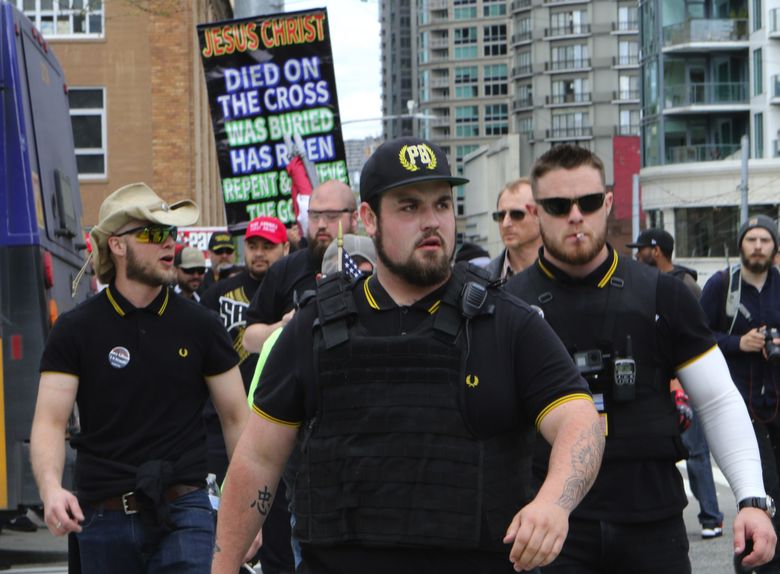
A Proud Boys demonstration in Seatle

Long before Trump became President, I noticed that some on the left were confusing contemporary America with the Weimar Republic in 1920s Germany. In 2010, I commented on an interview that Chris Hedges did with Noam Chomsky that encapsulated this misreading of history. Hedges starts off:

“It is very similar to late Weimar Germany,” Chomsky told me when I called him at his office in Cambridge, Mass. “The parallels are striking. There was also tremendous disillusionment with the parliamentary system. The most striking fact about Weimar was not that the Nazis managed to destroy the Social Democrats and the Communists but that the traditional parties, the Conservative and Liberal parties, were hated and disappeared. It left a vacuum which the Nazis very cleverly and intelligently managed to take over.”

As I have always tried to do when encountering a blinkered take on Weimar, I introduced some economic data:

To start with, the economic situation during the late Weimar Republic was far worse than today in the U.S. In 1932, there were 5 million unemployed German workers out of a total population of 66 million, an unemployment rate of 30 percent–twice what we are suffering in the U.S. today. Also, keep in mind that unemployment insurance, which had been introduced in Germany in 1927, was the victim of fiscal austerity after the 1929 market crash. All public funding was suspended, which resulted in higher contributions by the workers and fewer benefits for the unemployed.

After Trump was elected in 2016, the Weimar analogies increased dramatically for obvious reasons. Trump was widely perceived as the second coming of Adolf Hitler (or Mussolini) and as such it was incumbent on the left to study what happened in Germany in order to prevent another 1932. Both Ted Glick and Harold Meyerson tried to scare voters into pulling the lever for Hillary Clinton by bringing up the Weimar bogeyman. In my reply, I took exception to their notion that Jill Stein’s Green Party candidacy had anything to do with the German Communist Party’s insane ultraleft policy that equated the Socialist Party with the Nazis. I added that if there was any analogy, it was with the SP’s centrist politics that lost the votes of workers in the same way that Hillary Clinton’s continuation of Obama’s pro-Wall Street presidency made it possible for Trump to demagogically attack her Goldman-Sachs speeches. It was doubtful that either Glick or Meyerson had given much thought to SP policies in the 1920s:

Like the Democratic Party, the German Socialists cut deals with the opposition rightwing parties to stay in power. In effect, they were the Clinton and Obamas of their day. In 1928, the Socialists were part of a coalition government that allowed the SP Chancellor Hermann Müller to carry out what amounted to the same kind of sell-out policies that characterized Tony Blair and Bernard Hollande’s nominally working-class governments.

To give just one example, the SP’s campaign program included free school meals but when Müller’s rightwing coalition partners demanded that the free meals be abandoned in order to fund rearmament, Müller caved in.

My last reference to the Weimar Republic was a CounterPunch article last October that recapitulated previous articles and added:

Attempts to liken the Proud Boys or the Boogaloos to Hitler’s Brownshirts fall apart when examined under a historical spotlight. By 1932, it had 400,000 men that had years of experience attacking working-class demonstrations and rallies. By contrast, antifa confrontations with Trump supporters are skirmishes that generally do not involve casualties. When one happens, as was the case with Kyle Rittenhouse, the left must express outrage while it puts his actions into perspective. Like the driver who plowed his car into Heather Heyer in Charlottesville, this was an exception to the rule. America’s would-be fascists are primarily looking for fist-fights, not to commit homicide—at least for the time being.

For obvious reasons, the Weimar card is being played again after Trump supporters swarmed into the Capitol. Walden Bello has an article in Foreign Policy in Focus titled “America Has Entered the Weimar Era” that warns:

Future electoral contests for power may well end up being decided by a strong dose of street warfare, as the U.S. goes the way of Germany’s ill-fated Weimar Republic. The violent storming of the Capitol by a Trumpian mob underlined the face of crises to come.

You get the same thing from blogger Kenn Orphan whose post “Warnings from Weimar” is long on rhetoric but sketchy on the historical details:

There are many similarities of current day American politics to the final years of the Weimar Republic of the early 20th century: a bureaucratic plutocracy governed by out of touch liberal capitalists, incapable of understanding, let alone meeting, the needs of ordinary working people, in a nation where factions of the left foolishly downplayed the looming threat of the far right. This terrible recipe created the conditions that led many Germans to feel increasingly alienated from public life, and thus easily manipulated by nationalism, racism and the scapegoating of all of their problems.

Governed by out of touch liberal capitalists? Well, not exactly. More to the point, unless you get into the nitty-gritty realities of 1920s Germany, you might as well just say nothing since spouting glittering generalities does not help the left prepare for the possible emergence of a genuine fascist threat. In this post, I want to dig deeper into the concrete realities of Weimar that should make it obvious how different our situation is today. We have plenty to deal with but mostly it involves trying to build a socialist movement that in the final analysis is the best defense against fascism as opposed to voting for someone like Hillary Clinton or Joe Biden.

To start with, the conditions facing Germans immediately after WWI were disastrous. Forced to sign an onerous treaty imposed by the allies, the country suffered a precipitous drop in economic well-being. On one hand, it led to revolutionary struggles that failed to take power as I have outlined elsewhere. On the other, it spawned a far-right movement led by the Freikorps that had no parallels with today’s Proud Boys or any other white supremacist militia.

Between 1918 and 1922, 354 German politicians of the left had been murdered by the Freikorps or other rightwing militias that predated the Nazi Party. To give you an idea of the social weight of the Freikorps, over 1.5 million men joined for the sole purpose of beating up or, less frequently, killing leftists. Given the precarious position of the Socialist Party government in the immediate postwar period, it is not surprising that it relied on the ultraright militia to maintain “law and order”. It was SP President Friedrich Ebert’s decision to give the Freikorps the green light to murder Rosa Luxemburg and Karl Liebknecht in 1919.

By 1925, conditions had stabilized in Germany to the point where the Freikorps had outlived its usefulness. Another rightwing terrorist group called the Organization Consul continued assassinating leftists but less frequently and with less mass support.

But in only four years, conditions reverted to the early 20s as a consequence of the Great Depression. Millions of Germans were plunged into poverty to the point that they’d rally behind any group on the right or the left that could “make Germany great again”. Unlike the largely middle-class MAGA cap wearing louts that invaded the Capitol, the Germans susceptible to Hitler’s demagogy were driven by economic misery rather than nationalism for the most part.

A brief article from the June 19, 1932 New York Times should give you a feel for the desperate situation in Germany:

In the Bischofshem forest hikers found the corpses of a family of five—father, mother, and three children from 3 to 7—a brief note in the man’s pocket stating that economic misery had determined him and his wife to commit suicide, and take their children with them. “The courageous don’t grow old,” the note concluded. Its writer was 35 years old, a World War veteran, out of work, trying to eke out a living selling newspapers. He had shot his wife and children, and then himself.

Eighteen thousand people killed themselves in Germany last year, according to the provisional figures. Berlin alone had nearly seven hundred suicides the first four months of this year. The suicide curve seems to be rising steeply, and common sense interprets this as the reflection of constantly increasing economic pressure.

This time, however, it was Adolf Hitler’s Nazi stormtroopers that were targeting the left, Jews and Roma rather than the Freikorps. His party grew but so did the Communist Party. The Nazis had 107 seats in the Reichstag but the CP had 77. More importantly, the SP had 143. Added together, the two nominally socialist parties had twice as much political clout than the Nazis but their failure to unite against the fascists led to a tragic defeat. As stated above, the SP urged a vote for capitalist politicians like Bruning and von Hindenburg while the CP carried out a sectarian “united front from below” that went so far as to back a Nazi referendum that would result in the unseating of an SP governor in Saxony. How does this compare to the USA with zero socialists in Congress except the squad that has little influence over national or international affairs.

Having almost zero resemblance to the street fights between antifa and the Proud Boys, et al, the battle for control over the streets between Nazis and Reds after 1929 were bloody battles that took the lives of 155 and injured another 426 in Prussia. Most of the casualties, of course, were Reds who had to face the combined forces of cops and fascists.

On January 2nd, I posted a link to an article by Jairus Banaji titled “The Political Odyssey of Arthur Rosenberg, Germany’s Forgotten Marxist” that appeared in Jacobin. It refers to his most important work, “A History of the German Republic” that fortunately can be read on Marxists.org.

The final paragraphs of the concluding chapter titled “Chapter IX: The End, 1928-1930” will put Hitler’s rise into context. You had a Socialist Party with millions of members that makes the American left today look like a flea next to an elephant. While not quite as large as the SP, the CP was far more militant and far more willing to battle the Nazis in the street. It is our misfortune that the self-styled antifa has little understanding of why punching Nazis, or even killing them, would do little to block Hitler’s rise to power. Let Arthur Rosenberg explain why:

A united front SPD – KPD that ruthlessly waged war upon Brüning’s dictatorship and capitalism might still have decided the destiny of the German republic by compelling the new Nazi electorate to decide between capitalism and socialism. The necessity for any such decision would have broken up Hitler’s following and deprived the counter-revolution of its popular basis. Since, however, the KPD leaders did not want a revolution, but only wished to follow the easy road of making propaganda against the SPD, and since the right-wing Socialist leaders mistrusted the power of the proletariat and preferred the ‘lesser evil’, no such united socialist fighting front came into existence. Moreover, left-wing Socialists were hemmed in between the majority in their own party and the official KPD, and therefore rendered incapable of action.

The new Reichstag was composed of 150 supporters of the Hitler – Hugenberg block, 220 Marxists and about 200 supporters of Brüning’s government. The Conservatives did not fear either the SPD or the KPD, but the competition of the Hitler – Hugenberg block, which had scored such a notable success at the polls. The struggle between the Conservatives and Hugenberg’s supporters was, however, a domestic concern of the great capitalists and their friends among the territorial magnates. The SPD regarded the Conservative government as the lesser evil, and therefore gave its support to Brüning in his struggle with the Hitler – Hugenberg block and the KPD.

On 18 October 1930 the majority in the Reichstag composed of Brüning’s supporters and the Social Democrats resolved to refer the question of the emergency decrees to a special commission of the Reichstag and to pass to the order of the day without discussing the proposed vote of no confidence that lay upon the table. The Reichstag thus abandoned the struggle with the unconstitutional dictatorship of Brüning and his friends by a majority vote. The same hour saw the death of the Weimar Republic. Since then one dictatorship has succeeded to another in Germany.

The leading Social Democrats, who were convinced that the socialist proletariat was too weak to embark upon open warfare, indulged themselves in hopes that the existing crisis would run the same course that had been followed by the crisis of 1923. They were prepared to ‘tolerate’ the emergency decrees in a similar fashion to that in which they had formerly ‘tolerated’ the enabling act. If Brüning in his struggle with Hitler and Hugenberg only contrived to avoid making any really serious mistake, it was possible – so they argued – that some fortunate concatenation of circumstances would permit of the resuscitation of the Weimar Republic. These men forgot that in 1924 democracy in Germany was not rescued by their endeavours, but by the intervention of the New York Stock Exchange. In 1930-31, American financiers were neither willing nor able to rescue the Weimar Republic for a second time.

The middle-class republic established in 1918 in Germany was the creation of the working classes. The middle classes themselves had either fought against it or only half-heartedly supported it. The middle-class republic collapsed in 1930 because its destiny had been entrusted to the middle classes, and because the working classes were no longer strong enough to save it. Although the working classes comprised three-quarters of the entire nation, they were unable to unite either upon their political ideals or their political tactics. The counter-revolution triumphed because the working classes squandered their immense forces in internecine warfare.

3467. Poll Finds Many Believe QAnon And Other Conspiracy Theories

By Joel Rose, NPR, December 30, 2020


A significant number of Americans believe misinformation about the origins of the coronavirus and the recent presidential election, as well as conspiracy theories like QAnon, according to a new NPR/Ipsos poll.

Forty percent of respondents said they believe the coronavirus was made in a lab in China even though there is no evidence for this. Scientists say the virus was transmitted to humans from another species.

And one-third of Americans believe that voter fraud helped Joe Biden win the 2020 election, despite the fact that courtselection officials and the Justice Department have found no evidence of widespread fraud that could have changed the outcome.

The poll results add to mounting evidence that misinformation is gaining a foothold in American society and that conspiracy theories are going mainstream, especially during the coronavirus pandemic. This has raised concerns about how to get people to believe in a "baseline reality," said Chris Jackson, a pollster with Ipsos.

"Increasingly, people are willing to say and believe stuff that fits in with their view of how the world should be, even if it doesn't have any basis in reality or fact," Jackson said.

"What this poll really illustrates to me is how willing people are to believe things that are ludicrous because it fits in with a worldview that they want to believe."

"That's terrifying"

The NPR/Ipsos poll of 1,115 U.S. adults was conducted Dec. 21 to 22. The credibility interval for the overall sample is 3.3 percentage points.

One of the most striking poll findings has to do with QAnon, the baseless conspiracy theory that gained widespread attention this year as two of its backers were elected to Congress.

The poll asked respondents whether they believe that "a group of Satan-worshipping elites who run a child sex ring are trying to control our politics and media" — the false allegation at the heart of QAnon. While only 17% said it was true, another 37% said they didn't know.

"It's total bonkers," said Jackson, "and yet ... essentially half of Americans believe it's true or think that maybe it's true. They don't really know. And I think that's terrifying that half of Americans believe that could be the case."

According to the poll, 39% of Americans believe another key tenet of the QAnon theory: that there is a deep state working to undermine President Trump.

The president is himself a major source of misinformation, as he continues to make baseless claims about election fraud on Twitter and elsewhere. Conservative media also have devoted hours of coverage to exaggerated or debunked claims.

The NPR/Ipsos poll suggests those claims are having an impact. Two-thirds of Republicans surveyed said they believe that voter fraud helped Biden win the election, and fewer than half of Republicans said they accept the outcome of the election.

"There's just too much information out there," said Brooke Williams, a Republican voter and self-described QAnon follower from Oro Valley, Ariz., during a follow-up interview with NPR. "I can't see how anybody is not thoroughly convinced that Biden was illegally elected."

In contrast, only 11% of Democrats think voter fraud helped Biden win the election, and 93% accept the outcome.

Whom Americans trust

Overall, most respondents said they do want to see a peaceful transition to a Biden administration in January, though many are worried about political violence over the next four years.

The vast majority of Americans said they're also worried about the spread of false information, with 4 out of 5 poll respondents saying they're concerned about misinformation related to the coronavirus and vaccines in particular.

But Republicans were more likely than Democrats to believe misinformation about the virus, including that it was created in a lab in China and that COVID-19 is no more of a "serious threat" than the seasonal flu.

"I think it was deliberately released by China," said Jon Costello, a Republican from Huntsville, Ala., who responded to the poll. "I think this big thing of shutting down businesses, shutting down education systems ... is all part of a plan to break the spirit and the will of Americans."

Poll respondents of both parties expressed skepticism about the vaccines that are now being distributed in the U.S., though Republicans were less likely than Democrats to say that they would "take the COVID-19 vaccine as soon as it is made available to me."

"I shouldn't have to take a vaccine for something that was man-made," said Shaena Castro, a Democrat who lives in New York City. "I guess you can call me a conspiracy theorist or whatever, but yeah, I am convinced that it's man-made."

When asked whom they trust, respondents mostly pointed to the people they encounter in their daily lives. Personal physicians scored highly, as did faith or spiritual leaders.

Politicians and media figures did not fare as well. Tucker Carlson of Fox News, Rachel Maddow of MSNBC and Wolf Blitzer of CNN were at the bottom of the list.

More Americans trust Biden than Trump, but both lagged behind Dr. Anthony Fauci, the director of the National Institute of Allergy and Infectious Diseases, who scored the highest of any specific person the poll asked about.

New misinformation vs. old conspiracy

Pollsters say that multiple factors make people more or less susceptible to misinformation — including educational attainment, media consumption and political affiliation — and that people are more likely to believe conspiracy theories that fit into their worldview.

For example, almost half of respondents said that the majority of racial justice protests over the summer were violent, when in fact the vast majority were peaceful. Poll respondents from all demographics answered this question incorrectly — but they were even more likely to do so if they were Republicans and if they got their news from Fox News or conservative online outlets like Breitbart or the Daily Caller.

Recent misinformation held more sway than some older conspiracy theories.

About 60% of Americans correctly answered that former President Barack Obama was born in the United States and that several mass shootings in recent years were not staged hoaxes. And about 70% correctly answered that humans do play a significant role in climate change — roughly the same percentage who believe astronauts landed on the moon in the 1960s and '70s.

It's also clear from the poll results that Americans are worried about misinformation, even if there's no clear prescription for what to do about it.

Nearly 70% of respondents said they are concerned that information they receive on social media is inaccurate; a similar percentage is concerned about foreign interference in U.S. social media.

"I'm concerned to see so many people living in a false reality, seeing relatives honestly believe that this was some kind of rigged election," said William Street, who lives in northeast Mississippi.

"It terrifies me that people can be that misled and believe conspiracy theories like that," Street tells NPR. "I'm concerned that with even just a little prodding from this man in office, they could be led to do very desperate things."

NPR senior producer Marisa Peñaloza contributed to this story.

Saturday, January 9, 2021

3466. Riot on the Hill

By Mike Davis, Sidecar, January 7, 2021


Yesterday’s ‘sacrileges’ in our temple of democracy – oh, poor defiled city on the hill, etc. – constituted an ‘insurrection’ only in the sense of dark comedy. What was essentially a big biker gang dressed as circus performers and war-surplus barbarians – including the guy with a painted face posing as horned bison in a fur coat – stormed the ultimate country club, squatted on Pence’s throne, chased Senators into the sewers, casually picked their noses and rifled files and, above all, shot endless selfies to send to the dudes back home. Otherwise they didn’t have a clue. (The aesthetic was pure Buñuel and Dali: ‘Our only rule was very simple: no idea or image that might lend itself to a rational explanation of any kind would be accepted.’) 


But something unexpectedly profound happened: a deus ex machina that lifted the curse of Trump from the careers of conservative war hawks and right-wing young lions, whose ambitions until yesterday had been fettered by the presidential cult. Today was the signal for a long-awaited / prison break. The word ‘surreal’ has been thrown around a lot, but it accurately characterizes last night’s bipartisan orgy, with half of the Senate election-denialists channeling Biden’s call for a ‘return to decency’ and vomiting up vast amounts of noxious piety. 


Let me be clear: the Republican Party has just undergone an irreparable split. By the White House’s Fuhrerprinzip standards, Pence, Tom Cotton, Chuck Grassley, Mike Lee, Ben Sasse, Jim Lankford even Kelly Loeffler are now traitors beyond the pale. This ironically enables them to become viable presidential contenders in a still far-right but post-Trump party. Since the election and behind the scenes, big business and many mega-Republican donors have been burning their bridges to the White House, most sensationally in the case of that uber-Republican institution, the National Association of Manufacturers, which yesterday called for Pence to use the 25th Amendment to depose Trump. Of course, they were happy enough in the first three years of the regime with the colossal tax cuts, comprehensive rollbacks of environmental and labor regulation, and a meth-fed stock-market. But the last year has brought the unavoidable recognition that the White House was incapable of managing major national crises or ensuring basic economic and political stability. 


The goal is a realignment of power within the Party with more traditional capitalist interest groups like NAM and the Business Roundtable as well as with the Koch family, long uncomfortable with Trump. There should be no illusion that ‘moderate Republicans’ have suddenly been raised from the grave; the emerging project will preserve the core alliance between Christian evangelicals and economic conservatives and presumably defend most of the Trump-era legislation. Institutionally, Senate Republicans, with a strong roster of young talents, will rule the post-Trump camp and, via vicious darwinian competition – above all, the battle to replace McConnell – bring about a generational succession, probably before the Democrats’ octogenarian oligarchy has left the scene. (The major internal battle on the post-Trump side in the next few years will probably center on foreign policy and the new cold war with China.) / That’s one side of the split. The other is more dramatic: the True Trumpists have become a de facto third party, bunkered down heavily in the House of Representatives. As Trump embalms himself in bitter revenge fantasies, reconciliation between the two camps will probably become impossible, although individual defections may occur. Mar-a-Lago will become base camp for the Trump death cult which will continue to mobilize his hardcore followers to terrorize Republican primaries and ensure the preservation of a large die-hard contingent in the House as well as in red-state legislatures. (Republicans in the Senate, accessing huge corporation donations, are far less vulnerable to such challenges.) 


Tomorrow liberal pundits may reassure us that the Republicans have committed suicide, that the age of Trump is over, and that Democrats are on the verge of reclaiming hegemony. Similar declarations, of course, were made during vicious Republican primaries in 2015. They seemed very convincing at the time. But an open civil war amongst Republicans may only provide shortterm advantages to Democrats, whose own divisions have been rubbed raw by Biden’s refusal to share power with progressives. Freed from Trump’s electronic fatwas, moreover, some of the younger Republican senators may prove to be much more formidable competitors for the white college-educated suburban vote than centrist Democrats realize. In any event, the only future that we can reliably foresee – a continuation of extreme socio-economic turbulence – renders political crystal balls useless. Read on: Mike Davis’s New Year’s blast to the American left.

3465. Americans Remain Distrustful of Mass Media

By Megan Brenan, Gallup, Septermber 20, 2020

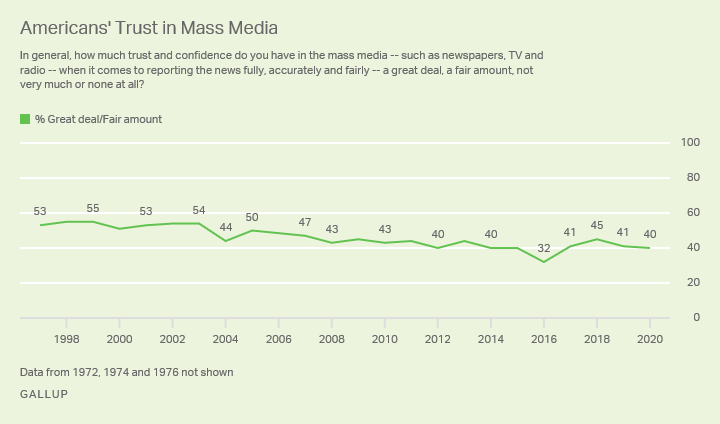
At a time when Americans are relying heavily on the media for information about the coronavirus pandemic, the presidential election and other momentous events, the public remains largely distrustful of the mass media. Four in 10 U.S. adults say they have "a great deal" (9%) or "a fair amount" (31%) of trust and confidence in the media to report the news "fully, accurately, and fairly," while six in 10 have "not very much" trust (27%) or "none at all" (33%).

Line graph. Americans' trust in the mass media when it comes to reporting the news fully, accurately and fairly since 1997. Currently, 40% have a great deal or fair amount of trust in the mass media, and 60% have not very much or none at all.

Gallup first asked this question in 1972 and has continued to do so nearly every year since 1997. Trust ranged between 68% and 72% in the 1970s, and though it had declined by the late 1990s, it remained at the majority level until 2004, when it dipped to 44%. After hitting 50% in 2005, it has not risen above 47%.

The latest findings, from Gallup's annual Governance poll conducted Aug. 31-Sept. 13, are consistent with all but one recent trust rating -- in 2016, a steep decline in Republicans' trust in the media led to the lowest reading on record (32%).

Republicans' trust has not recovered since then, while Democrats' has risen sharply. In fact, Democrats' trust over the past four years has been among the highest Gallup has measured for any party in the past two decades. This year, the result is a record 63-percentage-point gap in trust among the political party groups.

Line graph. Partisans' trust in the mass media when it comes to reporting the news fully, accurately and fairly since 1997. Currently, 73% of Democrats, 36% of independents and 10% of Republicans have a great deal or fair amount of trust in the mass media. This is the widest gap in trust between Democrats and Republicans that Gallup has recorded.

While majorities of Democrats have consistently expressed confidence in the media since 1997, this has not been true of independents since 2004. Republicans' last majority-level reading for trust in the media was in 1998.

Democrats' and Republicans' Degrees of Trust Have Shifted

Although Americans' overall trust in the media has remained steady since last year, the 33% who do not have any confidence this year reflects a five-point uptick and is the highest reading on record. Republicans are the main drivers behind this change: 58% of them now express this view, marking a 10-point increase and the first-ever majority-level reading.

Although Democrats' overall level of trust has not changed, the 57% who now say they have a fair amount of trust represents a 12-point jump from 2019, mostly attributable to a decrease in the percentage saying they trust the media a great deal.

Partisans' Trust in Mass Media, 2019 vs. 2020
In general, how much trust and confidence do you have in the mass media -- such as newspapers, TV and radio -- when it comes to reporting the news fully, accurately and fairly?
A great dealA fair amountNot very muchNone at all
%%%%
Total U.S. adults
20209312733
201913283028
Democrats
20201657216
201924452110
Republicans
2020373158
20194113748
Independents
20206302935
20199273430
Bolded figures are statistically significant changes
GALLUP

Bottom Line

Americans' confidence in the media to report the news fairly, accurately and fully has been persistently low for over a decade and shows no signs of improving, as Republicans' and Democrats' trust moves in opposite directions. The political polarization that grips the country is reflected in partisans' views of the media, which are now the most divergent in Gallup's history. Recent Gallup/Knight Foundation polling has shown that although Americans increasingly see bias in news coverage, they nonetheless believe that an independent media is key to democracy.

View complete question responses and trends (PDF download).

Learn more about how the Gallup Poll Social Series works.


Friday, January 8, 2021

3464. The Long-Lasting Effects of COVID-19

By Anthony L. Komaroff, Harvard Health Letter, January 2021


Q. I read that the death rate from COVID-19 is going down, but that people who recover from the infection still can remain sick for a long time. Is that true?

A. It is true, but we don't yet know how big the problem is: COVID-19 has been with us for only a year, and there hasn't been enough time to know the long-term effects.

When people first started getting sick with COVID, doctors thought that it affected primarily the lungs. Unfortunately, we quickly learned that it also could affect the heart, kidneys, brain, and other organs. This surprised many of us. In late February 2020, a previously healthy 30-year-old man I knew told me he had been running fevers, had experienced a seizure, and was worried he might have COVID. I reassured him, but I was wrong and the patient was right. Within the next four weeks, doctors around the world were reporting various brain conditions in people with COVID.

Some previously healthy people who survived COVID have been left with evidence of injury to the heart and kidneys. It is too soon to know whether the damage is permanent and whether it will affect their level of function.

There also are people who survived COVID and have no evidence of injury to the heart, kidneys, or brain — but who nevertheless have not returned to full health. They still have fatigue, body aches, shortness of breath, difficulty concentrating, inability to exercise, headache, and trouble sleeping. Some studies find that more than 50% of people who "recovered" from COVID remain hobbled by these symptoms three months later. They can't return to work. They can't fulfill their responsibilities at home. They are being called "long haulers." Such lingering symptoms have been reported following "recovery" from a number of other infectious illnesses, including mononucleosis, Lyme disease, and SARS (another disease caused by a coronavirus). So, it is not surprising that this illness — which is similar to the illness called myalgic encephalomyelitis / chronic fatigue syndrome — develops following COVID.

In other words, while fewer people who get COVID are dying, not all of them are recovering. We don't know how many people will remain hobbled, long-term. But it is plausible that tens of thousands in the United States may never be the same again.

The first reported cases of COVID in the United States and South Korea occurred on the same day. South Korea implemented containment strategies that were developed by the U.S. CDC. The United States did not. Since then (as of the time I write this), the United States has had 50 times more deaths per capita from COVID than South Korea. We could therefore have 50 times more long haulers, too. And the U.S. economy has shrunk, while South Korea's has grown. Bad mistakes rarely lead to only temporary damage.

— Anthony L. Komaroff, M.D.

Editor in Chief, Harvard Health Letter