Fueled in part by human-caused climate change, a “megadrought” appears to be emerging in the western U.S., astudy published Thursday suggests.
In fact, the nearly-20-year drought is almost as bad or worse than any in the past 1,200 years, scientists say.
Megadroughts – defined as intense droughts that last for decades or longer – once plagued the Desert Southwest. Thanks to global warming, an especially fierce one appears to be coming back:
"We now have enough observations of current drought and tree-ring records of past drought to say that we're on the same trajectory as the worst prehistoric droughts," said study lead author A. Park Williams, a bioclimatologist at Columbia University, in a statement. This is “a drought bigger than what modern society has seen."
Scientists say that about half of this historic drought can be blamed on man-made global warming. Some of the impacts today include shrinking reservoirs and worsening wildfire seasons. Since temperatures are projected to keep rising, it is likely the drought will continue for the near future or fade briefly only to return, researchers say.
The study covers an area stretching across nine U.S. states from Oregon and Montana down through California, New Mexico and part of northern Mexico.
Daniel Swain, a UCLA climate scientist who wasn’t part of the study, called the research important because it provides evidence “that human-caused climate change transformed what might have otherwise been a moderate long-term drought into a severe event comparable to the ‘megadroughts’ of centuries past.”
Williams said the region could stay dry for centuries. "That's not my prediction right now, but it's possible."
Naturally occurring western megadroughts have taken place many times before. In fact, most of the USA's droughts of the past century, even the 1930s Dust Bowl that forced migrations of Oklahomans and others from the Plains, "were exceeded in severity and duration multiple times by droughts during the preceding 2,000 years," the National Climate Assessment said.
The difference now, of course, is the western USA is home to more than 70 million people who weren't here for the previous medieval megadroughts. The implications are far more daunting.
University of Michigan environment dean Jonathan Overpeck, who studies southwestern climate and was not part of the study, calls this drought “the first observed multidecadal megadrought in recorded U.S. history.”
To identify past droughts, scientists studied thousands of tree rings to find out how much – or little – rain fell hundreds of years ago. Scientists used historical data in combination with several computer model simulations to reach their conclusions.
One additional worrisome fact from the study was that the 20th century was the wettest century in the entire 1,200-year record. It was during that time that the population boomed in the western U.S., and that has continued.
"The 20th century gave us an overly optimistic view of how much water is potentially available," said study co-author Benjamin Cook, a NASA climate scientist, in a statement.
"It goes to show that studies like this are not just about ancient history," he said. "They're about problems that are already here."
The study was published Thursday in the peer-reviewed journal Science.
By Louis Proyect, The Unrepentant Marxist, April 20, 2020
Bhaskar Sunkara
One big difference between the Jacobin left and the left of my generation is over the “road map”. In 1973 or so, nobody in the SWP or any Maoist, for that matter, had any idea of how a revolution could take place except in the most general terms. We all pretty much understood that the workers would not march under the banner of socialism, at least understood according to the Communist Manifesto, unless there was a profound change in American society that forced them to engage in uncompromising struggle such as that which took place during the Great Depression. It was up to us to engage in various struggles as they arose, from the right to an abortion to challenging the trade union bureaucracies, but we accepted the idea that as Marx put it in “The German Ideology”: “The ideas of the ruling class are in every epoch the ruling ideas, i.e. the class which is the ruling material force of society, is at the same time its ruling intellectual force.”
In the late 70s, the SWP accepted the word of its leadership that revolution was on the agenda but there was no road map as such that described the specific routes. The entire membership was instructed to get blue-collar jobs because increasing class conflict was making the factories and mines like Columbia University and Berkeley were in 1968. This was delusional of course.
Then along came Bhaskar Sunkara who with his customary aplomb and self-confidence told his readers in the penultimate chapter of “The Socialist Manifesto”: “The dilemma for socialists today is figuring out how to take anger at the unjust outcomes of capitalism and turn it into a challenge to the system itself…Easier said than done. But this chapter offers a road map based on the long, complex, variously inspiring and dismal history of left politics—for challenging capitalism and creating a democratic socialist alternative to it.”
It is not too difficult to figure out what this road map looked like. It began on the expressway built by Jeremy Corbyn in England and Bernie Sanders in the USA. Although there was no guarantee that their becoming Prime Minister and President respectively was assured, it made much more sense to drive in your battery-operated car on that road than to waste your time in revolutionary organizations like the kind we belonged to in the 60s and 70s.
After all, Sunkara’s guru Vivek Chibber, who was to the NYU Sociology Department as Lenin was to the Smolny Institute, had put down the word in an article titled “Our Road to Power”. (Road, get it? It’s a leitmotif in the Jacobin oeuvre.) Chibber warns his readers about taking “the Russian road”: “The Russian road, as it were, was for many parties a viable one. But starting in the 1950s, openings for this kind of strategy narrowed. And today, it seems entirely hallucinatory to think about socialism through this lens.”
For Chibber and virtually all the Jacobin intellectuals, Washington could never be mistaken for the decaying Czarist state. It was virtually unsmashable: “Today, the state has infinitely greater legitimacy with the population than European states did a century ago. Further, its coercive power, its power of surveillance, and the ruling class’s internal cohesiveness give the social order a stability that is orders of magnitude greater than it had in 1917.”
So, if the “Russian road” was precluded by permanent structural obstacles, how could we get past capitalism? This is where Jacobin becomes a bit more elusive. Ever since the 2016 elections, the emphasis has been less on the need for system change than it has been for a “political revolution”, a term that meant, first of all, electing Corbyn and Sanders and politicians that received benediction from Jacobin and Tribune, the British magazine that became part of Sunkara’s publishing empire.
For most DSA members, the prospect of seeing Bernie Sanders in the White House was so enthralling that the questions posed in Marx’s writings on the Paris Commune could not be less germane. Why bother yourself with obscure questions of workers ruling in their own name when enlightened politicians could shepherd legislation like a Green New Deal through Congress. Sunkara nimbly made the case for socialism being largely realized through enlightened government policies:
Luckily, the United States doesn’t have to contend with antidemocratic supranational organizations like the eurozone, and it has immense resources to work with. We ultimately have larger ambitions than “socialism in one country,” but if it’s possible anywhere, it’s possible here. Cobbling together the legislative power to achieve these reforms will not be easy.
But it is possible to achieve certain socialist goals within capitalism. As we’ve seen in the history of social democracy, any achievements will be vulnerable to crises and resisted at every step, but they are morally and politically necessary nonetheless.
I could spend 10 thousand words dismantling the ideological baggage that underpins this absurd passage but suffice it to say that the word “socialism” is misused here. Larger ambitions than “socialism in one country” in a capitalist country? WTF? Socialist goals within capitalism? When you peel away the rhetoric, it is simply a recipe for electing politicians like Sanders and the squad. Or as Eduard Bernstein once put it, “The movement is everything, the final goal is nothing.”
Granted, most Jacobin intellectuals seemed ready to accept a Sanders victory as the first leg in the road to power, especially after his thrilling victory in Las Vegas. Dustin Guastella and Connor Kilpatrick were beside themselves. In an article titled “After the Nevada Blowout, It’s Bernie’s Party Now”, they rolled out the red carpet: “He’s on his way to not just the nomination, but the White House.” If someone ever wrote a book about articles that had a brief shelf life, this one would make it right alongside that one:
For normal people, Biden’s subsequent clearing the pool table operation, abetted by Obama’s behind-the-scenes maneuvering and Sanders’s fulsome deference to his “old friend” Joe Biden, might be enough to convince them that the signs on the Jacobin road map were starting to look this:
Until now, Jacobin’s Grand Poobah has not weighed in but members of his court have tried to put the best possible spin on the reversal of fortune. Heir to Kautsky’s throne, Eric Blanc spoke for those who slapped themselves on the back for helping to make Sanders’s “ideological victory” possible:
Since our collective expectations were raised so high after Nevada, it’s easy to forget how much we’ve already accomplished in the face of seemingly insurmountable odds. As Bernie correctly emphasized in his suspension speech this morning, the campaign has largely won the battle of ideas. And the paralyzing myth that there is no political alternative to the neoliberal status quo has been shattered.
How this will translate in “road map” terms to the next election remains uncertain. Sanders has turned in a truly demoralizing performance as he began walking off the stage. In an video co-produced by the Biden and Sanders campaign, you are reminded of Vladimir and Estragon in a sequel to the Beckett classic titled “Waiting for Socialism”:
Unlike Blanc, some of the Jacobin intellectuals were undeterred. They brazened it out, finding nothing wrong with being embedded in the Democratic Party as if it were some sort of 21st Century version of Lenin’s vanguard party. Yeah, it didn’t have much to do with socialism but it was legitimated by the facts on the ground. What are you going to do, anyhow? Waste your time on some tiny group that still takes The Communist Manifesto seriously when you can be devoting the next four years to help elect Alexandria Ocasio-Cortez? Yes, she is showing less and less “democratic socialist” credibility but everybody loves a winner unlike those pathetic Green Party candidates who prioritize principles.
Dustin Guastella, who co-wrote the article about the Sanders take-over of the DP referred to above, warned about abandoning the world’s oldest still-functioning capitalist party in Jacobin just yesterday in an article titled “Like It or Not, If We Run Third Party, We Will Lose” Showing the kind of bluster once heard from “socialist” UFT leader Albert Shanker, Guastella, a Teamsters Union official in Philadelphia, rolled out all the predictable reasons for staying inside Joe Biden’s political catacombs. Ballot laws kept 3rd parties on the defensive, including new laws in NY State that would make both the Greens and the Working Families Party victims of the “enlightened” governor’s hunger for power.
Guastella, who will likely to be paid as a Teamster official for the foreseeable future, warns against futile efforts to create a radical left party in the USA:
That third parties are destined to lose is no secret — it’s right there in the name. They are the distant bronze medalists of American politics. But, a skeptic might ask, if what you say is true — that party realignment and break are outcomes of struggle — why haven’t we seen Joe Biden bend on key policy issues? And, further, what basis is there for believing that the Democrats will ever bend (or break)?
Patience. We are still a weak, small movement — despite the fact that our ideas have captured the attention of voters, our candidates haven’t won the loyalty of mass constituencies, and our base is largely disorganized. After all, the Democratic establishment just steamrolled us with a candidate that seems severely confused at best and demented at worst.
After reading Blanc and Guastella, I am left with the conclusion that these people are hopeless. I left the SWP in 1978 because I became convinced that nothing could deter the cult leadership from a self-destructive path. The culture of “democratic centralism” created a mindset that made it impossible for Barnes and company to reverse course. While the Jacobin/DSA is no cult, the people around Blanc and Guastella’s Bread and Roses caucus wear self-enforcing ideological blinders that make it impossible for them to consider anything else except operating on the fringes of the Democratic Party.
For those whose minds are not captive to Leninist or Kautskyite formulas, it is obvious that a profound and highly momentous changes are in play as a result of the pandemic. Right now, half of all men under the age of 45 in Los Angeles County are either unemployed or working reduced hours. All across the USA, men and women vulnerable to getting the disease are starting to carry out wildcat strikes. Today there was a report on the “Service workers strike at two luxury Manhattan buildings“:
The service workers, who are based at The Chamberlain and 432 West 52nd Street condominiums, walked out at 11:30 a.m. Thursday and will strike for 24 hours, they said.
They accuse their employer, building-services contractor Planned Companies, of paying them substandard rates while they work through the coronavirus pandemic, and blocking their efforts to join labor union SEIU 32BJ. They also say Planned failed to provide enough masks and gloves to protect them on the job.
Unlike Jacobin/DSA, both the Philly Socialists and the activists who produce Cosmonaut have circulated an appeal for young activists to get jobs working at Amazon:
The COVID-19 pandemic has pushed Amazon’s infrastructure and workforce to their limits. As people self-quarantine and flock to the e-commerce giant to home-deliver their stockpiles of food, water, and sanitation supplies, logistics workers at Amazon and elsewhere strain under the increased burden. As the virus spreads and schools close, leaving working-class children with no caretakers, workers are forced to make impossible decisions between earning a wage and caring for their family. The current crisis is rapidly accelerating class conflict within these dynamics. Workers in Italy are going on strike, and unrest is developing here in the United States. The left should see this as an opportunity to expand the efforts of workers already organizing on the ground, pushing forward demands that will not only help drive a humane working-class centered response to the crisis, but further the groundwork for stronger working-class organization moving forward.
This is what a socialist party has to be all about. Organizing men and women to get involved with fights for working class power. The DSA has to understand that it will be expected to put its substantial muscle behind such organizing efforts if it wants to have any credibility. Eric Blanc showed that he had some appreciation for the need for this kind of solidarity through his articles on the wildcat teachers’ strikes, even if it was framed in terms of how important Bernie Sanders was in getting them going—a claim some teacher activists found overstated.
In any case, Lenin’s party rather than Kautsky’s is a model for what is needed today. Even if Lenin credited Kautsky’s party as a model, the Russians always put struggle first. The Bolsheviks ran candidates but mostly in the interest of spreading socialist ideas rather than taking over the capitalist state. As for understanding the Bolshevik electoral policy, I recommend August Nimtz’s “Lenin’s Electoral Strategy from 1907 to the October Revolution of 1917: The Ballot, the Streets―or Both”. For those unwilling to read the book for lack of time, I at least urge you to watch this video. It was made for the stormy period we are entering:
The world has changed dramatically in the three months since our last update of the World Economic Outlook in January. A rare disaster, a coronavirus pandemic, has resulted in a tragically large number of human lives being lost. As countries implement necessary quarantines and social distancing practices to contain the pandemic, the world has been put in a Great Lockdown. The magnitude and speed of collapse in activity that has followed is unlike anything experienced in our lifetimes.
This is a crisis like no other, and there is substantial uncertainty about its impact on people’s lives and livelihoods. A lot depends on the epidemiology of the virus, the effectiveness of containment measures, and the development of therapeutics and vaccines, all of which are hard to predict. In addition, many countries now face multiple crises—a health crisis, a financial crisis, and a collapse in commodity prices, which interact in complex ways. Policymakers are providing unprecedented support to households, firms, and financial markets, and, while this is crucial for a strong recovery, there is considerable uncertainty about what the economic landscape will look like when we emerge from this lockdown.
Under the assumption that the pandemic and required containment peaks in the second quarter for most countries in the world, and recedes in the second half of this year, in the April World Economic Outlookwe project global growth in 2020 to fall to -3 percent. This is a downgrade of 6.3 percentage points from January 2020, a major revision over a very short period. This makes the Great Lockdown the worst recession since the Great Depression, and far worse than the Global Financial Crisis.
Assuming the pandemic fades in the second half of 2020 and that policy actions taken around the world are effective in preventing widespread firm bankruptcies, extended job losses, and system-wide financial strains, we project global growth in 2021 to rebound to 5.8 percent.
This recovery in 2021 is only partial as the level of economic activity is projected to remain below the level we had projected for 2021, before the virus hit. The cumulative loss to global GDP over 2020 and 2021 from the pandemic crisis could be around 9 trillion dollars, greater than the economies of Japan and Germany, combined.
This is a truly global crisis as no country is spared. Countries reliant on tourism, travel, hospitality, and entertainment for their growth are experiencing particularly large disruptions. Emerging market and developing economies face additional challenges with unprecedented reversals in capital flows as global risk appetite wanes, and currency pressures, while coping with weaker health systems, and more limited fiscal space to provide support. Moreover, several economies entered this crisis in a vulnerable state with sluggish growth and high debt levels.
For the first time since the Great Depression both advanced economies and emerging market and developing economies are in recession. For this year, growth in advanced economies is projected at -6.1 percent. Emerging market and developing economies with normal growth levels well above advanced economies are also projected to have negative growth rates of -1.0 percent in 2020, and -2.2 percent if you exclude China. Income per capita is projected to shrink for over 170 countries. Both advanced economies and emerging market and developing economies are expected to partially recover in 2021.
Alternative adverse scenarios
What I have described is a baseline scenario but, given the extreme uncertainty around the duration and intensity of the health crisis, we also explore alternative, more adverse scenarios. The pandemic may not recede in the second half of this year, leading to longer durations of containment, worsening financial conditions, and further breakdowns of global supply chains. In such cases, global GDP would fall even further: an additional 3 percent in 2020 if the pandemic is more protracted this year, while, if the pandemic continues into 2021, it may fall next year by an additional 8 percent compared to our baseline scenario.
Exceptional policy actions
Flattening the spread of COVID-19 using lockdowns allows health systems to cope with the disease, which then permits a resumption of economic activity. In this sense, there is no trade-off between saving lives and saving livelihoods. Countries should continue to spend generously on their health systems, perform widespread testing, and refrain from trade restrictions on medical supplies. A global effort must ensure that when therapies and vaccines are developed both rich and poor nations alike have immediate access.
While the economy is shut down, policymakers will need to ensure that people are able to meet their needs and that businesses can pick up once the acute phases of the pandemic pass. The large, timely, and targeted, fiscal, monetary, and financial policies already taken by many policymakers—including credit guarantees, liquidity facilities, loan forbearance, expanded unemployment insurance, enhanced benefits, and tax relief—have been lifelines to households and businesses. This support should continue throughout the containment phase to minimize persistent scars that could emerge from subdued investment and job losses in this severe downturn.
Policymakers must also plan for the recovery. As containment measures come off, policies should shift swiftly to supporting demand, incentivizing firm hiring, and repairing balance sheets in the private and public sector to aid the recovery. Fiscal stimulus that is coordinated across countries with fiscal space will magnify the benefit for all economies. Moratoria on debt repayments and debt restructuring may need to be continued during the recovery phase.
Multilateral cooperation is vital to the health of the global recovery. To support needed spending in developing countries, bilateral creditors and international financial institutions should provide concessional financing, grants, and debt relief. The activation and establishment of swap lines between major central banks has helped ease shortages in international liquidity, and may need to be expanded to more economies. Collaborative effort is needed to ensure that the world does not de-globalize, so the recovery is not damaged by further losses to productivity.
At the International Monetary Fund, we are actively deploying our 1-trillion-dollar lending capacity to support vulnerable countries, including through rapid-disbursing emergency financing and debt service relief to our poorest member countries, and we are calling on official bilateral creditors to do the same.
There are some hopeful signs that this health crisis will end. Countries are succeeding in containing the virus using social-distancing practices, testing, and contact tracing, at least for now, and treatments and vaccines may develop sooner than expected.
In the meantime, we face tremendous uncertainty around what comes next. Commensurate with the scale and speed of the crisis, domestic and international policy responses need to be large, rapidly deployed, and speedily recalibrated as new data becomes available. The courageous actions of doctors and nurses need to be matched by policymakers all over the world so we can jointly overcome this crisis.
Dr. Liz Caballero putting on her mask before going door-to-door to check on residents in the El Carmelo municipality of Havana, Cuba, March 31, 2020
HAVANA, CUBA—Every night at 9 PM, applause erupts across Havana, filling the city’s dark, empty streets. It’s hard to see where the clapping is coming from, but if you look up, you can spot people leaning out windows and over balconies.
I’m currently in Cuba with Belly of the Beast, a media organization that reports on the island through journalism and cinematography.
On most nights, after the applause for the doctors, I call my mother to check in. She lives in Blaine County, Idaho, which recently had one of the highest infection rates in the US. As of Thursday, there were 467 cases among the county’s 23,000 residents.
As a journalist, I’ve covered war, political violence, and natural disasters, and it’s typically my mother who is worried about my safety. She still is. Though, strange as it may seem, I feel I am safer in Cuba than she is in the US.
Cuba’s doctors, who are revered like servicemen and women are in the US, also fight, like soldiers, on the front lines in far-off places against deadly enemies. In the last month, more than a thousand Cuban doctors and nurses have traveled to twenty countries to join the global battle against Covid-19. There’s historical precedence for this. In 2011, Cuba was the first country to send doctors to Haiti to fight a cholera epidemic. In 2016, then US Ambassador to the UN Samantha Power called Cuba’s efforts to combat Ebola in West Africa “awe-inspiring.”
But while Cuban doctors have been welcomed from Andorra to Togo, the country’s medical internationalism has been condemned by the Trump administration. US officials claim the 30,000 Cuban doctors currently serving in medical missions in sixty countries are victims of “modern slavery.” Last month, shortly after fifty Cuban doctors arrived in Lombardy, Italy, the State Department tweeted that countries should “scrutinize agreements” with Cuba to “end labor abuses.”
I met some of the Italy-bound doctors at a small ceremony on the outskirts of Havana hours before they left on buses for the airport.
“Nobody is forcing me to be here,” said Dr. Graciliano Díaz Bartolo, a veteran of medical missions to Bolivia, Haiti, and Guinea. “Being humane is what’s most important, to share what we have with those who are in need. And right now, Italy needs us.”
My confidence in Cuba is not rooted in numbers. Cuba has 862 cases, giving it an incidence rate 265 times lower than that of Blaine County, Idaho. (Cuba is at an earlier stage of contagion and cases are expected to increase at a more rapid pace in the coming weeks.) Instead, my assurance is based on the country’s public health system and its extensive network of dedicated, community-based doctors. Even with so many doctors abroad, 70,000 physicians remain in Cuba, giving the country one of the highest doctor-to-patient ratios in the world—more than double that of the US.
On March 31, I followed one of these doctors, Liz Caballero, as she went door-to-door with two second-year medical students in the El Carmelo municipality of Havana. Dr. Liz, as she introduces herself, and her students hustled down alleys and up narrow stairways, knocking on dozens of doors, polling and educating residents on symptoms and best practices to avoid contagion. During dengue outbreaks, a small army of health professionals and students knock on every door across the country. This has become a daily routine in recent weeks—I received a check-in the other day from a pair of students while a doctor examined my ninety-five-year-old neighbor.
Video by Belly of the Beast
“They come every day around this time,” one resident told me. “I’m so grateful for what they’re doing,” said another.
Even in normal times, house calls are common in Cuba, where “family doctors” living in the same communities as their patients are the lynchpin of the country’s free healthcare system.
“The family doctor is playing a crucial role in fighting coronavirus because we have the community in our hands,” said Dr. Liz. “We’re working hard not just to avoid the worst-case scenario, but to alter the course of the disease.”
Three days after my visit to El Carmelo, it became the first neighborhood in Havana to be quarantined, after registering its eighth case of the coronavirus.
In spite of its inspiring public health system, Cuba is still facing immense challenges as it attempts to slow the spread of Covid-19. In the last three years, Trump has tightened the near sixty-year-old embargo against the island, devastating its already fragile economy. Shortages of food and medicine were common before the pandemic. They are worse now.
Lines for chicken, toilet paper, and detergent are long, and the supply often disappears before the line does. Earlier this month, Cuban officials said that a donation of facemasks, diagnostic kits, ventilators, and gloves was blocked when Avianca Airlines, a Colombian company, refused to deliver the aid from China because its major shareholder was subject to US sanctions.
And still, the greatest resource of Cuba’s health system is undoubtedly human.
In El Carmelo, I asked the two medical students following Dr. Liz if they were optimistic about the possibility of Cuba’s containing the virus. They laughed as if I’d posed a stupid question.
“Always,” said nineteen-year-old Talía González. “What kind of doctors would we be if we were pessimistic?” ■
This week, we are reopening the WCS (Wildlife Conservation Society) office in Guangzhou, China, and—after working from home for over two months—our staff are returning to their desks. The Covid-19 pandemic has forced us to close critical programs protecting wildlife around the world, so this is a rare beacon of hope.
Why, you may ask, is an international conservation organization, whose mission is to save wildlife and wildlands, working in the middle of one of largest urban jungles in the world? However, today, our job in Guangzhou is more important than ever, and a city previously famed for consumption and trade of wildlife, is at the forefront of putting in place policies to reduce the risk of future pandemics.
On April 9, Guangzhou adopted a set of municipal regulations on wildlife stronger than those of the Chinese central government. These include both higher fines—with the penalty for eating nationally protected wild animals up to double that of the national decision—and stricter regulations, for instance prohibiting keeping wild animals as pets, and banning the consumption of wild animals for medicine.
The neighboring mega-city of Shenzhen has done likewise, in addition strictly prohibiting the consumption of companion animals such as cats and dogs. The challenge now is to make these new regulations stick.
Guangzhou and Shenzhen have long been recognized as global trading hubs, and have led much of China’s modern growth, supplying goods manufactured from the Pearl River Delta and across China to the world. Increasingly, however, with growing wealth, they have come to be recognized for a darker reason, as the end destination and hub for much of the world’s wildlife trade, legal and illegal.
Over the past decade on visits Guangzhou, I have been taken by Chinese colleagues to visit markets, often vast and sprawling, selling everything from elephant ivory from the savannas of Africa and parrots from the rainforest of Amazon, to freshwater turtles from the lakes and rivers of North America and Saiga antelope horn from the steppes of Central Asia.
We began a small program in Guangzhou in 2007 specifically to build awareness of the issues around wildlife consumption and the global wildlife trade, and to work with local partners to build capacity to combat wildlife trafficking. In that time, local government agencies have made significant progress. On my trips to Guangzhou in recent years, I am no longer shown ivory in the art shops, exotic turtles in the pet markets, or pangolin scales in the traditional medicine markets. Today such achievements are under the global spotlight.
On February 3, in response to Chinese scientists identifying a live animal market in Wuhan as the probable source of the novel virus sweeping the country, President Xi Jinping announced plans to review relevant legislation and prevent the risks to public health from consuming wild animals.
Three weeks later, the Standing Committee of the National People’s Congress of China released a decision, “Comprehensively Prohibiting the Illegal Trade of Wild Animals, Eliminating the Bad Habits of Wild Animal Consumption, and Protecting the Health and Safety of the People.” This banned the hunting, trade, transportation, and consumption of almost all terrestrial wild animal species—whether captive-bred or wild caught. The laws are currently under review and are expected to be approved at the next People’s Congress.
As in much of this region, the issues around wildlife consumption in China are no longer primarily those of rural food security, but of increasing urban demand. The Chinese government has already closed wildlife markets selling live animals for consumption. It is outlawing wildlife trade and changing the way we think about future regulatory frameworks for wildlife worldwide. While just a beginning, upon my next return to Guangzhou I expect to see fundamental changes in the patterns of wildlife trade and consumption.
The Chinese government is now leading the global community with these new regulations. However, the real challenge lies in implementation—not today, but in years to come when a vaccine is widely available and the fear of Covid-19 is fading from memory. Will we really see government and societal commitment to the long-term economic and social change relating to wildlife and its use necessary to reduce the risk of these events happening again?
To prevent future viral outbreaks such as Covid-19 that impact human health, well-being, economies, and security on a global scale, governments worldwide need to support policies that stop all commercial trade in wildlifefor human consumption—particularly of birds and mammals—and close all such wildlife markets. In today’s interlinked world, we truly are all in this together.
Supporting the efforts of my colleagues and their partners in Guangzhou is more critical today than ever. We are glad they are back at their desks. There is much to be done.
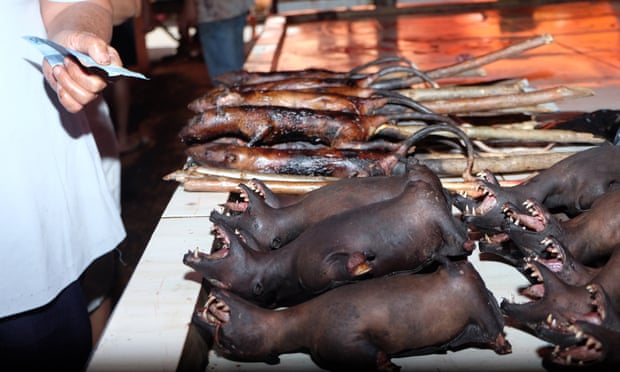
Traders selling bat meat at a market in Tomohon City, Indonesia. Photograph: Ronny Adolof Buol/Sijori Images via Zuma Wire/Rex/Shutterstock
Where did the virus causing the current pandemic come from? How did it get to a food market in Wuhan, China, from where it is thought to have spilled over into humans? The answers to these questions are gradually being pieced together, and the story they tell makes for uncomfortable reading.
Let’s start at the beginning. As of 17 March, we know that the Sars-CoV-2 virus (a member of the coronavirus family that causes the respiratory illness Covid-19) is the product of natural evolution.A study of its genetic sequence, conducted by infectious disease expert Kristian G Andersen of the Scripps Research Institute in La Jolla, California, and colleagues, rules out the possibility that it could have been manufactured in a lab or otherwise engineered. Puff go the conspiracy theories.
The next step is a little less certain, but it seems likely that the original animal reservoir for the virus was bats. Andersen’s team showed – like the Chinese before them –that the sequence of Sars-CoV-2 is similar to other coronaviruses that infect bats.
Since other bat coronaviruses have transited to humans via an intermediate animal host, it seems likely that this one did too. That animal was probably one that some Chinese people like to eat, and that is therefore sold in “wet” markets (those that sell fresh meat, fish, seafood and other produce). This animal may have been the scaly mammal called a pangolin. That can’t be conclusively proved, but several groups have found sequence similarities between Sars-CoV-2 and other coronaviruses that infect pangolins.
If this is indeed the route the virus took to humans, it has two critical interfaces: one between us and the intermediate host, possibly a pangolin, and one between that host and bats. Most of the attention so far has been focused on the interface between humans and the intermediate host, with fingers of blame being pointed at Chinese wet markets and eating habits, but both interfaces were required for the pandemic to ignite. So where and how did the spillover from the bat to the pangolin – or other wild or semi-wild intermediate host – occur?
“Our study does not directly shed light on the geographical origin of the virus,” says Andersen. “However, all the available evidence shows that it was inside China.”
Case closed then, and President Trump is right to call Sars-CoV-2 the “Chinese virus”. Well, no, because if you want to understand why this pandemic happened now and not, say, 20 years ago – since Chinese people’s taste for what we in the west consider exotic fare is not new – you have to include a number of other factors. “We can blame the object – the virus, the cultural practice – but causality extends out into the relationships between people and ecology,” says evolutionary biologist Rob Wallace of the Agroecology and Rural Economics Research Corps in St Paul, Minnesota.
Starting in the 1990s, as part of its economic transformation, China ramped up its food production systems to industrial scale. One side effect of this, as anthropologists Lyle Fearnley and Christos Lynteris have documented, was that smallholding farmers were undercut and pushed out of the livestock industry. Searching for a new way to earn a living, some of them turned to farming “wild” species that had previously been eaten for subsistence only. Wild food was formalised as a sector, and was increasingly branded as a luxury product. But the smallholders weren’t only pushed out economically. As industrial farming concerns took up more and more land, these small-scale farmers were pushed out geographically too – closer to uncultivable zones. Closer to the edge of the forest, that is, where bats and the viruses that infect them lurk. The density and frequency of contacts at that first interface increased, and hence, so did the risk of a spillover.
It’s true, in other words, that an expanding human population pushing into previously undisturbed ecosystems has contributed to the increasing number of zoonoses – human infections of animal origin – in recent decades. That has been documented for Ebola and HIV, for example. But behind that shift has been another, in the way food is produced. Modern models of agribusiness are contributing to the emergence of zoonos
Take flu, a disease that is considered to have high pandemic potential, having caused an estimated 15 pandemics in the past 500 years. “There is clearly a link between the emergence of highly pathogenic avian influenza viruses and intensified poultry production systems,” says spatial epidemiologist Marius Gilbert of the Université Libre de Bruxelles in Belgium.
The reasons, many of which were documented in Wallace’s 2016 book Big Farms Make Big Flu, include the density with which chickens, turkeys or other poultry are packed into factory farms, and the fact that the birds in a given farm tend to be near genetic clones of one another – having been selected over decades for desirable traits such as lean meat. If a virus gets introduced into such a flock, it can race through it without meeting any resistance in the form of genetic variants that prevent its spread. Both experimental manipulations and observations in the real world have demonstrated that this process can result in a ratcheting up of the virus’s virulence. If it then spills over into humans, we are potentially in trouble.
In a paper published in 2018, Gilbert’s group reviewed historical “conversion events”, as they call them – when a not-very-pathogenic avian flu strain became much more dangerous, and found that most of them had occurred in commercial poultry systems, and more frequently in wealthy countries. Europe, Australia and the US had generated more of them than China.
That doesn’t let China off the hook. Two highly pathogenic forms of avian flu – H5N1 and H7N9 – have emerged in that country in recent decades. Both infect humans, though not easily (yet). The first human cases of H7N9 were reported in 2013, and there were small annual outbreaks thereafter. But, says Gilbert, “nothing was done until the virus turned out to be pathogenic for chickens as well. Then it became an important economic issue and China started to mass-vaccinate its poultry against H7N9, and that ended the transmission to humans.”
China is one of the world’s major exporters of poultry, but its poultry industry is not wholly Chinese-owned. After the recession of 2008, for example, New York-based investment bank Goldman Sachs diversified its holdings and moved into Chinese poultry farms. So if China has its share of responsibility for spillover events, it isn’t alone. That is why Wallace insists on talking about relational geographies rather than absolute geographies, when it comes to identifying the causes of disease. Or as he puts it: “Follow the money.”
Not everybody sees a straightforward link between factory farming and new and dangerous forms of flu. Michael Worobey, an evolutionary biologist at the University of Arizona, points out that before they were brought into factory farms, poultry were kept outside. The factory model may ramp up virulence, he says, but it probably protects a flock from being infected by a virus in the first place.
Still, Worobey doesn’t doubt that farming and other human-animal interactions have shaped our disease ecology. His group collects the sequences of flu viruses from a range of animal hosts, including humans, and plots them on a family treeto try to understand how flu has evolved over time. Flu is constantly mutating – that’s the reason the seasonal flu vaccine has to be updated each year – but it mutates at different rates in different hosts, which means that his flu family tree is informative both about the parentage and intermediate host of each strain and about the approximate timing of past spillover events.
It’s possible – though by no means certain – that flu first became a disease of humans after the Chinese domesticated ducks about 4,000 years ago – drawing that animal reservoir into human communities for the first time. But humans can also catch flu from, and give flu to, pigs – another animal we have lived alongside for millennia. A few years ago, Worobey suggested – controversially – that birds might not always have been the main intermediate host for human flu viruses. Until about a century ago, he reported, people may have caught flu from horses. Around the time that motor vehicles supplanted horses as transport, poultry farming was expanding in the western hemisphere, and it’s possible, Worobey argued, that birds then took over as the main intermediate host of flu for humans.
Not everyone buys that scenario. Wendy Barclay, a virologist at Imperial College London, says that if horses were once the main intermediate host for flu, “most avian viruses would contain the mammalian adaptation”, and they don’t. David Morens of the US National Institute of Allergy and Infectious Diseases in Bethesda, Maryland, thinks that it is more likely that the horse was a temporary detour, and that the main intermediate host of flu for humans has always been birds – especially wild ones. But all agree that humans have shaped these host-pathogen relationships, through our use of land and other animal species. And as Worobey points out, the sheer size of the human population today means that in the 21st century, we are doing so on an unprecedented scale. He estimates, for example, that domesticated ducks probably outnumber wild ones by now.
And we’re not just talking about birds. Gilbert believes a ratcheting up of viral virulence is happening in pig herds, too. Porcine reproductive and respiratory syndrome (PRRS), a disease of pigs that was first described in the US in the late 1980s, has since spread to herds across the worldand strains detected recently in China are more virulent than the early American ones. A 2015 study carried out by Martha Nelson of the US National Institutes of Health and colleagues mapped the genetic sequences of swine flu viruses and found that Europe and the US – the largest global exporters of pigs – are also the largest exporters of swine flu.
There have been claims on social media, sometimes posted by vegans, that if we ate less meat there would have been no Covid-19. Interestingly, some of these have been blocked by mainstream news organisations as “partly false”. But the claims are also partly true. Though the links they draw are too simplistic, the evidence is now strong that the way meat is produced – and not just in China – contributed to Covid-19.
It is clear that to prevent or at least slow the emergence of new zoonoses, as Fearnley and Lynteris have argued, China’s wet markets will need to be better regulated. But we also need to look behind those markets, at how our food is produced globally.
Though it may not feel like it now, Wallace says, we have been lucky with Sars-CoV-2. It appears to be far less lethal that either H7N9 – which kills around a third of those it infects – or H5N1, which kills even more. This gives us an opportunity, he says, to question our lifestyle choices – because chicken isn’t cheap if it costs a million lives – and vote for politicians who hold agribusiness to higher standards of ecological, social and epidemiological sustainability. “Hopefully,” he says, “this will change our notions about agricultural production, land use and conservation."
Living Everything that is me, cannot be contained in one version of me, cannot be contained at all, really. There is so much in here that wants to get out into the world and try on a thousand – maybe a million – ways of being. “What do you do?” Oh, so many things. So many wonderful things. ~ Jamie K. Reaser, Author Published in Conversations with Mary: Words of Attention and Devotion