Thursday, January 18, 2018

2797. Book Review: Democracy in Chains: The Deep History of the Radical Right’s Stealth Plan for America

By Cliff Conner, Socialist Action, January 2018
Who is James McGill Buchanan? He was a Nobel laureate in “economic sciences,” but if his name is unfamiliar to you, you are not alone. He was not a publicity hound. He didn’t broadcast his views far and wide because he never wanted them to be widely known. Buchanan (who died in 2013) believed that certain vital truths about the political world we inhabit should be hidden from public view.
Buchanan’s secret truth was that democracy and liberty are incompatible and that therefore democracy must be suppressed. After his death, his private papers revealed warnings to co-thinkers that “conspiratorial secrecy is at all times essential.”[i]
We know about those private papers and their contents thanks to historian Nancy MacLean, whose “Democracy in Chains” has exposed them to the world and alerted us to the danger they represent. This remarkable book is based on a large trove of documents discovered among James M. Buchanan’s private papers after his death in 2013. It is evident from their contents that Buchanan never intended for these documents to be made public.
Buchanan was a key figure in the development of today’s powerful libertarian movement. Be advised: This is not your grandfather’s libertarianism. If you still think of libertarianism as the quaintly eccentric blend of laissez faire economics with concerns such as privacy rights, civil liberties, and antimilitarism, you are behind the times. That old-time libertarianism has been marginalized by a hardcore, right-wing, enemy-of-humanity libertarianism fashioned by Buchanan and the Koch Brothers.
What the “Liberty” in libertarianism has come to mean
The well-funded libertarian movement today is the creation of self-interested billionaires, led by Charles and David Koch, who want above all else to decrease their taxes and minimize government regulation of their businesses. They disparage old-time “conventional libertarians” as impotent, and flaunt the hegemony of their own right-wing agenda.
When the hard-right libertarians trumpet their devotion to individual rights, it is code for individual property rights and has nothing to do with the human rights of the vast majority of individuals. In the new libertarian worldview, an individual without property has no rights.
Today’s libertarians are single-mindedly devoted to “dismantling the administrative state.” As anti-tax crusader Grover Norquist famously exclaimed, “I don’t want to abolish government. I simply want to reduce it to the size where I can drag it into the bathroom and drown it in the bathtub.”
If there is any lingering confusion regarding libertarian commitment to genuine individual freedom, it should be laid to rest by their interpretation of the 1973 Pinochet coup in Chile. To this day libertarian polemicists continue to hail that abominable crime against humanity as an “economic miracle” confirming the wisdom of the free-market economic policy.
They claim that an economic revival following Augusto Pinochet’s seizure of power was due to the guidance of Los Chicago Boys, Chilean economists who had been educated in free-market principles at the University of Chicago. The “miracle” they wrought was built upon the destruction of a vital labor movement requiring the murder and torture of tens of thousands of trade-unionists and their supporters. It was liberty for wealthy investors and property owners at the expense of the life, liberty, and happiness of the majority of the Chilean people.

“Los Chicago Boys,” Chilean economists who studied at the University of Chicago in the 1950s. Left to right: Luis Arturo Fuenzalida, Alberto Valdés, Larry Sjaastad, Pedro Jeftanovic, and Sergio de Castro.
As for the vaunted economic revival, its benefits flowed mainly to foreign investors and the Chilean upper classes. A United Nations report cites “a virtual explosion of poverty in both urban and rural areas” in Chile between 1970 and 1980, and attributes it in part to the “policy reforms under the authoritarian rule of the Pinochet regime.”[ii]
Libertarian apologists sometimes deny that they or Los Chicago Boys endorsed Pinochet’s tyranny or his oppressive methods. But even if their denials were to be accepted at face value, the “Chilean miracle” dramatically refutes their ideological claim that free-market economics is synonymous with democracy and freedom.
The libertarians’ love affair with the Pinochet dictatorship also exposes their greatest paradox. While denouncing “statism” and all governmental influence on the economy, they allow one enormous exception: They depend on the power of the state—in the Chilean example, a police state—to defend the property rights upon which their notion of “liberty” is based. American right-wing politicians are no less hypocritical in demanding the total destruction of governmental power while nurturing the most powerful military state—or “national security state”—the world has ever seen.
Makers versus takers
In 1980 Buchanan, who was also educated at the University of Chicago, was invited to Chile by the Pinochet regime to participate in drafting a new constitution for the country.
Buchanan’s hardcore libertarian definition of liberty—the absolute freedom of entrepreneurs to run their businesses in any way they please—is not one most people would find satisfying. He knew that most Chileans would not be attracted to his profoundly anti-democratic program so it would be a waste of time trying to achieve it openly, via the will of the majority.
Jan. 2018 Pinochet
Chilean dictator Augusto Pinochet
“Despotism,” Buchanan once wrote, “may be the only organizational alternative to the political structure that we observe.”[iii] By “the political structure that we observe,” he meant the system defined by the American constitution.
His service to the Pinochet regime demonstrated a willingness to embrace despotism that was not merely hypothetical. Buchanan helped the Chilean “alliance of capital and the armed forces” create a legal framework to eliminate the trade unions, privatize the social security and healthcare systems, constrain governmental regulatory power, and destroy the public education system.[iv]
The extremism of Buchanan’s views might be more astonishing if they had not already become part of the national discourse in the United States. Mitt Romney created a stir during his 2012 campaign for the U.S. presidency when remarks he thought would remain private were leaked to the public. In those comments, Romney complained that 47 percent of the American people “pay no income tax,” are “dependent on government,” “believe the government has a responsibility to care for them,” and “believe that they are entitled to health care, to food, to housing, to you-name-it.”[v]
Romney’s views were in perfect harmony with Buchanan’s, although the latter would surely have put the percentage way higher than 47. In Buchanan’s worldview, the population is divided into makers and takers. The makers are the productive classes—owners of capital whose profit-making activities expand the national economy—and the takers are the indolent masses. To Buchanan, any taxation that redistributes wealth from the makers to the takers is a downright immoral form of robbery, and any governmental attempt to regulate the makers’ businesses is a criminal violation of their liberty.
The economic history of the world is indeed a story of takers robbing makers, but Buchanan’s odious interpretation has the relationship upside-down and backward. The great wealth of the United States was founded first of all on agricultural production created by the unpaid labor of African slaves, and secondarily on the industrial production of the underpaid labor of industrial workers. A small number of Southern plantation owners and Northern manufacturers amassed fabulous fortunes by appropriating the profits those laborers produced. Who, then, were really the makers and who were the takers?
The ill-gotten wealth of the exploiters of labor allowed them to gain political control, limit the franchise of the laborers, and create a legal system to consolidate their system of economic injustice. Adding insult to injury, the slaveholders and Robber Barons justified their conquest by propagating ideologies, from Social Darwinism to libertarianism, that denied and devalued the laborers’ role in creating the modern economy.
To appreciate the sheer audacity of Buchanan’s perversion of history, consider the plight of the former slaves after the U.S. Civil War. Having been forcibly taken from their homelands, having had their labor violently taken from them for decades, and being left in dire poverty in the post-war South, many were dependent on barebones federal assistance for survival. That made them, in Buchanan’s eyes, contemptible “takers.”
The Lenin of libertarianism?
What places Buchanan among the most dangerous of the right-wing ideologues is that he not only professed anti-democratic ideas; he devised strategies to successfully implement them. He was a social engineer who found ways to turn libertarian theory into public policy. It has been suggested that as the movement’s key cadre-builder, Buchanan was to libertarianism what Lenin was to Marxist socialism.
Buchanan took the ideas he learned from his Chicago School mentors to the University of Virginia and created a more extreme Virginia School of economics. Its institutional expression was the Thomas Jefferson Center for Studies in Political Economy, which he founded in 1957 to develop “a line of new thinkers” to challenge the “increasing role of government in economic and social life.”[vi] That was to be accomplished by a “constitutional revolution” that would covertly rewrite the rules of the American economy to enrich the few at the expense of the many. Among its primary ambitions were the total elimination of the social security, public health, and public school systems.
Buchanan stated privately that the study center was named after Thomas Jefferson to deflect attention from the “extreme views” that were “the real purpose of the program.” This was the embryo of the modern libertarian intellectual movement. He envisioned the creation of a “counter-intelligentsia” backed by a “vast network of political power” to replace the existing establishment intellectuals.[vii] He thus provided the blueprint for today’s powerful array of libertarian think tanks and their army of paid academics, lobbyists, and politicians.
Buchanan was fully aware, however, that his plans would have languished on the drawing board without the material support necessary to put them into practice. Attracting that support was part of his master plan. In 1983, he reconstituted his academic institute at George Mason University, renaming it the Center for Study of Public Choice. George Mason University, identified in the Wall Street Journal as “the Pentagon of conservative academia,”[viii] was the ideal venue for Buchanan’s operation.
GMU has sometimes been referred to as Koch U. due to its position “at the center of the Koch college universe.”[ix] When Buchanan’s strategy for totally annihilating the government’s influence over the economy gained the support of Charles and David Koch, the counter-intelligentsia of their shared dreams began to become a reality.
The Koch brothers have donated tens of millions of dollars to George Mason University and to Buchanan’s Center for the Study of Public Choice, which trained the young intellectuals who would fill the Koch think tanks and become speechwriters for Koch-financed congressmen. Eventually, tactical disagreements led the impatient billionaire brothers to force Buchanan out and take direct control of the research center. If Buchanan had been the movement’s Lenin, the Kochs became its Stalin (all proportions guarded, of course).
White supremacist roots of Buchanan’s antigovernment crusade
Buchanan’s first research institute was created in the mid-1950s to provide ideological cover for the defiance of federal orders to desegregate the public schools. Two years after the landmark Brown v. Board of Education Supreme Court decision in 1954 declared segregationist state laws unconstitutional, Buchanan presented the University of Virginia with a plan to mobilize its intellectual resources in defense of the state’s white supremacist institutions. University officials agreed, and in 1957 the Thomas Jefferson Center for Studies in Political Economy was born.Jan. 2018 Race mixing
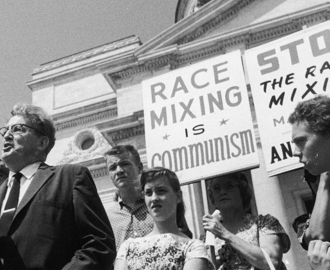
Buchanan was careful not to frame the Center’s mission in explicitly racial terms. Instead, it threw the weight of “economic science” behind the familiar States Rights argument that the federal government had no right to usurp the authority of Virginia’s legislature and assert dictatorial control over Virginia institutions. When it became obvious that the States Rights position would not prevail, Buchanan proposed that Virginia should privatize its school system and do away with public education altogether.
De jure segregation eventually ended in Virginia and the rest of the United States, but, as economist Marshall Steinbaum has observed, “the racist stench attached to Buchanan’s intellectual projects and that of his heirs” endured.[x] And destroying the public school system, which taxes “makers” to benefit “takers,” remained a central plank of Buchanan’s ideological platform to the end of his days.
As I was writing this account of Buchanan’s words and deeds, a headline popped up on my computer’s news feed: “219 Republican House Members Just Voted to Cut Medicaid, Medicare, and Public Education to Give Tax Breaks to Millionaires and Corporations.”[xi]
The U.S. House of representatives had voted 219 to 208 to approve a national budget proposal that would cut more than five trillion dollars—$5,800,000,000,000—from healthcare, education, environmental protection, services for children and the disabled, scientific research, the arts, and other federal programs that are essential to human wellbeing.
This was a timely reminder of the real-world consequences of Buchanan’s abominable “makers and takers” ideology and the misery it has already inflicted on American society. While the draconian budget cuts had not at that time achieved the force of law, they provided a clear indication of how deeply the libertarian cancer had already pervaded the body politic. Although Buchanan’s full program of completely eliminating all beneficial social programs has not yet been accomplished, its partial fulfillment has already damaged or destroyed millions of human lives.
Buchanan’s antipathy to public education was not only due to its cost but to its function as an essential pillar of a democratic, self-governing society. That a majority of elected representatives in the U.S. Congress could vote to transfer trillions of dollars from the social majority to a relative handful of super-wealthy individuals further indicates how successful Buchanan’s well-funded strategy to undermine American democracy has been.
How scientific is Buchanan’s “economic science?”
The official name of the honor Buchanan received in 1986 is “The Nobel Memorial Prize in Economic Sciences,” but his practice of the discipline made a mockery of the very notion of economics as a science.
Buchanan’s economics research centers have long been recognized not as institutes of independent thought but as partisan propaganda mills. The “science” they promote is not founded on objective premises but on the moral judgment that the vast majority of human beings are economic parasites on the capitalist class. The notion that the world’s poor are stealing the billionaires’ lunch money is so contrary to reason that without the funding of self-interested billionaires it would be unlikely to attract many followers.
Beyond its fundamental irrationality, Buchanan’s economic ideology is unscientific in its a priorismand reductionism. A priorism is the method characteristic of Aristotelian science, the rejection of which was the central achievement of the Scientific Revolution of the 16th and 17th centuries.
When, for example, Buchanan was confronted with empirical evidence that raising the minimum wage does not create unemployment, he rejected it out of hand on the basis that it contradicts laissez-faire theory. To allow such a possibility, he angrily responded, is “equivalent to a denial that there is even minimal scientific content in economics.”[xii] On the latter point I find myself in agreement with him.
As for reductionism, Buchanan’s “Public Choice Theory” reduces real-world economic decision-making to the sterile abstractions of mathematical game theory. In a universe where human beings always act like purely self-interested automatons, game theory could perhaps offer some useful insights into economic behavior. But Buchanan applies mathematical models based on misanthropic assumptions about human nature to complex social interactions.
Nancy MacLean describes the hypothetical social order from which Public Choice theorists deduced their axioms as one in which “individuals always acted to advance their personal economic self-interest rather than collective goals for the common good.” Buchanan and his fellow theorists, she writes, were simply conducting “thought experiments, or hypothetical scenarios with no true research—no facts—to support them, while the very terms of their analysis denied such motives as compassion, fairness, solidarity, generosity, justice, and sustainability.”[xiii]
In brief, Buchanan’s method is of no scientific value at all. It is designed not to attain new knowledge about economics, but to justify an economic system of vast material inequality.
“Democracy in Chains” is a must-read for all people engaged in the struggle for social justice. No matter how well you think you already know thine enemy, I predict—based on my own experience—that you have much more to learn from this book.
[A note about the footnotes: Traditionally, I would have included page numbers in citations from Democracy in Chains, but that is no longer necessary in today’s world of digital books and search functions.]
Endnotes:
[i] Quoted by MacLean, Democracy in Chains, from a February 1973 typescript conference-planning document by Buchanan bearing the title “The Third Century Movement.”
[ii] Oscar Altimir, “Income Distribution and Poverty through Crisis and Adjustment,” CEPAL Review, December 2008. [CEPAL is the Spanish acronym for the United Nations Economic Commission for Latin America and the Caribbean.]
[iii] James M. Buchanan, The Limits of Liberty: Between Anarchy and Leviathan (2000); quoted by MacLean.
[iv] MacLean, Democracy in Chains.
[v] Video clip: “Mitt Romney Fundraising Comments on Video in Boca Raton,” C-Span, c-span.org, May 17, 2012.
[vi] Buchanan, “Working Papers for Internal Discussion Only,” December 1956; quoted by MacLean.
[vii] James M. Buchanan, “America’s Third Century,” Atlantic Economic Journal, November 1973; quoted by MacLean.
[viii] Lawrence Mone, “Thinkers and Their Think Tanks Move on Washington,” Wall Street Journal, March 19, 1988; cited by MacLean.
[ix] David Levinthal, “Koch Brothers’ Higher-Ed Investments Advance Political Goals,” Center for Public Integrity, publicintegrity.org, November 4, 2015.
[x] Marshall Steinbaum, “The Book That Explains Charlottesville,” Boston Review, bostonreview.net, August 14, 2017.
[xi] Common Dreams, commondreams.org, October 5, 2017.
[xii] From a Wall Street Journal op-ed of April 1996; quoted in Steinbaum, “The Book That Explains Charlottesville.”
[xiii] MacLean, Democracy in Chains.

Wednesday, January 17, 2018

2796. A Long-Simmering Factor in Iran Protests: Climate Change

By Shashank Bengali and Ramin Mostaghim, The Los Angeles Times, January 17, 2018
Danial Mirakhouri, 14, works in his family's drought-stricken cotton field in Qiyasabad, Iran, in 2016.
Photo: Carolyn Cole / Los Angeles Times.

In the mountains of western Iran, the province of Chaharmahal-Bakhtiari is known for mile-high lagoons, flowing rivers and wetlands that attract thousands of species of migratory birds.
But years of diminishing rainfall have shriveled water sources. Conditions worsened, residents say, after Iranian authorities began funneling water 60 miles away to the lowland city of Esfahan, sparking protests as far back as 2014.

On Dec. 30 of last year, about 200 people gathered in front of the provincial governor’s office to protest the water transfer project. Their slogans soon morphed into chants of “Death to the dictator,” the main rallying cry of anti-government protesters who poured into streets nationwide in the biggest spasm of public anger Iran has seen in years.
The uprising — in which at least 21 people died and thousands were arrested before authorities reimposed order — had many sparks: rising prices, persistent unemployment, bank collapses, a wide wealth gap, corruption in the theocracy.

But an overlooked factor, analysts say, is the impact of climate change and the widespread perception that Iran’s leaders are mishandling a growing problem of water scarcity.
“People believe that this is yet another major crisis the country is facing, and the people at the top are too incompetent and too corrupt to care,” said Meir Javedanfar, a professor of Iranian politics at Interdisciplinary Center Herzliya, an Israeli university.
“It does not seem to be a priority of the regime to address the drought issue,” he said. “As long as it’s not a priority, nothing will happen until something breaks.”
Many environmental activists believe Iran is quickly approaching its breaking point as diminishing rainfall and warmer temperatures have caused lakes to disappear, kicked up blinding dust storms and emptied out once fertile regions as farmers seek economic refuge in cities.

Drought is a concern across the Middle East, but Iran’s 80 million people are especially at risk. This month, the director of Iran’s Drought and Crisis Management Center, Shahrokh Fateh, said that 96% of the country’s land area was experiencing prolonged drought conditions, the semiofficial ISNA news agency reported.
In some of the hardest hit areas, including border provinces where ethnic and religious minorities complain of official neglect, concerns over natural resources were a key driver of the demonstrations that began in late December.
“People in my area do not want to politicize their environmental concerns, but water shortages and pollution of the air and rivers are seen as political crises,” said Yusef Farhadi Babadi, an environmental activist in Chaharmahal-Bakhtiari. “People want to reclaim their rights to clean air and water and efficient water use.”
In the province, which covers an area slightly larger than the state of Connecticut, there were once 3,800 natural springs, but about 1,100 have dried up, Babadi said, citing official statistics. The Iran Meteorological Organization forecast recently that for the Iranian year ending March 20, rainfall in the province would be more than 80% below the long-term average.
Many in the predominantly agricultural region complain about a controversial series of canals the government has built to bring hundreds of millions of cubic feet of water from the Karun River, which runs through Chaharmahal-Bakhtiari, to growing populations in central provinces.
Some of the water has gone to state-run steel mills in Esfahan, which Babadi described as “bankrupt industries.” Meanwhile, with the exception of Shahr-e Kord, the provincial capital of about 150,000 people, towns in the area rely on tanker water that is riddled with chemicals, he said.
Farmers and cattle breeders have occasionally clashed with security forces, including in 2016, when multiple days of protests in the town of Boldaji left one demonstrator dead and nearly 200 injured. The Islamic Revolutionary Guard, Iran’s powerful paramilitary organization, reportedly sent troops from 16 units to put down the uprising.
In neighboring Khuzestan, an oil-rich province with a large population of ethnic Arabs on the border with Iraq, desertification and industrial waste have destroyed date orchards and wetlands. The World Health Organization lists the provincial capital of Ahvaz as one of the world’s most polluted cities, and for much of the year a yellow smog blankets the city, sending residents fleeing to the hospital for help with breathing difficulties.
Ahvaz saw large protests for more than a week beginning Dec. 30, but they were the latest in a years-long string of demonstrations over environmental conditions, said Abafazl Abidi, a correspondent for the reform-minded Shargh newspaper in Tehran.
“Many are suffering from chronic environmental problems or pollution-related diseases like asthma and skin ailments,” Abidi said. “People suffer from acid rain, visibility is only a few meters, there are outages of drinking water and electricity. The recent protests seem to me no surprise at all.”
The conditions have worsened because of the rampant construction of dams, more than a dozen of which have been built in the province in the last 40 years, many reportedly by businesses linked to the Revolutionary Guard.
Experts say the projects have aimed to benefit regions and industries with better political connections while worsening water access for marginalized people.
“They have built them in a way that the consequences are so bad for the environment,” Javedanfar said. “And there is so much lack of trust that even if the water projects were justified, people would oppose them. If the Iranian regime were to reinvent the wheel, some would complain that it’s too round.”
Supreme leader Ayatollah Ali Khamenei has called on the government to “manage climate change and environmental threats,” but the response from successive governments has been mixed.
Former President Mahmoud Ahmadinejad promised populist schemes to help farmers, but allowed industries to build haphazardly, and he once blamed Iran’s drought on Western countries. President Hassan Rouhani, elected in 2013, has pumped funds into restoring the depleted Lake Urmia, but when he visited Khuzestan last year he was greeted by a fierce protest.
“In every election we try to send defenders of our rights to parliament or elect presidents who can address environmental issues…but in vain,” Babadi said.
Authorities cracked down swiftly on the recent protests in Shahr-e Kord, but Babadi predicted the respite would be temporary.
“The drought and water transfer projects are so dangerous and detrimental that environmental protests will resume soon,” he said.

Tuesday, January 16, 2018

2795. The Catalan Integral Cooperative … The Simpler Way Revolution Is Well Underway!

By Ted Trainer, January 15, 2018
The Catalan Integral Cooperative is a political project to merge labor and consumer initiatives.  
This is a remarkable and inspiring movement in Spain, now involving hundreds of people in what I regard as an example of The Simpler Way transition strategy … which is primarily about going underneath the conventional economy to build our own new collective economy to meet community needs, turning our backs on and deliberately undermining and eventually replacing both the capitalist system and control by the state.  

The context
It is now abundantly clear that a just and sustainable world cannot be achieved unless consumer-capitalist society is basically scrapped. It involves levels of resource use and environmental impact that are already grossly unsustainable, yet growth is the supreme goal. The basic form the alternative must take is not difficult to imagine.  (For the detail see TSW: Summary Case.) The essential concept must be mostly small, highly self-sufficient and self-governing communities in which we can live frugally but well putting local resources directly into producing to meet local needs … without allowing market forces or the profit motive or the global economy to determine what happens.  

Unfortunately even many green and left people do not grasp the magnitude of the De-growth that is required.  We will probably have to go down to around 10% of the present rich world per capita levels of resource use. This can only be done in the kind of settlements and systems we refer to as The Simpler Way. Most of the alarming global problems now threatening our survival, especially ecological damage, resource depletion, conflict over resources and markets, and deteriorating social cohesion, cannot be solved unless we achieve a global transition to a general settlement pattern of this kind. 

For some time the Eco-village and Transition Towns movements have been developing elements of the alternative we need to build, and there are impressive radically alternative development initiatives in the Third World, notably the Zapatistas and the Kurdish PKK.  But the Catalan Integral Cooperative provides us with an inspiring demonstration of what can be done and what we need to take up.  

The CIC response
Although only begun in 2010 the cooperative now involves many hundreds of people and many productive ventures, 400 of them involving growing or making things. Although there are far more things going on than those within the CIC its annual budget is now $480,000! (More on the scale later.)

It is not just about enabling people to collectively provide many things for themselves underneath and despite the market system --- it is explicitly, deliberately, about the long-term goal of replacing both capitalism and control by the state. These people have not waited for the government to save them, they are taking control over their own fate, setting up their own productive arrangements, food supply systems, warehouses and shops, basic income schemes, information and education functions, legal and tax advice, technical R, and D, and even an investment bank. Best of all is the collectivist worldview and spirit, the determination to prevent the market and profit from driving the economy and to establish cooperative arrangements that benefit all people, not just co-op members. The explicit intention is to develop systems which in time will “ … overcome the state and the capitalist system.” In other words, the orientation differs fundamentally from the typical “socialist” assumption that the state has to run things. 

We are in an era in which the conventional economy will increasingly fail to provide for people. What we urgently need are examples where “ordinary” people, not officials or governments, just start getting together to set up the arrangements that gear the productive capacity they have around them to meeting their collective needs. The remarkable CIC shows that people everywhere could do this, especially in the many regions Neoliberalism has condemned to poverty, stagnation and “austerity”.

Stated principles and practices
Note that this not just a wish list of future goals or ideals, it is mostly a list of the aims and values guiding practices that have already been implemented.

The CIC is not a central agency running everything; it is an umbrella organisation facilitating, supporting and advising re the activities of many and varied cooperatives.  Thus it is not like typical cooperatives wherein members focus on a single mutual interest, and work only for the benefit of members. 

It is important to recognise the significance of the concept ”integral”. The word “integral” refers to the concern with,  “ …  the radical transformation of all facets of social and economic life.” That is, they are out to eventually bring about comprehensive social revolution. Simpler Way thinking about settlement design emphasises integration, i.e., the way interconnections between functions that small-scale makes possible enables synergism and huge reductions in resource use. For instance, backyard and cooperative poultry production enable “wastes” to go straight to gardens, imperfect fruit to be used, chickens to clean up garden beds, and elimination of almost all energy-intensive inputs such as fertilizer, trucking, and super-marketing.

The CIC is establishing projects which benefit all people in the region whether or not they are members of the CIC or associated cooperatives. Unlike most cooperatives, the CIC develops structures and tools which are not reserved just for its members, but are accessible to everyone.” For instance, non-members can use the arrangements that have been set up for providing legal advice, they can use the technologies developed, and they can use the new local currency. There are about six hundred people who are not in cooperatives but are self-employed and are able to use the services the CIC has created. Similarly, the machines and agricultural tools developed for small-scale producers are “…freely reproducible”, i.e., their design information is available to all free, giving anyone the ability to build them on their own and customize them according to their needs. 

Thus the concern is to prevent goods being treated as commodities produced to make a profit, but to see them as things that are produced to meet needs; “…  basic needs like food and healthcare are not commodities but social goods everyone has access to.”

To be part of the CIC cooperative projects need to practise consensus decision making and to follow certain basic principles including transparency and sustainability. Once the assembly embraces a new project it enjoys legal and other provisions and its income is managed via the CIC accounting office, where a portion goes toward funding the shared infrastructure.
The huge significance of all this could be easily overlooked. In a world where capital, profit and market forces dump large numbers into “exclusion” and poverty, and governments will not deal properly with the resulting problems, these people have decided to do the job themselves.  They are literally building an alternative society, not just organising the provision of basic goods and services, but moving into providing free public services like health and transport. Note again the noble and radically subversive worldview and values here; people are working to meet the needs of their community, driven not by self-interest or profit but by the desire to build good social systems.  This ridicules the dominant capitalist ideology that is the conventional economic theory!

The Scale
Many people in different groups participate in varying degrees. There are about six hundred self-employed members, mostly independent professionals and small producers, who use the legal and economic services made available by the cooperative, such as insurance at less than the normal rate in Spain. There are more than 2,500 who use the LETS system. Many are involved in the Catalan Supply Center (CAC), which is the CIC committee coordinating the transportation and delivery of food and other items from the producers to the “pantries”, i.e., distribution points. In addition there are several co-ops associated with the CIC. 

The headquarters of the CIC is in their 1,400 square metre building, which includes space for a library and for rent.  The “eco-network” has 2,634 members. The scale and numbers are also indicated by the food distribution system described below.

Economics
As noted above the project involves creating an economic system which contradicts and rejects the mainstream economy. It is an economy that is not driven by profit, self-interest or what will maximise the wealth of those with capital to invest. There is social control over their economy, that is, there are collective decisions and planning in order to set up systems to meet community needs. People work to build and run good systems, not to get rich.
Non-monetary forms of exchange are encouraged, including free goods and services, barter, direct connections between producers and consumers, and mutual giving.  The CIC regulates the estimation of fair prices and informs producers of consumers’ needs. 

There is a LETS-type currency, the ECO, which cannot be converted into euros and cannot be invested or yield interest. About 2,600 people have accounts. Anyone can see the balance in another’s account. “The currency is not just a medium of exchange; it's a measure of the CIC's independence from capitalism." There is a “Social Currency Monitoring Commission whose job it is to contact members not making many transactions and to help them figure out how they can meet more of their needs using the currency.” 

The CIC’s financial operations do not involve any interest payments.  No interest is paid on loans made by the cooperative. In this radically subversive economy finance is about enabling the creation of socially-necessary production, not providing lucrative profits to the rich few who have the capital to lend. (The US finance industry was recently made about 40% of all corporate income.) The committee entitled ‘Cooperative of Social and Network Self-financing’ deals with savings, donations and project funding in order to “ …  finance self-managed individual or collective projects aiming at the common good”. It has 155 members. Contributions to this agency earn no interest, so “… it is truly remarkable that the total amount of deposits made in the last four years exceeds €250.000.”

It is especially noteworthy that emphasis is put on the sustainability of activities, Permaculture, localism, and De-growth. National and global systems are avoided as much as possible and local arrangements are set up.  As advocates of the Simpler Way emphasise, unless rich world per capita levels of resource use can be cut enormously sustainability cannot be achieved, and this requires local economies and happy acceptance of frugal lifestyles. Frugality is an explicit goal of the CIC.

The creation of commons is of central importance. There is “Collective ownership of resources to generate common goods.” That is, they seek to develop common properties for the benefit of whole communities. Some lands have been purchased by cooperatives, and some donated by individuals. Included in the category of commons are non-material “assets” such as the LETS system, the software for accounting purposes, and other services made available. Each of these is managed by a committee. “We promote forms of communal property and of cooperative property as formulas that … enhance … self-management and self-organization …” Again the intent is to develop systems run entirely by citizens and that do not involve either capitalism or the state.

One participant says, "I cultivate a garden and I hardly buy any food in euros: I acquire everything I need in the eco-network and through the CIC with the ecos, I earn by selling my vegetables." Fairs and market days are organised. "Going to the markets and the fairs is like recreation, it’s meeting up with friends and family in a spiritual sense."  

Note again the remarkable anti-capitalist element that loans are extended to assist the establishment of new ventures enabling people to begin producing … but no interest is charged. (Kennedy, 1995, estimated that in the normal economy interest charges make up 40% of all prices paid.) Another radical element is the refusal to regard things like food as commodities, that is to be produced and sold to make a profit. In seeing the point of economics as producing to meet needs they are contradicting a central taken-for-granted premise of the conventional mentality.

Income
The CIC has two main expenses: the ‘basic income’ paid to the members of its committees and the funding it provides for projects. It pays half of these expenses with fees levied on the 600 member individuals, firms and co-ops (e.g., E25/month from the self-employed businesses). Most of the remaining 50% of income comes from tax refunds the CIC’s legal people are able to engineer.  In addition, donations are received.

“Shops”: The distribution outlets

Many goods are distributed through the “Catalan Supply Centre”, one of the most active CIC committees. It is a network for the transportation and delivery of the products of many small producers across the entire Catalonia region. These are brought to “… the self-managed pantries that the CIC has set up all over Catalonia – twenty of them ... Each one of them is run autonomously by a local consumer group that wishes to have access to local products as well as products made (by producers associated with the CIC) in other parts of Catalonia. “This system cuts out middlemen, reducing costs. The CIC currently lists more than a thousand products.  “The Supply Centre provides the markets throughout the region with about 4,500 pounds of goods each month, most of which come from the cooperative's farmers and producers.”
“Of all the initiatives, by far the most successful is the one focused on food.”
Again note the scale of operations.

The technology R and D committee
There is a technology committee responsible for the development of tools and machines adapted to the needs of member producers. They often find that devices on sale are not appropriate for the needs of small-scale or commons-oriented projects. They develop machines mostly for agriculture and small firms.  These devices, “…exemplify the principles of open design, appropriate technology, and the integral revolution – geared to the needs of small cooperative projects.” This committee also organizes training workshops to share knowledge. The agency occupies a 4,000 square metre site, and no longer needs financial assistance from the CIC.

Example projects
Dafermos sketches several of the settlements and projects whereby people are coming together to set up arrangements to enable communities to apply their productive capacities to providing a wide range of things for each other.

For instance, the Calafou village of twenty-two people has a housing cooperative managing twenty-seven small houses. Tenants pay €175 per month for each house. The aim is to become “… a collectivist model for living and organizing the productive activities of a small self-managed community.” It has “ … a multitude of productive activities and community infrastructures, including a carpentry, a mechanical workshop, a botanical garden, a community kitchen, a biolab, a hacklab, a soap production lab, a professional music studio, a guest-house for visitors, a social centre …, as well as a plethora of other productive projects.” There is a general assembly each Sunday, operating on the consensus principle.
Members of the AureaSocial cooperative can choose to live in an affiliated block of apartments in Barcelona or at a farming commune with teepees, yurts and horses, where residents organize themselves into "families”.

Macus is a group occupying a 600 square metre space hosting a close-knit group of modern as well as traditional craft producers of wooden furniture, clothes and herbal medicine, photography, sculpture and digital music, as well as fixing bicycles and repairing home electronics.

Government 
Their form of government is a direct deliberative, participatory democracy involving decentralization, self-management, voluntary committees, “town assemblies” … and no bureaucracy and no top-down ruling or domination.  Note that “direct” means more than “participatory”; all individual members meet to make (or ratify) the decisions. “Each cooperative project, working commission, eco-network or local group makes its own decisions.” Committees and fortnightly general assemblies work out mutually agreed solutions, decisions are not handed down by executives, CEOs or political parties.
In all meetings the goal is consensus decision making; there is no voting. “ In case of a predicament, the proposal is reformulated until the consensus is reached, thus eliminating the minorities and the majorities. All previous agreements are revocable.”  “…the quality of the agreements is a great success, and there hasn’t been any major decision-making conflict in all these years.”

All issues are handled at the lowest level possible, as distinct from being taken by higher or central agencies. This is the basic Anarchist principle of “subsidiarity.”
There are about a dozen main committees, including Reception to handle inquiries from groups wishing to join, an Economic Management Committee, a Legal Committee, an IT Committee, and one managing Common Spaces. The Productive Projects Committee facilitates ‘self-employment’ and the exchange of knowledge and skills and helps job seekers to match their skills to jobs, using an online directory of self-managed and cooperative projects in Catalonia. That is, they have set up their own employment agency, independent of the state, and its focus is on helping people to find opportunities to get into socially useful productive activity. 

 “CIC committee members receive a kind of salary from the cooperative, known as ‘basic income’, which has the purpose of freeing them from having to work somewhere else, thus allowing them to commit themselves full-time to their work at the CIC.”

Creating public services
No aspect is more remarkable than the concern to set up public services. The intention is “… to displace the centrally-managed state apparatus of public services with a truly cooperative model for organizing the provision of social goods such as health, food, education, energy, housing and transport.” The legal services, the technical contribution and the currency are also in this category. Again these are projects that are not designed by or for the members of specific cooperatives; they are services for the benefit of people in general. 

One of these service operations, organized by the “Productive Projects Committee” is the employment facilitation agency mentioned above. It helps people to become “self-employed, and to share knowledge and skills enabling people to increase their earning capacity.”  It makes it possible for “ … job seekers to match their skills to jobs posted by productive projects associated with the CIC …” There is “….  an online directory of self-managed and cooperative projects in Catalonia…” in which people can function using the ECO currency.  Thus this committee assists people who are unemployed, without many skills and likely to be poor, to find some socially useful activity they can take up in order to earn an income. “…anyone has some abilities that they can offer to people and with that acquire what they need." 

The activities of the above-mentioned supply centre constitute another public service. It enables small producers to sell their produce and many to buy what they need, without having to earn normal money. 

This public service providing realm is only developing slowly, which Dafermos thinks is because Spain’s service sector is relatively satisfactory.

Problems, questions, doubts?
It is important to look for problems and faults in alternative initiatives because we urgently need to clarify what the best options are.  Although I have little information apart from the Dafermos report, I am not aware of any serious problems or criticisms that might detract from its potential. However, following are some of the concerns I have come across.
Does the underlying “theory of transition” lack depth? Does the rationale derive from a comprehensive global analysis of the many alarming and terminal problems consumer-capitalism is generating, (including environmental destruction, Third World poverty, resource wars…) and is the CIC seen as the solution to them all (… I firmly believe it is the beginning of the solution.) The Simpler Way analysis of our situation includes detailed argument on the global scene; does the CIC vision extend far enough beyond setting up coops?

This involves the question of long-term strategy for getting rid of capitalism.  This question is studiously ignored by the Transition Towns movement …at least my attempts to get them to deal with it have failed. Their strategy is just do something, anything alternative in your town and eventually it will all add up to the existence of a beautiful, sustainable and just world. The red left rightly scathes at this; they want to know how precisely are your community gardens and clothing swaps going to lead to us taking state power and eliminating the capitalist class? Simpler Way analysis has an answer to this question; whether it’s satisfactory is another issue. It could be that CIC people also have an answer but if so it’s important that they should make it clear to us.

This leads to the need for a manual. One would hope that we can all soon benefit from a document designed to assist us to set up similar projects, especially suggesting mistakes to avoid.

Some people believe the CIC was established using funds acquired via questionable financial activities. I am not able to pronounce on this but I think it is irrelevant.  What I want to focus on is the fact that the CIC now seems to be an extremely effective movement and model, one that I think could be followed with little or no funds, and that I can see no reason why it cannot thrive in the wreckage neoliberalism has wrought.

There is, however, an associated issue that I think requires careful thought, i.e., the role and nature of alternative currencies.  The CIC uses a basic LETS system and this seems to me to be the ideal. However much effort is going into establishing another system, “FairCoin”, intended to enable new alternative economies.  I am uneasy about this; it seems complex, costly to set up, a “substitution” currency (requiring normal money to purchase), and not easily capable of enabling the amount of economic activity that would occur in a whole economy. It seems to be geared to longer distance trade and in the coming world of intense scarcity and localism we won't need much of that.  It seems similar to Bitcoin in being a commodity open to speculative investment and price rises.  But a sacred principle on the left is that money, labour and land should not be commodities. Above all it seems to me to be unnecessary; a kind of LETS will do. 

I am also uneasy about any focus on currency; I would rather see most attention being given to getting people to understand the goals and to join the co-ops. 

It is not clear to me the extent to which the success of the CIC has been due to an initial access to capital.  (It is said to be self-funding now.) What we want are strategies that require little or no money to set up, and I believe these are available. 

Spreading the revolution
Considerable effort is being put into “spreading the model.” “The members give talks about eco-networks, the cooperative, and social currency in various parts of the country. As a result there are seeds of integrated cooperatives in Basque Country, Madrid and other regions of Spain and France.” In 2017 the Athens Integral Cooperative began. 

It would be difficult to exaggerate the significance of the CIC achievement. The scale of its activities and the good that is being done are now huge.  But what is most remarkable is its subversive focus and power, and potential. To repeat, the CIC is “…an activism for the construction of alternatives to capitalism.”  In my view it is one of the leading initiatives in a movement that constitutes by far the greatest threat that capitalism has ever confronted.  Along with the Zapatistas, the Kurdish PKK, the Senegalese Eco-villages, and many others it is demonstrating that there is a marvelous alternative way, that it can be built by ordinary people, quickly, and without overt conflict or violence (at least not yet.). It is shredding the taken for granted TINA legitimacy and inevitability of allowing capital, market forces and profit to determine what happens to us. Above all, it is showing that ordinary people can and must come together to collectively take control of their own economic and political situation, without having to depend on capital or the state.

Consider the implications for Third World development. The conventional view takes it for granted that “Development” can only mean an investment of capital to crank up more business activity, more production for sale into the global economy in order to earn money to enable purchasing from it and to create jobs. It is taken for granted that profit and the market must drive the process, meaning that it enriches the already rich and the rest must wait for the trickle down…while their national resources are shipped out to rich world supermarkets. Thus about four billion are very poor and will remain so for a long time … yet the CIC is showing how quickly and easily they could implement a totally different model of development, a different path to different goals, without approval or assistance from existing state governments. Obviously, even a little state assistance would make a huge difference to what could be done. In Senegal thousands of villages are moving in the Eco-village direction, assisted by the government. (St Onge, 2015.)

It is not surprising that the CIC has originated in the Catalan region.  That’s where the Spanish Anarchists In the 1930’s performed miracles, establishing an entire economy on worker-cooperative lines.  In the Barcelona region containing up to a million people, voluntary committees of citizens ran factories, transport systems, hospitals, health clinics etc., strenuously rejecting any role for paid bureaucrats or politicians.  The CIC seems to be a textbook example of Anarchism … at least the variety I’m in favour of.  Consider again the themes noted above; citizens coming together to turn their backs on the market system, the capitalist class and central government, and on any form of top-down rule, and resolving to govern themselves, setting up arrangements for collective benefit, using thoroughly direct and participatory processes that do not involve bureaucrats or politicians of superior authorities, striving for consensus decisions, subsidiarity and spontaneity, thereby “prefiguring” ways they want to become the norm in the new society. This is precisely what The Simper Way vision has been about for decades, and it is the only way the required revolution can come about.

Consider the built-in but easily overlooked wisdom. The inclusiveness and empowerment of all and the prioritising of arrangements that attend to the needs of all generate community morale, public spirit, enthusiasm and willingness to contribute. Thus synergism is increased; for instance giving is appreciated and generates further generosity. Motivation is positive: doing good things like joining a working bee or giving away surpluses is enjoyable, not a burdensome duty. Contrast this with present competitive, individualistic, winner-take-all society which often forces us into situations that do not bring out the best in us. 

The power to release resources and spiritual energy is also easily overlooked. My study of an outer Sydney dormitory suburb (TSW: Remaking Settlements) found that by reorganising space and use of time the suburb might be able to produce a high proportion of its own food and other needs, while dramatically reducing resource and environmental impacts. Consider the fact that if people in the suburb gave only two hours a week to community working bees, rather to watching trivia on a screen, the equivalent input of 150 full-time council workers would be going into community gardens etc. And they would be much more happy, conscientious and productive workers than council employees, and community familiarity and solidarity would be generated.

And then there are the consequences for the personal development of citizens. Bookchin pointed out the profound educational benefits the Ancient Greeks saw when every individual had the responsibility of participating directly in the process of government. This means that there is no government up there to do it for us and we had better take responsibility for thinking carefully, discussing ideas, considering the good of all, being well informed, …or w might make the wrong decisions and have to live with the consequences. If we take a long historical perspective it is evident that accepting being governed, ruled over, represents an immature stage of political development; we will not have grown up until we all take part in governing ourselves, in direct and participatory ways.

Also easily overlooked is the significance of empowerment.  Ivan Illich stressed the passivity and lack of responsibility characteristic of consumer society. Your role is to obey the rules set by others. If something goes wrong it’s up to some official or professional to fix it. As I see it the crucial turning point in the Transition Towns process is the shift from being a passive acceptor of the system designed and run by unseen others, to see it as your system and if it's not working well it’s a problem you worry about and want to do something about. Good citizens have the sense of owning their communities, of knowing that they share control over what’s going on and willingly sharing responsibility for making things work well. In other words, they feel empowered. “This is this my town. I’m proud of it. If there’s a problem that’s my/our problem, let’s get at it.”  This seems to be a strongly held orientation among CIC participants.

All this clarifies the distinction between Eco-socialist and Eco-Anarchist perspectives.  Both recognise the need to transcend capitalism but the former assumes the transition must come through the taking of state power and then “leadership” by the state. But fundamental to Simpler Way analysis is the fact that when the realities of limits and scarcity are grasped it is clear that the alternative society must be extremely localised, not centralised, that it cannot be established or run by the state, and that it can only work satisfactorily if it is run by communities via participatory means. Although there will always be a role for some central agencies it will be a relatively minor one as most of the decisions and administration will (have to) be handed down at the small community level. Note again that the CIC emphatically rejects the state as a means for achieving or running the new society.

The Simpler Way vision of a workable and attractive alternative society (See TSW: The Alternative) is sometimes criticised as unachievable because it is unrealistically utopian. The existence of the CIC demolishes that criticism. Its significance cannot be exaggerated; it and related movements are showing that the path that has to be taken if we are to get to a sustainable and just world can easily be taken.

References:
CIC website.     https://cooperativa.cat/en/
Dafermos, G., (2017), The Catalan Integral Cooperative: an organizational study of a post-capitalist cooperative”, Commons Transition, 19th Oct. https://cooperativa.cat/en/george-dafermos-publishes-his-report-about-catalan-integral-cooperative/
Kennedy, M., (1995), Interest and Inflation Free Money: Creating an Exchange Medium That Works for Everybody and Protects the Earth, Seva International.  
St Onge, E., (2015), “Senegal Transforming 14,000 Villages Into Ecovillages!” Collective Evolution, http://www.collective-evolution.com/2015/06/17/senegal-transforming-14000-villages-into-ecovillages/
TSW: Remaking Settlements. thesimplerway.info/RemakingSettlements.htm
TSW: Summary Case.   thesimplerway.info/main.htm
TSW: The Alternative.   thesimplerway.info/THEALTSOCLong.htm

Monday, January 15, 2018

2794. How the Other Half Lives in Iran

By Shahram Khosravi, The New York Times, January 14, 2018
A Kurdish koolbar (porter) who carry goods between Kurdistan of Iran and Kurdistan of Iraq on their back.  Kurds are an oppressed nationality in both countries and have been fighting for self-determination for decades. 
The village of Zaras lies in a valley circled by the Zagros Mountains in southwestern Bakhtiari Province of Iran. An hour’s ride from Izeh, the nearest town, Zaras is home to about 60 families, who make a living from farming, pastoral nomadism and working as migrant laborers in Iranian cities.

On a September afternoon in 2014, I sat by the mud wall of a hazelnut garden with Darab, a 50-year-old farmer in Zaras. Darab, a man with a charming face and rough, calloused hands, cultivated potatoes, beans and onions on a plot of land slightly larger than an acre. Yet the harvest wasn’t enough to feed his family — his wife, his six children and his elderly parents. Iran imported grains and potatoes on an enormous scale, and the prices fell each year.
Darab supplemented his meager earnings by digging wells and working for a few months at construction sites in nearby cities. He would make less than the equivalent of about 20 American dollars for 10 hours at a construction site — work that did not offer the safety net of insurance against accidents or ill health.

The village of Zaras has, like the rest of Iran, suffered from drought in the past decade. The land and the harvest have depleted. Darab spoke wistfully about a time when there was enough water for the gardens and the fields in the village. “It gets worse every year,” he said. “Nowadays they pour some water around the trees. It does not reach the roots.” Many hazelnut trees around us were already dead.

On Dec. 31, Izeh, the town near Darab’s village, witnessed one of the more violent protests triggered by economic hardships across Iran. Young men in Izeh took over the city for several hours. Several young men were killed; many were injured. They had
But the first targets of the protesters’ rage were the buildings housing the banks. The drought has forced an increasingly large number of people in the region to seek loans. Unable to pay off their loans, their debt grows, and the bank confiscates what they have left — land, a house or a tractor.

“People’s lives are worthless!” I repeatedly heard Iranians in the villages and the cities make this despairing declaration. Sociologists use the term “precarity” to describe this abandonment, these depriving people of a livable life. “The world has boycotted us,” Darab said. Before the sanctions were imposed on Iran, Darab and other workers would travel to Iran’s Persian Gulf area to work for oil and gas companies. Foreign companies moved out after the sanctions and the jobs dried up.

Almost all young men in Darab’s village moved to cities to join the growing urban precariat, who are exploited as cheap and docile workers in the informal labor market. The absence of opportunity has intensified the migration from the villages to the urban areas, which have been growing five times faster. According to the Iranian Parliament data, the number of Iranians living in slums has increased 17 times since the revolution in 1979 to almost 10 million.

Every year more Iranians are classified as poor. Official sources reported in 2015 that 40 percent of Iranians lived below the poverty line. The unemployment rate among young people — between 20 and 24 years old — rose to 30 percent in 2016. This explains why more than 90 percent of the people arrested during the recent protests were under age 25.
About 11 million Iranians, around 50 percent of the workforce, work in irregular employment, according to Iran’s Ministry of Labor and Social Affairs. Almost all young workers I met during my extended fieldwork in the past 15 years have been in irregular employment, rarely paid on time, with little protection from exploitative employers. Between 10 million and 13 million Iranians are entirely excluded from health, work or unemployment insurance.

The Iranian poor do see the vast riches of the Iranian elite. Since the early 2010s Iran has witnessed the growth of a consumerist culture and rising inequality. An increasing number of imported luxury cars have appeared on the roads; buildings whose price per square meter equals three years of a worker’s wage have come up across the cities. Ice cream covered in edible gold — worth a worker’s monthly salary — is on the menus of luxury restaurants.

After the day’s work, I would walk with workers from Darab’s village from the construction sites in wealthy neighborhoods in North Tehran to their modest rented rooms in the poorer South Tehran. As we walked past Porsches and Maseratis parked outside luxury boutiques and restaurants, they would address God satirically and say, “If these people are your creatures, what am I then?”

Alongside financial insecurity and drought, Iranians are reeling from intense pollution in the cities. A decade of sanctions has significantly increased the prices of groceriesmedicines and fuel. The sanctions also excluded Iranians from the formal international banking system and forced them toward informal cash-based transactions, making them vulnerable to fraud and black market prices. The value of the Iranian toman has fallen by more than half against the dollar since 2012, which affected all other costs inside the country.

President Trump’s anti-Iranian tirades leave no hope for lifting or easing sanctions on Iran. The fear of military attack by Israel or the United States has added to the popular anxieties.
Yet hope for democracy and social justice in modern Iran has been replicated time and again through political struggles, from the constitutional revolution in 1911, the oil nationalization movement in 1950, the revolution in 1979, the green movement in 2009 and the most recent protests led by the poor.

As the images of the protests in Iran appeared on screens worldwide, I thought of my conversation with Darab in his village. We had stared at the distant mountains rising toward a clear, blue sky in silence. “See all these lands that we cannot get one single toman from. We do not have water. Write it,” he had commanded. “And write that those in Tehran have been taking all money for themselves and have forgotten that we also are people.”

Shahram Khosravi, a professor of Anthropology at Stockholm University, is the author of “Precarious Lives: Waiting and Hope in Iran” and “Young and Defiant in Tehran.”