Thursday, September 14, 2017

2706. How Civilization Started

By John Lanchester, The New Yorker, September 18, 2017

A life of hunting and gathering had advantages over one of farming and settlement. Art: Golden Cosmos.

In “Against the Grain: A Deep History of the Earliest States,” James C. Scott, a professor of political science at Yale, presents a plausible contender for the most important piece of technology in the history of man. It is a technology so old that it predates Homo sapiens and instead should be credited to our ancestor Homo erectus. That technology is fire. We have used it in two crucial, defining ways. The first and the most obvious of these is cooking. As Richard Wrangham has argued in his book “Catching Fire,” our ability to cook allows us to extract more energy from the food we eat, and also to eat a far wider range of foods. Our closest animal relative, the chimpanzee, has a colon three times as large as ours, because its diet of raw food is so much harder to digest. The extra caloric value we get from cooked food allowed us to develop our big brains, which absorb roughly a fifth of the energy we consume, as opposed to less than a tenth for most mammals’ brains. That difference is what has made us the dominant species on the planet.Science and technology: we tend to think of them as siblings, perhaps even as twins, as parts of stem (for “science, technology, engineering, and mathematics”). When it comes to the shiniest wonders of the modern world—as the supercomputers in our pockets communicate with satellites—science and technology are indeed hand in glove. For much of human history, though, technology had nothing to do with science. Many of our most significant inventions are pure tools, with no scientific method behind them. Wheels and wells, cranks and mills and gears and ships’ masts, clocks and rudders and crop rotation: all have been crucial to human and economic development, and none historically had any connection with what we think of today as science. Some of the most important things we use every day were invented long before the adoption of the scientific method. I love my laptop and my iPhone and my Echo and my G.P.S., but the piece of technology I would be most reluctant to give up, the one that changed my life from the first day I used it, and that I’m still reliant on every waking hour—am reliant on right now, as I sit typing—dates from the thirteenth century: my glasses. Soap prevented more deaths than penicillin. That’s technology, not science.

The other reason fire was central to our history is less obvious to contemporary eyes: we used it to adapt the landscape around us to our purposes. Hunter-gatherers would set fires as they moved, to clear terrain and make it ready for fast-growing, prey-attracting new plants. They would also drive animals with fire. They used this technology so much that, Scott thinks, we should date the human-dominated phase of earth, the so-called Anthropocene, from the time our forebears mastered this new tool.

We don’t give the technology of fire enough credit, Scott suggests, because we don’t give our ancestors much credit for their ingenuity over the long period—ninety-five per cent of human history—during which most of our species were hunter-gatherers. “Why human fire as landscape architecture doesn’t register as it ought to in our historical accounts is perhaps that its effects were spread over hundreds of millennia and were accomplished by ‘precivilized’ peoples also known as ‘savages,’ ” Scott writes. To demonstrate the significance of fire, he points to what we’ve found in certain caves in southern Africa. The earliest, oldest strata of the caves contain whole skeletons of carnivores and many chewed-up bone fragments of the things they were eating, including us. Then comes the layer from when we discovered fire, and ownership of the caves switches: the human skeletons are whole, and the carnivores are bone fragments. Fire is the difference between eating lunch and being lunch.

Anatomically modern humans have been around for roughly two hundred thousand years. For most of that time, we lived as hunter-gatherers. Then, about twelve thousand years ago, came what is generally agreed to be the definitive before-and-after moment in our ascent to planetary dominance: the Neolithic Revolution. This was our adoption of, to use Scott’s word, a “package” of agricultural innovations, notably the domestication of animals such as the cow and the pig, and the transition from hunting and gathering to planting and cultivating crops. The most important of these crops have been the cereals—wheat, barley, rice, and maize—that remain the staples of humanity’s diet. Cereals allowed population growth and the birth of cities, and, hence, the development of states and the rise of complex societies.

The story told in “Against the Grain” heavily revises this widely held account. Scott’s specialty is not early human history. His work has focussed on a skeptical, peasant’s-eye view of state formation; the trajectory of his interests can be traced in the titles of his books, from “The Moral Economy of the Peasant” to “The Art of Not Being Governed.” His best-known book, “Seeing Like a State,” has become a touchstone for political scientists, and amounts to a blistering critique of central planning and “high modernism,” the idea that officials at the center of a state know better than the people they are governing. Scott argues that a state’s interests and the interests of subjects are often not just different but opposite. Stalin’s project of farm collectivization “served well enough as a means whereby the state could determine cropping patterns, fix real rural wages, appropriate a large share of whatever grain was produced, and politically emasculate the countryside”; it also killed many millions of peasants.

Scott’s new book extends these ideas into the deep past, and draws on existing research to argue that ours is not a story of linear progress, that the time line is much more complicated, and that the causal sequences of the standard version are wrong. He focusses his account on Mesopotamia—roughly speaking, modern-day Iraq—because it is “the heartland of the first ‘pristine’ states in the world,” the term “pristine” here meaning that these states bore no watermark from earlier settlements and were the first time any such social organizations had existed. They were the first states to have written records, and they became a template for other states in the Near East and in Egypt, making them doubly relevant to later history.

The big news to emerge from recent archeological research concerns the time lag between “sedentism,” or living in settled communities, and the adoption of agriculture. Previous scholarship held that the invention of agriculture made sedentism possible. The evidence shows that this isn’t true: there’s an enormous gap—four thousand years—separating the “two key domestications,” of animals and cereals, from the first agrarian economies based on them. Our ancestors evidently took a good, hard look at the possibility of agriculture before deciding to adopt this new way of life. They were able to think it over for so long because the life they lived was remarkably abundant. Like the early civilization of China in the Yellow River Valley, Mesopotamia was a wetland territory, as its name (“between the rivers”) suggests. In the Neolithic period, Mesopotamia was a delta wetland, where the sea came many miles inland from its current shore.

This was a generous landscape for humans, offering fish and the animals that preyed on them, fertile soil left behind by regular flooding, migratory birds, and migratory prey traveling near river routes. The first settled communities were established here because the land offered such a diverse web of food sources. If one year a food source failed, another would still be present. The archaeology shows, then, that the “Neolithic package” of domestication and agriculture did not lead to settled communities, the ancestors of our modern towns and cities and states. Those communities had been around for thousands of years, living in the bountiful conditions of the wetlands, before humanity committed to intensive agriculture. Reliance on a single, densely planted cereal crop was much riskier, and it’s no wonder people took a few millennia to make the change.

So why did our ancestors switch from this complex web of food supplies to the concentrated production of single crops? We don’t know, although Scott speculates that climatic stress may have been involved. Two things, however, are clear. The first is that, for thousands of years, the agricultural revolution was, for most of the people living through it, a disaster. The fossil record shows that life for agriculturalists was harder than it had been for hunter-gatherers. Their bones show evidence of dietary stress: they were shorter, they were sicker, their mortality rates were higher. Living in close proximity to domesticated animals led to diseases that crossed the species barrier, wreaking havoc in the densely settled communities. Scott calls them not towns but “late-Neolithic multispecies resettlement camps.” Who would choose to live in one of those? Jared Diamond called the Neolithic Revolution “the worst mistake in human history.” The startling thing about this claim is that, among historians of the era, it isn’t very controversial.

The other conclusion we can draw from the evidence, Scott says, is that there is a crucial, direct link between the cultivation of cereal crops and the birth of the first states. It’s not that cereal grains were humankind’s only staples; it’s just that they were the only ones that encouraged the formation of states. “History records no cassava states, no sago, yam, taro, plantain, breadfruit or sweet potato states,” he writes. What was so special about grains? The answer will make sense to anyone who has ever filled out a Form 1040: grain, unlike other crops, is easy to tax. Some crops (potatoes, sweet potatoes, cassava) are buried and so can be hidden from the tax collector, and, even if discovered, they must be dug up individually and laboriously. Other crops (notably, legumes) ripen at different intervals, or yield harvests throughout a growing season rather than along a fixed trajectory of unripe to ripe—in other words, the taxman can’t come once and get his proper due. Only grains are, in Scott’s words, “visible, divisible, assessable, storable, transportable, and ‘rationable.’ ” Other crops have some of these advantages, but only cereal grains have them all, and so grain became “the main food starch, the unit of taxation in kind, and the basis for a hegemonic agrarian calendar.” The taxman can come, assess the fields, set a level of tax, then come back and make sure he’s got his share of the harvest.

It was the ability to tax and to extract a surplus from the produce of agriculture that, in Scott’s account, led to the birth of the state, and also to the creation of complex societies with hierarchies, division of labor, specialist jobs (soldier, priest, servant, administrator), and an élite presiding over them. Because the new states required huge amounts of manual work to irrigate the cereal crops, they also required forms of forced labor, including slavery; because the easiest way to find slaves was to capture them, the states had a new propensity for waging war. Some of the earliest images in human history, from the first Mesopotamian states, are of slaves being marched along in neck shackles. Add this to the frequent epidemics and the general ill health of early settled communities and it is not hard to see why the latest consensus is that the Neolithic Revolution was a disaster for most of the people who lived through it.

War, slavery, rule by élites—all were made easier by another new technology of control: writing. “It is virtually impossible to conceive of even the earliest states without a systematic technology of numerical record keeping,” Scott maintains. All the good things we associate with writing—its use for culture and entertainment and communication and collective memory—were some distance in the future. For half a thousand years after its invention, in Mesopotamia, writing was used exclusively for bookkeeping: “the massive effort through a system of notation to make a society, its manpower, and its production legible to its rulers and temple officials, and to extract grain and labor from it.” Early tablets consist of “lists, lists and lists,” Scott says, and the subjects of that record-keeping are, in order of frequency, “barley (as rations and taxes), war captives, male and female slaves.” Walter Benjamin, the great German Jewish cultural critic, who committed suicide while trying to escape Nazi-controlled Europe, said that “there is no document of civilization which is not at the same time a document of barbarism.” He meant that every complicated and beautiful thing humanity ever made has, if you look at it long enough, a shadow, a history of oppression. As a matter of plain historical fact, that seems right. It was a long and traumatic journey from the invention of writing to your book club’s discussion of Jodi Picoult’s latest.

We need to rethink, accordingly, what we mean when we talk about ancient “dark ages.” Scott’s question is trenchant: “ ‘dark’ for whom and in what respects”? The historical record shows that early cities and states were prone to sudden implosion. “Over the roughly five millennia of sporadic sedentism before states (seven millennia if we include preagriculture sedentism in Japan and the Ukraine),” he writes, “archaeologists have recorded hundreds of locations that were settled, then abandoned, perhaps resettled, and then again abandoned.” These events are usually spoken of as “collapses,” but Scott invites us to scrutinize that term, too. When states collapse, fancy buildings stop being built, the élites no longer run things, written records stop being kept, and the mass of the population goes to live somewhere else. Is that a collapse, in terms of living standards, for most people? Human beings mainly lived outside the purview of states until—by Scott’s reckoning—about the year 1600 A.D. Until that date, marking the last two-tenths of one per cent of humanity’s political life, “much of the world’s population might never have met that hallmark of the state: a tax collector.”

The question of what it was like to live outside the settled culture of a state is therefore an important one for the over-all assessment of human history. If that life was, as Thomas Hobbes described it, “nasty, brutish, and short,” this is a vital piece of information for drawing up the account of how we got to be who we are. In essence, human history would become a straightforward story of progress: most of us were miserable most of the time, we developed civilization, everything got better. If most of us weren’t miserable most of the time, the arrival of civilization is a more ambiguous event. In one column of the ledger, we would have the development of a complex material culture permitting the glories of modern science and medicine and the accumulated wonders of art. In the other column, we would have the less good stuff, such as plague, war, slavery, social stratification, rule by mercilessly appropriating élites, and Simon Cowell.

To know what it is like to live as people lived for most of human history, you would have to find one of the places where traditional hunting-and-gathering practices are still alive. You would have to spend a lot of time there, to make sure that what you were seeing wasn’t just a snapshot, and that you had a real sense of the texture of lived experience; and, ideally, you would need a point of comparison, people with close similarities to your hunter-gatherers, but who lived differently, so that you would have a scientific “control” that allowed you to rule out local accidents of circumstance. Fortunately for us, the anthropologist James Suzman did exactly that: he spent more than two decades visiting, studying, and living among the Bushmen of the Kalahari, in southwest Africa. It’s a story he recounts in his new book, “Affluence Without Abundance: The Disappearing World of the Bushmen.

The Bushmen have long been of interest to anthropologists and scientists. About a hundred and fifty thousand years ago, fifty thousand years after the emergence of the first anatomically modern humans, one group of Homo sapiens was living in southern Africa. The Bushmen, or Khoisan, are still there: the oldest growth on the human family tree. (The term “Bushman,” once derogatory, is now used by the people themselves, and by N.G.O.s, “invoking as it does a set of positive if romantic stereotypes,” Suzman notes, though some Khoisan prefer to use the term “San.”) The genetic evidence suggests that, for much of that hundred and fifty thousand years, they were the largest population of biologically modern humans. Their languages use palatal clicks, such as a tsk, made by bringing the tongue back from the front teeth while gently sucking in air, and the “click” we make by pushing the tongue against the roof of the mouth, then bringing it suddenly downward. This raises the fascinating possibility that click languages are the oldest surviving variety of speech.

Suzman first visited the Bushmen in 1992, and went to stay with them two years later, as part of the research for his Ph.D. The group he knows best are the Ju/’hoansi, between eight and ten thousand of whom are alive today, occupying the borderlands between Namibia and Botswana. (The phonetic mark /’ represents a tsk.) The Ju/’hoansi are about ten per cent of the total Bushman population in southern Africa, and they are divided into a northern group, who retain significant control over their traditional lands, and who therefore still have the ability to practice hunting and gathering, and a southern group, who were deprived of their lands and “resettled” into modern ways of living.

To a remarkable extent, Suzman’s study of the Bushmen supports the ideas of “Against the Grain.” The encounter with modernity has been disastrous for the Bushmen: Suzman’s portrait of the dispossessed, alienated, suffering Ju/’hoansi in their miserable resettlement camps makes that clear. The two books even confirm each other’s account of that sinister new technology called writing. Suzman’s Bushman mentor, !A/ae, “noted that whenever he started work at any new farm, his name would be entered into an employment ledger, documents that over the decades had assumed great mystical power among Ju/’hoansi on the farms. The secrets held by these ledgers evidently had the power to give or withhold pay, issue rations, and determine an individual’s right to stay on any particular farm.”

It turns out that hunting and gathering is a good way to live. A study from 1966 found that it took a Ju/’hoansi only about seventeen hours a week, on average, to find an adequate supply of food; another nineteen hours were spent on domestic activities and chores. The average caloric intake of the hunter-gatherers was twenty-three hundred a day, close to the recommended amount. At the time these figures were first established, a comparable week in the United States involved forty hours of work and thirty-six of domestic labor. Ju/’hoansi do not accumulate surpluses; they get all the food they need and then stop. They exhibit what Suzman calls “an unyielding confidence” that their environment will provide for their needs.

The web of food sources that the hunting-and-gathering Ju/’hoansi use is, exactly as Scott argues for Neolithic people, a complex one, with a wide range of animal protein, including porcupines, kudu, wildebeests, and elephants, and a hundred and twenty-five edible plant species, with different seasonal cycles, ecological niches, and responses to weather fluctuations. Hunter-gatherers need not only an unwritten almanac of dietary knowledge but what Scott calls a “library of almanacs.” As he suggests, the step-down in complexity between hunting and gathering and domesticated agriculture is as big as the step-down between domesticated agriculture and routine assembly work on a production line.

The news here is that the lives of most of our progenitors were better than we think. We’re flattering ourselves by believing that their existence was so grim and that our modern, civilized one is, by comparison, so great. Still, we are where we are, and we live the way we live, and it’s possible to wonder whether any of this illuminating knowledge about our hunter-gatherer ancestors can be useful to us. Suzman wonders the same thing. He discusses John Maynard Keynes’s famous 1930 essay “The Economic Possibilities for Our Grandchildren.” Keynes speculated that if the world continued to get richer we would naturally end up enjoying a high standard of living while doing much less work. He thought that “the economic problem” of having enough to live on would be solved, and “the struggle for subsistence” would be over:

When the accumulation of wealth is no longer of high social importance, there will be great changes in the code of morals. We shall be able to rid ourselves of many of the pseudo-moral principles which have hag-ridden us for two hundred years, by which we have exalted some of the most distasteful of human qualities into the position of the highest virtues. We shall be able to afford to dare to assess the money-motive at its true value. The love of money as a possession—as distinguished from the love of money as a means to the enjoyments and realities of life—will be recognized for what it is, a somewhat disgusting morbidity, one of those semi-criminal, semi-pathological propensities which one hands over with a shudder to the specialists in mental disease.

The world has indeed got richer, but any such shift in morals and values is hard to detect. Money and the value system around its acquisition are fully intact. Greed is still good.

The study of hunter-gatherers, who live for the day and do not accumulate surpluses, shows that humanity can live more or less as Keynes suggests. It’s just that we’re choosing not to. A key to that lost or forsworn ability, Suzman suggests, lies in the ferocious egalitarianism of hunter-gatherers. For example, the most valuable thing a hunter can do is come back with meat. Unlike gathered plants, whose proceeds are “not subject to any strict conventions on sharing,” hunted meat is very carefully distributed according to protocol, and the people who eat the meat that is given to them go to great trouble to be rude about it. This ritual is called “insulting the meat,” and it is designed to make sure the hunter doesn’t get above himself and start thinking that he’s better than anyone else. “When a young man kills much meat,” a Bushman told the anthropologist Richard B. Lee, “he comes to think of himself as a chief or a big man, and he thinks of the rest of us as his servants or inferiors. . . . We can’t accept this.” The insults are designed to “cool his heart and make him gentle.” For these hunter-gatherers, Suzman writes, “the sum of individual self-interest and the jealousy that policed it was a fiercely egalitarian society where profitable exchange, hierarchy, and significant material inequality were not tolerated.”

This egalitarian impulse, Suzman suggests, is central to the hunter-gatherer’s ability to live a life that is, on its own terms, affluent, but without abundance, without excess, and without competitive acquisition. The secret ingredient seems to be the positive harnessing of the general human impulse to envy. As he says, “If this kind of egalitarianism is a precondition for us to embrace a post-labor world, then I suspect it may prove a very hard nut to crack.” There’s a lot that we could learn from the oldest extant branch of humanity, but that doesn’t mean we’re going to put the knowledge into effect. A socially positive use of envy—now, that would be a technology almost as useful as fire. 

Sunday, September 10, 2017

2705. In the Wake of US Climate Failures, Don't Look to China for a Panacea

By Richard Smith, Truthout, September 7, 2017
Beijing smoke alarm. Photo: Reuters.
Since President Trump pulled out of the Paris climate accord, there has been speculation that China could take the lead in the fight against climate change. China's leader Xi Jinping has certainly been eager to assume this role, just as he took up the cause of free trade against Trump's nationalist posturing.
At first glance, this might seem improbable. After all, China is by far the leading emitter of CO2, pumping out more emissions per year than the US, the EU and Japan combined. Moreover, China wastes stupendous amounts of energy in its inefficient industries: According to the US Energy Information Administration, China's industries consume 7.9 times as much energy per US dollar of GDP as Japan, 5.8 times as much as the UK and 3.9 times as much as the US. As energy analyst Robert Wilson writes: "China has now passed America and is now the most physically important country on the planet. No other country has a more important influence on the biosphere, whether in terms of what we take from it or what we dump into it."
Yet, while China is the world's leading polluter by far, it is also the world's leading producer of both wind turbines and solar panels. China also leads the world in installed capacity of both wind and solar. So Xi Jinping's ambition is perhaps not entirely implausible.
Besides, the US has hardly been a leader in the fight against climate change. While President Obama made some modest efforts to improve vehicle fleet mileage and suppress coal emissions, these gains were rapidly outstripped by his parallel efforts to promote fracking, build "enough pipelines to encircle the Earth and then some," expand deep ocean drilling, open the Arctic and US Eastern seaboard to drilling, and more. In fact, US fossil fuel output grew by some 40 percent on Obama's watch, turning "Saudi America" into an oil exporter for the first time in decades. Indeed, Obama ramped up oil production so much that cheap fuel has encouraged Americans to buy gas-guzzling SUVs and enormous trucks -- so much so that sales of actual cars have collapsed, with the result that fleet mileage actually declined under his presidency. Brilliant.
Yet, in my view, the notion that China is going to lead the world fight against climate change is even more absurd. That's because China is different. China's growth drivers are, if anything, even more powerful than those of "normal" capitalism elsewhere, while at the same time, China's bureaucratic particularist political system -- in which power is widely dispersed throughout the 89 million member ruling party -- means that Xi Jinping has little power to change direction even if he wanted to.
China's Drivers of Hypergrowth
In capitalism, competition is the motor that drives growth like a perpetual motion machine. Growth is built in and cannot be exorcised. All efforts to date to "green" capitalism -- cap-and-trade, carbon taxes, dematerialization of production, and so on, have foundered on the brutal reality that no government and no industrialized economy will accept binding limits on greenhouse gas emissions because no one has yet found a way to staunch emissions without staunching economic growth.
Yet, in capitalism, there is a one built-in limit to growth: profits. If companies can't make a profit, they will cease production and lay off workers, sometimes masses of workers. Hence, the business cycle. Now and again, economic recession or collapse brings growth to a halt, at least temporarily, until sufficient value has been destroyed such that the cycle can begin all over again on an enlarged scale. Further, in capitalist democracies, there is still some freedom to organize, so environmental organizations have been able to impose some restraint on pollution -- gains which as we know are now under unprecedented assault.
But in China, none of this applies. China's rulers are not private capitalists -- at least not with respect to their state economy. China's rulers are bureaucratic collectivists who run a hybrid bureaucratic collectivist-capitalist economy, a system largely exempted from the laws of capitalism. Of course, it's difficult to make generalizations about the "Chinese economy" because what's true of the state-owned sector, about half the economy, is not necessarily true of the foreign-invested joint venture sector or the domestic private capitalist sector. Here I'm mainly concerned with the state-owned/controlled economy, which overdetermines the rest of the economy as well. China's state-owned companies do not live and die by the rules of the market. For all the market reforms since 1978, the government has not allowed a single major state-owned company to fail and go bankrupt, no matter how inefficient, no matter how indebted. China's statist economy abides by different laws of motion, different drivers.
Capitalist economies are driven by a single maximand: profit maximization. China's state-led economy is driven by a different maximand: maximizing the security, power and wealth of the Chinese Communist Party bureaucracy. China's rulers are first and foremost nationalists. As nationalists, and in particular as "communist" nationalists, they faced Cold War hostility, blockades and other threats from the first days of the People's Republic under Mao, so they had little choice but to self-industrialize. Partly by circumstance and partly by design, Mao sought to build China as a more or less fully autarkic economy. Hostile to markets and lacking capitalist methods of economic development, he tried to drive the economy to "surpass Britain and catch up with the U.S." by means of political campaigns based on "revolutionary" self-sacrifice and voluntarism. That didn't work out so well. After Mao's death in 1976, Deng Xiaoping abandoned politics for economics and under the banner of "market reform and opening" invited Western companies to set up in China, initially in an archipelago of coastal Special Economic Zones (SEZs) where foreign companies partnered with state-owned industries to exploit China's ultra-cheap migrant labor in exchange for new technology and knowhow from the West.
From Deng Xiaoping to Xi Jinping, China's leaders have sought to build China into a modern industrial superpower but one that's still largely self-sufficient in order to prevent the return of foreign domination. Thus, while introducing capitalism, the government has systematically maintained state supremacy and induced foreign companies to hand over technology and intellectual property for market access but restricted foreign investors to limited sectors (auto manufacturing, electronics, export industries, some retail and others) in order to prevent their taking over key sectors and the commanding heights of the economy. The party's strategic goal of comprehensive economic development has obliged it to rely on three main drivers: state-sector modernization and expansion, employment generation and consumerism -- and all these have had enormous environmental impacts.
First, profitable joint venture partnerships brought in mountains of foreign exchange earnings, which enabled the party to renovate, modernize and greatly expand its state-owned industries from the 1990s. In the 1970s, no company from the People's Republic of China counted among the Fortune Global 500 list. By 2016, 128 of the Global 500 companies were Chinese (vs. 110 American companies) including three of the top ten, and nearly all of them, and all the big ones, were state-owned. The government also modernized and monetized its central planning apparatus.
China's Five-Year Plans have spelled out strategic goals in comprehensive industrialization plans and funded priority and "pillar" industries, from basic steel, coal, power generation and such in the 1950s, up through the highest tech aspirations to smart manufacturing, robotics, cloud computing, 5G internet, big data, new materials, renewable energy, hybrid vehicles and more, detailed in the 12th and 13th Five-Year Plans (2000-2020).
With his call for "national rejuvenation" centered on his Made in China 2025 initiative and New Silk Road project, Xi Jinping takes all this to a new level: He aims not just to make China the world's leading high-tech manufacturer but also to bring much of Asia, Africa and even Europe under the sway of Chinese market domination and political hegemony, in order to construct a New World Order in which China regains its "rightful" place as the center of the world economy. So this is the first driver: the need to compete and succeed as a nation against Western (especially US) domination.
Secondly, the Chinese leadership must maximize growth to generate jobs to keep up with its population growth and create work for workers in sunset industries like coal. In capitalist economies, corporations don't care about the unemployed. If workers, even masses of workers, get laid off, that's not the capitalists' problem. It's not even seen as the government's problem either, except in severe downturns, such as the Great Depression, when our government was obliged to create Civilian Conservation Corps-type jobs programs or face the threat of unrest if not revolt. But because the Chinese Communist Party was once a workers' party, and because the party claims its legitimacy as the (self-appointed) representative of the working class for whom it led the revolution, it cannot completely ignore the workers as capitalists can do in the West.
The Chinese Communist Party has been very cruel to workers, as when it subjected them to pitiless exploitation at the hands of foreign corporations in the SEZs. But it must still strive to keep them employed to keep the peace. Already, the government faces hundreds of mass protests across the country virtually every day, more than 160,000 "mass incidents" a year, and strikes and protests against unpaid back pay or overtime, against land grabs, against pollution and against corruption. So, the government cannot afford to let masses of workers be laid off. That's why in November 2013 economic czar and Prime Minister Li Keqiang said:
Employment is the biggest thing for well-being. The government must not slacken on this for one moment ... For us, stable growth is mainly for the sake of maintaining employment.
This explains why the 12th and 13th Five-Year Plans have insisted that the government will do all it can to keep unemployment below 5 percent, declaring that the government will create some 15 million new jobs each year, enough to meet or exceed population growth. And this is why the government keeps its "zombie" steel companies, aluminum companies, coal mines and construction companies in business year after year, rolling over their debts, rather than letting them fail and close down as western economists are always admonishing them to do.
Thirdly, after the collapse of communism in East Europe and Russia and the Chinese communists' own near-death experience with the Tiananmen uprising of 1989, the ruling party prioritized the creation of a mass consumer economy and also gradually raised incomes in order to focus people's minds on consumption and consumerism instead of politics. This is why, ever since the early 1990s, successive Five-Year Plans have prioritized new consumer industries and the government has promoted one after another consumer craze: the car craze, the shopping mall craze, the foreign tourism craze, the condo craze, the cruise boat craze, the theme park craze, the bike-sharing craze and more. The government has also partnered and backed private capitalists, such as Jack Ma's Alibaba (China's eBay) and other consumer-oriented industries -- to promote shopping, video gaming, social media, and more shopping. Government banks have created a consumer credit industry from scratch and gone into the mortgage business to spur consumption and drive the economic growth.
There are further drivers, below the top leadership. Industrial ministries led by the oil ministry, the coal ministry, the steel ministry, the railroad ministry and others are all mighty drivers of growth in their own right. They employ millions of staff and workers and contribute billions in GDP growth and tax revenues. They compete against one another for central resources, lobbying for their share of centrally distributed funds to grow their respective sectors. And as China's growth has slowed since 2012, they have fought efforts by the central government to force them to cut back.
Then there are the local drivers. When Deng Xiaoping introduced market reforms in local governments and state industries, he cut various profit-sharing deals with local officials and state-owned company bosses. He insisted that state-owned companies fulfill their planned production as previously, but gave them the right to sell over-quota output on the new free markets, and also gave them the freedom to reinvest their retained profits as they saw fit, and to initiate new lines of production for market. After the rise of Poland's Solidarność trade union in 1980 and collapse of communism in 1989, Deng saw China's opportunity in stark Manichaean terms: China was presented with a once-in-an-epoch opportunity to catch up with the West -- or China's communists would join their Soviet comrades in the dustbin of history. In 1980, Deng told China's officials and managers to double per capita GDP to $500 by 1990, then double it again to $1,000 by 2000, then once more by 2030-50 to achieve a national GDP of $1 trillion. In 1992, he invited local officials and state-owned company bosses to "jump into the sea of commerce" and exhorted them to grow the economy or get out of the way: "Any leader who cannot boost the economy must leave office."
Local officials didn't need to be told twice. Deng's exhortations led in short order to GDP "tournaments" as overachieving local officials competed with one another to generate higher growth rates to win promotions and more government largesse. Thus, the 11th Five-Year Plan (2006-2010) set a national GDP target of 7.5 percent. But all of China's 31 provinces set targets higher than this. Average: 10.1 percent; highest 13.0 percent; lowest 8.5 percent. Local officials pursued "blind production," "blind investment" and "blind growth," squandering resources and profligately wasting energy in all these processes, in full confidence that the government would continue to bail them out, which so far, it has done.
Further, the introduction of market reforms amplified tendencies in the old bureaucratic economy to redundant investment. Generally speaking, officials in, say, inland Sichuan Province can't invest in industries in coastal provinces like Guangdong or Shanghai, like capitalist investors in a market economy. So if local officials in Sichuan or Henan want to profit off central government initiatives to boost auto production or boost windmill production, the way to do so is to build their own. So, local officials built thousands of redundant industries across the economy. As a result, today, China has at least 140 auto plants (vs. 45 plants in the US), some producing fewer than a thousand cars per year, one even fewer than a hundred cars per year, more than 100 wind turbine producers, most operating at less than 50 percent capacity, more than a hundred electric car makers, none of which make money, and so on. This has resulted in lost economies of scale, lower efficiency and more pollution.
Local officials also expropriated land from hundreds of millions of peasants, selling their farmland to developers building infrastructure, useless "blingfrastructure" and "ghost cities" across the country. Since the beginning of market reform in 1978, China's Five-Year Plans never called for national GDP growth rates higher than 8 percent per year, but this target has been regularly exceeded: In 1983-88, GDP growth averaged 11.9 percent per year. In 1985 the economy grew at 15.2 percent, nearly double the target. Over two decades, 1992-2011, GDP growth averaged 10.5 percent, hitting 13 percent and 14 percent on the crest of the boom in 2006-2007. In this way, China's competitive, overachieving officials easily soared past Deng's targets and China's GDP exceeded 11 trillion in 2016.
To be fair, some of these resources -- roughly 20 percent -- are embedded in the production of goods for export to the West. But these are partially offset by China's own imports of embedded resources in the Boeing airplanes, soy beans, beef, pork and so on that the country imports in large quantities. The rest is consumed in domestic production, overproduction and waste at home.This is why, with just 19 percent of the world's population and a GDP equal to just 63 percent of the US GDP in 2016, China has nevertheless become by far the world's biggest consumer of marketed primary industrial raw materials (cement, metal ores, industrial minerals, fossil fuels and biomass). China consumes more than 32 percent of the world's total of these resources -- nearly four times as much as the US, the second-largest consumer. China is the leading producer and consumer of steel, with 50 percent of world output. China consumes just over half the world's coal and a third of the world's oil. China consumes 60 percent of the world's cement. In building and over-building its infrastructure, technology analyst Vaclav Smil notes that China poured more cement in just the three years of 2011-2013 than US builders poured during the entire 20th century to build all US cities, ports, road and rail systems, airports and more. China has also become the world's largest consumer of lumber and forest products, leveling forests from Siberia to Southeast Asia, New Guinea, Congo and Madagascar. Thanks increasingly to China's voracious consumption, Greenpeace has warned that "future generations will be living on a planet without ancient forests." And this is why China surged past the US to become the world's largest consumer of energy in 2009, and on present trends, will soon be consuming fully twice as much energy as the United States with an economy less than two-thirds as big.
In China's statist economy it becomes rational to regularly overproduce -- to produce mountains of steel and aluminum that can't be sold at home, that can only be sold at a loss overseas by dumping them at below cost. It becomes rational for state builders to build empty airports all over the country, near empty high-speed trains, empty expressways and empty bridges. It's likewise sensible, if bizarre and stupendously wasteful, to build dozens of "ghost cities" and "New Areas" where almost no one lives. Indeed, right now, China's planners and builders are in the process of building 3.4 billion new homes -- in a country with just 1.4 billion people, most of whom have already been rehoused in new homes since the 1990s. China's perpetual infrastructure overconstruction program can be understood as something like a non-stop national Civilian Conservation Corps, though it's also an engine of cadre corruption -- one of many means to loot the state.
Further, since 1999 when the government ordered its large state-owned companies to "go out, go global" in search of new markets, China's state-owned companies have been building hundreds of infrastructure-for-resources (and/or for loans) projects across Southeast Asia, Africa, Latin America, and even in Europe and the US. In most cases, China compels its weaker neo-colonies to use Chinese companies, Chinese finance and Chinese labor. Today, with China already massively overbuilt, Xi Jinping's New Silk Road initiative is pushing this imperialist venture to a new level, to expand China's economic empire around the world to contest the US for global hegemony.
Built-in Barriers to Change
The foregoing are the main drivers of excessive growth, overproduction, over-construction and resource and energy waste in China. What about the built-in barriers to change? First of all, China's police state brooks no opposition. Trade unionists, environmentalists, democrats, feminists and their lawyers are all routinely arrested and often tortured and imprisoned. Chinese people risk their lives to fight the environmental destruction of their country as bravely as they can.
Secondly, China's ruling class owns the economy (or most of it) collectively, not privately, as with capitalists. This means that power is dispersed throughout the party-state bureaucracy. In the West, it's often been argued that, "Well, China may be a dictatorship, but at least that means the government should be able to get things done. So it should be able to force a transition to solar and wind power quickly." Indeed, China's government gets things done like no other nation on Earth -- "at China speed" as the People's Daily likes to brag. A new airport? Consider it done. A new high-speed train line? Done. A new 57-story skyscraper? One was recently put up in 19 days. An entirely new city like the Xiongan New Area now under construction south of Beijing? That might take a year or two. But, hey, it's a whole city and planned to be triple the size of New York City. The government has had little trouble forcibly evicting hundreds of millions of people to use their lands for dams, developers, industrial parks, shopping malls, highways, airports or anything else the government desires.
But when it comes to stopping overbuilding, overproduction and pollution, not to mention corruption, the central government can't seem to enforce its will. It can't systematically discipline the people in its own ranks. When the government orders local officials to stop overbuilding or overproducing, to obey state environmental laws, stop dumping pollutants into waterways, turn on the sewage treatment plants, suppress coal production and shift to solar and wind, strangely, its orders are routinely ignored. As a local official I quote in my forthcoming book said, "We don't think those orders [to stop polluting] apply to us."
How is it that a highly centralized neo-totalitarian party state cannot force its own subordinate officials to obey its own orders and laws? The problem is the collective nature of China's ruling class. Beijing can't regularly enforce its writ against resistance from below because it can't fire those people because they are members of the same ruling class as the leaders in Beijing. This is why in China it's often said that "Xi Jinping is master of nothing" and "orders don't leave Zhongnanhai" (Zhongnanhai is the compound in central Beijing where the top party leaders have lived and worked since 1949). In this formally hierarchical system, the day-to-day reality is that all relations are intensely personal, governed by what the Chinese call guanxi (connections or relations). If you've got good guanxi, good connections with higher-ups, especially all the way to Beijing, and a solid base of supporters below, then you can ignore orders from above, you can keep making money on your polluting factory, buy off your superiors and carry on. The coal ministry, the oil ministry -- these are very powerful and very profitable ministries with millions of party bureaucrats and employees. They like things the way they are, they intend to keep them that way, and they have the power to do so.
Thirdly, though the leaders in Beijing rail at the waste and pollution in their system, at the end of the day, China's leaders, as much as their profit-seeking subordinate officials, are more concerned to maximize growth, employment and profits than they are to clean up the environment. So for all their talk, they don't really try very hard to suppress pollution. As the people of Beijing this past winter suffered through the worst bout of smog in the city's history, the government called on people to be patient, saying, "It will take time to solve this complicated problem." This is why increasingly, China's upper and middle classes are voting with their feet: fleeing China's northern cities, even emigrating en masse abroad to Sydney, Vancouver, New York, Los Angeles and beyond.
What Does This Mean for Climate Change?
All this means that Xi Jinping has no chance of leading a global fight against global warming. It means that China's economy is likely to continue leading the drive to planetary ecological collapse. Short of nuclear war, China's economic engine poses the greatest threat to life on Earth. While the US, Europe and Japan limp along at 1-3 percent annual GDP growth, China's supercharged communist-capitalist economy is still barreling along at 7 percent GDP increase per year. This is down from its 10+ percent rate during the two decades up to 2011 but still double and triple the growth rates in capitalist countries. China's breakneck growth has had a staggering impact on global resource consumption and global pollution. Yet, for all his police-state powers, Xi Jinping is unlikely to reverse these trends. Given the pressures he faces to grow the economy, to produce jobs, to bring mass consumerism to a billion and a half Chinese people, to sell his economy's overproduction and employ the country's surplus workers, Xi Jinping must remain committed to prioritize growth over all else.

More growth must mean more fossil fuel consumption, lots more. The fact that China has reduced coal production by a few percentage points since 2014 has raised hopes in the West that China may be soon reaching "peak coal." But in truth, this slight drop hardly matters since coal is still king in China and is set to remain so for decades to come. It still accounts for around 65 percent of China's electricity generation, and even the most optimistic government projections foresee renewable energy (hydro, solar, wind, biomass) contributing no more than 20 percent of China's energy production by 2030. To make matters worse, while promising to shut down 100 coal-fired power plants at home, China's state-owned companies are building some 700 coal-powered power plants around the world, driving global coal consumption far beyond China itself. 
Yes, China is also building solar and wind power plants at a furious pace. Yet, despite the fact that China leads the world in installed capacity for wind and solar, these only account for a trivial share of electricity generation in China itself. In 2015, China spent a record $102 billion on wind, solar, geothermal and other low- or no-carbon renewable energy. Yet, in 2016 wind produced just 4 percent and solar, barely 1 percent of China's electricity. The reason why China produces so little renewable energy despite all the investment is that so much of China's renewable energy is "curtailed" (i.e. wasted). Nationally, about 21 percent of wind energy is curtailed, as much as 40 percent in some provinces, even more than 60 percent in Xinjiang, ironically, the province with the most installed wind power.
Why? Again, the answer is the nature of China's ruling class and its requirements for reproduction in this system. Ever since the founding of the People's Republic of China, its economic administration has been highly decentralized and fragmented, with each locality striving to be largely self-sufficient, in effect mirroring the national economy. For all the market reforms, this remains largely true today for much of the economy. China doesn't really have a national electric grid. Many wind and solar plants are built in good locations, but then not connected to any grid.
Furthermore, local officials can normally profit only from enterprises in their bailiwicks. So, to maximize their income, they must maximize their output and sales, including power generation, in their own locality. Wind and solar aren't suitable for every location, and they're intermittent. So, rather than buy wind and solar power from distant locations at higher prices and also face the inevitable problem of intermittency, local officials rely on and protect their own coal-fired power plants.
Thus, according to Jing ji can kao bao [Economic Information Daily] of February 2, 2017:
A stunning 60% of all electricity generated ... comes from captive coal-fired power plants, which factories operate to meet their own requirements. This is putting the region's electricity grid at risk and making the transition to renewables harder.... The availability of cheap coal is a major driver in the northwestern Chinese province for energy and resource intensive enterprises, such as coal chemicals and electrolytic aluminum plants ... these factories can cut their electricity cost by more than half by building their own captive power plants. In 2016, such coal plants generated 63% of all electricity in Xinjiang. [My translation]
In effect, local officials and the coal ministry sabotage renewable energy to keep their coal-fired plants in operation. Yet, because they are all part of the ruling class, and have responsibility for employing tens of millions of workers, they very often do so with Beijing's tacit approval despite government public pronouncements to the contrary.
Worse, in the effort to clear the air in China's northern cities, Xi Jinping's government is building vast "coal gasification" bases out west in Shanxi, the Ordos Basin, Inner Mongolia and other remote areas. These plants will burn coal directly on site to generate electricity and convert coal to liquid fuels like "syngas," which will then be transported to the cities to be burned in power plants, factories and cars. These huge bases, some encompassing areas larger than the states of Delaware and Connecticut, will be the largest fossil fuel development projects on Earth and they will consume so much coal-fired energy to produce the syngas and other chemicals that they will generate almost twice as much CO2 emissions as if the coal were just directly burned in Beijing power plants. Scientists tell us that if these plants come on line they will "doom the climate." Some have already come on line and are contributing to the global surge in CO2 emissions.
And as if all this weren't awful enough, "climate fight leader" Xi Jinping is putting pedal to the metal to frack the country like the US in a bid to enforce his higher priority: to make China relatively self-sufficient in oil and gas production to reduce coal consumption and fuel his country's ever-growing fleet of useless cars mostly stalled in traffic jams in China's smog-choked cities.
Planned Deindustrialization or Unplanned Ecological Collapse
Given the foregoing, it's difficult to see how China's drive to ecological collapse can be reversed -- at least, so long as the Communist Party remains in power. The Chinese Communist Party is locked in a death spiral and can't break the drive to collapse. Whatever Xi Jinping might aspire to do, given the built-in drivers and barriers reviewed above, he has little power to change very much and every incentive to keep the engines of destruction at full throttle. As I've argued previously, the only solution to China's ecological crisis is to shut down, or at least drastically retrench, most of the industries that have been built up in the last four decades of market mania: shut down all but critically essential coal-fired power plants; shut down most of the coast export industries, the bulk of which are dedicated to producing completely unsustainable disposable, throw-away, repetitive-consumption products; shut down most of the useless auto industry; and shut down most of the aviation, shipping and the many other superfluous, wasteful, resource-hogging industries. Launch an emergency program for environmental restoration; launch a national public works program to re-employ the millions of workers in China's unsustainable industries that need to be closed to save the planet. This sounds extreme no doubt. But a 4-6 degree Centigrade rise in global temperatures will be a lot more extreme. Such a catastrophe will shut down all of China's industries and agriculture and in a most brutal fashion: Just look at Houston. That's the permanent future of Shanghai and all of the country's coastal industrial centers before the end of this century, unless much of China's industrial juggernaut is brought to a screeching halt. And the same applies not just to China but also to the rest of the overindustrialized North.
Climate scientists tell us we now face a climate emergency: If we don't immediately begin drastically suppressing fossil fuel emissions, we're doomed. The time for half-measures like carbon taxes and cap-and-trade is past. We've now reached the point where either we find a way to organize a rationally planned partial deindustrialization -- an emergency shutdown of nonessential industries -- or we're going to face a chaotic collapse of civilization and possibly our own extinction.
Since neither China's Communist Party nor the US's capitalist industries and their political parties can bring themselves to throttle back their engines of apocalypse, unless great masses of people rise up and overthrow these social orders and replace them with some kind of democratically managed eco-socialism, we're all most likely doomed. That's a stark assessment. And in this day and age, when it seems like civilization is already collapsing around us, it's hard to feel any optimism, let alone imagine reordering the entire world's societies and economies for the common good. That said, economic systems come and go, governments rise and fall.
Right now, we're living in the most critical moment in all of human history. As the prospect of imminent planetary ecological collapse looms ever larger, support for capitalism is crumbling everywhere and people around the world are desperately searching for an ecologically sustainable and more equitable socio-economic system. We may fail to build that better world, and that may be our fate. Yet, inured as I am, somehow I still can't believe that humanity won't find a way. Somehow, perhaps irrationally, I just can't believe that after more than a million years of evolution, and after all the astonishing achievements of thousands of years of human civilization and culture, we're going to throw it all away and drive ourselves and many other species off the cliff to extinction to save our 300-year-old system of capitalism, let alone to save China's ghastly 40-year-old system of police-state capitalism. That would be an appallingly sad coda to life on Earth.
Note: This article draws on Richard Smith's forthcoming book, China's Engine of Ecological Apocalypse (Verso 2018), which argues that the built-in drivers and barriers of China's hybrid bureaucratic collectivist-capitalism not only render the idea that China could lead the fight against climate change implausible but also reinforce China's role as the leading driver of global warming and thus, planetary collapse.

2704. Lenin and the "Aristocracy of Labor"

By Eric Howbsbaum, Monthly Review, December 2012
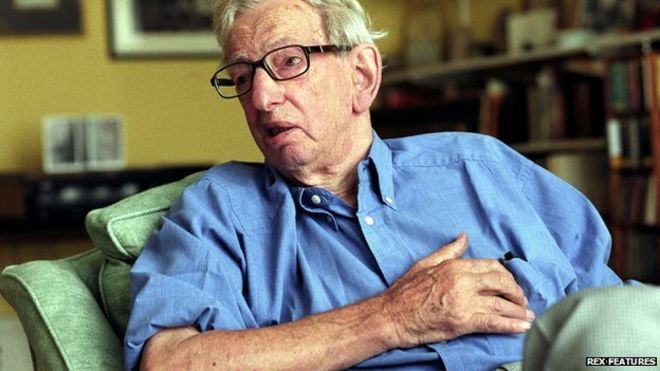
Eric Hobsbawm
Eric Hobsbawm, who died last October 1, aged ninety-five, has been much celebrated as one of the twentieth century’s greatest English-language historians despite his steadfast advocacy of socialism and use of the tools of Marxian analysis. But, if asked, the founding editors of Monthly Review, Leo Huberman and Paul Sweezy, his lifelong colleagues, and comrades, would have differed a bit. They would have said that it was precisely because Marxism was intrinsic to his theory, understanding, and action that he gained his preeminence.
Both Hobsbawm and MR were born in turbulent times, he in the year of the Bolshevik Revolution, this magazine in the chaotic aftermath of the Second World War. But both came of age with the grim realities of the Cold War. Hobsbawm’s first book, published in the United States as Social Bandits and Primitive Rebels (1960), looked for lessons for fundamental change in pre-modern forms of resistance and rebellion, just as Huberman, Sweezy, and Baran were examining emerging revolutionary forms, especially in China and Cuba. Hobsbawm, of course, went on to chronicle the nineteenth-century revolutionary awakening of Europe while MR examined and analyzed the nascent radical upsurge in the global South.
Given the differences in their respective projects, distinctions in emphasis and direction were inevitable. In the aftermath of the 1956 events in the Soviet sphere Hobsbawm championed Eurocommunism, seemingly a break with the “hard line” Communism of the postwar European parties, but his stance was always to struggle within the movement not to separate himself from it. And for the next half-century he never considered himself anything other than part of the same project in which the editors of MR were engaged. So when W. W. Rostow’s The Stages of Economic Growth: A Non-Communist Manifesto (1960), later seen as a justification for the Kennedy-Johnson third world imperial plans in Vietnam and elsewhere, became the blueprint for the counterattack against the insurgent developing countries, Paul Baran and Hobsbawm published a powerful rebuttal, that among other things, noted the uses that Cold War social science was put in aid of the U.S. imperial enterprise (see “The Stages of Economic Growth,” Kyklos, May 1961, pages 234–42). The impact of this much-cited article was such that little attention is paid any longer to Rostow’s work.

But like many radical academics, Hobsbawm’s perhaps greatest contributions were as a teacher and communicator; something he shared, especially, with MR editor Leo Huberman, who was most committed to what he called “spreading the word.” The two of them became great friends when Hobsbawm came to New York for the first time at the end of the 1950s. In addition to much political talk, Hobsbawm took Huberman to The Five Spot, a dark smoky jazz club on the Bowery to hear music by the young followers of Charlie “Bird” Parker. Huberman, of course, had no idea who that was, but later said that the music and Hobsbawm’s running commentary was an extraordinary introduction to the quintessential musical form of this country. Hobsbawm was able to communicate to Huberman, as he did in his jazz reviews for the New Statesman, the place of jazz and Parker in the narrative of the struggle against Jim Crow on the eve of the civil rights movement. The reviews were collected in The Jazz Scene, which Hobsbawm published with the pseudonym Francis Newton, brought out by Monthly Review Press in the United States in 1960.
Hobsbawm’s interests were wide-ranging, but his scholarship was singular and his commitment to socialism was steely. What made his work especially interesting was his ability not only to capture the historical specificity of a given age, but also his tendency to look at what was on the outskirts of the dominant view and see change as it emerged from the margins. Related to this was his proclivity to take on some of the hardest issues, including those facing the left. The following article, “Lenin and ‘The Aristocracy of Labor,’” from the August 1970 issue of Monthly Review is an instance of the latter.
—Monthly Review Editors
The following brief essay is a contribution to the discussion of Lenin’s thought, on the occasion of the hundredth anniversary of his birth. The subject is one which can be appropriately treated by a British Marxist, since the concept of an “aristocracy of labor” is one which Lenin clearly derived from the history of British nineteenth-century capitalism. His concrete references to the “aristocracy of labor” as a stratum of the working class appear to be exclusively drawn from Britain (though in his study notes on imperialism he also remarks upon similar phenomena in the “white” parts of the British Empire). The term itself is almost certainly derived from a passage by Engels written in 1885 and reprinted in the introduction to the 1892 edition of The Condition of the Working Class in England in 1844 which speaks of the great English trade unions as forming “an aristocracy among the working class.”
The actual phrase may be attributable to Engels, but the concept was familiar in English politico-social debate, particularly in the 1880s. It was generally accepted that the working class in Britain at this period contained a favored stratum—a minority but a numerically large one—which was most usually identified with the “artisans” (i.e., the skilled employed crafts—men and workers) and more especially with those organized in trade unions or other working-class organizations. This is the sense in which foreign observers also used the term, e.g., Schulze-Gaevernitz, whom Lenin quotes with approval on this point in the celebrated eighth chapter of Imperialism. This conventional identification was not entirely valid, but, like the general use of the concept of an upper working-class stratum, reflected an evident social reality. Neither Marx nor Engels nor Lenin “invented” a labor aristocracy. It existed only too visibly in Britain of the second half of the nineteenth century. Moreover, if it existed anywhere else, it was clearly much less visible or significant. Lenin assumed that, until the period of imperialism, it existed nowhere else.
The novelty of Engels’s argument lay elsewhere. He held that this aristocracy of labor was made possible by the industrial world monopoly of Britain, and would therefore disappear or be pushed closer to the rest of the proletariat with the ending of this monopoly. Lenin followed Engels on this point, and indeed in the years immediately preceding 1914, when the British labor movement was becoming radicalized, tended to stress the second half of Engels’s argument, e.g., in his articles “English Debates on a Liberal Workers’ Policy” (1912), “The British Labor Movement” (1912), and “In England, the Pitiful Results of Opportunism” (1913). While not doubting for a moment that the labor aristocracy was the basis of the opportunism and “Liberal-Laborism” of the British movement, Lenin did not appear as yet to emphasize the international implications of the argument. For instance, he apparently did not use it in his analysis of the social roots of revisionism (see “Marxism and Revisionism,” 1908, and “Differences in the European Labor Movement,” 1910). Here he argued rather that revisionism, like anarcho-syndica1ism, was due to the constant creation on the margins of developing capitalism of certain middle strata—small workshops, domestic workers, etc.—which are in turn constantly cast into the ranks of the proletariat, so that petty-bourgeois tendencies inevitably infiltrate into proletarian parties.
The line of thought which he derived from his recognition of the labor aristocracy was at this stage somewhat different; and it is to be noted that he maintained it, in part at least, to the end of his political life. Here it is perhaps relevant to observe that Lenin drew his knowledge of the phenomenon not only from the writings of Marx and Engels, who commented frequently on the British labor movement, and from his personal acquaintance with Marxists in England (which he visited six times between 1902 and 1911), but also from the fullest and best-informed work on the “aristocratic” trade unions of the nineteenth century, Sidney and Beatrice Webb’s Industrial Democracy. This important book he knew intimately, having translated it in his Siberian exile. It provided him, incidentally, with an immediate understanding of the links between the British Fabians and Bernstein: “The original source of a number of Bernstein’s contentions and ideas,” he wrote in September 1899 to a correspondent, “is in the latest books written by the Webbs.” Lenin continued to quote information drawn from the Webbs many years later, and specifically refers to Industrial Democracy in the course of his argument in What Is To Be Done?
Two propositions may be derived in part, or mainly, from the experience of the British labor aristocracy. The first was “that the subservience to the spontaneity of the labor movement, belittling of the role of ‘the conscious element,’ of the role of Social Democracy, means, whether one likes it or not, the growth of influence of bourgeois ideology among the workers.” The second was that a purely trade unionist struggle “is necessarily a struggle according to trade, because conditions of labor differ very much in different trades, and consequently the fight to improvethese conditions can only be conducted in respect to each trade.” (What Is To Be Done? The second argument is supported by direct reference to the Webbs.)
The first of these propositions appears to be based on the view that, under capitalism, bourgeois ideology is hegemonic, unless deliberately counteracted by “the conscious element.” This important observation leads us far beyond the mere question of the labor aristocracy, and we need not pursue it further here. The second proposition is more closely linked to the aristocracy of labor. It argues that, given the “law of uneven development” within capitalism—i.e., the diversity of conditions in different industries, regions, etc., of the same economy—a purely “economist” labor movement must tend to fragment the working class into “selfish” (“petty bourgeois”) segments each pursuing its interest, if necessary in alliance with its own employers, at the expense of the rest. (Lenin several times quoted the case of the “Birmingham Alliances” of the 1890s, attempts at a joint union-management bloc to maintain prices in various metal trades. He derived this information almost certainly also from the Webbs.) Consequently such a purely “economist” movement must tend to disrupt the unity and political consciousness of the proletariat and to weaken or counteract its revolutionary role.
This argument is also very general. We can regard the aristocracy of labor as a special case of this general model. It arises when the economic circumstances of capitalism make it possible to grant significant concessions to the proletariat, within which certain strata manage, by means of their special scarcity, skill, strategic position, organizational strength, etc., to establish notably better conditions for themselves than the rest. Hence there may be historic situations, as in late nineteenth-century England, when the aristocracy of labor can almost be identified with the effective trade union movement, as Lenin sometimes came close to suggesting.
But if the argument is in principle more general, there can be no doubt that what was in Lenin’s mind when he used it was the aristocracy of labor. Time and again we find him using phrases such as the following: “the petty bourgeois craft spirit which prevails among this aristocracy of labor” (“The Session of the International Socialist Bureau,” 1908); “the English trade unions, insular, aristocratic, philistinely selfish”; “the English pride themselves on their ‘practicalness’ and their dislike of general principles; this is an expression of the craft spirit in the labor movement” (“English Debates on a Liberal Workers’ Policy,” 1912); and “this aristocracy of laborisolated itself from the mass of the proletariat in close, selfish, craft unions” (“Harry Quelch,” 1913). Moreover, much later, and in a carefully considered programmatic statement—in fact, in his “Preliminary Draft Theses on the Agrarian Question for the Second Congress of the Communist International” (1920)—the connection is made with the greatest clarity:
The industrial workers cannot fulfill their world-historical mission of emancipating mankind from the yoke of capital and from wars if these workers concern themselves exclusively with their narrow craft, narrow trade interests, and smugly confine themselves to care and concern for improving their own, sometimes tolerable, petty bourgeois conditions. This is exactly what happens in many advanced countries to the “labor aristocracy” which serves as the base of the alleged Socialist parties of the Second International.
This quotation, combining the earlier and the later ideas of Lenin about the aristocracy of labor, leads us naturally from the one to the other. These later writings are familiar to all Marxists. They date in the main from the period 1914–1917, and form part of Lenin’s attempt to provide a coherent Marxist explanation for the outbreak of the war and especially the simultaneous and traumatic collapse of the Second International and most of its constituent parties. They are stated most fully in the eighth chapter of Imperialism, and the article “Imperialism and the Split in the Socialist Movement,” written a little later (autumn 1916) and complementing it.
The argument of Imperialism is well-known, though the glosses of “Imperialism and the Split” are not so widely known. Broadly speaking, it runs as follows. Thanks to the peculiar position of British capitalism—“vast colonial possessions and a monopolist position in the world markets”—the British working class tended already in the mid-nineteenth century to be divided into a favored minority of labor aristocrats and a much larger lower stratum. The upper stratum “becomes bourgeois,” while at the same time “a section of the proletariat allows itself to be led by people who are bought by the bourgeoisie, or at least are in their pay.” In the epoch of imperialism what was once a purely British phenomenon is now found in all the imperialist powers. Hence opportunism, degenerating into social chauvinism, characterized all the leading parties of the Second International. However, “opportunism cannot now triumph in the working-class movement of any country for decades as it did in England,” because world monopoly has now to be shared between a number of competing countries. Thus imperialism, while generalizing the phenomenon of the aristocracy of labor, also provides the conditions for its disappearance.
The relatively cursory passages of Imperialism are expanded into a rather fuller argument in “Imperialism and the Split.” The existence of a labor aristocracy is explained by the super-profits of monopoly, which allows the capitalists “to devote a part (and not a small one at that) to bribe their own workers, to create something like an alliancebetween the workers of a given nation and their capitalists against the other countries.” This “bribery” operates through trusts, the financial oligarchy, high prices, etc. (i.e., something like joint monopolies between a given capitalism and its workers). The amount of the potential bribe is substantial—Lenin estimated it as perhaps one hundred million francs out of a billion—and so, under certain circumstances, is the stratum which benefits from it. However, “the question as to how this little sop is distributed among labor ministers, ‘labor representatives’labor members of war industrial committees, labor officials, workers organized in narrow craft unions, office employees, etc., etc., is a secondary question.” The remainder of the argument, with exceptions to be noted below, amplifies but does not substantially alter the argument of Imperialism.
It is essential to recall that Lenin’s analysis was attempting to explain a specific historic situation—the collapse of the Second International—and to buttress specific political conclusions which he drew from it. He argued, first, that since opportunism and social chauvinism represented only a minority of the proletariat, revolutionaries must “go down lowerand deeper, to the real masses”; and second, that the “bourgeois labor parties” were now irrevocably sold to the bourgeoisie, and would neither disappear before the revolution nor in some way “return” to the revolutionary proletariat, though they might “swear by the name of Marx” wherever Marxism was popular among the workers. Hence revolutionaries must reject a factitious unity between the revolutionary proletarian and the opportunist philistine trend within the labor movement. In brief, the international movement had to be split, so that a Communist labor movement could replace a Social Democratic one.
These conclusions applied to a specific historical situation, but the analysis supporting them was more general. Since it was part of a specific political polemic as well as a broader analysis, some of the ambiguities of Lenin’s argument about imperialism and the labor aristocracy are not to be scrutinized too closely. As we have seen, he himself pushed certain aspects of it aside as “secondary.” Nevertheless, the argument is in certain respects unclear or ambiguous. Most of its difficulties arise out of Lenin’s insistence that the corrupted sector of the working class is and can only be a minority, or even, as he sometimes suggests polemically, a tiny minority, as against the masses who are not “infected with ‘bourgeois respectability’” and to whom the Marxists must appeal, for “this is the essence of Marxian tactics.”
In the first place, it is evident that the corrupted minority could be, even on Lenin’s assumptions, a numerically large sector of the working class and an even larger one of the organized labor movement. Even if it only amounted to 20 percent of the proletariat, like the labor organizations in late nineteenth-century England or in 1914 Germany (the illustration is Lenin’s), it could not be simply written off politically, and Lenin was too realistic to do so. Hence a certain hesitation in his formulations. It was not the labor aristocracy as such, but only “a stratum” of it which had deserted economically to the bourgeoisie (“Imperialism and the Split”). It is not clear which stratum. The only types of workers specifically mentioned are the functionaries, politicians, etc., of the reformist labor movements. These are indeed minorities—tiny minorities—corrupted and sometimes frankly sold to the bourgeoisie, but the question why they command the support of their followers is not discussed.
In the second place, the position of the mass of the workers is left in some ambiguity. It is clear that the mechanism of exploiting a monopoly of markets, which Lenin regards as the basis of “opportunism,” functions in ways which cannot confine its benefits to one stratum only of the working class. There is good reason to suppose that “something like an alliance” “between the workers of the given nation and their capitalists against the other countries” (and which Lenin illustrates by the Webbs’s “Birmingham Alliances”) implies some benefits for all workers, though obviously much larger ones for the well organized and strategically strong labor aristocrats among them. It is indeed true that the world monopoly of nineteenth-century British capitalism may have provided the lower proletarian strata with no significant benefits, while it provided the labor aristocracy with substantial ones. But this was because there was, under the conditions of competitive, liberal, “laissez-faire” capitalism and inflation, nomechanism other than the market (including the collective bargaining of the few proletarian groups capable of applying it), for distributing the benefits of world monopoly to the British workers.
But under the conditions of imperialism and monopoly capitalism this was no longer so. Trusts, price maintenance, “alliances,” etc., did provide a means of distributing concessions more generally to the workers affected. Moreover, the role of the state was changing, as Lenin was aware. “Lloyd Georgeism” (which he discussed most perceptively in “Imperialism and the Split”) aimed at “securing fairly substantial sops for the obedient workers, in the shape of social reforms (insurance, etc.).” It is evident that such reforms were likely to benefit the “non-aristocratic” workers relatively more than the already comfortably situated “aristocrats.”
Finally, Lenin’s theory of imperialism argues that the “handful of the richest, privileged nations” turned into “parasites on the body of the rest of mankind,” i.e., into collective exploiters, and suggests a division of the world into “exploiting” and “proletarian” nations. Could the benefits of such a collective exploitation be confined entirely to a privileged layer of the metropolitan proletariat? Lenin was keenly aware that the original Roman proletariat was a collectively parasitic class. Writing about the Stuttgart Congress of the International in 1907, he observed:
The class of those who own nothing but do not labor either is incapable of overthrowing the exploiters. Only the proletarian class, which maintains the whole of society, has the power to bring about a successful social revolution. And now we see that, as the result of a far-reaching colonial policy the European proletariat has partly reached a situation where it is not its work that maintains the whole of society but that of the people of the colonies who are practically enslaved. . . . In certain countries these circumstances create the material and economic basis for infecting the proletariat of one country or another with colonial chauvinism. Of course this may perhaps be only a temporary phenomenon, but one must nevertheless clearly recognize the evil and understand its causes.
“Marx frequently referred to a very significant saying of Sismondi’s to the effect that the proletarians of the ancient world lived at the expense of society whereas modem society lives at the expense of the proletarian” (1907). Nine years later, in the context of a later discussion, “Imperialism and the Split” still recalls that “the Roman proletariat lived at the expense of society.”
Lenin’s analysis of the social roots of reformism is often presented as if it dealt only with the formation of a labor aristocracy. It is of course undeniable that Lenin stressed this aspect of his analysis far more than any other and, for purposes of political argument, almost to the exclusion of any other. It is also clear that he hesitated to follow up other parts of his analysis, which seemed to have no bearing on the political point he was at that time overwhelmingly concerned to make. However, a close reading of his writings shows that he did consider other aspects of the problem, and that he was aware of some of the difficulties of an excessively one-sided “labor aristocratic” approach. Today, when it is possible to separate what is of permanent relevance in Lenin’s argument from what reflects the limits of his information or the requirements of a specific political situation, we are in a position to see his writings in historical perspective.
If we try to judge his work on the “aristocracy of labor” in such a perspective, we may well conclude that his writings of 1914–1916 are somewhat less satisfactory than the profound line of thought which he pursued consistently from What Is To Be Done? to the Preliminary Draft Theses on the Agrarian Question of 1920. In fact, though much of the analysis of a “labor aristocracy” is applicable to the period of imperialism, the classic nineteenth-century (British) model of it, which formed the basis of Lenin’s thinking on the subject, was ceasing to provide an adequate guide to the reformism of, at least, the British labor movement by 1914, though as a stratum of the working class it was probably at its peak in the late nineteenth and early twentieth century.
On the other hand the more general argument about the dangers of “spontaneity” and “selfish” economism in the trade-union movement, though illustrated by the historic example of the late nineteenth-century British labor aristocracy, retains all its force. It is indeed one of the most fundamental and permanently illuminating contributions of Lenin to Marxism.