Tuesday, January 10, 2017

2535. Climate Change: Will a Crucial Ocean Current Shut Down?

By Robinson Meyer, The Atlantic, January 7, 2017


Americans who are concerned about climate change have long found themselves in an unenviable position: They have to debate about the existence of a debate.

For about two decades, the vast majority of climate scientists have agreed that human industrial activity is forcing the planet to warm. For about as long, some doubters have argued that this consensus is nonexistent or premature—and that, despite repeated studies identifying it, media attempts to report on the consensus constitute so much liberal bias.

These fights will likely be recapitulated this month. Scott Pruitt, the attorney general of Oklahoma and President-elect Donald Trump’s nominee to lead the EPA, has invested a lot of time in fighting the Obama administration’s climate and environmental regulations. He has not, however, said very much on the record about climate change.

One of his only quotes on the matter appeared in a National Review editorial last year. “Scientists continue to disagree about the degree and extent of global warming and its connection to the actions of mankind,” he wrote, in an article co-authored with Alabama attorney general Luther Strange.

The problem is: Not all of this sentence is true. While scientists continue to explore the consequences of climate change, there is essentially no debate among scientists about global warming’s “connection to the actions of mankind.”

Nor has there been a debate for years. Since at least 1995, the balance of evidence in climate science has indicated that human-caused greenhouse-gas emissions are behind the planet’s warming. Agreement on this question has only strengthened since. By 2012, an international panel of leading researchers in the field said there was at least a 95 percent chance that human activity has caused global warming since 1950.

There are active discussions in climate science—they’re just not about this. So before we all have to talk about a topic on which there is near total scientific agreement, I thought it might be fascinating to examine a real area of dispute in the field. And one of the most consequential disagreements is about something called the Atlantic Meridional Overturning Circulation, or AMOC.

* * *

In 1769, Ben Franklin became the first person to map the Gulf Stream when he made the above chart. (NOAA)

Many Americans know AMOC as the Gulf Stream: the warm, surface-level current in the Atlantic Ocean that hugs the East Coast. You may have seen it in the old map by Ben Franklin, pictured above: It flows up the Carolinas, passes by New England and Nova Scotia, and then veers toward Europe. Eventually it arrives near the British isles and northwestern Europe.

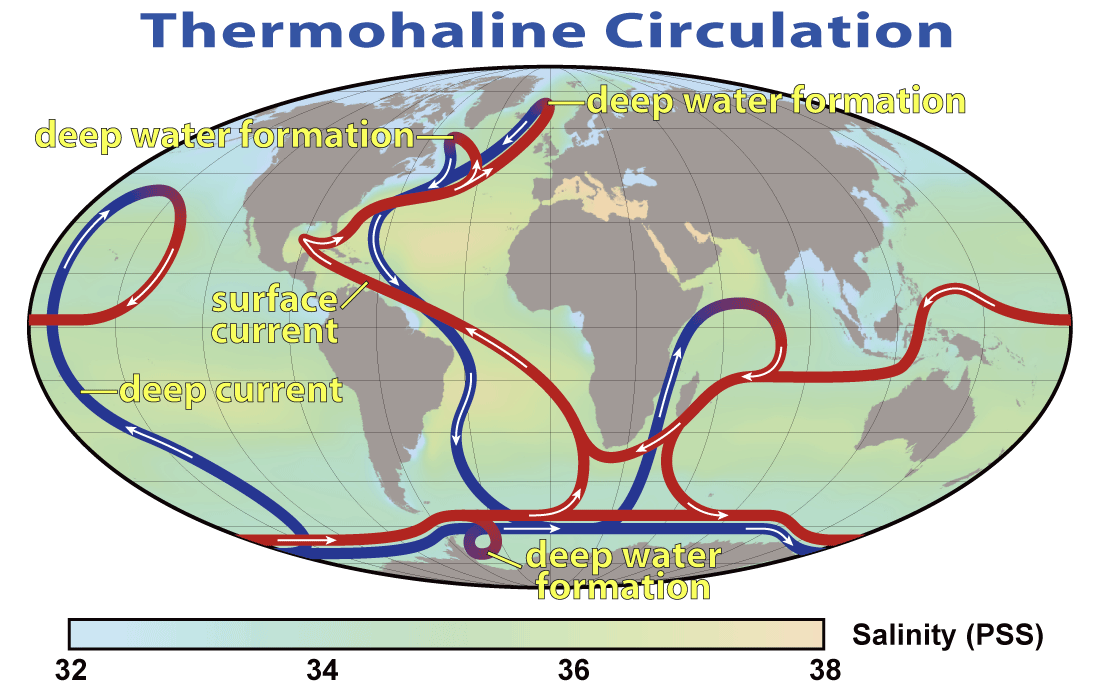
The Gulf Stream is part of a much larger system, however. As that warm water flows northeast, it gradually cools, and in cooling, compresses and sinks. Eventually, in the Labrador and Greenland Seas, it becomes dense enough that it plunges down thousands of meters into the deep ocean. There it becomes a new current, running back south. It can remain in this deep-ocean current for many years until it eventually upwells at the equator or in the Southern Ocean.

This global conveyor belt of water is AMOC, and it is critical to the world’s climate. (Most scientists pronounce it as AY-mock.)

When AMOC is strong, it sends millions of cubic meters of ocean water north every day. A strong AMOC seems to shape the entire planet’s climate systems. It moderates the intensity of Atlantic hurricanes, lessens the risk of drought in North America, and assures the health of monsoons in India. AMOC also ferries warm weather from the equator to Western Europe, where it helps bring the region unusually mild winters. (Consider that temperate Berlin is about as far from the equator as the snowy Chilean city of Punta Arenas.)

Crucially, the entire AMOC system depends on cool, dense water “overturning” in the northwest Atlantic Ocean. Without cooled water plunging into the deep ocean near Greenland, and turning back south, the entire conveyor belt will stop.

About 30 years ago, climate researchers became concerned that AMOC could suddenly shut down as a result of anthropogenic climate change. The “paleoclimatic record”—that is, what the planet’s geology and fossil record reveal of previous global climates—showed that the AMOC has rapidly collapsed in the past. “Rapidly” here means “within the span of a human lifetime.”

The crumpling of AMOC could potentially cause big problems for the global economy. AMOC’s disappearance would quickly worsen sea-level rise on the U.S. East Coast and subject the Southeast to unusually intense tropical storms. It could upheave agriculture in India, Europe, and the African Sahel.

But as climate models improved, those fears dissipated. “No current comprehensive climate model projects that the AMOC will abruptly weaken or collapse in the 21st century,” wrote a team of NOAA researchers in 2008. “We therefore conclude that such an event is very unlikely.”

Thomas Delworth was the lead author of that report. Delworth is a researcher at the NOAA Geophysical Fluid Dynamics Laboratory and a professor of atmospheric and oceanic science at Princeton University. He says that scientists are now re-examining those old conclusions.

“Some recent work now is challenging that consensus. It suggests that the real climate system may be less stable than [the models] think,” Delworth told me.

The most attention-getting of this work: a paper last year by James Hansen and 18 other scientists that argued the AMOC’s collapse could threaten global civilization this century. The paper built on older work showing that huge injections of freshwater have historically destabilized AMOC, essentially by flooding the Atlantic with cold water and screwing up its finely tuned density cycle. Hansen and his colleagues argued that as the Greenland ice sheet melts, it would be able to provide exactly such a pulse—and that, crucially, climate models failed to account for this physical process.

The paper made headlines around the world. Though he now is a professor at Columbia University, Hansen led the NASA Goddard Institute for Space Studies for more than three decades. In 1988, he became one of the first scientists to warn Congress of the dangers of global warming.

This week, the consensus on AMOC was challenged again. A team of researchers have showed in Science Advances that a popularly used climate model may significantly overestimate the stability of AMOC. Once you account for this bias, AMOC proves much more likely to collapse, they argue. And this collapse could happen without any freshwater injection from Greenland.

In other words, they show that the stress of global warming can push AMOC into collapse all by itself in at least one model. Freshwater doesn’t need to pour in from Greenland for AMOC to fall apart; simply increasing the temperature of the ocean can do it.

That’s because climate models make AMOC more stable than it actually is in nature, said Wei Liu, an oceanography researcher at Yale University and one of the authors of the study. “In a stable routine, if you increase the CO2, then AMOC only weakens. But in an unstable routine, if you add global warming, then AMOC will collapse by itself,” he told me.

He argues that field observations of the Atlantic Ocean suggest that AMOC is in fact unstable. Between mid-2009 and mid-2010, AMOC appeared to weaken, with the current carrying only two-thirds of its usual volume of water. At the same time, sea-level rise on the East Coast accelerated and Europe experienced an unusually frigid winter.

In their study, Liu and his colleagues tried to make their model more unstable. Most models, they say, do a bad job of representing AMOC. They don’t have enough salty water entering the Atlantic at the equator, and they also don’t have enough freshwater leaving it in the deep ocean.

In their experiment, they fixed this extremely crudely. Instead of fixing the underlying physics, they told the model to add much more saltwater and freshwater to the simulation. Then they doubled the amount of carbon dioxide in the simulated atmosphere, stepped back, and watched to see what would happen.

; line-height: normal;"> What happened is that, between year 200 and 300 of their adjusted model, AMOC rapidly collapsed.

Delworth said that even though their experiment was crude, it was revealing. “It’s a very interesting and provocative work,” he told me. “I think they are opening up this topic and saying our models may be too stable.”

“In this new study, they’ve just put a band-aid on [this stability]. They’ve said, if we alter these characteristics, the model is much less stable. But sometimes it’s really good to have these simple ad hoc techniques to address, ‘What’s the sensitivity of our models?’” he said.

The paper alone didn’t overthrow the consensus, he added, but it did suggest it should be re-examined.

Hansen, on the other hand, was more dismissive of the study’s approach. “You can’t fix the climate model simulation via ‘bias removal’—you should fix what is wrong with the model physics,” he said in an email. “They are doubling CO2, letting that change the temperature, rainfall, etc. and seeing what that does to the AMOC in their model. It’s been more than 35 million years since we had that much CO2 in the air, and sea level was more than 200 feet higher then. If we (humanity) are so stupid as to double CO2, you can count on the AMOC to shut down much faster than 300 years.”

Other climatologists, especially those who study Earth’s past, were much more positive about the paper, describing it as a necessary improvement to how we understand current climate models.

“This is an important step forward,” said Jean Lynch-Stieglitz, a professor of Earth and atmospheric sciences at Georgia Tech. “This study identifies a specific property of the climate models that would tend to make the AMOC in the models more stable than in reality.”

“Importantly, it reminds us that even if most climate model projections agree on their projections for future AMOC changes, that doesn’t necessarily mean that the projections are correct,” she added.

The instability of AMOC is one of the great open questions remaining in our understanding of climate change, one of the ongoing explorations into global warming’s “degree and extent.”

It is, in other words, an active debate in climate science.

But I want to highlight how it does and doesn’t look like a political debate. To my eye, it looks more like an open investigation: Researchers share their results, compare the models to the field observations, make tentative corrections to the software and underlying assumptions, and move chaotically together toward a deeper understanding of how the planet works.

Sometimes, they may disagree about how best to proceed or about the validity of any one study. But they do not disagree about the underlying chemistry and physics of their enterprise—all of which show that people are warming the planet through their industrial greenhouse-gas emissions.  

Martha Buckley, a research professor of oceanography at George Mason University, may have put it best.

“It is certainly a possibility that the AMOC is too stable in current [global climate models],” she said in an email.“The most obvious weakness of the paper is that the experiment is done for a single model.” She called the authors’ methods of fixing it “relatively crude.”

But then she went on. From what we know right now, the possibility that AMOC will shut down remains a “potential impact of climate change with significant consequences.”

“Yet other impacts are much more certain” to result from climate change, she said, listing “increased surface temperatures, sea level rise, and ice melt.” While some harms, like those of a collapsing AMOC, are still up for debate, it is almost completely certain that climate change will bring serious consequences for us in our time. Rampant drought, drier rivers, and vanished coasts are all ours to inherit.

2534. Cities Are the New Laboratories of Evolution

By Sarah DeWeerdt, Anthropocene Magazine, January 3, 2017

Cities are driving rapid evolutionary changes to plant and animal species, according to a study published yesterday in the Proceedings of the National Academy of Sciences.
Usually, we think of evolution as happening in remote, isolated, or pristine places—the Galapagos Islands, for example. But the new findings suggest that scientists can’t understand evolution as it’s currently occurring without grappling with the complex and expanding urban landscape.
An international team of researchers searched the scientific literature for data on changes in the phenotype—meaning outward characteristics, like appearance and behavior—of species living in different environments.
They analyzed these changes according to whether the species studied lived in an urban landscape, another type of human-influenced environment such as agricultural land, or in natural areas. Overall, their analysis included 89 studies that gauged over 1,600 characteristics of 155 species.
The researchers used statistical models to determine how well urban-related versus other variables explain the observed changes in these characteristics. Models that include urban variables are more accurate than those that do not, they found. This means that urbanization is a key driver of contemporary evolution.
Surprisingly, merely living in a human-influenced landscape has a rather modest effect on a species’ characteristics. But the pace of urbanization makes a bigger difference.
“Our study shows a clear urban signal; rates of phenotypic change are greater in urbanizing systems compared with natural and nonurban anthropogenic systems,” the researchers write.
Interactions with humans, such as selective harvesting of a medicinal plant, and the introduction of new predator, prey, and competitor species also spur evolutionary change.
And cities are the sites of novel evolutionary pressures, such as high concentrations of zinc around electrical transmission towers that have resulted in the development of zinc tolerance in certain plants.
The researchers caution that the results may reflect the particular species involved in available studies. For example, lots of the studies involve migratory birds, especially in Europe, and these species don’t seem to change their migration routes much in response to urban sprawl. But other types of species and other characteristics could be more greatly affected by the fragmentation of natural habitats that comes along with urbanization.
The study is also among the first to systematically link the traits that are changing in urban plants and animals to ecosystem functions and services. For example, evolution of ecosystem engineers like marsh plants, mangroves, and seagrasses could influence flood control in coastal cities and their capacity to adapt to climate change.
In other words, by building cities we’re also driving evolutionary changes that could affect the sustainability of those cities down the line. That means studying the evolutionary effects of urbanization isn’t just necessary to understand evolution in some abstract sense—the future of our own species may also depend on it.

Friday, January 6, 2017

2533. On Commodity Fetishism: The Gift of Death

By George Monbiot, monbiot.com, December 10, 2012

There’s nothing they need, nothing they don’t own already, nothing they even want. So you buy them a solar-powered waving queen; a belly button brush; a silver-plated ice cream tub holder; a “hilarious” inflatable zimmer frame; a confection of plastic and electronics called Terry the Swearing Turtle; or – and somehow I find this significant – a Scratch Off World wall map.

They seem amusing on the first day of Christmas, daft on the second, embarrassing on the third. By the twelfth they’re in landfill. For thirty seconds of dubious entertainment, or a hedonic stimulus that lasts no longer than a nicotine hit, we commission the use of materials whose impacts will ramify for generations.

Researching her film The Story of Stuff, Annie Leonard discovered that of the materials flowing through the consumer economy, only 1% remain in use six months after sale(1). Even the goods we might have expected to hold onto are soon condemned to destruction through either planned obsolescence (breaking quickly) or perceived obsolesence (becoming unfashionable).

But many of the products we buy, especially for Christmas, cannot become obsolescent. The term implies a loss of utility, but they had no utility in the first place. An electronic drum-machine t-shirt; a Darth Vader talking piggy bank; an ear-shaped i-phone case; an individual beer can chiller; an electronic wine breather; a sonic screwdriver remote control; bacon toothpaste; a dancing dog: no one is expected to use them, or even look at them, after Christmas Day. They are designed to elicit thanks, perhaps a snigger or two, and then be thrown away.

The fatuity of the products is matched by the profundity of the impacts. Rare materials, complex electronics, the energy needed for manufacture and transport are extracted and refined and combined into compounds of utter pointlessness. When you take account of the fossil fuels whose use we commission in other countries, manufacturing and consumption are responsible for more than half of our carbon dioxide production(2). We are screwing the planet to make solar-powered bath thermometers and desktop crazy golfers.

People in eastern Congo are massacred to facilitate smart phone upgrades of ever diminishing marginal utility(3). Forests are felled to make “personalised heart-shaped wooden cheese board sets”. Rivers are poisoned to manufacture talking fish. This is pathological consumption: a world-consuming epidemic of collective madness, rendered so normal by advertising and the media that we scarcely notice what has happened to us.

In 2007, the journalist Adam Welz records, 13 rhinos were killed by poachers in South Africa. This year, so far, 585 have been shot(4). No one is entirely sure why. But one answer is that very rich people in Vietnam are now sprinkling ground rhino horn on their food or snorting it like cocaine to display their wealth. It’s grotesque, but it scarcely differs from what almost everyone in industrialised nations is doing: trashing the living world through pointless consumption.

This boom has not happened by accident. Our lives have been corralled and shaped in order to encourage it. World trade rules force countries to participate in the festival of junk. Governments cut taxes, deregulate business, manipulate interest rates to stimulate spending. But seldom do the engineers of these policies stop and ask “spending on what?”. When every conceivable want and need has been met (among those who have disposable money), growth depends on selling the utterly useless. The solemnity of the state, its might and majesty, are harnessed to the task of delivering Terry the Swearing Turtle to our doors.

Grown men and women devote their lives to manufacturing and marketing this rubbish, and dissing the idea of living without it. “I always knit my gifts”, says a woman in a television ad for an electronics outlet. “Well you shouldn’t,” replies the narrator(5). An advertisement for Google’s latest tablet shows a father and son camping in the woods. Their enjoyment depends on the Nexus 7’s special features(6). The best things in life are free, but we’ve found a way of selling them to you.

The growth of inequality that has accompanied the consumer boom ensures that the rising economic tide no longer lifts all boats. In the US in 2010 a remarkable 93% of the growth in incomes accrued to the top 1% of the population(7). The old excuse, that we must trash the planet to help the poor, simply does not wash. For a few decades of extra enrichment for those who already possess more money than they know how to spend, the prospects of everyone else who will live on this earth are diminished.

So effectively have governments, the media and advertisers associated consumption with prosperity and happiness that to say these things is to expose yourself to opprobrium and ridicule. Witness last week’s Moral Maze programme, in which most of the panel lined up to decry the idea of consuming less, and to associate it, somehow, with authoritarianism(8). When the world goes mad, those who resist are denounced as lunatics.

Bake them a cake, write them a poem, give them a kiss, tell them a joke, but for god’s sake stop trashing the planet to tell someone you care. All it shows is that you don’t.

3. See the film Blood in the Mobile. http://bloodinthemobile.org/
7. Emmanuel Saez, 2nd March 2012. Striking it Richer: the Evolution of Top Incomes in the United States (Updated with 2009 and 2010 estimates). http://elsa.berkeley.edu/~saez/saez-UStopincomes-2010.pdf
8. http://www.bbc.co.uk/programmes/b01p424r

2532. Political Economy of Science: The Case of Honeybees and Pesticides

By Danny Hakim, The New York Times, December 31, 2016
The agrochemical giant Syngenta has been paying off scientists to deny pesticides are a leading cause of honeybees colony collapse disorder. 
EXETER, England — The bee findings were not what Syngenta expected to hear.

The pesticide giant had commissioned James Cresswell, an expert in flowers and bees at the University of Exeter in England, to study why many of the world’s bee colonies were dying. Companies like Syngenta have long blamed a tiny bug called a varroa mite, rather than their own pesticides, for the bee decline.

Dr. Cresswell has also been skeptical of concerns raised about those pesticides, and even the extent of bee deaths. But his initial research in 2012 undercut concerns about varroa mites as well. So the company, based in Switzerland, began pressing him to consider new data and a different approach.

Looking back at his interactions with the company, Dr. Cresswell said in a recent interview that “Syngenta clearly has got an agenda.” In an email, he summed up that agenda: “It’s the varroa, stupid.”

For Dr. Cresswell, 54, the foray into corporate-backed research threw him into personal crisis. Some of his colleagues ostracized him. He found his principles tested. Even his wife and children had their doubts.

“They couldn’t believe I took the money,” he said of his family. “They imagined there was going to be an awful lot of pressure and thought I sold out.”

The corporate use of academia has been documented in fields like soft drinks and pharmaceuticals. But it is rare for an academic to provide an insider’s view of the relationships being forged with corporations, and the expectations that accompany them.

A review of Syngenta’s strategy shows that Dr. Cresswell’s experience fits in with practices used by American competitors like Monsanto and across the agrochemical industry. Scientists deliver outcomes favorable to companies, while university research departments court corporate support. Universities and regulators sacrifice full autonomy by signing confidentiality agreements. And academics sometimes double as paid consultants.

In Britain, Syngenta has built a network of academics and regulators, even recruiting the leading government scientist on the bee issue. In the United States, Syngenta pays academics like James W. Simpkins of West Virginia University, whose work has helped validate the safety of its products. Not only has Dr. Simpkins’s research been funded by Syngenta, he is also a $250-an-hour consultant for the company. And he teamed up with a Syngenta executive in a consulting venture, emails obtained by The New York Times show.

Dr. Simpkins did not comment. A spokesman for West Virginia University said his consulting work “was based on his 42 years of experience with reproductive neuroendocrinology.”

Scientists who cross agrochemical companies can find themselves at odds with the industry for years. One such scientist is Angelika Hilbeck, a researcher at the Swiss Federal Institute of Technology in Zurich. The industry has long since challenged her research, and she has been outspoken in challenging them back.

Going back to the 1990s, her research has found that genetically modified corn — intended to kill bugs that eat the plant — could harm beneficial insects as well. Back then, Syngenta had not yet been formed, but she said one of its predecessor companies, Ciba-Geigy, tried to stifle her research by citing a confidentiality agreement signed by her employer then, a Swiss government research center called Agroscope.

Confidentiality agreements have become routine. The United States Department of Agriculture turned over 43 confidentiality agreements reached with Syngenta, Bayer and Monsanto since the beginning of 2010 after a Freedom of Information Act request. Agroscope turned over an additional five with Swiss agrochemical companies.

Many of the agreements highlight how regulators are often more like collaborators than watchdogs, exploring joint research and patent deals that they agree to keep secret.

One agreement between the U.S.D.A. and Syngenta, which came with a five-year nondisclosure term, covered things including “research and development activities,” “manufacturing processes” and “financial and marketing information related to crop protection and seed technologies.” In another agreement, a government scientist was barred even from disclosing sensitive information she heard at a symposium run by Monsanto.

The Agriculture Department, in a statement, said that without such agreements and partnerships, “many technological solutions would not make it to the public,” adding that research findings were released “objectively without inappropriate influence from internal or external partners.”

Luke Gibbs, a spokesman for Syngenta, which is now being acquired by the China National Chemical Corporation, said in a statement, “We are proud of the collaborations and partnerships we have built.”

“All researchers we partner with are free to express their views publicly in regard to our products and approaches,” he said. “Syngenta does not pressure academics to draw conclusions and allows unfettered and independent submission of any papers generated from commissioned research.”

A look at the experiences of the three scientists — Dr. Cresswell, Dr. Simpkins and Dr. Hilbeck — reveals the ways agrochemical companies shape scientific thought.

A Reluctant Partner
For James Cresswell, taking money from Syngenta was not an easy decision.
Dr. Cresswell has been a researcher at the University of Exeter, in England’s southwest, for a quarter-century, mostly exploring the esoterica of flower reproduction in papers with titles like “Conifer ovulate cones accumulate pollen principally by simple impaction.” He was not used to making headlines.

But about a half-decade ago, he became interested in the debate over neonicotinoids, a class of pesticide derived from nicotine, and their effects on bee health. Many studies linked the chemicals to a mysterious collapse of bee colonies that was in the news. Other studies, many backed by industry, pointed to the varroa mite, and some saw both factors at play.

Dr. Cresswell’s initial research led him to believe that concerns about the pesticides were overblown. In 2012, Syngenta offered to fund further research.

While many academics resisted efforts by The Times to examine their communications with Syngenta, Dr. Cresswell did not challenge a records request submitted to his university. And he spoke with candor.

“The last thing I wanted to do was get in bed with Syngenta,” Dr. Cresswell said. “I’m no fan of intensive agriculture.”

But turning away research funding is difficult. The British government ranks universities on how useful their work is to industry and society, tying government grants to their assessments.

“I was pressured enormously by my university to take that money,” he said. “It’s like being a traveling salesman and having the best possible sales market and telling your boss, ‘I’m not going to sell there.’ You can’t really do that.”

The issue soon came up at Dr. Cresswell’s dinner table.

“Me and my mum were like, ‘Oh, you’re taking money,’” his daughter Fay, now a 21-year-old university student, recalled of the conversation that took place. “We didn’t have an argument, but it did get quite heated. We just said, ‘Don’t.’”

Duncan Sandes, a spokesman for Exeter, declined to discuss specific research grants. He said in a statement that up to 15 percent of university research in Britain was funded by industry. “Industry sponsors are fundamentally aware that they will receive independent analysis that has been critically evaluated in an honest and dispassionate manner,” Mr. Sandes said.

But the degree of independence is in question.

Dr. Cresswell and Syngenta agreed on a list of eight potential causes of bee deaths to be studied. They discussed how to structure grant payments. They reviewed research assistant candidates. Dr. Cresswell sought permission from Syngenta to pursue new insights he gained, asking at one point, “Please can you confirm that you are happy with the direction our current work is taking?”

But he also pushed back at times. An email from Syngenta to the university said that Dr. Cresswell “will have final editorial control,” but Dr. Cresswell, in another email, expressed concern that a proposed confidentiality clause “grants Syngenta the right to suppress the results,” adding, “I am not happy to work under a gagging clause.” He says the term of the clause was reduced to only a few months.

Neonicotinoids are now subject to a moratorium in the European Union. A recent study by Britain’s Centre for Ecology & Hydrology attributed a population loss of at least 20 percent of many kinds of wild bees to the pesticides.

Syngenta and its competitors argue that the real culprit is a disease called varroosis, which is spread by varroa mites. The Bayer Bee Care Center in Germany includes menacing sculptures of the little pest.

But Dr. Cresswell’s initial research for Syngenta did not support the varroosis claims. “We are finding it pretty unlikely that varoosis is responsible for honey bee declines,” he wrote to Syngenta in 2012.

An executive wrote back, suggesting that Dr. Cresswell look more narrowly at “loss data” of beehives rather than at broader bee stock trends, “As this may give a different answer!”

For the next several weeks, the company repeatedly asked Dr. Cresswell to refocus his examination to look at varroa. In another email, the executive told Dr. Cresswell, “it would also be good to also look at varroa as a potential uptick factor” in specific countries where it could have exacerbated bee losses.
In the same email, part of a chain with the subject line “Varoosis report,” he also asked Dr. Cresswell to look at changes in Europe, rather than worldwide. Dr. Cresswell agreed and said, “I have some other angles to look at the varoosis issue further.”

By changing parameters, varroa mites did become a significant factor. “We’re coming to the view that varoosis is potent regarding colony loss at widespread scale,” Dr. Cresswell wrote in January 2013. A later email included scoring that bore that out.

Mr. Gibbs of Syngenta said, “We discussed and defined the direction of the research in partnership with the researcher with the aim of ensuring that it was focused and relevant.” He added, “We did not undermine Dr. Cresswell’s independence, dictate his approach to assessing the eight factors agreed upon with him, or restrict any of the conclusions he subsequently drew.”

That said, Syngenta was a client and Dr. Cresswell was providing a service. Looking back, Dr. Cresswell said that while he still thought concerns about the pesticides were overblown, aspects of his project were inevitably influenced by the nature of the relationship.

“You can write it up as, Syngenta had an effect on me,” he said. “I can’t actually deny that they didn’t. It wasn’t conniving on my part, but absolutely they influenced what I ended up doing on the project.”

For Dr. Cresswell, the affiliation with Syngenta became a burden. Environmentalists saw him as an adversary, and his industry connection came to define him in news articles. When he was called to testify before Parliament, Dave Goulson, a biology professor at the University of Sussex, sat next to him. Dr. Goulson likened taking money from agrochemical companies to taking money from the tobacco industry, which long denied that cigarettes were addictive.

Some people thrive on controversy. Dr. Cresswell does not.

“It hurt me more than I was willing to admit at the time,” he said. “Everything happened so fast.”

He had a breakdown. He said that he began to feel “I was virtually incompetent,” adding that he would put his head on his desk and think his work was a mess. He ended up leaving his job for several months. Although he presented his research publicly, it was never published.

In an interview, Dr. Goulson said, “I’ve known James for a very long time and always thought he was a good guy.

“You can’t win,” Dr. Goulson added. “If you are funded by industry, people are suspicious of your research. If you’re not funded, you’re accused of being a tree-hugging greenie activist. There’s no scientist who comes out of this unscathed.”

Today, Dr. Cresswell has returned to less controversial areas of bee research. He says he respects scientists he has met from Syngenta, but views collaboration with industry as a Faustian bargain.

He called Syngenta “a kind of devil.”

“What I didn’t realize is that supping with them would actually have a broader impact on how the world sees me as a scientist,” he said. “That was my misjudgment.”

A Tangled Relationship
If some scientists struggle to reconcile themselves with taking corporate money, others embrace complex business relationships.

James W. Simpkins, a professor at West Virginia University and the director of its Center for Basic and Translational Stroke Research, is one of many outside academics whom Syngenta turns to for research.

He has focused on the Syngenta product atrazine — the second most popular weed killer in America, widely used on lawns and crops — often co-authoring research with Syngenta scientists.

Atrazine, banned in the European Union, has also been controversial in America. Most notably, Syngenta started a campaign to discredit Tyrone B. Hayes, a professor it once funded at the University of California, Berkeley, when Dr. Hayes found that atrazine changes the sex of frogs.

Dr. Simpkins has had a different relationship with the company. In 2003, he appeared before American regulators on Syngenta’s behalf, saying that “we can identify no biologically plausible mechanism by which atrazine leads to an increase in prostate cancer.”

Dr. Simpkins was also lead author of a 2011 study finding no support that atrazine causes breast cancer. And last year, he was part of a small team of Syngenta-backed scientists that fought California’s move to require that atrazine be sold with a warning label. He also recently edited a series of papers on atrazine for Syngenta, garnering praise from a senior researcher at the company, Charles Breckenridge, who wrote in an email that the “papers tell a simple, yet compelling story.”

The depth of the financial intertwining of Dr. Simpkins and Syngenta was laid out in nearly 2,000 pages of email traffic, obtained by The Times after a Freedom of Information Act request. Not only does Dr. Simpkins receive research grants, but the company also pays him $250 an hour as a consultant for his work on expert panels, studies and manuscripts, records show. Syngenta even asked Dr. Simpkins to contribute to Dr. Breckenridge’s annual performance review.

Asking outsiders to contribute to corporate reviews is not unusual. However, Dr. Simpkins is also described in the emails as a partner in a venture set up by Dr. Breckenridge called Quality Scientific Solutions to consult on pesticides and other issues.

West Virginia University’s website says that “research conducted at W.V.U. is data-driven, objective and independent” and “not influenced by any political agenda, business priority” or “funding source.” And John A. Bolt, a university spokesman, said that all of Dr. Simpkins’s Syngenta-related research had been conducted before Dr. Simpkins arrived at West Virginia in 2012.

But a review of Dr. Simpkins’s published work shows that he wrote favorable atrazine studies with Syngenta scientists in 2014 and 2015, and listed his university affiliation. Mr. Bolt said Dr. Simpkins only “served as an expert adviser” in the studies.

In 2014, Syngenta made a $30,000 donation to the university’s foundation. Mr. Bolt said that the donation was made “in general support of the research activities of Dr. James W. Simpkins.” None of the money, Mr. Bolt said, was “used to support research related to Syngenta.”

Dr. Simpkins’s collaborations with Dr. Breckenridge appear to be expansive. In an email to Dr. Simpkins last year, Dr. Breckenridge sent him a study on the Mediterranean Diet and suggested that they use a multilevel marketing company to help them sell a product of their own.

“If we could come up with a better Snake Oil,” he wrote to Dr. Simpkins, “we would have access to a massive marketing force.”

A Critic and a Target
Some scientists labor outside the industry. It can be a difficult path.

Angelika Hilbeck worked for Agroscope, a Swiss agricultural research center, in the 1990s, when she began to examine genetically modified corn. The corn was engineered to kill insect larvae that fed on it, but Dr. Hilbeck found that it was also toxic to an insect called the lacewing, a useful bug that eats other pests.

Ciba-Geigy, a predecessor of Syngenta, had a confidentiality agreement with Agroscope, and insisted that she keep the research secret, she said. Confidentiality agreements are not unusual for Agroscope. In one such agreement obtained by The Times, the agency agreed to return or destroy corporate documents it received as part of a research project.

Dr. Hilbeck said she refused to back down and eventually published her work. Her contract at Agroscope was not renewed. An Agroscope spokeswoman said the episode took place too long ago to comment on.

Dr. Hilbeck continued as a university researcher and was succeeded at Agroscope by Jörg Romeis, a scientist who had worked at Bayer and has since co-authored research with employees from Syngenta, DuPont and other companies. He has spent much of his career trying to debunk Dr. Hilbeck’s work. He followed her lacewing studies by co-authoring his own, finding that genetically modified crops were not harmful to the lacewing.

Next, after Dr. Hilbeck co-wrote a paper outlining a model for assessing the unintended risks of such crops, Dr. Romeis was lead author of an alternative approach with a Syngenta scientist among his co-authors.

Then, in 2009, Dr. Hilbeck was an author of a paper looking at risks to ladybug larvae from modified crops. Dr. Romeis followed by co-authoring a study that found “no adverse effects” to ladybug larvae. In subsequent publications, he referred to work by Dr. Hilbeck and others as “bad science” and a “myth.”

“They were my little stalkers,” Dr. Hilbeck said. “Whatever I did, they did.”
In an interview, Dr. Romeis, who now leads Agroscope’s biosafety research group, said, “Her work does not affect our mission in any way,” adding that the idea of researching the effects of genetically modified crops was “not patented by her.”

Refereeing a scientific dispute is difficult. But Dr. Romeis and his collaborators do seem preoccupied with Dr. Hilbeck’s work, judging from a review of email traffic between Agroscope and the U.S.D.A. obtained by The Times after a Freedom of Information Act request.

In 2014, as Dr. Romeis was developing a paper assailing Dr. Hilbeck’s work, one U.S.D.A. scientist, Steven E. Naranjo, joked in a message to Dr. Romeis: “Joerg, its generous of you to see that Hilbeck gets published once in a while :)”

Dr. Hilbeck is used to looking over her shoulder. “We shouldn’t be running into all kinds of obstacles and face all this comprehensive mobbing just doing what we’re supposed to do,” she said. “It’s totally corrupted this field.”