Thursday, October 2, 2014

1569. Life in a ‘Degrowth’ Economy, and Why You Might Actually Enjoy It

By Samuel Alexander, The Conversation, October 1, 2014

What does genuine economic progress look like? The orthodox answer is that a bigger economy is always better, but this idea is increasingly strained by the knowledge that, on a finite planet, the economy can’t grow for ever.
This week’s Addicted to Growth conference in Sydney is exploring how to move beyond growth economics and towards a “steady-state” economy.
But what is a steady-state economy? Why it is it desirable or necessary? And what would it be like to live in?
The global predicament
We used to live on a planet that was relatively empty of humans; today it is full to overflowing, with more people consuming more resources. We would need one and a half Earths to sustain the existing economy into the future. Every year this ecological overshoot continues, the foundations of our existence, and that of other species, are undermined.
At the same time, there are great multitudes around the world who are, by any humane standard, under-consuming, and the humanitarian challenge of eliminating global poverty is likely to increase the burden on ecosystems still further.
Meanwhile the population is set to hit 11 billion this century. Despite this, the richest nations still seek to grow their economies without apparent limit.
Like a snake eating its own tail, our growth-orientated civilisation suffers from the delusion that there are no environmental limits to growth. But rethinking growth in an age of limits cannot be avoided. The only question is whether it will be by design or disaster.
Degrowth to a steady-state economy
The idea of the steady-state economy presents us with an alternative. This term is somewhat misleading, however, because it suggests that we simply need to maintain the size of the existing economy and stop seeking further growth.
But given the extent of ecological overshoot – and bearing in mind that the poorest nations still need some room to develop their economies and allow the poorest billions to attain a dignified level of existence – the transition will require the richest nations to downscale radically their resource and energy demands.
This realisation has given rise to calls for economic “degrowth”. To be distinguished from recession, degrowth means a phase of planned and equitable economic contraction in the richest nations, eventually reaching a steady state that operates within Earth’s biophysical limits.
At this point, mainstream economists will accuse degrowth advocates of misunderstanding the potential of technology, markets, and efficiency gains to “decouple” economic growth from environmental impact. But there is no misunderstanding here. Everyone knows that we could produce and consume more efficiently than we do today. The problem is that efficiency without sufficiency is lost.
Despite decades of extraordinary technological advancement and huge efficiency improvements, the energy and resource demands of the global economy are still increasing. This is because within a growth-orientated economy, efficiency gains tend to be reinvested in more consumption and more growth, rather than in reducing impact.
This is the defining, critical flaw in growth economics: the false assumption that all economies across the globe can continue growing while radically reducing environmental impact to a sustainable level. The extent of decoupling required is simply too great. As we try unsuccessfully to “green” capitalism, we see the face of Gaia vanishing.
The very lifestyles that were once considered the definition of success are now proving to be our greatest failure. Attempting to universalise affluence would be catastrophic. There is absolutely no way that today’s 7.2 billion people could live the Western way of life, let alone the 11 billion expected in the future. Genuine progress now lies beyond growth. Tinkering around the edges of capitalism will not cut it.
We need an alternative.
Enough for everyone, forever
When one first hears calls for degrowth, it is easy to think that this new economic vision must be about hardship and deprivation; that it means going back to the stone age, resigning ourselves to a stagnant culture, or being anti-progress. Not so.
Degrowth would liberate us from the burden of pursuing material excess. We simply don’t need so much stuff – certainly not if it comes at the cost of planetary health, social justice, and personal well-being. Consumerism is a gross failure of imagination, a debilitating addiction that degrades nature and doesn’t even satisfy the universal human craving for meaning.
Degrowth, by contrast, would involve embracing what has been termed the “simpler way” – producing and consuming less.
This would be a way of life based on modest material and energy needs but nevertheless rich in other dimensions – a life of frugal abundance. It is about creating an economy based on sufficiency, knowing how much is enough to live well, and discovering that enough is plenty.
The lifestyle implications of degrowth and sufficiency are far more radical than the “light green” forms of sustainable consumption that are widely discussed today. Turning off the lights, taking shorter showers, and recycling are all necessary parts of what sustainability will require of us, but these measures are far from enough.
But this does not mean we must live a life of painful sacrifice. Most of our basic needs can be met in quite simple and low-impact ways, while maintaining a high quality of life.
What would life be like in a degrowth society?
In a degrowth society we would aspire to localise our economies as far and as appropriately as possible. This would assist with reducing carbon-intensive global trade, while also building resilience in the face of an uncertain and turbulent future.
Through forms of direct or participatory democracy we would organise our economies to ensure that everyone’s basic needs are met, and then redirect our energies away from economic expansion. This would be a relatively low-energy mode of living that ran primarily on renewable energy systems.
Renewable energy cannot sustain an energy-intensive global society of high-end consumers. A degrowth society embraces the necessity of “energy descent”, turning our energy crises into an opportunity for civilisational renewal.
We would tend to reduce our working hours in the formal economy in exchange for more home-production and leisure. We would have less income, but more freedom. Thus, in our simplicity, we would be rich.
Wherever possible, we would grow our own organic food, water our gardens with water tanks, and turn our neighbourhoods into edible landscapes as the Cubans have done in Havana. As my friend Adam Grubb so delightfully declares, we should “eat the suburbs”, while supplementing urban agriculture with food from local farmers’ markets.
We do not need to purchase so many new clothes. Let us mend or exchange the clothes we have, buy second-hand, or make our own. In a degrowth society, the fashion and marketing industries would quickly wither away. A new aesthetic of sufficiency would develop, where we creatively re-use and refashion the vast existing stock of clothing and materials, and explore less impactful ways of producing new clothes.
We would become radical recyclers and do-it-yourself experts. This would partly be driven by the fact that we would simply be living in an era of relative scarcity, with reduced discretionary income.
But human beings find creative projects fulfilling, and the challenge of building the new world within the shell of the old promises to be immensely meaningful, even if it will also entail times of trial. The apparent scarcity of goods can also be greatly reduced by scaling up the sharing economy, which would also enrich our communities.
One day, we might even live in cob houses that we build ourselves, but over the next few critical decades the fact is that most of us will be living within the poorly designed urban infrastructure that already exists. We are hardly going to knock it all down and start again. Instead, we must ‘retrofit the suburbs’, as leading permaculturalist David Holmgren argues. This would involve doing everything we can to make our homes more energy-efficient, more productive, and probably more densely inhabited.
This is not the eco-future that we are shown in glossy design magazines featuring million-dollar “green homes” that are prohibitively expensive.
Degrowth offers a more humble – and I would say more realistic – vision of a sustainable future.
Making the change
A degrowth transition to a steady-state economy could happen in a variety of ways. But the nature of this alternative vision suggests that the changes will need to be driven from the “bottom up”, rather than imposed from the “top down”.
What I have written above highlights a few of the personal and household aspects of a degrowth society based on sufficiency (for much more detail, see here and here). Meanwhile, the ‘transition towns’ movement shows how whole communities can engage with the idea.
But it is critical to acknowledge the social and structural constraints that currently make it much more difficult than it needs to be to adopt a lifestyle of sustainable consumption. For example, it is hard to drive less in the absence of safe bike lanes and good public transport; it is hard find a work-life balance if access to basic housing burdens us with excessive debt; and it is hard to re-imagine the good life if we are constantly bombarded with advertisements insisting that “nice stuff” is the key to happiness.
Actions at the personal and household levels will never be enough, on their own, to achieve a steady-state economy. We need to create new, post-capitalist structures and systems that promote, rather than inhibit, the simpler way of life. These wider changes will never emerge, however, until we have a culture that demands them. So first and foremost, the revolution that is needed is a revolution in consciousness.
I do not present these ideas under the illusion that they will be readily accepted. The ideology of growth clearly has a firm grip on our society and beyond. Rather, I hold up degrowth up as the most coherent framework for understanding the global predicament and signifying the only desirable way out of it.

The alternative is to consume ourselves to death under the false banner of “green growth”, which would not be smart economics.

1568. The Hypocrisy Behind the Big Business Climate Change Battle

By Naomi Klein, The Guardian, September 12, 2014
Naomi Klein
I denied climate change for longer than I care to admit. I knew it was happening, sure. But I stayed pretty hazy on the details and only skimmed most news stories. I told myself the science was too complicated and the environmentalists were dealing with it. And I continued to behave as if there was nothing wrong with the shiny card in my wallet attesting to my "elite" frequent-flyer status.
A great many of us engage in this kind of denial. We look for a split second and then we look away. Or maybe we do really look, but then we forget. We engage in this odd form of on-again-off-again ecological amnesia for perfectly rational reasons. We deny because we fear that letting in the full reality of this crisis will change everything.
And we are right. If we continue on our current path of allowing emissions to rise year after year, major cities will drown, ancient cultures will be swallowed by the seas; our children will spend much of their lives fleeing and recovering from vicious storms and extreme droughts. Yet we continue all the same.
What is wrong with us? I think the answer is far more simple than many have led us to believe: we have not done the things needed to cut emissions because those things fundamentally conflict with deregulated capitalism, the reigning ideology for the entire period we have struggled to find a way out of this crisis. We are stuck, because the actions that would give us the best chance of averting catastrophe – and benefit the vast majority – are threatening to an elite minority with a stranglehold over our economy, political process and media.
That problem might not have been insurmountable had it presented itself at another point in our history. But it is our collective misfortune that governments and scientists began talking seriously about radical cuts to greenhouse gas emissions in 1988 – the exact year that marked the dawning of "globalisation". The numbers are striking: in the 1990s, as the market integration project ramped up, global emissions were going up an average of 1% a year; by the 2000s, with "emerging markets" such as China fully integrated into the world economy, emissions growth had sped up disastrously, reaching 3.4% a year.
That rapid growth rate has continued, interrupted only briefly, in 2009, by the world financial crisis. What the climate needs now is a contraction in humanity's use of resources; what our economic model demands is unfettered expansion. Only one of these sets of rules can be changed, and it's not the laws of nature.
What gets me most are not the scary studies about melting glaciers, the ones I used to avoid. It's the books I read to my two-year-old. Looking For A Moose is one of his favourites. It's about a bunch of kids who really want to see a moose. They search high and low – through a forest, a swamp, in brambly bushes and up a mountain. (The joke is that there are moose hiding on each page.) In the end, the animals all come out and the ecstatic kids proclaim: "We've never ever seen so many moose!" On about the 75th reading, it suddenly hit me: he might never see a moose.
I went to my computer and began to write about my time in northern Alberta, Canadian tar sands country, where members of the Beaver Lake Cree Nation told me how the moose had changed. A woman killed one on a hunting trip, only to find the flesh had turned green. I heard a lot about strange tumours, which locals assumed had to do with the animals drinking water contaminated by tar sand toxins. But mostly I heard about how the moose were simply gone.
Will my son ever see a moose?
In our desire to deal with climate change without questioning the logic of growth, we've been eager to look both to technology and the market for saviours. And the world's celebrity billionaires have been happy to play their part.
In his autobiography/new age business manifesto Screw It, Let's Do It, Richard Branson shared the inside story of his road to Damascus conversion to the fight against climate change. It was 2006 and Al Gore, on tour with An Inconvenient Truth, came to the billionaire's home to impress upon him the dangers of global warming."It was quite an experience," Branson writes. "As I listened to Gore, I saw that we were looking at Armageddon."
As he tells it, his first move was to summon Will Whitehorn, then Virgin Group's corporate and brand development director. "We took the decision to change the way Virgin operates on a corporate and global level. We called this new approach Gaia Capitalism in honour of James Lovelock and his revolutionary scientific view" (this is that the Earth is "one single enormous living organism"). Not only would Gaia Capitalism "help Virgin to make a real difference in the next decade and not be ashamed to make money at the same time", but Branson believed it could become "a new way of doing business on a global level".
Before the year was out, he was ready to make his grand entrance on to the green scene (and he knows how to make an entrance – by parachute, by jetski, by kitesail with a naked model clinging to his back). At the 2006 Clinton Global Initiative annual meeting in New York, the highest power event on the philanthropic calendar, Branson pledged to spend $3bn over the next decade to develop biofuels as an alternative to oil and gas, and on other technologies to battle climate change. The sum alone was staggering, but the most elegant part was where the money would be coming from: Branson would divert the funds generated by Virgin's fossil fuel-burning transportation lines.
In short, he was volunteering to do precisely what our governments have been unwilling to legislate: channel the profits earned from warming the planet into the costly transition away from these dangerous energy sources. Bill Clinton was dazzled, calling the pledge "ground-breaking". But Branson wasn't finished: a year later, he was back with the Virgin Earth Challenge – a $25m prize for the first inventor to figure out how to sequester 1bn tonnes of carbon a year from the air "without countervailing harmful effects". And the best part, he said, is that if these competing geniuses crack the carbon code, the "'doom and gloom' scenario vanishes. We can carry on living our lives in a pretty normal way – we can drive our cars, fly our planes." The idea that we can solve the climate crisis without having to change our lifestyles – certainly not by taking fewer Virgin flights – seemed the underlying assumption of all Branson's initiatives. In 2009, he launched the Carbon War Room, an industry group looking for ways that different sectors could lower their emissions voluntarily, and save money in the process. For many mainstream greens, Branson seemed a dream come true: a media darling out to show the world that fossil fuel-intensive companies can lead the way to a green future, using profit as the most potent tool.
Bill Gates and former mayor of New York Michael Bloomberg have also used their philanthropy aggressively to shape climate solutions, the latter with large donations to green groups such as the Environmental Defense Fund, and with the supposedly enlightened climate policies he introduced as mayor. But while talking a good game about carbon bubbles and stranded assets, Bloomberg has made no discernible attempt to manage his own vast wealth in a manner that reflects these concerns. In fact, he helped set up Willett Advisors, a firm specialising in oil and gas assets, for both his personal and philanthropic holdings. Those gas assets may well have risen in value as a result of his environmental giving – what with, for example, EDF championing natural gas as a replacement for coal. Perhaps there is no connection between his philanthropic priorities and his decision to entrust his fortune to the oil and gas sector. But these investment choices raise uncomfortable questions about his status as a climate hero, as well as his 2014 appointment as a UN special envoy for cities and climate change (questions Bloomberg has not answered, despite my repeated requests).
Gates has a similar firewall between mouth and money. Though he professes great concern about climate change, the Gates Foundation had at least $1.2bn invested in oil giants BP and ExxonMobil as of December 2013, and those are only the start of his fossil fuel holdings. When he had his climate change epiphany, he, too, raced to the prospect of a silver-bullet techno-fix, without pausing to consider viable – if economically challenging – responses in the here and now. In Ted talks, op-eds, interviews and in his annual letters, Gates repeats his call for governments massively to increase spending on research and development, with the goal of uncovering "energy miracles".
By miracles, he means nuclear reactors that have yet to be invented (he is a major investor and chairman of nuclear startup TerraPower), machines to suck carbon out of the atmosphere (he is a primary investor in at least one such prototype) and direct climate manipulation (Gates has spent millions funding research into schemes to block the sun, and his name is on several hurricane-suppression patents). At the same time, he has been dismissive of the potential of existing renewable technologies, writing off energy solutions such as rooftop solar as "cute" and "noneconomic" (these cute technologies already provide 25% of Germany's electricity).
Almost a decade after Branson's epiphany, it seems a good time to check in on the "win-win" crusade. Let's start with his "firm commitment" to spending $3bn over a decade developing a miracle fuel. The first tranche of money he diverted from his transport divisions launched Virgin Fuels (since replaced by private equity firm Virgin Green Fund). He began by investing in various agrofuel businesses, including making a bet of $130m on corn ethanol. Virgin has attached its name to several biofuel pilot projects – one to derive jet fuel from eucalyptus trees, another from fermented gas waste – though it has not gone in as an investor. But Branson admits the miracle fuel "hasn't been invented yet" and the fund has since moved its focus to a grab-bag of green-tinged products.
Diversifying his holdings to get a piece of the green market would hardly seem to merit the fanfare inspired by Branson's original announcement, especially as the investments have been so unremarkable. If he is to fulfil his $3bn pledge by 2016, by this point at least $2bn should have been spent. He's not even close. According to Virgin Green Fund partner Evan Lovell, Virgin has contributed only around $100m to the pot, on top of the original ethanol investment, which brings the total Branson investment to around $230m. (Lovell confirmed that "we are the primary vehicle" for Branson's promise.)
Branson refused to answer my direct questions about how much he had spent, writing that "it's very hard to quantify the total amount… across the Group". His original "pledge" he now refers to as a "gesture". In 2009, he told Wired magazine, "in a sense, whether it's $2bn, $3bn or $4bn is not particularly relevant". When the deadline rolls around, he told me, "I suspect it will be less than $1bn right now" and blamed the shortfall on everything from high oil prices to the global financial crisis: "The world was quite different back in 2006… In the last eight years, our airlines have lost hundreds of millions of dollars."
Given these explanations for falling short, it is worth looking at some of the things for which Branson did manage to find money. In 2007, a year after seeing the climate light, he launched domestic airline Virgin America. From 40 flights a day to five destinations in its first year, it reached 177 flights a day to 23 destinations in 2013. At the same time, passengers on Virgin's Australian airlines increased from 15 million in 2007 to 19 million in 2012. In 2009, Branson launched a new long-haul airline, Virgin Australia; in April 2013 came Little Red, a British domestic airline.
So this is what he has done since his climate change pledge: gone on a procurement spree that has seen his airlines' greenhouse gas emissions soar by around 40%. And it's not just planes: Branson has unveiled Virgin Racing to compete in Formula One, (he claimed he had entered the sport only because he saw opportunities to make it greener, but quickly lost interest) and invested heavily in Virgin Galactic, his dream of launching commercial flights into space, for $250,000 per passenger. According to Fortune, by early 2013 Branson had spent "more than $200m" on this vanity project.
It can be argued – and some do – that Branson's planet-saviour persona is an elaborate attempt to avoid the kind of tough regulatory action that was on the horizon when he had his green conversion. In 2006, public concern about climate change was rising dramatically, particularly in the UK, where young activists used daring direct action to oppose new airports, as well as the proposed new runway at Heathrow. At the same time, the UK government was considering a broad bill that would hit the airline sector; Gordon Brown, then chancellor, had tried to discourage flying with a marginal rise in air passenger duty. These measures posed a significant threat to Branson's profit margins.
So, was Branson's reinvention as a guilt-ridden planet-wrecker volunteering to solve the climate crisis little more than a cynical ploy? All of a sudden, you could feel good about flying again – after all, the profits from that ticket to Barbados were going to help discover a miracle green fuel. It was an even more effective conscience-cleaner than carbon offsets (though Virgin sold those, too). As for regulations and taxes, who would want to hinder an airline supporting such a good cause? This was always Branson's argument: "If you hold industry back, we will not, as a nation, have the resources to come up with the clean-energy solutions we need." It is noteworthy that his green talk has been less voluble since David Cameron came to power and made it clear that fossil fuel-based businesses faced no serious threat of climate regulations.
There is a more charitable interpretation of what has gone wrong. This would grant Branson his love of nature (whether watching tropical birds on his private island or ballooning over the Himalayas) and credit him with genuinely trying to figure out ways to reconcile running carbon-intensive businesses with a desire to help slow species extinction and avert climate chaos. It would acknowledge, too, that he has thought up some creative mechanisms to try to channel profits into projects that could help keep the planet cool.
But if we grant him these good intentions, then the fact that all these projects have failed to yield results is all the more relevant. He set out to harness the profit motive to solve the crisis, but again and again, the demands of building a successful empire trumped the climate imperative.
The idea that only capitalism can save the world from a crisis it created is no longer an abstract theory; it's a hypothesis that has been tested in the real world. We can now take a hard look at the results: at the green products shunted to the back of the supermarket shelves at the first signs of recession; at the venture capitalists who were meant to bankroll a parade of innovation but have come up far short; at the fraud-infested, boom-and-bust carbon market that has failed to cut emissions. And, most of all, at the billionaires who were going to invent a new form of enlightened capitalism but decided, on second thoughts, that the old one was just too profitable to surrender.
At some point about seven years ago, I realised I had become so convinced we were headed toward a grim ecological collapse that I was losing my capacity to enjoy my time in nature. The more beautiful the experience, the more I found myself grieving its loss – like someone unable to fall fully in love because she can't stop imagining the inevitable heartbreak. Looking out over British Columbia's Sunshine Coast, at an ocean bay teeming with life, I would suddenly picture it barren – the eagles, herons, seals and otters all gone. It got worse after I covered the 2010 BP spill in the Gulf of Mexico: for two years after, I couldn't look at any body of water without imagining it covered in oil.
This kind of ecological despair was a big part of why I resisted having kids until my late 30s. It was around the time that I began work on my book that my attitude started to shift. Some of it, no doubt, was standard-issue denial (what does one more kid matter?). But it was also that immersing myself in the international climate movement had helped me imagine various futures that were decidedly less bleak. And I was lucky: pregnant the first month we started trying. But then, just as fast, my luck ran out. A miscarriage. An ovarian tumour. A cancer scare. Surgery. Month after month of disappointing single pink lines on pregnancy tests. Another miscarriage.
It just so happened that the five years it took to write my book were the same years my personal life was occupied with failed pharmaceutical and technological interventions and, ultimately, pregnancy and new motherhood. I tried, at first, to keep these parallel journeys segregated, but it didn't always work. The worst part was the ceaseless invocation of our responsibilities to "our children". I knew these expressions were heartfelt and not meant to be exclusionary, yet I couldn't help feeling shut out.
But along the way, that feeling changed. It's not that I got in touch with my inner Earth Mother; it's that I started to notice that if the Earth is indeed our mother, then she is a mother facing a great many fertility challenges of her own.
I had no idea I was pregnant when I went to Louisiana to cover the BP spill. A few days after I got home, though, I could tell something was off and did a pregnancy test. Two lines this time, but the second strangely faint. "You can't be just a little bit pregnant," the saying goes. And yet that is what I seemed to be. After more tests, my doctor told me my hormone levels were much too low and I'd probably miscarry, for the third time. My mind raced back to the Gulf – the toxic fumes I had breathed in for days and the contaminated water I had waded in. I searched on the chemicals BP was using in huge quantities, and found reams of online chatter linking them to miscarriages. Whatever was happening, I had no doubt that it was my doing.
After a week of monitoring, the pregnancy was diagnosed as ectopic - the embryo had implanted itself outside the uterus, most likely in a fallopian tube. I was rushed to the emergency room. The somewhat creepy treatment is one or more injections of methotrexate, a drug used in chemotherapy to arrest cell development (and carrying many of the side-effects). Once foetal development has stopped, the pregnancy miscarries, but it can take weeks.
It was a tough, drawn-out loss for my husband and me. But it was also a relief to learn that the miscarriage had nothing to do with the Gulf. Knowing that did make me think a little differently about my time covering the spill, however. As I waited for the pregnancy to "resolve", I thought in particular about a long day spent on the Flounder Pounder, a boat a group of us had chartered to look for evidence that the oil had entered the marshlands.
Our guide was Jonathan Henderson of the Gulf Restoration Network, a heroic local organisation devoted to repairing the damage done to the wetlands by the oil and gas industry. As we navigated the narrow bayous of the Mississippi Delta, Henderson leant far over the side to get a better look at the bright green grass. What concerned him most was not what we were all seeing – fish jumping in fouled water, Roseau cane coated in oil – but something much harder to detect without a microscope and sample jars.
Spring is the start of spawning season on the Gulf Coast, and Henderson knew these marshes were teeming with nearly invisible zooplankton and tiny juveniles that would develop into adult shrimp, oysters, crabs and fin fish. In these fragile weeks, the marsh grass acts as an aquatic incubator, providing nutrients and protection from predators. "Everything is born in these wetlands," he said.
The prospects for these microscopic creatures did not look good. Each wave brought in more oil and dispersants, sending levels of carcinogenic polycyclic aromatic hydrocarbons (PAHs) soaring. And this was all happening at the worst possible moment in the biological calendar: not only shellfish, but also bluefin tuna, grouper, snapper, mackerel, marlin and swordfish were all spawning. Out in the open water, floating clouds of translucent proto-life were just waiting for one of the countless plumes of oil and dispersants to pass through them like an angel of death. Unlike the oil-coated pelicans and sea turtles, these deaths would attract no media attention, just as they would go uncounted in official assessments of the spill's damage. If a certain species of larva was in the process of being snuffed out, we would likely not find out about it for years, and then, rather than some camera-ready mass die-off, there would just be… nothing. An absence. A hole in the life cycle.
As our boat rocked in that terrible place – the sky buzzing with Black Hawk helicopters and snowy white egrets – I had the distinct feeling we were suspended not in water but in amniotic fluid, immersed in a massive multi-species miscarriage. When I learned that I, too, was in the early stages of creating an ill-fated embryo, I started to think of that time in the marsh as my miscarriage inside a miscarriage. It was then that I let go of the idea that infertility made me some sort of exile from nature, and began to feel what I can only describe as a kinship of the infertile.
A few months after I stopped going to the fertility clinic, a friend recommended a naturopathic doctor. This practitioner had her own theories about why so many women without an obvious medical reason were having trouble conceiving. Carrying a baby is one of the hardest physical tasks we can ask of ourselves, she said, and if our bodies decline the task, it is often a sign that they are facing too many other demands – high-stress work, or the physical stress of having to metabolise toxins, or just the stresses of modern life. Most fertility clinics use drugs and technology to override this, and they work for a lot of people. But if they do not (and they often do not), women are frequently left even more stressed, their hormones more out of whack. The naturopath proposed the opposite approach: try to figure out what might be overtaxing my system, and then remove those things. After a series of tests, I was diagnosed with a whole mess of allergies I didn't know I had, as well as adrenal insufficiency and low cortisol levels. The doctor asked me a lot of questions, including how many hours I had spent in the air over the past year. "Why?" I asked warily. "Because of the radiation. There have been some studies done with flight attendants that show it might not be good for fertility."
I admit I was far from convinced that this approach would result in a pregnancy, or even that the science behind it was wholly sound. Then again, the worst that could happen was that I'd end up healthier. So I did it all. The yoga, the meditation, the dietary changes (the usual wars on wheat, gluten, dairy and sugar, as well as more esoteric odds and ends). I went to acupuncture and drank bitter Chinese herbs; my kitchen counter became a gallery of powders and supplements. I left Toronto and moved to rural British Columbia. This is the part of the world where my parents live, where my grandparents are buried.
Gradually, I learned to identify a half-dozen birds by sound, and sea mammals by the ripples on the water's surface. My frequent-flyer status expired for the first time in a decade, and I was glad.
For the first few months, the hardest part of the pregnancy was believing everything was normal. No matter how many tests came back with reassuring results, I stayed braced for tragedy. What helped most was hiking, and during the final anxious weeks, I would calm my nerves by walking for as long as my sore hips would let me on a trail along a pristine creek. I kept my eyes open for silvery salmon smolts making their journey to the sea after months of incubation in shallow estuaries. And I would picture the cohos, pinks and chums battling the rapids and falls, determined to reach the spawning grounds where they were born. This was my son's determination, I would tell myself. He was clearly a fighter, having managed to make his way to me despite the odds; he would find a way to be born safely, too.
I don't know why this pregnancy succeeded any more than I know why earlier pregnancies failed – and neither do my doctors. Infertility is just one of the many areas in which we humans are confronted with our oceans of ignorance. So, mostly, I feel lucky.
And I suppose a part of me is still in that oiled Louisiana marsh, floating in a sea of poisoned larvae and embryos, with my own ill-fated embryo inside me. It's not self-pity that keeps me returning to that sad place. It's the conviction that there is something valuable in the body-memory of slamming up against a biological limit – of running out of chances – something we all need to learn. We are built to survive, gifted with adrenaline and embedded with multiple biological redundancies that allow us the luxury of second, third and fourth chances. So are our oceans. So is the atmosphere.
But surviving is not the same as thriving, not the same as living well. For a great many species, it's not the same as being able to nurture and produce new life. With proper care, we stretch and bend amazingly well. But we break, too – our individual bodies, as well as the communities and ecosystems that support us.

• This is an edited extract from This Changes Everything: Capitalism v The Climate, by Naomi Klein
Wednesday, October 1, 2014

1567. People’s Climate March Was a Huge Success; What to Do Next?

By Kamran Nayeri, October 1, 2014
Climate March in New York City, September 21, 2014


What was accomplished
The September 21 People’s Climate March in New York City was a huge success.  Over 310,000 people consisting of hundreds of contingents of various origins and interests marched in New York (some have put the number of marchers as high as 400,000).  The organizers report that 2,807 similar actions took place in 166 countries during that weekend.  In New York, contingents representing environmentalists, trade unionists, students and youth, indigenous activists, community organizations, religious and political groups and many others represented the breadth of support for immediate effective action to stop and reverse global warming and catastrophic climate change.  Although dozens of similar protests took place elsewhere in the U.S., thousands of participants came to New York on 550 buses, many trains and planes to give the march a national character.  Also, the march had an international character because it was in response to the UN September 23 meeting of heads of state and corporate leaders to address climate change.  It is not secret that only an internationally coordinated response can successfully address climate change.  Among marchers there was not just high-profile environmentalists like Bill McKibben of 350.org, Leonardo DiCaprio, Jane Goodall and Vandana Shiva but also key politicians including U.S. Senators Sheldon Whitehouse (D-R.I.), Bernie Sanders (I-Vt.) and Charles Schumer (D-N.Y.), New York Mayor Bill de Blasio and Al Gore.  U.N. Secretary-General Ban Ki-moon also joined the March.  President Obama sent a supporting Twitter message.  While mainstream media did not cover the march in proportion to its importance there was positive coverage of its in the New York Times and other influential mass media.    


Still, it is doubtful if many participants returned home thinking that the U.S. and world elite have heard their message and will now collaborate on a plan to slow and then stop emission of greenhouse gases in a timely fashion.  Two-decades of fruitless international “negotiations” have made any thinking person skeptical about the intentions of capitalist politicians and corporate leaders who are after their own narrow self-interests rather than the health of the planet and its peoples.  The key accomplishment of these protests was the broad collaborative effort of many constituencies who are serious about putting an end to greenhouse emissions and address other planetary crises and the message they sent to the rest of the people of the world.  We can build on the success of this march and similar events to continue bottom up pressure for change in climate and public policy in the U.S. and worldwide.  To this end, I like to take up a few lessons from our recent experience. 

“Left-wing” criticism of the People’s Climate March
There was considerable hesitancy on the part of some socialist organizations and personalities to embrace the opportunity to build the climate actions called for by the organizers of the New York march.  In Oakland, California, where a very successful rally of 4,000 was held on the afternoon of September 21 some socialist organizations in the Climate Change Not System Change local coalition that initiated the process were hesitant to work with “reformist environmentalist groups” like 350.org and Sierra Club.  Some even did not think a successful event can be organized because they knew the local socialist groups have little political influence to bring in a crowd and they already excluded working with environmentalist groups in their minds.  It took a lot of discussion for almost everyone to be convinced that (1) a successful event can be organized and (2) it is not only OK to work with “reformist environmentalist groups” but it is imperative that we do so. 

A similar attitude was expressed toward the main event in New York. Chris Hedges some of his articles I really like wrote an article for truthdig.org on August 30 entitled “The Last Gasp of the Climate Change Liberals.” He said: 

“Our only hope comes from radical groups descending on New York to carry out direct action, including Global Climate Convergence and Popular Resistance. March if you want. But it should be the warm-up. The real fight will come once people disperse on 11th Avenue.” 

Thus, he counterposed the massive People’s Climate March (which he estimated in his article to be about 200,000) to the “radical” action on the following day that happened to bring together 3,000 to stop the traffic in Wall Street area and lay the blame for climate change on “capital.”

Anne Petermann who had already criticized the organizers of the march earlier for lacking any demands wrote in Climate Connections on the eve of the march an article entitled “Confronting Climate Catastrophe: Direct Action is the Antidote for Despair; Or, Why the UN is Worse than Useless and we need to Flood Wall Street!”  She too counterposed the mass march of well over 300,000 people to the “direct action” of 3,000.

Clearly, Hedges and Petermann have proved wrong.  Few people anywhere in the world would hold that the Flood Wall Street action of 3,000 people was the main show and the People’s Climate March of over 3000,000 a merely side-show.  

Petermann has also proved wrong about a lack of demand—nobody else seems to be in doubt what the main demand of the marchers was: STOP CATASTROPHIC CLIMATE CHANGE NOW!  Unless, of course, Petermann wants the marchers to agree on a plan of action on how to carry this demand to a successful conclusion!  

Socialist groups who finally poured their energy into building the very successful rally in Oakland have no doubt that working alongside the environmentalist groups was key to its success.  They too have come out of this experience stronger. 

“Gasps of despair” better exemplifies the state of individuals and organizations that either sat outside of these mass events or counterposed to them “radical” actions of the “enlightened” few.  

It does seem that the meaning of “direct action” is muddled in the discussion no doubt due to decades very low levels mass struggle in the United States.  Lessons of anti-Vietnam war and civil rights movements in the U.S., not to mention lesson from the world revolutions seem to have been entirely lost to some, including Hedges and Petermann.  In the revolutionary socialist and labor movements, the concept of “direct action” was never severed from mass action. The reason is simple—radical social change can never be the work of any elite group’s action.  Only the working people can change the course of history.  And the fight against climate change is nothing less than changing the course of history.  

What about Flood the Wall Street march? 
How about the Flood the Wall Street march of 3,000 that happened on Monday September 22?  In “What Is Wrong With the Radical Critique of the People’s March” in The Nation, Jonathan Smucker and Michael Premo correctly criticize Hedges’ ultra-left sectarian position.  As participants in both People’s Climate March and Flood the Wall Street march they correctly argue: 

“What Hedges overlooks is how easily direct acts of revolt can be dismissed or repressed, if they are carried out by a small number of people who are not visibly tied to a broader social base. This is why Flood Wall Street’s mobilization in relation to the PCM (People’s Climate March) was so vital.”  

I think Smucker's and Rremo’s article is an excellent contribution to the discussion among socialist and ecological socialists involved in the movement to stop catastrophic climate change and I urge everyone to read it carefully.  However, I also wish to add a note that the so-called “escalated tactics” of the Flood the Wall Street march could not have served the movement well because it was not a mass march contrary to idea of “flooding” in its name.  It remained an elite action because it would have been much larger if only the communities that organizations claimed to represente participated in it.   Furthermore, blocking the traffic and holding “capital” responsible for climate change do not advance our movement.  Raising consciousness and organizing on a daily basis do.   And I submit the latter is much harder to do than the former—to patiently explain, educate, agitate and organize. These will require close collaboration with many other groups currently led by reform-minded leaderships, especially the environmental groups, especially 350.org.  The bulk of those who came to the People’s Climate March came because of the work of these organizations and that more reason why instead of “escalating tactics” we need to spend more time working with them building future protests.

1566. Kissinger Drew Up Plans to Attack Cuba, Records Show

By Frances Robles, The New York Times, September 30, 2014
Secretary of State Henry A. Kissinger, with President Gerald R. Ford, was angered by Fidel Castro’s 1975 incursion into Angola. Photo: Gerald R. Ford Presidential Library, via Associated Press
MIAMI — Nearly 40 years ago, Secretary of State Henry A. Kissinger mapped out secret contingency plans to launch airstrikes against Havana and “smash Cuba,” newly disclosed government documents show.
Mr. Kissinger was so irked by Cuba’s military incursion into Angola that in 1976 he convened a top-secret group of senior officials to work out possible retaliatory measures in case Cuba deployed forces to other African nations, according to documents declassified by the Gerald R. Ford Presidential Library at the request of the National Security Archive, a research group.
The officials outlined plans to strike ports and military installations in Cuba and to send Marine battalions to the United States Navy base at Guantánamo Bay to “clobber” the Cubans, as Mr. Kissinger put it, according to the records. Mr. Kissinger, the documents show, worried that the United States would look weak if it did not stand up to a country of just eight million people.
“I think sooner or later we are going to have to crack the Cubans,” Mr. Kissinger told President Ford at a meeting in the Oval Office in 1976, according to a transcript.
The documents are being posted online and published in “Back Channel to Cuba,” a new book written by the longtime Cuba experts William M. LeoGrande, a professor of government at American University, and Peter Kornbluh, the director of the archive’s Cuba Documentation Project.
The previously undisclosed blueprint to strike Cuba highlights the tumultuous nature of American-Cuban relations, which soured badly after the 1959 revolution that brought Fidel Castro to power.
Mr. Kissinger, who was secretary of state from 1973 to 1977, had previously planned an underground effort to improve relations with Havana. But in late 1975, Mr. Castro sent troops to Angola to help the newly independent nation fend off attacks from South Africa and right-wing guerrillas.
That move infuriated Mr. Kissinger, who was incensed that Mr. Castro had passed up a chance to normalize relations with the United States in favor of pursuing his own foreign policy agenda, Mr. Kornbluh said.
“Nobody has known that at the very end of a really remarkable effort to normalize relations, Kissinger, the global chessboard player, was insulted that a small country would ruin his plans for Africa and was essentially prepared to bring the imperial force of the United States on Fidel Castro’s head,” Mr. Kornbluh said.
“You can see in the conversation with Gerald Ford that he is extremely apoplectic,” Mr. Kornbluh said, adding that Mr. Kissinger used “language about doing harm to Cuba that is pretty quintessentially aggressive.”
The plans suggest that Mr. Kissinger was prepared after the 1976 presidential election to recommend an attack on Cuba, but the idea went nowhere because Jimmy Carter won the election, Mr. LeoGrande said.
“These were not plans to put up on a shelf,” Mr. LeoGrande said. “Kissinger is so angry at Castro sending troops to Angola at a moment when he was holding out his hand for normalization that he really wants to, as he said, ‘clobber the pipsqueak.' ”
The plan suggested that it would take scores of aircraft to mine Cuban ports. It also warned that the United States could seriously risk losing its Navy base in Cuba, which was vulnerable to counterattack, and estimated that it would cost $120 million to reopen the Ramey Air Force Base in Puerto Rico and reposition destroyer squadrons.
The plan also drafted proposals for a military blockade of Cuba’s shores. The proposal warned that such moves would most likely lead to a conflict with the Soviet Union, which was a top Cuba ally at the time.
“If we decide to use military power, it must succeed,” Mr. Kissinger said in one meeting, in which advisers warned against leaks. “There should be no halfway measures — we would get no award for using military power in moderation. If we decide on a blockade, it must be ruthless and rapid and efficient.”
Mr. Kissinger, now 91, declined a request to comment.
The memos show that Donald H. Rumsfeld, who was secretary of defense from 1975 to 1977 under President Ford, and again under President George W. Bush, was also present at the meeting when Mr. Kissinger ordered up the contingency plan. Mr. Rumsfeld, 82, also declined a request to comment.
Some Cuba historians said the revelations were startling, particularly because they took place just as the United States was coming out of the Vietnam War.

“The military piece dumbfounds me a little bit,” said Frank O. Mora, a former deputy assistant secretary of defense who now directs the Latin American and Caribbean Center at Florida International University. “For Kissinger to be talking the way they were talking, you would think Cuba had invaded the whole continent.”

1565. What’s Wrong With the Radical Critique of the People’s Climate March

By Jonathan Smucker and Michael Premo, The Nation, September 30, 2014
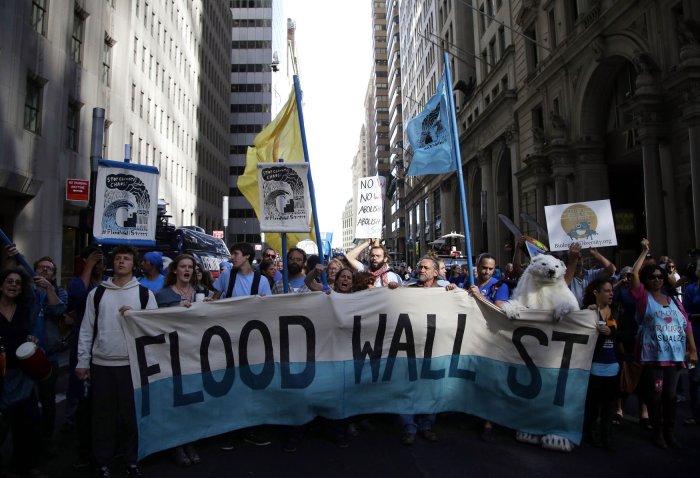
Some 3,000 protester blocked traffic in wall Street area on September 22, 2014

Last Sunday’s march was an important step toward building a popular movement for climate justice, which, in turn, is a necessary condition for more radical actions—like the ones FWS organized. The dichotomy between the PCM and FWS is a false one. What the world saw last week in New York was a vibrant movement ecosystem in which a broad mobilization and its radical edges engaged in a critical interplay.

Last Sunday, we joined 400,000 people in the People’s Climate March(PCM) to demand action on climate change. The next day, we joined with 3,000 others to participate in Flood Wall Street (FWS), disrupting business as usual and naming capital as the chief culprit of climate change.
In the days leading up to these mobilizations, a few critics on the left framed a stark dichotomy between these two kinds of actions. The PCM was cast as a depoliticized, corporate-friendly sellout, in contrast to more militant direct action, which Flood Wall Street soon emerged to organize.Chris Hedges, for example, called the PCM “the last gasp of climate change liberals,” and argued that the real resistance would come afterward “from those willing to breach police barricades.” Resistance, according to Hedges, can only be effective “when we turn from a liberal agenda of reform to embrace a radical agenda of revolt.” Likewise, Arun Gupta accused PCM of spending too much money on subway advertisements and wondered how much political value a march can have when mainstream politicians and other elites felt comfortable enough to march in it.
Surely there are critiques to be made of last week’s mobilization—there is always room for improvement. But last Sunday’s march was an important step toward building a popular movement for climate justice, which, in turn, is a necessary condition for more radical actions—like the ones FWS organized. The dichotomy between the PCM and FWS is a false one. What the world saw last week in New York was a vibrant movement ecosystem in which a broad mobilization and its radical edges engaged in a critical interplay.
What Hedges overlooks is how easily direct acts of revolt can be dismissed or repressed, if they are carried out by a small number of people who are not visibly tied to a broader social base. This is why Flood Wall Street’s mobilization in relation to the PCM was so vital. To grasp this relationship requires us to shed the dichotomous thinking that pits this vs. that and us vs. them—too often extended to even our closest allies—and that limits our options to the absurdity of a multiple choice test.
Even if we are partial to the escalated tactics of Flood Wall Street, it is clear that the efforts and resources that poured into the PCM literally set the stage for a radical edge to then move further. Leading the radical edge was the Climate Justice Alliance (CJA), a collaborative of over 35 community-based and movement support organizations uniting frontline communities. CJA put out a call to action that accomplished several important things. First, it inserted a deeper structural analysis into the mobilization, both naming corporate profit and power as culprit and articulating how different communities—indigenous peoples, people of color, and working-class whites, for example—are disproportionately impacted. Second, CJA called for nonviolent tactical escalation. Indeed, Flood Wall Street was initiated in response to this call. Third, the call helped build Sunday’s massive march by encouraging CJA’s social bases and allies to attend the march and organize delegations. By insisting that the people who are affected by the climate crisis should be involved in the solutions, CJA positively altered the composition, framing, and narrative of the march.
Rather than position itself as an outsider in relation to the broader mobilization—which was being organized primarily by 350.org, Avaaz and the New York City Host Committee, which included a network of labor, economic and environmental justice organizations—CJA positioned itself as a left pole that pulled the larger mobilization in its direction. Later, FWS positioned itself similarly—not as “the most radical kid on the block,” but as a complementary operation that had something important to contribute to the larger effort.
Radicals who are serious about political change—and not just engaging in self-righteous sideline critique—would be wise to learn from CJA and FWS’s strategy here. CJA added capacity to the broader efforts and both groups constituted a left pole that pulled a broader base toward a more visionary direction. The Climate Justice Alliance brought perspectives, participation and leadership from frontline communities that had been lacking in the more mainstream climate movement. And Flood Wall Street brought tactical innovation, cultural creativity, smart political targeting, and a willingness to take risks.
Having the most radical-sounding solutions in the world is all for naught if those solutions are only believed by a relatively small number of self-identifying radicals. We have to engage broader social bases by meeting new participants at the on-ramps by which they initially enter into collective action. The PCM provided such an on-ramp to many thousands of newcomers. Those of us who identify with the left end of the progressive spectrum need to be honest with ourselves about our current lack of capacity for building such on-ramps on our own. If we want to move more people in a radical direction—to fundamentally reengineer the roots of a broken system—it behooves us to build and maintain good relationships with organizations that have more resources and a greater reach, even if they do not share all of our politics. The left of the left spectrum has to muster the courage and savvy to enter into alignments that are too big for us to be able to control.
The dead-end alternative is for radicals to work only with other radicals—and to remain stuck in a story of the righteous few, whose protagonists bravely fight the good fight but always lose. Part of our trouble is that we are at the end of a decades-long period of fragmentation and decline in the broad social justice left. Some on the left have become so accustomed to powerlessness that they have become attached to it. Success itself becomes suspect, and politics becomes framed only in terms of expressing values and making righteous stands—instead of asintervention in the terrain of power. Accustomed to the margins, we can have a hard time recognizing how many of our ideas have actually become popular.
This is not to say that radicals should not push. But if radicals find the plans for big marches limited and constrained, the most constructive push we can make is to plan a complement to the action that adds the things we see as lacking. This has to be done with strategy, principle and loving care; with the knowledge that autonomous actions will impact the whole mobilization, one way or another—with potentially negative outcomes. This is why Flood Wall Street insisted upon clear action agreements to guide its nonviolent civil disobedience on Monday. And this is why both CJA and FWS engaged in principled open communication with all organizational partners throughout the mobilization.
The emergent climate justice movement is stronger now because of the People’s Climate March, the Climate Justice Alliance and Flood Wall Street — and because of the over all positive interplay between these complementary efforts. Around the world a growing network of communities is embracing a multipronged strategy to challenge the powers that are pushing our planet to the brink. Such a strategy has to tap into a broad-and-growing base of support, and it also has to be willing to turn up the heat and disrupt business as usual. Such an alignment will, of course, be full of challenges. But these are good challenges to have. Let us lean into them together.