Friday, February 7, 2014

1308. British Government Will Not Stand Against Animal Research

By Katia Moskvitch, Science Insider, February 7, 2014

London—The number of live animals used in the United Kingdom for scientific research will not be capped, the British government announced today. Instead, a policy document unveiled this morning says the government will only "encourage" researchers to use alternatives whenever possible. The number of animal experiments has been on the rise in recent years in the United Kingdom, as it has in many other countries.
The policy document, presented at a press conference by David Willetts, the U.K. minister for universities and science, has reassured scientists. But animal rights lobbyists are critical. The British Union for the Abolition of Vivisection (BUAV) called it “a missed opportunity for the Government to make meaningful and lasting change for the millions of animals suffering in UK laboratories.”
“Britain is a world leader in science and it has also got a great tradition of concern about the welfare of animals," Willetts said at today's briefing. "What we do in this document is bring these two great traditions together in our delivery plan.”
The Conservative and Liberal Democrat parties agreed to tackle the issue of animal studies in their 2010 deal to form a coalition government. Despite the stated ambition to reduce the number of animal experiments, their numbers have been steadily rising—a trend that started in the early 2000s.
The most recent data available show that in 2012, researchers conducted more than 4.11 million experiments on animals—well over 11,000 procedures a day and a rise of 8% over 2011, according to Home Office figures. The rapid growth is caused primarily by the massive use of genetically modified animals.
Most animals used in scientific research in the United Kingdom are bred specifically for this purpose, in line with the 1988 Protection of Animals Act. However, wild-caught primates are also used at times, if the scientists can provide exceptional and specific justification.
The government says that the policy paper, Working to reduce the use of animals in scientific research, is designed to balance the desire for reducing the number of animal experiments with the need to protect U.K. science and innovation. It relies on the long-established international principle of “the 3Rs”: replace animal tests with other studies wherever possible, reduce the number of animals involved, and refine procedures to minimize suffering.
But Willetts refused to discuss what kind of reduction the government is aiming for; the approach isn’t “about a numerical target," he said, but about encouraging more ethical research methods. “The commitment is to 'work to reduce the use of animals.' Ultimately the final figure will depend on patterns of scientific advance,” he said.
The government’s plan outlines the need for more transparency and openness. The public should be better informed about what is actually going on in animal research labs, says Dominic Wells, chair of the Animal Science Group, a special interest group within the U.K.-based Society of Biology. Scientists should be reporting what happens to the animals “rather than just giving the numbers.”
Wendy Jarrett, chief executive of Understanding Animal Research in London, a group that tries to promote understanding about advances stemming from animal experiments, welcomes the openness initiative. More than 40 U.K. organizations involved in bioscience are now drawing up the Concordat on Openness on Animal Research, a document that will set out ways for biomedical researchers to explain what they are doing with animals and why, she said in a statement today. “We support all efforts to replace, reduce and refine the use of animals in research and we are delighted by today's announcement that the Government will be giving the [National Centre for the Replacement, Refinement and Reduction of Animals in Research] even more funding," she added.
But BUAV CEO Michelle Thew calls the plan “a whitewash” that “shows that the Government has in reality given up on what it promised to do and that is to reduce the number of animal experiments.” The National Anti-Vivisection Society (NAVS) called for much stricter measures including a ban on monkey experiments. “Animal experiments have risen year on year [...] whilst the Government has twiddled its thumbs,” NAVS Chief Executive Jan Creamer said in a statement. “Such crude and outdated animal research methods can be replaced with quicker, cheaper and scientifically superior methods—the cutting edge of modern science.”

Willetts said the government hoped its policy would also set animal research standards elsewhere. Animal testing of cosmetics, for example, is not carried out in the United Kingdom, but still exists in some other countries. “We … try and persuade them that they don’t need to use animal testing in cosmetics,” Willetts said.

Thursday, February 6, 2014

1307. Life of Factory Farm Sheep and Goat

By Farm Sanctuary, February 5, 2014
Lamb shang
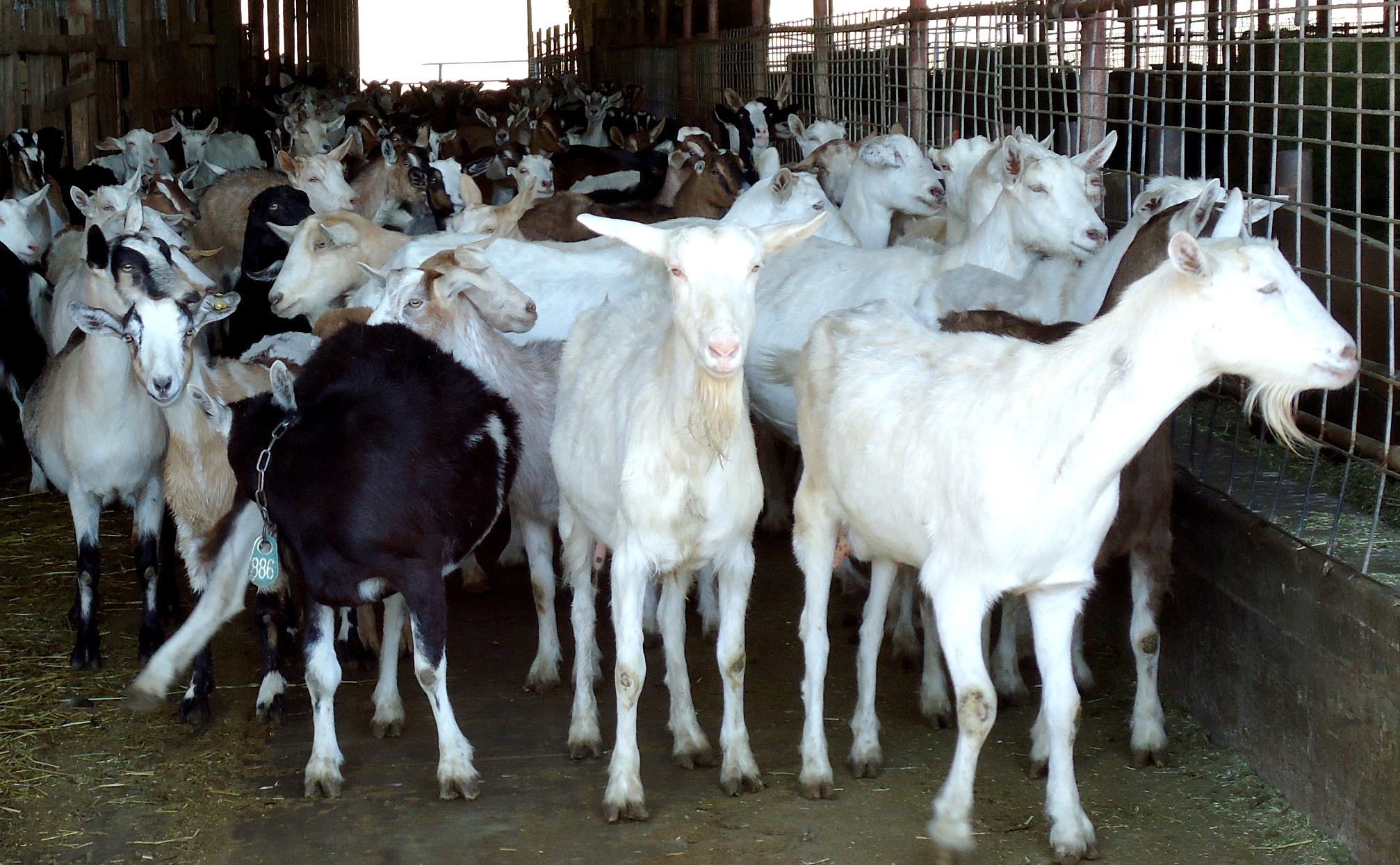
In the U.S., sheep and goats are raised for meat, for milk, and for fibers used in textiles. In all three industries, these playful, intelligent animals routinely suffer inhumane treatment throughout their lives and are ultimately slaughtered for human consumption. In the U.S., an estimated 2.2 million sheep and lambs and 1.5 million goats are slaughtered for meat every year.
• Sheep used for meat in the U.S. are typically slaughtered when they are very young, because consumers prefer lamb. A lamb is typically slaughtered when he six to eight months old, a tiny fraction of his natural lifespan.

• Most sheep and lambs are “tail-docked” within a few weeks of birth. This involves either cutting off the tail or fastening a tight rubber ring around the appendage until it rots and falls off. Lambs exhibit sings of pain when subjected to either method. Tail docking can also lead to chronic pain and an increase in the occurrence of rectal prolapse.
• A sheep’s wool production naturally declines with age. In the wool industry, sheep with decreased wool production are sent to slaughter. In Australia, the source of most of the world’s wool, these sheep are typically exported to Middle Eastern countries by sea, enduring grueling journeys of up to three weeks. The death by throat-slashing that awaits these sheep at their destination often occurs while they are fully conscious.

• Goat meat and milk are the most widely consumed animal products in the world. Goats are slaughtered very young, at just a fraction of their natural lifespan. A kid is typically slaughtered when he is just three to five months old.

• Like dairy cows, goats used for dairy are kept continually impregnated through artificial insemination so that they keep producing milk. Kids are taken away at birth, so that their mother’s milk can be used for human consumption. Male kids, considered useless in the dairy industry, are immediately killed.

1306. Seattle City Council Member Kshama Sawant Responds to Obama's State of Union Address

By Kshama Sawant, January 29, 2014


1305. Inauguration Speech of the Socialist Seattle City Council Member Kshama Sawant

By Kshama Sawant, Socialist Alternative, January 6, 2014
My brothers and sisters,


Thank you for your presence here today.
This city has made glittering fortunes for the super wealthy and for the major corporations that dominate Seattle’s landscape. At the same time, the lives of working people, the unemployed and the poor grow more difficult by the day. The cost of housing skyrockets, and education and healthcare become inaccessible.
This is not unique to Seattle. Shamefully, in this, the richest country in human history, fifty million of our people – one in six – live in poverty. Around the world, billions do not have access to clean water and basic sanitation and children die every day from malnutrition.
This is the reality of international capitalism. This is the product of the gigantic casino of speculation created by the highway robbers on Wall Street. In this system the market is God, and everything is sacrificed on the altar of profit. Capitalism has failed the 99%.
Despite recent talk of economic growth, it has only been a recovery for the richest 1%, while the rest of us are falling ever farther behind.
In our country, Democratic and Republican politicians alike primarily serve the interests of big business. A completely dysfunctional Congress DOES manage to agree on one thing – regular increases in their already bloated salaries – yet at the same time allows the federal minimum wage to stagnate and fall farther and farther behind inflation. We have the obscene spectacle of the average corporate CEO getting seven thousand dollars an hour, while the lowest-paid workers are called presumptuous in their demand for just fifteen.
To begin to change all of this, we need organized mass movements of workers and young people, relying on their own independent strength. That is how we won unions, civil rights and LGBTQ rights.
Again, throughout the length and breadth of this land, working people are mobilizing for a decent and dignified life for themselves and their children. Look at the fast food workers movement, the campaigns of Walmart workers, and the heroic activism to stop the Keystone XL pipeline!
Right here in SeaTac, we have just witnessed the tremendous and victorious campaign for fifteen dollars an hour. At the same time, in Lorain County, Ohio, twenty-four candidates ran, not as Democrats or Republicans, but as ‘Independent Labor’ and were elected to their City Councils.
I will do my utmost to represent the disenfranchised and the excluded, the poor and the oppressed – by fighting for a $15/hour minimum wage, affordable housing, and taxing the super-rich for a massive expansion of public transit and education. But my voice will be heard by those in power only if workers themselves shout their demands from the rooftops and organize en masse.
My colleagues and I in Socialist Alternative will stand shoulder to shoulder with all those who want to fight for a better world. But working people need a new political party, a mass organization of the working class, run by – and accountable to – themselves. A party that will struggle and campaign in their interest, and that will boldly advocate for alternatives to this crisis-ridden system.
Here in Seattle, political pundits are asking about me: will she compromise? Can she work with others? Of course, I will meet and discuss with representatives of the establishment. But when I do, I will bring the needs and aspirations of working-class people to every table I sit at, no matter who is seated across from me. And let me make one thing absolutely clear: There will be no backroom deals with corporations or their political servants. There will be no rotten sell-out of the people I represent.
I wear the badge of socialist with honor. To the nearly hundred thousand who voted for me, and to the hundreds of you who worked tirelessly on our campaign, I thank you. Let us continue.
The election of a socialist to the Council of a major city in the heartland of global capitalism has made waves around the world. We know because we have received messages of support from Europe, Latin America, Africa and from Asia. Those struggling for change have told us they have been inspired by our victory.

To all those prepared to resist the agenda of big business – in Seattle and nationwide – I appeal to you: get organized. Join with us in building a mass movement for economic and social justice, for democratic socialist change, whereby the resources of society can be harnessed, not for the greed of a small minority, but for the benefit of all people. Solidarity.

Monday, February 3, 2014

1304. A Little Neanderthal in All of Us

By Carl Zimmer, The New York Times, January 29, 2014
Artist's depiction of a band of Neanderthals. Credit: BBC

Ever since the discovery in 2010 that Neanderthals interbred with the ancestors of living humans, scientists have been trying to determine how their DNA affects people today. Now two new studies have traced the history of Neanderthal DNA, and have pinpointed a number of genes that may have medical importance today.
Among the findings, the studies have found clues to the evolution of skin and fertility, as well as susceptibility to diseases like diabetes. More broadly, they show how the legacy of Neanderthals has endured 30,000 years after their extinction.
“It’s something that everyone wanted to know,” said Laurent Excoffier, a geneticist at the University of Bern in Switzerland who was not involved in the research.
Neanderthals, who became extinct about 30,000 years ago, were among the closest relatives of modern humans. They shared a common ancestor with us that lived about 600,000 years ago.
In the 1990s, researchers began finding fragments of Neanderthal DNA in fossils. By 2010 they had reconstructed most of the Neanderthal genome. When they compared it with the genomes of five living humans, they found similarities to small portions of the DNA in the Europeans and Asians.
The researchers concluded that Neanderthals and modern humans must have interbred. Modern humans evolved in Africa and then expanded out into Asia and Europe, where Neanderthals lived. In a 2012 study, the researchers estimated that this interbreeding took place between 37,000 and 85,000 years ago.
Sir Paul A. Mellars, an archaeologist at the University of Cambridge and the University of Edinburgh, who was not involved in the research, said the archaeological evidence suggested the opportunity for modern humans to mate with Neanderthals would have been common once they expanded out of Africa. “They’d be bumping into Neanderthals at every street corner,” he joked.
The first draft of the Neanderthal genome was too rough to allow scientists to draw further conclusions. But recently, researchers sequenced a far more accurate genome from a Neanderthal toe bone.
Scientists at Harvard Medical School and the Max Planck Institute for Evolutionary Anthropology in Germany compared this high-quality Neanderthal genome to the genomes of 1,004 living people. They were able to identify specific segments of Neanderthal DNA from each person’s genome.
“It’s a personal map of Neanderthal ancestry,” said David Reich of Harvard Medical School, who led the research team. He and his colleagues published their results in the journal Nature.
Living humans do not have a lot of Neanderthal DNA, Dr. Reich and his colleagues found, but some Neanderthal genes have become very common. That’s because, with natural selection, useful genes survive as species evolve. “What this proves is that these genes were helpful for non-Africans in adapting to the environment,” Dr. Reich said.
In a separate study published in Science, Benjamin Vernot and Joshua M. Akey of the University of Washington came to a similar conclusion, using a different method.
Mr. Vernot and Dr. Akey looked for unusual mutations in the genomes of 379 Europeans and 286 Asians. The segments of DNA that contained these mutations turned out to be from Neanderthals.
Both studies suggest that Neanderthal genes involved in skin and hair were favored by natural selection in humans. Today, they are very common in living non-Africans.
The fact that two independent studies pinpointed these genes lends support to their importance, said Sriram Sankararaman of Harvard Medical School, a co-author on the Nature paper. “The two methods seem to be converging on the same results.”
It is possible, Dr. Akey speculated, that the genes developed to help Neanderthal skin adapt to the cold climate of Europe and Asia.
But Dr. Akey pointed out that skin performs other important jobs, like shielding us from pathogens. “We don’t understand enough about the biology of those particular genes yet,” he said. “It makes it hard to pinpoint a reason why they’re beneficial.”
Both teams of scientists also found long stretches of the living human genomes where Neanderthal DNA was glaringly absent. This pattern could be produced if modern humans with certain Neanderthal genes could not have as many children on average as people without them. For example, living humans have very few genes from Neanderthals involved in making sperm. That suggests that male human-Neanderthal hybrids might have had lower fertility or were even sterile.
Overall, said Dr. Reich, “most of the Neanderthal genetic material was more bad than good.”
Some of the Neanderthal genes that have endured until today may be influencing people’s health. Dr. Reich and his colleagues identified nine Neanderthal genes in living humans that are known to raise or reduce the risk of various diseases, including diabetes and lupus.
To better understand the legacy of Neanderthals, Dr. Reich and his colleagues are collaborating with the UK Biobank, which collects genetic information from hundreds of thousands of volunteers. The scientists will search for Neanderthal genetic markers, and investigate whether Neanderthal genes cause any noticeable differences in anything from weight to blood pressure to scores on memory tests.
“This experiment of nature has been done,” said Dr. Reich, “and we can study it.”

1303. Its Great Lake Shriveled, Iran Faces Crisis of Water Supply

By Thomas Erdbrink, The New York Times, January 30, 2014
Lake Urumiah, 90 miles by 30 miles salt water lake, has now dried up
LAKE URMIA, Iran — After driving for 15 minutes over the bottom of what was once Iran’s largest lake, a local environmental official stepped out of his truck, pushed his hands deep into his pockets and silently wandered into the great dry plain, as if searching for water he knew he would never find.
Just an hour earlier, on a cold winter day here in western Iran, the official, Hamid Ranaghadr, had recalled how as recently as a decade ago, cruise ships filled with tourists plied the lake’s waters in search of flocks of migrating flamingos.
Now, the ships are rusting in the mud and the flamingos fly over the remains of the lake on their way to more hospitable locales. According to figures compiled by the local environmental office, only 5 percent of the water remains.
Iran is facing a water shortage potentially so serious that officials are making contingency plans for rationing in the greater Tehran area, home to 22 million, and other major cities around the country. President Hassan Rouhani has identified water as a national security issue, and in public speeches in areas struck hardest by the shortage he is promising to “bring the water back.”
Experts cite climate change, wasteful irrigation practices and the depletion of groundwater supplies as leading factors in the growing water shortage. In the case of Lake Urmia, they add the completion of a series of dams that choked off a major supply of fresh water flowing from the mountains that tower on either side of the lake.
“Only some years ago the water here was 30 feet deep,” Mr. Ranaghadr said, kicking up dust with each step on the dry lake bed. In the distance, spots of land — once islands where tourists would spend vacations in bungalows overlooking the blue waters — were surrounded by plains of brown mud and sand. “We just emptied it out,” he said with a sigh, stepping back into the car.
Iran’s water troubles extend far beyond Lake Urmia, which as a salt lake was never fit for drinking or agricultural use. Other lakes and major rivers have also been drying up, leading to disputes over water rights, demonstrations and even riots.
Major rivers near Isfahan, in central Iran, and Ahvaz, near the Persian Gulf, have gone dry, as has Hamoun Lake, in the Afghanistan border region. Dust from the dry riverbeds has added to already dangerously high air pollution levels in Iran, home to four of the 10 most polluted cities in the world, the United Nations says.
But nowhere is the crisis more pronounced than at Lake Urmia, once one of the largest salt lakes in the world — at 90 miles long and roughly 35 miles wide, it was slightly larger than Great Salt Lake in Utah. Environmentalists are warning that the dried salt could poison valuable agricultural lands surrounding the lake, and make life miserable for the three million people who live in its vicinity.
Along what used to be a lakeshore boulevard, worn-down snack bars and dressing rooms are testament to the days when people from across Iran would come to water-ski on the lake or cover themselves in its black mud, which is said to have healing powers.
About two decades ago, a local villager, Mokhtar Cheraghi, began to notice the water line receding. “First a hundred meters, then two hundred meters. After a while, we couldn’t see the shoreline anymore,” he said, standing in what was once his thriving cafe, Cheraghi’s Beach. “We kept waiting for the water to return, but it never did.”
Most people in the area blame the half-dozen major dams the government has built in the region for the lake’s disappearance. The dams have greatly reduced the flow of water in the 11 rivers that feed into the lake. As an arid country with numerous lofty mountain chains, Iran has a predilection for dams that extends to the reign of Shah Mohammed Reza Pahlavi.
Dam construction was given renewed emphasis under Mr. Rouhani’s predecessor as president, Mahmoud Ahmadinejad, who as an engineer had a weakness for grand projects. Another driving force is the Islamic Revolutionary Guards Corps, which through its engineering arm, Khatam al-Anbia Construction, builds many of the dams in Iran and surrounding countries.
Half an hour’s drive into the mountains above the city of Urmia stands the mighty Chahchai Dam, collecting water that would otherwise have reached the lake. The dam, finished during Mr. Ahmadinejad’s first term, now holds a huge lake itself, which local farmers use for irrigating their lands.
“Some of Urmia’s water is here,” said Mr. Ranaghadr, raising his voice over the howling winds that blow down from the surrounding snowcapped peaks. “The people here need water, too, is what they say.”
Besides producing badly needed electricity, the dams are intended to address the water shortage. But too often, the water is wasted through inefficient irrigation techniques, particularly spraying, Mr. Ranaghadr and other experts say.
In recent decades, the amount of land dedicated to agriculture in the region, the country’s heartland, has tripled, with many farmers growing particularly thirsty crops like grapes and sugar beets, Mr. Ranaghadr pointed out. His department has calculated that about 90 percent of all the water that should end up in the lake is sprayed on fields.
In a 2005 book that he wrote on national security challenges for Iran, Mr. Rouhani estimated that 92 percent of Iran’s water is used for agriculture, compared with 80 percent in the United States (90 percent in some Western states).
“They turn open the tap, flood the land, without understanding that in our climate most of the water evaporates that way,” said Ali Reza Seyed Ghoreishi, a member of the local water management council. “We need to educate the farmers.”
The lake has also been attacked from underground. As part of the government’s drive to promote local agriculture, large landholdings were divided into smaller plots, and most of the new owners promptly dug new wells, soaking up much of the groundwater.
“There are around 30,000 legally dug wells and an equal amount of illegal wells,” Mr. Seyed Ghoreishi said. “As the water is becoming less, they have to dig deeper and deeper.”
Climate change, particularly rising temperatures, has played a role. Average temperatures around Lake Urmia have risen by a little over 3 degrees Fahrenheit in the past decade, official statistics show.
A long drought in the region seems to have ended two years ago, with rainfall levels returning to normal. But the increased rainfall has not made up for the other factors that are draining the lake.
“We are all to blame,” Mr. Ranaghadr said. “There are just too many people nowadays, and everybody needs to use the water and the electricity the dams generate.”
Back in his office, the Department of Environment, officials sounded like soldiers on a doomed mission. They had drawn up no fewer than 19 plans to save the lake, ranging from the sensible (educating farmers in new irrigation technologies) to the fanciful (seeding clouds to increase rainfall).
“We can start now,” said Abbas Hassanpour, the head of the office. Flanked by his assistants, including Mr. Ranaghadr, he said his department had created “task forces and models ready to implement.”
While Iran is shooting monkeys into space to advance its missile program, the Rouhani government, low on funds because of the impact of the international sanctions against Iran’s nuclear program, has not made any money available for efforts to restore the lake.
Even if it did, officials say, it is probably too late to save Lake Urmia. All the money in the world can be poured into the lake, one said, but in the most optimistic projections, it would take decades for the water to reach its old levels, assuming it even could. There are simply too many problems, too many competing interests, for the rescue to be feasible.
Not doing anything, or not enough, will still create many problems. In 2010 and 2011, violent protests over the lake erupted in Urmia, and security forces had to be flown in to restore order.
“We are not allowed to speak of the lake,” said Morteza Mirzaei, who lives in Urmia. “But they built their dams, and now everything is gone.” Others said ordinary people are also to blame, but “the government is the steward of the country,” said Mushin Rad, who sells printer equipment. “They are responsible.”

Mr. Ranaghadr, who grew up around the lake, said he spends free time battling poachers in the hills around it. “You know what the real problem is?” he said. “Everybody across the world is only thinking of money. We did, too, and now our lake is gone.”

1302. California’s Water Wars: 2014-2030

By Craig Collins, February 2, 2014
Craig Collins

The following article is a work of political future-fiction commonly known as back-casting.  Looking back from 2030, it tries to imagine, as realistically as possible, how climate change, drought and peak oil might shape California’s conflict over water in the coming decades.  It chronicles the battle between those who connive to gain private control over California’s shrinking water supply and those who hope to keep this vital resource in public hands to be used in a more equitable and sustainable manner.

It’s 2030.  California is drying up and looking more like Nevada every day.  Climate change has imposed a relentless dry spell over most of the state.  This perpetual water crisis has forced the state to reluctantly retreat from the 20th century's high-handed hubris toward water.  That wasteful, shortsighted approach spurned conservation.  Instead, water scarcity was treated as a mere supply problem, to be solved by ingenious feats of hydraulic engineering.

The southern part of the state has always been dry.  But in past centuries Sierra snowmelt kept rivers running year round and replenished over drawn Central Valley aquifers, while rainfall drenched the North most of the year.  Back then the state used its bountiful petroleum reserves to erect a vast hydraulic infrastructure to deliver water to the vast, bone-dry corporate farms of the Westlands in the southern San Joaquin Valley and the thirsty urban sprawl of the LA basin.  Dams, canals, aqueducts, reservoirs, pumps, levees, irrigation ditches and sewers drained and diverted distant watersheds, generated electricity and transported water and electricity hundreds of miles through deserts and over mountains.

But now, three decades into the 21st century, the energy and fresh water reserves of the state, and the entire Southwest, are dangerously depleted.  Without cheap, abundant water and energy, the state’s economy has failed to grow for over a decade.  And California isn’t alone.  The worldwide globalization bubble burst when China’s economy tanked in 2019.  For years now, politicians and pundits have avoided the term "economic growth" altogether because it reminds everyone of the empty promises and unfulfilled expectations of a time, not long ago, when each new generation could expect to live better than their parents.

Since falling off the peak oil plateau back in 2015, globalization has been strangled by energy shortages and extreme climate calamities caused by our addiction to mainlining the Earth’s vanishing stores of fossil fuel.  Yet, like all good junkies, denial is a potent psychological crutch.  So "stability" has replaced "growth" as the latest buzzword politicians promise those who still wish to pretend that industrial civilization hasn’t entered a long period of uneven, irreversible cold turkey.  But things are anything but stable.  For twenty years now Californians have been slammed by a series of environmental calamities and rocked by alternating bouts of stagflation and depression.

The whole situation has been aggravated by a stealth campaign to rob Californians of their dwindling water resources.  Multinational corporations, banks and landowners have exercised their political muscle in Sacramento to become water barons.  By privatizing as much of the state’s water sources as they can get their hands on, they have been quickly and quietly cornering the water market.  Once in control, they sell “their” water to desperate citizens, cities and farms forced to pay their inflated prices.

By the late 20s, widespread public discontent with water shortages and price gouging, a failing economy and a rigged political system finally erupted into a full-blown populist insurrection that transformed the political landscape.  2030 may go down as a landmark year in the state’s history.  Energized, angry citizens are converging on Sacramento this June to participate in a constitutional convention.  They are vowing to completely overhaul the state constitution in the hope that this will widen the avenues of democratic participation and crack down on the political schemes that have handed over public resources like water to multinational corporations.

For the first time in decades, Californians are hopeful that things are changing for the better.  If instituted, these constitutional reforms may prove essential for reversing water privatization schemes, conserving California's dwindling water supply and sharing it fairly.  Though the battle is far from over, people believe these democratic breakthroughs will improve the chances of building a more stable, resilient, equitable economy in balance with the ecosystems that sustain it.

Today’s constitutional reform movement was born during the peaceful insurrection of 2025, after ten years of drought and a 6-year global depression brought the state to its knees.  In 2019, the collapse of "the Chinese economic miracle" devastated California's trading centers--LA, San Diego and San Francisco.  Thousands of jobless people abandoned the state.  The decline in population and economic activity produced such a significant reduction in water use that the drought’s impact gained less attention than the state’s economic woes.

During the first years of drought, corporate agribusiness touted their commitment to water efficiency in an unsuccessful bid to convince Californians they could be trusted to conserve water without being tightly regulated and stripped of their water rights and subsidies.  By 2018, these heavily hyped voluntary measures proved no match for a deepening drought that was further aggravated by series of severe weather calamities and sleezy water privatization schemes that were sending Southern Californian's water bills through the roof.

Now that we're 3 decades into the 21st century, Californians have come to regret how long it took to acknowledge that calling climate chaos "global warming" was like calling pneumonia “the sniffles.”  Over the last few decades, elevated ocean acidity and an unrelenting series of El Niño episodes have decimated California's marine ecosystems and gutted the state's fishing industry.  Rising sea levels and high tides frequently inundate the Sacramento-San Joaquin Delta with salt water, forcing the delta's pumping stations, that normally send fresh water to farms and cities in the south, to shut down.  In addition, climate disruption has meant more rain (but less snow) in the far North; less snowfall in the Sierras; and persistent droughts in the South.  Under these arid conditions, the number of forest fires in the state has shot up 500% in the last fifteen years.

To make matters worse, torrential tropical rainstorms, blown in from the Hawaiian Islands, have occasionally interrupted our fifteen-year drought.  These storms have melted the Sierra's dwindling snowpack, unleashing disastrous flash floods along the Yuba, American and Sacramento Rivers.  By 2020, these "pineapple express" floods had ruptured the Delta's aging levees three times, causing hundreds of deaths and billions in property damage.  After the first two floods obliterated vast tracts of Sacramento's suburban sprawl, insurance became unavailable in these vulnerable areas.  Fortunately, these flood plains have been reclaimed by nature and are now thriving riparian and wetland ecosystems.

In the wake of these climate-induced traumas, Californians began seriously reconsidering their relationship with water. Of course, some powerful interests still lobbied for building more dams to contain floods and make up for vanishing aquifers and snowpack loss.  In 2021, an unrepentant cabal of old-school water developers from Southern California even lobbied for a dam to be built under the Golden Gate Bridge so the Bay could be drained of its salt water.  They argued that since the San Francisco-Oakland harbor was no longer a thriving enterprise, the Bay could be put to better use by making it an enormous fresh water reservoir that could trap all of the fresh water flowing out to sea.

This hare-brained scheme found some support in the South, but met angry opposition in the Bay Area.  Ultimately, it never gained traction because neither the state nor the federal government had the money to finance extravagant new water projects while struggling to maintain the state's aging hydraulic infrastructure and crumbling levee system.

The state's depleted budget and perpetual water crisis generated growing enthusiasm for a simpler, more common sense approach to water.  Instead of funding ever-more expensive, complex, high-tech methods of capturing water, reformers advocated conservation, recycling, equitable distribution and ecosystem revival.  They insisted that water be treated as a precious common resource--a vital ingredient for all life--that must be used and reused sparingly and wisely to benefit future generations of Californians and the other creatures who share the state with us. 

Since 2015, sweltering summers and constant drought have made life in Southern California hotter, harder and considerably less glamorous.  Today, blistering heat waves make summers miserable.  Electricity brownouts and soaring energy prices have made air-conditioning an unreliable luxury.  Temperatures that refuse to drop below 120 degrees for weeks on end have driven thousands of long-time LA residents to abandon the city for cooler climates.  For the suffering souls who remain, the beach has become a last refuge for those seeking relief.  Strict conservation ordinances and rising water bills have all but eliminated the green lawns and azure swimming pools that were once the status symbols of Southern California's envied lifestyle.

Today, city ordinances forbid watering lawns, playing in the sprinkler, washing your car, or even using the hose on hot summer days.  The only remaining golf course in business has replaced water hazards with sand traps and grass with Astroturf and drought resistant plants wherever possible; outrageous green fees are levied to cover the cost of watering their remaining fairways and putting greens.

After years of reluctance and resistance, Californians are finally embracing conservation.  To keep water bills from bankrupting them, businesses, schools and families have installed all the latest conservation devices in their faucets, showers and toilets.  Water catchment systems collect rain, and gray water systems recycle and reuse precious water that once went straight down the drain.  As a result, per capita water consumption dropped 63% between 2015 and 2030.  Recent city ordinances, especially in the south, encourage homeowners to use composting toilets.  This should reduce water consumption much further and allow homeowners to sell the compost they don't use in their gardens to the biosolids collectors who market it to local farmers.

California agriculture has been transformed by the rising value and scarcity of water.  Small farmers and city folks became fed-up with paying huge water bills while government subsidies kept irrigation costs for agri-business "dirt cheap."  However, big growers argued that soaring energy prices had already cut deeply into their profit margins so their water rights and subsidies were more important than ever.  Indeed, many large-scale agricultural exporters had gone under due to the mounting cost of petroleum-based fertilizers, pesticides, mechanization, processing and global transportation.  Those that remained insisted that they were conserving water by shifting from thirsty crops like alfalfa, corn and rice to those more suited to minimal irrigation.

All this was true.  In fact, some corporate landowners abandoned large-scale agriculture all together.  Instead, they made huge profits by becoming absentee land and water barons.  They began leasing parcels of land to family farmers and using their government-granted water rights to sell their government-subsidized water to desperate farmers and thirsty towns and cities.

As the water crisis intensified, an angry alliance of family farms, co-ops and urban consumers called for an end to the government's preferential system of water rights and subsidies.  By 2020, this grassroots movement successfully pressured Sacramento and Washington to cut back "water welfare" doled out to the largest mega-farms in the state.  This became the final nail in the coffin for most California agri-barons, who have auctioned off or leased vast tracts of farmland to less water and petroleum dependent small growers producing for an eager local market of consumers who can no longer afford expensive imported foods. This partial victory is a hopeful sign that the public may finally be turning the tide against further privatization of the state's water resources.

Water privatization in California was part of a global strategy to control fresh water.  Way back in 2005, European multinationals (Nestlé, Suez, RWE, Unilever and Vivendi) and American corporations (PepsiCo, Coca-Cola and Crystal Geyser) began scheming to own as much as possible of the world's fresh water supply.  European multinationals moved quietly into the United States water market by purchasing American companies like U.S. Filter, United Water and American Water Works.  By 2010, about 20% of Californians bought their water from private corporations; today, this figure had doubled.

This privatization trend isn’t unique to California.  All over the planet, multinational water conglomerates have been waging stealth campaigns to quietly seize control of public water resources and hydraulic infrastructure.  After their water monopolies are in place, these conglomerates jack up water prices, generating angry resistance despite all of their efforts to keep a low profile.  In the last few decades, popular resistance to water privatization has toppled governments in Bolivia, Egypt, Kenya, Libya, Peru, Italy, Jordan and Pakistan.

Although resistance to privatization is growing around California, corporate water barons employ several crafty methods to overcome public opposition.  The most effective Trojan horse used to bamboozle the public and capture their water resources is technology.  Wherever clean fresh water is scarce and local governments lack the funds to build and operate expensive desalinization plants, water recycling facilities and nanotechnology or reverse osmosis decontamination systems, these corporations are eager to step in and peddle their hi-tech solutions.

Water barons promise city governments that their new technologies will improve water quality and supply with minimal sacrifice.  To sweeten the deal, they offer cash-strapped municipalities big bucks to sign over public water systems to them.  In the name of raising government revenues, cutting spending, stimulating the economy and improving the water delivery system, many local water districts have taken the bait.

Once in control, the new corporate water lords lobby the state and federal governments for tax breaks and subsidies to construct their expensive, energy intensive desalinization and water treatment systems.  Yet, time after time, these sweet deals have turned toxic as corporations fattened themselves on the taxpayer dole, jacked-up water bills, cut their operation costs by ignoring water quality and infrastructure maintenance, and ignored widespread public grievances.

As the water crisis deepened, people became openly hostile to water privatization schemes that left ecosystems, struggling family farmers and poor communities high and dry.  Years of drought and deception sparked many angry protests, but it took two week-long water riots that spread like wildfire through poor neighborhoods in LA, Long Beach and Fresno in 2018 and 2022 to make Southern California the epicenter of this issue around the nation.

In all three cases, these water riots were sparked by police and private armed security guards who shut off water to whole neighborhoods where residents refused to pay their soaring water bills.  Shut off valves were sealed with cement after residents brought their water bills to impromptu “water town hall meetings” and denounced secret deals between city officials and water executives on the evening news.  Over the next few years these water rebellions erupted all over the country, from Dallas to Detroit.

By the mid-20s, a national movement to outlaw water privatization had gained momentum.  Activists warned that unless publicly owned systems of water conservation, catchment and recycling were developed to preserve, protect and distribute water as a common resource, water would become fully commodified and sold only to the highest bidders.  After successful initiatives eliminated water subsidies for big-ag in 2028, California's Water Action Movement (WAM)--an alliance of urban water consumers, small farmers and environmental activists--blocked several water privatization schemes and went on the offensive to demand more democratic control over the state's precious water resources.

Today, WAM has become one tributary of a larger political current pushing for a fundamental reform of California's dysfunctional political system.  After decades of depression and stagflation, bankrupt government services and decaying infrastructure, dysfunctional public education, water and energy shortages and multiple environmental calamities, Californians finally decided they'd had enough.

Re-writing the state constitution became the primary focus of this populist insurrection when politicians from both parties refused to tax oil extraction to fund disaster relief after levee ruptures flooded Sacramento in 2022 and 2024 and wildfires ravaged Southern California in the same years.  Public anger exploded over corruption and misuse of relief funds by state and federal agencies and massive insurance fraud intensified these disasters.  By 2026 this torrent of public anger and populist activism engulfed Sacramento, forcing politicians to succumb to the demand for a new constitutional convention in 2030.

One of the key demands of many citizen-activists coming to the convention is a constitutional amendment that establishes a public trust to govern the use of water, energy and other vital resources.  A lively debate rages over how to bring these resources under more democratic control and protect them from privatization and overuse.  The outcome of this confrontation may determine the fate of the state’s water resources for generations to come.

********************************

20 Important Facts About Water
• One-half of 1 percent of the world's water is FRESH (not saltwater).
• Of that .5 percent, about 50 percent is polluted.
• One in 6 people don't have access to clean, safe water.
• Five food and beverage giants — Nestlé, Unilever, Coca-Cola, Anheuser Busch, and Groupe Danone — consume almost 575 billion liters of water per year, enough to satisfy the daily water needs of every person on the planet. 
• The average human needs about 13 gallons of water each day for drinking, cooking, and sanitation. 
• An average North American uses about 150 gallons of water each day. 
• An average African: 1.5 gallons. 
• The average Bay Area resident: 72 gallons. 
• The average Los Angeles resident: 122 gallons. 
• About half the water used by a typical home goes for lawns, gardens, and pools. 
• 50 percent of US water comes from non-renewable groundwater. 
• 86 percent of Americans get their water from public water systems.
• 80 percent of California's homes get water from public systems.
• The 20 percent of CA households receiving water from privately-owned systems pay an average of 20 percent more for it. 
• Of the 4.5 billion people with access to clean drinking water worldwide, 15 percent are buying it from private water companies. 
• It takes 3 liters of water to produce 1 liter of bottled water.
• Tests of 1,000 bottles of water spanning 103 brands revealed that about one-third contained some level of contamination.
• The bottled water industry is worth $60 billion a year.
• Water is the third biggest industry in the world, worth $425 billion, ranking just behind electricity and oil.

• About 70 percent of CA's water lies north of Sacramento, but 80 percent of the demand is from the southern two-thirds of the state.