Thursday, August 1, 2013

1119. Energy and the Economy–Basic Principles and Feedback Loops


By Gail Tverberg, Our Finite World, July 20, 2013

Does a fish know that its nose is wet? Probably not. It swims in water, and assumes that is the only way any animal lives.
We live in an economic world. Economic models that were developed years ago were created based on observations of how the economy seemed to work at the time. As time goes on, it is becoming clear that early economists missed important connections. The most important of these is the role of energy and its connection to the economy. It takes energy to make anything, from a piece of steel to a loaf of bread. It takes energy to transport anything. Humans need energy in the form of food to continue to live. Clearly, energy should have a place in economic models.
In this post, I explain some of the basic principles as I see them:
1. Humans have evolved to be dependent on external energy.
2. Humans now supplement their own limited energy supply with external energy of various types. In general, the more external energy used, the more humans are able to control their environment.
3. Over the 1 million+ years during which humans have been able to control fire, humans have generally been in situations with favorable feedback loops, due to increasing efficiency in producing goods and services required to meet basic needs. Such loops allowed continued population growth and economic growth.
4. We are now reaching limits on these feedback loops. The result is feedback loops that are changing from favorable feedbacks to contraction.
5. Part of the change in feedback loops relates to the cost of energy sources, such as oil. A rise in the price of oil tends to reduce salaries of workers (because of layoffs) as well as reduce discretionary income (because of higher price of food and commuting), contributing to the trend toward contraction.
All of this is very concerning, because in the past, adverse feedback loops of this type  seem to have led to collapse.
The Many Types of Energy
The most basic type of energy, at least from a human perspective, is human energy. This is the energy we as humans have that allows us to move our own bodies and allows us to think. Each of us is given approximately the same amount of energy, with males having somewhat more energy for lifting and pushing objects, and females having the special ability to give birth to new humans.
In order to use human energy, humans need to eat food of appropriate kinds. Most of this food is from plants and animals that we process in some way for this purpose. (This processing normally requires some type of energy.) The only food that is not from plants and animals is mother’s milk. Women need to increase their own intake of food from plant and animals, in order to produce enough milk for their babies.
Humans are able to leverage their own energy with many types of external energy. One very old source of external energy is burning wood and other plant matter. Such energy is used in keeping warm, cooking food, making sharper tools, and warding off predators. Another very old source of external energy is energy from dogs, trained to help with hunting, and from draft animals, trained to help with plowing and grinding tasks.
Humans have learned to harness various other forms of other energy, such as wind, water, and geothermal energy. In the last 200 years, the use of fossil fuels (coal, natural gas, and oil) has greatly expanded the amount of external energy available to humans.
Fossil fuels are important, not just because they can be burned directly, but because they enable the use of electricity from a wide range of sources—including hydroelectric, nuclear, and solar photovoltaic. While we think of these latter sources as non-carbon fuel sources, they are today available only within a system powered by fossil fuels. It takes fossil fuels to create metals in the quantity needed for electrical transmission; it takes fossil fuels to make and transport the type of concrete used in hydroelectric dams and wind turbines; it takes fossil fuels to purify silicon and other materials used in making solar PV.
While people talk about a system that does not require fossil fuels, no one has mapped out how the world could in fact transition from a system that uses fossil fuels to capture these types of energy to a system that would work without fossil fuels. The best we can hope for within the next 100 years is to use fossil fuels more sparingly.
One specialized form of energy is embedded energy that has been stored up in goods for the long term. Examples of early embedded energy includes heat-sharpened stone ax blades, used by hunter gatherers, and clothing, whether made by hand or machine. Today, there is much embedded energy in roads, pipelines, and electrical transmission systems. The vast majority of today’s embedded energy is derived from fossil fuels.
External Energy as a Human Need
Most animals seem to get along fine without external energy, other than the sun’s rays. They live in the parts of the world where they are adapted. They more or less live in balance with their predators. The number of a given species may rise for a while, but if the number grows too much, the species will exhaust its food supply, leading to population decline.
Humans have moved to a different model. The change came when humans (or predecessors to humans) first learned to control fire, over 1,000,000 years ago. Being able to control fire gave humans many advantages over other animals. Humans were able to cook part of their food. This had many advantages: It greatly reduced chewing time, allowing time for other activities, such as making tools and clothing. It improved nutrition, by making food more digestible. It allowed the human body to evolve in ways that used more energy for brain development, and less for chewing and digestion. [i]
The way the natural order works is that each species gives birth to far more offspring than is needed to survive to adulthood. “Natural selection” determines which of these offspring will survive. If humans had been like apes, chimpanzees, or gorillas, total population might have reached a plateau of perhaps 3,000,000, (based on historical animal populations). This limit would be reached because of competition with other species, and because climate is less hospitable outside of a narrow range.
With the help of external energy, such as the controlled use of fire and the use of dogs for hunting, humans were able to gain an advantage over other species and spread to all areas of the globe. This is what allowed population to grow, and continues to help it grow.
The natural order assures that far more human offspring are born than are needed to survive to adulthood. If humans are intelligent, they desire to extend their own lives and the lives of their offspring. The result of this dynamic is that there tends to be continual upward pressure on population.
There is a second dynamic as well. Because of humans’ intelligence, humans have the ability to over-consume at least some of the wildlife in the areas. For example, we learned on our recent visit to Iceland that when Vikings first discovered the island, there were both walruses and the flightless bird, the auk, on the island, but both disappeared soon after humans moved to the island.
Because of these dynamics, there has been tendency to need more food, and more energy supplies of other types, over time. To meet the need for greater food supply, humans began using agriculture about 10,000 years ago. With the advent of agriculture, the amount of human food available per acre was greatly increased.
The availability of agriculture added to the two dynamics noted previously for hunter-gatherers. As before, (1) population tended to increase, because the natural order provides for far more births than are needed for replacement, and because humans, with their intelligence, now had a way to provide more food per acre. Also, (2) there was a tendency of the amount of food available from a given acre of land to degrade over time, because the methods used for agriculture were less than perfect. Erosion was a problem, especially when planting was done on slopes. If irrigation was used, salt deposits often became a problem. Rising population combined with degrading resources led to a need recurring need for additional energy, since supplemental energy could indirectly add to food supply. In situations when additional energy was not found, populations had a tendency to collapse after many years of growth.
Besides the two basic dynamics of rising population and degrading resources leading to a need for additional resources, there were other forces that tended to add to the need for increasing amounts of energy:
a. Cheapest resources used first. Soon after agriculture began, humans began to use resources of other types, such as wood from forests and metals such as iron and bronze. With any of these resources, there is a tendency to use the “cheapest” (easiest to extract, closest at hand, highest ore concentration) first. If extraction is to continue, increasing amounts of energy per unit extracted are likely to be required for later extraction.
b. Increased disease transmission when population is packed more closely together. This issue can be overcome with techniques that kill germs and that keep humans separated from waste products of other humans. The need for these techniques adds to the need for external energy.
c. Deforestation. Without fossil fuels, there was a severe tendency to overuse forests. Deforestation occurred as early as 4000 B. C. E., according to Sing Chew. Historian Norman Cantor writes, “By 1500 Europe was on the edge of a fuel and nutritional disaster [from] which it was saved in the sixteenth century only by the burning of soft coal and the cultivation of potatoes and maize.” The use of coal allowed more energy per person, and took pressure off of limited forest resources.
d. Pull of Technology. The availability of fossil fuels, starting around 1800, has allowed much of what we now call “technology.” Without fossil fuels, our ability to make materials such as metals and glass is severely restricted. Without fossil fuels, we are also lacking for the basic building blocks for plastics, synthetic fabrics, and even modern medicines. Technology provided ways to use fossil fuel resources in ways that helped overcome many human limits. The desire to use more technology led to increasing use of fossil fuels in the 19th and 20th centuries.
Hunter-Gatherer Economies
There were no doubt many different types of economies in the over one million years when humans and pre-humans were hunter-gatherers. One documented approach is the gift-economy. With this approach, those who killed animals shared what they obtained with others in their group. Status was gained based on how much an individual was able to provide to others in the group. Members of the group played different roles—some were involved with caring for children, or too old to work, but what was available was shared with the group as a whole.
In the days of hunter-gatherers, the function of the economy was not too complicated. There was little need to “save for tomorrow,” because it was difficult to carry anything during travels. The amount of food an individual could eat was pretty much limited by appetite, so having “more food” for one individual wasn’t particularly helpful. If one person was the leader, he (or she) might have special adornment.
If population rose too high, relative to resources, this may not have been apparent in “normal” times—when weather was good, and when a particular hunter-gatherer group had an area to itself. But if there was a major weather problem or an encounter with another group needing space as well, population pressure could lead to a crisis. It seems likely that die-offs occurred from time to time, especially during natural “bottle-necks.”
A Simple Agricultural Economy
Thinking about a simple agricultural society gives us some insight as to how early economies must have operated.
Consider a simple economy in which some members produce barley; others produce fish. The fish can be salted and dried, so both the fish and the barley can be stored, if desired. The big issue in such a system is how efficient the barley and fish operation is. If in order to feed the group, half of the group must work full time growing barley, and half of the group must work full time catching, salting, and drying fish, then no matter what kind of economic system is in place, the result will simply be trading fish for barley. Everyone will continue to have to work at either producing fish or barley. The economic system will simply move some of the fish to the barley producers, and some of the barley to the fish producers.
Let’s suppose instead that the barley and fish producers are much more efficient. Suppose that with 10% of the population working at barley production and 10% of the population working at fish production, the population can provide enough food for the full population, leaving 80% of the population (100% – 10% barley producers – 10% fish producers) to pursue other activities. How the remaining 80% of the population will spend its time will depend on resources available and the desires of the citizens. Perhaps 30% of the citizens would make goods of various types (build homes, make clothing, and make furniture) and 20% of the citizens would provide services of various types (education, health, artwork, and hair cutting). This would leave 30% for government and finance. The government portion would include pay for government officials and police and transfer payments to the elderly and disabled.
The total wealth of the community is then the sum of all of the goods and services in this community. The financial system will redistribute the goods and services produced among the members of the community, perhaps allowing some “savings” for future consumption. Those producing goods and services will expect to be included in the redistribution, but so will others, if this has been the tradition in the community.
If the economy operates without fossil fuels, the quantity produced is limited by the speed with which biomass regrows. Thus, unless the community is willing to live with deforestation, it can’t use much wood each year. This puts a severe limit on the amount of goods produced. Printing more money does not change this dynamic.
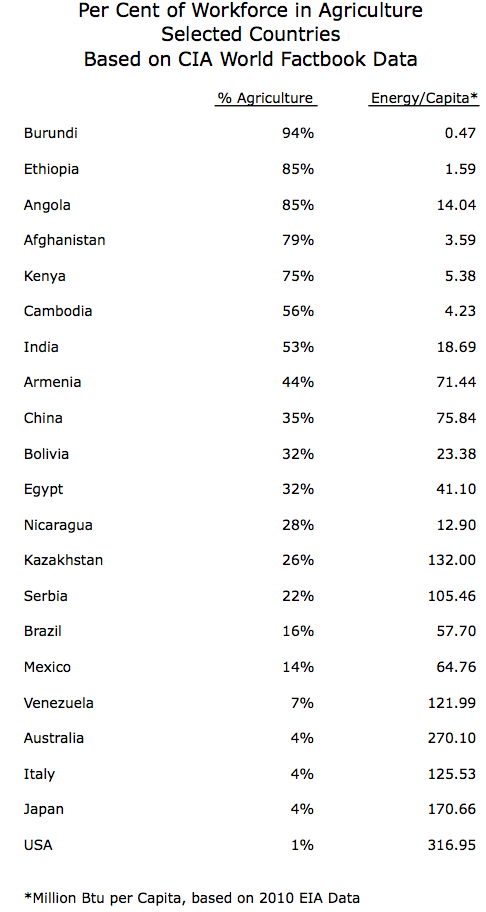
In the example above, I suggested an efficient economy might need only 20% of its population for food production. In fact, the percentage of the population involved in food production varies greatly across economies. Before fossil fuels use, typically 80% of the population of a country was involved in agriculture. With so many involved in agriculture, the number who were involved in manufacturing and services of all types (including government services) was necessarily very limited, because they needed to be “squeezed into” the remaining 20% of the economy.
If, in our hypothetical community, population rises because more children live to maturity, this adds a new dynamic. There is a need for more food, clothing, and housing for the growing population. Unless land area keeps increasing, there becomes a need to grow more barley per acre. In a world without fossil fuels, increasing grain yields becomes difficult. More farmers can be added to a given plot, but the additional yield for additional manual effort (perhaps picking off insects that might eat the crop) is not very high. This dynamic tends to lead to what we think of as falling wages of the common worker, when population becomes high relative to resources available. As I have mentioned in previous posts, based on the book Secular Cycles by Turchin and Nefedof, collapse often occurs in such situations. Governments have promised significant services, but it becomes difficult to collect enough taxes to pay for these services, with falling wages of the common worker.
The dynamic is similar if energy supplies of types other than food (such as oil and coal) does not rise as fast as population. The amount of goods produced using these energy supplies will tend to fall, unless technology advances are able to offset the decline in energy consumption per capita. Such technology is normally fossil fuel dependent. If goods per capita falls, this will be reflected in what we think of as falling inflation-adjusted wages, since it is not possible for workers to have more than what is produced.
Adding Fossil Fuels


If metal tools can be used—say metal plows—these metal tools can greatly ramp up efficiency of farming, allowing fewer people to work in the agricultural sector. If we think about the result in the last section, this situation allows a greater proportion of the population to be employed in producing discretionary services, and thus more wealth for the community as a whole.
The problem with making metals such as iron using renewable resources is that huge amounts of charcoal are needed to make even small amounts of iron. If one wants reasonable quantities of metal, or modern alloys such as steel used in plows and trucks, a person needs fossil fuels.
If a person wants to add fossil fuels and the things that fossil fuels can make to a community that does not have fossil fuels, the question becomes how to pay for the new goods using fossil fuels. As an extreme example, if farmers have always planted barley with a stick, the amount of barley each farmer produces is tiny, and the population is likely mostly farmers. If a farmer can use a new tractor, with the latest equipment, a single farmer can perhaps feed the whole community. The tractor will provide the improved efficiency needed to free up a whole community of workers for other purposes.
The secret to adding fossil fuels (or any kind of energy source that can improve efficiency, and allow fewer people to produce essential goods and services) is debt. While the farmer cannot pay for the new tractor with his earnings from growing barley using a stick, the farmer can indeed pay for the tractor with all of the goods and services that the whole community can produce, as the result of the tractor handling work that now takes many workers to do. By growing much more grain, and selling that grain to all of the workers who are now freed up to provide discretionary services, the farmer will have enough funds in the future to repay the loan for the equipment which will allow much greater efficiency. (The problem is that the tractor requires a huge amount of embedded energy from fossil fuels. Workers who have been working without fossil fuels will not be able to earn enough to pay for this embedded energy without debt.)
Salaries of Workers
In my imaginary simplified economy, there is only one country. In such a country, the amount of salaries that workers receive then is closely related to the amount of goods and services that the economy produces. There will be part of the production that goes to the owners of factories, farms, and other sources of production, but they cannot eat any more than anyone else, or sleep in more than one place at a time. If they get paid much more than others, some of it must be in the form of “paper income” that they can theoretically use at some time in the future, but does not involve current consumption.
In general, the more goods and services produced relative to the population, the more workers will receive in inflation-adjusted salary. If the economy is so distorted that most of the goods are made with machines, the government must play a much bigger role, providing transfer payments to those who cannot find employment (unless the government is prepared to handle uprisings by citizens). If workers are not receiving adequate wages to pay the taxes, taxes will need to come from some other source–possibly from the owners of the sources of production.
To see how a rise in oil prices will affect the economy, lets consider what can be expected to happen to a manufacturing company. Suppose that for a particular manufacturer, costs are distributed as follows (the actual percentages aren’t important–just the point that wages tend to be a big piece of the total):
  •  Wages 40%
  • Oil products 10%
  • Electricity 5%
  • Raw Materials other than Oil 20%
  • Rent 15%
  • Profit 10%
If the cost of oil doubles and the manufacturer is not able to raise prices, the higher cost will wipe out profits. In fact, the cost of other raw materials is likely to rise as well, because oil is used in extracting and transporting raw materials. This will make the impact on profit even worse than the oil-only comparison would suggest.
To “fix” the problem, the manufacturer has to make some sort of adjustment, and the adjustment will almost certainly lead to less dollars being paid for wages. One such approach is to “make a smaller batch,” with the amount produced equal to what can be sold at the higher price. If this is done, the manufacturer will employ fewer workers. It will also cut back on oil consumption, other raw materials, electricity consumption, and rent. The result will look like recession.
Thus, a rise in oil prices, such has happened since the early 2000s, can be expected to affect feedback loops for countries that use very much oil.

The Positive-Feedback Loop
When can an economy grow? If an economy can grow in efficiency—that is, fewer and fewer people employed creating the basic requirements for life, then more of the population can be employed in providing discretionary services. In total, the wealth of the economy will grow. Historically, this has happened as increasing amounts of fossil fuel energy is added to supplement human energy.
If an economy can increase its debt, and that debt can finance equipment or infrastructure that will allow greater efficiency in producing basic services, this will also allow an economy to grow.
In economic analyses, increases in population are counted as part of economic growth. The problem with population growth is that it leads to more population per acre available for cultivation, and more population relative to external energy sources of all types. This sets up a competition: can enough external energy be added to maintain (and even increase) goods and services per capita?
Economies of scale are also important as producing positive feedback loops. Once an energy investment, such as a road, is made, it can be used for an increasingly large population, often without much additional cost. Businesses also find growth beneficial, since they can build a factory, and operate it more hours, with little additional cost.
The combination of all of these favorable feedbacks leads to the pattern of growth that economists seem to think always occurs.
What Can Go Wrong?
The big “oops” that takes place happens when we start hitting natural limits:
1. The cost of oil extraction goes up, because we pulled the easy-to-extract oil out first. This means that workers start having less discretionary income, rather than more, because they now needed to spend more on commuting to work and on food. Wages tend to stagnate or decline, for reasons described above. A larger percentage of the population needs to work in oil extraction, and more fossil fuels of various types must be used in oil extraction, leaving fewer workers and less energy supplies for other purposes.
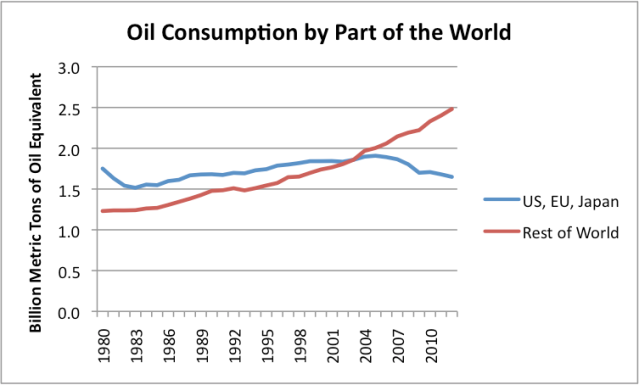
2. The economies of countries consuming large amounts of oil are disproportionately affected by rising prices, and oil consumption begins to drop in these countries, even though world oil consumption in total is still rising.
3. Debt added to produce oil tends to produce fewer and fewer barrels of oil per dollar invested, as the cost of oil extraction rises. With fewer barrels of oil produced per dollar of investment, less goods are transported per dollar invested. If other energy products also rise in cost of extraction, or if the cost of making metals increases, we reach a situation where increasing debt, in general, starts adding a smaller and smaller quantity of goods per dollar of investment. (Substituting a different high-cost source of energy does not fix the situation.) Eventually, so little benefit is gained from additional debt that huge defaults occur. These huge defaults are likely to lead to higher interest rates and more layoffs.
Of course, during favorable feedback loops, the economic growth that comes with increasing energy consumption plays a major role in permitting debt to be paid back with interest. If energy consumption, in fact, starts contracting, this contraction will contribute to debt defaults.
4. As the economies of individual countries got richer and richer, the natural tendency was to add more government services. Pensions and health care were promised, based on what looked possible when the economy was growing rapidly. Now, the economy is not growing as rapidly, and increasing wage disparity is occurring. There is no way to tax the common people enough to pay for the benefits promised to people. People become very unhappy when told that the government cannot pay promised pension benefits. The tendency is toward increasing unhappiness with government status quo, perhaps even leading to new (cheaper) forms of government.
5. Because of energy limits, we find a need to conserve, but in the process discover that we are inadvertently hitting “diseconomies of lack of scale” instead of “economies of scale”. Instead of continually adding new jobs based on construction of new infrastructure, job opportunities for young people start to disappear. This adds to the dynamic of contraction, even if changes are planned.
6. All the time, natural forces are eroding the huge amount of infrastructure that has been built. Hurricanes and earthquakes cause destruction that must be fixed, if the current system is to be maintained. Lesser forces, such as freezing and thawing and roots of trees growing tend to ruin roads over time, and cause buildings to need repairs. While this has always happened, if the government is poorer, the cost becomes an increasing burden.
______
As a result of these influences, the natural feedback loop is now changing to contraction, instead of continually adding a positive increment. This is an unknown situation relative to what we are used to. There is no “reverse gear” on the economy.
We know that in the past, economies that have hit these adverse feedback loops have tended to collapse. The situation is indeed worrisome.
[i] Despite evolving in the direction of requiring external energy, there is still a possibility that a few individuals in particularly advantageous parts of the world might be able to “get along” without external energy. These individuals would probably live in areas where raw fish is available for food, and where predators are not particularly a problem. If these individuals are able to use stored energy in the form of modern knives, shoes, and clothing, such stored energy may take the place of other external energy that ancient people normally required.

1118. Cuba Reports Little Progress Five Years Into Agricultural Reform


By Marc Frank, Reuters, July 30, 2013 

HAVANA, July 30 (Reuters) - Agriculture in Cuba remains in crisis and the country is still dependent on imports five years into Raul Castro's presidency and efforts to reform the sector, according to a government report released this week.
The communist-run nation is investing in some crops to reduce imports and others to boost exports, even as it gradually loosens the state's grip on all food production and distribution in favor of individual initiative and the law of the market.
Cash-strapped Cuba imports some 60 percent of the food it consumes at a cost of around $2 billion annually, mainly bulk cereals and grains such as rice, corn, soy and beans, as well as other items such as powdered milk and chicken.
Last year, $500 million of the imports came from the United States under an exception to the trade embargo that allows agricultural sales for cash.
Unprocessed rice production was up almost 50 percent at 642,000 tonnes in 2012, compared with 436,000 tonnes in 2008 when Castro stepped in for his ailing brother Fidel, and production of beans rose during the same period by 28 percent to 127,000 tonnes, the only significant progress reported.
Cuba and Brazil have been working for a number of years to grow soy for the first time on the Caribbean island, alternating the crop with corn. But there was no mention of soy in the report by the National Statistics Office (www.one.cu/aec2012.htm), and corn production increased by just 30,000 tonnes to 360,000 tonnes during the five-year period.
Castro has decentralized decision making, leased vacant land to 180,000 would-be farmers, allowed all agricultural producers to sell more of their goods on the open market (47 percent in 2012) and raised the prices the state pays for produce. Yet tonnage for root and garden vegetables and bananas and plantains has stagnated at around 5 million tonnes.
The state owns 80 percent of the land and leases 70 percent of that to farmers and cooperatives. The other 20 percent of land is owned by private family farmers and their cooperatives and produces a far higher percentage of the nation's food.
Export crops, from coffee and citrus to tobacco and sugar cane declined over the last five years, according to the report.
Livestock fared no better with most categories either stagnating or declining, except milk, which increased by 8 percent to 604,000 tonnes.
During the period three major hurricanes hit Cuba, where less than 10 percent of the farm land has adequate irrigation and drainage.
In a paper delivered at a local economic conference earlier this year, Cuban economist Armando Nova said farmers should be able to purchase supplies at will, instead of having to wait for them to be assigned and delivered by the state.
"You have to free up the entire production cycle, not just parts of it," Nova said.
The first wholesale produce market run by a cooperative instead of the state opened this month. Castro's point man for reform, Marino Murillo, told parliament that the government would launch a pilot project on the Isla de la Juventud, just off the southwest coast, where farmers could directly purchase fertilizer and other supplies. 

1117. Orcas in Captivity: Profits vs. Ethics


By James Gorman, The New York Times, July 29, 2013
Orca in the ocean where it belongs


Should some of the most social, intelligent and charismatic animals on the planet be kept in captivity by human beings?

That is a question asked more frequently than ever by both scientists and animal welfare advocates, sometimes about close human cousins like chimpanzees and other great apes, but also about another animal that is remarkable for its intelligence and complex social organization — the killer whale, or orca.
Killer whales, found in all the world’s oceans, were once as despised as wolves. But in the last half century these elegant black-and-white predators — a threat to seals and other prey as they cruise the oceans, but often friendly to humans in the wild — have joined the pantheon of adored wildlife, along with the familiar polar bears, elephants and lions.
With life spans that approach those of humans, orcas have strong family bonds, elaborate vocal communication and cooperative hunting strategies. And their beauty and power, combined with a willingness to work with humans, have made them legendary performers at marine parks since they were first captured and exhibited in the 1960s. They are no longer taken from the wild as young to be raised and trained, but are bred in captivity in the United States for public display at marine parks.
Some scientists and activists have argued for years against keeping them in artificial enclosures and training them for exhibition. They argue for more natural settings, like enclosed sea pens, as well as an end to captive breeding and to the orcas’ use in what opponents call entertainment and marine parks call education.
Now the issue has been raised with new intensity in the documentary film “Blackfish” and the book “Death at SeaWorld,” by David Kirby, just released in paperback.
The film and book both focus on the 2010 death of Dawn Brancheau, a trainer, at SeaWorld in Orlando, Fla. She was dragged underwater by a whale called Tilikum, who had been involved in two earlier deaths.
The event led to two citations for safety violations by the Occupational Safety and Health Administration for an unsafe workplace, and an ongoing struggle over OSHA requirements that trainers be separated from killer whales. The most recent fine was in June, and SeaWorld is appealing both decisions.
Both the book and film argue that Tilikum’s actions were deliberate and that his behavior was a result of the psychological damage of captivity, not just at SeaWorld but also at another facility where he was first kept. SeaWorld has said the death was an accident, not a deliberate killing.
Beyond the death of Ms. Brancheau and the arguments over how SeaWorld manages its many facilities lies a fundamental disagreement about whether killer whales, and other cetaceans — the group of marine mammals that includes whales, dolphins and porpoises — should be held captive at all.
It is reminiscent in many ways of the movement to put all captive chimpanzees into sanctuaries, which recently scored two major successes when the National Institutes of Health decided to retire most of its chimpanzees and the Fish and Wildlife Service proposed listing all chimps as endangered, raising new barriers to experimentation.
But the situation for killer whales is different. There are many fewer in captivity — a total of 45 worldwide, according to the organization Whale and Dolphin Conservation — and thousands of people have come to love them partly because of the very exhibitions in marine parks like SeaWorld that disturb those who oppose keeping the whales in captivity. A great deal of scientific study of marine mammals has also been done in these marine parks.
But even some scientists who have worked with captive dolphins set orcas apart because of their size, their range of movement in the wild, and the close-knit nature of their social groups.
Diana Reiss of Hunter College, who has studied self-recognition in captive dolphins and who was not involved in the making of “Blackfish,” said that the question of whether animals like bottlenose dolphins should be kept in captivity is important and should be discussed.
But, Dr. Reiss said, she does not see ambiguity about killer whales. “I never felt that we should have orcas in captivity,” she said. “I think morally, as well as scientifically, it’s wrong.”
The animal in question, Orcinus orca, is actually the largest dolphin. Its name apparently came not because it was a vicious whale, but because it preyed on whales.
The species as a whole has a varied diet, with some groups specializing in fish eating, and others concentrating on seals. They have been known to eat penguins and other seabirds, occasionally squid and turtles, even a swimming moose or deer.

The males can reach 32 feet long and weigh up to 22,000 pounds. The females are smaller, up to 16,500 pounds, but live longer. While males average about 30 years and may reach 60, females normally live about 50 years but can reach 90. They live in family groups or pods, typically ranging from a couple of animals to 15, although they may temporarily join in groups of 200 or more.
They exist around the world, and subgroups differ in diets, behaviors and physical traits. One subgroup in the Pacific Northwest, called the Southern Resident population, is listed as endangered under the U.S. Endangered Species Act.
Orcas can travel great distances. “They can go 100 miles in a day,” said Lori Marino, an Emory University researcher who worked with Dr. Reiss and an activist, who appears in “Blackfish” and opposes keeping dolphins and orcas in marine parks.
Killer whales have complex brains, and the behaviors of different groups are so diverse that scientists talk about them as having different cultures.
The opposition to keeping them in captivity is based partly on evidence that they are smart, social and wide ranging. Those facts are not really disputed, nor is the principle that humans owe the orcas now in captivity a good life.
Opponents of captivity cite a number of physical and psychological problems, including repetitive behaviors, dental issues and attacks on trainers, like the one on Ms. Brancheau.
Yet opponents of captivity recognize that the animals, for their own safety, cannot simply be released into the wild, and so are not calling for SeaWorld or other marine parks to close. Rather, they say, they would like to see the parks keep the orcas in larger, more natural settings, something like sea pens — inshore areas of ocean that can be closed in by nets.
Naomi Rose, a whale biologist who is moving from the Humane Society of the United States to the Animal Welfare Institute, was a co-author of a Humane Society paper in 2011 opposing the keeping of orcas in captivity. She said creating sanctuaries for orcas is “highly feasible,” and could and should be done by companies like SeaWorld, which has 22 orcas, nearly half of the total in captivity.
Merlin Entertainment, which owns amusement parks like Legoland and some Sea Life aquariums, mostly in Europe, has been exploring the possibility of a sanctuary for bottlenose dolphins with Whale and Dolphin Conservation. Cathy Williamson, the captivity program manager for the organization, said it had been “quite tricky” finding a location in Europe where a large natural area, a cove or bay, could be enclosed. Yet, she said, it is feasible to create “a very large netted area, so they’re still in captivity, but they wouldn’t be performing tricks for tourists.” The same kind of sanctuary could also work for orcas, she said.
But both SeaWorld and the Association of Zoos and Aquariums say that such sanctuaries would be a solution for a problem that does not exist. The association has 222 members, 212 in the United States, including the SeaWorld parks in Orlando, San Antonio and San Diego.
The organization sets accreditation standards with requirements for the physical, social and psychological well-being of the animals. “That would be true for an orca, a tiger and a chimpanzee,” said Steven Feldman, a spokesman.
But while the organization opposes the use of chimpanzees for entertainment, and joined in petitioning the Fish and Wildlife Service to declare captive chimpanzees endangered, it considers the jumps, dives and other behaviors that killer whales and other marine mammals exhibit at marine parks to be in the nature of education rather than pure entertainment.
“They’re natural behaviors,” said Paul Boyle, senior vice president for conservation and education at the association. “They’re highly coordinated and people enjoy seeing them.”
Christopher Dold, vice president of veterinary services at SeaWorld, argues that orcas at SeaWorld facilities already have “a phenomenal quality of life.” SeaWorld and the Association of Zoos and Aquariums say that SeaWorld offers a high level of veterinary care and psychological enrichment programs for the captive animals.
They also say that research is being done there on cognition, behavior and the physiology of killer whales and other cetaceans that could not be done any other way. That knowledge, and the chance for the public to see the animals in action, Dr. Dold said, can educate the public and support the cause of conservation.
“That’s why killer whales that connect with people in zoos every day are so important to us as a society,” he said.
Dr. Rose, the opponent of keeping orcas in captivity, also points out that much of the science began in marine park studies. “The history is that our science is built on the backs of people who got their start in the public display industry,” she said, adding, “It’s an issue that our community doesn’t like to grapple with” — one that she hopes to remedy.
At a meeting in New Zealand of the Society for Marine Mammology, Dr. Rose will be one of several co-authors presenting a paper about survival of captive orcas. She said it shows that captive orcas do not do as well as wild ones, and that changes in the care of the animals and an increase in the percentage of captive-born animals since 1995 have not improved survival rates.
The scientific community, she said, has some “hard truths” it needs to confront.

1116. Immediate Update on the Court Hearing Concerning Compassionate Release for Lynne Stewart


By Ralph Schoenman, July 31, 2013


Ten minutes ago the hearing today before Judge John Koetl concluded. The following is a synopsis of what transpired as reported in a telephone call with Ralph Poynter:

Lynne Stewart's attorneys filed an emergency Motion (2255) with Judge Koetl seeking Lynne's "immediate conditional release" pending consideration of the legal issues presented in their brief.

The judge asked why they chose to exhaust their one time right to an emergency motion. The Defense response was that Lynne Stewart is terminally ill. The luxury of time is not available to her or her counsel. An expeditious response from the Court is imperative in the face of her medical condition and in the light of the Bureau of Prisons' unwarranted denial of her application for compassionate release and protracted delays that could be expected if she submitted another application.

The Prosecution, acting for the Justice Department of Barack Obama, asserted that the Judge has no standing because there is no motion for Compassionate Release before him from Federal Bureau of Prisons Director Charles E. Samuels, Jr. as specified in the 1984 Sentencing Act.

The Defense presented a Brief which documents that the Federal Bureau of Prisons had violated separation of powers as the 1984 Congressional Statute assigns to the Court the right to modify a prison sentence in light of facts not available at the time of trial, notably those pertaining to terminal illness. "The BOP has implemented its own interpretation and refused to notify the sentencing judge of objectively 'extraordinary and compelling circumstances,' including but not limited to imminent death, unless, in its own judgment, a motion should be granted. Between 2000 and 2008, on average, 21.3 motions were filed each year. In about 24% of those motions, the prisoner died before the district court ever had a chance to rule on the motion."

"Lynne Stewart is dying," wrote her attorneys. She does not want to die in prison or become another statistic of someone who dies while the Bureau of Prisons delays its reconsideration of another application for compassionate release that she plans to file soon.

Judge Koetl gave a directive to the Federal Attorney to set out its case by
next Tuesday and also to explain why the Bureau of Prisons has refused to disclose or release the records that provide the basis for its denial of Lynne Stewart's recent application for compassionate release.

Lynne Stewart's defense attorneys will have one day to answer before the next hearing scheduled for Thursday, August 8 at 2 p.m.

Judge Koetl has the authority to mandate immediate conditional release to Lynne Stewart.

Monday, July 29, 2013

1115. Urgent Appeal from Lynne Stewart


By Lynne Stewart, Justice for Lynne Stewart, July 25, 2013


To All:

By Now we will have filed papers which take us back into Federal Court in New York City to request that Judge Koeltl overturn the barbaric decision by the Bureau of Prisons and allow me to leave this empty loveless Prison and go home to People and Places familiar and beloved.   I certainly am sick enough--even my oncologist revised her prognosis down to 18 months now. 

However, my spirit remains undaunted and when I compare myself to other far worse off than I am--the Guantanamo and Pelican Bay prisoners, Marie Mason, Afra Siddiqui, Hugo
Yogi Pinell, those under death Penalty like Kevin Cooper, the remaining Angola
2, Ruchel Magee and my fellow New Yorkers Jalil, Sekou, Herman, Seth, David,
Abdul --let me stop before I choke up here... I know we MUST win my fight and
the struggle for all other political prisoners to be freed.  And then we must
struggle for all to be free in this country.

How much can we, the People, take?  Their austerity is barbaric cruelty with
food stamps gone and public housing unavailable, permanently.  How long can
the 1% continue to rule and the corporations call the shots?  There is so much
wrong but we are not allowed to despair since we have been given sight in this
land of the blind and hopeless and heartless,  So, that said, let's once again
get out there as often as needs be--for all the causes, for all the humanity.
for the future.  Forward, ever Forward !!

Lynne

For a list of planned rallies see Justice for Lynne Stewart.  

Sunday, July 28, 2013

1114. Killing Sharks for Fun


By Jim Rutenberg, The New York Times, July 22, 2013
Photo credit: Gordon M. Grant for The New York Times
Landon Garrett, 7, left, and Collin Troll, 6, at Montauk Marine Basin’s shark-hunting contest last month. This weekend the marine basin will host a different kind of tournament, in which not a single shark will be killed.


MONTAUK, N.Y. — This seaside community is increasingly getting attention as a trendy summer playground for the wealthy, but for decades it has been known for something else entirely: killing sharks.

The shark-fishing craze started here in the 1970s with a colorful push from a local angler, Frank Mundus, who popularized what he called “Monster Fishing” and who was a model for the grizzled shark hunter, Quint, in “Jaws.”
Today the piers are decorated with tails and dorsal fins of the sharks that swim these parts: threshers, makos, blues and the occasional great whites. The collection is replenished by the annual tournaments that offer pots of hundreds of thousands of dollars for the biggest sharks. The winning beast is hung by its tail, like a toothy testimony to man’s fear conquered.
Every now and then environmentalists would show up, carrying signs warning about the global decline of shark populations from overfishing and calling for an end to the slaughter. They were mostly ignored in a place where bumper stickers declare that the National Marine Fisheries Service, which regulates fishing hauls, has been “Destroying Fishermen and Their Communities Since 1976.”
But times change. And this summer, an artist, April Gornik, and an environmental group, Concerned Citizens of Montauk, led a successful effort to persuade some of the most prominent shark fishermen to try something new, and they hope, lasting: a contest where not a single shark is killed.
Instead, all of the sharks caught in the contest, being held this weekend, will be photographed and released where they are caught. Fishermen will be asked to use circle hooks, believed to inflict less damage on the fish. And they will be asked to help scientific study by attaching tracking tags to select sharks before they are let go. The winner, determined based on a point system, will receive a painting by Ms. Gornik and $6,000.
It is enough to make some of the old fishermen here wonder what is happening to the world. They lament that their friends are letting the environmentalists get to them, and predict that a shark contest without a winning carcass on the dock will not be viewed as a shark contest at all by the hundreds who still come for them.
“People want to see sharks,” Jack Passie, the captain of the charter boat Windy, which ties off at the Star Island Yacht Club, declared emphatically.
But for those who agree to participate — among them the musician Jimmy Buffett, organizers say — it is a chance for Montauk to lead the way once again, this time to help preserve the shark population.
“Fishermen of Montauk are aware of one thing: The shark fishery is probably going to come to an end down the road,” said Carl Darenberg, the owner of the Montauk Marine Basin, which held one of the first shark-hunting contests in the country 43 years ago and will host the catch-and-release contest. “If you want to have fish around to catch in the future, you have to make adjustments.”
As a fourth-generation Montauk fisherman, Mr. Darenberg, 63, has extra credibility. His great-grandmother came here soon after emigrating from Sweden, having married the local lighthouse keeper. He has been around long enough to remember Mr. Mundus before he was legend.
“He wanted to learn more about how sharks tick,” Mr. Darenberg said one recent afternoon at his bait shop. “And he sat there and caught them and caught them and caught them when everybody else was out catching swordfish and marlin.”
The technique was simple enough: dump containers of chum into the water and wait for the sharks to be drawn by the wafting odor of blood. Mr. Mundus made a great show of it all the same, playing off the persistent shark phobia. Charging up to $1,800 a day, he would take his passengers — among them the “Jaws” author Peter Benchley — on his “Monster Fishing” expeditions.
His weapon of choice was not a rod and reel but a harpoon attached to a series of floating barrels to wear the fish down. Some saw his techniques as silly, but the results were as plain as the 4,500-pound great white he brought to the piers in the summer of ’64.
This niche pursuit took off in the 1970s because of two unrelated developments. The swordfish, marlin and tuna pursued by most sport fishermen became increasingly scarce, and the director Steven Spielberg turned Mr. Benchley’s book into a hit movie.
“ ‘Jaws’ changed the world,” said Michael Potts, a second-generation Montauk fisherman and the captain of the Blue Fin IV.
The town was besieged with aspiring shark hunters, and their appetite was equal to that of their prey. The carcasses piled up.
“The more sharks you threw on the dock, the better the day you had,” Mr. Potts, who is helping the catch-and-release tournament organizers, said during an interview at a harbor restaurant. “Nobody questioned it for years.”
The local marinas, led by the Montauk Marine Basin, capitalized on the interest by presenting shark-fishing contests, which brought more tourists, more money, and, eventually, environmentalists. “The greenies were flying a plane over — ‘Save the Sharks,’ you know?” said Barry Kohlus, who has fished here for 52 years.
Mr. Kohlus is among those who point out that many marine biologists say the real culprits for diminished shark populations are demand in Asia for shark-fin soup and commercial boats’ use of lines that are miles long and snag sharks in huge numbers, intended or not. Federal rules limit recreational shark catches to one per boat per trip anyway, he said.
“You can’t wipe out a species with a rod and reel — it’s not happening,” he said.
But other anglers had developed some doubts over the years, citing large sharks that were later found to be pregnant and a shift in attitudes about killing sharks — many of which are not very palatable — for sport.
Even Mr. Mundus grew concerned. Before he died at 82 in 2008 he called for gentler treatment and more study of sharks, warning that many were being released to their deaths because hooks used to catch them caused serious injuries. He became an advocate for circle hooks.
His concern caught the eye of Ms. Gornik, the artist, who had joined protesters against a shark tournament a few years ago and realized their effort just alienated the fishermen. “That mode of approach was so polarizing that no one from the fishing community was going to talk about anything in between,” she said.
She teamed with Rav Freidel, an environmentalist and a director of the Concerned Citizens of Montauk. A recreational fisherman with strong ties to the fishing community, Mr. Freidel had been fed up with “seeing Dumpsters filled with dead sharks.”
Switching tactics, Ms. Gornik and Mr. Freidel began promoting circle hooks, buying them by the thousands to distribute at the docks. It did not go well at first; the hooks they handed out were too small for East Coast shark fishing, reinforcing some captains’ wariness about their use.
But, after adjusting the giveaways to the correct size — they say they eventually handed out at least 30,000 — they raised their goal, and persuaded Mr. Darenberg to hold a circle-hook-only, catch-and-release-only tournament, called “Shark’s Eye.” Noting that other conservation efforts have helped bring back the striped bass and porgie populations, they say they hope catch-and-release will do the same for sharks.
“It’s about getting sustainable fisheries,” Mr. Freidel said. “Once the fishery is sustainable, hang the fish — I don’t care.”

1113. Philanthropic Colonialism


By Peter Buffet, The New York Times, July 26, 2013


I HAD spent much of my life writing music for commercials, film and television and knew little about the world of philanthropy as practiced by the very wealthy until what I call the big bang happened in 2006. That year, my father, Warren Buffett, made good on his commitment to give nearly all of his accumulated wealth back to society. In addition to making several large donations, he added generously to the three foundations that my parents had created years earlier, one for each of their children to run.

Early on in our philanthropic journey, my wife and I became aware of something I started to call Philanthropic Colonialism. I noticed that a donor had the urge to “save the day” in some fashion. People (including me) who had very little knowledge of a particular place would think that they could solve a local problem. Whether it involved farming methods, education practices, job training or business development, over and over I would hear people discuss transplanting what worked in one setting directly into another with little regard for culture, geography or societal norms.
Often the results of our decisions had unintended consequences; distributing condoms to stop the spread of AIDS in a brothel area ended up creating a higher price for unprotected sex.
But now I think something even more damaging is going on.
Because of who my father is, I’ve been able to occupy some seats I never expected to sit in. Inside any important philanthropy meeting, you witness heads of state meeting with investment managers and corporate leaders. All are searching for answers with their right hand to problems that others in the room have created with their left. There are plenty of statistics that tell us that inequality is continually rising. At the same time, according to the Urban Institute, the nonprofit sector has been steadily growing. Between 2001 and 2011, the number of nonprofits increased 25 percent. Their growth rate now exceeds that of both the business and government sectors. It’s a massive business, with approximately $316 billion given away in 2012 in the United States alone and more than 9.4 million employed.
Philanthropy has become the “it” vehicle to level the playing field and has generated a growing number of gatherings, workshops and affinity groups.
As more lives and communities are destroyed by the system that creates vast amounts of wealth for the few, the more heroic it sounds to “give back.” It’s what I would call “conscience laundering” — feeling better about accumulating more than any one person could possibly need to live on by sprinkling a little around as an act of charity.
But this just keeps the existing structure of inequality in place. The rich sleep better at night, while others get just enough to keep the pot from boiling over. Nearly every time someone feels better by doing good, on the other side of the world (or street), someone else is further locked into a system that will not allow the true flourishing of his or her nature or the opportunity to live a joyful and fulfilled life.
And with more business-minded folks getting into the act, business principles are trumpeted as an important element to add to the philanthropic sector. I now hear people ask, “what’s the R.O.I.?” when it comes to alleviating human suffering, as if return on investment were the only measure of success. Microlending and financial literacy (now I’m going to upset people who are wonderful folks and a few dear friends) — what is this really about? People will certainly learn how to integrate into our system of debt and repayment with interest. People will rise above making $2 a day to enter our world of goods and services so they can buy more. But doesn’t all this just feed the beast?
I’m really not calling for an end to capitalism; I’m calling for humanism.
Often I hear people say, “if only they had what we have” (clean water, access to health products and free markets, better education, safer living conditions). Yes, these are all important. But no “charitable” (I hate that word) intervention can solve any of these issues. It can only kick the can down the road.
My wife and I know we don’t have the answers, but we do know how to listen. As we learn, we will continue to support conditions for systemic change. 
It’s time for a new operating system. Not a 2.0 or a 3.0, but something built from the ground up. New code.
What we have is a crisis of imagination. Albert Einstein said that you cannot solve a problem with the same mind-set that created it. Foundation dollars should be the best “risk capital” out there.
There are people working hard at showing examples of other ways to live in a functioning society that truly creates greater prosperity for all (and I don’t mean more people getting to have more stuff). 
Money should be spent trying out concepts that shatter current structures and systems that have turned much of the world into one vast market. Is progress really Wi-Fi on every street corner? No. It’s when no 13-year-old girl on the planet gets sold for sex. But as long as most folks are patting themselves on the back for charitable acts, we’ve got a perpetual poverty machine.
It’s an old story; we really need a new one.
Peter Buffett is a composer and a chairman of the NoVo Foundation.