Saturday, July 7, 2012

844. Parliamentary Inquiry Declares Fukushima Crisis a Man-Made Disaster


Anti-nuclear activists protest restart of a nuclear reactor in Japan

By Hiroko Tabuchi, The New York Times, July 5, 2012

TOKYO — The nuclear accident at Fukushima was a preventable disaster rooted in government-industry collusion and the worst conformist conventions of Japanese culture, a parliamentary inquiry concluded Thursday.

The report, released by the Fukushima Nuclear Accident Independent Investigation Commission, challenged some of the main story lines that the government and the operator of the Fukushima Daiichi Nuclear Power Plant have put forward. Most notably, the report said the plant’s crucial cooling systems might have been damaged in the earthquake on March 11, 2011, not only in the ensuing tsunami. That possibility raises doubts about the safety of all the quake-prone country’s nuclear plants just as they begin to restart after a pause ordered in the wake of the Fukushima crisis.

“It was a profoundly man-made disaster — that could and should have been foreseen and prevented,” said Kiyoshi Kurokawa, the commission’s chairman, in the report’s introduction. “And its effects could have been mitigated by a more effective human response.”
While assigning widespread blame, the report avoids calling for the censure of specific executives or officials. Some citizens’ groups have demanded that executives of the plant’s operator, the Tokyo Electric Power Company, or Tepco, be investigated on charges of criminal negligence, a move that Dr. Kurokawa said Thursday was out of his panel’s purview. But criminal prosecution “is a matter for others to pursue,” he said at a news conference after the report’s release.
The very existence of an independent investigating commission — which avoids reliance on self-examination by bureaucracies that might be clouded by self-defense — is a break with precedent in Japan, but follows the pattern followed in the United States after major failures involving combinations of private companies, government oversight and technology issues. Those cases, which were cited by the panel, include the Three Mile Island nuclear accident in 1979, the Columbia and Challenger space shuttle disasters in 1986 and 2003 and the terrorist attacks on Sept. 11, 2001.
The 641-page report criticized Tepco as being too quick to dismiss earthquake damage as a cause of the fuel meltdowns at three of the plant’s six reactors, which overheated when the site lost power. Tepco has contended that the plant withstood the earthquake that rocked eastern Japan, instead placing blame for the disaster on what some experts have called a “once in a millennium” tsunami that followed. Such a rare calamity was beyond the scope of contingency planning, Tepco executives have suggested, and was unlikely to pose a threat to Japan’s other nuclear reactors in the foreseeable future.
The parliamentary report, based on more than 900 hours of hearings and interviews with 1,167 people, suggests that Reactor No. 1, in particular, might have suffered earthquake damage, including the possibility that pipes burst from the shaking, leading to a loss of coolant even before the tsunami hit the plant about 30 minutes after the initial earthquake. It emphasized that a full assessment would require better access to the inner workings of the reactors, which may not be possible for years.
“However,” the report said, “it is impossible to limit the direct cause of the accident to the tsunami without substantive evidence. The commission believes that this is an attempt to avoid responsibility by putting all the blame on the unexpected (the tsunami),” the report continued, adding, “and not on the more foreseeable quake.”
The report, submitted to Parliament on Thursday, also contradicted accounts put forward by previous investigations that described the prime minister at the time, Naoto Kan, as a decisive leader who ordered Tepco not to abandon the plant as it spiraled out of control. There is no evidence that the operator planned to withdraw all its employees from the plant, the report said, and meddling from Mr. Kan, including his visit to the plant a day after the accident, confused the initial response.
Instead, the report by the commission — which heard testimony from Mr. Kan and a former Tepco president, Masataka Shimizu — described a breakdown in communications between the prime minister’s office and Tepco, blaming both sides.
“The prime minister made his way to the site to direct the workers who were dealing with the damaged core,” the report said, an action that “diverted the attention and time of the on-site operational staff and confused the line of command.”
The report faulted Mr. Shimizu for an “inability to clearly report” to the prime minister’s office “the intentions of the operators,” which deepened the government’s misunderstanding and mistrust of Tepco’s response.
The commission also accused the government, Tepco and nuclear regulators of failing to carry out basic safety measures despite being aware of the risks posed by earthquakes, tsunamis and other events that might cut off power systems. Even though the government-appointed Nuclear Safety Commission revised earthquake resistance standards in 2006 and ordered nuclear operators around the country to inspect their reactors, for example, Tepco did not carry out any checks, and regulators did not follow up, the report said.
The report placed blame for the tepid response on collusion between the company, the government and regulators, saying they had all “betrayed the nation’s right to safety from nuclear accidents.” Tepco “manipulated its cozy relationship with regulators to take the teeth out of regulations,” the report said.
Dr. Kurokawa reserved his most damning language for his criticism of a culture in Japan that suppresses dissent and outside opinion, which he said might have prompted changes to the country’s lax nuclear controls.
“What must be admitted, very painfully, is that this was a disaster ‘Made in Japan,’ ” Dr. Kurokawa said in his introduction to the English version of the report. “Its fundamental causes are to be found in the ingrained conventions of Japanese culture: our reflexive obedience; our reluctance to question authority; our devotion to ‘sticking with the program’; our groupism; and our insularity.” The Japanese version contained a similar criticism.
Shuya Nomura, a commission member and a professor at the Chuo Law School, said the report had tried to “shed light on Japan’s wider structural problems, on the pus that pervades Japanese society.”

Friday, July 6, 2012

843. Physicists Find Elusive Particle Seen as Key to Universe


By Dennis, Overbye, The New York Times, July 4, 2012

Scientists in Geneva on Wednesday applauded the discovery of a
subatomic particle that looks like the Higgs boson.
ASPEN, Colo. — Signaling a likely end to one of the longest, most expensive searches in the history of science, physicists said Wednesday that they had discovered a new subatomic particle that looks for all the world like the Higgs boson, a key to understanding why there is diversity and life in the universe.

Like Omar Sharif materializing out of the shimmering desert as a man on a camel in “Lawrence of Arabia,” the elusive boson has been coming slowly into view since last winter, as the first signals of its existence grew until they practically jumped off the chart.

“I think we have it,” said Rolf-Dieter Heuer, the director general of CERN, the multinational research center headquartered in Geneva. The agency is home to the Large Hadron Collider, the immense particle accelerator that produced the new data by colliding protons. The findings were announced by two separate teams. Dr. Heuer called the discovery “a historic milestone.”
He and others said that it was too soon to know for sure, however, whether the new particle is the one predicted by the Standard Model, the theory that has ruled physics for the last half-century. The particle is predicted to imbue elementary particles with mass. It may be an impostor as yet unknown to physics, perhaps the first of many particles yet to be discovered.
That possibility is particularly exciting to physicists, as it could point the way to new, deeper ideas, beyond the Standard Model, about the nature of reality.
For now, some physicists are simply calling it a “Higgslike” particle.
“It’s something that may, in the end, be one of the biggest observations of any new phenomena in our field in the last 30 or 40 years,” said Joe Incandela, a physicist of the University of California, Santa Barbara, and a spokesman for one of the two groups reporting new data on Wednesday.
Here at the Aspen Center for Physics, a retreat for scientists, bleary-eyed physicists drank Champagne in the wee hours as word arrived via Webcast from CERN. It was a scene duplicated in Melbourne, Australia, where physicists had gathered for a major conference, as well as in Los Angeles, Chicago, Princeton, New York, London and beyond — everywhere that members of a curious species have dedicated their lives and fortunes to the search for their origins in a dark universe.
In Geneva, 1,000 people stood in line all night to get into an auditorium at CERN, where some attendees noted a rock-concert ambience. Peter Higgs, the University of Edinburgh theorist for whom the boson is named, entered the meeting to a sustained ovation.
Confirmation of the Higgs boson or something very much like it would constitute a rendezvous with destiny for a generation of physicists who have believed in the boson for half a century without ever seeing it. The finding affirms a grand view of a universe described by simple and elegant and symmetrical laws — but one in which everything interesting, like ourselves, results from flaws or breaks in that symmetry.
According to the Standard Model, the Higgs boson is the only manifestation of an invisible force field, a cosmic molasses that permeates space and imbues elementary particles with mass. Particles wading through the field gain heft the way a bill going through Congress attracts riders and amendments, becoming ever more ponderous.
Without the Higgs field, as it is known, or something like it, all elementary forms of matter would zoom around at the speed of light, flowing through our hands like moonlight. There would be neither atoms nor life.
Physicists said that they would probably be studying the new particle for years. Any deviations from the simplest version predicted by current theory — and there are hints of some already — could begin to answer questions left hanging by the Standard Model. For example, what is the dark matter that provides the gravitational scaffolding of galaxies?
And why is the universe made of matter instead of antimatter?
“If the boson really is not acting standard, then that will imply that there is more to the story — more particles, maybe more forces around the corner,” Neal Weiner, a theorist at New York University, wrote in an e-mail. “What that would be is anyone’s guess at the moment.”
Wednesday’s announcement was also an impressive opening act for the Large Hadron Collider, the world’s biggest physics machine, which cost $10 billion to build and began operating only two years ago. It is still running at only half-power.
Physicists had been icing the Champagne ever since last December. Two teams of about 3,000 physicists each — one named Atlas, led by Fabiola Gianotti, and the other CMS, led by Dr. Incandela — operate giant detectors in the collider, sorting the debris from the primordial fireballs left after proton collisions.
Last winter, they both reported hints of the same particle. They were not able, however, to rule out the possibility that it was a statistical fluke. Since then, the collider has more than doubled the number of collisions it has recorded.

The results announced Wednesday capped two weeks of feverish speculation and Internet buzz as the physicists, who had been sworn to secrecy, did a breakneck analysis of about 800 trillion proton-proton collisions over the last two years.
Up until last weekend, physicists at the agency were saying that they themselves did not know what the outcome would be. Expectations soared when it was learned that the five surviving originators of the Higgs boson theory had been invited to the CERN news conference.
The December signal was no fluke, the scientists said Wednesday. The new particle has a mass of about 125.3 billion electron volts, as measured by the CMS group, and 126 billion according to Atlas. Both groups said that the likelihood that their signal was a result of a chance fluctuation was less than one chance in 3.5 million, “five sigma,” which is the gold standard in physics for a discovery.
On that basis, Dr. Heuer said that he had decided only on Tuesday afternoon to call the Higgs result a “discovery.”
He said, “I know the science, and as director general I can stick out my neck.”
Dr. Incandela’s and Dr. Gianotti’s presentations were repeatedly interrupted by applause as they showed slide after slide of data presented in graphs with bumps rising like mountains from the sea.
Dr. Gianotti noted that the mass of the putative Higgs, apparently one of the heaviest subatomic particles, made it easy to study its many behaviors. “Thanks, nature,” she said.
Gerald Guralnik, one of the founders of the Higgs theory, said he was glad to be at a physics meeting “where there is applause, like a football game.”
Asked to comment after the announcements, Dr. Higgs seemed overwhelmed. “For me, it’s really an incredible thing that’s happened in my lifetime,” he said.
Dr. Higgs was one of six physicists, working in three independent groups, who in 1964 invented what came to be known as the Higgs field. The others were Tom Kibble of Imperial College, London; Carl Hagen of the University of Rochester; Dr. Guralnik of Brown University; and François Englert and Robert Brout, both of Université Libre de Bruxelles.
One implication of their theory was that this cosmic molasses, normally invisible, would produce its own quantum particle if hit hard enough with the right amount of energy. The particle would be fragile and fall apart within a millionth of a second in a dozen possible ways, depending upon its own mass.
Unfortunately, the theory did not describe how much this particle should weigh, which is what made it so hard to find, eluding researchers at a succession of particle accelerators, including the Large Electron Positron Collider at CERN, which closed down in 2000, and the Tevatron at the Fermi National Accelerator Laboratory, or Fermilab, in Batavia, Ill., which shut down last year.
Along the way the Higgs boson achieved a notoriety rare in abstract physics. To the eternal dismay of his colleagues, Leon Lederman, the former director of Fermilab, called it the “God particle,” in his book of the same name, written with Dick Teresi. (He later said that he had wanted to call it the “goddamn particle.”)
Finding the missing boson was one of the main goals of the Large Hadron Collider. Both Dr. Heuer and Dr. Gianotti said they had not expected the search to succeed so quickly.
So far, the physicists admit, they know little about their new boson. The CERN results are mostly based on measurements of two or three of the dozen different ways, or “channels,” by which a Higgs boson could be produced and then decay.
There are hints, but only hints so far, that some of the channels are overproducing the boson while others might be underproducing it, clues that maybe there is more at work here than the Standard Model would predict.
“This could be the first in a ring of discoveries,” said Guido Tonelli of CERN.
In an e-mail, Maria Spiropulu, a professor at the California Institute of Technology who works with the CMS team of physicists, said: “I personally do not want it to be standard model anything — I don’t want it to be simple or symmetric or as predicted. I want us all to have been dealt a complex hand that will send me (and all of us) in a (good) loop for a long time.”
Nima Arkani-Hamed, a physicist at the Institute for Advanced Study in Princeton, said: “It’s a triumphant day for fundamental physics. Now some fun begins.”


Related reading: What in the world is a Higgs boson? 

Wednesday, July 4, 2012

842. China Says No More Shark Fin Soup at State Banquets


JAWS: Demand for shark fin is increasing with
the rise of income in Asia

By Bettina Wassener, The New York Times, July 3, 2012

HONG KONG — China said Tuesday that it would prohibit official banquets from serving shark fin soup, an expensive and popular delicacy blamed for a sharp decline in global shark populations.

The ban, reported by Xinhua, the state-run news agency, could take as many as three years to take effect, and it remains unclear how widely it will be adhered to across a sprawling nation where orders issued by Beijing are often shrugged off by officials in faraway regions and provinces.
Still, the decision to stop serving shark fin soup at official functions was welcomed by environmental campaigners. Experts have long cautioned that soaring demand for the soup over the past two decades has imperiled shark populations around the globe.
“This is a very positive step forward,” said Andy Cornish, director of conservation at W.W.F. in Hong Kong. “It is the first time that the Chinese central government has expressed a decision to phase out shark fin from banquets funded by taxpayers’ money.” He said the move would send an important signal to consumers in China, the largest market for the fins.
Stan Shea, a project coordinator in Hong Kong at Bloom Association, a marine conservation organization, likewise welcomed the policy change, saying it represented a “big step” to help shark populations.
The soup, brewed from dried shark fins, is largely tasteless and slithery but has considerable cachet as a status symbol. Many in China consider it a must-serve at lavish, multicourse banquets to celebrate weddings, anniversaries and corporate and state events.
Retailers in Hong Kong, the main hub for the international trade in the fins, charge more than 2,000 Hong Kong dollars, or $260, per catty, a traditional weight measure commonly used in markets here. Equal to just over one pound, one catty makes about 10 portions of soup, which works out to $26 a portion.
Rapid economic growth across Asia in recent years has catapulted millions into the ranks of those who can now afford the dish.
In an effort to conserve shark populations, several nations have banned the fishing of sharks. Several American states, including California, have banned the possession, sale and distribution of shark fins. And in Hong Kong, several high-end restaurants and hotels have recently taken shark fin off the menu in response to shifting public awareness in the city. The Hong Kong government has so far resisted calls from shark conservationists to curtail the trade or consumption of shark fins.
“The Hong Kong government has repeatedly dodged the question of implementing a banqueting ban on shark fin soup, saying that it sees no need for such guidelines,” said Mr. Cornish of W.W.F. “We strongly hope that the new administration in Hong Kong government will shortly follow suit.”
The Hong Kong Environmental Protection Department’s media office, in an e-mail on Tuesday, reiterated its long-held stance that the government carries out the Convention on International Trade in Endangered Species of Wild Fauna and Flora, known by its acronym, Cites.
Environmentalists, however, argue that Cites should list as threatened a far larger number of shark species than it does.
Hong Kong government guidelines stipulate that official banquets not be “extravagant,” and this means menus do not “generally include shark fin,” the media department added. It did not say whether Hong Kong would echo Beijing’s decision to ban the dish from official banquets.

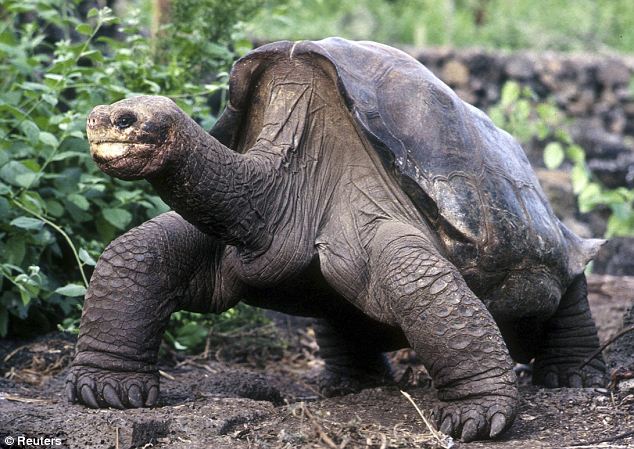
841. A Giant Tortoise’s Death Gives Extinction a Face


Lonesome George was the last of his species.

By Chalres Hulse, The New York Times, July 2, 2012

PUERTO AYORA, Galápagos Islands — Lonesome George is gone, and there will never be another like him.

George, the last giant tortoise of his subspecies in this archipelago, was found dead in his corral at the Charles Darwin Research Station here the morning of June 24 — to the shock of his devoted caretakers, who had hoped he would survive for decades to continue his line.
The cause was natural, according to a necropsy, with the liver showing definite signs of aging. Giant tortoises can live well into their second century; George, who was brought here in 1972 from the northern island of Pinta, was thought to be around 100.
The Galápagos is home to other types of giant tortoises, though their numbers remain low and their populations vulnerable. But in recent years, it was George who came to symbolize endangered species around the world, and he was enmeshed in the soul of the Galápagos — enshrined in stamps, logos and countless T-shirts.
His loss has left the islands’ human inhabitants a bit bereft.
“It is a very sad story for all of us,” said Christian Saa, a national park ranger, guide and naturalist who had never been at the research center when George was not on hand.
“We were expecting to have George another 50 years,” he said as he stood before the pen, which houses a heart-shaped pool in which the tortoise’s caretakers had hoped to entice him to produce an heir with two biologically close female tortoises who remain. “It feels kind of empty.”
George’s death was a singular moment, representing the extinction of a creature right before human eyes — not dinosaurs wiped out eons ago or animals consigned to oblivion by hunters who assumed there would always be more. That thought was expressed at the shops and restaurants that are the research center’s neighbors on Charles Darwin Avenue.
“We have witnessed extinction,” said a blackboard in front of one business. “Hopefully we will learn from it.”
It especially struck home with Fausto Llerena, the 72-year-old ranger who cared for George for many of the tortoise’s 40 years at the center. Mr. Llerena was part of the original expedition that found George on Pinta Island in 1972, when all the tortoises there were thought to be gone, and brought him here to Santa Cruz Island. Through the years, he said, George had come to recognize him.
“He came toward me and he stopped and stretched his neck out, opened his mouth like a greeting, welcoming me,” said Mr. Llerena, interviewed while he was weighing and measuring young tortoises that the center hopes to eventually return to the wild. “That was his behavior with me and my companions at work.”
On June 24, Mr. Llerena noticed that George was not in his usual morning spot. On closer inspection, he found the tortoise dead. Several days later, he said it was still hard to fathom.
“He was like a member of the family to me,” he added. “To me, he was everything.”
Over the decades, notables from many countries had visited George to ooh and ahh, and his death has drawn worldwide attention. But here on these isolated islands, the loss is much more personal.
Washington Tapia, a senior official at Ecuador’s park service, said he cried when he heard the news; for him, it was like losing his grandparents. The plan now, he said, is to prepare George for display in a new tortoise museum.
The Pinta subspecies of giant tortoises was hardly the first Galápagos animal to disappear, Mr. Tapia said. Over the centuries, whalers, sailors, explorers and pirates gathered tens of thousands of tortoises for food and introduced nonnative species that crowded out indigenous ones.
“Sadly, it is not the first species that has become extinct,” he said. “But because of the reputation that he had, the reaction to it is more unusual.”
After George arrived here in 1972, researchers at the center used numerous strategies to get him to reproduce, introducing him to female tortoises and even trying artificial insemination. A $10,000 reward was offered for identifying a Pinta Island female. Hopes were raised when tortoise eggs were found in the enclosure, but they turned out to be unfertilized.
Lonesome George, who was thought to have been named for the clueless character popularized by the 1950s comedian George Gobel, was not universally popular in the islands. In 1995 sea-cucumber fishermen blockaded the research center to protest proposed environmental restrictions, shouting “Death to Lonesome George!” The standoff ended without harm to George, and the Galápagos have embraced eco-tourism as a way to balance conservation and economic need.
Park officials say they hope George’s death drives home the lesson that humanity must take greater care in interacting with other species. And though George was a powerful emblem of the Galápagos, they see his loss as a beginning as much as an end.
“George is very important, but the Galápagos is more than just George,” Mr. Tapia said. “The Galápagos is one of the last places in the world where we can see those things, nature in its purest state.”

840. Growing Ship Traffic Threatens Blue Whales


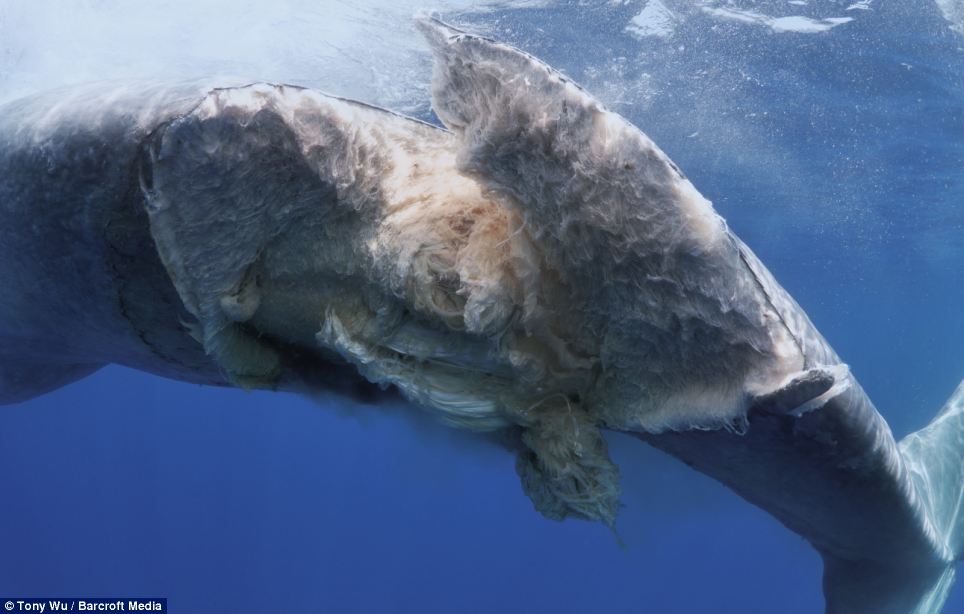
Blue whale struck and killed  by ship

By Erik Olsen, The New York Times, July 2, 2012

MIRISSA, Sri Lanka — In early April, whale watchers off this country’s southern coast were greeted by a disturbing sight: the lifeless body of a 60-foot-long blue whale floating in the water about 12 miles offshore.

The body was swelling rapidly, and suckerfish swarmed across its skin. Even more unsettling was the condition of its tail, which had been nearly severed from the body.
“It was very obviously from a ship’s propeller,” said Mazdak Radjainia, a structural biologist and underwater photographer from the University of Auckland in New Zealand who happened upon the whale. “It must have been a really cruel death, because it was such a massive injury.”
Researchers say ship strikes are a leading cause of death among whales around the globe. Many that are killed are from endangered populations like blue whales that are barely holding on.
The problem is particularly troublesome here in Sri Lanka, where a largely unstudied population of blue whales, possibly numbering in the thousands, has come under increasing pressure from commercial shipping and from a boom in unregulated whale-watching boats.
Because these waters are poorly monitored, scientists do not know for sure whether ship strikes are on the rise. But the whale’s death in April was already the sixth of the year, according to news reports. In one grisly encounter in March, a blue whale was found draped over the bow of a container vessel in the harbor in the capital, Colombo, 90 miles north of this beach resort. Last year, some 20 whale carcasses (not all of them blue whales) were seen around the island, according to Arjan Rajasuriya, a research officer with the National Aquatic Resources Research and Development Agency in Colombo. It is not known how many of the deaths resulted from ship strikes.
“These strikes likely represent only a portion of the likely true mortality,” said John Calambokidis, a whale researcher in Olympia, Wash., who documents ship strikes off the West Coast of the United States. Because blue whales often sink soon after they are struck, most such deaths go unrecorded, and Dr. Calambokidis says the true number “could be 10 or 20 times” the number seen.
Fifteen miles off the southern coast of Sri Lanka is one of the world’s busiest shipping lanes, and whales are known to swim regularly inside them. But some scientists believe that the increase in whale watching could be forcing whales to seek food farther out, pushing them into the big ships’ path.
“I’m afraid the whales are being harassed by the whale-watching boats and that this could affect their movement,” said Asha de Vos, a whale researcher here.
The threat to the whales has some researchers scrambling to learn as much as they can about them and to find a way to protect them.
“Having these whales right off the coast is pretty amazing,” said Ari S. Friedlaender, a research scientist at the Duke University Marine Laboratory. “We know so little about blue whales in general that any place that you have easy access to animals like this, your learning curve is going to be exponential.”
In 2009, Sri Lanka ended a deadly 25-year civil war that largely kept foreign scientists and researchers away from these waters. Several general surveys in the 1970s revealed that there were whales here, but it was not until the 1990s that interest started to grow. Researchers were particularly drawn by the whales’ tendency to stay here year round; other blue whale populations are known to migrate vast distances.
Perhaps no one has studied these whales and promoted their conservation as much as Ms. de Vos.
Three years ago, Ms. de Vos started the Sri Lankan Blue Whale Project, a long-term research program that she hopes will stop the carnage and raise awareness of the whales here. For the last three years, from December to May, she has been photographing the whales and using scientific instruments to better understand their feeding behaviors.
“Clearly, there’s something down there that’s keeping them around. But we need to know where it is and how much,” she said.

In March, Ms. de Vos was helped by a team of researchers from the Duke University Marine Lab who brought along an electronic echo sounder, which uses sound waves to measure the density of prey in the water. For 10 days, she and the team crisscrossed miles of water, taking measurements and finding spots thick with krill.

The data will help scientists better understand where and when the whales are feeding — and, she hopes, persuade the government to shift the shipping lanes farther out to sea.
Ms. de Vos, who was born and raised in Colombo, became a champion of the blue whales after she took a boat ride in 2006 and was astounded by what she saw.
“There were six whales within four square kilometers of where I was, and that was it for me,” she said. “That was a sign, and I knew I wanted to better understand and protect them.”
But her effort is fraught with challenges, including a lack of support from local authorities and the disadvantages of being a young woman in a society dominated by men. “I’m very much on my own around here,” she said. “I don’t have a lot of infrastructure or equipment to do my work.”
She has received some financial support from the University of Western Australia, where she is completing a doctorate in oceanography.
“Her work is really setting the stage for further research on these animals,” said Dr. Friedlaender, who hopes to visit the region next year.
Ms. de Vos notes that with the end of Sri Lanka’s civil war, there is now a major push to increase tourism, and whale watching is a critical part of the government’s development strategy. While the effort may bring much-needed economic development to this poor country, Ms. de Vos is concerned that it may all be happening too fast.
“Right now, whale-watching boats are driving helter-skelter around the animals,” she said. “I don’t want it to explode into something that becomes a harassment for the whales.”
In other countries with established whale-watching industries, laws prohibit getting close to the animals; the United States sets the minimum distance at 100 yards. Ms. de Vos would like to see similar regulations here.
“In this new era of peace, the blue whale is very fast becoming the symbol of our country,” she said. “It would be very sad to harm these animals because of our foolishness.”

839. A New Particle Could Be Physics’ Holy Grail


By Denise Overbye, The New York Times, July 4, 2012

British physicist Peter Higgs arrived at
 CERN headquarters today
ASPEN, Colo. — Physicists working at CERN’s Large Hadron Collider said Wednesday that they had discovered a new subatomic particle that looks for all the world like the Higgs boson, a potential key to an understanding of why elementary particles have mass and indeed to the existence of diversity and life in the universe.

The British physicist Peter Higgs arrived at CERN's headquarters on Wednesday.
“I think we have it,” Rolf-Dieter Heuer, the director general of CERN, said in an interview from his office outside Geneva, calling the discovery “a historic milestone.” His words signaled what is probably the beginning of the end for one of the longest, most expensive searches in the history of science. If scientists are lucky, the discovery could lead to a new understanding of how the universe began.
Dr. Heuer and others said that it was too soon to know for sure whether the new particle, which weighs in at 125 billion electron volts, one of the heaviest subatomic particles yet, fits the simplest description given by the Standard Model, the theory that has ruled physics for the last half-century, or whether it is an impostor, a single particle or even the first of many particles yet to be discovered. The latter possibilities are particularly exciting to physicists since they could point the way to new deeper ideas, beyond the Standard Model, about the nature of reality. For now, some physicists are calling it a “Higgslike” particle.
“It’s great to discover a new particle, but you have find out what its properties are,” said John Ellis, a theorist at CERN, the European Organization for Nuclear Research.
Joe Incandela, of the University of California, Santa Barbara, a spokesman for one of two groups reporting data on Wednesday, called the discovery “very, very significant.”
“It’s something that may, in the end, be one of the biggest observations of any new phenomena in our field in the last 30 or 40 years, going way back to the discovery of quarks, for example,” he said.
Here at the Aspen Center for Physics, a retreat for scientists that will celebrate its 50th birthday on Saturday, the sounds of cheers and popping corks reverberated early Wednesday against the Sawatch Range through the Roaring Fork Valley of the Rockies, as bleary-eyed physicists watched their colleagues read off the results in a webcast from CERN. It was a scene duplicated in Melbourne, Australia, where physicists had gathered for a major conference, as well as in Los Angeles, Chicago, Princeton, New York, London and beyond — everywhere that members of a curious species have dedicated their lives and fortunes to the search for their origins in a dark universe.
Nima Arkani-Hamed, a physicist at the Institute for Advanced Study in Princeton, said: “I was really impressed. It’s a triumphant day for fundamental physics. Now some fun begins!”
At CERN itself, 1,000 people stood in line all night to get into the auditorium, according to Guido Tonelli, a CERN physicist who said the atmosphere was like a rock concert. Peter Higgs, the University of Edinburgh theorist for whom the boson is named, entered the meeting to a standing ovation.
Confirmation of the Higgs boson or something very much like it would constitute a rendezvous with destiny for a generation of physicists who have believed in the boson for half a century without ever seeing it. And it affirms a grand view of a universe ruled by simple and elegant and symmetrical laws, but in which everything interesting in it, like ourselves, is a result of flaws or breaks in that symmetry.
According to the Standard Model, which has ruled physics for 40 years, the Higgs boson is the only visible and particular manifestation of an invisible force field, a cosmic molasses that permeates space and imbues elementary particles that would otherwise be massless with mass. Particles wading through it would gain heft.
Without this Higgs field, as it is known, or something like it, physicists say all the elementary forms of matter would zoom around at the speed of light, flowing through our hands like moonlight. There would be neither atoms nor life.
Physicists said that they would probably be studying the new Higgs particle for years. Any deviations from the simplest version of the boson — and there are hints of some already — could open a gateway to new phenomena and deeper theories that answer questions left hanging by the Standard Model: What, for example, is the dark matter that provides the gravitational scaffolding of galaxies? And why is the universe made of matter instead of antimatter?

“If the boson really is not acting standard, then that will imply that there is more to the story — more particles, maybe more forces around the corner,” Neal Weiner, a theorist at New York University, wrote in an e-mail. “What that would be is anyone’s guess at the moment.”

One intriguing candidate for the next theory they have been on the watch for is called supersymmetry, “SUSY” for short, which would come with a whole new laundry list of particles to be discovered, one of which might be the source of dark matter. In supersymmetry there are at least two Higgs bosons.
Dr. Incandela said, “The whole world thinks there is one Higgs, but there could be many of them.”
Michael Turner, a cosmologist at the University of Chicago and the chairman of the physics center board, said, “This is a big moment for particle physics and a crossroads — will this be the high water mark or will it be the first of many discoveries that point us toward solving the really big questions that we have posed?”
Wednesday’s announcement is also an impressive opening act for the Large Hadron Collider, the world’s biggest physics machine, which collides protons and only began operating two years ago. It is still running at only half-power.
Physicists had been holding their breath and perhaps icing the Champagne ever since last December. Two teams of about 3,000 physicists each — one named Atlas, led by Fabiola Gianotti, and the other CMS, led by Dr. Incandela — operate giant detectors in the collider, sorting the debris from the primordial fireballs left after proton collisions. Last winter they both reported hints of the same particle. They were not able, however, to rule out the possibility that it was a statistical fluke.
Since then the collider has more than doubled the number of collisions it has recorded.
The new results capped three weeks of feverish speculation and Internet buzz as the physicists, who had been sworn to secrecy, did a breakneck analysis of some 800 trillion proton-proton collisions over the last two years. They were racing to get ready for a major conference in Melbourne that started on Wednesday, where they had promised an update on the Higgs search.
In the end, the CERN council, which consists of representatives from each of CERN’s 20 member states, decided that the potentially historic announcement should come from the lab’s own turf first.
Up until last weekend, physicists from inside were reporting that they themselves did not know what the outcome would be, though many were having fun with the speculation.
“HiggsRumors” became one of the most popular hashtags on Twitter. The particle also acquired its own iPhone app, a game called “Agent Higgs.” Expectations soared when it was learned that the five surviving originators of the Higgs boson theory had been invited to the CERN news conference.
On the eve of the announcement, in what was an embarrassing moment for the lab where the Web was invented, a video of Dr. Incandela making his statement was posted to the Internet and then quickly withdrawn. Dr. Incandela said he had made a series of video presentations with alternate conclusions so that the video producers would not know the right answer ahead of time, but the one that was right just happened to get posted.
But the December signal was no fluke.
Like Omar Sharif materializing out of a distant blur of heated air into a man on a camel in “Lawrence of Arabia,” what was once a hint of a signal had grown over the last year, until it practically jumped off the chart. “I believe it now; I didn’t before,” said a physicist who was one of the first to see the new results but was not authorized to discuss them.
The new particle has a mass of about 125.3 billion electron volts, in the units of mass and energy — Einstein showed they are the same — that are favored by physicists, about as much as a whole barium atom, according to the CMS group, and 126 billion according to Atlas.
Both groups said that the likelihood that their signal was a result of a chance fluctuation was less than one chance in 3.5 million, so-called “five sigma,” which is the gold standard in physics for a discovery.

On that basis, Dr. Heuer said that he had decided only Tuesday afternoon to call the Higgs result a “discovery.”
He said, “I know the science, and as director general I can stick out my neck.”
Dr. Incandela’s and Dr. Gianotti’s presentations were repeatedly interrupted by applause as they showed slide after slide of data bumps rising like mountains from the sea.
Dr. Gianotti said at one point: “Why are you applauding? I’m not done yet. This is just beginning. There is more to come.”
She noted that the mass of the putative Higgs made it easy to study its many behaviors and channels. “So,” she said, “thanks, nature.”
Gerald Guralnik, one of the founders of the Higgs theory, said he was glad to be at a physics meeting “where there is applause like a football game.”
Asked to comment after the announcements, Dr. Higgs seemed overwhelmed, saying, “For me, its really an incredible thing that’s happened in my lifetime.”
In quantum theory, which is the language of particle physicists, elementary particles are divided into two rough categories: fermions, which are bits of matter like electrons; and bosons, which are bits of energy and can transmit forces, like the photon that transmits light.
Dr. Higgs of the University of Edinburgh, was one of six physicists, working in three independent groups, who in 1964 invented the notion of the cosmic molasses, or Higgs field. The others were Tom Kibble of Imperial College, London, Carl Hagen of University of Rochester, Dr. Guralnik of Brown University, and Francois Englert and the late Robert Brout, both of Université Libre de Bruxelles.
One implication of their theory was that this cosmic molasses, normally invisible and, of course, odorless, would produce its own quantum particle if hit hard enough, by the right amount of energy. The particle would be fragile and fall apart within a millionth of a second in a dozen different ways depending upon its own mass.
Unfortunately, the theory did not say how much this particle should weigh, which is what made it so hard to find. The pesky particle eluded researchers at a succession of particle accelerators, including the Large Electron Positron collider at CERN, which closed down in 2000, and the Tevatron at the Fermi National Accelerator Laboratory, or Fermilab, in Batavia, Ill., which shut down last year.
Along the way the Higgs boson achieved a notoriety rare for abstract physics. To the eternal dismay of his colleagues, Leon Lederman, the former director of Fermilab, called it the “God particle,” in his book of the same name, later quipping that he had wanted to call it “the Goddamn particle.”
Finding the missing boson was one of the main goals of Large Hadron Collider.
Both Dr. Heuer and Dr. Gianotti said they had not expected the search to succeed so quickly, a tribute they said, to the people who had built the collider and the detectors and learned to run them efficiently. “It’s truly amazing,” said Lisa Randall, a prominent Harvard theorist.
Dr. Heuer recently extended the current run of the collider an extra three months, to the end of the year, during which the experimenters say they expect to triple their data on the new particle, narrowing some its possible identities.
The collider will then shut down for two years for major repairs. When it starts up again, theories of both inner space and outer space could be up for grabs.
Although they have never been seen, Higgs-like fields play an important role in theories of the universe and in string theory. Under certain conditions, according to the strange accounting of Einsteinian physics, they can become suffused with energy that exerts an anti-gravitational force. Such fields have been proposed as the source of an enormous burst of expansion, known as inflation, early in the universe, and, possibly, as the secret of the dark energy that now seems to be speeding up the expansion of the universe.
Knowing more about the new particle will help put those theories on firmer ground, Dr. Turner of Chicago said.
So far the physicists admit, they know little. The CERN results are mostly based on measurements of two or three of the dozen different ways, or “channels,” by which a Higgs boson could be produced and then decay.
There are hints, but only hints so far, that some of the channels are overproducing the Higgs while others might be underproducing, clues maybe that there is more than the Standard Model at work.
“This could be the first in a ring of discoveries,” said Dr. Tonelli.
CERN will be examining the rest of the channels over the coming months and years, and the idea that the Standard Model could be cracking is a prospect that physicists find thrilling. Only time, and a few more trillions of proton collisions, will tell.
In an e-mail, Maria Spiropulu, a professor at the California Institute of Technology who works with the CMS team at CERN wrote about the Higgs, “I personally do not want it to be standard model anything — I don’t want it to be simple or symmetric or as predicted. I want us all to have been dealt a complex hand that will send me (and all of us) in a (good) loop for a long time.”