Friday, January 29, 2016

2181.The House That Marx Built

By Benjamin Kunkel, Dissent, Fall 2015
Street art in San Francisco's Mission District, 2009. Photo:  Dave R / Flickr.

The classical and continuing aim of Marxism, you might say, is to coordinate a complete theory of social evolution with a comprehensive politics of revolution: a very tall order. And precisely this systematic or totalizing character of Marxism has imposed a certain fragmentary quality on all political or intellectual activity carried out in its spirit. The impossibility of any single mind, or for that matter any pair of minds, achieving the total perspective required is obvious, and the program first drafted by Marx and Engels—at once a political program and a research program—was bound to remain incomplete, even in outline, during their lifetimes.

Some of the enduring incompleteness of the Marxist project, across later generations, is historical and regrettable. Since the demise of the Second International, the drift has been toward the mutual estrangement of intellectuals and activists, and intellectuals among themselves have tended to put on the blinders of their separate academic disciplines, forgetting that the borders within the social sciences and the divisions between those sciences and such realities as “nature” and “culture” are only features of maps of the world and not of its unbroken terrain. Activists, for their part, are liable to forget that ideas constitute a material force in history. But there is another and better cause of the incomplete or fragmentary state of Marxism, which is simply its special openness as a way of thinking to the whole of human and indeed nonhuman life; its broken-off, frustrated, and even incoherent character is, in this sense, merely the sign of its ongoing life. It remains unfinished because so does history.

In recent years, Marxism has shown itself to be a living proposition particularly through the opening up of two lines of investigation that were, in the work of Marx and Engels and in that of most of their heirs, detectable but undeveloped.

The first of these lines of investigation resumes the elaboration of a Marxist ecology, to modify the title of an important book by John Bellamy Foster. Marx’s Ecology (2000) demonstrated that Marx and Engels were genuinely ecological thinkers, aware that the productive activity of human beings, based on whatever form of social relations, is also a way of managing or mismanaging the metabolic exchange between our uniquely political species and other kinds of terrestrial nature. Marx was notably concerned with the matter of soil exhaustion. The capitalism of his time starved the soil of vital nutrients, first by concentrating the population in great cities where human waste no longer fertilized the earth but instead polluted streets and waterways, and, second, by encouraging mono-cropping through the commodification of agriculture. On this basis, Bellamy Foster derives a general concept of the metabolic rift between capitalist humanity and nonhuman nature. Though he doesn’t say so, there exists an obvious analogy between the tendency of capitalism to take from human laborers more than it returns in wages, and to take from nonhuman nature more than it replenishes in usable energy and biological life.

The green turn in Marxism advances old insights: capitalism, we read in Capital, undermines not just one but both of the “original sources of all wealth—the laborer and the soil.” Ecosocialist thought can nevertheless be criticized for not having gone far enough. Thinkers like Bellamy Foster, James O’Connor, and Paul Burkett in Marxism and Ecological Economics (2007) have so far mainly established the compatibility of Marxism with ecology. This is no small thing, given Marxism’s association, in theory, with the heedless development of “all the productive forces” available to any mode of production, and, in practice, with the disgraceful environmental record of the Soviet Union. But due integration of Marxist ecology and economics, in empirical and analytic terms as well as abstract and axiomatic ones, doesn’t seem to have taken place yet. Jason W. Moore’s Capitalism in the Web of Life promises to do something to redress this failure.

Alongside the new Marxist ecology has also sprung up what might be called a Marxist oikology. Oikos, Greek for household, is the root shared by the words ecology and economics: ecology (from oikos plus logos, for discourse) literally means the study of a household, while economy (oikos plus nomia) means the management of one. Ecology refers, then, to studying the planetary household of the natural world; “the economy” refers to managing the—currently capitalist—household of formal commodity exchange; and oikology would have to do with the household or reproductive activities of human beings wherever these take place by means other than commodity exchange, that is, without money.

Oikological phenomena would thus encompass uncompensated household cleaning, repairs, and food preparation; uncompensated care for children, the sick, and the elderly (rather than the paid work of professional teachers and nurses); uncompensated counseling (by friends and family rather than psychiatrists), uncompensated sex (with volunteering lovers rather than sex workers), and so on. Because the burden of such unwaged labor has fallen disproportionately on women since the advent of capitalism and before, feminists have drawn special attention to the oikological arena. Silvia Federici’s “Wages Against Housework” (1975), a landmark of Marxist feminism, emphasized the indispensable role of unwaged and typically female labor in sustaining the household of the—at the time—typically male wage-laborer. More recently, Nancy Fraser’s 2014 essay in New Left Review, “Behind Marx’s Hidden Abode,” called “for an expanded conception of capitalism” that fully acknowledges the non-economic conditions essential to the maintenance of the capitalist economy. These include both “the natural processes that sustain life and provide the material inputs for social provisioning,” and the “solidary relations” and “affective dispositions” that furnish “the appropriately socialized and skilled human beings who constitute ‘labor.’”

Marxism intuited something like this interdependency from the outset, as it fumbled toward the ungraspable object of totality, or “the evolution of society as a whole,” as Lukács put it. If it hasn’t yet taken the full measure of this intuition, it has started to look with sharper eyes at the eco-totality—simultaneously ecological, economic, and oikological—that was always in view. That alone is enough to distinguish it from all those varieties of scholarship, journalism, opinion, and ideology that are more congenial to capital, and to guarantee the pertinence of the tradition to any future worth pursuing. It would be facile to say, in a breath, that an enlarged theory should now unite with a renewed praxis, “proclaiming”—Lukács again—“the relation between the tasks of the immediate present and the totality of the historical process.” Still, at least two political results seem worth hoping for. One is an expanded constituency for socialism, or whatever you want to call it: not just more feminists and greens but more people—surely the majority—alive to the interrelationship between economic distress, ecological anxiety, and household or community frustration and neglect. A second and related result might be a better understanding of the vulnerabilities of a planetary capitalism that can appear omnipotent. After all, the same global economy that dominates the ecological and oikological spheres of life also helplessly depends upon those spheres for its continued expansion. It survives at the mercy not only of workers but of unwaged human life and nonhuman nature, should they turn uncooperative.

Benjamin Kunkel is the author, most recently, of Utopia or Bust (Verso, 2014), an essay collection, and Buzz, a play on ecological themes.

Thursday, January 28, 2016

2180. Saudi Arabia Keeps Pumping Oil, Despite Financial and Political Risks

By Stanley Reed, The New York Times, January 27, 2016


Call it the Saudi calculus.

Oil prices were already plummeting 14 months ago when, at Saudi Arabia’s insistence, OPEC put the global petroleum industry on notice: The member countries would not try to prop up prices by cutting production.

“We don’t want to panic,” Abdalla el-Badri, secretary general of the Organization of the Petroleum Exporting Countries, told reporters at the group’s November 2014 meeting in Vienna. “We want to see how the market behaves.”

Since then, the market has behaved in a way few could have predicted — including Saudi Arabia, the world’s biggest oil exporter. The price of oil has collapsed under the weight of a growing international glut, made worse by slower growth in the global economy.

And yet the Saudis keep pumping oil at virtually full capacity. And they have persuaded their Persian Gulf OPEC allies — Kuwait, the United Arab Emirates and Qatar — to do the same, despite mounting pressure from other big OPEC members to curtail production.

It is a risky strategy — one that is already straining Saudi finances and threatening the kingdom’s ability to continue providing generous social programs, like subsidized housing and cheap energy, that the royal family has long used to buy domestic tranquillity.

Oil provides more than 70 percent of Saudi government revenue. And though the Saudis still have about $630 billion in financial reserves, they are spending them at a rate of $5 billion to $6 billion a month, according to Rachel Ziemba, an analyst at Roubini Global Economics in New York.

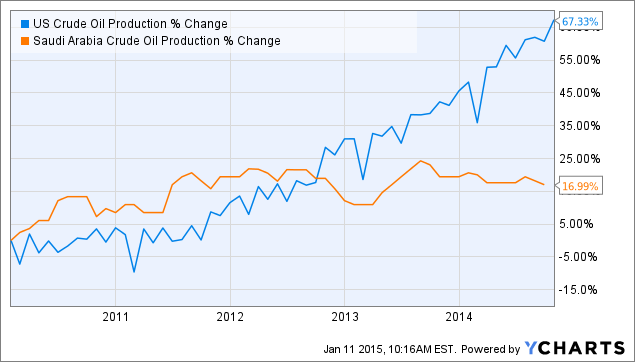
But so far, Saudi Arabia is essentially betting that it can win an oil-price war of attrition — not only against its OPEC rivals like Iran, Iraq and Venezuela, but also against non-OPEC rivals like Russia and the many shale-oil producers in the United States that have contributed to the global glut.

The Saudis argue that throttling back oil production for a short-term pop in the price would be throwing a lifeline to the shale producers in the United States, some of which have already shown signs of wilting in the current environment.

Already, oil producers have dropped their rig count in the United States as bankruptcies spread in the oil patch. But daily production has remained resilient as the wells that remain become more efficient and as major oil projects in the Gulf of Mexico, conceived in an era of $100-a-barrel oil, come online.

On top of this, Iran can increase exports now that Western sanctions have been partly lifted, potentially raising its daily production well above the current level of 2.9 million barrels a day.

With the world awash in oil, the Saudis fear that cutting back might achieve nothing but erosion of their own share of the market — which is one of every nine barrels produced worldwide.

All of this adds up to oil prices that are not likely to rise significantly higher any time soon, unless the Saudi kingdom suddenly changes course.

“If prices continue to be low, we will be able to withstand it for a long, long time,” Khalid al-Falih, the chairman of Saudi Aramco, the kingdom’s national oil company, said last week at the World Economic Forum in Davos, Switzerland.

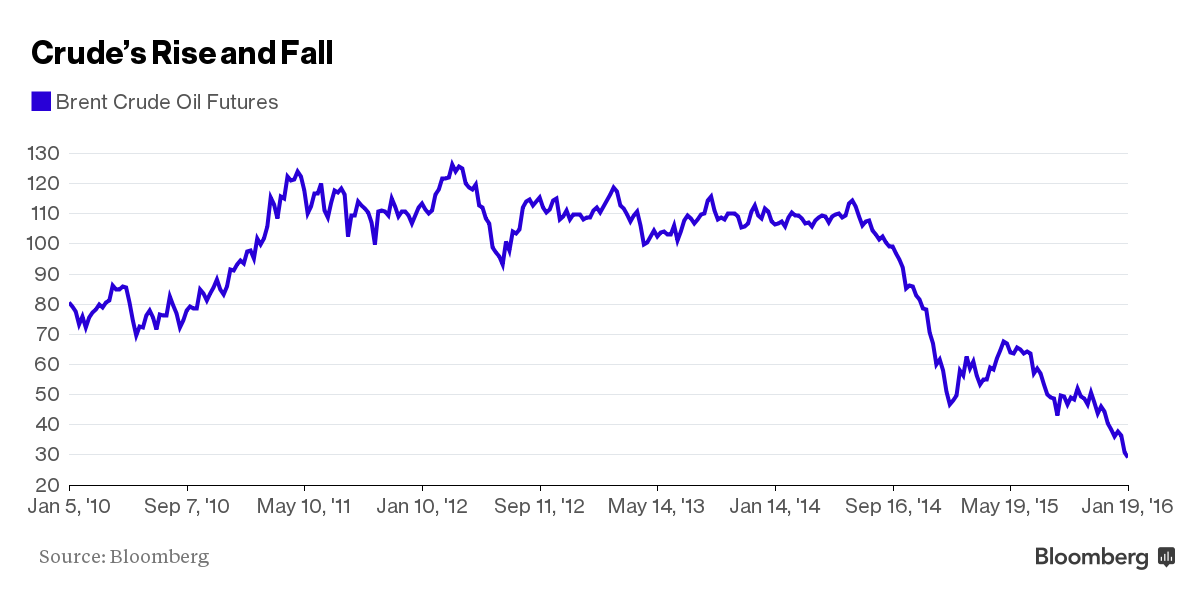
On Wednesday, Brent crude, an international benchmark, was trading around $31.80 a barrel. That is above the 12-year low of about $27 that oil hit last week. But it is still down more than 70 percent from the level of about $114 in mid-2014, before the price began collapsing.

As daring, or even self-defeating, as the Saudi approach might seem, it is a policy born of pragmatism. Whatever Saudi Arabia does with oil production, its two big OPEC neighbors — Iraq and Iran, the Saudis’ biggest regional rival — might have their own economic and geopolitical reasons to keep pumping or even raising output. And Russia, a big non-OPEC producer, is embroiled in a financial crisis from plunging oil prices and Western sanctions that might give it little choice but to maintain production and take whatever revenue it can.

The Saudis also need a high level of production to support their export network and their domestic refineries and petrochemical industry.

“In order to maintain an efficient economy in terms of investment you can’t be pushing your production up and down a half a million barrels every time the market requires it to prop up prices,” said Sadad al-Husseini, a former executive vice president of Saudi Aramco, who now runs Husseini Energy, a consulting firm with offices in Bahrain and

Still, the Saudis know that they are in for tough times and that their dependence on oil has left them vulnerable.

At a time of great political ferment in the Middle East, the plunging oil prices have gutted the export revenue that drove economic growth in Saudi Arabia and other Persian Gulf countries in recent years. The Saudi kingdom is staring at a growing budget deficit and facing the specter of an economic recession.

The Saudi government has already had to curtail some of its generous social subsidies, recently increasing consumer gasoline prices. And in hopes of finding a new way to monetize its oil assets and begin diversifying its oil-dependent economy, the kingdom has even floated the idea of a public stock offering for Saudi Aramco.

“As far as I am concerned, the strategy is not working,” Nordine Ait-Laoussine, a former energy minister of Algeria, an OPEC member, said of the Saudi commitment to high oil production.

Mr. el-Badri, the OPEC secretary general, who is Libyan, has evidently watched the market’s behavior for long enough. This week, he called for a collective effort to reduce the global oil glut.

“It is crucial that all major producers sit down to come up with a solution to this,” he said on Monday in a speech at Chatham House, a research institution in London.

Venezuela has been pressing for an emergency meeting of cartel members.

But the Saudis are standing firm. “Our investments in capacity of oil and gas have not slowed down,” Mr. al-Falih, the Saudi Aramco chairman, said on Monday.

The Saudis still speak darkly of the 1980s when as OPEC’s “swing producer” they curtailed production to prop up prices but ended up badly burned when other producers did not go along. Seeing its oil revenue and market share shrink, Saudi Arabia fought back with its own price war.

With OPEC having about one-third of the world market, for the Saudis to agree to a cut would mean persuading producers outside the organization, potentially including Russia, to make comparable trims. Analysts say that such a deal would be difficult to arrange, though it could eventually become necessary.

“I can imagine a set of circumstances that could develop this year, including a fall in U.S. output, where the economic pain would force countries to act to stabilize the price,” said Jason Bordoff, a former energy adviser in the Obama administration who is now the director of the Center on Global Energy Policy at Columbia University.

But Mr. Bordoff and other analysts say that from a Saudi perspective this is not an opportune time to consider cuts. Not only is Iran’s re-entry on the global market expected to increase supplies, but Iraq has also been increasing production rapidly.

Still, though the Saudis are burning through their financial reserves, there is no danger of depleting them soon.

Because of that, Bhushan Bahree, an OPEC analyst at the energy consulting firm IHS Energy in Washington, expects the Saudis to stay the course.

If Saudi Arabia cuts production on its own, Mr. Bahree said, “What is next? Iran produces more; Iraq produces more. So what have they done? Pushed the price up temporarily but lost market share, which they may have difficulty recovering.”

2179. US Electricity Could Be Powered Mostly by Affordable Solar and Wind Technology by 2030

By Science Daily, January 25, 2016
Since the sun is shining or winds are blowing somewhere across the United States all of the time, researchers theorized that the key to resolving the dilemma of intermittent renewable generation might be to scale up the renewable energy generation system to match the scale of weather systems. Image is courtesy of University of Colorado at Boulder.

The United States could slash greenhouse gas emissions from power production by up to 78 percent below 1990 levels within 15 years while meeting increased demand, according to a new study by NOAA and University of Colorado Boulder researchers.

The study used a sophisticated mathematical model to evaluate future cost, demand, generation and transmission scenarios. It found that with improvements in transmission infrastructure, weather-driven renewable resources could supply most of the nation's electricity at costs similar to today’s.

"Our research shows a transition to a reliable, low-carbon, electrical generation and transmission system can be accomplished with commercially available technology and within 15 years," said Alexander MacDonald, co-lead author and recently retired director of NOAA's Earth System Research Laboratory (ESRL) in Boulder.

The paper is published online today in the journal Nature Climate Change.

Although improvements in wind and solar generation have continued to ratchet down the cost of producing renewable energy, these energy resources are inherently intermittent. As a result, utilities have invested in surplus generation capacity to back up renewable energy generation with natural gas-fired generators and other reserves.

"In the future, they may not need to," said co-lead author Christopher Clack, a physicist and mathematician with the Cooperative Institute for Research in Environmental Sciences at the University of Colorado Boulder.

Since the sun is shining or winds are blowing somewhere across the United States all of the time, MacDonald theorized that the key to resolving the dilemma of intermittent renewable generation might be to scale up the renewable energy generation system to match the scale of weather systems.

So MacDonald, who has studied weather and worked to improve forecasts for more than 40 years, assembled a team of four other NOAA scientists to explore the idea. Using NOAA's high-resolution meteorological data, they built a model to evaluate the cost of integrating different sources of electricity into a national energy system. The model estimates renewable resource potential, energy demand, emissions of carbon dioxide (CO2) and the costs of expanding and operating electricity generation and transmission systems to meet future needs.

The model allowed researchers to evaluate the affordability, reliability, and greenhouse gas emissions of various energy mixes, including coal. It showed that low-cost and low-emissions are not mutually exclusive.

"The model relentlessly seeks the lowest-cost energy, whatever constraints are applied," Clack said. "And it always installs more renewable energy on the grid than exists today."

Even in a scenario where renewable energy costs more than experts predict, the model produced a system that cuts CO2 emissions 33 percent below 1990 levels by 2030, and delivered electricity at about 8.6 cents per kilowatt hour. By comparison, electricity cost 9.4 cents per kWh in 2012.

If renewable energy costs were lower and natural gas costs higher, as is expected in the future, the modeled system sliced CO2 emissions by 78 percent from 1990 levels and delivered electricity at 10 cents per kWh. The year 1990 is a standard scientific benchmark for greenhouse gas analysis.

A scenario that included coal yielded lower cost (8.5 cents per kWh), but the highest emissions.

At the recent Paris climate summit, the United States pledged to cut greenhouse emissions from all sectors up to 28 percent below 2005 levels by 2025. The new paper suggests the United States could cut total CO2 emissions 31 percent below 2005 levels by 2030 by making changes only within the electric sector, even though the electrical sector represents just 38 percent of the national CO2 budget. These changes would include rapidly expanding renewable energy generation and improving transmission infrastructure.

In identifying low-cost solutions, researchers enabled the model to build and pay for transmission infrastructure improvements--specifically a new, high-voltage direct-current transmission grid (HVDC) to supplement the current electrical grid. HVDC lines, which are in use around the world, reduce energy losses during long-distance transmission. The model did choose to use those lines extensively, and the study found that investing in efficient, long-distance transmission was key to keeping costs low.

MacDonald compared the idea of a HVDC grid with the interstate highway system which transformed the U.S. economy in the 1950s. "With an 'interstate for electrons', renewable energy could be delivered anywhere in the country while emissions plummet," he said. "An HVDC grid would create a national electricity market in which all types of generation, including low-carbon sources, compete on a cost basis. The surprise was how dominant wind and solar could be.”

The new model is drawing interest from other experts in the field.

"This study pushes the envelope," said Stanford University's Mark Jacobson, who commented on the findings in an editorial he wrote for the journal Nature Climate Change. "It shows that intermittent renewables plus transmission can eliminate most fossil-fuel electricity while matching power demand at lower cost than a fossil fuel-based grid -- even before storage is considered."

Journal Reference:
1 Alexander E. MacDonald, Christopher T. M. Clack, Anneliese Alexander, Adam Dunbar, James Wilczak, Yuanfu Xie. Future cost-competitive electricity systems and their impact on US CO2 emissionsNature Climate Change, 2016; DOI: 10.1038/NCLIMATE2921

Wednesday, January 27, 2016

2178. Climate Justice Alliance Delivers Plan for Transition Away from Fossil Fuel Economy to EPA

By Kate Aronoff, Waging Nonviolence, January 20, 2016

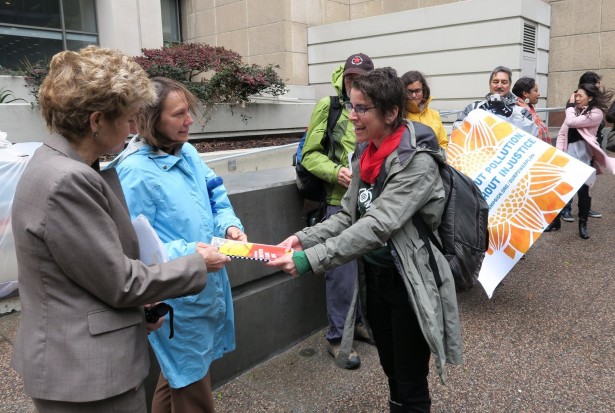
Activists deliver the Our Power Plan to the EPA’s regional office in San Francisco on January 19. (Facebook/CEJA)

Yesterday, activists at each of the Environmental Protection Agency’s 10 regional offices issued their own corrective on the Obama administration’s Clean Power Plan. Days before the end of the federal comment period, the Climate Justice Alliance’s Our Power Campaign — comprised of 41 climate and environmental justice organizations — presented its Our Power Plan, which identifies “clear and specific strategies for implementing the Clean Power Plan, or CPP, in a way that will truly benefit our families’ health and our country’s economy.”

Introduced last summer, the CPP looks to bring down power plants’ carbon emissions by 32 percent from 2005 levels within 15 years. The plan was made possible by Massachusetts vs. EPA, a 2007 Supreme Court ruling which mandates that the agency regulate greenhouse gases as it has other toxins and pollutants under the Clean Air Act of 1963. Under the CPP, states are each required to draft their own implementation plans by September of this year, or by 2018 if granted an extension. If they fail to do so, state governments will be placed by default into an interstate carbon trading, or “Cap and Trade,” system to bring down emissions.

Michael Leon Guerrero, the Climate Justice Alliance’s interim coordinator, was in Paris for the most recent round of UN climate talks as part of the It Takes Roots Delegation, which brought together over 100 organizers from North American communities on the frontlines of both climate change and fossil fuel extraction. He sees the Our Power Plan as a logical next step for the group coming out of COP21, especially as the onus for implementing and improving the Paris agreement now falls to individual nations.

“Fundamentally,” he said, “we need to transform our economy and rebuild our communities. We can’t address the climate crisis in a cave without addressing issues of equity.”

The Our Power Plan, or OPP, is intended as a blueprint for governments and EPA administrators to address the needs of frontline communities as they draft their state-level plans over the next several months. (People living within three miles of a coal plant have incomes averaging 15 percent lower than average, and are eight percent more likely to be communities of color.) Included in the OPP are calls to bolster what CJA sees as the CPP’s more promising aspects, like renewable energy provisions, while eliminating proposed programs they see as more harmful. The CPP’s carbon trading scheme, CJA argues, allows polluters to buy “permissions to pollute,” or carbon credits, rather than actually stemming emissions.

The OPP further outlines ways that the EPA can ensure a “just transition” away from fossil fuels, encouraging states to invest in job creation, conduct equity analyses and “work with frontlines communities to develop definitions, indicators, and tracking and response systems that really account for impacts like health, energy use, cost of energy, climate vulnerability [and] cumulative risk.”

Lacking support from Congress, the Obama administration has relied on executive action to push through everything from environmental action to comprehensive immigration reform. The Clean Power Plan was central to the package Obama brought to Paris. Also central to COP21 was U.S. negotiators’ insistence on keeping its results non-binding, citing Republican lawmakers’ unwillingness to pass legislation.

Predictably, the CPP has faced legal challenges from the same forces, who decry the president for having overstepped the bounds of his authority. Republican state governments, utility companies, and fossil fuel industry groups have all filed suit against the CPP, with many asking for expedited hearings. Leading up the anti-CPP charge in Congress has been Senate Majority Leader Mitch McConnell, who has called the plan a “regulatory assault,” pitting fossil fuel industry workers against the EPA. “Here’s what is lost in this administration’s crusade for ideological purity,” he wrote in a November statement, “the livelihoods of our coal miners and their families.”

Organizers of Tuesday’s actions, however, were quick to point out that the Our Power Plan is aimed at strengthening — not defeating — the CPP as it stands. Denise Abdul-Rahman, of NAACP Indiana, helped organize an OPP delivery at the EPA’s Region 5 headquarters in Chicago, bringing out representatives from Black Lives Matter Minneapolis, National People’s Action and National Nurses United.

“We appreciate the integrity of the Clean Power Plan,” she said. “However, we believe it needs to be improved — from eliminating carbon trading to ensuring that there’s equity. We want to improve CPP by adding our voices and our plan, and we encourage the EPA to make it better.” Four of the six states in that region — which includes Illinois, Indiana, Michigan, Minnesota, Ohio and Wisconsin — are suing the EPA.

Endorsed by the National Domestic Workers’ Alliance, Greenpeace and the Center for Popular Democracy, among other organizations, yesterday’s national day of action on the EPA came as new details emerged in Flint, Michigan’s ongoing water crisis — along with calls for Michigan Gov. Rick Snyder’s resignation and arrest. The EPA has also admitted fault for its slow response to Flint residents’ complaints, writing in a statement this week that “necessary [EPA] actions were not taken as quickly as they should have been.”

Abdul-Rahman connected the water crisis with the need for a justly-implemented CPP. “The Flint government let their community down by not protecting our most precious asset, which is water,” she said. “The same is true of air: we need the highest standard of protecting human beings’ air, water, land.”

2177. New Study Finds Genetically Engineered Alfalfa Has Gone Wild, Exposing Failure of “Coexistence” Policy

By Bill Freese, Center for Food Saftey, January 13, 2016
Genetically modified alfalfa field in Washington State.
A recent study by USDA scientists shows that genetically engineered (GE) alfalfa has gone wild, in a big way, in alfalfa-growing parts of the West.  This feral GE alfalfa may help explain a number of transgenic contamination episodes over the past few years that have cost American alfalfa growers and exporters millions of dollars in lost revenue.  And it also exposes the failure of USDA’s “coexistence” policy for GE and traditional crops.

The U.S. Dept. of Agriculture (USDA) has long maintained that genetically engineered (GE) crops can co-exist with traditional and organic agriculture.  According to this “co-existence” narrative, if neighboring GE and traditional farmers just sort things out among themselves and follow “best management practices,” transgenes will be confined to GE crops and the fields where they are planted.

The latest evidence refuting USDA’s co-existence fairytale comes from a recently published study by a team of USDA scientists.  The study involved Monsanto’s Roundup Ready alfalfa, which, like most GE crops in the U.S. is engineered to survive direct spraying with Roundup, Monsanto’s flagship herbicide.

In 2011 and 2012, USDA scientist Stephanie Greene and her team scouted the roadsides of three important alfalfa-growing areas – in California, Idaho and Washington – for feral (wild) alfalfa stands.  Because alfalfa is a hardy perennial plant, it readily forms self-sustaining feral populations that persist for years wherever the crop is grown.

Greene and colleagues found 404 feral alfalfa populations on roadsides.  Testing revealed that over one-quarter (27%) of them contained transgenic alfalfa – that is, plants that tested positive for the Roundup Ready gene.  They believe that most of these feral populations likely grew from seeds spilled during alfalfa production or transport.

However, the researchers also found clear evidence that the Roundup Ready gene was being spread by bees, which are known to cross-pollinate alfalfa populations separated by up to several miles.  Their results suggested that “transgenic plants could spread transgenes to neighboring feral plants, and potentially to neighboring non-GE fields” (emphasis added).  While they did not test this latter possibility, there is no doubt that non-GE alfalfa has in fact been transgenically contaminated – not just once, but on many occasions.

In 2013, a Washington State farmer’s alfalfa was rejected by a broker after testing revealed transgenic contamination.  In 2014, China rejected numerous U.S. alfalfa shipments that tested positive for the Roundup Ready gene.  Alfalfa exports to China, a major market that has zero tolerance for GE alfalfa, fell dramatically.  U.S. hay prices fell, and at least three U.S. alfalfa exporters suffered many millions of dollars in losses.

Both the Washington State farmer and those who sold to the exporters intended to grow only traditional alfalfa.  It is not clear how their produce became contaminated.  Besides cross-pollination from GE feral or cultivated alfalfa, possible explanations include inadvertent mixing during harvest or storage, or (most insidiously) transgenic contamination of the conventional alfalfa seed they planted.

What makes the high (27%) GE contamination rate found in this study so remarkable is how little GE alfalfa produced it.  USDA first approved Roundup Ready alfalfa in 2005, and it occupied just 1% of national alfalfa acreage in 2006.  A federal court prohibited new plantings starting in 2007, but allowed what had already been planted to remain in the ground (an alfalfa stand is typically grown for about five years).  Because this study was conducted just a few months after the re-approval of GE alfalfa in 2011, all of the feral GE alfalfa the researchers detected arose from the comparatively few fields planted in 2005 and 2006.  There is much more GE alfalfa being grown now (Monsanto says 30% of alfalfa seed sold is GE).  So there is likely much more feral GE alfalfa today than is suggested by this study.

It’s important to note that the study’s major finding – that feral GE alfalfa is present and poses a contamination risk – has been known for at least six years.  Oregon alfalfa seed grower Phillip Geertson presented USDA with documented evidence of feral GE alfalfa in Idaho and Oregon in 2009, but was ignored.  More broadly, USDA exhaustively discussed this and other modes of transgenic contamination in its voluminous 2010 Environmental Impact Statement (EIS) on Roundup Ready alfalfa.  In fact, buried in that EIS is data showing still earlier episodes of transgenic contamination of alfalfa dating back to the crop’s first commercial introduction in 2005.

What’s needed now is not more studies to tell us in finer detail what we already know, but regulatory action.  Yet the USDA – which is embarrassingly subservient to the biotechnology industry – has failed to voluntarily enact a single restriction on GE crop growers.  This forces traditional farmers to bear the entire burden of preventing transgenic contamination. 

The ineffectiveness of this policy is shown by contamination-induced losses of billions of dollars in corn exports to competitors like Brazil.  It is also suggested by the absurd spectacle of the U.S. (the world’s leading corn and soybean producer) importing organic corn and soy from countries like Romania and India.  Fear of transgenic contamination is one factor deterring more U.S. farmers from meeting America’s growing demand for organic foods.

Because of federal inaction, citizens have taken action to protect their traditional agriculture at the county level, and Center for Food Safety (CFS) has provided critical assistance to these efforts.  For instance, in 2014 voters in Jackson County, Oregon, overwhelmingly passed an ordinance prohibiting cultivation of GE crops in their county.  CFS helped the County and its farmers fend off a lawsuit seeking to invalidate the Ordinance brought by two GE alfalfa growers with financial backing from the biotechnology industry.

Similar “GE-free zones” have been created with CFS assistance in at least seven other counties in California, Washington, Hawaii and a second county in Oregon.  CFS is also proud to support a new ordinance introduced in November of last year in Costilla County, Colorado, that would establish a GMO-Free Zone to protect locally bred heirloom maize from transgenic contamination.

2176. Peru Declares Environmental State of Emergency in Its Rainforest

By Dan Collyins, The Gaurdian, Janauary 26, 2016
Location is the Peruian Amazon rainforest drenched in oil.
Peru has declared an environmental state of emergency in a remote part of its northern Amazon rainforest, home for decades to one of the country's biggest oil fields, currently operated by the Argentinian company Pluspetrol.

Achuar and Kichwa indigenous people living in the Pastaza river basin near Peru's border with Ecuador have complained for decades about the pollution, while successive governments have failed to deal with it. Officials indicate that for years the state lacked the required environmental quality standards.

A new law published on Monday that sets out, for the first time, environmental quality standards setting acceptable limits for contaminants in soil, may be a key advance, say officials.

Peru's environment ministry has given Pluspetrol 90 days to clean up the affected areas and reduce the risk of contamination to the local population.

In declaring the state of emergency, Peru's environment ministry said tests in February and March found high levels of barium, lead, chrome and petroleum-related compounds at different points in the Pastaza valley.

Pluspetrol, the biggest oil and natural gas producer in Peru, has operated the oil fields since 2001. It took over from Occidental Petroleum, which began drilling in 1971, and, according to the government, had not cleaned up contamination either.

Several multimillion dollar fines have been levied against Pluspetrol in recent years. The company has appealed against all of the fines in the Peruvian courts, including an $11m (£7m) fine levelled in January for failing to complete an environmental clean-up of an oil block located inside Peru's largest national park, Pacaya Samiria, in the Loreto region.

"We know that there has been bad environmental behaviour by the company in the past because there were no regulations but also in the present because it's not acting responsibly and it's not giving the correct information about what's happening in the zone," Peru's environment minister Manuel Pulgar-Vidal said of Pluspetrol to local media.

In a statement, his ministry said the government began administrative actions against Pluspetrol in March 2012 over contamination at block 1AB, Peru's biggest crude oil field in the adjacent Corrientes river basin. The ministry says further environmental checks will be carried out on the upper Marañón, Tigre and Corrientes river basins where Pluspetrol also operates.

"Serious attention to the environmental disaster in the northern Peruvian Amazon is long overdue. The Peruvian health ministry registered unacceptable levels of lead and cadmium in the blood of Achuar children almost seven years ago," Andrew Miller, lead Peru campaigner for Amazon Watch told the Guardian.

"Yet only following years of community-based environmental monitoring, pressure from indigenous federations, and the recent visit of Peruvian members of congress has the political will been created for the government to take appropriate action.”

The Peruvian government plans to auction a further 29 new oil and gas concessions this year.

A spokesman for Pluspetrol said the company was "evaluating the situation" but refused to comment further.

2175. Climate Deal's First Big Hurdle: Cheap Oil

By Clifford Krause and Diane Cardwell, The New York Times, Janaury 25, 2016
International Enery Agency predicts the world drowning in oil.
Barely a month after world leaders signed a sweeping agreement to reduce carbon emissions, the global commitment to renewable energy sources faces its first big test as the price of oil collapses.

Buoyed by low gas prices, Americans are largely eschewing electric cars in favor of lower-mileage trucks and sport utility vehicles. Yet the Obama administration has shown no signs of backing off its requirement that automakers nearly double the fuel economy of their vehicles by 2025.

In China, government officials are also taking steps to ensure that the recent plunge in oil prices to under $30 a barrel does not undermine its programs to improve energy efficiency. Earlier this month, the country’s top economic planning agency introduced a new regulation, effective immediately, aimed at deterring oil consumption.

For the climate accord to work, governments must resist the lure of cheap fossil fuels in favor of policies that encourage and, in many cases, require the use of zero-carbon energy sources. But those policies can be expensive and politically unpopular, especially as traditional fuels become ever more affordable.

“This will be a litmus test for the governments — whether or not they are serious about what they have done in Paris,” said Fatih Birol, executive director of the International Energy Agency.

So far, there is no sign that the world’s two largest energy consumers — the United States and China — are wavering. With those two countries staying the course, albeit in the early days since the signing, there is optimism among backers of the accord that the momentum is too strong to stop. And despite the recent turmoil in energy markets, renewable industries are prospering.

“The trend toward much greater penetration of low-carbon energy driven by policy and technological advancements is going to continue,” said Jason Bordoff, director of the Center on Global Energy Policy at Columbia University and a former top aide to President Obama. Despite the lower fuel costs, he added, “technological alternatives and policy drivers that are reducing demand for fossil fuels are already really starting to take a bite.”

A few days ago, the Energy Department projected that total renewable power consumed in the United States this year will increase by 9.5 percent, and the longer-term outlook appears bright as costs continue to plummet and after congressional action last December extended federal tax credits for new wind and solar projects.

Utility-scale solar power generation alone is expected to increase by 45 percent by 2017, according to the Energy Department. Administration officials express an ambition to make wind power the source of more than a third of the American electricity supply by 2050.

In China, the world’s biggest greenhouse gas emitter, the government implemented a new rule that no matter how low world crude oil prices may fall, the price of gasoline and diesel will continue to be set as though the world price of oil were still $40 a barrel. The goal is to prevent gasoline and diesel from becoming so cheap that China’s citizens would start consuming it indiscriminately.

China’s heavily state-owned refining industry will also not be allowed to keep the extra profits from buying crude oil cheaply and selling gasoline and diesel as though the crude oil still cost $40 a barrel. Instead, the Chinese government will take the extra refining profit margin and put the money into a special fund for energy conservation and pollution control.

But across the globe, the picture is not entirely rosy for zero-emission technologies.
Several nuclear power plants, which emit virtually no greenhouse gases, have closed in the United States in recent years, and few are under construction in part because of the competition of cheap natural gas.

Low oil prices also jeopardize the development of alternative fuels to replace petroleum in transportation and industry, including the advanced biofuels that once looked so promising. Cheap oil also reduces the price of diesel, the primary competitor of renewables in spreading electricity generation to impoverished rural areas of Africa and Southeast Asia.

And if governments’ support wanes, the alternative fuel industries could take a hit.
In Spain, the development of renewables has slowed to a crawl since the government started weakening support in 2009 because of an economic downturn. In Britain, analysts warn that the wind and solar industries could collapse as the government shifts subsidies away from renewables; two global wind developers recently canceled projects there. And in the United States, when an important tax credit lapsed briefly in 2013, installations of new wind farms all but ceased, falling 92 percent for the year.

“The challenge for governments is to continue appropriate clean energy subsidies even while the fossil fuel industry clamors over low prices,” said Paul Bledsoe, who was a staff member of the White House Climate Change Task Force under former President Bill Clinton.

Many developing countries have taken advantage of the decline in oil prices to cut subsidies on fuel consumption. India, Indonesia and Angola, among others, have taken such action, a move that economists say could conserve millions of barrels of oil from being burned every year in the future.

Saudi Arabia, one of the top energy-consuming nations, this month increased gasoline prices by 50 percent, and natural gas for industry and electrical generation by 67 percent.

Ultimately, supporters of the climate accord say that low oil prices can cut both ways in the march to renewables.

“It’s a double-edged sword,” said Amy Myers Jaffe, executive director for energy and sustainability at the University of California, Davis. She noted that low oil prices were cutting investments in drilling, which meant fewer emissions of methane, a powerful greenhouse gas, at well sites, and “it has clearly not slowed down the switch toward renewable energy.”

But at the same time, Ms. Jaffe said, low gasoline prices make driving more attractive, and in larger vehicles as well.

“It’s crippling for electric cars,” she said, “because the thing that made you think about buying an electric car was it was so painful for you to fill up your car with gasoline that was so expensive.”