By Elaine Brum, The Guardian, August 23, 2019
The Amazon is the centre of the world. Right now, as our planet experiences climate collapse, there is nowhere more important. If we don’t grasp this, there is no way to meet that challenge.
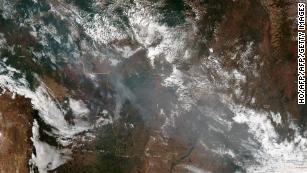
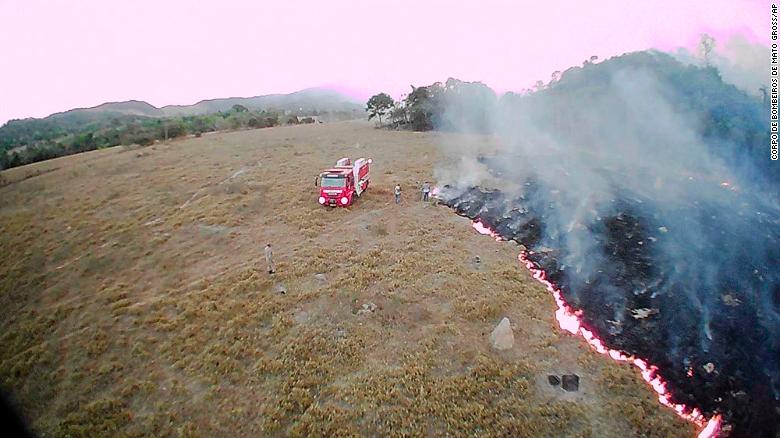
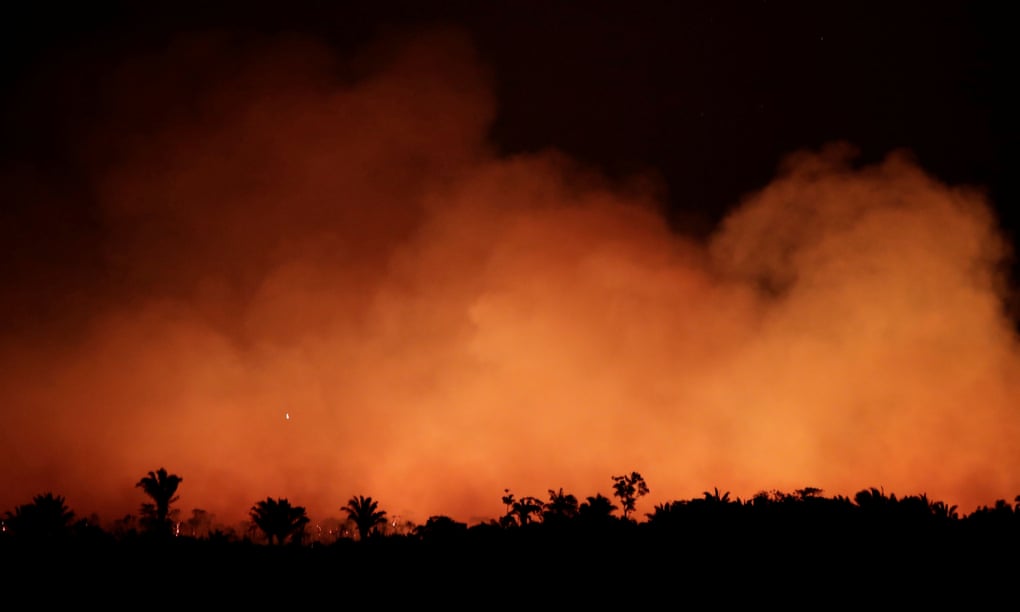
For 500 years, this has been a place of ruins. First with the European invasion, which brought a particularly destructive form of civilisation, the death of hundreds of thousands of indigenous men and women and the extinction of dozens of peoples. More recently, with the clearance of vast swaths of the forest and all life within it. Right now, in 2019, we are witnessing the beginning of a new, disastrous chapter. The area of trees being cleared has surged this year. In July, the deforestation rate was an area the size of Manhattan every day, a Greater London every three weeks. This month, fires are incinerating the Amazon at a record rate, almost certainly part of a scorched-earth strategy to clear territory. Why is this happening now? Because of a change in power.
A predatory form of politics called Bolsonarism has assumed nearly total, and totalitarian, power in Brazil. President Jair Bolsonaro’s chief project is to create more ruins in the Amazon forest, methodically and swiftly. This is why, for the first time since Brazil became a democracy again, it effectively has a minister against the environment.
For more than 30 years no environment minister has enjoyed the same autonomy as Ricardo Salles. He is a gofer for agribusiness, which is responsible for the majority of the deaths in the fields and forests, and Brazil’s greatest destructive force. The landowners lobby has always been part of Brazil’s government, formally or not. But today, this has reached a new level. They are not just in the government, they are the government.
Bolsonarism’s number one power project is to turn public lands that serve everyone – because they guarantee the preservation of natural biomes, the life of native peoples and regulate the climate – into private lands that profit a few. These lands, most of which lie in the Amazon forest, include the public lands to which indigenous peoples have the constitutional right to use, the public lands settled by ribeirinhos (people who have for over a century made their living by fishing, tapping rubber, and sustainably gathering Brazil nuts and other forest products), and the collective-use lands of quilombolas (descendants of rebel slaves who won their right to territories occupied by their ancestors).
The Amazon is the centre of the world. Right now, as our planet experiences climate collapse, there is nowhere more important. If we don’t grasp this, there is no way to meet that challenge.
For 500 years, this has been a place of ruins. First with the European invasion, which brought a particularly destructive form of civilisation, the death of hundreds of thousands of indigenous men and women and the extinction of dozens of peoples. More recently, with the clearance of vast swaths of the forest and all life within it. Right now, in 2019, we are witnessing the beginning of a new, disastrous chapter. The area of trees being cleared has surged this year. In July, the deforestation rate was an area the size of Manhattan every day, a Greater London every three weeks. This month, fires are incinerating the Amazon at a record rate, almost certainly part of a scorched-earth strategy to clear territory. Why is this happening now? Because of a change in power.
A predatory form of politics called Bolsonarism has assumed nearly total, and totalitarian, power in Brazil. President Jair Bolsonaro’s chief project is to create more ruins in the Amazon forest, methodically and swiftly. This is why, for the first time since Brazil became a democracy again, it effectively has a minister against the environment.
For more than 30 years no environment minister has enjoyed the same autonomy as Ricardo Salles. He is a gofer for agribusiness, which is responsible for the majority of the deaths in the fields and forests, and Brazil’s greatest destructive force. The landowners lobby has always been part of Brazil’s government, formally or not. But today, this has reached a new level. They are not just in the government, they are the government.
Bolsonarism’s number one power project is to turn public lands that serve everyone – because they guarantee the preservation of natural biomes, the life of native peoples and regulate the climate – into private lands that profit a few. These lands, most of which lie in the Amazon forest, include the public lands to which indigenous peoples have the constitutional right to use, the public lands settled by ribeirinhos (people who have for over a century made their living by fishing, tapping rubber, and sustainably gathering Brazil nuts and other forest products), and the collective-use lands of quilombolas (descendants of rebel slaves who won their right to territories occupied by their ancestors).
Infighting is constant in the government, in part because the
Bolsonaro administration employs the strategy of simulating its own
opposition so it can occupy every possible space. Yet there is a
consensus about opening up indigenous peoples’ protected lands and
conservation areas. When it comes to transforming the planet’s largest
tropical forest into a place for raising cattle, growing soybeans, and
mining ore, there is no fighting at all. A few somewhat dissonant voices
have already been deleted from the government.
Bolsonarism goes well beyond the man after whom it is named. At some point, it might even do without Bolsonaro. Deeply entwined with our global democracy crisis, Bolsonarism has been influencing the entire Amazon region, drawing out figures who have been hiding in sewers for years, sometimes decades, in other Latin American countries, where the fate of the world’s largest tropical forest is also being decided. And Bolsonarism, it bears repeating, is not a threat just to Brazil but to our planet, because it destroys the forest that is strategically vital to controlling global heating.
How do we resist this tremendous destructive force, this skilled destructive force?
For us to be capable of resisting, we must become the forest – and resist like the forest, the forest that knows it carries ruins within itself, that carries within itself both what it is and what it no longer is. We must lend shape to this political, affective feeling in order to lend meaning to our actions. This means shifting a few tectonic plates in our own thinking. We have to decolonise ourselves.
The fact that the Amazon is still regarded as something far away, on the periphery of our vision, shows just how stupid white western culture is. It is a stupidity that moulds and shapes the political and economic elites of the world, and likewise of Brazil. Believing the Amazon is far away and on the periphery, when the only chance of controlling global heating is to keep the forest alive, reflects ignorance of continental proportions. The forest is at the very core of all we have. This is the real home of humanity. The fact that many of us feel far away from it only shows how much our eyes have been contaminated, formatted and distorted. Colonised.
In the big cities of Brazil and the rest of the world, we are distanced from the deaths in which our small daily acts are accomplices. We have the privilege of not being forced to question the origin of the clothes we wear or the food we eat. But in the Amazon, if you eat beef, you know for sure it is beef from deforestation. If you buy wood, you know there is (almost) no truly legal lumber in Brazil. If you purchase a table or a wardrobe, you look at the furniture and think about how it was most likely made with wood torn off indigenous land or from an extractive reserve. In the Amazon, in the centre of the world, our relationship with the death of the forest and forest peoples, as well as with the death of family farmers, is direct. It is inescapable.
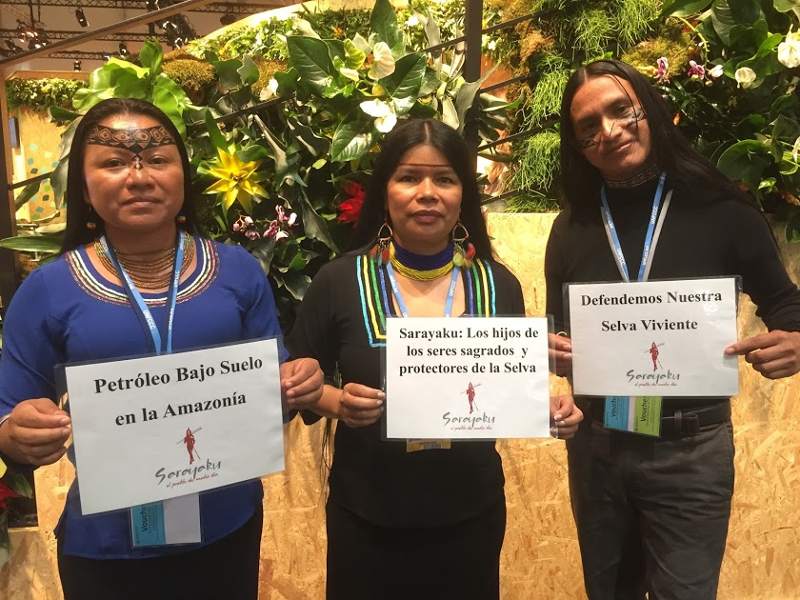
We need to humbly ask if the forest peoples accept us alongside them in the fight. They are the ones who know how to live despite the ruins. They are the ones who have experience resisting the great forces of destruction. If we are to have any chance of producing a resistance movement, we must understand that in this fight, we are not the protagonists.
We are the ones whoneed to let ourselves be occupied and allow our bodies to be affected by other experiences of being on this planet. But not as a form of violence, like the colonisation of the Amazon and its peoples; the colonisation still under way today, and going on at an ever faster pace. Rather, this time, as a form of exchange, a blending, a relationship of love.
Bolsonaro is not just a threat to the Amazon. He is a threat to the planet, precisely because he is a threat to the Amazon. Confronted with Bolsonarism’s accelerated forces of destruction, all of us, of all nationalities, must emulate the enslaved Africans who rebelled against their oppressors. We must forge communities like those established by Brazil’s escaped slaves. And since we don’t know how to do this, we will have to be humble enough to learn with those who do.
What is best, and most powerful, about today’s Brazil and the Amazon, in all its regions, are the peripheries that demand to be the centre. Our best chance lies in joining forces with the real centre of the world where the battle for the future is being waged.
More people are reading and supporting The Guardian’s independent, investigative journalism than ever before. And unlike many news organisations, we have chosen an approach that allows us to keep our journalism accessible to all, regardless of where they live or what they can afford. But we need your ongoing support to keep working as we do.
The Guardian will engage with the most critical issues of our time – from the escalating climate catastrophe to widespread inequality to the influence of big tech on our lives. At a time when factual information is a necessity, we believe that each of us, around the world, deserves access to accurate reporting with integrity at its heart.
Our editorial independence means we set our own agenda and voice our own opinions. Guardian journalism is free from commercial and political bias and not influenced by billionaire owners or shareholders. This means we can give a voice to those less heard, explore where others turn away, and rigorously challenge those in power.
Bolsonarism goes well beyond the man after whom it is named. At some point, it might even do without Bolsonaro. Deeply entwined with our global democracy crisis, Bolsonarism has been influencing the entire Amazon region, drawing out figures who have been hiding in sewers for years, sometimes decades, in other Latin American countries, where the fate of the world’s largest tropical forest is also being decided. And Bolsonarism, it bears repeating, is not a threat just to Brazil but to our planet, because it destroys the forest that is strategically vital to controlling global heating.
How do we resist this tremendous destructive force, this skilled destructive force?
For us to be capable of resisting, we must become the forest – and resist like the forest, the forest that knows it carries ruins within itself, that carries within itself both what it is and what it no longer is. We must lend shape to this political, affective feeling in order to lend meaning to our actions. This means shifting a few tectonic plates in our own thinking. We have to decolonise ourselves.
The fact that the Amazon is still regarded as something far away, on the periphery of our vision, shows just how stupid white western culture is. It is a stupidity that moulds and shapes the political and economic elites of the world, and likewise of Brazil. Believing the Amazon is far away and on the periphery, when the only chance of controlling global heating is to keep the forest alive, reflects ignorance of continental proportions. The forest is at the very core of all we have. This is the real home of humanity. The fact that many of us feel far away from it only shows how much our eyes have been contaminated, formatted and distorted. Colonised.
In the big cities of Brazil and the rest of the world, we are distanced from the deaths in which our small daily acts are accomplices. We have the privilege of not being forced to question the origin of the clothes we wear or the food we eat. But in the Amazon, if you eat beef, you know for sure it is beef from deforestation. If you buy wood, you know there is (almost) no truly legal lumber in Brazil. If you purchase a table or a wardrobe, you look at the furniture and think about how it was most likely made with wood torn off indigenous land or from an extractive reserve. In the Amazon, in the centre of the world, our relationship with the death of the forest and forest peoples, as well as with the death of family farmers, is direct. It is inescapable.
We need to humbly ask if the forest peoples accept us alongside them in the fight. They are the ones who know how to live despite the ruins. They are the ones who have experience resisting the great forces of destruction. If we are to have any chance of producing a resistance movement, we must understand that in this fight, we are not the protagonists.
We are the ones whoneed to let ourselves be occupied and allow our bodies to be affected by other experiences of being on this planet. But not as a form of violence, like the colonisation of the Amazon and its peoples; the colonisation still under way today, and going on at an ever faster pace. Rather, this time, as a form of exchange, a blending, a relationship of love.
Bolsonaro is not just a threat to the Amazon. He is a threat to the planet, precisely because he is a threat to the Amazon. Confronted with Bolsonarism’s accelerated forces of destruction, all of us, of all nationalities, must emulate the enslaved Africans who rebelled against their oppressors. We must forge communities like those established by Brazil’s escaped slaves. And since we don’t know how to do this, we will have to be humble enough to learn with those who do.
What is best, and most powerful, about today’s Brazil and the Amazon, in all its regions, are the peripheries that demand to be the centre. Our best chance lies in joining forces with the real centre of the world where the battle for the future is being waged.
As the crisis escalates…
… in our natural world, we refuse to turn away from the climate catastrophe and species extinction. For The Guardian, reporting on the environment is a priority. We give reporting on climate, nature and pollution the prominence it deserves, stories which often go unreported by others in the media. At this pivotal time for our species and our planet, we are determined to inform readers about threats, consequences and solutions based on scientific facts, not political prejudice or business interests.More people are reading and supporting The Guardian’s independent, investigative journalism than ever before. And unlike many news organisations, we have chosen an approach that allows us to keep our journalism accessible to all, regardless of where they live or what they can afford. But we need your ongoing support to keep working as we do.
The Guardian will engage with the most critical issues of our time – from the escalating climate catastrophe to widespread inequality to the influence of big tech on our lives. At a time when factual information is a necessity, we believe that each of us, around the world, deserves access to accurate reporting with integrity at its heart.
Our editorial independence means we set our own agenda and voice our own opinions. Guardian journalism is free from commercial and political bias and not influenced by billionaire owners or shareholders. This means we can give a voice to those less heard, explore where others turn away, and rigorously challenge those in power.