Tuesday, July 28, 2015

1952. Let's Give Feral Cats Their Citizenship

By Arian Wallach and Daniel Ramp, The Conversation, July 28, 2015
Millions of feral cats have gone wild in Australia 
There’s been a lot of talk about killing feral cats, with the government’s recently announced war on cats setting the goal of killing two million by 2020.

On The Conversation last week, Katherine Moseby and John Read explained several different ways to control feral cats, including baiting.

But we would like to offer a different idea: let’s embrace cats as part of Australia’s environment. We could even rename them “Australian wildcats”. Let us explain.
Embracing cats would primarily entail ending our practice of killing cats. This would have many advantages.

It would benefit the cats, because they would no longer endure our increasingly creative methods of ending their lives. We would also benefit greatly by unburdening ourselves of the task of causing suffering and death to cats. But what may seem counterintuitive is that leaving cats alone can also benefit Australia’s threatened native species.
Being kind to cats can help native wildlife

Many people love cats and do not want them harmed. Advocates for nonlethal approaches to control cat numbers often recommend sterilisation, but this idea is based on the mistaken assumption that feral cats are originating from our homes.

Many cats do live among us, but most now exist in a completely wild state, including in the middle of the driest of deserts and the lushest of rainforests. Sterilisation can help reduce the number of house cats without a home, but it will not benefit wildlife away from cities. We need to move beyond thinking about cats as either wards or enemies.

Several small and medium-sized native species have declined and gone extinct, partially due to non-native cats and foxes. Several decades of conservation efforts have therefore focused on killing these predators, a sufficiently long process to learn that this approach is not working.

Even highly coordinated and intensive eradication programs backfire. This can happen in two ways. Killing cats, even two million of them, can inadvertently increase cat numbers by enabling more cats to immigrate into vacant territories. Conversely, cat eradication can cause population booms of other species (such as rabbits and rats) and result in further harm.

Ecosystems are notoriously, and wonderfully, complex things. They are comprised of dense networks of interactions that bind the fate of species to one another. Cats have become deeply entangled in this web of life. Attempting to remove cats from Australian ecosystems will not be a clean and painless surgery, and it will not heal the patient.
Coexistence with cats is possible

For many years introduced species were believed to be harmful because natives have not evolved the traits to hold their own against them. But we are learning that species can be surprisingly adaptable.

For example, when native Australian predators first encounter cane toads they often mistake them for just another familiar amphibian and readily eat them, unaware of the toad’s defence – toxic glands on their backs.

Eventually predator populations recover as they learn how to eat them, they learn not to eat them, or they adapt to the toxin. Such a remarkable recovery has not occurred for many of the native prey species threatened by cat and fox predation, and not because they are slow. Their difficulty, instead, lies with the very actions we are taking to save them.

The number of cats and their influence on other wildlife are a function of ecological context. Major forces that influence the ability of prey to coexist with cats include vegetation cover and larger predators. Grazing and fire can reduce vegetation cover and make it harder for prey animals to escape. Significantly, larger predators, such as dingoes, are a major threat to cats.

Dingoes do more than just kill cats, they communicate with them and influence their behaviour. Cats fear dingoes, and stay away from areas frequented by them. They also avoid hunting when dingoes are most active. This creates areas of safety for the prey of cats. Our poisons and traps kill cats, but tell them nothing.

From foxes to cats
The war on cats is ultimately a consequence of our failed war on foxes.

Foxes have long been held as Australia’s primary environmental villain. They are also easier to kill, because they more readily scavenge. Meat baits laced with 1080 poison are used extensively in conservation programs.

This inhumane poison kills foxes and dingoes in untold numbers, and enables cats to breed up and move with impunity across the landscape.

For example, a major poison-baiting campaign did help recover endangered woylies for a time, but eventually the loss of foxes and dingoes caused cats to take over and the newly recovered population collapsed.

All Australian conservation programs dedicated to restoring small native species on the mainland continue to use 1080. National parks use it. Pastoral stations use it. Councils use it.

It is time to go cold turkey.

Embracing Australia’s wildlife without prejudice
Cats have become an integral part of Australia’s wildlife and beauty. Many native species successfully coexist with cats, especially when we leave predators alone.
Australian wildcats probably provide the same ecological functions as they do in their native ranges, such as suppressing population irruptions of their prey. Killing cats achieves only one outcome with consistency: it produces dead cats.

However, the aim of conservation is not to generate an ever increasing body count, but to guide human behaviour to enable the rest of the Earth’s species to flourish. 

Embracing cats is a paradigm shift. It means embracing the entirety of Australia’s modern ecosystems - native and feral - and letting go of the past.

It is time to accept these immigrants as Australian citizens.

1951. Biodiversity: Against Forgetting

By Derrick Jensen, OrionJuly/August 2013


Last night a host of nonhuman neighbors paid me a visit. First, two gray foxes sauntered up, including an older female who lost her tail to a leghold trap six or seven years ago. They trotted back into a thicker part of the forest, and a few minutes later a raccoon ambled forward. After he left I saw the two foxes again. Later, they went around the right side of a redwood tree as a black bear approached around the left. He sat on the porch for a while, and then walked off into the night. Then the foxes returned, hung out, and, when I looked away for a moment then looked back, they were gone. It wasn’t too long before the bear returned to lie on the porch. After a brief nap, he went away. The raccoon came back and brought two friends. When they left the foxes returned, and after the foxes came the bear. The evening was like a French farce: As one character exited stage left, another entered stage right.

Although I see some of these nonhuman neighbors daily, I was entranced and delighted to see so many of them over the span of just one evening. I remained delighted until sometime the next day, when I remembered reading that, prior to conquest by the Europeans, people in this region could expect to see a grizzly bear every 15 minutes.

This phenomenon is something we all encounter daily, even if some of us rarely notice it. It happens often enough to have a name: declining baselines. The phrase describes the process of becoming accustomed to and accepting as normal worsening conditions. Along with normalization can come a forgetting that things were not always this way. 

And this can lead to further acceptance and further normalization, which leads to further amnesia, and so on. Meanwhile the world is killed, species by species, biome by biome. And we are happy when we see the ever-dwindling number of survivors.

I’ve gone on the salmon-spawning tours that local environmentalists give, and I’m not the only person who by the end is openly weeping. If we’re lucky, we see 15 fish. Prior to conquest there were so many fish the rivers were described as “black and roiling.” And it’s not just salmon. Only five years ago, whenever I’d pick up a piece of firewood, I’d have to take off a half-dozen sowbugs. It’s taken me all winter this year to see as many. 

And I used to go on spider patrol before I took a shower, in order to remove them to safety before the deluge. I still go on spider patrol, but now it’s mostly pro forma. The spiders are gone. My mother used to put up five hummingbird feeders, and the birds would fight over those. Now she puts up two, and as often as not the sugar ferments before anyone eats it. I used to routinely see bats in the summer. Last year I saw one.

You can transpose this story to wherever you live and whatever members of the nonhuman community live there with you. I was horrified a few years ago to read that many songbird populations on the Atlantic Seaboard have collapsed by up to 80 percent over the last 40 years. But, and this is precisely the point, I was even more horrified when I realized that Silent Spring came out more than 40 years ago, so this 80 percent decline followed an already huge decline caused by pesticides, which followed another undoubtedly huge decline caused by the deforestation, conversion to agriculture, and urbanization that followed conquest.

My great-grandmother grew up in a sod house in Nebraska. When she was a tiny girl—in other words, only four human generations ago—there were still enough wild bison on the Plains that she was afraid lightning storms would spook them and they would trample her home. Who in Nebraska today worries about being trampled by bison? For that matter, who in Nebraska today even thinks about bison on a monthly, much less daily, basis?

This state of affairs is problematic for many reasons, not the least of which is that it’s harder to fight for what you don’t love than for what you do, and it’s hard to love what you don’t know you’re missing. It’s harder still to fight an injustice you do not perceive as an injustice but rather as just the way things are. How can you fight an injustice you never think about because it never occurs to you that things have ever been any different?

Declining baselines apply not only to the environment but to many fields. Take surveillance. Back in the 1930s, there were people who freaked out at the notion of being assigned a Social Security number, as it was “a number that will follow you from cradle to grave.” But since 9/11, according to former National Security Agency official William Binney, the U.S. government has been retaining every email sent, in case any of us ever does anything the government doesn’t like. How many people complain about that? And it’s not just the government. I received spam birthday greetings this year from all sorts of commercial websites. How and why does ESPN.com have my birth date? And remember the fight about GMOs? They were perceived as scary (because they are), and now they’re all over the place, but most people don’t know or don’t care. The same goes for nanotechnology.

Yesterday I ate a strawberry. Or rather, I ate a strawberry-shaped object that didn’t have much taste. When did we stop noticing that strawberries/plums/tomatoes no longer taste like what they resemble? In my 20s I rented a house where a previous resident’s cat had pooped all over the dirt basement, which happened to be where the air intakes for the furnace were located. The house smelled like cat feces. After I’d been there a few months, I wrote to a friend, “At first the smell really got to me, but then, as with everything, I got used to the stench and it just doesn’t bother me anymore.”

This is a process we need to stop. Milan Kundera famously wrote, “The struggle of man against power is the struggle of memory against forgetting.” Everything in this culture is aimed at helping to distract us from—or better, help us to forget—the injustices, the pain. And it is completely normal for us to want to be distracted from or to forget pain. Pain hurts. Which is why on every level from somatic reflex to socially constructed means of denial we have pathways to avoid it.

But here is what I want you to do: I want you to go outside. I want you to listen to the (disappearing) frogs, to watch the (disappearing) fireflies. Even if you’re in a city—especially if you’re in a city—I want you to picture the land as it was before the land was built over. I want you to research who lived there. I want you to feel how it was then, feel how it wants to be. I want you to begin keeping a calendar of who you see and when: the first day each year you see buttercups, the first day frogs start singing, the last day you see robins in the fall, the first day for grasshoppers. In short, I want you to pay attention.
If you do this, your baseline will stop declining, because you’ll have a record of what’s being lost.

Do not go numb in the face of this data. Do not turn away. I want you to feel the pain. Keep it like a coal inside your coat, a coal that burns and burns. I want all of us to do this, because we should all want the pain of injustice to stop. We should want this pain to stop not because we get used to it and it just doesn’t bother us anymore, but because we stop the injustices and destruction that are causing the pain in the first place. I want us to feel how awful the destruction is, and then act from this feeling.

And I promise you two things. One: Feeling this pain won’t kill you. And two: Not feeling this pain, continuing to go numb and avoid it, will.

1950. How a Debt Crisis Is Drowning Puerto Rico

By Daniel Orsini, socialistworker.org, July 22, 2015

PUERTO RICO'S Gov. Alejandro García Padilla has declared the island's $72 billion debt "unpayable" and is calling on the U.S. government and Puerto Rico's creditors to negotiate debt relief and other measures to restore Puerto Rico's economic viability.

In a Western Hemisphere replay of the debt crisis strangling the Greek economy, attempts by Puerto Rico's government to stabilize its economy through a combination of harsh austerity measures and further borrowing has created a vicious circle that chokes off economic growth, which only makes the debt overhang bigger.

Among the cutbacks and other measures imposed by Garcia's Popular Democratic Party (PPD), which is aligned with the Democratic Party in the U.S., are massive closures in the public school system; a sales tax increase from 7 to 11.5 percent; the rollback or elimination of public-sector pensions; cuts in teachers' health care benefits; an increase in the tax on a barrel of oil from $9.25 to $15.50; and steep increases in water and electricity bills.

Puerto Rico's gross national product has fallen on average by 2 percent each year for the last eight years. Some 270,000 jobs have been eliminated. The rapid deterioration in Puerto Rico's economic climate led 140,000 residents to flee the island in 2014 alone.

The government's austerity measures amount to an all-out offensive in the war against all working class people in Puerto Rico. But make no mistake: the colonial government is merely a "front man" for Corporate America and the wolves of Wall Street, which have been extraordinarily successful at compelling a string of governors to implement various neoliberal packages during the past two decades.

Puerto Rico's Shock Doctrine
The year was 1993, and the pro-statehood New Progressive Party (PNP), which is aligned with the U.S. Republican Party, was in power. The governor, Pedro Rosselló González, was the most extreme neoliberal voice the island had ever experienced. He was our native Ronald Reagan, our Margaret Thatcher. With an iron fist, he implemented dramatic changes in the colonial government and society.

One of his first laws, known as "Mano dura contra el crimen" ("Strong hand against crime")--led to the occupation of poor and working-class barrios and projects by the National Guard and militarized police. Cops set up checkpoints at the entrances and exits of targeted communities and, from these strategic strongholds, directed a campaign of brutality, harassment and intimidation against thousands of individuals and families throughout the island. The government's decapitation of the chief organized crime syndicate in Puerto Rico created one of the bloodiest gang wars ever seen, as various players vied for control over the suddenly headless drug trafficking business.

Puerto Rico used to have a relatively robust public-health system that depended on infrastructure all across the island. It was fairly accessible and affordable. If a person got sick, he or her could simply go to the hospital and get treated--no insurance card needed. But Gov. Rosselló privatized the whole system.

He did that by selling off hospitals at almost half their market value and issuing the island's residents private insurance coverage paid for out of public revenue (something like Obamacare). Nowadays, the Puerto Rican health system is on the edge of collapse. Doctors are fleeing the island, which is further raising the cost of health care, and the government's constant scramble to keep up with its health care bills has the entire system sinking in quicksand.

In 1998, the PNP government privatized what used to be one of the island's wealthiest public corporations: Telefónica de Puerto Rico (Puerto Rico Telephone). Telefónica's militant unions waged a fierce battle to maintain the company as a public asset, enjoying active solidarity from many unions in both the public and private sectors, as well as university students and the public generally.

The telephone workers organized a 41-day strike that became known as "La Huelga del Pueblo" (The People's Strike) because it inspired the participation of thousands of people across the island and beyond, including a two-day general strike and dozens of direct actions and work stoppages at various strategic workplaces. But it still wasn't enough. A heavily repressive governmental response defeated the strike and paved the way for privatization of the Telefónica.

In 1999, Rosselló cut $40 million from the University of Puerto Rico's budget. He was now on the offensive, and no social movement seemed capable of stopping him.

His administration also passed "Ley 40" (Law 40), which represented a broad attack on the rights of public-sector workers. In 2008, the governor used the provisions of that law, which made it illegal for teachers to go on strike, to decertify the grassroots Federación de Maestros teachers union after a 10-day strike.

Rosselló wasn't the first or the only governor to implement neoliberal policies, but until he took power, no one had done it so effectively or widely. Rosselló's neoliberal "reforms" contributed $10 billion of debt to the current $72 billion debt crisis.

After Rosselló's rule, the PPD won the next two gubernatorial elections, and continued to advance the neoliberal agenda, but in a more populist fashion. During the first two weeks of May 2006, the island government shut down because the executive branch controlled by the PPD and the House and Senate dominated by the PNP couldn't agree on which form of regressive taxation to implement in order to balance the budget.

The PPD preferred a value-added tax, which is a common form of taxation in Latin America, while the PNP preferred a U.S.-style sales tax. The successive PPD administrations of Sila María Calderón Serra, the first woman elected governor of Puerto Rico, and Aníbal Acevedo Vilá added to Puerto Rico's debt by $13.3 billion and $10.1 billion, respectively.

When the PNP returned to power in 2009, Gov. Luis Fortuño Burset quickly became a contender for Pedro Rossello's legacy as the island's foremost neoliberal heavyweight. Fortuño was a card-carrying member of the U.S. Republican Party and public admirer of Milton Friedman. He held up Ronald Reagan as the best president in American history. With that pedigree, it wasn't difficult to envisage his plans for Puerto Rico.

During his four-year term, a two-month-long student strike shook the island to its roots. An $800 increase in student fees was the detonator for this historic struggle that led to the student occupation of all 11 campuses of the University of Puerto Rico. While public and private police forces meted out violence and repression, the students fought back--with street art, political strategy, ingenious solidarity campaigns and, of course, self-defense.

But Fortuño's greatest neoliberal legacy was the "Special Law Declaring a Fiscal State Emergency and the Establishment of an Integral Plan of Fiscal Stabilization to Save Puerto Rico's Credit." No one in Puerto Rico knew the law by this ridiculous name--we just called it "La ley 7" (Law 7).

Law 7 resulted in the dismissal of 30,000 public employees, the freezing of all collective bargaining agreements in the public sector, massive tax credits for corporations, and on and on. Law 7's shock waves still reverberate in the collective consciousness of the people of Puerto Rico.

Fortuño's contribution to the debt was the most generous of all--he added as much to the debt as the previous two PPD governors combined: $23.4 billion. By the time he left office, the debt of Puerto Rico stood at $70 billion.

Last but not least, the current neoliberal in the Fortaleza (the governor's mansion) is Alejandro García Padilla. He represents the PPD's most conservative wing and has distinguished himself through his poor leadership, his marriage of the interests of national and international capital, and his shameful acceptance of the notion of Puerto Rican "democratic self-government" under the terms of U.S. military occupation.

His victory in the 2012 election was based on the logic of "lesser evilism." A lot of independentistas (people who support Puerto Rico's political independence), nonpartisans and even the PNP's working-class militants joined together to defeat Fortuño's bid for reelection. But the honeymoon with García Padilla was short-lived. A few weeks after his inauguration, García Padilla consummated Fortuño's efforts to privatize the island's international airport.

The Greece of the Caribbean
Alejandro García Padilla's rule has coincided with the worst economic crisis in Puerto Rican history. For good reason, Puerto Rico is now known internationally as "The Greece of the Caribbean." Puerto Rico's debt is roughly $72 billion, which amounts to nearly 70 percent of GDP. Greece's debt stands at 177 percent of GDP.

Besides the difference in their debt proportions, there are other significant factors to take into account. Since 1898, the year that the U.S. Navy bombarded Puerto Rico and began the occupation that continues to the present day, the island's economy has existed to serve the military, political and economic interests of the North American empire. For example, Puerto Rico's imports more than 80 percent of its consumer goods. Want to guess where they come from? That's right: the United States of America.

And that's not all. The Jones Act passed by the U.S. Congress in 1920 requires that all shipping to and from U.S. ports be conveyed by U.S. vessels and crews. As Nelson Denis, author of War Against All Puerto Ricans: Revolution and Terror in America's Colony, explains in a recent blog post:

This includes cars from Japan, engines from Germany, food from South America, medicine from Canada--any product from anywhere. In order to comply with the Jones Act, all this merchandise must be off-loaded from the original carrier, reloaded onto a U.S. ship and then delivered to Puerto Rico. It all makes as much sense as digging a hole and filling it up again. This is not a business model. It is a shakedown. It's the maritime version of the "protection" racket.

As a result, Puerto Rico's imports cost at least twice as much as neighboring islands.
Added to this burden, Puerto Rico can't establish trade relations with other countries without U.S. permission. A few years ago, for example, former Venezuelan President Hugo Chávez offered Puerto Rico a generous deal that would have brought a steady flow of Bolivarian crude oil to the island on very favorable terms. It didn't take long for the U.S. Congress to forbid such an arrangement.

The structure of the debt itself also distinguishes Puerto Rico from Greece. Puerto Rico's lack of sovereignty means that it cannot secure loans from the International Monetary Fund or World Bank. As a result, its debt takes the form of lines of credit and bond issues traded on the open market. In June 2015, Fortune magazine reported that more than 50 percent of the island's debt is owned by the infamous vulture funds. According to the hedge fund watchdog site Hedgeclippers.org, the debt vultures have a take-no-prisoners strategy for the island:

Hedge funds and billionaire hedge fund managers have swooped into Puerto Rico during a fast-moving economic crisis to prey on the vulnerable island. Several groups of hedge funds and billionaire hedge fund managers have bought up large chunks of Puerto Rican debt at discounts, pushed the island to borrow more, and are driving towards devastating austerity measures. At the same time, they are also using the island as a tax haven...They are fueling inequality by demanding low taxes on wealthy investors, higher taxes on working people, lower wages, harsh service cuts and privatization of public schools...The spoils they ultimately seek are not just bond payments, but structural reforms and privatization schemes that give them extraordinary wealth and power--at the expense of everyone else.

But perhaps the starkest difference between Greece and Puerto Rico at the moment is the character of the ruling political party. The agreement of Greek Prime Minister Alexis Tsipras to a new round of austerity measures has left the people of Greece and the international left with a bitter taste of betrayal after the historic July 5 referendum against austerity. Yet trying to compare Tsipras' left-wing SYRIZA government with García Padilla's PPD government would be like comparing Chile's former President Salvador Allende with the general who overthrew him in a coup, Augusto Pinochet.

While SYRIZA members are arguing in workplaces and communities for social revolt against austerity, García Padilla commissioned former IMF official Anne Krueger to issue a report on the island's economic situation as well as to propose solutions to the debt crisis. In keeping with the IMF's record of further impoverishing poor countries around the world with its program of "structural adjustment," the Krueger report prescribes the same bitter medicine to "improve" Puerto Rico's health:

-- Restore competitiveness by lowering labor costs, including eliminating the federal minimum wage and other deregulation of labor markets;
-- Cut federal welfare payments because they are "too generous" relative to Puerto Rico's low wages;
-- Allow private companies to compete with the public sector in generating electricity while keeping public electrical transmission and distribution, which are the least cost-effective sectors of the energy industry;
-- Reduce subsidies for the University of Puerto Rico;
-- Cut Medicaid benefits in excess of minimum standards on the U.S. mainland.
If Puerto Rico decides to impose the utterly predictable economic policy proposals of an IMF veteran like Anne Krueger, the island will most definitely follow Greece's path toward an ever-greater debt crisis.

Fight Like a Greek
If the people of Puerto Rico, including those who have recently fled in search of a better life, don't want the island's destiny placed in the hands of vulture-fund managers, transnational corporations, the U.S. and its colonial puppet government, we must fight--as the Greek people have been for some years now.

The Puerto Rican left has been evolving and transforming itself in recent years, but it still has yet to congeal into any semblance of a coherent social force. At this juncture, different groups have been organizing assemblies to assess the current situation and call for the development of a social movement capable of reaching beyond the organized labor and student movements in order to challenge the austerity regime.

At the beginning of June, more than 100 young activists from across the island participated in a youth assembly. In July, there was a progressive artists assembly as well as a women's assembly. These meetings are taking place in the run-up to a rally outside the island's Capitol on July 24.

The Puerto Rican nation is made up of roughly 8 million Puerto Ricans; only 3 million currently live on the island, while a majority of the rest lives in the U.S. Any serious political contribution to challenging U.S. imperialism and neoliberalism and to fighting for independence and socialism on the island must base itself not only on Puerto Ricans living in the colony, but also those living in the belly of the beast.

1949. How the Paris Communards Made Their Lives "Luxurious"

By Gabriel Levy, People and Nature, July 28, 2015


In her new book Communal Luxury: The Political Imaginary of the Paris Commune, Kristin Ross argues that a rich legacy of ideas and practices developed during the Commune – the workers’ democracy that ruled Paris for two-and-a-half months in 1871 before being violently suppressed –needs to be recovered for the twenty-first century. Here she discusses the book with Gabriel Levy.

Gabriel Levy: You urge the readers of Communal Luxury to look at the Paris Commune not as a precursor to the Soviet Union, and not as a precursor to the Third Republic in France. If it was not those things, what was it?  

Kristin Ross: Extricating the Commune from those two stories is an enormous challenge, in part because those two histories were the principal ways we had of understanding the Commune. They were the histories that claimed it. In each of these narratives the Commune was made to play an essentially edifying role, as though the Communards were martyrs to state socialism or martyrs to the French Republic. If you stop seeing what the insurgents did in this way – if you stop seeing them as martyrs, sacrificing themselves to the future – then suddenly a whole new vista becomes available and you can begin to see their self-emancipation at a daily level. You are radically in their present. If you dislodge the event from those two historiographies, you are back in the day-to-day of the Communards, and it becomes possible to see, perhaps for the first time, the kinds of political inventions and experimentations that they performed.

GL: When you spoke at the recent Planetary Natures conference at Binghamton University in the USA, you reacted very sharply to the suggestion that our relationship to the Commune is one in which we “learn from its defeat”. And you complained about the widespread habit of political back-seat driving practised on the Commune (all of it back-seat driving after the event, and therefore especially useless). Where does that false critique come from and how can it be countered?


KR: The false critique is associated particularly with these historiographies that I have mentioned. The Bolsheviks [who took power in Russia in 1917] needed a very strong myth of the Commune as the anticipation of their own revolution. They needed to have some sort of historical precedent to reassure their own people about their own transformations. So even what they considered to be the failure of the Commune – the aura of the martyrs – was supposed to, in their view,  generate its contrary. So right away you have the idea of errors serving as lessons, this notion of the pedagogical role that the past is supposed to play, as though there were some sort of progressive, linear temporality: that we, by coming after, are obliged to do it better, or we will do it better—despite the fact that our circumstances are not at all the same!

What this shows is the unshakeable desire we seem to have that the past teach us a lesson, or that we have to teach the past a lesson … it doesn’t matter which, it comes to the same thing! It shows the extent to which progressive thinking about emancipation still operates as though there were some sort of blueprint of ends to be attained; and as though those ends could be precisely determined and then we could measure objectively whether they have been achieved, or not achieved, according either to time-worn and timeless standards, or to criteria that we have drawn up on the fly in 2015.  It’s obviously very pleasurable to put yourself in the position of being the one who can establish what’s possible or what’s impossible, or decide when people acted too soon, when they acted too late, when they were being passé or outmoded or unrealistic.  But when you adopt that position you lose any sense of the experimental dimension of politics, or of art for that matter.

GL: Could I ask you about the chapter in the book devoted to the Communards’ efforts to remake education and to remake cultural production – or rather to break down the division between creative activity and alienated production (i.e. work)?  

KR: It’s significant that a large percentage of the Communards were art workers – they worked in the arts and crafts industries, they were artisans, they had an artisanal formation. There is a primacy of arts-and-crafts labour at the centre of the Commune; that model of a useful production is at the centre of their culture. And that is what [the English socialist writer and activist] William Morris would take up and develop at great length in his own thinking and in his attempt to transmit some of the political ideas of the Commune. This working culture was, incidentally, profoundly internationalist. These were people who, like many young people today, spent most of their time not working, but looking for work … and that meant moving not only from town to town but also from country to country. There were Spaniards, Italians, Poles and other nationalities who participated actively in the Commune.
In the book I use the example of the way they set about overcoming the division between high art and decorative, or industrial, art. Who counts as an artist? Who has the right to that status? Because painters and sculptors could sign their work, they were able to exert a certain amount of economic control over what they produced. This was not at all the case with songwriters, for example, or ceramicists. The Manifesto for an Artists’ Federation, read aloud at a mass meeting for “all artistic intelligences” at the university of the Sorbonne in April 1871 concludes: “We will work cooperatively toward our regeneration, the birth of communal luxury, future splendours and the Universal Republic.” (Communal Luxury, p. 58.) It was written by Eugene Pottier, a decorative artist, who also wrote the song The Internationale. Decorative artists and fine artists assembled together under the same name, the same status, and went about establishing a federation in which to work cooperatively to extend art education. I take my title, Communal Luxury, from their text and use it to refract a number of Communard ideas and practices. In this context it refers to those practices that overcome the division between those who have, and those who do not have, the luxury of playing with words or playing with images.

GL: I had the impression from the book that these issues were not a sideshow or a minority interest; this was central to the Commune’s activity.

KR: Yes, these transformations in the status of the artist were very much part of the means by which the Communards went about emancipating themselves. And this is what Karl Marx meant, by the way, when he said that the Commune’s greatest achievement was “its own working existence.” No great laws, no utopian blueprints—just the step-by-step dismantling of the bureaucratic hierarchies that govern life under capitalism in a centralized state.  When Marx looked at the Commune he saw for the first time in his life an unscripted example of non-capitalist existence – he saw what non-alienated or associative labour actually looked like.

GL: You also write in Communal Luxury about education. When the Communards confronted the issue of transforming the state, some of them tried to get to work right away by transforming school education – breaking down the division between the education of people who work with their brains and of those who work with their hands. In other books I have read about the Commune, these efforts don’t get paid much attention.

KR: Yes. The reason you don’t see much about that in many books about the Commune is because of the obsession of many historians with the street fighting or with the legislative quarrels that were taking place. But in fact there were people out in the neighbourhoods getting to work directly on what they saw as the central question, which was how to transform education in a city where one-third of children didn’t go to school at all, another third were in Catholic school … and of course there was a fierce anti-clericalism in the Commune, so religious schooling came under particular attack. The Communards actually invented the idea of mandatory free public education for all children. But it was different from the way public education looks now. Communard education was based on the idea – and this was the
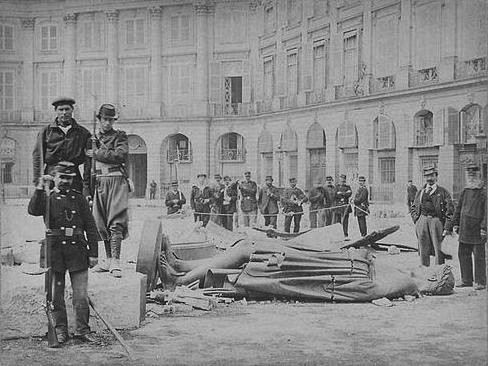
Paris Communards, photographed by Auguste Braquehais during their action in the spring of 1871
twist – that every child, regardless of gender and regardless of class, would have the same education, and that this education would include both what we would think of as theoretical education (science, maths, history, and so on) and a training in a trade or two trades. The idea was that everyone would have both types of formations—intellectual and manual.
GL: To open up the road to a world where there would not be that division of mental and manual labour that is characteristic of capitalism?

KR: Yes.

GL: You write about the Commune as a revolt in a city surrounded by the countryside, and more broadly as a project to remake human society that is surrounded by the natural environment. You draw attention to the very rich discussions of the issues of city-country and humanity-nature, that took place in the decades after the Commune, in large part inspired by it.

KR: Yes, I spend a lot of time in the book on the prolongation of Communard thought when the Communards who survived the massacre and who avoided imprisonment met up [in exile, in the 1880s and 1890s] with people like [the Russian anarchist and geographer] Petr Kropotkin, Morris and Marx, who were all enormously supportive of the Commune but who were all—just as importantly– transformed by its example. When these people met up with each other in London and Switzerland, the central theoretical problem that they were trying to think through was that city-country divide, which was, of course, an important factor in the demise of the Commune. [Many Communards saw the lack of a movement in rural France alongside the action in Paris as one of the factors that contributed to its eventual defeat.] How do you think the realisation of non-alienated labour in a major metropolitan centre like Paris together with the remnants of agrarian communist forms in the countryside? How do you think an urban insurrection like the one that occurred in Paris with those residual formations like the obshina in the Russian countryside?

William Morris posed the problem by considering the impossibility under capitalism of that kind of solidarity that existed among crafts workers engaged in useful production. In the case of Kropotkin and [the French geographer and anarchist] Elisée Reclus … these were geographers, people who had what was considered then a very scientific formation. Following a different path, they arrived at the same kind of uncompromising anti-capitalist and ecological (though they didn’t call it that)  analysis as Morris. They all believed that the principle factors in the degradation of nature were the centralized state and the capitalist system. And they believed that a systemic problem demanded a systemic solution.
GL: You refer to them as anti-Malthusians, and for example you describe Kropotkin’s critique of [the biologist] T.H. Huxley’s Malthusian reading of Darwin.

KR: Yes, they were fiercely anti-Malthusian. They believed, on the basis of empirical fact, that the earth contained riches enough for all and that all that was needed to enhance nature and humanity simultaneously was to dismantle commerce and private property.
GL: Could you say more about the 19th century socialists’ view of the city-country divide. You quote Morris, writing about pre-capitalist rural social forms: “a vision of non-alienated labour and pre-class society is placed to contemporary times – ‘the artificial poverty of covilisation’ – as a way of recruiting past hopes to serve present needs” (Communal Luxury, p. 75). Then there was the discussion between Marx, the Russian socialist writer Nikolai Chernyshevsky, and others, about what could be learned from the rural communes in Russia.

KR: One of the things I find so exciting about these thinkers is their ability to work with, and treasure, forms of uneven temporality. The Russian rural communes were not models for the future in some simplistic way. They were, for example, patriarchal, and oppressive in other ways. But what fascinated Kropotkin, Reclus and others was their sheer persistence: the fact that they had endured in the midst of modern industrialization, and as such constituted an alternative path at a moment that was already narrowing itself down to the single temporality of capitalism. These thinkers, influenced by the Commune, were able to see the value of the outmoded – what Walter Benjamin calls the “revolutionary potential of the outmoded” – and to use it as a resource. They could see these [rural, non-capitalist] forms [of social organisation] as anchored in the past and yet as possible prefigurations of another route.

GL: You refer to Marx’s contention that “what Thiers and company [i.e. the reactionary government that fought the Commune] fear most, even more than the emancipation of the urban proletariat, is the emancipation of the peasants” (Communal Luxury, p. 88). I think this is a thought that has been largely lost in the 20th century reworking of this history: that, for the other side too, this is not just about the industrial proletariat.

KR: I think that thought disappeared because of the way that Marx was read during the Second International and beyond, a reading that held sway for so long: a stagist Marx , a Marx who was focused on the centrality of the state, who gave primacy to the industrial worker. I think there is a new reading of Marx that has become available, beginning in the 1980s, perhaps, with books like Teodor Shanin’s Late Marx and the Russian Road. This is a Marx who, precisely because of the Paris Commune, becomes far more interested in the world outside of Europe, and far more interested in tribal and peasant societies, both ancient and contemporary—this is what preoccupied him during the last ten years of his life.
Marx makes the remark about Thiers and company fearing the emancipation of the peasants in the context of Algeria. One of the tangents that I was unable to follow in the book because of not knowing Arabic or Berber, is that, at precisely the same moment as the Commune, there was an enormous uprising in eastern Algeria, France’s foremost colony. Thiers and company were essentially fighting two battles at the same time – against the workers in the capital and against the revolt in Algeria. And the prisoners from both actions ended up in New Caledonia together.

GL: Could we talk about the group of people, that included former Communards, who you refer to in the book as “anarchist communists”. You are suggesting not that the polemic between Karl Marx and Mikhail Bakunin is not worth following, but that there were many others, this group among them, who also deserve our attention.

KR: There has been too much focus on the rivalry between Marx and Bakunin. People say that their dispute is what brought down the First International. Perhaps. But there was also the continental-wide counter-revolution that set in after the crushing of the Commune. If you broaden your focus a little beyond the tedious “political theory” discourse, you can see – especially in the people that I studied – a group of thinkers and militants who are slavishly beholden neither to Marx or to Bakunin, but who are
The head of the toppled Vendome column. A contemporary photo by Bruno Braquehais
busy performing a bricolage of anarchist and marxist ideas—a creative mixture that resonates very strongly with militant culture today. They were not locked into a battle about establishing the primacy of analyses based on economic exploitation over those based on political domination or vice versa. So they were able to move freely in both contexts and use both intellectual and political camps as a resource.
I sense that we’re in a similar period now, one that is not obsessed with political purity or theoretical purity of some kind.

GL: You are not trying to deliver “a message” to activists in 2015, but you do direct our attention to the way that a wide range of people in the movement at that time shared “a vision of social transformation predicated on a large federation of voluntary associations at the local level” (Communal Luxury, p. 111), notwithstanding their different approaches to theory or to history or to the analysis of capitalism.

KR: Right. And that included people who might have called themselves Marxists or called themselves anarchists: it didn’t matter. What the free commune meant to these thinkers, no matter what they called themselves, was the simultaneous dissolution of capital, state and nation. 28 July 2015.

■ Kristin Ross is a professor of comparative literature at New York University. Her other books include Fast Cars, Clean Bodies: Decolonization and the Reordering of French Culture and May ’68 and its Afterlives. The publisher’s information about Communal Luxury is here, and an extract here.

■ Some 19th-century archive material, on line:
and some more recent commentary …