Showing posts with label Domestication of animals. Show all posts

Tuesday, October 20, 2015

2054. Dogs Originated from Domestication of the Gray Wolf 15,000 Years Ago, Probably in Asia

By James Gorman, The New York Times, October 19, 2015
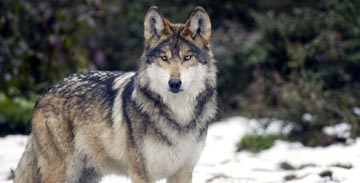
 A Gray Wolf
Where do dogs come from?

Gray wolves are their ancestors. Scientists are pretty consistent about that. And researchers have suggested that dogs’ origins can be traced to Europe, the Near East, Siberia and South China.

Central Asia is the newest and best candidate, according to a large study of dogs from around the world.

Laura M. Shannon and Adam R. Boyko at Cornell University, and an international group of other scientists, studied not only purebred dogs, but also street or village dogs — the free-ranging scavengers that make up about 75 percent of the planet’s one billion dogs.

Dr. Shannon analyzed three different kinds of DNA, Dr. Boyko said, the first time this has been done for such a large and diverse group of dogs, more than 4,500 dogs of 161 breeds and 549 village dogs from 38 countries. That allowed the researchers to determine which geographic groups of modern dogs were closest to ancestral populations genetically. And that led them to Central Asia as the place of origin for dogs in much the same way that genetic studies have located the origin of modern humans in East Africa.

The analysis, Dr. Boyko said, pointed to Central Asia, including Mongolia and Nepal, as the place where “all the dogs alive today” come from. The data did not allow precise dating of the origin, he said, but showed it occurred at least 15,000 years ago. They reported their findings Monday in Proceedings of the National Academy of Sciences.

Greger Larson of Oxford University, who is leading an international effort to analyze ancient DNA from fossilized bones, said he was impressed by the scope of the study. “It’s really great to see not just the sheer number of street dogs, but also the geographic breadth and the number of remote locations where the dogs were sampled,” he said. He also praised the sampling of different kinds of DNA and the analytic methods.

But in the world of dog studies, very little is definitive. The most recent common ancestor of today’s dogs lived in Central Asia, Dr. Boyko said, although he cannot rule out the possibility that some dogs could have been domesticated elsewhere and died out. Or dogs domesticated elsewhere could have gone to Central Asia from somewhere else and then diversified into all the canines alive today, he said.

Dr. Larson, who was not involved with the study, said he thought the Central Asia finding required further testing. He said he suspected that the origins of modern dogs were “extremely messy” and that no amount of sampling of living populations would be definitive. He said a combination of studies of modern and ancient DNA was necessary.
Dr. Boyko said the research for the first time studied three sources of DNA from purebred and village dogs worldwide. The team analyzed DNA from all the chromosomes in the cell nucleus, from the Y chromosome specifically, found only in males, and from mitochondria, cellular energy machines outside the nucleus that are inherited from the mother.

Dr. Boyko traveled to a number of the locations where blood was drawn from village dogs. He said: “The great thing about working with dogs is that if you show up with food you don’t usually have trouble recruiting subjects. Usually.”

He added: “We showed up in Puerto Rico at a fishing village and the dogs turned up their noses at roast beef sandwiches. They were used to eating fish entrails.”

Tuesday, July 28, 2015

1952. Let's Give Feral Cats Their Citizenship

By Arian Wallach and Daniel Ramp, The Conversation, July 28, 2015
Millions of feral cats have gone wild in Australia 
There’s been a lot of talk about killing feral cats, with the government’s recently announced war on cats setting the goal of killing two million by 2020.

On The Conversation last week, Katherine Moseby and John Read explained several different ways to control feral cats, including baiting.

But we would like to offer a different idea: let’s embrace cats as part of Australia’s environment. We could even rename them “Australian wildcats”. Let us explain.
Embracing cats would primarily entail ending our practice of killing cats. This would have many advantages.

It would benefit the cats, because they would no longer endure our increasingly creative methods of ending their lives. We would also benefit greatly by unburdening ourselves of the task of causing suffering and death to cats. But what may seem counterintuitive is that leaving cats alone can also benefit Australia’s threatened native species.
Being kind to cats can help native wildlife

Many people love cats and do not want them harmed. Advocates for nonlethal approaches to control cat numbers often recommend sterilisation, but this idea is based on the mistaken assumption that feral cats are originating from our homes.

Many cats do live among us, but most now exist in a completely wild state, including in the middle of the driest of deserts and the lushest of rainforests. Sterilisation can help reduce the number of house cats without a home, but it will not benefit wildlife away from cities. We need to move beyond thinking about cats as either wards or enemies.

Several small and medium-sized native species have declined and gone extinct, partially due to non-native cats and foxes. Several decades of conservation efforts have therefore focused on killing these predators, a sufficiently long process to learn that this approach is not working.

Even highly coordinated and intensive eradication programs backfire. This can happen in two ways. Killing cats, even two million of them, can inadvertently increase cat numbers by enabling more cats to immigrate into vacant territories. Conversely, cat eradication can cause population booms of other species (such as rabbits and rats) and result in further harm.

Ecosystems are notoriously, and wonderfully, complex things. They are comprised of dense networks of interactions that bind the fate of species to one another. Cats have become deeply entangled in this web of life. Attempting to remove cats from Australian ecosystems will not be a clean and painless surgery, and it will not heal the patient.
Coexistence with cats is possible

For many years introduced species were believed to be harmful because natives have not evolved the traits to hold their own against them. But we are learning that species can be surprisingly adaptable.

For example, when native Australian predators first encounter cane toads they often mistake them for just another familiar amphibian and readily eat them, unaware of the toad’s defence – toxic glands on their backs.

Eventually predator populations recover as they learn how to eat them, they learn not to eat them, or they adapt to the toxin. Such a remarkable recovery has not occurred for many of the native prey species threatened by cat and fox predation, and not because they are slow. Their difficulty, instead, lies with the very actions we are taking to save them.

The number of cats and their influence on other wildlife are a function of ecological context. Major forces that influence the ability of prey to coexist with cats include vegetation cover and larger predators. Grazing and fire can reduce vegetation cover and make it harder for prey animals to escape. Significantly, larger predators, such as dingoes, are a major threat to cats.

Dingoes do more than just kill cats, they communicate with them and influence their behaviour. Cats fear dingoes, and stay away from areas frequented by them. They also avoid hunting when dingoes are most active. This creates areas of safety for the prey of cats. Our poisons and traps kill cats, but tell them nothing.

From foxes to cats
The war on cats is ultimately a consequence of our failed war on foxes.

Foxes have long been held as Australia’s primary environmental villain. They are also easier to kill, because they more readily scavenge. Meat baits laced with 1080 poison are used extensively in conservation programs.

This inhumane poison kills foxes and dingoes in untold numbers, and enables cats to breed up and move with impunity across the landscape.

For example, a major poison-baiting campaign did help recover endangered woylies for a time, but eventually the loss of foxes and dingoes caused cats to take over and the newly recovered population collapsed.

All Australian conservation programs dedicated to restoring small native species on the mainland continue to use 1080. National parks use it. Pastoral stations use it. Councils use it.

It is time to go cold turkey.

Embracing Australia’s wildlife without prejudice
Cats have become an integral part of Australia’s wildlife and beauty. Many native species successfully coexist with cats, especially when we leave predators alone.
Australian wildcats probably provide the same ecological functions as they do in their native ranges, such as suppressing population irruptions of their prey. Killing cats achieves only one outcome with consistency: it produces dead cats.

However, the aim of conservation is not to generate an ever increasing body count, but to guide human behaviour to enable the rest of the Earth’s species to flourish. 

Embracing cats is a paradigm shift. It means embracing the entirety of Australia’s modern ecosystems - native and feral - and letting go of the past.

It is time to accept these immigrants as Australian citizens.