By Leon Trotsky, Marxism.org, December 14, 1938
 |
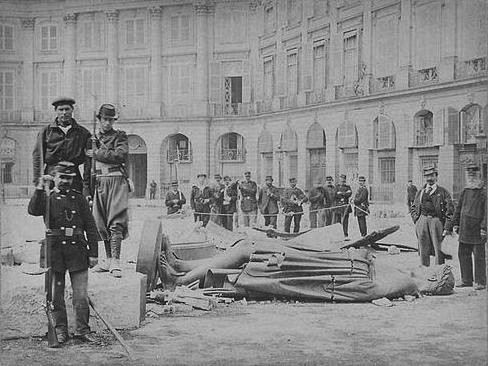
| The French protesters at barridas, 1934. |
Each day, whether we wish it or not, we convince ourselves anew that the earth continues to revolve upon its axis. Likewise, the laws of the class struggle act independently of the fact that we recognize them or not. They continue to operate despite the politics of the Popular Front. The class struggle makes the Popular Front its instrument. After the experience of Czechoslovakia it is now the turn of France: the most hidebound and the most backward have a new occasion to teach themselves.
The Popular Front is a coalition of parties. Every coalition, that is, every durable political alliance, has by necessity as its program of action the program of the more moderate of the coalesced parties. The French Popular Front has signified, since its debut, that the Socialists and Communists placed their political activity under the control of the Radicals. The French Radicals represent the left flank of the imperialist bourgeoisie. On the banner of the Radical party are inscribed “patriotism” and “democracy.” Patriotism signifies defense of the colonial empire of France; “democracy” signifies nothing real, but serves solely to enchain the petty bourgeois classes to the chariot of imperialism. It is precisely because the Radicals unite plundering imperialism with verbal democratism that more than any other party they are constrained to lie and to betray the masses.
One can say without exaggeration that the party of Herriot-Daladier is the most corrupt of all the French parties, representing a sort of culture for careerists, venal individuals, stock manipulators of the Bourse, and in general adventurers of all kinds. Since the parties of the Popular Front could not reach beyond the program of the Radicals, this signified in reality the submission of the workers and the peasants to the imperialist program of the most corrupt wing of the bourgeoisie.
In order to justify the politics of the Popular Front they invoked the necessity for an alliance between the proletariat and the petty- bourgeoisie. It is impossible to imagine a more scurrilous lie! The Radical party expresses the interests of the big bourgeoisie, and not of the petty. By its very essence it represents the political machinery of the exploitation of the petty bourgeoisie by imperialism. The alliance with the Radical party is, consequently, an alliance not with the petty bourgeoisie, but with their exploiters. To realize a genuine alliance between the workers and the peasants is not possible except by teaching the petty bourgeoisie how to emancipate themselves from the Radical party, how to cast off once and for all its yoke from their necks. Meanwhile the Popular Front acts in a directly opposite manner; entering into this “front,” Socialists and Communists take upon themselves the responsibility for the Radical party and thus help it in this way to exploit and to betray the masses.
In 1936, Socialists, Communists, and Anarcho-syndicalists aided the Radical party in slowing down, and in crumbling the powerful revolutionary movement. Big capital has succeeded during the last two years and a half in recovering a little from its fright. The Popular Front, having fufilled its role as brake, now represents nothing more for the bourgeoisie than a useless hindrance. French imperialism has also changed its international orientation. The alliance with the U.S.S.R. was recognized as of little value and of great risk – the accord with Germany, necessary. The Radicals received from finance capital this order: break with your allies, the Socialists and the Communists. As always, they carried out the order without hesitation.
The absence of opposition among the Radicals at the time of the change in course demonstrated once more that this party is imperialist in essence and “democratic” in words only. The Radical government, rejecting all the lessons of the Comintern on the “united front of the democracies,” reconciled itself with fascist Germany and, in passing, took back naturally all the “social laws” which had been the by-product of the workers’ movement in 1936. All this was accomplished in accordance with the strict laws of the class struggle, and that is why this could be predicted, and was in fact predicted.
But the Socialists and the Communists, petty bourgeois blind men, found themselves caught unawares and covered their confusion with a hollow declamation: What? They, patriots and democrats, who helped reestablish order, curbed the labor movement, rendered inestimable service to the “republic,” that is, the imperialist bourgeoisie, are now booted out the door” without ceremony! In fact, if they have been booted outside, it is precisely for having rendered to the bourgeoisie all the services enumerated above. Gratitude has never yet been a factor in the class struggle.
Jouhaux Guarantees Betrayal
The discontent of the betrayed masses is immense. Jouhaux, Blum, and Thorez are constrained to do something in order not to lose their credit definitively. In response to the spontaneous movement of the workers, Jouhaux proclaims a “general strike,” a protest of “crossed arms.” Legal, peaceful, completely inoffensive protest! For twenty-four hours only, he explains with a deferential smile in the direction of the bourgeoisie. Order will not be disturbed, the workers will conserve a “dignified” calm, not a hair will tumble from the head of the ruling class. He gives a guarantee, he, Jouhaux. “Don’t you know me, Messrs. Bankers, Industrialists, and Generals? Have you forgotten that I saved you at the time of the war of 1914-1918?” Blum and Thorez second from their side the general secretary of the C.G.T.: “Only a peaceful protest, a little protest, sympathetic, patriotic!”
Meanwhile, Daladier militarizes the important categories of workers and prepares the troops. In the face of a proletariat with crossed arms, the bourgeoisie, recovering from its panic thanks to the Popular Front, prepares not at all to cross its arms; it intends to utilize the demoralization engendered by the Popular Front in the workers’ ranks in order to carry out a decisive coup. Under these conditions the strike could not end except by defeat.
What Means This Strike?
The French workers have recently passed through a tumultuous strike wave including the occupation of the factories. The subsequent stage for them could not be anything but a genuine revolutionary general strike which poses on the order of the day the conquest of power. No one indicates nor is able to indicate to the masses any other way out of the internal crisis, any other means of struggle against growing fascism and the war which draws near. Every French worker who reflects understands that the day following a theatrical strike of twenty-four hours with “arms crossed” the situation will not be better, but worse. Nevertheless the important categories of workers risk paying for it cruelly by loss of jobs, by fines, by punishment in prison. In the name of what? Order will in no case be disturbed, swears Jouhaux. Everything will remain in place: property, democracy, colonies, and with them misery, high cost of living, reaction and the danger of war. The masses are capable of enduring great sacrifices, but they wish to have before them a great political perspective. They must know clearly what is the goal, what are the methods, who is the friend, who is the enemy. Yet the leaders of the workers’ organizations have done everything in order to mislead and disorient the proletariat.
Yesterday the Radical party was still glorified as the most important element of the Popular Front, as the representative of progress, of democracy, of peace, etc. The confidence of the workers in the Radicals was not, certainly, very great. But they tolerated the Radicals to the extent to which they grant confidence to the Socialist, and Communist parties and the trade union organizations. The rupture in the top circles (with the Radicals) came about as always in such cases unexpectedly. The masses were kept in ignorance until the last moment. Worse yet, the masses were given information designed to permit the bourgeoisie to take the workers unawares. And still the workers made ready to enter into struggle. Entangled in their own nets, the “leaders” called the masses – don’t laugh! – to a “general strike.” Against whom? Against the “friends” of yesterday. In the name of what? No one knows. Opportunism is always accompanied by the contortions of adventurism.
Bureaucrats Prepare Defeat
The general strike is, by its very essence, a revolutionary means of struggle. In a general strike the proletariat assembles itself as a class against its class enemy. The use of the general strike is absolutely incompatible with the politics of the Popular Front which signifies alliance with the bourgeoisie, that is to say, the submission of the proletariat to the bourgeoisie. The miserable bureaucrats of the Socialist and Communist parties as well as of the trade unions consider the proletariat as a simple auxiliary instrument in their combinations behind the scenes with the bourgeoisie. They propose that the workers pay for a simple demonstration with sacrifices which cannot have any meaning in the workers’ eyes unless it is a question of a decisive struggle. As if the masses of millions of workers could make turns to the right and to the left at will, according to parliamentary combinations!
At bottom, Jouhaux. Blum and Thorez have done everything possible in order to assure the defeat of the strike: they themselves fear the struggle not less than the bourgeoisie; at the same time they are forced to create an alibi for themselves in the eyes of the proletariat. That is the habitual war strategem of reformists: to prepare the defeat of action by the masses and then accuse the masses of the defeat or, no better, praise themselves with a non-existent success. Can one be astonished that this opportunism, supplemented with homeopathic doses of adventurism, brings nothing else to the workers but defeat and humiliation?
Has the Revolution Begun?
On June 9, 1936, we wrote: “The French revolution has begun.” It must seem that events have refuted this diagnosis. The question is in reality more complicated. That the objective situation in France has been and still is revolutionary, there cannot be the least doubt. The crisis in the international situation of French imperialism; linked with it, the internal crisis of French capitalism; the financial crisis of the state; the political crisis of democracy; the extreme confusion of the bourgeoisie; the manifest absence of escape through the old traditional channels.
Nevertheless, as Lenin already indicated in 1913:
“It is not from every revolutionary situation that revolution surges but only from a situation such that, to the objective change is joined a subjective change – that is, the capacity of the revolutionary class to carry out revolutionary mass actions sufficiently powerful to crush ... the old government, which never, not even in the period of crisis, ‘fails’ if one does not ‘make’ it fail.”
Recent history has furnished a series of tragic confirmations of the fact that it is not from every revolutionary situation that a revolution surges, but that a revolutionary situation becomes counter-revolutionary if the subjective factor, that is, revolutionary offensive of the revolutionary class, does not come in time to aid the objective factor.
Popular Front Stems Revolutionary Tide
The vast torrent of strikes in 1936 demonstrated that the French proletariat was ready for revolutionary struggle and that it had already entered on the road of struggle. In this sense we had the full right to write that “the revolution has begun.” But “if it is not from every revolutionary situation that revolution surges,” neither is every beginning revolution assured a subsequent uninterrupted development. The beginning of a revolution, which hurls the young generation into the arena, is always colored with illusions, with naive hopes and with credulity. The revolution needs usually a harsh blow from the side of reaction in order to take a more decisive step forward.
If the French bourgeoisie had responded to the demonstrations and to the sit-down strikes, with police and military measures – and this would inevitably have been done if it had not had in its service Blum, Jouhaux, Thorez and Co, – the movement at an accelerated tempo would have reached a more elevated level; the struggle for power would have posed itself indubitably as the order of the day. But the bourgeoisie, utilizing the services of the Popular Front, responded by an apparent retreat and by temporary concessions; to the offensive of the strikers they opposed the ministry of Blum which appeared to the workers as their own, or almost their own, government. The C.G.T. and the Comintern supported this betrayal with all their strength.
In order to lead the revolutionary struggle for power, it is necessary to see clearly the class from whom the power must be wrested. The workers did not recognize the enemy because he, was disguised as a friend. In order to struggle for power, it is necessary moreover to have the instruments of struggle, the party, the trade unions, the Soviets. The workers found these instruments rubbed out, because the leaders of the workers’ organizations formed an enclosure around the bourgeois power in order to mask it, to render it unrecognizable and invulnerable. Thus the revolution that began found itself braked, arrested, demoralized.
The past two and a half years since then have revealed step by step the impotence, the falsity, and the hollowness of the Popular Front. What appeared to the laboring masses as a “popular” government is revealed to be simply a temporary mask of the imperialist bourgeoisie. This mask is now discarded. The bourgeoisie apparently think that the workers are sufficiently deluded and weakened; that the immediate danger of a revolution has passed. The ministry of Daladier is only, in accordance with the design of the bourgeoisie, an unavoidable stage in passing over to a stronger and more substantial government of the imperialist dictatorship.
Has the Revolutionary ‘Danger’ Passed?
Is the bourgeoisie correct in its diagnosis? Has the immediate danger to it really passed? In other words, has the revoution really been deferred to an indefinite, that is to say, remote future? Nothing demonstrates this. Assertions of this type are, at the least, hasty and premature. The last word in the present crisis has not yet been said. In any case to be optimistic over the accounts of the bourgeoisie is not at all the way of the revolutionary party, which is the first to sally forth on the field of battle and the last to leave it.
Bourgeois “democracy” has now become the privilege of the most powerful and the wealthiest exploiting and slave-holding nations. France belongs to this category, but among them she is the weakest link. Her specific economic weight has not corresponded for a long time with her world position inherited from the past. That is why imperialist France now falls under blows of history that she will not escape. The fundamental elements of the revolutionary situation not only have not disappeared in the last two or three years but have been, on the contrary, greatly strengthened. The international and internal situation of the country has grown worse. The war danger draws near. If the fear of the bourgeoisie before the revolution has been lessened, the general consciousness of an impasse has increased.
Nevertheless, how shall we present matters concerning the “subjective factors,” that is, concerning the will of the proletariat to struggle? This question – precisely because it concerns the subjective sphere and not the objective – cannot be resolved by a precise a priori investigation. What decides in the final score is living action, that is, the real movement of the struggle. But there do exist certain criteria, not without importance, for the evaluation of the “subjective factors”; even from a great distance one can deduce them from the experience of the last “general strike.”
The Workers Wanted to Fight
Unfortunately we cannot give here a detailed analysis of the struggle of the French workers in the second half of November and the first days of December. But even the most general data are sufficient for the question which interests us. The participation in the demonstration strike of close to two million workers, with five million members in the C.G.T. (at least on paper), is a defeat. But upon taking into account the political conditions already indicated and, above all, the fact that the principal “organizers” of the strike were at the same time the principal strike-breakers, the figure of two millions testifies to the spirit of struggle evinced by the French proletariat. This conclusion becomes even more evident and more clear in the light of previous events – the tumultuous meetings and demonstrations, the encounters with the police and the army, the strikes, the occupation of factories commencing November 17 and tending to increase with the active participation of the rank and file Communists, Socialists and syndicalists. The C.G.T. manifestly commences to lose footing in the events. On November 25 the trade union bureaucrats called a “non-political” peaceful strike for November 30. That is, five days later.
In other words, instead of developing, extending, and generalizing the genuine movement which took on more and more combative aspects, Jouhaux and Co. countered to this revolutionary movement with the hollow idea of a platonic protest. The delay of five days, at a moment when each day is a month, was necessary to the bureaucrats in order to paralyze, wipe out, in tacit collaboration with the authorities, the movement which was developing spontaneously and which they feared no less than did the bourgeoisie. The police and military measures of Daladier could not have had serious effect unless Jouhaux and Co. had driven the movement into an impasse.
The non-participation (or weak participation) in the “general strike” by the railway workers, workers in the war industries, metal workers. and other advanced layers of the proletariat was in no case due to indifference on their part: during the previous two weeks the workers of these categories had taken an active part in the struggle. But precisely the advanced layers understood better than the others, above all after Daladier’s measures, that now it is not a question of demonstrations nor of platonic protests but of the struggle for power. The participation of the most backward or, from a social point of view, less important layers of workers, in the demonstration-strike testifies on the other hand to the profound crisis of the country and to the fact that in the toiling masses revolutionary energy still exists despite the years of disintegrating Popular Front politics.
Find Road to Workers!
History has shown certainly that even after a decisive and definitive defeat of the revolution the most backward layers of the workers have undertaken the offensive, the railway workers, the metal workers, etc., remaining passive. This, for example, happened in Russia after the crushing of the insurrection of December 1905. But that situation was the result of the fact that the advanced layers had already consumed their strength in the long previous battles: strikes, lockouts, demonstrations, encounters with the police and the army, insurrections. One cannot say this for the French proletariat. The movement of 1936 has not in any way consumed the forces of the vanguard. The deception invoked by the Popular Front has been able, certainly, to bring about a temporary demoralization in certain layers; but this is balanced by the exacerbation of revolt and impatience in other layers. At the same time the movements of 1936 as well as 1938 have enriched the entire proletariat with an invaluable experience and developed thousands of local workers’ leaders independent of the official bureaucracy. It is necessary to understand how to find access to these leaders, to link them with one another, to arm them with a revolutionary program.We have not the least intention of offering from afar counsel on tactics to our French friends who find themselves on the scene of action and who can feel much better than we the pulse of the masses. Nevertheless, for all revolutionary Marxists it is now more than ever evident that the only serious and definitive measure for drawing a balance of the forces, among them the willingness of the masses to struggle, is action. Pitiless criticism of the Second and of the Third Internationals has no revolutionary value except to the extent that it aids in mobilizing the advance guard for direct intervention in the events. The fundamental slogans for the mobilization are given in the program of the Fourth International, which has in the present period a more timely character In France than in any other country. On our French comrades there rests an immense political responsibility. To aid the French section of the Fourth International with all our forces and with all our means, moral and material, is the most important and most imperious duty of the international revolutionary vanguard.