Showing posts with label labor movement. Show all posts

Friday, August 21, 2020

3410. The Dangerous Delusion of Basic Income

By John Clarke, The Canada File, August 17, 2020


Leah Gazan, the NDP MP for Winnipeg Centre, has put forward a private members bill in the federal parliament calling for the introduction of a ‘guaranteed livable basic income’ to be provided to ‘all Canadians over the age of 18.’ It is presented as ‘a concerted effort to eradicate poverty and ensure the respect, dignity and security of all persons in respect of Canada’s domestic and international legal obligations.’ The MP has worked with Basic Income Manitoba and the Basic Income Canada Network to develop this initiative.
This bill is not the work of any voice of the establishment. Leah Gazan is a highly respected Indigenous activist with a long standing involvement in struggles for social justice. Even as she puts it forward, however, another push for basic income is underway.
A group calling itself ‘UBI Works’ is campaigning for the adoption of this social policy. A glance at their rather slick website makes it clear that they are of a very different political stripe. For them, basic income is something that can ‘realize the compassionate potential of capitalism to end poverty, reduce violence, and secure our personal freedoms.’ Their list of backers and believers is an impressive collection of corporate movers and shakers and, in 2018, they were able to publish a letter, calling for a UBI, that was signed ‘by over 120 Canadian CEOs representing over $2.3B in combined revenues.’
Not for the first time, it becomes clear that basic income has a curious mix of supporters, drawn from each side of the political spectrum and the class divide. It is necessary to ask why this concept of a reworked system of income support can create such an accord. I’m going to suggest that basic income would actually advance a neoliberal agenda if it was implemented. In my view, the CEOs who signed the above mentioned letter were taking a clear minded step that was in their interests as exploiters while, on the other hand, hopes on the left for a progressive basic income are based on several misunderstandings and miscalculations that I would like to consider.
Poor Laws to Pandemic
The most glaring deficiency I find in proposals for progressive versions of basic income is that they tend to focus on supposed benefits without realistically considering the factors that would have to be overcome in order for them to be realized.  The first and fundamental consideration that is missed is the basic role and function of an income support system in a capitalist society. Capitalism is based on the exploitation of workers and, for this to occur, a certain level of economic coercion has to be in play. The English peasantry had to be thrown off the land before waged work could become the norm because an alternative means of livelihood would have given potential workers a totally unacceptable level of bargaining power.  As the land was cleared and a reserve of unemployed workers was generated, the authorities had to respond to the destitution and social unrest that resulted with some level of social provision. However, they were sure to provide only as much as they had to and as little as they could get away with. The English Poor Law systems were based on this fundamental consideration, later given the title of ‘less eligibility’ and, to this day, the twin objections of controlling dislocation and disorder, while ensuring the maximum level of economic coercion, define, shape and limit systems of income support. Were basic income to be adopted, it would face those same constraints as long as it existed in the context of a capitalist job market.
The second factor that progressive UBI supporters have not considered, is the fact that we live in period when the coercive element has been greatly intensified.  The neoliberal years have seen the rate of exploitation of workers pushed to much higher levels and the degrading of income support systems has been central to this. The explosion of low wage precarious work has necessitated the gutting of programs like unemployment insurance and social assistance in order to generate a climate of desperation and vulnerability. At this particular moment, this drive is being taken even further. In the exceptional circumstances of the pandemic lockdown, the Canada Emergency Relief Benefit (CERB) was thrown together, precisely because the degraded income support system could not have measured up during the crisis. The present drive to return people to work, before the pandemic is over and the risks to health and safety contained, has led to the elimination of CERB. In Canada, and internationally, the drive to reopen the economy and restore a robust profit making regime, will require a high level of economic coercion. The idea that a private members bill or a lobbying effort is going to prevail upon the Trudeau Liberals to introduce an adequate universal payment that elevates working class bargaining power, is simply not rooted in reality.

There is a third miscalculation on the part of progressive basic income advocates. In the form that it would actually be adopted, their policy would advance, rather than impede, the very agenda of enhanced exploitation and social abandonment they hope to tackle.  There are two aspects to the concept of basic income that would greatly assist the neoliberal agenda. First of all, it would be provided as a de facto wage top up to workers in the low wage sector.  That is its great appeal to those on the political right and features strongly in the arguments put forward by people like the reactionary UBI advocate, Charles Murray.  If the income of the worst paid workers comes, in large part, out of the general tax revenues, the pressure on employers to increase wages and governments to raise minimum wage levels, is reduced considerably. Employers receive what is in effect a subsidy and this is entirely in line with the developing agenda. The elimination of CERB is taking place as the Canada Emergency Wage Subsidy (CEWS) is being extended and enriched.
A basic income system would also represent a huge move towards the commodification of social provision. A meagre cash benefit, provided universally or very widely, would be regarded by austerity driven governments as a means of replacing other parts of the social infrastructure. Cuts to public services would be justified on the grounds that the new payment was now meeting the needs of the population. Advocates of a progressive UBI will, of course, respond that their vision is one in which the payment augments, rather than replaces, other social programs. This brings me to the fourth miscalculation I feel they are making.
False Hope
After decades of an advancing agenda that has reversed previous gains and driven down the adequacy of income support systems, a certain amount of demoralization has set in on the left. The attempt to stop the erosion of social benefits has not succeeded and, in my view, basic income has emerged as a kind of false hope. We have not held back the attack on existing systems so people imagine that basic income has some almost quality about it that will render it immune from the dictates of neoliberal austerity. However, the strategic imperative of maximizing economic coercion by ensuring as inadequate a form of income support as possible would still exist and the capacity of capitalists and their political representatives to press for this would still be there even if a UBI were in place. The illusion is that an unfavourable balance of societal forces can be overcome by  a social policy modification and it simply can’t happen. Indeed, the basic income model would actually further the advance of the very regressive agenda its progressive advocates seek a way around.
The final problem with the basic income illusion, at this particular time especially, is that it represents a dangerous diversion. We are coming out of the lockdown facing nothing less than class war. In conditions of mass unemployment, employers will hammer workers and their unions to try and win major concessions. A crisis of hunger has emerged during the lockdown. Hundreds of thousands of tenants are facing an immediate and dreadful risk of eviction. Governments are looking to compensate for the vast outlays made during recent months with a huge round of social cutbacks. We will have to move forward, in this situation, on the basis of militant mass social action. The inadequacies of the austerity damaged EI system will have to be challenged, as will the wretchedly eroded framework of provincial social assistance. A fight for adequate income, available to all in need without bureaucratic intrusion, is urgently needed. We have no time for that struggle to be put on hold while liberal academics and ‘enlightened’ corporate CEOs hold consultations and run pilot projects while governments keep the circus going as long as possible. We need to be on the streets fighting for concrete and vital demands.
The undermining of income support systems has not been the result of any misunderstanding or some design flaw in those systems. It has been a key element of a drive to increase the level of exploitation by rendering people as poor and desperate as possible and vast profits have been obtained out of this attack. There is no social policy route around this reality and basic income represents a false hope, a harmful direction and a dangerous diversion that we should reject.

Tuesday, January 14, 2020

3304. France at a Crossroads


By Richard Greeman, January 13, 2020 
The longest strike movement since 1968
The nationwide general strike in France, now entering its record seventh week, seems to be approaching its crisis point. Despite savage police repression, about a million people are in the streets protesting President Macron’s proposed neo-liberal “reform” of France’s retirement system, established at the end of World War II and considered one of the best in the world. At bottom, what is at stake is a whole vision of what kind of society people want to live in – one based on cold market calculation or one based on human solidarity – and neither side shows any sign of willingness to compromise.

Now or Never?

On one side, the Macron government has staked its legitimacy on pushing through this key “reform” intact as a matter of principle, however unpopular. On the other side stand the striking railroad and transit workers, who are bearing the brunt of this conflict and have already sacrificed thousands of Euros in lost pay since the strike began last Dec. 5. After six weeks, they cannot accept the prospect of returning to work empty-handed, and they have set their sights high: withdrawal of the whole government project. 

This looks like a “now or never” situation. Moreover, it seems clear that the transport workers mean business. When the government (and the union leaders) proposed a “truce” in the transport strike during the sacred Christmas/New Year vacation period, the rank and file voted to continue the struggle, and their leaders were obliged to eat their words. 

Nor are the transport workers isolated, despite the inconvenience to commuters and other travelers. They have been joined by emergency-room nurses and doctors (who have been on strike for months over lack of beds, personnel and materials), public school teachers (protesting undemocratic and incomprehensible “reforms” to the national curriculum), lawyers and judges (visible in their judicial robes), and the dancers at the Paris Opera (visible in their tutus) among the other professions joining the strike.

Strikers and “Yellow Vests” Together

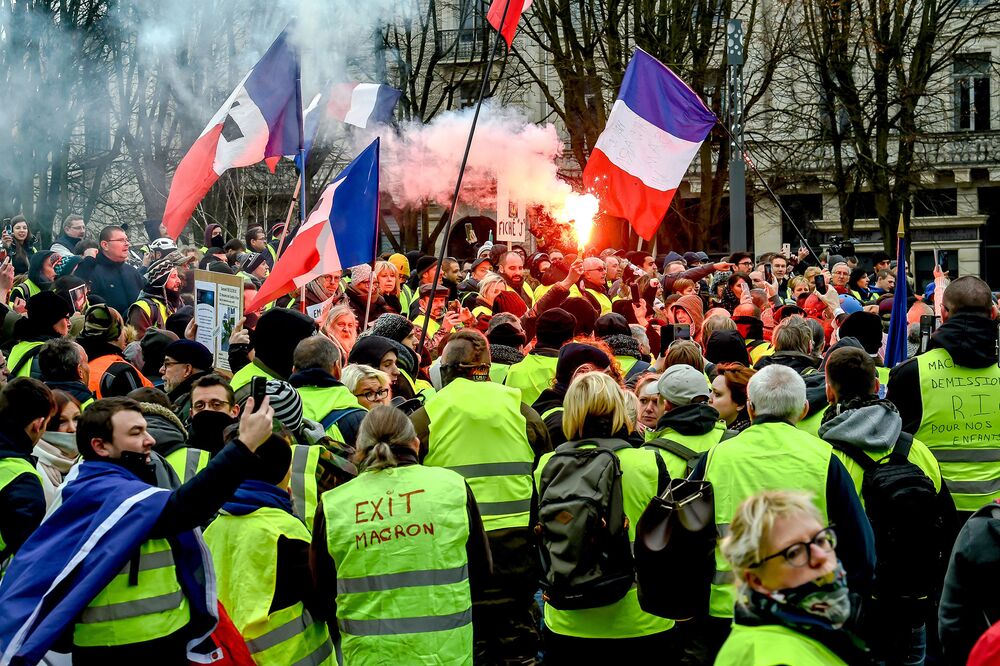
Along side the strikers, and quite visible among them, the so-called Yellow Vests are a crucial element. For over a year, they have been setting a “bad example” of self-organized, largely leaderless, social protest which captured the public imagination and through direct action in the streets won some real concessions from Macron in December 2018. This victory impressed the rank-and-file of the French organized labor movement, which after three months of disciplined, but limited, stop-and-go strikes in the Spring of 2018, failed utterly to wring any concessions and went back to work poor and empty-handed while Macron pushed through a series of neoliberal privatizations and cuts in unemployment compensation. 

Although their numbers diminished, the Yellow Vests continued their spontaneous protests throughout 2019 despite savage government repression, distorted media coverage stressing Black Block violence, and snubbing on the part of the union leadership; but their “bad example” was not lost on the union rank and file. Today’s general strike was originally sparked last September by a spontaneous walkout by Paris subway workers, who, contrary to custom, spontaneously shut down the system without asking permission from their leaders and management. 

Meanwhile, the Yellow Vests, initially suspicious of the unions but isolated in their struggle with Macron, had begun to seek “convergence” with the French labor movement. Finally, at the Yellow Vest national “Assembly of Assemblies” last November, their delegates voted near-unanimously to join the “unlimited general strike” proposed for Dec. 5 by the unions. Reversing his previous standoffishness, Philippe Martinez, head of the CGT labor federation, immediately welcomed their participation. 

Government Provocation

Today’s intractable nationwide confrontation over retirement – a sacred cow, like Social Security in the U.S. – is best understood as a deliberate provocation on the part of Macron, both in its form and its substance. There was no urgent reason for pension reform, nor for abolishing the venerable system outright and hastily replacing it from above with an abstract neo-liberal plan based on “universality.” The pension program was not in debt, and the alleged need to replace the twenty-odd “special” retirement funds –negotiated over the years with the representatives of different trades and professions –with a single “point system” in the name of fairness, efficiency and rationality was only a smokescreen. 

In fact, these “special funds” cover only about one percent of retirees – a million or so miners, railroad workers, transit workers, sailors, ballet dancers and such – who get to retire early because of the physically or mentally taxing nature of their specific labors. (Even if you include the four million public employees as “special,” the figure rises to under 25%). Moreover, Macron has himself recently violated this principle of “universality” by giving special exceptions to the police and army (whom he cannot afford to alienate) and the ballerinas of the Opera (whom no one can imagine toe-dancing at the age of sixty). 

Behind this confusing smokescreen of “fairness to all” is an old con: equalize benefits by reducing them to the lowest common denominator. Indeed, according to independent calculations, under Macron’s point system the average pension would be reduced by about 30%. And since these “points” would be calculated over the total lifetime number of years worked before retirement, rather than on the current criterion of 75% of the worker’ best or final years, Macron’s point system would particularly penalize those whose careers were irregular – for example, women who took off years for child-care. Yet the government brazenly claims that women will be “the big winners” in this so-called reform!

A Pig in a Poke

However, the biggest con embodied in this point system is that the actual cash value of each accumulated point would only be calculated at the time of retirement. The sum in Euros would then be determined by the government then in power on the basis of the economic situation at that moment (for example in 2037 when the plan goes into full effect). Thus, under the present system, every school-teacher, railroad worker and clerk can calculate how much s/he will received when s/he retires at 62 and plan accordingly (for example opting for early retirement). Macron’s point system would leave her in total darkness until it is too late. His system resembles a gambling casino where you buy 10 chips for a certain amount (say 10 Euros each), place your bets, and later take your winning chips to the cashier’s window only to discover that your chips are now worth only 5 Euros each. Surprise! The house wins!

Today, thanks to their existing pension system, French people live on average five years longer than other Europeans. Moreover, according to the New York Times: “In France the poverty rate among those older than 65 is less than 5 percent, largely because of the pension system, while in the United States it approaches 20 percent, according to the Organization for Economic Cooperation and Development. In France, life expectancy is increasing, while in the United States it is diminishing in significant sectors of the population.”  And although the pro-government French media have presented Macron’s confused and confusing reform in the best possible light, it is a hard sell. So why change it?

Not an Ordinary President

When Emmanuel Macron took power in 2017, he vowed he would not be “an ordinary president.” From the beginning he has openly proclaimed his iron determination to revolutionize French society in order to bring it into line with the neo-liberal Thatcher/Reagan revolution of the 1980’s, and his methods have been authoritarian. He has imposed his program of privatizations and counter-reforms from above, mainly by decree, deliberately circumventing negotiations with “intermediate bodies” like the parliament, the political parties, the local authorities and above all the labor unions, who have traditionally been the “social partners” (official designation) of government along with the employers’ associations (who are Macron’s main base of support). 

Backed by the mainstream media (controlled by the government and three big corporations) Macron has been so far largely successful in steam-rolling through his neo-liberal program, openly designed to improve French “competitivity” (i.e. corporate profits) by lowering living standards (thus increasing inequality).  If successful, his proposed “reform” of pensions would open the gates to his ultimate goal, the “reform” of France’s socialized healthcare system (Medicare for all), already on the road to privatization.  

Naturally, all these moves have been unpopular, but until now Macron, whose executive style has been characterized as “imperial,” has been successful in dividing and destabilizing his opposition – if necessary through massive use of police violence. This has been the fate of the spontaneous movement of Yellow Vests, who have been subjected to routine beatings and tear-gas attacks as well as hundreds of serious injuries (including blindings, torn-off hands and several deaths) – all with police impunity and media cover-ups. Now the government’s savage repressive methods – condemned by the U.N. and the European Union – are being applied to strikers and union demonstrators traditionally tolerated by the forces of order in France. 

This repression may turn out to be like throwing oil on the flames of conflict. On January 9, at the end of the peaceful, legal, mass marches (estimated half-million demonstrators nationwide), members of the particularly brutal BAC (Anti-Criminal Brigade) in Paris, Rouen and Lille were ordered to break off sections of the marches, surround them, inundate them with teargas, and then charge in among them with truncheons and flash-ball launchers fired at close range, resulting in 124 injuries (25 of them serious), and 980 sickened by gas. 

These brutal attacks, which focused particularly on journalists and females (nurses and teachers) were captured on shocking videos, viewed millions of times on YouTube, but pooh-poohed by government spokesmen. Far from discouraging the strikers, this deliberate violence may only enrage them. And, what with the “bad example” of the Yellow Vests,” the labor leaders may not be able to reign them in.

The Center Cannot Hold

Why is Macron risking his prestige and his Presidency on this precarious face-off with the labor leadership, traditionally viewed as the compliant hand-maidens of the government on such occasions? Historians here recall that in 1936 Maurice Thorez, leader of Communist-affiliated CGT (General Confederation of Workers), brought the general strike and factory occupations to an end with the slogan “We must learn how to end a strike” and that at the Liberation of France in 1945 the same Thorez, fresh from Moscow, told the workers to “roll up your sleeves” and rebuild French capitalism before striking for socialism. Similarly in 1968, during the spontaneous student-worker uprising, the CGT negotiated a settlement with De Gaulle and literally dragged reluctant strikers back to work. 

Not for nothing are today’s government-subsidized French unions officially designated as “social partners” (along with government and business), yet Macron, loyal to neo-liberal, Thatcherite doctrine, has consistently humiliated the CGT’s Martinez and the other union leaders and excluded them – along with the other “intermediary bodies – from the policy-making process.

Something’s Got to Give

France’s “not-an-ordinary-President” has from the beginning remained consistent with his vision of an imperial presidency. Although seen by many abroad as a “progressive,” Macron, like Trump, Putin, and other contemporary heads of state, adheres to the neo-liberal doctrine of “authoritarian democracy,” and he is apparently willing to stake his future, and the future of France, on subduing his popular opposition, particularly the unions, once and for all. 

Thus, what is at stake today is not just a quarrel over pension rights, which would normally be negotiated and adjudicated through a political process including political parties, elected representatives, parliamentary coalitions and collective bargaining with labor, but a question of what kind of future society French people are going to live in: social-democratic or neo-liberal authoritarian. The seasoned Paris bureau chief of the NY Times Adam Nossiter put it simply in his revealing Jan. 9 article: “A fight between the rich and the poor amplified by 200 years of French history.”

A technocrat and former Rothschild banker, Macron rose to power unexpectedly in 2017 when the traditional Left and Right parties fell apart during the first round of the Presidential Election, leaving him alone as the lesser of two evils candidate in a face-off with the proto-fascist National Front of LePen. Considered “the President of the rich” by most French people, Macron must remain inflexible because he has nothing behind him but the Bourse (Stock Exchange), the MEDEF (Manufacturers’ Association), and the police. 

Second Thoughts

On the other hand, as the struggle enters its seventh week, it occurs to me that if this were true general strike, if all the organized workers had walked out on December 5, if the railroads, the subways, the buses, the schools and the hospitals – not to mention the refineries and the electrical generators – had been shut down, it would all have been over in a few days. 

But this is not the U.S. where in Sept-Oct. 2019, 48,000 members of the United Auto Workers recently shut down 50 General Motors plants for more than six weeks, and where not a single worker, not a single delivery of parts, not a single finished car crossed the picket lines until the strike was settled. 

In France, there are no “union shops” much less closed shops, few if any strike funds, and as many as five different union federations competing for representation in a given industry. Here picket lines, where they exist, are purely informational, and anywhere from 10% to 90% of the workers may show up on the job on any given day during a strike. Today, for example, seven out of ten TGV high-speed bullet-trains were running as many railroad workers returned to the job to pay their bills while planning to go back on strike and join the demonstrations later in the week. How long can this go on?

“When in irresistible force meets an immovable object, something’s got to give,” goes the old saying, and a show-down seems to be in the offing. With his arrogant intransigence over the retirement issue, Macron is apparently risking his presidency on one throw of the dice. Only time will tell. And Macron may be betting that time is on his side, waiting for the movement to slowly peter out so as to push through his reforms later in the Spring.

Update: French Prime Minister Edouard Philippe’s much-ballyhooed Jan. 12 declaration of a “provisionary” withdrawal of his proposal to extend the “pivotal” age of retirement from 62 to 64 is yet another smokescreen designed to divide the opposition and further prolong the struggle, as suggested above. 

Although denounced as such by the CGT and other striking unions, the government’s promise was immediately accepted by the openly class-collaborationist (“moderate”) CFDT union, to their mutual advantage. The CFDT will now be included in the negotiations over the financing of the proposed point system, which the CFDT, having collaborated with previous governments in earlier neo-liberal reforms, supports. 

Philippe’s declaration is obviously an empty promise, as there are only two ways of increasing the retirement fund: either by extending the number of years paid in or by increasing the amount annual contributions, which are shared by labor and management. And although labor has signaled its willingness to raise its dues, the MEDEF (manufacturers’ association) has adamantly refused to pay its share, ruling out the obvious solution to this manufactured crisis.

Friday, May 17, 2019

3250. The Yellow Vests of France: Six Months of Struggle

By Richard Greeman, May 17, 2019


I am writing you from Montpellier, France, where I am a participant-observer in the Yellow Vest movement, which is still going strong after six months, despite a dearth of information in the international media.

But why should you take the time to learn more about the Yellow Vests?  The answer is that France has for more than two centuries been the classic model for social innovation, and this unique, original social movement has enormous international significance. The Yellow Vests have already succeeded in shattering the capitalist myth of “representative democracy” in the age of neo-liberalism. Their uprising has unmasked the lies and violence of republican government, as well as the duplicity of representative institutions like political parties, bureaucratic unions and the mainstream media.

Moreover, the Yellow Vests represent the first time in history that a spontaneous, self-organized social movement has ever held out for half a year in spite of repression while retaining its autonomy, resisting cooptation, bureaucratization and sectarian splits. All the while, standing up to full-scale government repression and targeted propaganda, it poses a real, human alternative to the dehumanization of society under the rule of the capitalist “market.”

Six months ago on Nov. 17, 2018, Yellow Vests burst literally “out of nowhere,” with autonomous local units springing up all over France like mushrooms, demonstrating on traffic circles (roundabouts) and toll-gates, marching every Saturday in cities, including Paris. But unlike all previous revolts, it was not Paris-centered. The humid November soil from which these mushrooms sprouted was the near-universal frustration of French people at the abject failure of the CGT and other unions to effectively oppose Macron’s steam-roller imposition last Spring of his historic Thatcherite “reforms”: an inflexible neo-liberal program of cutting benefits, workplace rights, and privatizing or cutting public services, while eliminating the so-called Wealth Tax designed to benefit the poor.

The immediate cause of this spontaneous mass rising was to protest an unfair tax on fuel  (fiscal justice) but the Yellow Vests’ demands quickly expanded to include restoration of public services (transport, hospitals, schools); higher wages, retirement benefits, healthcare for the poor, peasant agriculture, media free of billionaire and government control, and, most remarkably, participatory democracy. Despite their disruptive tactics, the Yellow Vests were from the beginning wildly popular with average French people (73% approval), and they are still more popular than the Macron government after six months of exhausting, dangerous occupations of public space, violent weekly protests and slanderous propaganda against them.

Tired of being lied to, cheated, manipulated and despised, the Yellow Vests instinctively from the beginning rejected being instrumentalized by the corrupt  “representative” institutions of capitalist democracy – including political parties, union bureaucracies and the media (monopolized by billionaires and subsidized by the government). Jealous of their autonomy, a concept which radical intellectuals have been exploring for years, the Yellow Vest eschewed “leaders” and spokespeople even among their own ranks, and are even now very gradually learning to federate themselves and negotiate convergence with other social movements.

From the very beginning, the Yellow Vests’ basically non-violent unauthorized gatherings were met by massive police repression – teargas, flashballs, beatings,

10, 000 arrests, immediate drum-head trials, stiff sentences for minor infractions. The Macron government just passed a new “anti-vandalism” law making it virtually impossible to demonstrate legally. Macron’s orthodox neo-liberal French Republic has arguably become as repressive of domestic opposition as the right-wing “populist” regimes in Poland, Hungary, Turkey.

Macron’s violent repression of political opposition is responsible for at least two deaths, 23 demonstrators blinded in one eye, thousands seriously wounded. It has been condemned by the U.N. and European Union. But Macron has never acknowledged these injuries, which are rarely shown in the media. The TV news concentrates on sensational images of the violence (to property) of the Black Block vandals at the fringes of Yellow Vest demonstrations, never on the human victims of systematic government violence. A popular slogan proclaimed in Magic Marker on a demonstrator’s Yellow Vest reads: “Wake up! Turn off your TV! Join us!”

Since the Yellow Vests have no recognized spokespersons, government propaganda, abetted by the media, has had a free hand to dehumanize them to justify treating them inhumanly. Macron, from the height of his monarchical presidency, at first pretended to ignore their uprising, then attempted to buy them off with crumbs (a very few crumbs which were rejected) and then denounced them as “a hate-filled mob.” (N.B. In real life the Yellow Vests are largely low-income middle-aged folks with families from the provinces whose trade-mark is friendliness and improvised barbeques.) Yet for Macron and the media they constitute a hard-core conspiracy of “40,000 militants of the extreme right and the extreme left” often characterized as “anti-Semites,” who threaten the Republic.

Small wonder that, subjected to increasing violence and continuous slander, the numbers of Yellow Vests willing to go out into the streets to protest every week has diminished over 27 weeks.  But they are still out there and their favorite chant goes: “Here we are!  Here we are! What if Macron doesn’t like it? Here we are!” (On est là! Même si Macron ne veut pas, On est là!) 

Fortunately, in the past few weeks the League for the Rights of Man and other such humanitarian groups have at last turned out to protest police brutality while committees of artists and academics have signed petitions in support of the Yellow Vests’ struggle for democratic rights, condemning the government and media. At the same time, Yellow Vests are more and more converging with Ecologists (“End of the Month/End of the World/Same Enemy/Same Struggle” ) and feminists (women play a big role in the movement). 

Also with workers, many of them active as opponents of the bureaucracy in their unions. Red CGT stickers on Yellow Vests are now frequent sights at demos. Philippe Martinez, the General Secretary of the CGT, who has heretofore been sarcastic and negative about the Yellow Vests, has now been forced to admit that the cause of their rise was the failure of the unions, “a reflection of all the union deserts.” He was referring to “small and medium size businesses, retired people, poverty people, jobless people and lots of women” (the demographic of the Yellow Vests) that the unions have ignored.

The Yellow Vests are still here, in the fray, holding the breach open. The crisis in France is far from over. If and when the other oppressed and angry groups in France – the organized workers, ecologists, North African immigrants, students struggling against Macron’s educational “reforms”  – also turn off their TV’s and go down into the streets, things could change radically. The Yellow Vests’ avowed goal is to bring France to a grinding halt and impose change from below.

What if they succeed? We know what the “success” of structured parties like Syriza in Greece and Podemos in Spain led to. Maybe a horizontal federation of autonomous base-groups attempting to re-invent democracy could do better.

P.S. Latest news: the CGT just held its convention and voted unanimously for “convergence” with the Yellow Vests, something our group in Montpellier has been working towards for months. Tomorrow, for the first time, we are meeting with the other Yellow Vest groups in our region. “On ne lâche rien!” (Nothing escapes us/ we don’t give in).

Wednesday, April 10, 2019

3221. Yellow Vests Movement Struggles to Reinvent Democracy as Macron Cranks Up Propaganda and Repression


By Richard Greeman, April 10, 2019
Yellow Vests march in Paris last February

After five months of constant presence at traffic circles, toll-booths and hazardous Saturday marches,  the massive, self-organized social movement known as the Yellow Vests has just held its second nationwide “Assembly of Assemblies.” Hundreds of autonomous Yellow Vest activist groups from all over France each chose two delegates (one woman, one man) to gather in the port city of St. Nazaire for a weekend of deliberation (April 5-7). 

After weeks of skirmishing with the municipal authorities, the local Yellow Vests were able to host 700 delegates at the St. Nazaire “House of the People,” and the three-day series of general meetings and working groups went off without a hitch in an atmosphere of good-fellowship. A sign on the wall proclaimed: “No one has the solution, but everybody has a piece of it.”

Their project: mobilize their “collective intelligence” to reorganize, strategize, and prolong their struggle. Their aim: achieve the immediate goals of livable wages and retirements, restoration of social benefits and public services like schools, transportation, post offices, hospitals, taxing the rich and ending fiscal fraud to pay for preserving the environment, and, most ambitious of all, reinventing democracy in the process. Their Declaration ends with the phrase “government of the people, by the people, and for the people.” I often wonder if they know who coined it.

Yellow and Green Unite and Fight
Particular attention was paid to the issue of the environment, reaffirming the popular slogan: “End of the week. End of the world. Same logic, same struggle.” (It rhymes in French.) The Assembly went further and called on “All persons who wish to put an end to the expropriation of the living to take up a conflictual stance against the present system in order to create, together, a new ecological, popular social movement.” 

This shows growth from the original Yellow Vest uprising which began as a protest against a hike in taxes on Diesel fuel imposed in the name of the “saving environment.” (Less well known is that only 17% of that tax was actually earmarked for the environment. In any case, Macron rescinded it in an early attempt to pacify the movement). Since then, the Yellow Vests have tentatively converged with the environmental groups, whom many poor and working-class Yellow Vests can’t help seeing as bourgeois on bicycles wanting to be nice but unwilling to struggle directly against the establishment. 

So their call for unity is also in part a challenge to the environmental movement: “join us in the struggle for social equality and be ready to fight the whole system.” Brilliant! Who said an unstructured autonomous movement of ordinary, not well-educated people, could not come up with strategies and tactics? Psychologists explain that this “wisdom of crowds” emerges whenever people are on an equal footing and free of constraint. It grows through experience. And discussion. A dialectical process leading to its emergence. “No one has the solution, but everybody has a piece of it.” This was the basis of direct democracy in Athens, from which the Yellow Vests have also borrowed the idea of choosing representatives by lot.

Autonomy
The Assembly of Assemblies reaffirmed the Yellow Vest founding principle of keeping clear of political parties. Also of leaders. To my mind, this is a genius stroke. Every popular mass movement I have participated in over the past 60 years has been co-opted by the establishment (or crushed). Leaders set up an office, they try to raise money and gain access to power, end up compromising; they treat the rank and file activists like a mailing list and the power and dynamic of the mass movement melts away,– like the Nuclear Freeze which once mobilized millions. Eventually, Democratic Party lures them. Here, the Socialist Party swallowed SOS Racism, the embryo of a much-needed Civil Rights movement here in France. 

Instinctively, from the beginning, the Yellow Vests seem to have assimilated and put into practice the profound criticism of representative democracy that goes back to the 18th century and was applied during the Paris Commune in 1871. Their delegates were given limited mandates, subject to instant recall, regularly rotated, and paid at workmen’s wages. The Communards also called on other cities to rise and link up as a federation. This is precisely the Yellow Vests modus operandi. 

Europe
This critique of representation explains the Assembly’s attitude toward the upcoming elections for the European Parliament, which will play out as a rehearsal for the next legislative elections when parties will be competing seriously for votes. The fear of being manipulated for political purposes as strong. Last month Yellow Vests at a Paris demonstration recognized a Yellow Vest who had just declared her candidacy to great media fanfare, apparently in the name of the Yellow Vests. They were furious and yelled at her until she withdrew, shaken. Ugly, but a necessary example to anyone else who would rather be a politician than a Yellow Vest (without resigning first).

As far as Europe is concerned,  the Assembly, far from calling for a Frexit, reached out to social movements in the other countries of the European Union in a call to come together and struggle against its neo-liberal policies. The Assembly saw no point in voting in this sham election. As everyone knows, the European Parliament has no power or even visibility. It’s not even in Brussels, where the important decisions are made by representatives of the German banks and multi-national corporations. Moreover, it limits the deficit spending of its member countries, thus making it illegal for France to finance the social services and environmental reconstruction the people are demanding. 

Restructuring and Reflection
Last weekend’s Assembly of Assemblies coincided with Act 21 of the Yellow Vests’ long struggle to occupy public spaces and freely proclaim their hopes and anger, and it brought out only 23,400 people (government count) across France, the lowest number so far. Small wonder after five straight months of bloody repression. The police were as usual out in force, and they stopped and frisked 14, 919 people according to the Paris Prefecture. After twenty-one weekly battles, many of us are too tired, too scared and/or too old to continue “running with the bulls” through the streets dodging gas canisters. 

“We thought we were off for a sprint. In fact, we were involved in a marathon and we need to prepare ourselves,” admitted one speaker.”  We realize we need to vary our tactics, refine our goals, organize our democratic structures better for the movement to last, and last weekend’s Assembly attempted to face this challenge, starting with three weeks of discussion and a number new approaches.

Among the new tactics was a call for a huge nationwide protest against the increasing repression being imposed by the Macron government, the liberation of all those in jail, whether Yellow Vests or in other “criminalized” struggles and refers directly to the oppressed North African and immigrant communities in France, whose 2005 youth rising was brutally put down. “[The violent repression] we are experiencing today now has been for decades the daily experience in the popular quarters [ghetto-like “suburbs” –Ed.]” and concludes: “Now authoritarianism is being generalized to the whole society.

Macron’s Response: Propaganda and Violent Repression
In contrast to these deliberations, last weekend the Macron government delivered the results of its official “Great Debate,” a publicity stunt organized by his government at a cost of 12 million Euros to showcase the President articulately answering questions from selected audiences of mayors and local notables in towns and villages across the country. In all, Macron logged 92 hours of speaking. 

France’s elected monarch concocted this “Debate,” whose limits were set in advance (taxing the rich and the corporations were off the table), as his “answer” to the Yellow Vests’ demand for participatory democracy. The results were unsurprising: the French want “lower taxes, no cuts to services” (NYT April 9). Asked if the “Great Debate” was a “success for Macron and his government,” only 6% of those polled by BFM-TV answered “yes.” Another poll revealed that 35% of French people still approve the Yellow Vests (down from 70% last December) while only 29% approve of Macron. 

PR aside, the Macron government’s real answer to public opposition posed by the Yellow Vests has been brutally stark: slander, violent repression and strict new laws limiting the right to demonstrate – a right enshrined in the Declaration of Human Rights and the French Constitution. Macron and his ministers have publicly denounced the Yellow Vests as “anti-Semites,” “fascists,”  “a hateful mob,” and a violent conspiracy of “40-50,000” terrorists “of the extreme left and extreme right,” out to destroy French institutions. 

This vicious caricature, echoed endlessly by the media and reinforced by scary images of violence and vandalism against the symbols of wealth and power in Paris, is designed to dehumanize the protesters, otherwise easily recognizable as poor provincials who are tired of being ignored. Thus demonized, the Yellow Vests’ actual demands for dignity and justice can be ignored.  As a threat to France, they must be repressed by any means necessary.

Since November 2018, when the Yellow Vest movement suddenly sprung up 300,00 strong, the government has unleashed unprecedented police brutality, using military grade weapons against unarmed demonstrators, provoking hundreds of serious injuries (including blindings, loss of limbs, and broken faces). Although invisible on French mainstream media (government subsidized and corporate owned), this French government violence has been repeatedly condemned by human rights panels in France and the European Union, as well as by Michelle Bachelet, former President of Chile and UN High Commissioner for Human Rights.

Government Violence At Last Exposed
On Saturday, March 23, as President Macron was visiting the Riviera, 73-year-old Geniève Legay, local spokesperson ATTAC (the 20-year-old international NGO that proposes taxing financial transactions for social purposes) joined the Yellow Vest demonstration at Nice to speak out against this repression. Interviewed on local TV carrying a rainbow peace flag, she declared “We are here to say we have the right to demonstrate …We will leave this square when we choose. And if they use force… Then we’ll see. I’m not afraid. I’m 73 years old, what could happen to me? I’m fighting for my grand-children. Against tax havens, and all the money the banks are laundering, against fossil energy.” 

Moments later, Police Commander Souchi ordered his heavily armed riot police to charge the peaceful group in which Geneviève Legay was standing, and she found herself on the ground, surrounded by riot cops, bleeding profusely, with a cracked skull and broken ribs. She is still in the hospital with serious injuries. 

On Monday, the Public Prosecutor and President Macron categorically denied that she had had any contact with the police, and the President, interviewed by the local paper, made a hypocritical apology, “wishing her a speedy recovery and hoping that she might learn some ‘sagesse” (literally “wisdom” but typically applied to children in the sense of learning to “behave.”) 

According to the President of France, as a fragile elderly person, Mme Legay should have known better than to go out to the square in the first place, and so had got herself trampled in the crowd. (The haughty Macron, like the arrogant Trump, seems to enjoy adding insult to injury.) But, as her TV interview makes clear, Geneviève Legay knew very well she was risking her life to defend the democratic freedom to demonstrate and foresaw such an attack moments before it was ordered by police Commander Souchi. 

Indeed, videos taken on the spot and the testimony of street-medics and other eyewitnesses (including policemen) told a different story. Apparently, a policeman wielding a had shield hit her in the head and knocked her down, whereupon he and other cops straddled her and dragged her away bleeding, refusing to allow street-medics to attend her. They may also have kicked her when she was down, which would explain her cracked ribs. 

Later, police entered her hospital room, where Mme Legay was alone (her daughters having been barred without explanation). They repeatedly tried to get Mme Legay to admit that a “cameraman” had pushed her down, but when she repeated that it was a policeman, they stopped taking notes. 

Meanwhile, videos of the attack were all over the Internet, and the independent, subscriber-supported news site Médiapart gathered eyewitness evidence and presented it to the Public Prosecutor, who on March 29 was obliged to reverse himself and affirm police involvement. 
Then, on April 8, Médiapart exposed the deliberate official cover-up of this attack. It turns out that the person placed in charge of the investigation, Hélène P, one of the policewomen who had pressured Mme Legay in her hospital room to declare that she had been pushed down by a “cameraman,” was none other than the common-law wife of Commander Souchi, who had shouted the order to “Charge! Charge!” at the peaceful group in which Mme Legay was standing. 

This scandal has finally broken official silence on French police brutality after five months of violent, indiscriminate attacks on Yellow Vests – visible on YouTube but not on TV. Even the death, during a housing demonstration in Marseille, of  Zaineb Redouane, an 80-year-old woman who was killed on Dec. 4 at her upstairs window when shot directly in the face with tear-gas grenade, went unacknowledged. (She was only an Algerian.) 

Macron’s Lies and Cover-ups
Thus, the President of the Republic was caught outright lying to cover up police brutality. Not as strange as one might think, given the scandal that has clung to him like a tick since last summer, also uncovered by Médiapart, is the Benalla Affair – named for Macron’s Security Chief, who last year was captured on a video, wearing a borrowed riot police uniform, viciously clubbing a demonstrator lying on the ground – apparently for the fun of it. It then emerged that Macron’s protégé and left-hand man Benalla was also involved in a variety of international intrigues and scams, which continue tarnish Macron’s Mister Clean image in France as new evidence emerges. 

Nonetheless, Macron,  a former Socialist, is still seen internationally as a progressive, democratic leader, efficiently modernizing France’s archaic “exception” to neo-liberal dogma, basically a friend to human rights. The extraordinary violence of his regime has remained hidden behind a smokescreen of demonization of the Yellow Vests and de facto censorship by the mainstream media. Even the liberal New York Review of Books, which in the 60s printed a diagram of a Molotov cocktail on its front page, has clung to this line, placing the blame for “violence” on the protestors. So before leaving this subject, let’s look at some unpleasant statistics and then examine the role of the Black Block of so-called casseurs (“trashers”) in sustaining this image.

Whose Violence?
The official narrative is that the Yellow Vests have been attacking the forces of order, and indeed they are often seen on TV throwing teargas canisters back at the police. Interior Minister Castener has been categorical: “I know of no policeman who has attacked the Yellow Vests.” Here are the statistics.

No policemen have been reported as seriously injured during the five months of weekly clashes with the Yellow Vests. 

On the other hand, the latest official Interior Ministry figures list 2, 200 wounded demonstrators, 10 eyes permanently put out, 8,700 arrests, 1,796 convictions, 1, 428 teargas canisters fired, 4, 942 dispersion grenades fired, 13, 460 Flashballs (LBDs) fired. 
Flashballs, manufactured in Switzerland, is listed as “sub-lethal military weapons” but when they cross the French border, they magically become crowd-control devices. They are extremely powerful and accurate at 50 yards, and the number head-wounds indicate that they have been deliberately aimed at demonstrators’ heads, as have been tear-gas canisters and grenades. 

Médiapart’s list counts 606 demonstrators wounded including one death, 5 hands ripped off, 23 blinded in one eye, 236 head wounds (including jaws ripped off) and 103 attacks on journalists. Among the wounded 464 were demonstrators, 39 minors, 22 bystanders, 61 journalists and 20 medics. 

What About the Violent Vandals?
Concerning the Black Block and other casseurs (“trashers”) they are certainly guilty of property damage on a fairly significant scale, but have as far as I know not wounded, blinded or crippled any human beings. That, to me (but apparently not to the French media), is a significant difference. I have never eaten at Fouquet’s restaurant, and I’m sure they have insurance. 

My problem with the Black Block at Yellow Vest demonstrations is that they never get arrested or struck by flashballs. Go on YouTube and you can see dozens of videos of masked, black-clad guys with crowbars smashing banks and trashing stores in plain sight. No one ever stops them. Why? 

A certain number of casseurs have been spotted (and videoed) as police provocateurs, infiltrating the demonstrations, smashing stuff, and then being exfiltrated through police lines. This is an old French police tactic designed to spoil the image of a demonstration and justify violent repression, but the whole truth is that Europe is full of angry young men, self-styled anarchists, deeply invested in fighting the establishment by smashing its symbols. They come in from all over Europe. 

So the cops leave them alone and concentrate on their main mission: brutalizing the crowds of ordinary demonstrators to scare them off and stifle dissent. Moreover, the Black Block folks are more likely to kick the shit out of the cops who try to stop them than are high-school kids, parents with children, and old folks like me and Geneviève. I’d like the Black Block much more if they would fight the cops themselves, instead of using us as human shields while expressing their quite understandable rage while we get gassed and shot at.

Libertycidal” Legislation
The new “anti-casseurs” laws that Macron is pushing through the legislature will legalize and set in stone for the future the repressive practices used against the Yellow Vests, making them permanently available to his successors (for example Marine LePen). They have nothing to do with actual casseurs (who are obviously breaking existing laws and need only to be apprehended under them) and everything to do with making it nearly impossible for ecologists, trade-unionists or Yellow Vests to demonstrate. 

For example, if you are a small-town Yellow Vest and take the train to Paris on a Saturday, you are likely to be stopped several times between the station and the Champs Elysées. If you have in your backpack Vaseline, eye drops, ski goggles, a bicycle helmet, a face-scarf or God forbid a gas mask, you can be arrested, brought to summary trial, and convicted the very same day for being part of a “group organized for the purpose of destroying public order and obstructing the forces of order.” 

Of course, if you insist on a real trial with lawyers and everything, they will gladly hold you over in jail, but if you’re not at work on Monday you’ll lose your job and meanwhile who is minding the kids? And if you eventually do get to demonstrate and the demonstration leads to property damage, you may also be made legally and financially responsible. You may also be placed on a list of dangerous people and barred from demonstrating again at the whim of the local Prefect. 

The chilling prospect of turning these absurd police-state practices into law is what brought pacifists like Geneviève Legay out into the streets with the Yellow Vests. Interviewed in the hospital, where she is still in pain and recovering slowly from multiple injuries, she declared: “Today I am determined to carry on the fight. It is ever more necessary to do so when you see the anti-democratic drift of this government […] The yellow Vests support me and I will continue supporting them. I am not going to stop fighting to defend our rights, as I have for 50 years, and to struggle against State repression whatever form it may take.”

The Cat Is Out of the Bag
She will not be alone. The League for the Rights of Man and more than 50 other civil liberties groups, religious associations, trade unions, civic associations and far-left parties have just called for a massive national demonstration for the right to demonstrate, along with the Yellow Vests this Saturday, April 13. I hope it will be massive.

The choice of Saturday is significant as an act of solidarity with the Yellow Vests, who alone have been defending the public’s right to assemble in public places, and this at considerable personal risk. For 22 weeks, the Yellow Vests have been acting out this basic democratic right through their principled refusal to beg the police for special permission for citizens to gather in a public square or parade through the streets. Imagine “Occupy Wall St.” happening all around the country, in cities and on traffic circles, on a weekly basis. All alone, the Yellow Vests have sustained thousands of injuries and thousands of arrests through this weekly act of civil disobedience, proclaiming the right to the city. Now, at last, they have recognition and allies.

This new convergence of other groups, along with the new perspectives flowing from the Yellow Vests’ Assembly of Assemblies, may mark a new phase in their long and lonely struggle against Macron’s harsh, anti-democratic, neo-liberal regime in its implacable drive to wipe out the relative advantages in living standards, social services and personal liberties won by previous generations of French people in 1936 (the general strike), 1945 (the Liberation) and 1968 (the general strike and student uprising). Indeed, since 1789 (the Declaration of the Rights of Man, which enshrines the people’s right to demonstrate grievances).

P.S. Meanwhile, the Algerian people, having suffered a century of French colonial rule, a long and bloody war for independence, and more than 60 years of corrupt police-state rule, are carrying on a similar struggle for dignity and democracy, filling the streets once a week (but on Friday, not Saturday) in-so-far peaceful massive demonstrations. (The Montpellier Yellow Vests immediately voted their support.) The irony is that the Algerian police have held back on violence, whereas here in France, the level of state repression against the Yellow Vests reminds me of the oppressive atmosphere of police repression I experienced as a student in Paris during the Algerian War. 

P. P.S. In my next report from Montpellier, I will try relate, as a participant-observer, what it’s like inside the Yellow Vests. Meanwhile, don’t hesitate to send me any questions you may have about this under-reported but much-maligned autonomous popular movement.