Showing posts with label habitat loss. Show all posts

Saturday, November 17, 2018

3082.California Fires Destroy Habitat Range of Mountain Lions

By Filipa Ioannou, SFGate, November 15, 2018
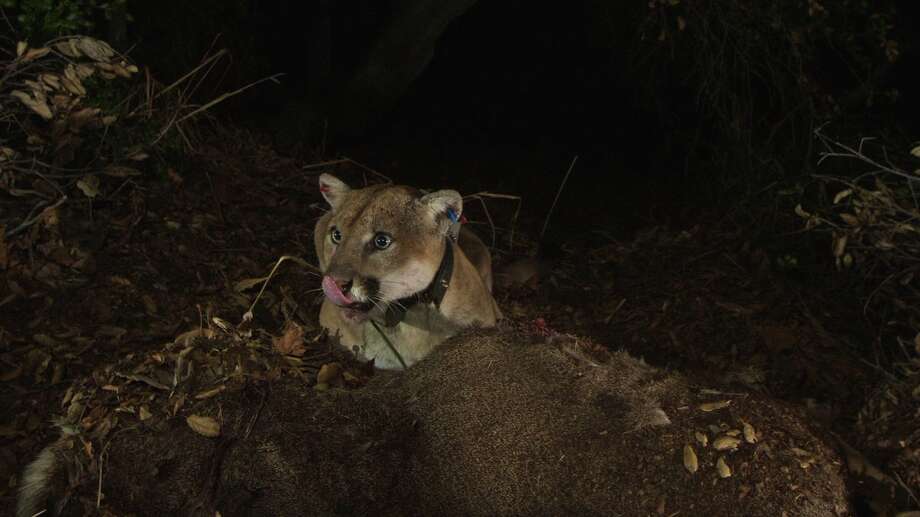
Mountain lion P-22 was unaccounted for after the Woolsey Fire but has since been located. Click through the gallery to see photos that show the fire's impact. Photo: Santa Monica Mountains NRA
Photo: Santa Monica Mountains NRA


It's not only humans who are losing their homes as fires tear through California — the fires are destructive enough to wipe out whole swaths of wildlife habitat, as well, taking a toll on Southern California's well-loved and closely tracked mountain lions and bobcats.
The Woolsey Fire ripped through 20,000 acres of the Santa Monica Mountains Recreational Area, more than 80 percent of the land, decimating the native chaparral and coastal sage scrub, replacing them with "scorched earth," a surreal and barren "moonscape," National Park Service spokeswoman Kate Kuykendall told KPCC.
The mountain lions in and around the Santa Monica Mountains are closely tracked, their goings-on followed by doting admirers, despite their penchant for mauling the occasional mini-horse.
Eight of the 13 mountain lions with radio collars in and around the Santa Monica Mountains appeared to be alive and moving as of Monday, the Recreation Area wrote on Twitter.
"There are 5 other lions (P-22, P-42, P-47, P-54, P-74) that we're unsure about, either because their GPS collar has not transmitted points yet (not unusual) or because they need to be tracked in person with telemetry," officials wrote.
Three of those mountain lions have since been located. Among them is fan favorite and suspected koala-murderer P-22, the only mountain lion known to have crossed from the western to the eastern flank of the Santa Monica Mountains, crossing two L.A. freeways in the process.
It seems the bobcats have fared worse.
"Of the 4 bobcats we're tracking, it appears the entire home ranges for all 4 have burned," the Recreation Area said Monday. "It's possible they managed to survive but only time will tell."
A home range is a defined area of habitat where mammals find food, shelter and mates, according to the National Park Service.
As of Wednesday, none of the four had been found, "despite fairly extensive efforts."
Since starting last Thursday, the Woolsey Fire has spread to 98,362 acres and was 57 percent contained as of this morning, according to Cal Fire. Three bodies have been found; abating winds are helping firefighters as they work to contain the fire, the growth of which was spurred forward by 50 mph gusts earlier in the week.
The landscape of the Santa Monica Mountains has been altered by major fires before, so biologists have some idea of which species recover best on new, charred terrain. After the 2013 Springs Fire, cameras were set up to monitor animal activity at 90 different points throughout the region
Coyotes and gray foxes were first to return to the burned areas, biologists found, with coyotes spotted even more frequently in burned areas than unburned ones. Rabbits were much slower to return — many died in the fire or starved to death in the aftermath, ecologists said — which also hurt the bobcats that eat them. Bobcats nearly vanished from the burn zone in the year after the fire.
Officials hope the wildlife will recover this time, but nothing is certain, and the danger of mudslides that will likely accompany future rain looms.
"We know that wildlife is extremely adaptable and they still have unburned habitat to the east and the west," said Kuykendall, "but we're not sure what the future holds."

Sunday, April 24, 2016

2288. Beyond Milkweed: Monarchs Face Habitat, Nectar Threats

By Science Daily, April 22, 2016


In the face of scientific dogma that faults the population decline of monarch butterflies on a lack of milkweed, herbicides and genetically modified crops, a new Cornell University study casts wider blame: sparse autumnal nectar sources, weather and habitat fragmentation.

"Thanks to years of data collected by the World Wildlife Fund and citizen-scientists across North America, we have pieced together the monarch life cycle to make inferences about what is impacting the butterflies," said Anurag Agrawal, Cornell University professor of ecology and evolutionary biology and senior author on the new paper, to be published April 25 in the journal Oikos.

The scientists did not find evidence supporting the "milkweed-limitation hypothesis" during the monarch's summer breeding season in the midwestern and northeastern United States. Rather, through statistical analyses, the group found problems in the transition from the U.S. and southern Canada to the overwintering grounds in Mexico. Milkweed is only a food source for the caterpillars in summer, but not as the butterflies leave for their epic southern migration in autumn. The study finds that a "lack of milkweed, the only host plant for monarch butterfly caterpillars, is unlikely to be driving the monarch's population decline, as the problem appears to occur after they take flight in the fall," said Agrawal.

In any given year, four generations of monarch butterflies traverse much of North America over a 2,000-mile trek beginning in early spring when they leave the Mexican wintering grounds. In the first generation, millions of monarchs flow through Texas and Oklahoma, with the subsequent generations moving into the Midwest and Northeast, until the start of fall, when the fourth generation returns to the mountainous, high-altitude Oyamel fir forests of central Mexico.

Despite the seemingly good news of annual population bounce-back on the return from the south each year, the scientists were clear that the monarch population has been dwindling. Yes, said Agrawal: "The consistent decline at the overwintering sites in Mexico is cause for concern. Nonetheless, the population is six times what it was two years ago, when it was at its all-time low." Agrawal credits the population rebound to improved weather and release from the severe drought in Texas.

Agrawal said that a persistent decline caused by lack of nectar sources or other threats such as habitat loss or insecticide use can conspire with large annual population fluctuations -- mostly due to weather -- and may eventually push monarchs to dangerously low numbers.

"Given the intense interest in monarch conservation, the blame being put on herbicide use and the national dialog about potentially listing monarchs under the endangered species act, we have to get the science right," said Agrawal.

Journal Reference:
Hidetoshi Inamine, Stephen P. Ellner, James P. Springer, Anurag A. Agrawal. Linking the continental migratory cycle of the monarch butterfly to understand its population decline. Oikos, 2016; DOI: 10.1111/oik.03196

Tuesday, October 20, 2015

2056. China's Coastal Wetlands Are Vanishing

By Edward Wong and Mia Li, The New York Times, October 19, 2015
China's coastal wetlands (marked in green)

BEIJING — Coastal wetlands in China have vanished at an alarming rate because of the country’s economic development, and current economic plans could diminish them to below the minimum needed for “ecological security,” including fresh water, fishery products and flood control, according to a report released Monday by Chinese scientists and an American research center.

The report adds to the rising concerns of scientists, ordinary Chinese and some officials that China’s decades of rapid economic growth have caused huge and possibly irreversible damage to the environment. In recent years, there have been public outcries over air, water and soil pollution. Some Chinese leaders have acknowledged the need to protect environmental resources, but many agencies and officials still view economic growth as their top priority.

With annual growth now slowing to 7 percent or lower, many people are watching to see what measures central and local governments will use to sustain it, and how those measures will affect the environment.

The report was released by the Chinese State Forestry Administration, the Chinese Academy of Sciences and the Paulson Institute, a research center on China that is based in Chicago.

“The life-support system is degenerating,” Lei Guangchun, a dean at Beijing Forestry University who was a lead researcher on the study, said in an interview on Monday. “Wetlands are the core of biodiversity along the coastlines. Now they are disappearing.”
Dr. Lei said 60 percent of China’s natural coastline had disappeared because of development.

Henry M. Paulson Jr., chairman of the Paulson Institute and a former United States Treasury secretary, said in a written statement that “it is time to rethink the economic development model of the past and take decisive actions toward a more sustainable economic transition.”

Among the chief political questions in China is whether President Xi Jinping is serious about transforming the nation’s infrastructure-driven economic model to a more sustainable one, and whether he has the power to do so. This is expected to be a main topic at a plenary session this month of the Communist Party’s Central Committee, which plans to discuss the 13th Five-Year Plan for economic development.

Last year, the State Council, which is China’s cabinet, and the State Forestry Administration announced that China had to ensure that by 2020 coastal wetlands did not fall below 131 million acres — the minimum necessary for ecological security. But plans to reclaim land from the sea and other projects endanger that goal, the report says.

“Sea reclamation is deemed as the quickest and cheapest way to increase land supply in China’s eastern coastal areas,” the report says. It adds that “huge economic returns from reclamation have prompted local governments to ‘bypass’ regulations issued by the central government.”

The report points to systemic problems with environmental conservation efforts. It says that “the legal system and effective legal basis remains inadequate to conserve coastal wetlands in China” and that conservation efforts “are still confronted with conflicts of multiple institutions and mechanisms.”

This last point became evident at a news conference about the report on Monday that central government officials from various agencies attended. Several officials thanked the researchers but said that their agencies did not bear sole responsibility for protecting coastal wetlands.

The report calls for the central government to form a more systematic approach to wetlands conservation, an effort that now involves the overlapping authorities of 12 agencies and 11 coastal administrative areas.

The report identifies about 180 priority areas for conservation along the east coast, as well as 11 of the most important habitats for migratory birds.

Zhang Zhengwang, a professor of zoology at Beijing Normal University who worked on the report, said Chinese coastal wetlands lay on the most important of nine global routes for migratory birds and were a critical resting point. “China’s wetlands are the only gas station, so to speak, along the way,” he said in an interview. “If they cannot feed here, they will die.”

Thursday, July 16, 2015

1934. Climate Change Narrows Bumble Bee Range

By Rachel Nuwer, smithsonian.com, July 9, 2015
Climate change contributes to Bumble bee decline by narrowing its range in North American and Europe
Honeybee woes dominate the news, but those pint-sized pollinators aren’t the only members of the Apoidea family that are dropping like flies. Bumblebees are also feeling the heat—specifically, from climate change. Across both North America and Europe, those fuzzy insects are failing to keep up with shifting temperatures, disappearing from their southern range while also refusing to migrate north.

Researchers have known for several years that bumblebees in certain parts of the world, including the U.S., are on the decline. Until now, however, no one had figured out why that was so or definitively connected the trend to climate change. To probe the mystery, scientists from Canada, Europe and the U.S. turned to bumblebee observation records collected across Europe and North America, dating back 110 years and encompassing 67 species. They overlaid these geo-tagged observations with temperature data for the same locations and time span, and then used a statistical analysis to look for correlations. They also controlled for factors such as human development and pesticide use.

Across the board, temperature was the only variable that significantly correlated with bumblebee loss, the team reports today in Science. As the global thermostat has crept up, bumblebees that were commonly found along the hottest, southernmost parts of their species’ ranges from 1901 to 1974 have now simply disappeared. In both Europe and the U.S., the bees’ southern ranges have contracted by up to 185 miles. In some hilly southern locations, bumblebees are still present but only at higher elevations—and thus, cooler temperatures—than in past decades.

At the same time, the researchers were surprised to find that bumblebees have failed to shift their range north, a coping strategy that has been seen in many other species, including butterflies, birds and even some trees. This is despite the fact that warmer temperatures have created potential habitats in places that were previously too cold for the bees.

While the researchers do not know why bumblebees are not moving north, they suspect it might have something to do with their evolutionary history. While many other insects originally evolved in tropical climates and moved outward from there, bumblebees originated in the Palearctic, or cooler areas in the northern hemisphere. This distinction perhaps makes them more averse to following warming temperatures, as other species have done in the past and are doing now, the authors speculate.  
“Global warming has trapped bumblebees in a kind of climate vise,” lead author Jeremy Kerr, a biologist at the University of Ottawa, says in a statement. “For species that evolved under cool conditions, like bumblebees, global warming might be the kind of threat that causes many of them to disappear for good.”

Bumblebees, like honeybees, are important pollinators that help perpetuate many crops that humans depend on. To ensure that these insects are around in the future, Kerr and his colleagues warn that manual transplants—moving bees from warmer to cooler locations—might be necessary. Whether such an extreme plan would actually work, however, is unknown. As the team points out, the only sure-fire way to save bumblebees, as well as droves of other species, is to halt climate change. 

Saturday, March 1, 2014

1337. Habitat Loss Speeds Up a Kestrel’s Life

By Sindya N. Bhanoo, The New York Times, February 24, 2014
Kestrel chicks
To survive the destruction of forests in its island habitat, a rare bird called the Mauritius kestrel has adopted a new strategy, researchers say: Live fast and die young.
Native forest now makes up only 2 percent of the land area of Mauritius, an island nation in the Indian Ocean. So the birds have been forced to nest in sugarcane fields.
Kestrels living in agricultural areas have more offspring earlier in life and also die earlier — “a sort of speeding-up of the pace of life,” said Samantha J. Cartwright, an ecologist at the University of Reading in England and an author of a new study about the birds in the journal Current Biology.
Birds in both forested and agricultural areas “ultimately produce the same number of offspring in life,” she added.
That the birds are now resilient to changes in their habitat is a good sign, she said. Kestrels have been through some troubling times.
By 1974, after years of habitat loss and the use of pesticides like DDT, the kestrel population on Mauritius was down to four. Today, there are about 400.
Dr. Cartwright and her colleagues used 23 years of detailed data gathered on some of these birds.

“We know where they were born, who they bred with, how many chicks they had,” she said. Despite the apparent success of the Mauritius kestrel, the study shows that human activities can have drastic effects on wild animals, she said, adding, “Other species might not react in the same way and may not be as resilient.”