Showing posts with label World economy. Show all posts

Tuesday, September 8, 2015

2012. On Global Capitalism: Chris Hedges Interviews Leo Panitch

By Chris Hedges, Days of Revolt, September 8, 2015


CHRIS HEDGES, HOST, DAYS OF REVOLT: Hi. I'm Chris Hedges. Welcome to Days of Revolt. 

Today we're going to be speaking with Leo Panitch, the author, with Sam Gindin, of The Making of Global Capitalism, the role of the state, and in particular the American state, in creating a new form of empire that denies that it is empire or is a form of imperialism. 

Thank you, Leo. 

LEO PANITCH: Good to be here, Chris.

HEDGES: So let's begin with this concept which you lay out in the book, which I think is correct, that--and I'm going to quote Harold Innis, 1948, which you quote in the book: "American imperialism has been made plausible and attractive in part by the insistence that it is not imperialistic." And that is a fundamental theme of your book. And maybe you can explain how that happened. 

PANITCH: It's--goes all the way back, I guess, to the American Revolution, which was an anti-imperial revolution. And the United States therefore conceived itself, politically and culturally, as a non-imperial force while engaging in imperial behavior. 

HEDGES: Especially to Native Americans.

PANITCH: Especially on this continent, initially. And then, as the most dynamic of modern capitalisms on the face of the earth, it developed within the United States, very much encouraged by the American state at various points of the 19th century. It was never a laissez-faire state. It was always a highly interventionist state. 

HEDGES: Well, you talk about the tariffs, which essentially built walls that allowed America to become an industrial giant. 

PANITCH: Yes, and through many other direct interventions--the building of infrastructure at public expense, and often as public projects. 

HEDGES: And they're selling it off now. 

PANITCH: They're selling some of it off, or they're letting some of it--. 

HEDGES: Including the U.S. Post Office. 

PANITCH: That's right, or they're letting a lot of it atrophy. 

HEDGES: It's not funny, actually. 

PANITCH: Yeah, and they're letting a lot of it atrophy. So it isn't a formal empire. The United States, even in told Teddy Roosevelt's time--. 

HEDGES: And let me just stop you there. By formal empire, you mean in terms of the physical occupation, like King Leopold in the Congo kind of empire, the British in India. 

PANITCH: Yeah, although Argentina and eventually the white dominions, like my own country, Canada, had a different status than India as a colony, despite the development of similar types of companies within the two of them, Argentina after the breakaway from Spain, and Canada in its movement from colony to independent state, to dominion, as they were called, remained very much within the orbit of the British state, but as independent states. And that became the model for how the American empire evolved. People who thought that Teddy Roosevelt was about creating colonies, that what was happening between 1998 (1898) and 1902 was America turning itself into a formal empire, that proved to be the exception much more than the rule. 

And that's not to say that independent states don't exist within the panoply of this informal American empire. Canadians know very well the extent to which in substantive terms we've moved from having been a colony to an independent dominion, to a colony, in substantive terms, if not in formal terms, of the American empire. 

HEDGES: Yes, of course. When you talk about the effectiveness of American imperialism, you highlight the fact that part of the reason it's so effective is because it has been able to be largely invisible, and it has been invisible, you point out, through, I think, two mechanisms, one, that it trains the elites in other countries in order to manage affairs on behalf of American imperialism, and also because it disseminates, through popular media, images of America that in essence--I'm not sure you use this word exactly--indoctrinate or brainwash a population into allowing them to believe that America is instilled with values that in fact it doesn't have, the ability of imperialistic forces to supposedly give these values to the countries they dominate. I mean, that is a kind of a raison d'être for economic and even military intervention, as we saw in Iraq, in planning democracy in Baghdad and letting it spread out across the Middle East, or going into Afghanistan to liberate the women of Afghanistan. That, as somebody who spent 20 years on the outer edges of empire, is a lie. 

PANITCH: It depends how cynical you think they are. And I think it varies depending on the administration in question, and indeed different personnel inside each administration, going back to the types of interventions we were discussing under Teddy Roosevelt. There were some people who quite genuinely and naively believed that by supporting reactionary forces against rebellions in Central America, they nevertheless could establish a liberal democracy in those countries, and they ended up getting in bed with and in cahoots with extremely reactionary and conservative forces that they would have preferred would become like the United States but were unable to make them do so. The imperial power--and the Romans discovered this first of all, of course--is not absolute. And even when the Americans become a very powerful social and political force inside other countries, their ability to make those countries into a image of the United States, which they may naively have thought they were going to do, has always been limited. 

HEDGES: Well, Graham Greene kind of eviscerated this kind of America. And I think it does break down between those who are very cynical and, for lack of a better word, those who are very stupid. And we saw a lot of stupid people--Wolfowitz, Cheney, Perle, and others--who know nothing about the Middle East, who knew nothing about the instrument of war, and certainly knew nothing about the culture and history of Iraq, believed that they could implant this very naive vision. And what always happens in cases like that is rivers of blood. 

PANITCH: Yeah, no. I think that's true. I think that the American empire is most powerful, actually, not in those regions of the world in which it has intervened militarily, at least in recent decades. It's more powerful in those regions of the world that have become, if I may use the word, Canadianized, that is, where American capital has penetrated, where economic relations are extremely deep, where American multinational corporations are a social force inside those countries. And therefore I think the strongest linkages are with the former old imperial countries of Europe. 

HEDGES: Germany. You write a lot about Germany. 

PANITCH: And Germany represents that. So you see the mess in Iran or Iraq, etc.--I mean Iran with the Shah back in the '70s and Iraq in the current millennium. But the strongest linkages of empire are those amongst the advanced capitalist states, which also operate under the rubric of the American Treasury, the Federal Reserve, etc. Nevertheless, even there, as you see with Germany's behavior vis-à-vis Greece, which the American administration and the Treasury wouldn't have wanted, they aren't able to give them orders. That does show you the relative autonomy that states within an informal empire have as compared to ones that are subjected militarily, as some countries are. 

HEDGES: Well, you write a lot about the kind of collapse, because of the war, of European economies after World War II and the re-creation, with the help of the American labor movement, the AFL-CIO, which was going over there working on behalf of the CIA to break what they deemed communist or leftist or socialist unions. And much of the book, I think, makes a very strong argument that especially after World War II we re-created economic political systems in our own image, which wasn't complete, as you point out correctly vis-à-vis Greece, does not mean that we had iron control. But they work within those imperialistic, capitalist, globalist parameters. 

PANITCH: That's right. The difference is that even the Germans, who are so central to contemporary global capitalism, and especially to European capitalism, have never taken the responsibility upon themselves that the Americans did, trying to do with Wilson at the end of World War I, but then effectively did during the course of World War II, have never taken responsibility on themselves for managing a global capitalism and for all of the headaches that that involves in terms of the difficulties and contradictions of that. The Germans have, primarily in Europe, tried to ensure that the international institutions are replicas of the old German central bank, the Bundesbank. And they've primarily oriented the euro, let us say, to play the kind of role that the Deutsche Mark used to play. They're mainly concerned, in other words, with the competitiveness and status of the German economy. 

The Americans have carried a burden. All empires carry a burden. And their burden has been--and it's an enormous headache, and they screw it up often, as Iraq shows--of trying to manage a global capitalism. And the German state doesn't do that. It's an enormous difference. 

HEDGES: Right. Well, let's not feel too sorry for the Americans that killed 3 million Vietnamese and 1 million Iraqis. 

PANITCH: The responsibilities of power often go with very, very dirty hands. 

HEDGES: Right. I'm not sure I'd use the word responsibility

PANITCH: I think we have to see it that way. I think we do have--I know that a lot of the left doesn't like to see it that way, but I think it's more a structural thing. And I think if you and I were dropped into being head of the Federal Reserve without having the type of political forces behind us that can allow us to transform its utter nature, we wouldn't be behaving all that differently than the current chair of the Federal Reserve, unfortunately.

HEDGES: Right. Well, they would never asked me to [crosstalk] 

PANITCH: Or me. So yeah, exactly. 

HEDGES: I mean, capitalism in America has changed from the old Fordism and the Rockefellers, the Carnegie, which produced, manufactured, broke labor unions, as you correctly highlight in your book, broke our radical movements, and it's shifted into the hands of financiers, into insurance, into real estate, who now virtually control the global economy at the expense of industrial capitalism, and often, I would argue, at the expense of governments. 

PANITCH: And I wouldn't. 

HEDGES: I know you wouldn't. 

PANITCH: I don't think that there's a divorce and an antagonism between industrial and financial capital. I think they're highly integrated. I think that finance performs an absolutely crucial function for multinational industrial corporations, an essential one in terms of the productive networks around the globe. It isn't just speculation--although it is speculation, it isn't just speculation finance. Moreover, I think it isn't at the expense of states. I think that--. 

HEDGES: Well, let me just ask. I mean, they're hoarding how many trillions of dollars overseas to escape taxation? 

PANITCH: Well, whether that's industrial capital or financial capital is--. 

HEDGES: Right, but it is at the expense of states and essentially the migration of manufacturing, first over the border with NAFTA to Mexico, Vietnam, Bangladesh, where people are earning $0.22 an hour. Global capitalism is saying, if you want to be competitive on a global marketplace, you have to be a serf. And we're seeing that. I mean, you just look at the whole--the nationalization of GM, the renegotiating of contracts, the diminishing of the power of labor within the United States. 

PANITCH: Well, you're using states in an idealistic way, I think. If you understand that, as I think they are, that states are the handmaidens of capital, if one abandons this mistaken conception that comes from neoclassical economics, then one doesn't have this notion that there's an opposition between them. Of course where you have democracies, where working classes have won the right to vote, that does at least create a tendency on the part of states to be sensitive to presenting themselves in ways that look democratic and introducing the type of policies that bind working classes more deeply to the capitalist state. Sometimes that involves redistribution. Sometimes it involves benefits to them. But it isn't--. 

HEDGES: You point out in your book that the American working class in particular was bought off. And you quote from--I think it's a letter that Roosevelt wrote that in essence says to the oligarchic elite--I'm kind of paraphrasing--you better give up some of your money or we're going to get a revolution and you're going to lose all of your money. I mean, he spoke--used that word revolution, and so that the whole reforms of the New Deal were not--and I don't argue with you here--some kind of beneficence on the part of--and Roosevelt came out of the oligarchic class--because of their goodheartedness or because they cared about the suffering, but because of the pressure of radical movements that have now been largely destroyed, but that rose with the breakdown of capitalism. 

PANITCH: That's right. But it also happens when derivatives are used to secure mortgages for black Americans who have been excluded from the New Deal housing reforms for most of the era up to the 1990s. Thereto, politicians encourage the development of derivative markets--and we're talking about Democratic politicians now. This occurred more in the Clinton era than any other initially. And they took pride in the fact that capitalists around the world were investing in the derivative mortgage markets in the United States. And this was allowing the black poor of Cleveland to buy houses. And that too was represented as meeting democratic pressures. 

HEDGES: Right, but until they were repossessed and there were foreclosures, which the banks and financial firms like Goldman Sachs knew were coming. It was a scam. 

PANITCH: Of course.

HEDGES: So, I mean, the idea that--at that point I think it's evidence of a breakdown of democracy, Clinton being the kind of poster child for this, where they spoke in that traditional "feel your pain" language and concern for the poor and the underclass and the working class, and yet rammed through or allowed to go through a series of policies that were completely predatory in terms of the poor. 

PANITCH: I think that neither politicians nor businessmen think in such long-run terms. I think insofar as those derivative mortgage markets were growing and were growing for five, ten years, that's the terms that they think in. Yes, I think you're right that all of them--none of them take for a moment seriously the notions of neoclassical economists about market equilibrium. They all know that crises happen. They expect them to happen. They just hope they aren't going to happen on their watch. 

HEDGES: Right. But Leo, Goldman Sachs did think in the long term in that it bet against those derivatives and subprime mortgages through AIG. They knew. 

PANITCH: Eventually.

HEDGES: They knew they were going to collapse. 

PANITCH: Well, of course. Derivatives are all about counter-hedging. And Goldman Sachs was smart enough to counter-hedge earlier. And, heaven's sake, they had done it during the 1970s, when Goldman Sachs wasn't a major player. They had done it during the 1970s commercial paper crisis, where they were selling off commercial paper to municipalities and universities, knowing that Penn State was going to go bankrupt. 

HEDGES: Right. Well, there's word for that. It's called fraud. 

PANITCH: Yeah. And they paid off some fines, they were in court in the 1970s, etc. 

HEDGES: Well, I mean, the LIBOR, they fixed the--for five years they [fixed] the world currency rates. They make eighty-plus billion dollars profit and they pay a $9 billion fine. That's not a bad business. 

PANITCH: Well, there's always been a phenomenon of double agents in the American political system. Corporate lawyers who have worked for the major corporations taught them how to get around regulations, gone into the state, and then written the regulations that they told them how to get around. 

HEDGES: Right. Well, you make that point in the book, that it has become a symbiotic, incestuous relationship, where the very people who are gaming the system then go into the system. And I think in the book you actually say that they go into the system to essentially fight the entities that they come out of. I'm not sure I would agree with that. I mean, you can look at Liz Fowler, the person who wrote the disastrous for-profit health care bill in the United States known as Obamacare, where she worked on--I think these people work on behalf of essentially writing regulations into a kind of a two-tiered system, where corporations like Goldman Sachs can write laws and regulations that allow them to carry out fraud. And then these people like Fowler are funneled right back into the system and amply rewarded for their work. 

PANITCH: Yes. But the private health agencies don't have to worry about the types of popular pressures that produce this ersatz public health system in the United States. So when she's brought in, she's brought in to do something that she doesn't have to do when she's working for these private corporations. Similarly, when Robert Rubin leaves Goldman Sachs and becomes the secretary of Treasury, he is performing a function that is about reproducing Goldman Sachs and reproducing Wall Street, but nevertheless using his knowledge to engage in the management of global capitalism, which is an entirely different set of responsibilities than he occupies with Goldman Sachs. And that often involves him calling in the principals of Wall Street and telling them to do things that they otherwise wouldn't do, and which they do in order to reproduce the system, but wouldn't do it on their own. 

HEDGES: Right. But if there is a single figure who's--you know, if we had to pick one--responsible for the 2008 meltdown, it's Robert Rubin. 

PANITCH: Yes. I mean--

HEDGES: So, I mean, it's not knowledge; it's idiocy. 

PANITCH: Well, is it idiocy? What do you mean? American capitalism continues to thrive in relative terms. 

HEDGES: Well, because it loots the U.S. Treasury to the tune of trillions of dollars,--

PANITCH: Sure.

HEDGES: --and because the Fed gives it virtually zero percent interest rate on money. 

PANITCH: Sure.

HEDGES: But that's not capitalism. It's extortion. 

PANITCH: No. Well, if you want to call it extortion--it's not merely extortion. It's accumulation. I don't see how it's extortion insofar as the state legalizes this. And--. 

HEDGES: It's extortion of the taxpayer, because the average citizen gets austerity rammed down their throat to pay for it. 

PANITCH: And the average citizen, for a period, and for a long period, was able to thrive on financial markets. 

I mean, the point is we are all integrated into this system. We are all dependent on it. Had radical journalists like Michael Moore gotten their way and let Wall Street collapse instead of being bailed out by the TARP program, which of course was designed to save the banks, who would have suffered most? The point is that we are all dependent. And why we need to be really radical in trying to change this system is precisely because we need to recognize the extent to which we are all embedded in it. 

HEDGES: Right. But there was an alternative to bailing out the banks, and it wasn't letting it collapse. It was creating regional banks, capitalizing them at $10 billion, leveraging them ten to one, helping people deal with their mortgages, rather than giving this money to zombie banks. There was alternatives, and that was never discussed. 

PANITCH: Well, that would have involved, of course--and I've been advocating this for a very long time--turning the American banking system, and above all the principals of the American banking system, the big commercial investment banks--into public utilities. 

HEDGES: Well, that's what we should do. 

PANITCH: Of course. And it isn't just a matter of creating a regional bank like the Bank of North Dakota. Where do they put their surpluses every night? They put them into Wall Street. So it's a matter of taking the whole system and nationalizing it. 

HEDGES: Right.

PANITCH: And I think that's an old-fashioned term, in fact, because that does imply something that I would not like to imply about the type of state we would like to have. But it does involve turning them into democratic public utilities as part of a democratic economic planning system. 

Now, for that, you need to change not only the bourgeoisie. You need to change the way in which the working class is integrated into the system, the way even unemployed black people are integrated into the system and are so embedded in it, are so dependent on it for the house over their heads, for the roof over their heads. 

HEDGES: The word that is called socialism. 

PANITCH: Yeah, it's a word called socialism, which we're both happy to use.

HEDGES: Now we agree. 

Thank you very much, Leo. 

PANITCH: Happy to talk to you, Chris. 

HEDGES: And thank you for watching Days of Revolt.

Tuesday, June 16, 2015

1884.Why We Have an Over-Supply of Everything

By Gail Tverberg, Our Finite World, May 6, 2015

The Wall Street Journal recently ran an article called, Glut of Capital and Labor Challenge Policy Makers: Global oversupply extends beyond commodities, elevating deflation risk. To me, this is a very serious issue, quite likely signaling that we are reaching what has been called Limits to Growth, a situation modeled in 1972 in a book by that name.
What happens is that economic growth eventually runs into limits. Many people have assumed that these limits would be marked by high prices and excessive demand for goods. In my view, the issue is precisely the opposite one: Limits to growth are instead marked by low prices and inadequate demand. Common workers can no longer afford to buy the goods and services that the economy produces, because of inadequate wage growth. The price of all commodities drops, because of lower demand by workers. Furthermore, investors can no longer find investments that provide an adequate return on capital, because prices for finished goods are pulled down by the low demand of workers with inadequate wages.
Evidence Regarding the Connection Between Energy Consumption and GDP Growth
We can see the close connection between world energy consumption and world GDP using historical data.
Figure 1. World GDP in 2010$ compared (from USDA) compared to World Consumption of Energy (from BP Statistical Review of World Energy 2014).
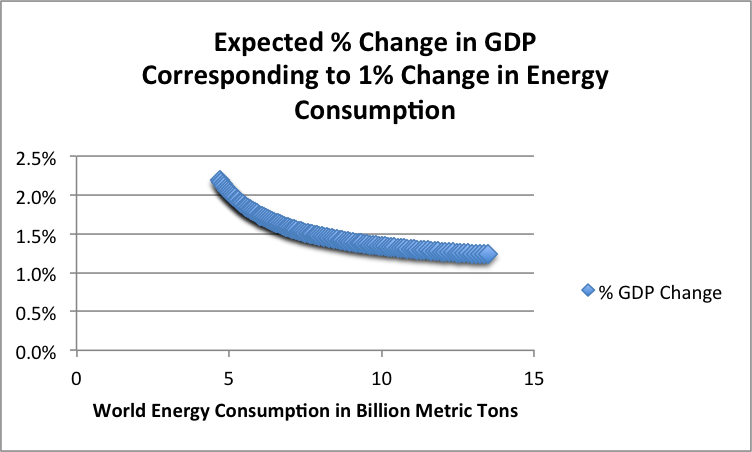
This chart gives a clue regarding what is wrong with the economy. The slope of the line implies that adding one percentage point of growth in energy usage tends to add less and less GDP growth over time, as I have shown in Figure 2. This means that if we want to have, for example, a constant 4% growth in world GDP for the period 1969 to 2013, we would need to gradually increase the rate of growth in energy consumption from about 1.8% = (4.0% – 2.2%) growth in energy consumption in 1969 to 2.8% = (4.0% – 1.2%) growth in energy consumption in 2013. This need for more and more growth in energy use to produce the same amount of economic growth is taking place despite all of our efforts toward efficiency, and despite all of our efforts toward becoming more of a “service” economy, using less energy products!
Figure 2. Expected change in GDP growth corresponding to 1% growth in total energy, based on Figure 1 fitted line.
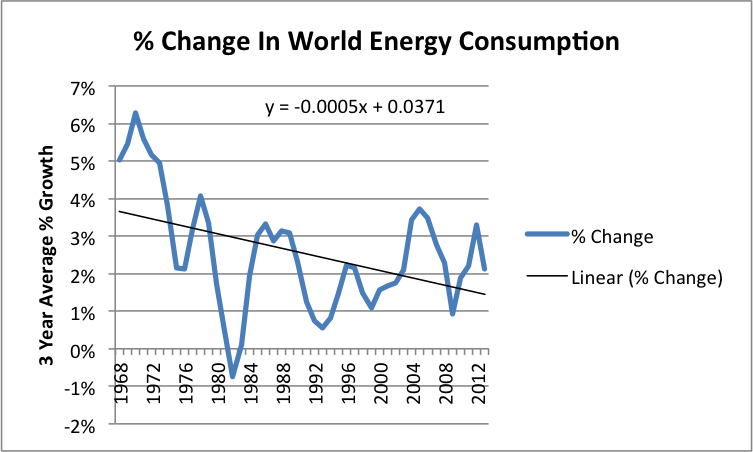
To make matters worse, growth in world energy supply is generally trending downward as well. (This is not just oil supply whose growth is trending downward; this is oil plus everything else, including “renewables”.)
Figure 3. Three year average percent change in world energy consumption, based on BP Statistical Review of World Energy 2014 data.
Figure 3. Three-year average percent change in world energy consumption, based on BP Statistical Review of World Energy 2014 data.
There would be no problem, if economic growth were something that we could simply walk away from with no harmful consequences. Unfortunately, we live in a world where there are only two options–win or lose. We can win in our contest against other species (especially microbes), or we can lose. Winning looks like economic growth; losing looks like financial collapse with huge loss of human population, perhaps to epidemics, because we cannot maintain our current economic system.
The symptoms of losing the game are the symptoms we are seeing today–low commodity prices (temporarily higher, but nowhere nearly high enough to maintain production), not enough good paying jobs for common workers, and lack of investment opportunities, because workers cannot afford the high prices of goods that would be required to provide adequate return on investment.
How We Have Won in Our Contest with Other Species–Early Efforts 
The “secret formula” humans have had for winning in our competition against other species has been the use of supplemental energy, adding to the energy we get from food. There is a physics reason why this approach works: total population by all species is limited by available energy supply. Providing our own external energy supply was (and still is) a great work-around for this limitation. Even in the days of hunter-gatherers, humans used three times as much energy as could be obtained through food alone (Figure 1).
Figure 1
Figure 4
Earliest supplementation of food energy came by burning sticks and other biomass, starting one million years ago. Using this approach, humans were able to gain an advantage over other species in several ways:
  1. We were able to cook some of our food. This made a wider range of plants and animals suitable for food and made the nutrients from these foods more easily available to our bodies.
  2. Because less energy was needed for chewing and digesting, our bodies could put energy into growing a larger brain, thus giving us an advantage over other animals.
  3. The use of cooked food freed up time for such activities as hunting and making clothes, because less time was needed for chewing.
  4. Heat from burning plant material could be used to keep warm in cold areas, thereby extending our range and increasing total human population that could be supported.
  5. Fire could be used to chase off predatory animals and hunt prey animals.
Our bodies are now adapted to the need for supplemental energy. Our teeth our smaller, and our jaws and digestive apparatus have shrunk in size, as our brain has grown. The large population of humans that are alive today could not survive without supplemental energy for many purposes, such as cooking food, heating homes, and fighting illnesses that spread when humans are in as close proximity as they are today.
Our Modern Formula For Winning the Battle Against Other Species
In my view, the formula that has allowed humans to keep winning the battle against other species is the following:
  1. Use increasing amounts of inexpensive supplemental energy to leverage human energy so that finished goods and services produced per worker rises each year.
  2. Pay for this system with debt, because (if supplemental energy costs are cheap enough), it is possible to repay the debt, plus the interest on the debt, with the additional goods and services made possible by the cheap additional energy.
  3. This system gradually becomes more complex to deal with problems that come with rising population and growing use of resources. However, if the output of goods per worker is growing rapidly enough, it should be possible to pay for the costs associated with this increased complexity, in addition to interest costs.
  4. The whole system “works” as long as the total quantity of finished goods and services rises rapidly enough that it can fund all of the following: (a) a rising standard of living for common workers so that they can afford increasing amounts of debt to buy more goods, (b) debt repayment, and interest on the debt of the system, and (c) an increasing amount of “overhead” in the form of government services, medical care, educational services, and salaries of high paid officials (in business as well as government). This overhead is needed to deal with the increasing complexity that comes with growth.
The formula for a growing economy is now failing. The rate of economic growth is falling, partly because energy supply is slowing (Figure 3), and partly because we need more and more growth of energy supply to produce a given amount of economic growth (Figure 2). With this lowered world economic growth, the amount of goods and services being produced is not rising fast enough to support all of the functions that it needs to cover: interest payments, growing wages of common workers, and growing “overhead” of a more complex society.
Some Reasons the Economic Growth Cycle is Now Failing
Let’s look at a few areas where we are reaching obstacles to this continued growth in final goods and services. An overarching problem is diminishing returns, which is reflected in increasingly higher prices of production.
1. Energy supplies are becoming more expensive to extract.
We extract the easiest to extract energy supplies first, and as these deplete, need to use the more expensive to extract energy supplies. We hear much about “growing efficiency” but, in fact, we are becoming less efficient in the production of energy supplies.
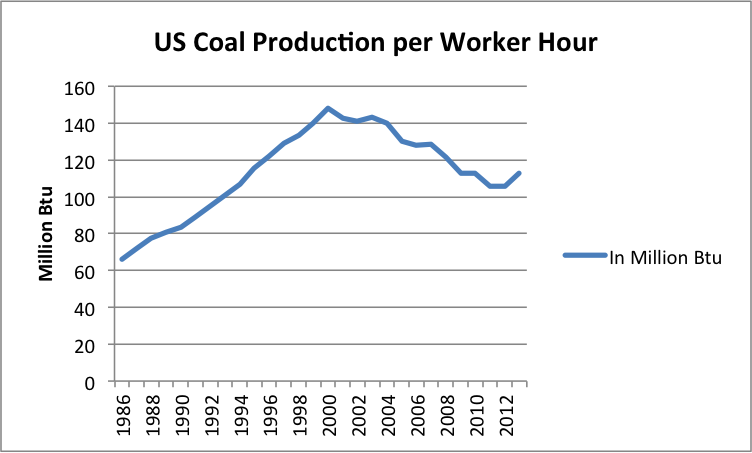
In the US, EIA data shows that we are becoming less efficient at coal production, in terms of coal production per worker hour (Figure 5).
Figure 5. US coal production per worker, on a Btu basis based on EIA data.
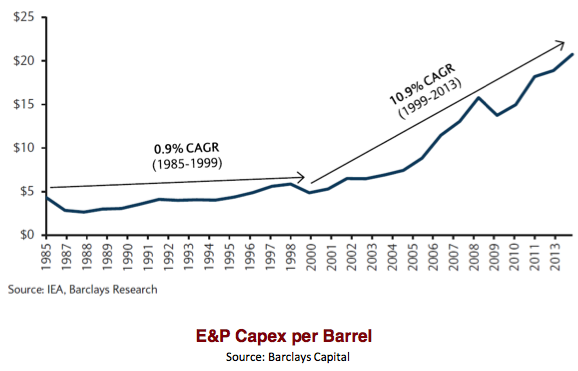
With oil, growing inefficiency is shown by the steeply rising cost of oil exploration and production since 1999 (Figure 6).
Figure 6. Figure by Steve Kopits of Westwood Douglas showing trends in world oil exploration and production costs per barrel.
Figure 6. Figure by Steve Kopits of Douglas-Westwood showing trends in world oil exploration and production costs per barrel.
Thus, it is for a fairly recent period, namely the period since about 2000, that we have been encountering rising costs both for US coal and for worldwide oil extraction.
The extra workers and extra costs required for producing the same amount of energy  counteract the tendency toward growth in the rest of the economy. This occurs because the rest of the economy must produce finished products with fewer workers and less resources as a result of the extra demands on these resources by the energy sector.
2. Other materials, besides energy products, are experiencing diminishing returns. 
Other resources, such as metals and other minerals and fresh water, are also becoming increasingly expensive to extract. The issue with mineral ores is similar to that with fossil fuels. We start with a fixed amount of ores in good locations and with high mineral percentages. As we move to less desirable ores, both human labor and more energy products are required, making the extraction process less efficient.
With fresh water, the issue is likely to be a need for desalination or long distance transport, to satisfy the needs of a growing population. Workarounds again involve more human labor and more resource use, making the production of fresh water less efficient.
In both of these cases, growing inefficiency leaves the rest of the economy with less human energy and less energy products to produce the finished goods and services that the economy needs.
3. Growing pollution is taking its toll.
Instead of just producing end products, we are increasingly finding ourselves fighting pollution. While this is a benefit to society, it really is only offsetting what would otherwise be a negative. Thus, it acts like overhead, rather than producing economic growth.
From the point of view of workers having to pay for higher cost energy in order to fight pollution (say, substitution of a higher cost energy source, or paying for more pollution controls), the additional cost acts like a tax. Workers need to cut back on other expenditures to afford the pollution control workarounds. The effect is thus recessionary.
4. The amount of “overhead” to the world economy has been growing rapidly in recent years, for a number of reasons: 
  • The amount of overhead is growing because we are reaching natural barriers. For example, population per acre of arable land is growing, so we need more intensity of development to produce food for a rising population.
  • With greater population density and increased bacterial antibiotic resistance, disease transmission becomes a more of a problem.
  • Increasing education is being encouraged, whether or not there are jobs available that will make use of that education. Education that cannot be used in a productive way to produce more goods and services can be considered overhead for the economy. Educational expenses are frequently financed by debt. Repayment of this debt leads to a decrease in demand for other goods, such as new homes and vehicles.
  • We have more elderly to whom we have promised benefits, because with the benefit of better nutrition and medical care, more people are living longer.
5. We are reaching debt limits.
As economic growth has slowed, we have been adding more and more debt, to try to mitigate the problem. This additional debt becomes a problem in many ways: (a) without cheap energy to leverage human labor, there are not many productive investments that can be made; (b) the addition of more debt leads to a need for more interest payments; and (c) at some point debt ratios become overwhelmingly high.
At least part of the slowdown in economic growth that we are seeing today is coming from a slowdown in the growth of debt. Without debt growth, it is hard to keep commodity prices high enough. Investment in new manufacturing plants is also affected by low growth in debt.
Reasons for Confusion in Understanding Our Current Predicament
1. Not understanding that all of the symptoms we are seeing today are manifestations of the same underlying “illness”. 
Most analysts think that the economy has stubbed its toe and has a headache, rather than recognizing that it has a serious underlying illness.
2. Academia is focused way too narrowly, and tied too closely to what has been written before. 
Academics, because of their need to write papers, focus on what previous papers have said. Unfortunately, previous papers have not understood the nature of our problem. Academics have developed models based on our situation when we were away from limits. The issues we are facing cover such diverse subjects as physics, geology, and finance. It is hard for academics to become knowledgeable in many areas at once.
3. Models that seemed to work before are no longer appropriate.
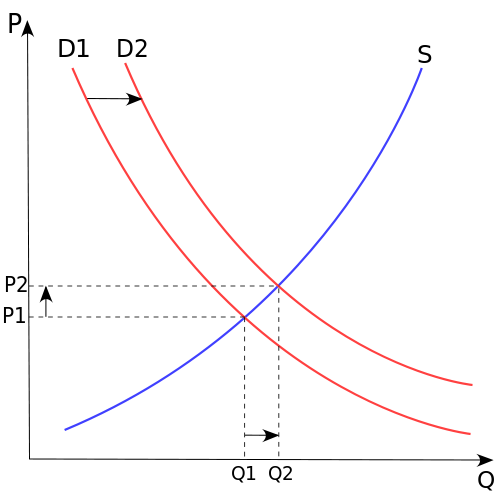
We take models like the familiar supply and demand model of economists and assume that they represent everlasting truths.
Figure 7. (Source Wikipedia). The price P of a product is determined by a balance between production at each price (supply S) and the desires of those with purchasing power at each price (demand D). The diagram shows a positive shift in demand from D1 to D2, resulting in an increase in price (P) and quantity sold (Q) of the product.
Unfortunately, as we get close to limits, things change. Both wage levels and debt levels have an impact on demand; the quantity goods available is also affected by diminishing returns. The model that worked in the past may be totally inappropriate now.
Even a complex model like the climate change model being used by the IPCC is likely to be affected by financial limits. If near-term financial limits are to be expected, IPCC’s estimate of future carbon from fuels is likely to be too high. At a minimum, the findings of the IPCC need to be framed differently: climate change may be one of a number of problems facing those people who manage to survive a financial crash.
4. Too much wishful thinking.
Everyone would like to present a positive result, especially when grants are being given for academic research will support some favorable finding.
A favorite form of wishful thinking is believing that higher costs of energy products will not be a problem. Higher cost energy products, whether they are renewable or not, are a problem for many reasons:
  • They represent growing inefficiency in the economy. With growing inefficiency, we produce fewer finished goods and services per worker, not more.
  • Countries using more of the higher cost types of energy become less competitive in the world market, and because of this, may develop financial problems. The countries most affected by the Great Recession were countries using a high percentage of oil in their energy mix.
  • The amount workers have available to spend is limited. If a worker has $100 to spend on energy supply, he can buy 100 times as much in energy supplies priced at $1 as he can energy supplies priced at $100. This same principle works even if the cost difference is much lower–say $3.50 gallon vs. $3.00 gallon.
5. Too much faith in, “We pay each other’s wages.”
There is a common belief that growing inefficiency is OK; the wages we pay for unneeded education will work its way through the system as more wages for other workers.
Unfortunately, the real secret to economic growth is not paying each other’s wages; it is growing output of finished products per worker through increased use of cheap energy (and perhaps technology, to make this cheap energy useful).
Increased overhead for the system is not helpful.
6.  An “upside down” peak oil story
Most people in the peak oil community believe what economists say about supply and demand–namely, that oil prices will rise if there is a supply problem. They have not realized that in a networked economy, wages and prices are tightly linked. The way limits apply is not necessarily the way we expect. Limits may come through a lack of good paying jobs, and because of this lack of jobs, inability to purchase products containing oil.
The connection between energy and jobs is clear. Good jobs require the use of energy, such as electricity and oil; lack of good-paying jobs is likely to be a manifestation of an inadequate supply of cheap energy. Also, high paying jobs are what allow rising buying power, and thus keep demand high. Thus, oil limits may appear as a demand problem, with low oil prices, rather than as a high oil price problem.
In my opinion, what we are seeing now is a manifestation of peak oil. It is just happening in an upside down way relative to what most were expecting.
Conclusion
One way of viewing our problem today is as a crisis of affordability. Young people cannot afford to start families or buy new homes because of a combination of the high cost of higher education (leading to debt), the high cost of fuel-efficient new cars (again leading to debt), the high cost of resale homes, and the relatively low wages paid to young workers. Even older workers often have an affordability problem. Many have found their wages stagnating or falling at the same time that the cost of healthcare, cars, electricity, and (until recently) oil rises. A recent Gallop Survey showed an increasing share of workers categorize themselves as “working class” rather than “middle class.”
It is this affordability crisis that is bringing the system down. Without adequate wages, the amount of debt that can be added to the system lags as well. It becomes impossible to keep prices of commodities up at a high enough level to encourage production of these commodities. Return on investment tends to be low for the same reason. Most researchers have not recognized these problems, because they are narrowly focused and assume that models that worked in the past will continue to work today.

Monday, July 21, 2014

1486. Global Industrial Production Shakes Off 2007 Doldrums

By Floyd Norris, The New York Times, July 18, 2014

INDUSTRIAL production around the world plunged after the Great Recession began, and in most advanced economies has yet to fully recover. But that is not the case in many emerging economies, with production hitting new highs.
The United States this week reported that industrial production, excluding construction, rose 0.2 percent in June and was up 4.3 percent from a year earlier. That is a faster rate than any other major advanced economy has shown recently, but it pales next to the rates of growth in such countries as China and India.
The accompanying charts show the change in levels of industrial production since the end of 2007, as the recession was beginning in the United States. The latest report indicates that production in the United States was 3 percent higher in June than it was in December 2007. That is, however, largely because of increased oil and gas production. Overall manufacturing output is still a bit below the pre-recession levels, although production in the motor vehicle industry has been strong.
Asia Leads the Way in Industrial Production
Industrial production in the United States has recovered from the Great Recession, but most other advanced countries continue to struggle. Emerging economies, led by those in Asia, have raised production much more rapidly. The charts show changes from production in December 2007, the month the recession began in the United States, with the world average shown for comparison.

The Netherlands government compiles industrial production reports from 27 advanced economies and 54 developing economies around the world, and computes international averages. Its latest report shows that world production in April was almost 12 percent higher than it had been at the end of 2007, but that production in the advanced economies was nearly 5 percent lower than it had been.
In the emerging economies, production was up by more than a third from the 2007 level, primarily because of the performance of Asian countries, where production is up by more than 60 percent.
China releases data only on annual changes, making any calculation of month-to-month changes hard to estimate, but it appears that its production has approximately doubled from the 2007 level. In India, production is up nearly a quarter since the recession began.
The Asian boom has not helped Japan, the largest advanced economy in the region. The latest production figure is nearly 14 percent lower than the 2007 number.
Until 2011, industrial production in Germany — the third largest exporter in the world, behind China and the United States — recovered more rapidly than did production in the United States. But since then, it has stabilized. In May, production remained nearly 3 percent below the 2007 level.
That is, however, much better than in any of the other major eurozone countries. Over all, production in the eurozone is 11 percent lower than in 2007. Among the three largest countries in the zone other than Germany, France has done the best, with production still down 15 percent. In Italy, production is off 22 percent and in Spain it is down 28 percent.
An exception to the eurozone doldrums seems to be Ireland, where production is now a little higher than it was in 2007. In May, the production figure was up more than 20 percent from the year before, a far better performance than in any of the major euro economies.

In Britain, which is outside the eurozone, production also seems to have stagnated. In May, the level was 12 percent below the 2007 figure.