Showing posts with label Working within the Democratic Party. Show all posts

Wednesday, January 11, 2017

2537. Cornel West on Obama's Legacy

By Cornel West, The Guardian, January 9, 2017
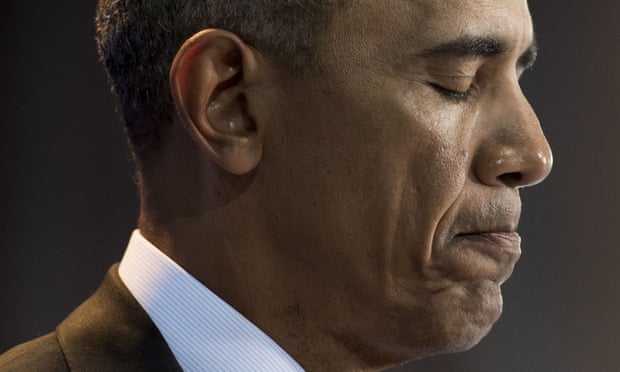
Eight years ago the world was on the brink of a grand celebration: the inauguration of a brilliant and charismatic black president of the United States of America. Today we are on the edge of an abyss: the installation of a mendacious and cathartic white president who will replace him.
This is a depressing decline in the highest office of the most powerful empire in the history of the world. It could easily produce a pervasive cynicism and poisonous nihilism. Is there really any hope for truth and justice in this decadent time? Does America even have the capacity to be honest about itself and come to terms with its self-destructive addiction to money-worship and cowardly xenophobia?
Ralph Waldo Emerson and Herman Melville – the two great public intellectuals of 19th-century America – wrestled with similar questions and reached the same conclusion as Heraclitus: character is destiny (“sow a character and you reap a destiny”). 
The age of Barack Obama may have been our last chance to break from our neoliberal soulcraft. We are rooted in market-driven brands that shun integrity and profit-driven policies that trump public goods. Our “post-integrity” and “post-truth” world is suffocated by entertaining brands and money-making activities that have little or nothing to do with truth, integrity or the long-term survival of the planet. We are witnessing the postmodern version of the full-scale gangsterization of the world.
The reign of Obama did not produce the nightmare of Donald Trump – but it did contribute to it. And those Obama cheerleaders who refused to make him accountable bear some responsibility. 
A few of us begged and pleaded with Obama to break with the Wall Street priorities and bail out Main Street. But he followed the advice of his “smart” neoliberal advisers to bail out Wall Street. In March 2009, Obama met with Wall Street leaders. He proclaimed: I stand between you and the pitchforks. I am on your side and I will protect you, he promised them. And not one Wall Street criminal executive went to jail.
We called for the accountability of US torturers of innocent Muslims and the transparency of US drone strikes killing innocent civilians. Obama’s administration told us no civilians had been killed. And then we were told a few had been killed. And then told maybe 65 or so had been killed. Yet when an American civilian, Warren Weinstein, was killed in 2015 there was an immediate press conference with deep apologies and financial compensation. And today we still don’t know how many have had their lives taken away. 
We hit the streets again with Black Lives Matter and other groups and went to jail for protesting against police killing black youth. We protested when the Israeli Defense Forces killed more than 2,000 Palestinians (including 550 children) in 50 days. Yet Obama replied with words about the difficult plight of police officers, department investigations (with no police going to jail) and the additional $225m in financial support of the Israeli army. Obama said not a mumbling word about the dead Palestinian children but he did call Baltimore black youth criminals and thugs.
In addition, Obama’s education policy unleashed more market forces that closed hundreds of public schools for charter ones. The top 1% got nearly two-thirds of the income growth in eight years even as child poverty, especially black child poverty, remained astronomical. Labor insurgencies in Wisconsin, Seattle and Chicago (vigorously opposed by Mayor Rahm Emanuel, a close confidant of Obama) were passed over in silence.
In 2009, Obama called New York City mayor Michael Bloomberg an “outstanding mayor”. Yet he overlooked the fact that more than 4 million people were stopped-and-frisked under Bloomberg’s watch. Along with Carl Dix and others, sat in a jail two years later for protesting these very same policies that Obama ignored when praising Bloomberg. 
Yet the mainstream media and academia failed to highlight these painful truths linked to Obama. Instead, most well-paid pundits on TV and radio celebrated the Obama brand. And most black spokespeople shamelessly defended Obama’s silences and crimes in the name of racial symbolism and their own careerism. How hypocritical to see them now speak truth to white power when most went mute in the face of black power. Their moral authority is weak and their newfound militancy is shallow. 
The gross killing of US citizens with no due process after direct orders from Obama was cast aside by neoliberal supporters of all colors. And Edward Snowden, Chelsea Manning, Jeffrey Sterling and other truth-tellers were demonized just as the crimes they exposed were hardly mentioned.
The president’s greatest legislative achievement was to provide healthcare for over 25 million citizens, even as another 20 million are still uncovered. But it remained a market-based policy, created by the conservative Heritage Foundation and first pioneered by Mitt Romney in Massachusetts. 
Obama’s lack of courage to confront Wall Street criminals and his lapse of character in ordering drone strikes unintentionally led to rightwing populist revolts at home and ugly Islamic fascist rebellions in the Middle East. And as deporter-in-chief – nearly 2.5 million immigrants were deported under his watch – Obama policies prefigure Trump’s barbaric plans. 
Bernie Sanders gallantly tried to generate a leftwing populism but he was crushed by Clinton and Obama in the unfair Democratic party primaries. So now we find ourselves entering a neofascist era: a neoliberal economy on steroids, a reactionary repressive attitude toward domestic “aliens”, a militaristic cabinet eager for war and in denial of global warming. All the while, we are seeing a wholesale eclipse of truth and integrity in the name of the Trump brand, facilitated by the profit-hungry corporate media.
What a sad legacy for our hope and change candidate – even as we warriors go down swinging in the fading names of truth and justice.

Sunday, September 25, 2016

2452. A Short History of Lesser-evilism in the United States: From Upton Sinclair to Bernie Sanders

By James N. Gregory, The Conversation, August 2, 2016


As we watch Bernie Sanders’ supporters struggling to come to terms with the nomination of Hillary Clinton, it makes sense to ask why leftists are involved in the Democratic Party in the first place.

It started in 1934 when Upton Sinclair, author of The Jungle and a socialist for most of his life, announced that he would run for governor of California as a Democrat. This began a unique relationship that has been important to American politics ever since.

Why unique?

In most countries throughout Europe and the Americas, the left has its own party or parties. And until the 1930s, American radicals were committed to standing apart from the two mainstream parties, especially the Democratic Party that had long represented white supremacy in the South and corrupt urban regimes in the North.

For 30 years, the Socialist Party carried the electoral hopes of most radicals. Then, in 1932, Socialist Party presidential candidate Norman Thomas endured a crushingly defeat, receiving just 2.2 percent of the vote.

Upton Sinclair, who had previously run for governor as a Socialist, now set out to do so again as a Democrat. His 1934 campaign electrified California and the nation. Announcing a bold socialistic plan to “End Poverty in California” during the Great Depression, he built a political movement much larger than anything the Socialist Party had ever accomplished.

I have written extensively about the EPIC movement and direct an online project that includes detailed accounts of the campaign and copies of campaign materials. And the Mapping American Social Movements project tracks the broader history of 20th-century radicalism.

Although finally defeated by red-baiting in the general election, Sinclair’s vote tally of 879,537 in California was close to what Norman Thomas had achieved nationwide.
The lesson was obvious. Radicals could do much better working inside the Democratic Party than trying to win elections on their own.

The New Deal Left
In the years that followed, radicals of many kinds became energetic New Dealers working from within to push the Democratic Party to the left. The Socialist Party withered. The radical labor activists who created the United Auto Workers and other new Congress of Industrial Organizations unions tied them closely to the party of Franklin D. Roosevelt. Even the Communist Party embraced the new strategy after 1936, still fielding some of its own candidates while working quietly to support progressive Democrats in what it called the Democratic Front.”

In some states, radicals found ways to be both separate and included. The Minnesota Farmer-Labor Party and Wisconsin Progressive Party cooperated with Democrats at the national level while competing with the older party in state and local elections. The American Labor Party in New York was also formally separate but in practice endorsed progressive New Dealers.

In many other states, radicals created caucuses inside the Democratic party similar to what Tea Party activists have done recently in the Republican Party. Radicals in California briefly controlled the party apparatus and managed to nominate progressives like California Governor Culbert Olson and U.S. Representative Helen Gahagan Douglas and help them win elections until the late 1940s. The Washington Commonwealth Federation was still more effective. Operating as a formal organization within the Democratic Party, the WCF nominated slates of candidates, developed platforms and pressured lawmakers at all levels for progressive legislation.

Rocky from the start
So began the marriage between radicals and the Democratic Party that continues today. It has been rocky from the start and there have been several near-divorces as leftists at some moments retested the strategy of independence.

In 1948, as the Truman administration geared up Cold War policies at home and abroad, former Vice President Henry Wallace agreed to mount a third-party challenge. Supported by the Communists, Wallace failed to pull most leftists away from the Democratic Party. Truman won reelection and the left lost credibility. For the next two decades, the Democratic Party was decidedly centrist at all levels and almost every state.

The radicals who built new social movements in the 1960s around civil rights, black power, feminism, environmentalism and opposition to the Vietnam War had no tolerance for the centrist Democratic Party, especially after Lyndon Johnson guided the nation from cold to hot war. The alienation yielded a new third party, the Peace and Freedom Party, that secured a position on the ballot in several states in the contentious 1968 election. Mostly, however, the New Left shunned electoral politics in the late 1960s. Their revolution was taking place in the streets.

Then in the early 1970s, the marriage resumed. It started at local levels and had much to do with African-American activists mobilizing for municipal elections and with feminist campaigns to see more women in office. When George McGovern won the Democratic presidential nomination in 1972, he was carried along by millions of young people determined to end the war abroad and transform society at home. McGovern lost, but the activists reformed the party, rewriting nomination and convention rules in ways that would encourage grassroots activism and insure significant roles for women and communities of color.

Involvement and frustration
The framework of 1972 has given radicals ever since a stake in the Democratic Party. It’s also been the source of a lot of frustration. The role of the left is mostly invisible and thus different than 1930s and 1940s when clearly identified radical caucuses were common. For one thing, it is hard to know what “the left” is and who belongs to it. The contemporary left has no structure nor even a definite label. “Progressive” has become a vague identifier, but the term is used so loosely as to be almost meaningless.

Secondly, the left has been largely shut out of national level Democratic Party campaigns since 1972. Only once has there been anything like the Sanders campaign. In 1984, Jessie Jackson’s Rainbow Coalition primary challenge turned into a grand crusade that energized and expanded the left in a manner not unlike 2016. Otherwise centrists have commanded the party’s main stage.

More often radicals have been engaged in local-level campaigns where now and then an exciting progressive has been elected to office. Examples include Former Mayor Harold Washington in Chicago, Mayor Antonio Villaraigosa in Los Angeles and Mayor Bill de Blasio in New York. Black, Latino, Asian and gay candidates, ballot measures defending the rights of women, immigrants, and LGBTQ people, or helping working people — these are the campaigns that refresh the passions of progressives and keep them active in electoral politics.

Most of all it is the power and threat from the right that has kept radicals involved in the Democratic Party.

The Green Party was launched in 1990 to try an independent electoral strategy once again. After winning some city council seats in California and Wisconsin, the party mounted presidential campaigns behind Ralph Nader in 1996 and 2000.

When Nader’s Florida vote cost Al Gore the 2000 presidential election, the lesson of 1934 was reemphasized: whatever the attractions of third parties, the best hope of the left is inside the Democratic Party.

There is another lesson from 1934 that the Sanders team is probably thinking about. The relationships of the New Deal Era worked better than more recent versions because the left was organized and visible within the Democratic Party. Radical New Dealers dragged the party to the left, pushing policies that transformed the political economy of the nation and the rights of Americans. Will the revitalized left coming out of this election play a similar role in the years to come?