Showing posts with label Wildlife as commodities. Show all posts

Saturday, November 24, 2018

3094. Selling Shares of Rhino Horn and Legalizing the Trade

By Adam Welz, November 20, 2018, Yale Environment 360

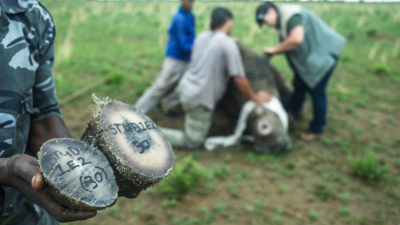
Recently removed rhino horns on a private ranch in the North West province of South Africa.
Recently removed rhino horns on a private ranch in the North West province of South Africa. MUJAHID SAFODIEN/AFP/GETTY IMAGES 

In a deep underground vault somewhere in South Africa is a well-guarded collection of rhino horns, each of which has been weighed, measured, photographed, and tagged with a microchip, and had its DNA sampled, decoded, and recorded in a database. Together, the horns — legally harvested from rhinos raised on private land — weigh 108 kilograms. “In terms of an undervalued asset, it’s madness,” says Alexander Wilcocks, a director of Cornu Logistics, the company that owns the stash.

Wilcocks is referring to the fact that illegally-traded rhino horn — used to make jewelry, or sold as “medicine” with no significant proven effect — is currently one of the most valuable commodities on the planet, going for up to $125 per gram on the black markets of Asia.


The international trade of rhino horn has been banned for decades. But that has not stopped Wilcocks and his partners, supported by South Africans who raise and protect rhinos on their own land, from devising a scheme that could net its investors massive profits should international trade one day be legalized. They’ve launched a new digital currency called Rhino Coin, through which almost anyone can own a share of the horn in Cornu’s vault for about $4 a gram — a tiny fraction of the black market value.


South Africa has by far the world’s largest rhino population, with an estimated 15,000 to 20,000 white and black rhinoceroses. But poachers have been killing more than 1,000 rhinos a year there since 2013, and many of the country’s 330 private rhino owners — who care for more than 7,000 rhinos — say they are going broke paying for security to keep heavily armed poaching syndicates from slaughtering their animals for their horns. By selling Rhino Coin — a virtual currency somewhat like Bitcoin, but backed by rhino horn — Wilcocks says his company can raise capital for rhino protection. It’s “cryptocurrency with a conscience,” he says.

“Private reserves have spent well over 2 billion Rand (about $140 million) from 2009 to the end of 2017 in protecting their animals,” says Pelham Jones, chairperson of the Private Rhino Owners Association. “We desperately require a revenue stream to pay for the conservation of these animals, especially when you put it in the context that we now own about 50 percent of the national herd.”

Rhino Coin lies at the bleeding edge of a debate that has raged for years about legalizing trade in rhino horn, a debate sharpened by ongoing, intense poaching. The international sale of rhino horn has been banned under the Convention on International Trade in Endangered Species (CITES) since 1977, and the domestic trade within most Asian countries, including the major markets of China and Vietnam, has also long been illegal.

The majority of global conservation and animal welfare organizations are dead-set against legalizing trade, believing that it could drastically worsen poaching by generating uncontrollable consumer demand for horn. Conservationists say that the pool of potential Chinese buyers is so large that they would consume legal stocks faster than they could ever be replenished, incentivizing poachers to make up the shortfall. And experts argue that because poached horn products are difficult to distinguish from horn products legally harvested and traded within South Africa, a legal international trade could create conduits for poached horn to find its way to market.

South Africa — unusual among African countries — has a large private wildlife ranching sector. Ranching is a loose term: Some ranchers operate what can only be described as rhino feedlots, where they confine dozens of rhinos to a single corral and give them factory-made feed every day. John Hume, the world’s largest rhino owner with a herd of more than 1,600 animals, keeps many of his animals this way. Hume has heavily backed the Rhino Coin initiative and is the leading contributor of horn to the system.

Other ranchers keep rhinos that are effectively wild, ranging over huge areas and feeding themselves. Almost all rhino ranches need security forces to ward off poachers, who wield increasingly powerful guns and even improvised explosive devices. Deadly firefights are common. Public and private reserves deploy rangers with automatic rifles and grenade launchers, miles of deadly electric fencing, light aircraft and helicopters, as well as military-grade radar, cameras, and listening tools. This has reduced poaching in some reserves. It’s also extremely expensive, hence efforts to raise funds through selling rhino horn.

South Africa placed a moratorium on the in-country trade of rhino horn in 2009 because government agencies found it being used as cover to sell poached horn to international crime syndicates. Despite opposition from conservation groups, well-resourced South African private rhino owners pushed for re-legalizing trade, and last year they won a case in the South African Constitutional Court and overturned the 2009 moratorium.

The government has now constructed somewhat cumbersome systems that can support in-country trade, such as a DNA horn registry, a national database, and a system of permits whereby registered buyers and sellers can legally trade horn within South Africa while the state keeps tabs on the ownership of each one. (Some 860 horns have been traded domestically this year, according to the Department of Environmental Affairs.)

Rhino Coin was launched earlier this year to simplify the process of legally trading horn and to create a revenue stream for rhino owners and rhino conservation in general. “Our concept was that it would be like the gold standard,” says Wilcocks. But his plan uses cryptocurrency traded on the Internet instead of paper dollars, and rhino horn instead of gold. Most Rhino Coin buyers are speculators, betting that the international rhino horn trade ban will one day fall away, and that horn can then be sold at a stupendous markup in Asia.

Under the Rhino Coin scheme, a horn owner places horn into the Rhino Coin system by legally selling it to Cornu Logistics. The horn is weighed to the nearest gram, audited, and placed in Cornu’s vault. One digital token — a Rhino Coin — is created for each gram of horn via blockchain technology, a means of creating a distributed database of records that are verifiable and resistant to corruption. Rhino Coins can be bought with South African Rands by domestic and international buyers and traded on the Cornuex exchange, where their price fluctuates according to supply and demand.

The horn owner is given 54 percent of the Rhino Coins and can retain those tokens or sell them on the exchange for cash at any point. The rest of the coins are allocated to a conservation foundation, a children’s home, and administrative costs, such as horn storage.

Wilcocks says that all the coins generated from the 108 kilograms of horn in Cornu’s vault are in circulation, but that trade volumes have been low because they’ve not been doing any promotion recently. No coins have been redeemed for horn yet. He says he plans to launch a publicity campaign in January to increase interest in Rhino Coin, and an additional 500 kilograms of horns are waiting to be audited to add to the system.

It’s become common for reserves and ranches to de-horn rhinos to lessen the animals’ value to poachers and allow horns to be harvested. Rhinos are typically tranquilized with a dart gun by a veterinarian and their horns painlessly cut off with a small chainsaw a couple of inches above the base. This can be repeated every two or three years as the horns regrow. Jones of the rhino owners’ association estimates that roughly 30 tons of horn are now stockpiled in South Africa — about 10 tons collectively owned by the private sector, and 17 to 20 tons sourced from national parks and other state-owned reserves and held in government vaults.

Jones says that horn from this stockpile, continually replenished from rhino farms, could generate a colossal 65 billion Rand (about $4.5 billion) over five years if legally sold in Asia. (More conservative estimates place the potential value of South Africa’s stockpile at more than $1 billion.)

Many rhino custodians — including certain government conservation agencies and the majority of private rhino owners in southern Africa — feel strongly that legal trade can further incentivize rhino conservation, and that Asian markets can be managed so that uncontrollable consumer demand doesn’t lead to runaway poaching.

But conservation organizations often cite a 2008 legal sale of elephant ivory from Botswana, South Africa, and Zimbabwe to China and Japan as a reason not to sell rhino horn. Like rhino horn, the international trade in ivory had long been forbidden, but in 2008 CITES allowed a strictly regulated “one-off sale.” Even though China rolled out sophisticated safeguards to monitor and control ivory from this sale, these failed, says Colman O Criodain, policy manager of wildlife practice for WWF International. Numerous unaccredited stores and ivory-carving workshops sprung up to take advantage of revived consumer demand, and “there was a parallel illegal market that they were either unwilling or unable to control.”

Elephant poaching and ivory trafficking skyrocketed to supply these illegal outlets; by 2011, at least 15,000 African elephants were being killed annually. Following international pressure, China has cracked down on illegal trade and banned the domestic sale of ivory; elephant poaching rates have since dropped.

Although Hume portrays himself as a rhino-loving conservationist, his motives have often been questioned. He owns tons of horn, and might make hundreds of millions of dollars if he gets to sell it in Asia. He has in the past sold rhinos to be shot by trophy hunters and also has sold the animals to two brothers, who are suspected rhino poachers and horn traffickers, according to the Organized Crime and Corruption Reporting Project.

Some observers say that since buyers can purchase tokens from anywhere, CITES might view Rhino Coin as a form of international horn trade and try to constrain it; after all, the treaty’s text regulates wild species “and their derivatives.” Tom Milliken of TRAFFIC, the wildlife trade research organization, says “I don’t have a lot to say about Rhino Coin other than it is an attempt to get funding to support a private rhino farmer who is quite a controversial figure, but it’s not really mainstream conservation in any sense of the word. It will probably not demonstrate any traction in financial markets as time goes by.”

WWF’s O Criodain says he would not bet on the trade in rhino horn being legalized internationally or within China because of powerful global resistance. Rhino Coin speculators may never realize a profit, he says. He points out that on October 30 the Chinese government announced that it would be lifting the ban on rhino horn use in Traditional Chinese Medicine (TCM), a possible first step to open trade. But it soon backed down under a storm of protest from conservation organizations, announcing on November 12 that “the detailed regulations for implementation” of the October legal change had been “postponed after study” and that the strict ban on sale and use of rhino horn remained in effect. It’s not clear whether regulations to allow TCM use will ever be written.

Although rhino deaths appear to be declining slightly in South Africa this year due to better anti-poaching measures, recorded incursions into reserves and attempts to poach continue to rise because transnational criminal syndicates are still buying horn. Meanwhile, private and government stockpiles continue to grow, further increasing the incentives to sell.


Monday, November 19, 2018

3086. Illegal Tiger Trade Uncovered in the EU

By Tristan Martin, The Guardian, November 19, 2018

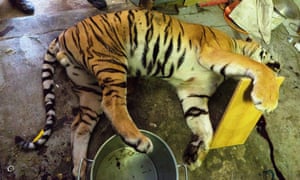
The body of a tiger discovered in in a house in Prague, next to a pot used to cook down tiger parts
The body of a tiger discovered in a house in Prague, next to a pot used to cook down tiger parts. 
Photograph: Handout Czech customs authority

The first thing that hit the inspectors was the smell. It was a sweltering midsummer day in Prague, and they had just opened an unplugged freezer filled with the rotting remains of tigers, lions and cougars. Pavla Rihova, the lead environmental inspector on the scene, said she had never seen anything like it.
“I have been working for the inspectorate 25 years … but the situation there was really horrible. If you can imagine: an old freezer, without electricity, full of meat and dead bodies, in the garden for two years. Absolutely incredible.”
In a shed next to the house they found a freshly killed tiger, shot through the neck so as not to damage its valuable pelt. In the same room was a heavy duty cooking pot on a gas hob, filled with the unidentified meat and bones of animals.
The raid was the culmination of five years of work carried out by the Czech police, customs authorities and environmental inspectorate, who say they have uncovered an organised ring of Czech and Vietnamese criminals illegally killing and processing protected big cats for the traditional Chinese medicine market. Officials across Europe are now beginning to realise that illegal tiger farms are not just a problem in south-east Asia, but are also operating in the middle of the EU.
The trail of evidence began in early 2013, when customs inspectors found a bag of tiger bones in the van of a Vietnamese man who claimed he had received them from a breeding facility in Slovakia. A few months later, the skeletons of two tigers were found concealed within a set of loudspeakers being exported to Hanoi.
As well as tiger remains, authorities were increasingly finding processed products such as tiger wine and broth, which seemed to have originated in the Czech Republic. Concerned about the source of these items, the environmental inspectorate conducted a full inspection of the country’s captive tiger population in 2015.
The movement of tigers across international borders is tightly controlled under international rules, while Czech laws go even further: each birth, death or sale of a tiger has to be recorded and the environmental inspectorate notified.
The inspectors soon realised the paperwork was a mess. Tigers were reportedly being exported multiple times, disappearing altogether, or not having their deaths recorded. Most worryingly, the mortality rate of tigers kept in private facilities was shockingly high. In zoos or in the wild, tigers can live to well over 20 years. In the Czech Republic’s private breeding facilities they were consistently dying before they reached five.
The attention of the authorities turned to Ludvík Berousek, a member of a well-known Czech circus family, who runs the country’s largest breeding facility for tigers and lions. Officially, he breeds big cats to supply circuses, stage shows and petting zoos. Customs officials, however, believed he was also the likely source for the tiger products they were seizing en route to Vietnam.

It took almost two years, but eventually Czech customs and police unravelled the network. At the top was Le Xuan Vu, a Vietnamese trader who would place the orders for the tigers. Berousek would then deliver them to the house of the taxidermist, a Czech hunting enthusiast called Miloš Hrozínek. Together with Vu, Hrozínek would dismember and cook the tigers in his house and shed.
Through covert surveillance operations, the officers understood that the gang could sell cubes of tiger stock, which in Chinese medicine is widely believed to strengthen bones and alleviate arthritis, for €60 (£52) per gram. The skins were worth from €2,000-€4,000 and the claws were worth €100 each. Though much of this product was clearly destined for Vietnam, authorities believe that a significant amount was also traded within the large Czech-Vietnamese community.
Though demand for tiger-based traditional medicine is driven by the Vietnamese population, many of whom arrived as guest workers during Czechoslovakia’s communist era, experts believe it is not the only factor at play. At the same time customs agents were starting to seize tiger products in 2013, there started to emerge a number of “kontaktni zoos” – small private zoos where children can cuddle baby tigers and lions.
“You can use the small tiger or lion cubs only for half a year, or one year, absolutely no longer. Because it is too dangerous for children,” Rihova said. In order to fulfil the growing demand for tiger and lion cubs, it is necessary to breed more and more animals.
When the cubs have outgrown the petting zoos, other businesses such as circuses and stage shows can make use of them for another few years. But once tigers and lions reach full sexual maturity, at four or five years old, they are too big and dangerous for any of these uses. At this point they are worth significantly more dead than alive.
Berousek, Hrozínek and Vu have all been charged with offences related to the illegal killing and trade of protected species. While Hrozínek remains in custody, Berousek and Vu are both out on bail. Berousek continues to operate his breeding facility.

Rihova believes the illegal tiger trade may also be active elsewhere in Europe, and urges the EU to take a more rigorous approach. “The European commission believes that they have an overview of big cats in Europe. But it’s not true,” Rihova says. “Without some registration, some documents, the registered movement of animals from one breeder to another, you cannot have an overview.”
“The world has already lost more than 90% of its tigers,” says Kieran Harkin of the charity Four Paws. “We call on the European commission to protect the endangered tigers and ban commercial trade in captive-bred tigers. Tiger traders and their cruel business should no longer have a place in the EU.”

Wednesday, April 15, 2015

1808. Invasive Species: The Snake That’s Eating Florida

By Clyde Haberman, The New York Times, April 5, 2015
Burmese python consuming a deer it killed in Florida
Ever since a serpent enticed Eve to munch on that forbidden fruit in the Garden of Eden, relations between humans and snakes have been at best strained. But at least the gullible Eve and her mate had to cope with just the one snake. In South Florida, wildlife officials have struggled for years with tens of thousands of the creatures: specifically, a species known as the Burmese python, an interloper from Southeast Asia that has taken up what looks like permanent residence in Everglades National Park and other areas of the state.

This is some snake. At full maturity, a Burmese python routinely reaches lengths of 12 feet or more. Twenty-footers weighing 250 pounds are not unheard-of. The pythons are prodigious breeders, with voracious appetites to match. They are believed to have eaten their way through the Everglades, bringing about startling changes in the ecosystem. 

Some mammals native to those marshes, like foxes and rabbits, seem to have disappeared, researchers say. Other species — among them raccoons, deer, opossums and bobcats — are close to being wiped out. Pythons that migrated from the mainland to Key Largo have put indigenous wood rats in mortal peril.

Retro Report, a series of video documentaries exploring major news stories of the past, trains its lens on the dawning realization more than a dozen years ago that the Burmese python had the potential to alter Florida’s environment far more than people realized. But the issue is really greater than one breed of Asian snakes that ran wild after being imported into the country as pets. The United States is awash in invasive species exacting a heavy toll on native wildlife and vegetation. The list of intruders is long. To name but a few, they include Argentine tegus, large lizards that feast on sea turtle eggs; venomous lionfish from Asia, which prey on local varieties of fish; Nile monitor lizards from Africa, which love to eat frogs and crocodile eggs; zebra mussels from Russia, which harm waterways and damage water treatment plants; and Asian carp, which threaten the environmental balance of the Great Lakes.

Florida draws much of the attention because its swamps and tropical climate provide splendid shelter for all sorts of creatures that are not supposed to call this country home. The state, as more than one person has observed, is the Ellis Island of exotic species.
Like many animals previously unknown on the North American continent, the Burmese python arrived through the pet trade. (Language purists might reasonably ask if it is fair to describe these snakes as invasive. It is not as if they barged in on their own. People created the problem.) At least two million constrictor snakes — boas, anacondas and pythons — are believed to have been imported since the 1970s, part of a lucrative market for exotic species. Miami is an important hub for this trafficking.

One issue with Burmese pythons is that people cavalierly bought them when they were maybe a foot long. In short order, those little fellows grew to eight feet, 12 feet, 16 feet. Talk about buyer’s remorse. Unable to deal with these giants, owners often dumped them wherever seemed feasible. One way or another, snakes in South Florida found their way to the Everglades. There, they multiplied, again and again. Recent estimates by the National Park Service put the numbers there as high as 100,000. Walter E. Meshaka Jr. was the supervisory curator for national parks in southern Florida from 1995 to 2000. Even back then, Mr. Meshaka told Retro Report, the question was whether the python population would explode. And, he said, “Lo and behold, it did.”

Quite possibly, some experts in the field suggest, the local wildlife has been slow to appreciate the menace. “It’s probably a safe assumption that things like raccoons and possums probably don’t associate snakes with being something that really is a major threat to them,” Michael E. Dorcas, a herpetologist at Davidson College in North Carolina, said in a 2012 interview with Yale Environment 360, an online publication of the Yale School of Forestry and Environmental Studies. “Because,” Mr. Dorcas continued, “there really hasn’t been a snake big enough to eat a raccoon living in Florida for about 18 million years.”

While the python is more of a direct threat to native birds and animals than to people, attacks on humans are not unknown. One of the more horrifying instances occurred in 2009 when a 2-year-old girl in northern Florida was strangled by a Burmese python that belonged to her mother’s boyfriend. This eight-foot snake, which was later found to have been severely malnourished, broke free, coiled itself around the girl and squeezed her to death. Both the mother and the boyfriend were held responsible — convicted of manslaughter and sentenced to 12 years in prison.

The authorities in Florida have tried getting the unwelcome reptile population under control, but to little avail. A couple of years ago, they organized a Python Challenge, a come-one, come-all snake hunt on state land near Everglades National Park. It put barely a dent in the python population; no more than a few dozen of them were captured. Pythons have shown themselves to be masters of stealth. In a rather glum assessment, the United States Fish and Wildlife Service said in a statement last month that “scientists have not found any way of eradicating invasive constrictor snakes once they become established in the wild.” Some experts say the best hope to kill these creatures en masse may be a deep and prolonged freeze in southern Florida. Of course, everyone would then worry about the devastating effect on the state’s citrus crop.

Should other sections of the country start fretting about possible python incursions of their own? Yes, say some scientists who predict that, in coming decades, the invaders could slither their way across one-third of the United States — perhaps even reaching New York City by 2100. Other experts, however, wave off such fears as overblown.

The Obama administration has chosen to take a stand. Three years ago, the Fish and Wildlife Service banned imports and interstate transport of four species of constrictors: Burmese pythons, yellow anacondas and northern and southern African pythons. Last month, the prohibition was extended to four other species: reticulated pythons, DeSchauensee’s anacondas, green anacondas and Beni anacondas. (Boa constrictors, an important component of the pet snake trade, were spared a ban.) Not surprisingly, reptile sellers and breeders are not happy with the restrictions, with slippery slopesters among them warning that all kinds of animals, including more familiar household pets, could become the next government target.

Effective or not, the import bans are a recognition that some species labeled invaders were invited in by humans. It is a reality reminiscent of a famous line from no less than a swamp creature: the possum Pogo, whose name was the title of Walt Kelly’s long-running comic strip. Referring to unwelcome environmental change, Pogo said, “We have met the enemy and he is us.”