Showing posts with label Water Scarcity. Show all posts

Monday, June 18, 2018

2949. As many as 600 Million Face Water Scarcity in India

By Maria Abi-Habib and Hari Kumar, The New York Times, June 17, 2018
Shimla’s population essentially doubles during the summer tourist season, increasing the strain on the water supply.CreditSaumya Khandelwal for The New York Times
SHIMLA, India — The people of Shimla haven’t agreed on much lately. A drought in the Himalayan resort has had residents blaming farmers, the tourism industry and one another for depleting the strained water supplies.

And everyone’s been angry at the key men.

Shimla’s decrepit network of water pipes, built under British colonial rule more than 70 years ago, depends on the civil servants known as key men to open and close the valves that supply each neighborhood. The current shortage, which in May left some homes without water for 20 days, has led to such fury toward the key men — accused, in just about every neighborhood, of depriving it of its fair share — that a court ordered police protection for them.

“I was getting angry phone calls calling me everything — stupid, worthless — at one or two in the morning,” said Inder Singh, 44, who has been a key man for 24 years. “I would be mobbed by dozens as I was trying to leave my home for work,” he said, inserting his key — a meter-long metal contraption — into the ground to open a valve.

Tourism is the mainstay of the economy in this mountain city, which the British colonial authorities made their summer capital so they could escape the brutal heat of New Delhi. But the drought — accompanied by unusually high temperatures, above 90 degrees Fahrenheit — has been so severe that in May, some residents took to Twitter to ask tourists to stay away and leave the water for local residents. Many in Shimla call it the worst shortage they can remember.

As much as 30 percent of the city’s hotel bookings have been canceled since last month because of concerns about the water supply, said Sanjay Sood, the president of northern India’s hotel and restaurant association. Some of those reservations were canceled by tourists, others by the hotels themselves.

Water tankers have been lined up at hotels along Shimla’s windy mountain roads. A slogan on one of them read, “If there is water, there is a tomorrow.”

A government report released on Thursday said that India was experiencing the worst water crisis in its history, threatening millions of lives and livelihoods. Some 600 million Indians, about half the population, face high to extreme water scarcity conditions, with about 200,000 dying every year from inadequate access to safe water, according to the report. By 2030, it said, the country’s demand for water is likely to be twice the available supply.
In Shimla, rising annual temperatures and dwindling rain and snowfall — the city’s main water sources — have been major factors in the crisis.

“There’s global warming all over India, and Shimla is no exception,” said Vineet Chawdhry, chief secretary of the state of Himachal Pradesh, whose capital is Shimla.
But the city’s ancient pipe system also leaks five million liters of water every day, Mr. Chawdhry said in an interview in his office. A $105 million, World Bank-backed upgrade of the system, including a pipeline drawing water from a nearby river, is scheduled to be finished in 2023.

The strain on the water supply increases greatly during the summer tourist season, when Shimla’s population essentially doubles. In the summer months, Mr. Chawdhry said, the city typically needs 45 million liters a day. He said the current daily supply stood at 31 million liters, and at the height of the crisis in May it was as low as 22 million.

Shimla is not the only Indian city whose water supplies are under increasing pressure. Last year was the country’s fourth hottest since record-keeping began in 1901, with rainfall down by nearly 6 percent from 2016, according to the Indian Ministry of Earth Sciences.

And many of the country’s cities have outdated water distribution systems, said Rajendra Singh, founder and chairman of Tarun Bharat Sangh, a conservation group. India has also fallen short on conservation measures like capturing rainfall and snowmelt, he said.

“There are around 90 cities in India which are water stressed. They face crisis today, tomorrow and the day after,” Mr. Singh said. “Shimla got more media attention, but many areas are facing water scarcity.”

That includes the capital, New Delhi. This year, in the city’s chronically water-deprived neighborhood of Wazirpur, a father and son died after a scuffle broke out among people waiting in line for a tanker.

Rahul Kumar, 18, was fatally injured in the fight in the grueling March heat, which began when a neighbor accused him and his brother of jumping the line. His father, Lal Bahadur, 60, died of a heart attack after trying to intervene, the authorities said.

Mr. Kumar’s mother, Sushila Devi, said that Wazirpur had run out of water in January — earlier in the season than usual. Other Wazirpur residents said that in the rare instances when tap water flows, it is dirty and undrinkable.

“My husband and son died because of water,” Ms. Devi said.
On a hot recent afternoon in Wazirpur, neighbors lined up again with empty jugs waiting for a government-supplied tanker. This time, as the tanker arrived, an older man directed the crowd, to make sure it was orderly.

“I do a public service,” the man said. “After the fight we came together in the neighborhood and made this system of queuing.”

But there were still tense moments. “Why is your pot so big? It’s too big!” one woman yelled at another. “It’s fine,” the other woman snapped back.

In Shimla, the water crisis has eased since last month. Municipal officials divided the city into three zones in late May, distributing water to them on a rotating basis so that none would go without for more than two days. Residents complained that the city had been slow to act, but over all, tensions have decreased.

“Namashkar!” residents yelled cheerfully to Mr. Singh, the key man, from their balconies as he made his rounds recently. Mr. Singh returned the traditional greeting, but he said they hadn’t always been so nice.

He said he was cursed and shouted at during the worst days of the crisis, but never physically attacked. But some of the city’s 61 other key men were held down by mobs and forced to keep the water on, municipal officials said.

The pandemonium moved Shimla’s High Court to act. It ordered that key men be supervised to ensure that they were not giving favorable treatment to hotels or V.I.P.s. The acting chief justice went into the streets personally to watch some of them work.

“The key man not only holds the key, but in fact, by the strength of the key, he can put the entire town to ransom,” the court said in its ruling this month.

The court also ordered that every key man be escorted by two police officers while on duty to ensure their safety. Some key men — surrounded by a veritable entourage — said they had never felt so important in their lives.

Monday, February 20, 2017

2561. Film Review: On the World Water Crisis

By Hydrationanywhere.com, April 1, 2016
Photo: Wall Street Journal
Fresh water is the vital resource without which no life on this planet would be possible – yet the amount of this unequivocally essential element grows more scarce each year. With human activities increasingly polluting fresh water beyond recoverable means through industrial and agricultural pollution, and with corporate and government interests working to privatize and commoditized the most valuable ingredient for life, increasingly water scarcity becomes more and more of a problem across the globe.

The impacts of this scarcity and decreasing availability of fresh water are felt most directly by those people in areas where water is most difficult to come by. Water-borne diseases thrive in areas where the impoverished lack proper sanitation or access to clean fresh water sources, accounting for up to 80% of all disease in developing nations. But even in the developed world, the diminishing supply of freshwater is causing terrible problems all its own, with waters tainted with fertilizers and agricultural waste, industrial by-products, and pharmaceutical drugs and their metabolites.

We took the time to watch five leading documentaries which aim to examine the world water crisis. These documentaries look at everything from where our water comes from to the political issues surrounding the current water issues and everything in between. While there is certainly some overlap between the themes and content of these documentaries, watching one or all of them will leave viewers with a good overview of some of the many issues contributing to the looming world water crisis.

Blue Gold: World Water Wars

Blue Gold World Water Wars Documentary CoverTaking a detailed look at the world’s shrinking supply of fresh water, Blue Gold: World Water Wars goes into great depth about the impacts of human activity on the world water supply. Looking at problems as diverse as top soil erosion, agricultural runoff industrial pollution, the impacts of dams and rerouting waterways and more, the film does a good job of highlighting the effects humanity has on its environment and how these effects are ultimately contributing to water scarcity.

The documentary also takes a close examination of the problems of water privatization, and how corporate and political interests are working to make a profit by controlling the supply of fresh water. Going into great detail about different issues faced across the globe as the result of attempts at privatization, this documentary is perhaps one of the best on this list for examining the role of corporate power in the world water crisis.

Based on the book “Blue Gold: The Fight to Stop the Corporate Theft of the World’s Water” the documentary certainly succeeds in living up to the subtitle, providing enlightening details about the ongoing struggle to kick corporate influence out of the world’s water management.

Tapped

Tapped Bottled Water Documentary Movie CoverFocusing on the environmental, political, and social impacts of the bottled water industry Tapped provides a fascinating window into the corporate and political climate in the United States which has allowed corporations to vastly exploit natural water resources. Exploring issues ranging from the pollution created by the bottles themselves to the efforts by corporations to create dependencies on bottled water, to the environmental impact of bottling operations on already dwindling fresh water resources, to the quality of bottled water itself.

An exceptionally well-produced and well-researched documentary, Tapped is an extremely informative 75-minute watch. It includes informative interviews with leading experts, scientists, and industry leaders. Of particular interest are the experiments explained in the documentary where laboratories analyzed water after storage in plastic bottles and demonstrated a range of contaminants.

Check out the trailer below. You can purchase or rent the film on Amazon.

FLOW: For Love Of Water

FLOW For Love Of Water World Water Crisis Documentary Movie Cover
The cleverly entitled FLOW is another look at the growing privatization of water resources across the globe. Identifying and describing the different parts and mechanisms behind the growing world water cartel, the documentary provides a good look into the environmental hazards of human activities of all descriptions.

With a look at climate change, the decreasing amount of fresh water, the exploitation of the water resources, companies attempts to capitalize on growing pollution, and raising a fundamental question about the morality of bottled water, FLOW paints a damning picture of human impacts and the corporate contribution to the growing water crisis.

Check out the trailer below or purchase or rent the movie on Amazon.

Bottled Life

Bottled Life The Truth About Nestles Business With Water Documentary Film Cover
Much like the film Tapped above, Bottled Life peers into the troubles being raised by the bottled water industry and their attempts to privatize water resources across the globe. Where Tapped narrows its focus onto the United States but looked at a spectrum of water bottling companies, Bottled Life instead narrows the focus specifically onto bottling giant Nestle while taking a broader and more international scope.

Identifying the problems created by Nestle’s activities on both a local and global level, the documentary succeeds in demonstrating the painful consequences of exploiting global water resources. Creating unnecessary waste, polluting water sources, harming local water supplies, and unnecessarily transporting water across the globe for profit, Bottled Life points the finger at Nestle as a major culprit in a growing world water crisis.

Check out the trailer below to get a glimpse at the film. You can purchase or rent the movie on Amazon. It is also available for free for Netflix subscribers.

PBS Frontline: Poisoned Waters

Frontline Poisoned Waters American Water Crisis Documentary Movie Cover
From season 27 of acclaimed PBS documentary series Frontline, Poisoned Waters provides an in-depth look at the growing water pollution epidemic across the United States. Focusing on the devastating ecological impact of pollutants in America’s waterways, the documentary includes a horrifying look at the impact of pollution on animal life and landscapes.

Going into detail about the growing variety of chemical contaminants, the documentary examines scientific evidence to demonstrate the human- and animal-health impacts from the growing contamination of waterways. With a broad scope focusing on both drinking water and non-potable water, the documentary provides an extremely educational tour of human impacts on water resources. Anyone who wants an in-depth look at why pollutants are being created, what they are and do, and how they pollute water resources should definitely check out this documentary.

Tuesday, February 16, 2016

2207. Global Scarcity of Fresh Water Worse Than Thought, Study Finds

By Andrea Germanos, Common Dreams, February 12, 2016
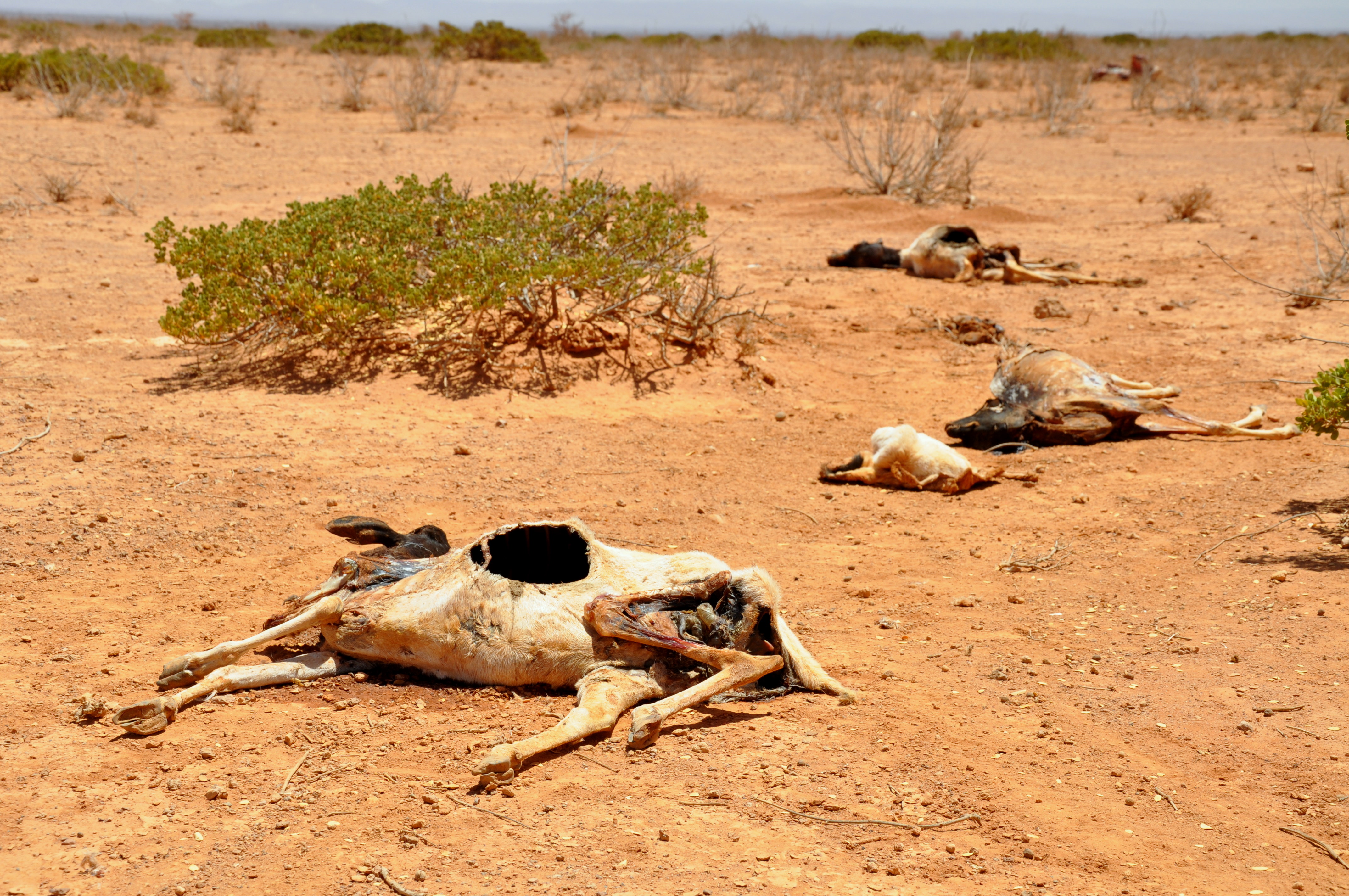
2011 drought in the Horn of Africa
A new analysis reveals that global water scarcity is a far greater problem than previously thought, affecting 4 billion people—two-thirds of the world's population—and will be "one of the most difficult and important challenges of this century."

Previous analyses looked at water scarcity at an annual scale, and had found that water scarcity affected between 1.7 and 3.1 billion people. The new study, published Friday in the journal Science Advances, assessed water scarcity on a monthly basis, more fully capturing the specific times of year when it could be an issue.

"Water scarcity has become a global problem affecting us all," stated study co-author Arjen Hoekstra, a professor of water management at the University of Twente in the Netherlands.

The study found that almost half of the 4 billion affected by severe water scarcity for a month or more are in India and China. Millions of others affected live in Bangladesh, Nigeria, Pakistan, and Mexico.

The United States is far from immune to the problem, with 130 million people affected by water scarcity for at least one month a year, mostly in the states of Texas, California, and Florida. And among the rivers the study notes that are fully or nearly depleted before reaching their end is the Colorado River in the West.

There are also half a billion people who face severe water scarcity year round, the analysis found.

From study:
Direct victims of the overconsumption of water resources are the users themselves, who increasingly suffer from water shortages during droughts, resulting in reduced harvests and loss of income for farmers, threatening the livelihoods of whole communities. Businesses depending on water in their operations or supply chain also face increasing risks of water shortages. Other effects include biodiversity losses, low flows hampering navigation, land subsidence, and salinization of soils and groundwater resources.
The study concludes that "[m]eeting humanity’s increasing demand for freshwater and protecting ecosystems at the same time. . . will be one of the most difficult and important challenges of this century."

The new publication follows a pair of NASA studies led by researchers from the University of California Irvine that showed that the impacts of global warming along with growing demand has caused the world's water supply to drop to dangerous levels.
"The water table is dropping all over the world," Jay Famiglietti, senior water scientist at NASA’s Jet Propulsion Laboratory, said at the time. "There's not an infinite supply of water."

"We need to get our heads together on how we manage groundwater," Famiglietti added, "because we’re running out of it."

Friday, February 13, 2015

1730. Starved for Energy, Pakistan Braces for a Water Crisis

By Salman Masood, The New York Times, February 12, 2015
In Islamabad residents compete for scare water brought in by a truck
ISLAMABAD, Pakistan — Energy-starved Pakistanis, their economy battered by chronic fuel and electricity shortages, may soon have to contend with a new resource crisis: major water shortages, the Pakistani government warned this week.

A combination of global climate change and local waste and mismanagement have led to an alarmingly rapid depletion of Pakistan’s water supply, said the minister for water and energy, Khawaja Muhammad Asif.

“Under the present situation, in the next six to seven years, Pakistan can be a water-starved country,” Mr. Asif said in an interview, echoing a warning that he first issued at a news conference in Lahore this week.

The prospect of a major water crisis in Pakistan, even if several years distant, offers a stark reminder of a growing challenge in other poor and densely populated countries that are vulnerable to global climate change.

In Pakistan, it poses a further challenge to Prime Minister Nawaz Sharif, whose government has come under sharp criticism for failing to end the country’s electricity crisis. In some rural areas, heavy rationing has meant that as little as four hours of electricity a day is available.In the interview, Mr. Asif said the government had started to bring the electricity crisis under control, and predicted a return to a normal supply by 2017. But energy experts are less confident that such a turnaround is possible, given how long and complex the problem has proved to be.

Now the country’s water supply looms as a resource challenge, intensified by Pakistan’s enduring infrastructure and management problems.

Agriculture is a cornerstone of the Pakistani economy. The 2,000-mile-long Indus River, which rises in the Himalayas and spans the country, feeds a vast network of irrigation canals that line fields producing wheat, vegetables and cotton, all major sources of foreign currency. In the north, hydroelectric power stations are a cornerstone of the creaking power system.

A combination of melting glaciers, decreasing rainfall and chronic mismanagement by successive governments has put that water supply in danger, experts say.

In a report published in 2013, the Asian Development Bank described Pakistan as one of the most “water-stressed” countries in the world, with a water availability of 1,000 cubic meters per person per year — a fivefold drop since independence in 1947, and about the same level as drought-stricken Ethiopia.

“It is a very serious situation,” said Pervaiz Amir, country director for the Pakistan Water Partnership. “I feel it is going to be more serious than the recent oil shortages.”

Shortages of resources have climbed to the top of the political agenda in recent years. Fuel shortages last month, for which government officials blamed mismanagement by the national oil company, caused lengthy lines outside fuel stations that embarrassed the government at a time of low global oil prices.

Mr. Sharif’s government was already grappling with the seemingly intractable electricity crisis, which regularly causes blackouts of 10 hours a day even in major cities. And Mr. Sharif has been visibly distracted by grueling political duels, with the opposition politician Imran Khan, who accuses him of stealing the 2013 election, and with powerful military leaders who have undermined his authority in key areas.

Mr. Asif, the water and energy minister, said the government had started to turn the corner. But he acknowledged that the country’s resource problems were, to a large degree, endemic. “There is a national habit of extravagance,” he said, noting that it extended across resource areas, whether gas, electricity or water.

“I will be very careful not to use the word ‘drought,’ but we are water stressed right now, and slowly, we are moving to be a water-starved country,” he said.

Evidence of chronic water shortages have been painfully evident in some parts of Pakistan in recent years. A drought caused by erratic rainfall in Tharparkar, a desert area in southern Sindh Province, caused a humanitarian emergency in the region last year.

“The frequency of monsoon rains has decreased but their intensity has increased,” said Mr. Amir of the Pakistan Water Partnership. “That means more water stress, particularly in winters.”

Water is also tied to nationalist, even jihadist, politics in Pakistan. For years, religious conservatives and Islamist militants have accused rival India, where the Indus River system rises, of constricting Pakistan’s water supply.

Hafiz Saeed, the leader of the militant group that carried out the 2008 attacks in Mumbai, India, Lashkar-e-Taiba, regularly rails against Indian “water terrorism” during public rallies.

Mr. Asif said that contrary to such claims, India was not building reservoirs on rivers that flow into Pakistan. “We will never let it happen,” he said, citing the Indus Water Treaty, an agreement between the two countries that was brokered by the World Bank and signed in the 1960s.

One major culprit in Pakistan’s looming water crisis, experts say, is the country’s inadequate water storage facilities. In India, about one-third of the water supply is stored in reservoirs, compared with just 9 percent in Pakistan, Mr. Amir said.

“We built our last dam 46 years ago,” he said. “India has built 4,000 dams, with another 150 in the pipeline.”

Experts say the country’s chaotic policies are hurting its image in the eyes of Western donors who could help alleviate the mounting resource crises.

“The biggest looming crisis is of governance, not water — which could make this country unlivable in the next few years,” said Arshad H. Abbasi, a water and energy expert with the Sustainable Development and Policy Institute, a research group based in Islamabad.

Monday, March 17, 2014

1354. United States: West’s Drought and Growth Intensify Conflict Over Water Rights

By Michael Wines, The New York Times, March 16, 2014
Under restrictions, a Mumford, Tex., farm on the Brazos River could not draw water from it, while cities and power plants could. CreditIlana Panich-Linsman for The New York Times
MUMFORD, Tex. — Across the parched American West, the long drought has set off a series of fierce legal and political battles over who controls an increasingly dear treasure — water.
Just outside this minuscule farm town, Frank DeStefano was feeding a 500-acre cotton crop with water from the Brazos River 16 months ago when state regulators told him and hundreds of others on the river to shut down their pumps. A sprawling petrochemical complex at the junction of the Brazos and the Gulf of Mexico held senior rights to the river’s water — and with the Brazos shriveled, it had run short.
State regulators ordered Mr. DeStefano and others with lesser rights to make up the deficit. But they gave cities and power plants along the Brazos a pass, concluding that public health and safety overrode the farmers’ own water rights.
Now Mr. DeStefano and other farmers are in court, arguing that the state is wrong — and so far, they are winning.
“I understand cities need water, people need water, but it kind of gets to me how agriculture is pushed to the back of the line,” he said. “We’re on pins and needles wondering when the next call is going to be made. It’s hard enough to make a living without things like this.”
Residents of the arid West have always scrapped over water. But years of persistent drought are now intensifying those struggles, and the explosive growth — and thirst — of Western cities and suburbs is raising their stakes to an entirely new level.
In southern Texas, along the Gulf coast southwest of Houston, the state has cut off deliveries of river water to rice farmers for three years to sustain reservoirs that supply booming Austin, about 100 miles upstream. In Nevada, a coalition ranging from environmentalists to the Utah League of Women Voters filed federal lawsuits last month seeking to block a pipeline that would supply Las Vegas with groundwater from an aquifer straddling the Nevada-Utah border.
In Colorado, officials in the largely rural west slope of the Rocky Mountains are imposing stiff restrictions on requests to ship water across the mountains to Denver and the rest of the state’s populous eastern half. Fearing for their existence, Colorado farm towns on the Arkansas River have mobilized to block sales of local water rights to Denver’s fast-growing suburbs.
In Arizona, activists and the federal government are fighting plans to tap groundwater used by a vast housing development — a move that would reduce the water level of a protected river. Kansas accuses Colorado and Nebraska of allowing their farmers to divert Kansas’ share of the Republican River, which flows through all three states. A similar dispute between New Mexico and Texas is before the United States Supreme Court.
California, in the midst of a major drought, so far has witnessed but a few local skirmishes. In January, environmentalists and sport fishermen sued to halt the drilling of hundreds of new groundwater wells sought by Central Valley farmers, saying more pumping would lower stream levels.
That may not last long, said Stuart Somach, a Sacramento water-rights lawyer. California farmers have long grumbled about big-city designs on their water; Northern California has long grumbled about being the spigot that supplies most of the water to the dry south.
“We’re very close to the time that people are going to start staking out rights. We’re right at the cusp,” Mr. Somach said. “If this drought persists, depending on how state and federal agencies react, you’re going to get some real conflicts going.”
In many places, the rules for owning or using groundwater are still in flux: In Texas, landowners own the groundwater beneath their property, but a neighbor pumping groundwater from the same aquifer can siphon it away without penalty. The Arizona court battle over a proposed housing development hinges on the still-murky question of whether the state can allow the builder to pump groundwater that sustains a river that is under federal control.
In contrast, the prevailing law on rivers and streams is all too clear: The earlier someone stakes a claim on a stretch of water, the more bulletproof that owner’s right to it.
“If you’ve got the oldest claim on that river, you get to use that water regardless of what you’re using it for — agriculture, industry, whatever,” said Gabriel Eckstein, a professor at Texas A & M University School of Law and a lawyer with Sullivan and Worcester. “That’s regardless of whether you’re doing it efficiently, regardless of whether it’s the highest use.”
In the rural West of days past, when even arid climes held enough water for everyone, that principle worked well. In the booming West of today, it is increasingly a recipe for conflict.
The Lower Colorado River Authority decided last month to cut off water deliveries to rice farmers after concluding that two reservoirs supplying Austin and other upstream towns were dangerously low — at about 38 percent of capacity. The farmers had no recourse, because they had no water rights: They had sold them to the authority decades ago.
The cutoff nevertheless has come to underscore the tinderbox relationship between the state’s rural past and its urban future. At a packed hearing before an administrative law judge last month, farmers and others downstream complained that they were surrendering their water while Austin residents continued to wash their cars, groom golf courses and water their lawns, albeit only once a week under water-saving restrictions.
Urbanites argue that drinking-water reservoirs were not intended to irrigate farms, a point the farmers contest, and that recreational businesses along the reservoirs are going bankrupt. A town on one of the reservoirs, Lake Travis, has to truck in water to keep taps flowing, they say.
“The tensions exist in every river basin in the state,” Jason Hill, a water-rights lawyer now representing the Texas city of San Angelo in another rights dispute, said. “You don’t really know the value of something until you run out of it and know you want it again. And water has historically been an underappreciated resource.”

Across Texas, as in Austin, rural interests clearly are waging a rear-guard battle. The Texas Water Development Board, the state’s planning agency, figures that cities’ demand for water will rise nearly 75 percent by 2060, while the use of water for irrigation will decline by 17 percent. By then, cities — not farmers — will be the dominant consumers of water.
But the farmers are not giving up without a fight.
In 2011, the Texas Legislature gave a nod to that shifting priority, authorizing the state’s Commission on Environmental Quality to suspend water rights in emergencies like droughts. While the commission still had to allot water to rights holders in order of seniority, the Legislature said, it also could consider — as much as was practical — how that water was being used before ordering a rights holder’s pumps shut off.

A year later, when drought left the Dow Chemical Company’s Freeport petrochemical plant short of Brazos River water, the company asked the commission to honor its 83-year-old water rights and to order more recent users to make up its shortage.
And the commission did — but only after deciding that 66 Texas towns and electric utilities should be exempted from a cutoff for health and safety reasons, even though hundreds of farmers and others who lost their water held more senior rights. Indeed, court documents state, the exempted towns and utilities held rights to 96 percent of the water affected by Dow’s claim. The remaining 4 percent, mostly farmers like Mr. De Stefano, lost all right to irrigate their crops until the suspension ended several weeks later.
In the ensuing lawsuit, Mr. DeStefano and others argued that the commission could not pick winners and losers when enforcing water rights enshrined in law. “State law says that first in time, first in right. That means what it says,” said Joshua Katz, an Austin lawyer representing the farmers’ interest. Prudent cities, he said, do what prudent farmers do to brace for drought: They buy more senior water rights.
A trial court sided last year with the farmers, and the case is on appeal. But should the region’s drought not let up, people here say, further lawsuits in Texas and across the West are all but inevitable.

“It truly is a good time to be a water attorney in Texas,” said Mr. Hill, the lawyer in San Angelo dispute. “There’s work here as far as the eye can see.”

Tuesday, March 11, 2014

1348. Meat Makes the Planet Thirsty

By James McWilliam, The New York Times, March 7, 2014
Credit: The New York Times, Sarah Mazzetti
Austin, Tex. — California is experiencing one of its worst droughts on record. Just two and a half years ago, Folsom Lake, a major reservoir outside Sacramento, was at 83 percent capacity. Today it’s down to 36 percent. In January, there was no measurable rain in downtown Los Angeles. Gov. Jerry Brown has declared a state of emergency. President Obama has pledged $183 million in emergency funding. The situation, despite last week’s deluge in Southern California, is dire.
With California producing nearly half of the fruit and vegetables grown in the United States, attention has naturally focused on the water required to grow popular foods such as walnuts, broccoli, lettuce, tomatoes, strawberries, almonds and grapes. These crops are the ones that a recent report in the magazine Mother Jones highlighted as being unexpectedly water intensive. Who knew, for example, that it took 5.4 gallons to produce a head of broccoli, or 3.3 gallons to grow a single tomato? This information about the water footprint of food products — that is, the amount of water required to produce them — is important to understand, especially for a state that dedicates about 80 percent of its water to agriculture.
But for those truly interested in lowering their water footprint, those numbers pale next to the water required to fatten livestock. A 2012 study in the journal Ecosystems by Mesfin M. Mekonnen and Arjen Y. Hoekstra, both at the University of Twente in the Netherlands, tells an important story. Beef turns out to have an overall water footprint of roughly four million gallons per ton produced. By contrast, the water footprint for “sugar crops” like sugar beets is about 52,000 gallons per ton; for vegetables it’s 85,000 gallons per ton; and for starchy roots it’s about 102,200 gallons per ton.
Factor in the kind of water required to produce these foods, and the water situation looks even worse for the future of animal agriculture in drought-stricken regions that use what’s known as “blue water,” or water stored in lakes, rivers and aquifers, which California and much of the West depend on.
Vegetables use about 11,300 gallons per ton of blue water; starchy roots, about 4,200 gallons per ton; and fruit, about 38,800 gallons per ton. By comparison, pork consumes 121,000 gallons of blue water per ton of meat produced; beef, about 145,000 gallons per ton; and butter, some 122,800 gallons per ton. There’s a reason other than the drought that Folsom Lake has dropped as precipitously as it has. Don’t look at kale as the culprit. (Although some nuts, namely almonds, consume considerable blue water, even more than beef.) That said, a single plant is leading California’s water consumption.
Unfortunately, it’s a plant that’s not generally cultivated for humans: alfalfa. Grown on over a million acres in California, alfalfa sucks up more water than any other crop in the state. And it has one primary destination: cattle. Increasingly popular grass-fed beef operations typically rely on alfalfa as a supplement to pasture grass. Alfalfa hay is also an integral feed source for factory-farmed cows, especially those involved in dairy
If Californians were eating all the beef they produced, one might write off alfalfa’s water footprint as the cost of nurturing local food systems. But that’s not what’s happening. Californians are sending their alfalfa, and thus their water, to Asia. The reason is simple. It’s more profitable to ship alfalfa hay from California to China than from the Imperial Valley to the Central Valley. Alfalfa growers are now exporting some 100 billion gallons of water a year from this drought-ridden region to the other side of the world in the form of alfalfa. All as more Asians are embracing the American-style, meat-hungry diet.
Further intensifying this ecological injustice are incidents such as the Rancho Feeding Corporation’s recent recall of 8.7 million pounds of beef because the meat lacked a full federal inspection. That equals 631.6 million gallons of water wasted by an industry with a far more complex and resource-intensive supply chain than the systems that move strawberries from farm to fork.
This comparison isn’t to suggest that produce isn’t occasionally recalled, but the Rancho incident reminds us that plants aren’t slaughtered, a process that demands 132 gallons of water per animal carcass, contributing even more to livestock’s expanding water footprint.
It’s understandable for concerned consumers to feel helpless in the face of these complex industrial and global realities. But in the case of agriculture and drought, there’s a clear and accessible action most citizens can take: reducing or, ideally, eliminating the consumption of animal products. Changing one’s diet to replace 50 percent of animal products with edible plants like legumes, nuts and tubers results in a 30 percent reduction in an individual’s food-related water footprint. Going vegetarian, a better option in many respects, reduces that water footprint by almost 60 percent.
It’s seductive to think that we can continue along our carnivorous route, even in this era of climate instability. The environmental impact of cattle in California, however, reminds us how mistaken this idea is coming to seem.

James McWilliams is a professor of history at Texas State University and the author, most recently, of “The Politics of the Pasture: How Two Cattle Inspired a National Debate About Eating Animals .”