Showing posts with label U.S. imperialism and Latin America. Show all posts

Saturday, April 6, 2019

3218. Hands Off Venezuela

By Bruce Lesnick, Socialist Action, April 4, 2019
Rally in Caracas on March 30 against the imperialist-abetted coup. (Ariana Cubillos / AP)
When you corner a rat, it lashes out. The rats in charge of the U.S. empire are cornered by the contradictions built into their own system: increasing economic inequality, regular depressions and recessions, declining profit rates, perpetual austerity, and endless wars promoted to stave off increasing global competition. The current vicious U.S. assault on Venezuela—along with the ongoing attacks on working people here at home—are what it looks like when the imperial rat lashes out.
The Trump administration has openly declared the goal of regime change in Venezuela. Such an aim is illegal under international law. The mere threat of aggression is “not only an international crime; it is the supreme international crime differing only from other war crimes in that it contains within itself the accumulated evil of the whole.”
But U.S. hostility toward that sovereign, independent nation did not begin with the current administration. In a classic case of what Malcolm X called “turning the victim into the criminal,” Barack Obama declared a state of emergency in January of 2017 asserting that Cuba and Venezuela were national security threats to the U.S.
What is the reason for U.S. hostility toward Venezuela, a country that has never threatened any other, let alone the U.S.? Simply put, the popularly elected Chavez and Maduro governments have failed to blindly adhere to U.S. neoliberal economic priorities and imperial dictates. As the CIA acknowledged: “Social investment in Venezuela during the Chavez administration reduced poverty from nearly 50% in 1999 to about 27% in 2011, increased school enrollment, substantially decreased infant and child mortality, and improved access to potable water and sanitation through social investment.”
Naturally, big business and the U.S. government they control couldn’t stand idly by while a country in their very “back yard” followed a road that, however tepidly and imperfectly, took steps that hinted at prioritizing human needs over private profits. A series of executive orders and sanctions, beginning under the Obama administration and continuing under Trump, have sought to economically strangle the Venezuelan people.
From freezing Venezuelan gold and U.S. dollar reserves held in foreign accounts, to blocking the sale of oil, Venezuela’s chief hard currency export, the impact on the Venezuelan economy is estimated to be upwards of $20 billion in 2018 alone. Together these sanctions amount to a criminal siege, according to UN Special Rapporteur for Venezuela, Alfred de Zayas.
This was followed by a U.S.-sponsored coup attempt on Jan. 23, 2019, when President Trump announced U.S. recognition of opposition politician Juan Guaidó as the “legitimate” president of Venezuela. This was despite Guaidó’s never having run in a presidential election.
Mainstream media complicity
To cover up its illegal aggression, the U.S. attempted to stage the delivery of “humanitarian aid” at the Columbian and Brazilian borders with Venezuela on Feb. 23. Venezuelan officials denounced the stunt as a “Trojan Horse,” noting that U.S. Special Envoy Eliot Abrams, who was promoting the phony aid drop, was known for concealing weapons in planes with Red Cross markings in support of the Contras—anti-Nicaraguan government mercenaries supported by the U.S. in the 1980s.
The phony aid drop was stopped by Venezuelan troops. Near opposition groups escorting the aid, one of the trucks caught fire. Video footage from the scene by Telesur showed opposition supporters starting the fire. Nevertheless, The New York Times, CNN and other mainstream media, plus John Bolton, Marco Rubio and Mike Pompeo, blamed the fire on the Venezuelan government forces for two weeks after the incident.
Only after the lie had been sufficiently spread and reinforced did The Times reverse itself on March 10, acknowledging that the same video published widely by Max Blumenthal of The Grayzone and by other alternative media sites weeks earlier proved that Venezuelan troops were not responsible for the fire.
The Times barely paused before spreading additional misinformation in a story entitled, “‘It Is Unspeakable’: How Maduro Used Cuban Doctors to Coerce Venezuela Voters.” The story was calculated to smear the Venezuelan and Cuban governments, as well as thousands of Cuban doctors and teachers who have volunteered to provide concrete, legitimate aid to the Venezuelan people.
Nine days later, Fairness and Accuracy in Reporting (FAIR) published a piece thoroughly debunking the Times story. Entitled, “Pathological Deceit: The NYT Inverts Reality on Venezuela’s Cuban Doctors,” the FAIR piece concludes, “the New York Times’ Andes bureau chief mobilizes anonymous sources and defectors—whose testimony ranges from dubious to preposterous—to further demonize Venezuela and provide cover for Washington’s murderous regime change policy.”
Multi-faceted attack
The next move in the imperial assault on Venezuela came on March 7 with a cyber-attack on Venezuela’s power grid.
According to Venezuela’s Telesur, “An ongoing series of cyber attacks were perpetrated starting Thursday against the El Guri hydroelectric plant control system leaving the Venezuelan population without electricity for now almost 96 hours. According to the Venezuelan government, this nationwide blackout was brought about by foreign-backed actions aimed at destabilizing the government [of] President Nicolás Maduro, who stressed that the aggression ‘affected everyone equally without political distinction.’”
As noted in a March 9 story in Forbes, the U.S. has long had plans for disrupting the infrastructure of “uncooperative” nations: “Interrupting power and water supplies, disrupting traffic patterns, slowing or interfering with internet access, causing smart homes to go haywire and even remotely triggering  meltdowns at nuclear power plants were all topics increasingly being discussed in the national security community at the time as legitimate and legal tactics to undermine a foreign state.”
The Cuban government issued a strong statement condemning the attack:
“The Revolutionary Government strongly condemns the sabotage perpetrated against the power supply system in Venezuela, which is a terrorist action intended to harm the defenseless population of an entire nation and turn it into a hostage of the non-conventional war launched by the government of the United States against the legitimate government headed by comrade Nicolás Maduro Moros and the civic and military union of the Bolivarian and Chavista people.”
Genuine aid
On March 25, The Wall Street Journal reported that two Russian military planes had landed in Caracas: “The Russian delegation, made up of 100 soldiers and military officials, arrived over the weekend to provide technical consultations linked to arms that Venezuela previously had purchased from Moscow, according to Russian state media. One of the planes carried 35 tons of unspecified equipment, said a security consultant with close ties to Caracas.”
Russia, Cuba and China have also delivered humanitarian aid in cooperation with the Venezuelan government. Telesur reported, “China delivered 65 tons of medicine and supplies to Venezuela Thursday as a result of strategic cooperation between the two countries. The delivery of aid is one of many, according to government officials.”
According to Nicolás Maduro, as quoted in the Feb. 19 edition of El Periódico, “On Wednesday, 300 tons of Russian humanitarian aid will be legally delivered to the international airport of Caracas.” The article continues, “He also insisted that the donations made by the United States and Colombia at the request of the Venezuelan Parliament, which has an opposition majority, and that is blocked at the border, are outdated and contaminated food.
“‘The issue of humanitarian aid is a show, it is a hunting trap, they rob us 30 billion dollars and they offer us 20 million in rotten food, contaminated, to try to intervene in Venezuela,’ he insisted while asking the Colombian president,, Ivan Duque, and the American, Donald Trump, stop the ‘madness.’”
Revolutionary socialists fully support the right of the Venezuelan government to obtain military, technical, and humanitarian aid from wherever they choose. One does not have to agree with every policy of the Maduro government to understand the stakes in the current conflict and to loudly demand: End the Sanctions! U.S. Hands Off Venezuela!

Monday, March 11, 2019

3209. The Path to Climate Justice Passes Through Caracas

By David Swartzman and Quincy Saul, Counterpunch, March 11, 2019
Caracas, February 2011: Hugo Chavez celebrating the 12th anniversary of the taking office as the President of Venezuela
It is critical to understand how blocking the regime change agenda with respect to Venezuela is integrally connected to confronting the challenge of climate change.
Fighting the Media War
Today we are all witness to the subversion and slander of one of our best hopes. Venezuelans call it “the media war.” Karl Marx called it “the war of calumny undertaken by the lying power of the civilised world,” and went on to describe how “all the sluices of slander at the disposal of the venal respectable press were opened at once to set free a deluge of infamy in which to drown the execrated foe. This war of calumny finds no parallel in history for the truly international area over which it has spread, and for the complete accord in which it has been carried on by all shades of ruling class opinion.”
These words of Marx describe an older media war –  a war against the International Workingmen’s Association, which later became known as The First International. Today they could be applied seamlessly to the media war against the democratically elected government of Venezuela and the revolutionary process it represents. And the comparison is historically and politically sound, because Venezuela was host to the founding in 2017 of the First Ecosocialist International– a piece of world news which has been all but completely drowned out in the furor to topple the only government in the world which has laid out a comprehensive plan for an ecosocialist mode of production “to preserve peace in the planet and save the human species.”
It hurts us to read and write about Venezuela today. A tyrannous troika of mendacity, ignorance and laziness rules with near impunity in the world or journalism; from Fox News to the BBC, from CNN to the Guardian, from Amnesty International to the Committee to Protect Journalists, from John Oliver to Jacobin Magazine. We would much prefer to write about how we have been moved to joy and courage and compassion by the mass popular democratic movements in this country. We would prefer to write about the sense of goodwill, hope, and inspiration which emanates from the grassroots Venezuelan revolutionary process. As Che Guevara said, revolutionaries are guided by great feelings of love.
The central purpose of this article is to discuss how the Green New Deal and other climate justice initiatives in the global north have so much to learn and gain from the Bolivarian revolution. But before we can trace this connection, before we can share our love, the way must be cleared of the deception which prevents hearts from beating together across borders. In the face of the scorn which is being heaped upon the Venezuelan revolution today, we must enter the fray and draw our pens to fight in this media war. If our language is sharp, it is because we are at war, a war which calls for sound and fury commensurate to the tales told by idiots.
Will the real shithole countries please stand up?
As many other commentators have detailed, the self-proclaimed interim president Juan Guaido – for whom billions of dollars belonging to the Venezuelan people have been expropriated by US and British banks – is a virtually unknown figure in Venezuela,. He simply declared himself sovereign, not even during an election year, and not according to any law. The speed and shamelessness with which the leaders of so many countries have abandoned any pretense to democracy, in their official recognition of Guaido, is rather remarkable. But let’s start by clarifying that this rejection of representative democracy only currently afflicts a minority of the world.
Once the EU came out for Guaido, it really seemed to some people for a moment that the whole world was against Maduro and against democracy in Venezuela. While most are not quite as shameless as Bono, a lot of people in the USA and Europe still really do believe that “we are the world.” However the fact fremains that it is only a minority of the world’s population which has tossed democracy into the dustbin of history. No one in Africa or Asia has recognized Guaido as legitimate. Is it that these countries don’t count? (Do black lives matter?)
There is something to be learned from this. A map compiled by Venezuela Analysis reveals, for anyone who cares to investigate, who the real shithole countries are. Perhaps we should not be surprised. In the moment when so-called liberal democracies around the world elect fascist leaders, they have reminded us that democracy is not on their agenda. So be it: Vassal states of the world unite! You have nothing to lose but your souls.
Neither Guaido nor Maduro?
With that said, a few paragraphs are also necessary to address certain sources, in Venezuela and internationally, who reject both the ongoing coup attempt, and also the current government: “Neither Guaido nor Maduro!” This discourse too must be discerningly dissected before we can lay the basis for solidarity between global climate justice activists and the Venezuelan revolutionary process.
There is a strange phenomenon taking place in the international left media, in which leftish reporters seem to be getting all their news from the right. Even Amy Goodman stooped to this in an interview with Venezuelan foreign minister Jorge Arreaza, citing studies by the IMF and Human Rights Watch, each of which has a well-documented history of sowing chaos and counterinsurgency in Venezuela. But the prize for a leftwing newspaper with a rightwing research wing goes to Jacobin. “Maduro was not democratically elected,” proclaimed a recent article– a lazy lie which has been repeated about every single election in Venezuela since Chavez first came to power, despite extensive reports and denunciations of international observers. [1] Phrases such as “the extent of popular power in Venezuela has diminished significantly in recent years” are published without a trace of evidence. In the hegemony of “human interest”  journalism, personal anecdotes eclipse historical analysis, and no one seems to note the demonstrations of thousands of people in support of Maduro. It is a surreal situation in which the masses of working-class Venezuelans are invisibilized in favor of solidarity with their simulacra.
Here’s another gem from Jacobin: “Opposition to Maduro is now common not only among upper and middle classes (as it has been for some time), but also among the popular sectors. Polls indicate that most Venezuelans want Maduro out”. The first claim is unsubstantiated in any way. Widely available videos and photos of opposition demonstrations reveal quite the opposite – they are lily white and racist to boot; they wave US and Israeli flags, and glorify Trump. And then a poll carried out by a think tank based in Washington DC is cited as an example of Venezuelan popular will! But perhaps it is folly to focus on this magazine which rejects the politics of its namesake; which emerged from Trotskyism only to wind up as the loyal opposition to multicultural capitalism.[2] Better to focus on other voices, which are taken more seriously on the international stage.
When it comes to the radical Venezuelan anti-Chavista/anti-Maduro intellectuals on the left, it is our experience that these voices are restricted to the marginal enclaves of the urban intelligentsia. These perspectives are articulated, in our experience, by professional intellectuals without organizations or bases; those who Antonio Gramsci called “‘vanguards’ without armies to back them up, ‘commandos’ without infantry or artillery.” But to an undiscerning foreign observer, especially those who read only English, these voices carry a greatly disproportionate weight compared to the forces they represent within Venezuela. We’ll limit ourselves to one example. Edgardo Lander is one of the more honest critics. (We share and applaud his ecosocialist philosophy, but not any of his arguments or tactics in relation to the government in the current conjuncture.) He admits in a recent article: “It’s not much more than a dozen people so it’s more of an opinion group… We aren’t a party, we don’t have a lot of people we can call upon to rally but we manage to have some impact in terms of public opinion… To be honest, the Citizen’s Platform itself has no mass capacity to mobilise”. Thus it is disconcerting and deplorable to observe the analysis of these isolated intellectuals repeated abroad – from Amandla Magazine in South Africa to ecosocialist collectives in South Asia – as if they were the spokespeople of the revolutionary masses.
Let’s be clear – critiques of the bourgeois, colonial state and the political economy inherited by the Chavista regime are rich and diverse throughout the country; these critiques are articulated mostly by outspoken Chavistas, who very often quote Chavez and Maduro on this subject. But we have yet to encounter a grassroots mass movement which denounces the Maduro government as illegitimate or authoritarian. The accusation of “authoritarianism” in the name of international solidarity is odd alongside near-total silence about the constant killings of social movement leaders in neighboring countries,and especially odd when it comes from people who are citizens of countries that are engaged in systematic torture and outrageous war crimes. While authoritarianism can be diversely defined, we will not deign to denounce claims that the Venezuelan government is a dictatorship; the so-called radical critics are invited to consult a dictionary.
We earnestly ask these radical anti-Chavistas – what purpose do their words serve in the current conjuncture? With which grassroots movements are they concretely in solidarity? Do they write for foreign NGOs or for popular newspapers? Who benefits when ecosocialists like Lander stage meetings with proto-fascists like Guaido? These “radical critics” who are lionized abroad but have no significant popular support at home, appear to want to criticize their cake and eat it too; to live in a revolutionary process but criticize it from the academic sidelines. Meanwhile, for those anti-Chavista critics living in the United States, it is difficult to stomach the spectacle of their posturing: Good citizens of a ruthless empire which is actively working at every level to overthrow a foreign democratically elected government, who take it upon themselves to denounce that foreign government for not being “radical enough”. Who is not being radical enough, really?
In this deeply complex and decisive historical moment, we share the humility of Lenin when he said: “I don’t know how radical you are, or how radical I am. I am certainly not radical enough. One can never be radical enough; that is, one must always try to be as radical as reality itself.” We too would like to witness the demolition of the bourgeois state, and the abandonment of the rentier petroleum and mining economies which are a legacy of colonialism. But we don’t believe a new mode of production can emerge by making demands and denunciations. We are not particularly outraged that Chavez and Maduro have failed to reverse 500 years of colonialism in a couple decades of a constitutional revolution. We struggle for solidarity with a path towards the future based on the realities of the world we live in today. Our 2015 proposal for the solarization of the Venezuelan economy and Mercosur (“An Ecosocialist Horizon for Venezuela; A Solar Communist Horizon for the World”) outlines such a proposal.
The Green New Deal in World-Systemic Perspective
One of us has been writing extensively for over a decade about how a Green New Deal (GND) should be embraced by ecosocialists as a site of class struggle.[3] Now that the GND is getting a lot of attention as a potential prevention program to avoid catastrophic climate change, it is important to note the contributions of the Green Party of the United States (GP) to making the link between the GND, climate change and the U.S. imperial agenda. Howie Hawkins, an ecosocialist, ran for Governor of New York with a GND in his platform starting in 2010, and the two Presidential campaigns of Dr. Jill Stein, which brought the vision of a GND to the attention of millions, made a significant impact. The GP’s  GND includes cutting the military budget and ending the imperial U.S. foreign policy which is in utter contradiction to the agendas of both the Republican and Democratic Party leadership. Nevertheless, there is growing dissent in Congress with Rep. Ilhan Omar (D-MN) vigorously challenging Elliot Abrams in a recent hearing, along with Sen. Bernie Sanders (I-VT), Rep. Tulsi Gabbard (D-HI), and Rep. Ocasio-Cortez (D-NY) standing out. And because of the assassination of Khashoggi and their murderous war in Yemen, the U.S./Saudi alliance is now under attack in Congress.
But in the Western Hemisphere, foreign policy consensus still prevails, so the Democratic leadership is currently giving a pass to the Trump coup threat to Venezuela. Only someone completely brainwashed by the imperial mass media can believe that this regime change agenda is actually in place because of humanitarian concerns – with Trump, Pompeo, Bolton and the war criminal from the Reagan era Elliot Abrams at the helm, noting that Venezuela has the biggest oil reserves in the world. There is little doubt that these political instruments of militarized fossil capital want this oil extracted. In an interview on Fox Business, Trump’s National Security Adviser John Bolton was open about the US- led coup in Venezuela being motivated by oil and corporate interests. Bolton said, “We’re looking at the oil assets…We don’t want any American businesses or investors caught by surprise. …we’re in conversation with major American companies now that are either in Venezuela, or in the case of Citgo here in the United States…It will make a big difference to the United States economically if we could have American oil companies really invest in and produce the oil capabilities in Venezuela. We both have a lot at stake here making this come out the right way.”
Venezuela has the largest proven oil reserves in the world: “With 300,878 million barrels of proven reserves, Venezuela has the largest amount of proven oil reserves in the world. The country’s oil is a relatively new discovery. Previously, Saudi Arabia had always held the number one position.  The oil sand deposits in Venezuela are similar to those in Canada. Venezuela also boasts plenty of conventional oil deposits. Venezuela’s Orinoco tar sands are significantly less viscous than Canada’s, so the oil sands there can be extracted using conventional oil extraction methods, giving it a considerable advantage over the Northern American rival in terms of capital requirements and extractions costs.” (World Atlas: World’s Largest Oil Reserves by Country”)
Extraction of this huge reserve would be a climate killer, while defeating the imperial agenda driving the Venezuela coup will potentially make an important contribution to global climate security. Venezuela must be left to determine her own destiny, making possible an alternative scenario, upon which the fate of the biosphere may hinge: that most of the oil reserve will stay in the ground, while a small fraction will be used as an energy source for a solar energy transition for Latin America. While Venezuela’ leaders may continue brag about their huge reserve, they surely know that most of it must remain in the ground to be consistent with Venezuela’s own ratification of the Paris Agreement, not to mention its own Plan of the Homeland, recognizing that much more radical curbs on greenhouse gas emission than presently committed are imperative to keep warming below the goal of 1.5 degrees centigrade.
As a major oil producer, Venezuela has the potential to significantly contribute to a solar energy transition, using this fossil fuel with the lowest greenhouse gas emission ratio to energy consumed as an energy source to replace itself. Venezuela could lead a wind/solar power transition in Latin America using a small fraction of her liquid petroleum reserves, while still gaining revenue from oil exports as well as contributing to the same energy transition globally. Implementing this approach would be a critical component of Venezuela’s self-identified path of ecosocialist development. The proven reserves of conventional light to heavy oil in Venezuela are estimated to be 39 billion barrels, (excluding 259 billion barrels of extra heavy oil in the Orinoco basin)[4], although the further expansion of this reserve has been neglected in recent years, particularly since the downturn in the economy following the sharp fall in the price of oil and sanctions regime imposed by the U.S. We have estimated that it is possible to reach the goal of ending energy poverty – necessary for a high quality of life for 400 million people in what were the Mercosur countries – and moreover that this can be achieved in 15 years or less, using 0.15 billion barrels of this oil per year to create a solar power infrastructure.[5]
But of course militarized fossil capital has other plans –  namely the destruction of the Bolivarian Revolution, coupled with extracting this huge oil reserve, regardless of the climatic and environmental consequences. And Cuba is explicitly next on the list for regime change; the fossil empire continues to plot the elimination of this example of ecosocialist transition, noting her vigorous conversion to agroecologies and cooperative ownership.[6]
And not coincidently, the US imperial regime change agenda is also aimed to Iran, which ranks 4th in proven oil reserves with 158,400 million barrels, behind U.S. allies Saudi Arabia and Canada.[7] Europe is resisting U.S. pressure to terminate the Iran nuclear deal, but in a reprise of the Monroe Doctrine, Europe is now supporting the U.S. regime change agenda.
Only a resurgent global movement can block this outcome. This challenge should be considered by climate and energy justice activists, and all those supporting the GND initiative in the US Congress, the growing Sunrise movement in particular. Finally, blocking the Trump coup against Venezuela would be an important step to undermining the power of the Military Industrial Complex. The US military is both the biggest polluter and also the biggest obstacle to freeing up resources necessary for a robust GND and creating a global regime of cooperation – so necessary to avoid catastrophic climate change in the ever-shrinking time we have left.
However, we must be on our guard, and be careful students of history. Like the New Deal before it, the GND’s devils are in its details. The New Deal famously left out women and African Americans, and less famously sealed the systematic de-radicalization of the US labor movement.[8] Similar dangers present themselves to climate justice activists today in the context of the GND. All the more reason to engage in the debates and struggles around and for the GND, as we have insisted from the beginning; not as a compromise, but as a class struggle.
Conclusion
Over a decade ago, one of us wrote: “The path to climate security must pass through Gaza, i.e., climate security for humankind will only be achieved with the end of the Israeli blockade of Gaza, termination of Israeli apartheid regime, and the full realization of the individual and collective rights of the Palestinian people.”
The argument still stands, more than ever. Today, noting the historic solidarity between the Venezuelan revolutionary process and the Palestinian people, we must add that the path to climate justice must pass through Caracas; i.e., climate justice for humanity will only be achieved if the world’s largest reserves of fossil fuels are mobilized for a continental and then global energy transition; that this is only possible with the termination of the US war of counterinsurgency and destabilization against the Venezuelan government, allowing them to focus their attention on the full realization of an ecosocialist mode of production. The legal, scientific and spiritual mandate for this ecosocialist revolution are articulated by the government in the Plan of the Homeland (2013-2019) by an independent coalition of scientists in the National Strategy for the Conservation of Biodiversity (2010-2020) and by the global grassroots alliance constituted in the First Ecosocialist International (2017-2517).
Does anyone who is serious about global climate justice have another proposal? Those who “stand for” neither Guaido nor Maduro are not forthcoming with a strategy to prevent climate catastrophe. Venezuela is the only country in the world with the energy resources and political-legal structure necessary to launch a revolutionary global energy transition against its class enemies. (Perhaps those who despise Maduro would prefer to trust the infrastructure development necessary for climate justice to the royal family of Saudi Arabia?) The international left has still not awoken to the fact that the largest oil reserves in the world are under the legal control of an ecosocialist government, whose current supreme power is neither Guaido’s national assembly nor Maduro’s executive government, but a constituent assembly composed of representatives of the working classes. It’s past time to wake up.
Those of us around the world who are looking for a way to save the biosphere, from Extinction Rebellion to the Sunrise Movement to the Green New Deal, should make it a top priority to join in concrete solidarity with both the revolutionary process of Venezuela and the government it has repeatedly elected. The farcebook spectacle of dueling proclamations of “I stand with” / “I stand against” (when it is obvious to all concerned that everyone is in fact sitting down in front of their computers) would be funny if the stakes weren’t so high and the consequences so tragic. Not only history, but the geologic record itself, will record our actions and inactions in defense of climate justice, whose fate is played out today on the streets of Caracas. Meanwhile, the people of Haiti are showing the world what real international solidarity looks like – thousands of people in the streets.[9]
The path to climate justice passes through Caracas, but it doesn’t stop there. It passes through and into the countryside, where a radical rural renaissance is taking place with the formation of ecosocialist communes in every bioregion. A new socio-territorial order, as called for by Chavez in his final “Strike at the Helm” speech to his ministers, and a return to Mother Earth, as articulated in the Combined Strategy and Plan of Action of the First Ecosocialist International, awaits the solidarity it deserves.
David Schwartzman is the co-author of The Earth is Not for Sale.
Endnotes.
[1]  Jacobin goes on to list a number of “frauds,” each one of which is parroted from the bourgeois press: Jacobin uncritically cites CNN, BBC, and the Wall Street Journal. Each of these claims has been denounced in detail by reporters and journalists. Like the cartography of an empire imagined by Jorge Luis Borges, a comprehensive denunciation of each of these articles would necessarily be as long as the original articles themselves. The monolingual culture of the US left is no excuse; each of these allegations have been extensively covered on Venezuela Analysis and Telesur English, among other sources. With international solidarity like this, who needs counterinsurgency?
[2] A more honest standard of Trotskyism is upheld by the Fourth International. We do not agree with much of this either, but a full counter-analysis is not possible within the confines of this essay. We can only suggest that it takes a serious study of dialectics and the inter-penetration of opposites, to begin to understand philosophically how the far left joins forces with the far right in moments of historical crisis.
[3]  “Green New Deal: An Ecosocialist Perspective,” by David Schwartzman, Capitalism Nature Socialism, 2011. See also the presentation “Green New Deal: System Change and Energy Transition,”2014, among others.
[4]  IESA (2016). Venezuela Energy in Figures 2014-2015, Instituto de Estudios Superiores de Administración, Venezuela, p. 21.
[5]  Schwartzman, D. and Saul, Q. (2015). An Ecosocialist Horizon for Venezuela: A Solar Communist Horizon for the World, Capitalism Nature Socialism, 26 (3), pp. 14-30. The current production of crude oil in Venezuela (January 2019) is 1.5 million barrels/day, equivalent to 0.5 billion barrels/year, a decline from 0.9 billion barrels/year in 2016;  https://tradingeconomics.com/venezuela/crude-oil-production.
[6]  See chapter 8 in Schwartzman, P. and D. Schwartzman. 2019. The Earth is Not for Sale: A Path Out of Fossil Capitalism to the Other World That is Still Possible. Singapore: World Scientific.
[8]  “Whose New Deal? The New Deal from the Standpoint of its Victims,” by Quincy Saul, Smashthisscreen, 2011 http://smashthisscreen.blogspot.com/2011/03/whose-new-deal.html
[9] “Haiti’s Unfolding Revolution is Directly Linked to Venezuela’s,” by Kim Ives, Haiti Liberte, February 2019: https://haitiliberte.com/haitis-unfolding-revolution-is-directly-linked-to-venezuelas/

Friday, March 8, 2019

3207. U.S. Gears Up for War on Venezuela

By Jeff Mackler and Bruce Lesnick, Socialist Action, March 5, 2019
February 19 protest in Santo Domingo, D.R., against U.S. intervention in Venezuela. 
Photo: Tony Savino / Socialist Action
The relentless U.S. imperial beast has embarked on a full-scale, openly declared, bipartisan regime-change war aimed at overthrowing Venezuela’s democratically elected government headed by President Nicolás Maduro.
Top U.S. officials—from President Donald Trump, Vice President Mike Pence, National Security Adviser John Bolton and special envoy Elliot Abrams of Iran/Contra infamy, to Democratic House Speaker Nancy Pelosi and pretend socialist Bernie Sanders—almost daily take to the airwaves, with the world’s corporate media cheering in lockstep, insisting that “all options are open,” including overt war via direct U.S. military intervention.
Sanders demanded that Venezuela open its borders to “humanitarian aid,” while DSA Democrat Alexandria Ocasio-Cortez waffled on the issue.
There are only two sides in the present conflict, period. One either supports the victory of the Maduro government over the U.S. onslaught, or one sides with the imperialist aggressors. There is no third option! And since the imperial U.S. war machine serves the same wealthy 1% that is responsible for cutbacks, austerity, exploitation, repression, and devastation in the U.S., the effects of a defeat of the Venezuelan people would be keenly felt by all working people here at home. This is why we must mobilize to demand:
• U.S. Out Now!
• End the Sanctions!
• Hands Off Venezuela!
President Trump’s most determined thrust toward war was set for Saturday, Feb. 23, at the Colombian border town of Cúcuta and at a manufacturing site at the Brazilian border, where U.S.-financed and orchestrated “humanitarian aid” conveys attempted to force their way into Venezuela, without success. The move was thwarted by Bolivarian National Guard forces and thousands of Venezuelan workers, peasants, and youth who blockaded the various bridges leading into their country.
The planned imperialist intervention was designed to serve as spectacular media opportunity depicting “murderous” Maduro forces turning back unarmed “humanitarian aid” trucks filled with food and medical supplies bound for the “starving people” of Venezuela.
Center stage in this crudely-orchestrated scenario was assigned to the U.S. and CIA-appointed puppet “president” Juan Guaidó, who slipped into Colombia to lead what was touted as a massive rebellion against the Venezuelan government. The high point of the event was projected to be mass desertions from the Bolivarian Armed Forces and Guaidó’s return to Venezuela, via a U.S. escort to be sure, as the nation’s new president. A vivid eyewitness account was presented by the weekly Latin American Summary (Resumen LatinoAmericano) in a Feb. 23 on-the-scene article entitled, “Bolivarian Venezuela Scores Another Strategic Victory”:
“Suddenly, as they rolled across the bridge on the Colombian side, they [the “aid” trucks] were set on fire by a group of guarimberos [road blockers] who sprayed the vehicles with gasoline while they were being filmed and photographed by many reporters.
“But since the hegemonic media are the violent advance units of mass mind poisoning, they invented another matrix of lies by accusing Chavismo supporters of starting the fire. What’s more, they told us that it was the members of the Bolivarian National Guard, who were stationed far from the scene, who were to blame for this clumsy action. And this morning every major corporate news agency from the National Public Radio (NPR), New York Times, Washington Post, BBC, the Guardian on down were reporting this as the gospel.
“What they didn’t say is that the thugs ‘hired’ by the opposition addicted to Guaidó and protected by the Colombian police (there are videos on the internet as evidence) became irate because things didn’t go well and they didn’t get paid their agreed upon fees. That’s why a hooded mob gave the ‘contractors’ a good beating. This also happened to Guaidó supporter Congressman José Antonio Olivares, who was hit in the face and head by a group shouting, ‘thieves, pay what you promised.’”
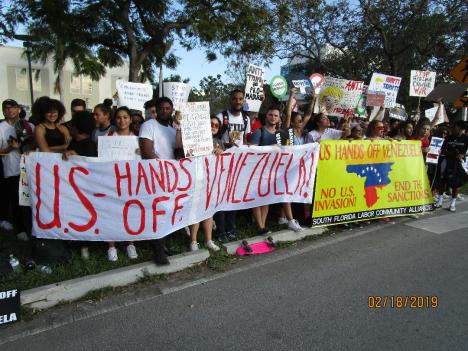
March 2019 Venez. Miami (Marty)
Hands Off Venezuela demonstration in Miami, Fla., on Feb. 18. (Photo: Marty Goodman / Socialist Action)
In a Feb. 27 address to the UN Security Council, Venezuelan Foreign Minister Jorge Arreaza claimed that some of the “aid” trucks sent to Colombia’s border with his country were found to contain nails and wire—which could be used in constructing barricades. He produced photographs to back up his assertions.
Antiwar activists may remember how in the 1980s President Ronald Reagan’s Deputy National Security Adviser, Elliot Abrams, and his CIA cohorts used planes with fake Red Cross markings to send arms to the Contras, who were fighting to overthrow the popular government in Nicaragua, violating U.S. and international law in the process.
In the end, Guaidó, who now calls for direct U.S. military intervention, was compelled to admit that his “humanitarian aid” gambit was a failure, as was his boast that 600,000 Venezuelans would mobilize in Caracas to demand the government’s resignation. The small groups that did take to the streets in Caracas threw rocks at government soldiers. Guaidó’s claim that some 400 Venezuelan soldiers had deserted to his side was left unsubstantiated; the Venezuelan government put the figure at 20.
U.S. economic warfare
While Guaidó’s hoped-for triumphant re-entry into Venezuela as the nation’s savior proved to be farce, the real war waged by the U.S. against Venezuela remains deadly serious. The sanctions and related economic measures imposed by the U.S. against oil-rich Venezuela have been draconian, if not unprecedented. These include instructions to all U.S. banking institutions to seize hundreds of billions of dollars in Venezuelan accounts and transfer the funds into accounts payable to puppet president Guaidó.
The details of this have been well documented. Here it is sufficient to report that the full force of the U.S. leading capitalist banking elites, from the Bank of America to the J.P. Morgan Chase financial behemoths, have joined in stealing funds generated from the sale of Venezuelan oil in the U.S. and around the world. Add to this the U.S.-pressured decision of the British ruling class to sequester Venezuelan gold deposited in British banks to the tune of $1.3 billion, and the severing of Venezuelan access to the world’s lending institutions, and you have nothing less than a U.S.-led war against the Venezuelan people.
Indeed, a U.S. Army document published in September 2008 by Wikileaks demonstrates that the U.S. government sees economic aggression as a key component of its warfare strategy.
On Feb. 25, Vice President Pence demanded that all Latin American countries “freeze the assets of Venezuela’s state oil company, PDVSA.” Pence, according to the Feb. 25 New York Times, “also warned some countries in the region that have conspicuously sought to remain neutral in the crisis convulsing Venezuela that they cannot remain so, singling out Mexico and Uruguay.” The endlessly pontificating and threatening Pence declared, “We believe there can be no bystanders. No one on the sidelines of this, particularly in our hemisphere.”
Despite Guaidó’s abject failure at the border, the U.S. persists in demanding that its allies accept Venezuela’s being effectively expelled from the world economy. Insisting on the present legitimacy of the historic U.S. imperial credo embodied in the Monroe Doctrine of 1823, Trump’s partisan warmakers proclaim that Venezuela is today situated in the U.S. “backyard” and, therefore, barred from exercising its sovereign rights as a nation.
In the same breath, they assert that Venezuela’s dire economic straits, including major food and medical shortages and a raging inflation, are of Venezuela’s own making! “The nation with the largest oil reserves in the world,” according to the cynical imperialist interveners, “can’t feed its own people.” Nothing could be further from the truth!
Pence announced that U.S. military planes were consciously violating Venezuelan airspace to find future “humanitarian aid” access routes into Venezuela from Brazil and Colombia.
“There is no turning back,” Pence insisted, declaring that, as in Libya, where U.S./NATO and allied forces from Qatar and other Gulf State monarchies destroyed the infrastructure of that nation and murdered thousands, including its president Muammar Gadhafi, the U.S. was seeking to construct yet another “coalition of the willing” to do its bidding.
With the world’s largest oil reserves, Venezuela makes a prime target for U.S. profit-hungry corporate titans. However, there’s another dimension to the current aggression. U.S. oligarchs, who represent a tiny portion of the population but wield the lion’s share of political and economic power, cannot abide any group stepping out of line, be it at home or abroad. Though they pretend to support democracy, in truth, democratic rule by the majority is to the ruling rich like a cross to a vampire. They will never give up their power and privileges voluntarily, regardless of the wishes of the other 99% of the population.
The current attack on Venezuela demonstrates what happens when a majority democratically decides to defy the dictatorship of the wealthy 1%: at such a time, those at the top shed their democratic masks and strike out with vicious, deadly force. While mobilizing today to defend Venezuela’s democratic right to self-determination, working people in the U.S. would do well to remember this lesson of who really supports democracy and who really promotes violence.
The U.S. is no newcomer to engineering coups in Venezuela. Its 2002 effort, backed to the hilt by the Bush administration, lasted for 48 hours and included the arrest of President Hugo Chavez by a core team of U.S.-paid generals. In the intervening hours before massive mobilizations forced Chavez’s release, the coup makers passed 49 decrees abolishing the government’s progressive social measures while privatizing Venezuela’s oil industry, all in the name of returning the country to economic and social stability.
Similarly, the U.S.-engineered 1973 coup against the popular Salvador Allende government in Chile put the rightist General Augusto Pinochet in power. Capitalist stability was restored by Pinochet’s slaughter of 60,000 Chilean workers herded into a sports arena or otherwise murdered out of public view. The string of U.S.-backed coups in the region also includes Haiti in 1991 and 2004 and Honduras in 2009.
Cuba calls for worldwide mobilizations
Anticipating the possibility of another such regime-change slaughter, the Cuban newspaper Granma published a government statement entitled, “It is imperative to halt the imperialist military adventure against Venezuela.” Cuba’s revolutionary government called for massive worldwide mobilizations in support of Venezuela’s sovereignty.
On Feb. 23, the “humanitarian aid” invasion date set by Trump and Co., an estimated 150 antiwar protests, mostly in the U.S., demanded, “U.S. Hands Off Venezuela!” and “No to a U.S. Coup!” The Oakland, Calif., demonstration of 200 activists, initiated by a broad range of antiwar and social justice forces, including the United National Antiwar Coalition (UNAC), won the unanimous endorsement of the delegates to the San Francisco Central Labor Council, AFL-CIO.
To the consternation of U.S. officials, Cuba, as well as Iran, Russia, and China—all sanctioned or threatened with severe economic measures by the U.S.—joined forces to deliver tons of food and medical supplies to beleaguered Venezuela. Russian and Chinese agreements to expand purchases of Venezuelan oil are justly seen by the Maduro government as vital and widely viewed, regardless of motivation, as mutually beneficial.
Estimates of the cost of the U.S. economic war against Venezuela exceed $7 billion this year and is expected to rise to $30 billion in the years ahead.
No doubt the solidarity of revolutionary Cuba, itself invaded (in 1962), embargoed, and blockaded by the imperialist beast for nearly 60 years, is widely seen among Latin America’s working masses as an example of socialist politics in action. It was revolutionary Cuba that, along with Venezuela in 2005, when Hurricane Katrina had devastated much of New Orleans, offered to send serious humanitarian aid to the people of that city, including vast numbers of doctors and medical supplies. U.S. officials rejected this “no strings attached” offer.
In contrast, today, the strings attached to the phony U.S. “humanitarian aid” include a military invasion, conquest of Venezuela, and its return to colonial status. Demonstrating his extreme imperial arrogance, Trump bragged that Cuba and Nicaragua were next in line for colonial conquest.
Venezuela’s foreign minister, Jorge Arreaza, while stating that the events of Feb. 23 demonstrated that “the momentum of the coup is over,” took great care to make clear that Venezuela was incapable of resisting a full U.S. invasion. Venezuela’s sole defense, he stated, was in the expected solidarity of the Latin American people, a factor that he obviously held high in cautioning that a U.S. invasion would extract a great political price across the continent. Arreza added that should a U.S. invasion become a reality, the Venezuelan people would defend their country with their lives.
Socialist vs. “pink” revolutions?
Venezuela’s “pink revolution”—as with all of Latin America’s recent experience with the political rule of social-democratic, reformist, or left nationalist governments that promised to improve the lives of the working masses without fundamentally challenging their nation’s capitalist and private property foundation—has proved to be inadequate to the task.
John Pilger’s Feb. 22, 2019, Counterpunch article entitled “The war on Venezuela is built on lies” makes this absolutely clear. Pilger, a longtime admirer and friend of former Venezuelan President Hugo Chavez and a sympathetic, anti-imperialist friend of Venezuela, explains in great detail what has been widely viewed as Venezuela’s democratic electoral process and its significant social achievements.
But Pilger’s balance sheet includes this painfully accurate yet contradictory statement: “For all the Chavistas’ faults—such as allowing the Venezuelan economy to become hostage to the fortunes of oil and never seriously challenging big capital and corruption—they brought social justice and pride to millions of people and they did it with unprecedented democracy.”
The iron laws of capitalism, whether in the U.S. or anywhere else in the world, repeatedly demonstrate that advancing the interests of the vast majority is inherently incompatible with defending the prerogatives of the minority ruling-class capitalist elite. Venezuela is a classic case in point. The Chavez/Maduro governments, as Pilger painfully notes, “never seriously challenged big capital,” that is, the overwhelming ownership and control by the “1 %” of Venezuela’s major industries—including its oil, partial “nationalizations” notwithstanding—its land, banking, and related financial institutions, basic resources, systems of transportation, shipping, etc.
Venezuela’s land largely remains the private property of big landowners. Its oil resource, vast as it is, remains dependent on imperialist ownership and control of the necessary infrastructure—refineries, pipelines, transport, etc.—to bring it from the ground to the market place. Indeed, Venezuela’s thick oil is largely incapable of passing through its pipelines without the importation and utilization of refined U.S. oil products to sufficiently dilute Venezuela’s crude.
In short, the Chavez/Maduro project of “coexisting” with capitalism left it incapable of developing a rounded economy capable of producing its own food—Venezuela imports almost all of its food—and instituting a semblance of planned and balanced economic growth aimed as satisfying human needs as opposed to capitalist profits. Today, 70 percent of Venezuela’s economy remains in capitalist hands, not to mention some 70 to 90 percent of its media.
Rhetoric aside, Venezuela is no socialist economy. The rhythms of its economic, and therefore social development, are contingent on the exigencies of the world capitalist market. When world oil prices, always manipulated by the U.S. and a few of the most powerful oil producers, plummeted from over $110 per barrel to less than $40 over the past decade, Venezuela’s economy suffered greatly and become increasingly subject to imperialism’s ever-deepening destabilization measures.
The Chavez government’s conscious decision to avoid any fundamental break with capitalism left it unprotected, as was the case with similar reform-minded governments in Brazil (Lula), Ecuador (Correa), Nicaragua (Ortega), and all the others. The Chavistas sought to coexist with the “boli-bourgeoisie” (Venezuelan capitalists) who occupied essential parts of the government infrastructure and were included in Venezuela’s United Socialist Party. Capitalism and government corruption are inseparable. In a true socialist society, real power resides in the democratic ownership, operation, and control of society’s wealth and resources by the working-class majority.
In contrast to Venezuela’s reform-minded but capitalist-committed Chavistas, Cuba’s socialist revolution of 1959 proceeded to rapidly, in Fidel’s words, “nationalize the capitalist class down to the nails in the heels of their boots.” It quickly established a planned economy based on meeting human needs, not capitalist profits; it distributed the land to the long-oppressed and exploited peasantry; and it armed its population to defend all of those gains. In consequence, Cuba’s proud revolutionary achievements remain largely intact and a shining example to oppressed people everywhere, despite more than a half-century of U.S. imperialist efforts to restore it to its former neo-colonial status.
The way forward for Venezuela
Venezuela today stands at the threshold of social change. It can take the Cuban route and move toward a fundamental break with capitalist domination or it can continue on the dead-end path of “peaceful” co-existence with an imperialist-backed internal capitalist elite. The latter course, as history has repeatedly demonstrated, is a sure road to disaster.
Genuine socialist revolution, established via direct and democratic rule of the working-class majority, requires the formation of a deeply-rooted mass revolutionary socialist working-class-based party with a program and cadre that have absorbed the lessons of history and are prepared to challenge capitalist/imperialist rule fundamentally. While such a party does not exist in Venezuela today, the conditions for its formation, given the deep radicalization brought on by the immediate threat of a U.S. invasion and the experience of millions with the failures of previous reformist projects, are propitious.
In the current context, the best defense is a good offence. There is nothing the Venezuelan government can do to placate the rapacious capitalists in the U.S. or within Venezuela. Appeasement will not work. Power must be met with power. And the only source of power within Venezuela that can match the imperial behemoth at the gates is an emboldened, organized, mobilized working class headed by a mass revolutionary socialist party.
A defeat for working people in Venezuela at the hands of the U.S. ruling rich would be a setback for working people the world over. The social forces attacking Venezuela are the same as those blocking efforts to seriously address climate change; the same as those promoting mass incarceration, racism, sexism, deportations, homophobia, and economic inequality; the same as those attacking unions and pushing austerity; the same as those advocating endless war. U.S. Hands Off Venezuela!