For Cynthia Cantero, putting solar panels atop her Oahu, Hawaii, home seemed like a no-brainer. In a state where most electricity is generated by burning pricey imported oil and where electricity rates are three times the U.S. average, she considered making her own power "a godsend."
The 54-year-old cancer patient and mother of five researched and shopped for months to put together her solar deal: She and her husband would secure a home equity loan to pay off mounting medical bills, buy a badly needed new family car, and install a solar array large enough for all of their electricity needs. Their loan payments would be less than the family's current $500-plus monthly electric bill, and once they paid off thenote, their home would be powered practically for free.
Math like that has made Hawaii one of the nation's solar leaders, with a higher proportion of solar-powered households than any other state--including 1 in 10 homes on its most populous island, Oahu.
But that same math is denting the revenues of the state's dominant utility, Hawaiian Electric Company. After Cantero's loan closed and her family had fully committed to going solar, Hawaiian Electric refused to approve their system. Homemade solar power, the utility notified her, had saturated the grid, threatening its reliability and safety. Circuits could malfunction and voltage could spike, it claimed, causing blackouts and brownouts. Cantero would have to wait while Hawaiian Electric studied the matter, then possibly pay thousands of dollars to help the utility upgrade its circuits. A thousand other Hawaii households were consigned to a similar solar limbo; Jeff Mikulina, executive director of the state's Blue Planet Foundation, called it a "de facto moratorium on solar."
Five months later, the utility's dire predictions haven't come to pass and the study remains uncompleted. But solar installations and jobs have slowed statewide, and Cantero and her husband, a Honolulu truck driver, have been paying their whopping electric bill plus the loan for the solar array that was supposed to replace it, while falling behind on everything else. They fear foreclosure is on the horizon.
"I thought I was doing the right thing for my family and the environment, and so I could know my children would be taken care of after I'm gone," Cantero says. "Here I am stuck in a nightmare, where a powerful utility can just change the rules while I lose everything."
Utility officials say they are doing the best they can with a grid built for one-way electricity flow, now strained by record amounts of home-brewed solar power flowing back upstream. Hawaiian Electric spokesman Peter Rosegg says that, despite restrictions, solar homeowners are still being connected--more than 40,000 homes to date--and that any delays are "to avoid safety and reliability risks for themselves and their neighbors with and without solar."
But Cantero sees herself as a casualty of a struggle that pits dirty energy against clean, old business models against new, and ratepayers against one another--a war over the future of rooftop solar.
She is not alone. Nor is Hawaii. In 21 other states across the country, the utility industry is challenging the laws, rules, and programs that have made solar a formidable clean energy contender. Investor-owned utilities see the recent rapid growth of rooftop solar--and all forms of homemade electricity, for that matter--as a revenue-killing, disruptive threat, particularly after a report last year from industry think tank Edison Electric Institute that both terrified and galvanized the industry. Utilities are fighting back with multimillion-dollar anti-solar ad campaigns that portray solar homeowners as mooching "free riders" who avoid paying their fair share for the grid and thereby raise electricity prices for everyone else. "I shouldn't have to pay for my neighbor's solar," a homeowner gripes in an anti-solar ad funded by Edison Electric.
Driving this battle is the simple economic reality that once-expensive solar energy is now competitive with utility power in many parts of the country--and sometimes dramatically cheaper. In Hawaii, the cost per kilowatt-hour for utility-scale solar power is less than half of what Hawaiian Electric charges its customers. And falling prices for solar panels, combined with government incentives and wildly popular no-money-down solar leases, make home-brewed solar energy not only viable for many homeowners but also downright profitable.
"I thought I was doing the right thing for my family and the environment. Here I am stuck in a nightmare, where a powerful utility can just change the rules while I lose everything."
The market has responded. Last year, a new rooftop solar system was installed in the United States every four minutes, according to green market analyst GTM Research--20 times the growth rate in 2006. By 2016, GTM predicts, a new rooftop solar system will go up every 83 seconds. Solar still represents less than 1 percent of U.S. electrical generation, but its stratospheric growth could quickly change that.
"David is starting to beat Goliath," says John Farrell, head of the Minnesota-based Democratic Energy Program of the Institute for Local Self-Reliance. Goliath, he notes, has "a business model that has been protected as a government-sanctioned monopoly for nearly a century. It has had no need to innovate--ever. And it seems incapable of change."
That business model is based on big centralized power plants, whereas rooftop solar's model is "distributed" energy, generated by scattered homes and businesses. "We have been generating power for a hundred years in a way that is environmentally unsustainable and a tragedy from an equity standpoint," Farrell says. "We finally have a chance to fix that. The notion that this is somehow a cost is silly. The centralized model is broken. The distributed model is working. It empowers people and democratizes energy."
Last year these dueling notions of power generation clashed dramatically in Arizona. With an average of 300 days of sunshine a year, the Grand Canyon State is an ideal landscape for solar. Nearly 2 percent of the customers of Arizona Public Service, the state's dominant utility, have rooftop solar installations--some 18,000 households. This lets them cut their home electric bills by an average of 70 percent, according to the Arizona Corporation Commission, which regulates utilities in the state.
In July the utility launched a major campaign to slow further home solar growth, taking aim at a crucial incentive called net metering. (The tactic was recommended by the American Legislative Exchange Council, the right-wing anti-renewable energy nonprofit funded in part by the Koch brothers' oil fortune.) Net metering, adopted in 43 states, lets solar homeowners' electric meters run backward when they generate more power than they need and compels utilities to credit homeowners for their electricity at retail rates. In other words, utilities must pay homeowners for their solar power at the same rate that they charge their customers.
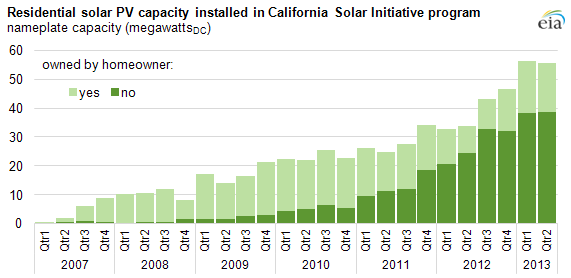
The utility industry loathes net metering; it wants to charge retail rates, not pay them. Just as predictably, the solar industry loves the program because it makes home solar pencil out, even for homeowners of modest means. More than any other factor, net metering has powered the recent growth in solar. It helped California, for example, double the amount of its rooftop solar last year to two gigawatts.
Arizona Public Service proposed two options to deal with future solar installations. It would either cut net metering payments in half or bill solar households $8 a month for every kilowatt of generating capacity on their rooftop. In Arizona, where the average rooftop capacity is just under 7 kilowatts, that would amount to a typical fee of $50 a month--and as much as $100 a month for homeowners with large systems. Staff analysts for the Arizona Corporation Commission countered with a proposal for a $3-per-kilowatt charge. Even that, solar advocates complain, would hurt the industry and kill jobs.
"Customers who chose to invest in solar should be rewarded, not taxed, for their investment," Lyndon Rive, CEO of solar-leasing giant SolarCity, wrote to Arizona officials in October. Penalizing fees, he warned, "would likely serve as the death knell for many participants in the solar industry."
The ensuing battle drew in national combatants, including Grover Norquist and his Americans for Tax Reform and the Edison Electric Institute. "California billionaires are getting rich off your tax dollars," one anti-solar television ad proclaimed, with images of suspicious business deals going on at the door of a corporate jet. The ad, produced by an organization called 60 Plus, which receives funding from the Koch brothers donor network, also tried to link California solar industry leaders Sunrun and SolarCity to the failed company Solyndra, which went bankrupt in 2012 after receiving federal subsidies from the Obama administration.
The campaign sought to tar solar rather than make a case against net metering. The "tax dollars" mentioned in the ads, for example, refer to federal solar subsidies and tax breaks that have nothing to do with net metering or utility rates. One of solar's benefits to utilities and ratepayers is that they don't have to pay a cent for the equipment; unlike utility power plants, which ratepayers really do subsidize, solar homeowners and businesses absorb those costs. This was a core justification for net metering in the first place--to reward homeowners for their infrastructure investment with a fair price. But it's a hard concept to explain in a 15-second TV spot.
Arizona Public Service initially denied involvement with the "California billionaires" ad and others like it, but eventually admitted that it had given money to 60 Plus as part of a $3.7 million campaign to unravel net metering in the state. The Edison Electric Institute kicked in another $500,000 to fund a 10-day TV campaign branding solar homeowners as free riders.
"The average rooftop solar system on an Arizona home adds $20,000 in costs for non-solar customers over its lifetime," claims Don Brandt, Arizona Public Service's chairman and CEO. "As more customers install solar . . . the burden on non-solar customers becomes greater and greater. Eventually, you run out of your neighbor's money.”
There's a problem with this cost-shift argument, says Tom Beach of CrossBorder Energy in Berkeley, California: The data don't support it. In fact, he says, "it's just the opposite.”
Beach has studied the costs and benefits of rooftop solar in eight battleground states, usually at the behest of solar energy companies and nonprofits. Brandt's $20,000 calculation, he says, is based on the cost to the utility of net metering but ignores or undervalues solar's benefits. When utilities assess the value of their own new power plants, they calculate the full range of lifetime costs and benefits. They don't do so for homegrown solar, however, so Beach did it for them, reckoning the dollar value of what distributed home solar brings to the table: It reduces the need for expensive new power plants and transmission lines; less energy is lost in transmission because much of the power is used right where it's generated; it requires no fuel and so provides a hedge against future fossil fuel price increases; and it could allow utilities to meet state renewable energy and greenhouse gas emission goals without paying for utility-scale solar and wind farms.
When Beach applied that analysis in California, he found that rooftop solar costs and benefits were about equal: Monthly electric bills were lower for solar homeowners, but the financial benefits their panels provided to the grid made up the difference.
"I thought I was doing the right thing for my family and the environment. Here I am stuck in a nightmare, where a powerful utility can just change the rules while I lose everything.”
When he ran the same study in Arizona, he found the benefits side was far higher: For every dollar of solar cost to the utility (primarily from net metering), the state's solar homeowners provided $1.54 in long-term benefits. According to Beach's analysis, Arizona's solar roofs subsidize other ratepayers and the utility to the tune of $34 million a year. So if anyone is free-riding, it's the utility and non-solar ratepayers.
This is why the cost-shifting argument has solar advocates in an uproar. "Their numbers are a joke," says Bernadette Del Chiaro, executive director of the California Solar Energy Industries Association. But explaining the complex web of benefits is much harder than pointing to the lower electric bills solar homeowners are paying and suggesting they're getting away with something. It's deceptive, Del Chiaro complains, but effective. "They've framed the debate," she says with grudging admiration. "Now the debate is not if there is a cost shift--it's about how much. That's what we're forced to talk about."
In the end, the Arizona Corporation Commission voted 3 to 2 last November for a compromise that preserved net metering but imposed a charge for solar customers that works out to about $5 a month for the average installation.
Solar industry representatives say they can live with the fee, although the margins on leased systems are so small that it's still likely to hurt growth. "It could have been much worse," says Annie Lappe, deputy director of the Vote Solar Initiative, which campaigned against any fee in Arizona. The state will likely launch a more comprehensive review of solar costs and benefits next year as part of an Arizona Public Service rate review. That could lead to higher fees for solar homeowners--or, as Lappe and her allies hope, a repeal of the $5 monthly charge.
For its part, Arizona Public Service was stung by the small size of the fee, an order of magnitude less than it had requested. But the victory may be the utility's in the end, because even a small fee sets a precedent. According to utility senior vice president Jeff Guldner, the decision ratified the notion that there is a cost shift from solar homeowners to other ratepayers. He predicted that other states would reach similar conclusions.
Indeed, the debate over cost and fairness has spread. Utilities in California and Colorado, among others, are disputing the value of home solar power. In California, major utilities want either a grid-usage fee for solar homes or a rollback of net metering. They had hoped to kill net metering this year with an industry-friendly cost-benefit study of rooftop solar that found massive cost shifts. Since discredited, the study considered as a "cost" not just the solar power that homeowners sell to the grid but also what they consume at home. (By that logic, installing home insulation or even LED lightbulbs would be free-riding too.) The same state legislature that ordered the bogus study then made it largely irrelevant by preserving net metering through 2016 or 2017 and ordering California's Public Utilities Commission to reevaluate the whole program and devise a successor.
Also on the block in California is the nascent market for home solar systems that incorporate battery storage. SolarCity is partnering with electric car company Tesla on one such system (the CEOs of the two companies, Rive and Elon Musk, are cousins). The idea is to store solar energy in battery packs for use at night, with a connection to the grid solely for backup. The state's three largest utilities--Southern California Edison, Pacific Gas and Electric, and San Diego Gas and Electric--have all refused to connect any such systems to the grid, citing reliability concerns. Even more than net metering, battery storage threatens the utility business model; it could, for example, allow homeowners to form small, superefficient neighborhood microgrids that huge, costly utilities could never outcompete. (See "Innovate," July/August 2013.) More than 300 California households are awaiting the commission's decision so they can flip the switch on the solar-battery systems waiting in their garages.
In Colorado, utility giant Xcel released a study last summer purporting to show massive cost shifts for solar power that justify slashing net metering reimbursement rates in half. The study was supposed to have been vetted by environmental and industry experts, but that never happened. ("A cynic might conclude that they hoped it would just slip through," Lappe says.)
Xcel's gambit led to public outcry. The utility commission received almost 30,000 comments opposing the move, more than 200 protesters marched on the utility's Denver office, and a poll showed that 78 percent of Coloradans support net metering. Tom Beach analyzed the situation and found, once again, that the utility had undervalued solar and that, in fact, its benefits in Xcel's service area outweigh costs by $13.6 million a year. In late January, after months of waffling, the Colorado Public Utilities Commission agreed to preserve net metering for the time being, pending a series of hearings later this year.
A similar dispute in Minnesota ended with a clean call in favor of solar. In order to meet future demand, the state decided it needed more electric generating capacity, and for the first time, it required competitive bids. Xcel and two other companies submitted plans for gas-fired power plants. Minnesota-based Geronimo Energy proposed a distributed solar project--not on rooftops, but a network of 20 ground-based solar outposts totaling 100 megawatts of maximum output. Geronimo cannily designed them to sit close to existing substations to minimize energy loss through transmission and the need for new lines. The proposal also dovetailed with Minnesota's new requirement that investor-owned utilities obtain 1.5 percent of their power from solar. "Everything was designed to make it cost-competitive with fossil fuels," says Betsy Engelking, Geronimo's vice president. "We knew it was a long shot, but the value was there."
The issue eventually came before administrative law judge Eric Lipman, who ran the numbers and found that the solar option would save Minnesota $46 million over the life of the project. "The greatest value to Minnesota and Xcel's ratepayers is drawn from selecting Geronimo's solar energy proposal," he wrote.
Xcel and other fossil fuel bidders decried Lipman's decision and are demanding that the state Public Utilities Commission overturn it. Should Geronimo's Aurora Project eventually be built, it would increase Minnesota's solar-generating capacity sevenfold.
"I thought I was doing the right thing for my family and the environment. Here I am stuck in a nightmare, where a powerful utility can just change the rules while I lose everything."
"Look at Hawaii," says Robert Harris, head of the Sierra Club's Hawaii Chapter. "This is the future of solar." He doesn't mean that in a good way; he worries that as other states begin to reach Hawaii's level of solar growth, utility-sponsored slowdowns and moratoriums will become more common.
Harris argues that Hawaiian Electric is using fears of solar oversaturation of the grid as a pretense for slowing down a competing energy source. There is no evidence, he says, of any brownouts, fires, failures, or other hazards from home solar installations. To the extent that there are technical issues with aged or inadequate circuits, he says, solar has been growing rapidly in the state for years, and Hawaiian Electric has had plenty of time to prepare for this moment.
"There are technical and economic issues that could be addressed if everyone comes to the table," he says. "Instead, our utility appears to publicly support solar but is working behind the scenes to stop greater adoption."
Cantero, who began a series of experimental cancer treatments in the midst of her solar disaster, says the stress was impeding her recovery. She turned to the state legislature for help and received a sympathetic reception while testifying in February. Republican state representative Cynthia Thielen advised Hawaiian Electric to embrace the rise of solar energy or risk obsolescence. "Remember what happened to Blockbuster Video," she said. "They used to be on every street corner too."
William Walker, who lives in the same Ewa Beach community of Oahu as Cantero, has also been forbidden to connect his solar installation, but he has gone on the offensive. The 33-year-old investigator for the Hawaii Department of Commerce and Consumer Affairs wrote a blistering op-ed in the Honolulu Star-Advertiser accusing the utility of trying to "preserve its century-old business model that keeps working-class ratepayers like me on the hook, while paying its bloated executives millions of dollars." Then, after paying his $300 electric bill for three months while his solar panels sat uselessly in the bright Hawaiian sun, Walker decided to flip his switch to see what would happen. There were no explosions, fires, or brownouts. His system, he says, is "fully functional yet not approved."
Clean energy advocate John Farrell believes the $270-billion-a-year investor-owned utility industry is making a strategic error by fighting home solar. State-by-state battles may slow distributed solar power, he says, but it's too late to stop it, because solar will soon beat utility power on price. Hawaii got to parity first, but other places are catching up: San Diego now, New York City later this year, followed by Southern California next year, according to a study by the Institute for Local Self-Reliance. This same study found that by 2021, rooftop solar power will be as cheap as or cheaper than electricity from local utilities for half the U.S. population.
"I thought I was doing the right thing for my family and the environment. Here I am stuck in a nightmare, where a powerful utility can just change the rules while I lose everything."
"A lot of political power and money is behind the utilities," Farrell says. "They feel their role is to send electrons to you and your role is to send money to them, and any change to that dynamic--like distributed solar generation--overturns that paradigm. I'm an optimist. There is going to be change, because people want the independence of making their own energy. The growth of distributed solar would be very difficult to quash now."
NET METERING BATTLEGROUNDS
Forty-three states plus the District of Columbia encourage rooftop solar through net metering--a policy that requires utilities to purchase energy from homeowners at retail rates. Investor-owned utilities hate that; they want to pay the wholesale rate, or less. Now they are seeking to modify or reverse this critical program in the following states--often by claiming that solar homeowners are unfairly shifting costs onto their non-solar neighbors.
Arizona
The state was the first to slap a net-metering fee onto customers after a multimillion-dollar media and lobbying campaign supported by Arizona Public Service, fossil fuel interests, and the right-wing American Legislative Exchange Council. Dominant state utility APS wanted a solar-killing $50-a-month average fee per net-metered customer, but got only $5.
California
Net metering was supposed to end this year, but got a legislative reprieve and is now set to expire in 2016 or 2017, when rooftop solar is expected to reach 5 percent of the state's generating capacity. Regulatory battles are also brewing over the utility industry's refusal to connect solar homes that have battery storage and over new rate proposals that could add 30 percent to the cost of rooftop solar.
Colorado
In 2013, utility giant Xcel slipped a request to gut net metering into a compliance hearing on state renewable energy standards. After a public outcry, state regulators turned down the request but opened a new proceeding to consider changes to net metering and the costs and benefits of rooftop solar; a decision is expected later this year.
Florida
Florida currently has one of the nation's most generous net metering programs: Any customer using any form of renewable energy up to a whopping two megawatts (enough power for 300 homes) is credited at the retail rate until their electric bill zeros out, and thereafter receives an annual check for excess power paid at what it would cost the utility to buy the power elsewhere. The issue is expected to come up in this year's governor's race.
Georgia
Georgia Power sought a $30 monthly charge for customers with rooftop solar. Unexpected opposition from a "Green Tea Coalition" of a Tea Party leader, the Sierra Club, the NAACP, and Occupy Atlanta got the utility to withdraw its request, but it vowed to try again at a later date.
Hawaii
Regulators are reviewing net metering and claims of cost shifting after the Hawaiian Electric Company stopped connecting new home solar installations late last year, claiming the grid was "saturated."
Idaho
Idaho Power sought permission to raise its $5 monthly grid-connect fee for net metering customers to $20.92 for homeowners and $22.49 for small businesses. Regulators said no, but invited the utility to raise net metering issues in a general rate hearing later this year.
Iowa
Regulators have opened a proceeding to craft new rules and rates for distributed generation of all types and to decide whether it should be encouraged or discouraged in the future. Utilities have gone to court and to the Iowa Utilities Board in an attempt to create new hurdles for rooftop solar.
Illinois
Confusion in this state's deregulated electricity market has allowed some electric companies to refuse to offer net metering for the hundreds of thousands of state residents who buy power from alternative retail electric suppliers rather than one of the state's major utilities. New rules are expected later this year.
Kansas
Hearings began early this year on legislation to kill net metering in a state that has seen explosive solar growth. Pending bills supported by Kansas's two major utilities would replace retail rates for home solar with much lower rates based on the utility's avoided costs.
Louisiana
Repeated utility proposals to kill retail rates for net metering failed last year, but attempts by the solar industry to lift very restrictive caps on the number of net-metered homes have stalled as well. Current caps allow each power company in the state to stop offering new connections once net-metered homes reach .05 percent of peak sales--as some utilities have already done.
Massachusetts
The state is about four-fifths of the way to hitting its 666-megawatt net metering cap, and the solar and utility industries are battling over what happens next. Legislative hearings began earlier this year.
Minnesota
This snowy but solar-friendly state is one of the hottest solar battlegrounds in the country. Regulators are considering how to replace net metering with a "value of solar tariff," which, depending on the formula used, could be more or less generous than retail rates. The program would be voluntary. Other changes on the table include lifting the statewide cap on individual system size from 40 kilowatts to 1 megawatt, which the utility industry opposes. Finally, utilities are fighting a recent decision to build Aurora, a large distributed solar project, instead of gas-fueled power plants to meet the state's future electricity needs.
Nevada
The future of net metering in the Silver State will be determined in October following a yearlong study of the costs and benefits of the program. At stake is the retail rate currently paid to solar homeowners that has fueled explosive solar growth here.
New York
Regulators are considering a petition to expand net metering to include remote installations, such as micro-hydroelectric generators. They could decide to expand--or limit--remote solar projects' eligibility for net metering.
North Carolina
Duke Energy is asking regulators to slash the net metering retail rate of 11 cents per kilowatt to the wholesale rate of 5 to 7 cents to avoid alleged cost shifting. Duke wants to buy solar wholesale from homeowners, then sell it back to its customers at the retail rate. The media campaign has begun, and cost-benefit studies are in the works. The state's utilities commission is expected to take up the request later this year.
Ohio
Regulators are revising rules on smart meters, the smart grid, and net metering. So far the proposals on the table are supported by the solar industry, but conservative lawmakers are attacking all programs that favor renewables. That faction is led by state lawmaker and American Legislative Exchange Council board member Bill Seitz, who likens Ohio's current rules to "Stalinist government mandates."
Rhode Island
Rhode Island joined the list of states where a repeal of all renewable energy standards is being attempted.
South Carolina
Two related battles will determine the fate of solar in South Carolina, which currently lags behind the rest of the nation. First is a regulatory hearing on all forms of distributive generation, in which solar companies and environmental groups--including the Sierra Club--are pushing to reverse an initial determination that rooftop-solar leases should be banned as unfair competition to the utility industry. Once that case is decided, regulators will consider expanding the state's stingy net metering policies, which currently have very low caps on the amount of solar allowed on individual rooftops and system-wide (0.2 percent of total capacity).
Utah
Rocky Mountain Power was pursuing state legislation to allow the utility to add a $4.25 monthly net metering fee for solar customers. A March compromise reached with solar advocates gives the state Public Service Commission the power to impose a "reasonable fee" on solar customers--but it must also weigh the benefits those customers provide to the grid.
Vermont
Thousands of residents were deterred from going solar in 2013 because the state's cap limited net metering to 4 percent of each power company's peak demand. Some power companies have already reached the limit. Legislation was introduced this year to boost the cap to 15 percent.
EDWARD HUMES is a Pulitzer Prize-winning journalist and author of 13 nonfiction books, including Garbology: Our Dirty Love Affair with Trash, PEN Award-winning No Matter How Loud I Shout: A Year in the Life of Juvenile Court, and the true-crime bestseller Mississippi Mud. His latest book is a biography of winemaking legend Jess Jackson, A Man and His Mountain. In addition to Sierra, Humes has written for Los Angeles, the Wall Street Journal, Forbes and other publications. He lives in Southern California with his wife, two children. Follow him on Twitter @edwardhumes and at www.edwardhumes.com.