Showing posts with label Rosa Luxemburg. Show all posts

Saturday, March 6, 2021

3482. We Need to Rescue Rosa Luxemburg From the Soap Opera Treatment

By Daniel Finn, Jacobin, March 5, 2021
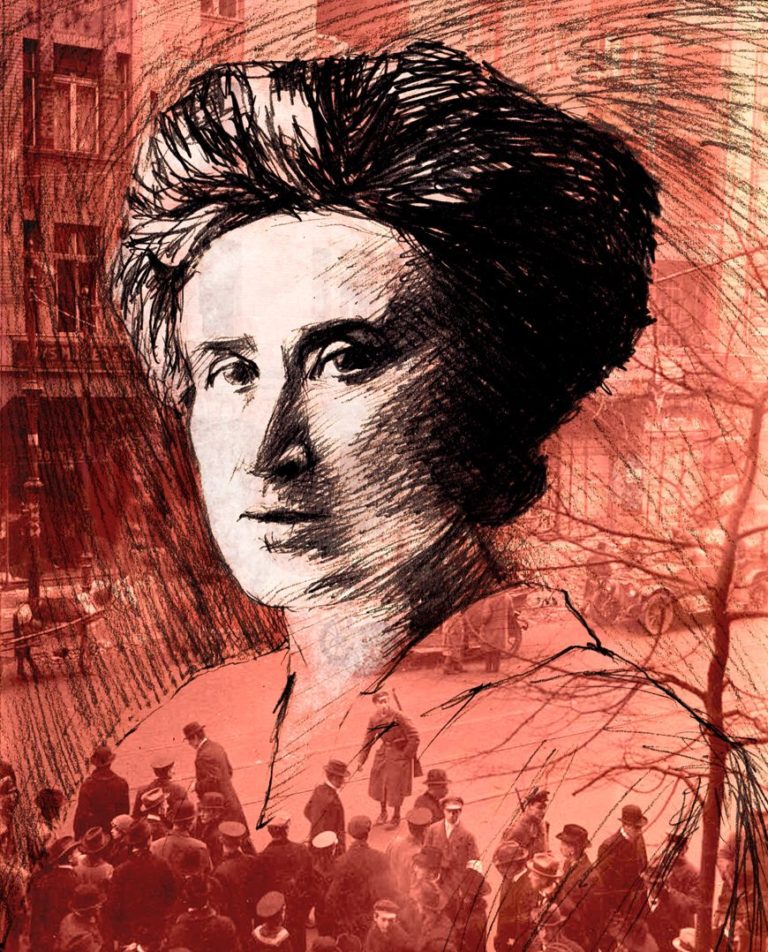
Rosa Luxemburg

Too much writing about Rosa Luxemburg nowadays focuses on her personal letters and relationships at the expense of her ideas. It’s good to humanize our heroes, but we risk belittling the significance of a revolutionary thinker whose understanding of socialism should be a touchstone for today’s left.

The twentieth century liked to place great revolutionaries on a pedestal, or even in a garish mausoleum. Our own age prefers to see them as the kind of people with whom you could go for a drink. It’s progress of a sort.

Everyone knows the story of Karl Marx going on a bender around the streets of London, pursued by the cops for strictly unpolitical hooliganism — there’s even a display about Marx and Engels in the Wetherspoons on Charing Cross Road. New biographies of Trotsky combine an account of his struggle against Stalin with the more colorful details of his affair with Frida Kahlo.

Lenin doesn’t really lend himself to the human-interest angle, but the many photos of the Soviet leader petting cats do at least give him a foothold in the latest Internet trends. Irish people delight in the claim that he spoke English with a posh Dublin accent, supposedly acquired from a tutor in London.

There’s no better example of this tendency at work than the popular image of Rosa Luxemburg. Latter-day writing about Luxemburg tends to focus on her personal letters and romantic relationships, pushing her views about capitalism and the way to end it into the background, or depicting them as an offshoot of her emotional life.

To some extent, this tendency is understandable and well-intentioned, and it certainly responds to market demand. It’s hardly surprising that the new edition of Luxemburg’s letters published by Verso attracted reviews in the Guardian and the Nation, the New Republic and the London Review of Books, while her more forbidding economic writings did not.

If this approach encourages a few people to read Luxemburg’s work and study the time in which she lived, it will have been worthwhile. But taken too far, it has the effect of trivializing rather than humanizing her legacy. There’s no point liberating revolutionary icons from the mausoleum only to confine them to a neatly manicured flower garden.

Private Affairs

It all starts with the name. It’s hard to imagine anyone talking about “Vladimir,” “Leon,” or “Nikolai” when they discuss the October Revolution. To the best of my knowledge, nobody has ever referred to Rudolf Hilferding as “Red Rudi,” or given his private correspondence more weight than theoretical tomes like Finance Capital. Luxemburg, on the other hand, frequently appears in the guise of “Rosa” — a small but telling detail of how she is perceived.

Of course, this superficial familiarity, with its unmistakably gendered thrust, is hardly unique to the world of politics. Another Polish woman of genius, born in the tsarist empire just a few years before Luxemburg, has recently inspired a graphic novel called Radioactive: Marie and Pierre Curie, A Tale of Love and Fallout (now adapted as a movie). As the publisher’s blurb has it:

They fell in love. They took their honeymoon on bicycles. They expanded the periodic table…

No male scientist of comparable importance would be likely to receive the same treatment: for better or worse, it is what it is. Luxemburg wasn’t just a great socialist thinker and activist: she led an interesting life, and her writings were often lyrical as well as theoretically sharp. If an author uses that side of her story to draw people in, it would be churlish to complain. It’s more of a problem if they also use her personality as a kind of master key for her political thought.

That perspective frequently intrudes on one important aspect of Luxemburg’s theoretical legacy: her critique of Bolshevism. Discussions of this critique often give you the impression that Luxemburg was more democratic than Lenin or Trotsky because she was softer and more compassionate, with a rich inner life that the Russian Marxists lacked. Reviewing her translated letters, Vivian Gornick and Jacqueline Rose leaned heavily upon this stereotype, implying that Luxemburg’s disagreements with the Bolshevik leader were the extension, on a world-historic stage, of her tempestuous, ill-fated relationship with Leo Jogiches.

This version of events has tremendous literary appeal, but that doesn’t make it good history or politics. There’s no reason to think that Lenin acted in the way that he did after 1917 because he was a callous individual with a taste for violence or the exercise of power for its own sake. Lenin’s successor at the helm of the Soviet state did possess all those vices — or at least acquired them along the way — but that still won’t suffice as an explanation of Stalinism.

If Luxemburg was right and Lenin was wrong — and there’s good reason to think that she was, though not about everything — it wasn’t because she was a nicer person than him. For what it’s worth, Luxemburg and Lenin seem to have had a good personal relationship, and even a shared love of cats. Their polemical exchanges show that Lenin had no monopoly on invective, but they respected each other all the same.

Her judgement rested on a superior understanding of some basic political questions that should be at the heart of the socialist project. That’s ultimately more important than whether we find Luxemburg to be a more attractive and engaging figure than Lenin.

Democracy and Socialism

Luxemburg’s pamphlet on the Russian revolution and the early days of Soviet rule comes with a lot of baggage that’s piled up since her death. An influential English-language edition, published in the 1960s by the University of Michigan Press, combined the 1918 essay with an earlier critique of Lenin that bore the snappy title “Leninism or Marxism?” But Luxemburg herself had given it a much less exciting name, “Organizational Questions of Russian Social Democracy,” and never claimed that it held the secret to her later issues with Bolshevism.

That edition also carried an introduction from Bertram Wolfe, a former Communist who had become a Cold War liberal, working in the orbit of the State Department and the Hoover Institution. Luxemburg referred disdainfully in the pamphlet to German “government-Socialists” who had enthusiastically supported the war effort (and her own imprisonment for opposing it). It’s easy to imagine what she might have had to say about US “government-Liberals” trying to recruit her spirit for their camp.

A stained glass view of Luxemburg does no justice to her or the Bolshevik leaders she was criticizing. On some important points — land reform, the non-Russian nationalities — her positions were impractical and would have required more centralized coercion rather than less to put them into effect. On the question of national self-determination, Lenin was always far more perceptive than Luxemburg, belying his image as a highly dogmatic Marxist by escaping the traps of class reductionism and economic determinism.

However, Luxemburg put forward a brilliant, penetrating argument about the necessary link between socialism and democracy that can still electrify the reader today. The most famous line from the pamphlet — “freedom is always only freedom for those who think differently” — often appears in isolation, as a kind of boilerplate liberal sentiment — worthy to be sure, but scarcely indistinguishable from the views of John Stuart Mill. It should be read in its original context, as part of a tightly reasoned case against the idea of a tutelary dictatorship that could lay the foundations of a socialist economy.

For Luxemburg, the very nature of socialism made this impossible:

Far from being an aggregation of ready-made prescriptions that have merely to be applied, the practical realization of socialism as an economic, social and legal system is something that lies in the mists of the future. What we possess in our program amounts to no more than a few major signposts that indicate the general direction in which to identify the measures that are to be taken, and these indications are predominantly of a negative character at that.

For the creative work of building a socialist system, political freedom was the essential lubricant:

Experience alone is capable of making corrections and opening up new paths. Uninhibited, effervescent life alone fashions a thousand new forms and improvisations, contains creative power, and corrects all mistakes. The public life of states where freedom is restricted is so meager, so miserable, so schematic and so sterile precisely because by excluding democracy, it occludes the living source of all intellectual wealth and progress.

After a century’s experience of monolithic post-revolutionary states, communist or otherwise, nobody can seriously dispute how right Luxemburg was about their development path:

Public life gradually falls into a slumber, a few dozen party leaders with inexhaustible energy and boundless idealism direct and govern; among the latter, a dozen outstanding minds are in reality the ones that lead, and an elite from within the working class is occasionally mustered in order to applaud the speeches of the leaders and to show unanimous approval for the resolutions drafted by them.

There’s only one qualification to add here: over time, the “few dozen party leaders” also tend to fall into a slumber themselves, as anyone who lived through the Brezhnev years in the Soviet Union will attest.

The Prophet Outcast

Vivian Gornick suggests that Luxemburg was “one of the most emotionally intelligent socialists in modern history,” and “knew instinctively that if socialists closed down inside, they’d become the kind of people who, devoid of fellow feeling, would make police-state socialism.” Maybe she was and maybe she did, but it sells her short if we leave the discussion there.

By any conventional standard, Luxemburg lived a life of intense political commitment and struggle, making huge personal sacrifices for the cause she believed in, just as much as any Bolshevik leader. Lenin and Trotsky, for their part, were deeply cultured men, with a feel for art and literature as well as politics. If Luxemburg saw further than them, it wasn’t simply because she was more empathic. It was also because, in some crucial respects, she was smarter, more perceptive, and more imaginative.

Luxemburg went out of her way to be fair to the Bolsheviks, suggesting that it would have been “superhuman” to conjure up a thriving socialist democracy under the dire circumstances in Russia at the time:

Through their resolute revolutionary stance, their exemplary drive and the force of their action, and their unswerving loyalty to international socialism, they have genuinely achieved all that was possible under such devilishly difficult conditions. The danger begins only where they make a virtue out of necessity by establishing a theory that sets in stone every detail of the tactics imposed upon them by such fatal conditions, and where they attempt to recommend to the international proletariat that it should emulate these as the paradigm of socialist tactics per se.

This was after a year of Bolshevik rule. It’s a matter for speculation how much further she would have gone if she had lived to the point when Paul Levi first published her pamphlet in 1922, by which time the Soviet leadership had fully institutionalized a one-party state. When it comes to later developments, there’s no reason to question the judgement of Stalin himself: hposthumously denounced Luxemburg as an ideological heretic, instinctively recognizing that she would have been a bitter foe of his.

Latter-day social democrats often contrast the two systems established in Germany during the Cold War, presenting the greater freedom and prosperity in the western zone as a retrospective vindication of the reformist tendency in European socialism. There are any number of problems with this argument, but the most striking one is this: by calling in proto-fascist death squads to repress the Spartacus League in 1919, the leaders of German Social Democracy eliminated the revolutionary thinker with the most implacable commitment to democratic rights as a necessary part of a socialist system. As such, they bear a large share of responsibility for the evolution of German Communism in the years before it eventually took power in Berlin after the Second World War.

“Ruthless Revolutionary Energy”

Luxemburg’s critique of authoritarian socialism was all the more important because it came from within the revolutionary camp. There’s sometimes a tendency to downplay this aspect of her thought, by stressing her principled aversion to unnecessary bloodshed — captured in her famous remark, uttered a few weeks before her murder, that anyone who stepped on a “poor earthworm” without cause on the road to socialism was guilty of a crime. That was a fine sentiment, and much preferable to macho rhetoric about the need to break eggs if we want to make an omelette.

However, when Luxemburg spoke in the same speech about the need to combine “ruthless revolutionary energy and tender humanity,” she meant every word of it, including the ruthlessness. The idea of a peaceful road to socialism seemed entirely implausible to her:

It is sheer insanity to believe that capitalists would goodhumoredly obey the socialist verdict of a parliament or of a national assembly, that they would calmly renounce property, profit, the right to exploit. All ruling classes fought to the end, with tenacious energy, to preserve their privileges … they all shed streams of blood, they all marched over corpses, murder, and arson, instigated civil war and treason, in order to defend their privileges and their power. The imperialist capitalist class, as last offspring of the caste of exploiters, outdoes all its predecessors in brutality, in open cynicism and treachery.

In order to see off this challenge, she insisted, “the violence of the bourgeois counterrevolution must be confronted with the revolutionary violence of the proletariat.” For today’s political consensus, such views are enough to put Luxemburg beyond the pale. Conventional wisdom stigmatizes revolutionary violence of all kinds as “terrorism” — even when a stateless people deploys it against a brutish occupying army, as in the cases of Palestine and Kurdistan — while depicting support for interstate violence as the essence of responsible politics.

It bears repeating that it took thirty years of war, revolution, and counterrevolution to establish liberal democracy as the dominant political system in Western Europe, let alone socialism. Luxemburg would no doubt have modified her views in some respects if she had lived to see the consolidation of capitalist democracy in large parts of the world — a development that she considered inconceivable in the early twentieth century. That doesn’t mean she would have become a pacifist or forgotten her warning about the lengths to which ruling classes will go when their privileges are at stake.

The Forbidden List

We can find echoes of Luxemburg in the most surprising places. In the 1970s, the British political philosopher Norman Geras published a fine book, The Legacy of Rosa Luxemburg, that played its part in the recovery of her thought. Geras later wrote an essay about the ethics of revolutionary violence, “Our Morals,” that was very much in the spirit of Luxemburg, stressing the need to exclude noncombatants from the list of “legitimate targets,” no matter how justified a struggle might be.

In 2018, officials at the University of Reading flagged up “Our Morals” as a dangerous text in the light of the British government’s counterterrorism program, Prevent. As the Guardian reported:

Third-year politics undergraduates have been warned not to access it on personal devices, to read it only in a secure setting, and not to leave it lying around where it might be spotted “inadvertently or otherwise, by those who are not prepared to view it.”

Stephen De Wijze, who had worked with Geras at the University of Manchester, said that he found it “hard to imagine what sensible criteria could have been used to make this initial negative assessment,” since the arguments made by Geras were “the very opposite of the hate-filled ideologies that Prevent is seeking to confront.” In fact, the officials at Reading had inadvertently grasped the true spirt of programs like Prevent, which conflate indiscriminate terrorism with other forms of armed resistance and even nonviolent civil disobedience.

A manual issued by counterterrorism police in 2020 listed climate change activists alongside neo-Nazis and Islamic fundamentalists under the heading of “extremism,” urging cops and teachers to keep tabs on anyone who spoke in “strong or emotive terms about environmental issues like climate change, ecology, species extinction, fracking, airport expansion or pollution.” Within months, the British Home Secretary Priti Patel had threatened to classify Extinction Rebellion as an organized crime group.

It’s safe to assume that Luxemburg would be speaking in “strong or emotive terms” about the threat of ecological breakdown if she were alive today. In her own time, she argued that capitalism would hit a brick wall when it ran out of noncapitalist spaces on which to encroach, so the capacity of the system to expand in purely economic terms would have surprised her. But that capacity for seemingly limitless growth is now running up against the natural limits of the Earth system, giving Luxemburg’s famous slogan “socialism or barbarism” renewed currency.

Luxemburg was certainly a likable, warmhearted figure in her private life. She was also a dangerous woman, an outlaw who wanted to tear down the established order. She could write affectionate letters to her friends and lacerating polemics against her enemies. In today’s world, she belongs on a wanted list or an index of forbidden books, not in a sepia-tinged photo album. The modern left can learn from her compassion, but it can also draw lessons from her ruthless determination.

Monday, September 14, 2020

3425. Rosa Luxemburg's Birds

By Richard Abernethy, The International Marxist Humanist, August 14, 2020
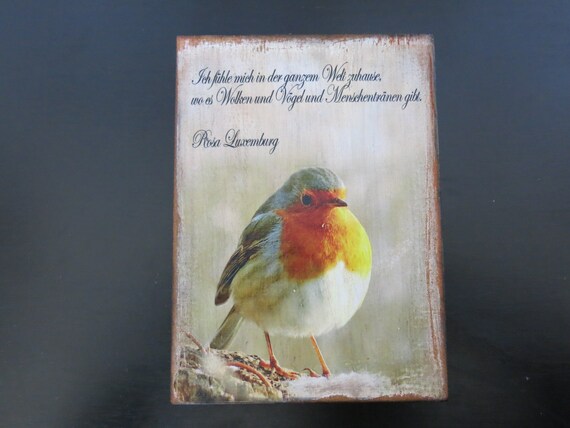
"I feel at home all over the world, where there are clouds and birds and human tears." Rosa Luxemburg. 
In Berlin, one morning in April 1916, Sophie and Karl Liebknecht received a telephone call from Rosa Luxemburg. On this occasion, the call was not about their shared politics – opposition to the First World War, as internationalists and revolutionary socialists. What Rosa had to tell them was that a nightingale was singing in the botanic gardens. The three of them made an excursion to listen to it.[1]
At that time of year, the nightingale would have just completed its spring migration, returning from an Africa carved up, subjugated and ruthlessly exploited by European powers, to a Europe where the slaughter and devastation of world war were unleashed.
Rosa Luxemburg was passionate about many things, among them, the natural world and especially bird life. For her, this was inseparable from her passion for human liberation. She wrote:
“I feel at home in the entire world, wherever there are clouds and birds and human tears…”[2]
Her studies at the University of Zurich included botany, zoology and geology, though later she switched to politics and economics. Later on, while devoting herself to socialist politics, she kept an herbarium, a collection of plants, dried, mounted and annotated.[3]
It was in her letters from prison that Luxemburg wrote about birds – in particular, those written in the period from October 1916 to July 1917, when she was held at the fortress of Wronke (now Wronki in Poland). At Wronke, she was allowed freedom of movement within the fortress grounds during daylight hours. There was a garden where she could observe the local bird and insect life and watch the clouds drifting overhead.
Her letters were written for personal friends and comrades, but in the knowledge that they would be monitored by the prison officers. One can only speculate whether she thought they would one day become part of her legacy. Through her responses to birds and the natural world, as well as to novels, poetry, drama, music and other topics, she expressed her own inner thoughts and emotions, creating an intimate self-portrait.
Like most birders today, Luxemburg was thrilled to see a species for the first time. On the outing to hear the nightingale in the botanic gardens, she was intrigued by the strange call of an unidentified bird. A year later, at Wronke, she was able to identify it:
“Just imagine that a few days ago, early in the morning, I suddenly heard the same sound here, nearby. My heart pounded with impatience finally to learn what it could be. I had no peace until I found out today: it is not an aquatic bird, but rather a wryneck, a kind of grey woodpecker. It is only a little bigger than a sparrow, and it takes its name from the fact that, when in danger, it attempts to frighten its enemies through comical gestures and contortions of its head. It lives only on ants with its sticky tongue like the anteater. That’s why the Spaniards call it Hormiguero – the ant-bird”.[4]
Next day, she wrote:
“Today I saw for the first time in my life a splendid bird: the yellowhammer. I sat so quiet and motionless that it hopped over quite close and I was able to observe it in exact detail.”[5]
Mostly, though, she wrote about the common, familiar birds that were her regular companions in the grounds of the fortress, such as great tits, blue tits and chaffinches, describing them for her friends in lively sketches. She did not simply observe them. She interacted with them in various ways. Not surprisingly, she fed them. She sang to them, spoke to them, mimicked their calls.
“The great tits are in loyal attendance in front of my window, they already know my voice exactly, and it seems that they like it when I sing. Recently I sang the Countess’s aria from Figaro, about six of them were perched on a bush in front of the window and listened without moving all the way to the end; it was a very funny sight to see.”[6]
Modern studies of bird behaviour confirm that birds do sometimes respond to human music. There is even one unique case of a tame bird, a cockatoo named Snowball, who breaks into his own dance moves when music is played.[7] Of course, it is also possible that the great tits were simply waiting to be fed.
The intensity of Rosa Luxemburg’s feelings towards birds must be partly due to her situation as a prisoner, separated from her friends and cut off from her political activities, all in the midst of a war she abhorred. In one of her letters, she quotes some heroic lines of poetry, suggests that she would like part of it written on her gravestone, then in a quick change of mood:
“Did you take that seriously, Mathilde? Hey, laugh at it. On my grave, as in my life, there will be no pompous phrases. Only two syllables will be allowed to appear on my gravestone: ‘Tsvee-tsvee’. That is the call made by the great tit, which I can imitate so well that they all immediately come running. And just think, in this call, which is usually quite clear and thin, sparkling like a steel needle, in the last few days there has been quite a low little trill, a tiny chesty sound. And do you know what that means, Miss Jacob? That is the first soft stirring of the coming spring. In spite of the snow and frost and loneliness, we believe – the titmice and I – in the coming of spring! And if in impatience I don’t live through it, then don’t forget that on my gravestone nothing is to appear except that ‘Tsvee-tsvee’…
I embrace you and Mimi with terrible longing, Your R.L.”[8]
Mimi was Rosa Luxemburg’s cat. Mathilde Jacob, secretary, comrade and friend of Rosa Luxemburg, was to die in Theresienstadt concentration camp in 1943.[9]
One bird in particular Luxemburg credited for lifting her out of a blue mood. Known to her as the arbour bird or garden mocker, this is a bird that nests mainly in Eastern Europe: the icterine warbler. She describes it with affectionate humour:
“This comrade with the jauntily held beak, steeply rising forehead, and eye of a know-it-all… This bird is quite an oddball. He doesn’t sing just one song or one melody, like other birds, but he is a public speaker by the grace of God, he holds forth, making his speeches to the garden… I laugh every time with joy and call to him out loud: ‘Sweet dumbhead!’”[10]
She believed that she could understand nuances of meaning in bird calls.
“My mother, who considered the Bible (next to Schiller) the highest source of wisdom, was firmly convinced that King Solomon understood the language of birds. Back then, with all the superiority of my fifteen years and my training in natural science, I used to smile at my mother’s naiveté. But now I myself am like King Solomon: I too understand the language of the birds, and of all animals. Not, of course, as if they were using human words, but I understand the most varied shades of meaning and of feeling conveyed by their tones. Only to the rude ear of one who is quite indifferent does the song of a bird seem always the same. If one has a love of animals, and a sympathetic understanding of them, one finds great diversity of expression, an entire ‘language’.”[11]
This is a remarkable claim, and quite possibly an exaggerated one. At least, Luxemburg was correct in thinking that bird vocalisations can convey a wide range of meanings. She was certainly ahead of her time in studying birds and other animals with “sympathetic understanding”, rather than dispassionately as objects.
Rather oddly, on being told that Karl Liebknecht wanted a book about bird voices, Luxemburg rather bossily tried to redirect his interest:
“It surprises me a little that Karl wants a book specifically about bird calls. For me the voice of the birds is inseparable from their habitat and their life as a whole, it is only the whole that interests me, rather than any detached detail. Give him a good book on the geographical distribution of animals, which will certainly give him a lot of stimulation.”[12]
When Luxemburg writes about birds, she generally does so from her own direct experience. One exception is a letter to her lover, Hans Diefenbach, where she gives a description of bird migration that she, as one of the greatest minds of the time, seems to have believed in all seriousness, but is no longer credible.[13]
“Hänschen, do you know that in their autumnal flights to the south, large birds like cranes often carry on their backs an entire load of smaller birds, such as larks, swallows, goldcrests etc.?! This is not just some fairy story for children, but a scientifically verified observation. And the little ones cheerfully twitter and converse in their ‘seats on the bus’.”
However appealing, the idea of small birds as hitch-hikers on the backs of larger ones was totally wrong. Most likely it arose because people could not believe that small birds could fly such long distances under their own power. Now we know that they do so by storing fat in their bodies to fuel their journey.
Her letter continues:
“Do you know that in these autumnal migrations it often happens that birds of prey – sparrowhawks, falcons, harriers – will make the journey in a single flock together with little songbirds, which they normally feed upon, in other circumstances, but during this journey a kind of God’s truce [treuga Dei], a general armistice, is in force? When I read something like this, I am so thrilled and it puts me in such a mood of joie de vivre that I begin to consider even Breslau a place fit for humans to live in. I myself don’t know why this affects me so; perhaps it’s because I’m reminded again that life is a beautiful story”.
Unfortunately, this particular beautiful story happens not to be true. Raptors (birds of prey) do not form mixed flocks with passerines (songbirds) on migration. Raptors, especially the larger species, fly mainly by soaring and gliding, and migrate by day. Small birds have a much more direct, level flight, powered by flapping; many (though not all) migrate by night. At most, a stream of migrants may include both types of bird, heading in the same direction, but without the coordination of a flock.
It is not difficult to see why Luxemburg wanted these tales of bird migration to be true: they reflected her desire for new human relations in socialism.
At one point, Luxemburg writes ruefully how changing methods of agriculture are making birds decline:
“Only yesterday I read why the warblers are disappearing from Germany. Increasingly systematic forestry, gardening and agriculture are, step by step, destroying all natural nesting and breeding places: hollow trees, fallow land, thickets and shrubs, withered leaves on the garden grounds. It pained me when I read that. Not because of the song they sing for people, but rather it was the picture of the silent, irresistible extinction of these defenceless little creatures which hurt me to the point where I had to cry. It reminded me of a Russian book which I read while still in Zurich, a book by Professor Sieber about the ravage of the redskins [sic] in North America. In exactly the same way, step by step, they have been pushed from their land by civilized men and abandoned to perish silently and cruelly.”[14]
Today, it is beyond dispute that many bird species (though by no means all) are in serious decline, and this includes many farmland birds that were once a familiar sight, such as turtle dove, grey partridge and corn bunting. What is surprising is that Luxemburg was aware of habitat loss and its impact on bird populations over a century ago. However, the warbler family is doing fairly well: most European species have a conservation status of green – least concern.
Two things Rosa Luxemburg could not foresee (although the fatalism of these few lines in a private letter should not be taken as a fixed opinion). If she could have known, she would have rejoiced. Extinction is resistible. And the Native Americans would rise again.
After Luxemburg’s tragic and violent death, Lenin, who had clashed with her many times in the battle of ideas within the socialist movement, expressed his esteem for her in an avian image:
“To this we reply with two lines from a good old Russian fable: an eagle can indeed sometimes fly lower than a chicken, but a chicken can never rise to the same heights as an eagle. Rosa Luxemburg erred on the question of Polish independence; she erred in 1903 in her evaluation of Menshevism… [a series of further ‘errors’ follows] … But despite these mistakes she was and remains an eagle.”[15]
An eagle – a powerful bird soaring to great heights. It’s a fitting image for Red Rosa, Marxist thinker and revolutionary leader. She herself would have most likely have preferred to be associated with the little songbirds she knew so well.
“Why are there blue tits in the world? I really don’t know, but I’m glad there are, and I experience it as a sweet consolation when a hasty tsee-tsee-bay sounds suddenly from the distance.”[16]
List of birds seen by Rosa Luxemburg and noted in her correspondence:
Feral Pigeon (Rock Dove) Columba livia
Wryneck Jynx torquillaBlue Tit Cyanistes caeruleusGreat Tit Parus majorSkylark Alauda arvensis
Icterine Warbler Hippolais icterina
Blackbird Turdus merula
European Robin Erithacus rebeculaNightingale Luscinia megarhynchosHouse Sparrow Passer domesticus
White Wagtail Motacilla alba
Chaffinch Fringilla coelebs
Greenfinch Chloris chlorisSiskin Spinus spinus
Yellowhammer Emberiza citronella
Photos, sound recordings and videos of all these birds can be found on the internet.

References

The Rosa Luxemburg Reader, edited by Peter Hudis and Kevin B. Anderson. Monthly Review Press, 2004.
The Letters of Rosa Luxemburg, edited by Georg Adler, Peter Hudis and Annelies Laschitza. Verso, 2011.
[1] To Sophie Liebknecht, 2 May 1917. Reader, 390.
[2] To Mathilde Wurm, 16 February 1917. Letters 376.
[3] Rosa Luxemburg: Herbarium published (in German) by Dietz Verlag, Berlin 2016
[4] To Sophie Liebknecht, 2 May 1917. Reader, 390.
[5] To Mathilde Jacob, 3 May 1917, Letters, 407.
[6] To Luise Kautsky, 26 January 1917, Letters, 368.
[8] To Mathilde Jacob, 7 February 1917, Letters 373.
[9] For an acclaimed biography of Mathilde Jacob (in German) see Heinz Knobloch: Meine liebste Mathilde: die beste Freundin der Rosa Luxemburg (My Dear Mathilde: the Best Friend of Rosa Luxemburg).
[10] To Hans Diefenbach, 6 July 1917, Letters, 426-427
[11] To Sophie Liebknecht, 23 May 1917, Letters, 411.
[12] To Sophie Liebknecht, 2 August 1917, Letters, 432.
[13] To Hans Diefenbach, 27 August 1917, Letters, 439.
[14] To Sophie Liebknecht, 2 May 1917, Reader, 390-391.
[15] Written in February 1922, first published in Pravda, 16 April 1924. Quoted by Iring Fetscher in his postscript to Paul Frölich: Rosa Luxemburg Pluto Press 1972 304.
[16] To Sophie Liebknecht, 23 May 1917, Letters 413.

Thursday, December 29, 2016

2523. Rosa Luxemburg: "My Innermost Personality Belongs More to My Tomtits than to the Comrades"

By Rosa Luxemburg, Marxists.org, May 2, 1917
Rosa Luxemburg

Editor's note: This following text is taken from a letter written from to Sophie Liebknecht (1884-1964), a Russian-born German socialist and feminist. She was the second wife of German revolutionary socialist leader Karl Liebknecht. The letter was first published in Letters from Prison: by Rosa Luxemberg: with a portrait and a facsimile, Young International at Schönberg in Berlin, 1921–1923.  KN

*     *     *

... Do you remember how, in April last year, I called you up on the telephone at ten in the morning to come at once to the Botanical Gardens and listen to the nightingale which was giving a regular concert there? We hid ourselves in a thick shrubbery, and sat on the stones beside a trickling streamlet. When the nightingale had ceased singing, there suddenly came a plaintive, monotonous cry that sounded something like “Gligligligligliglick!” I said I thought it must be some kind of marsh bird, and Karl agreed; but we never learned exactly what bird it was. Just fancy, I heard the same call suddenly here from somewhere close at hand a few days ago in the early morning, and I burned with impatience to find out what the bird was. I could not rest until I had done so. It is not a marsh bird after all.

It is a wryneck, a grey bird, larger than a sparrow. It gets its name because of the way in which, when danger threatens, it tries to intimidate its enemies by quaint gestures and writhings of the neck. It lives only on ants, collecting them with its sticky tongue, just like an ant-eater. The Spaniards call it hormiguero, – the ant-bird. Mörike[10] has written some amusing verses on the wryneck, and Hugo Wolf[11] has set them to music. Now that I’ve found out what bird it is that gave the plaintive cry, I am so pleased as if some one had given me a present. You might write to Karl about it, he will like to know.

You ask what I am reading. Natural science for the most part; I am studying the distribution of plants and animals.

Yesterday I was reading about the reasons for the disappearance of song birds in Germany. The spread of scientific forestry, horticulture, and agriculture, have cut them off from their nesting places and their food supply. More and more, with modern methods, we are doing away with hollow trees, waste lands, brushwood, fallen leaves. I felt sore at heart. I was not thinking so much about the loss of pleasure for human beings, but I was so much distressed at the idea of the stealthy and inexorable destruction of these defenceless little creatures, that the tears came into my eyes. I was reminded of a book I read in Zurich, in which Professor Sieber describes the dying-out of the Redskins in North America. Just like the birds, they have been gradually driven from their hunting grounds by civilised men.

I suppose I must be out of sorts to feel everything so deeply. Sometimes, however, it seems to me that I am not really a human being at all but like a bird or a beast in human form. I feel so much more at home even in a scrap of garden like the one here, and still more in the meadows when the grass is humming with bees than – at one of our party congresses. I can say that to you, for you will not promptly suspect me of treason to socialism! You know that I really hope to die at my post, in a street fight or in prison.

But my innermost personality belongs more to my tomtits than to the comrades. This is not because, like so many spiritually bankrupt politicians, I seek refuge and find repose in nature. Far from it, in nature at every turn I see so much cruelty that I suffer greatly.

Take the following episode, which I shall never forget. Last spring I was returning from a country walk when, in the quiet, empty road, I noticed a small dark patch on the ground. Leaning forward I witnessed a voiceless tragedy. A large beetle was lying on its back and waving its legs helplessly, while a crowd of little ants were swarming round it and eating it alive! I was horror stricken, so I took my pocket handkerchief and began to flick the little brutes away. They were so hold and stubborn that it took me some time, and when at length I had freed the poor wretch of a beetle and had carried it to a safe distance on the grass, two of its legs had already been gnawed off ... I fled from the scene feeling that in the end I had conferred a very doubtful boon.

The evening twilight lasts so long now. I love this hour of the gloaming. In the South End I had plenty of blackbirds, but here there are none to be seen or heard. I was feeding a pair all through the winter, but they have vanished.

In the South End I used to stroll through the streets at this hour. It always fascinates me when, during the last violet gleam of daylight, the ruddy gas lamps suddenly flash out, still looking so strange in the half light as if they were almost ashamed of themselves.Then one sees indistinctly a figure moving swiftly through the street, perhaps a servant maid hastening to fetch something from the baker or the grocer before the shops close. The bootmaker’s children, who are friends of mine, used to go on playing in the streets after dark, until a loud call summoned them in. And there was always a belated blackbird which could not settle down, but like a naughty child would go on wailing, or would wake with a start and fly noisily from tree to tree.

For my part, I would continue standing in the middle of the street numbering the stars as they came out, reluctant to go home, unwilling to leave the mild air, and the twilight in which day and night were so gently caressing one another.

Sonyusha, I will write again soon. Make your mind easy, everything will turn out all right, for Karl too. Good-bye till the next letter.

With love
Your Rosa

Footnotes
[10] German poet, born 1804, died 1875.
[11] Austrian composer, born 1860, died 1903. Celebrated as a writer of songs.