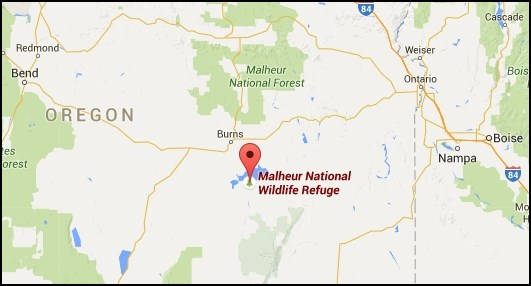
However, the weeks-long drama is now winding down, providing local media with an opportunity to dig deeper into the situation leading up to the takeover. Rather than supporting the militants’ cause, the picture that emerges makes this attempt to overthrow federal control of public property by force even more incoherent than it did at the start.
Poster boys for bad behavior
The first question that arises is why the takeover leader, Arizona businessman and Idaho resident Ammon Bundy, chose to travel to Oregon to champion the cause of two ranchers, Dwight and Steven Hammond. The two men’s history of illegal activities has apparently been screened by supportive community sentiment for years, but they don’t emerge as particularly sympathetic characters in the public record.
The immediate sequence of events leading up to the Malheur takeover was the re-sentencing of the Hammond ranchers, who were previously given light sentences for two arson charges related to brush fires on federal land in 2001 and 2006. In their 2012 trial, the judge ignored the fact that the charges carry a mandatory five-year minimum sentence. The father and son were accordingly re-sentenced last fall and agreed to turn themselves in to complete their time, which they did earlier this month.
Five years may seem extremely burdensome for setting two relatively small brush fires, considering that burning out brush and other debris is a common land management practice.
However, in a press release last fall, the U.S. Attorney prosecuting the case noted that the Hammonds had rejected an opportunity to plea-bargain for lesser sentences. He also noted that the Hammonds were well aware of their responsibility to work with federal officers on land management, and that their failure to do so in these two instances endangered firefighters, a group of hunters, and even one of their own relatives, who was 13 years old at the time.
The two convictions also tell only part of the story of the Hammonds’ activities. The website Wildfire Today has compiled a timeline dating back to 1994 for charges that include illegally attempting to build a fence on federal property, intimidating federal officials and interfering with other lawful users in addition to other instances of fire-setting. According to Wildfire Today, public pressure and threats against local Bureau of Land Management (BLM) officials were instrumental in having these other charges reduced or dropped. The arson charges that finally did stick were just two among multiple instances that were openly admitted by the Hammonds, or witnessed by other parties.
Many more details about the Hammonds’ behavior emerges in a 2014 BLM document refusing to renew the ranchers’ grazing permits. The agency’s formal decision cites their two convictions as sufficient reason for not renewing the permits, and it also goes much further. The BLM document cites a series of alleged arson episodes linked to the Hammonds in precise, blow-by-blow detail. It paints a picture of a reckless approach to land management that endangered human life on multiple occasions.
That’s the nut of the first Bundy miscalculation. He intended to showcase the Hammonds as victims of a federal agency run amok, but in doing so he has turned a spotlight on the family’s history of abusing their privilege as holders of federal grazing permits.
Fleeing through pregnant cows
Information is also starting to trickle in that suggests the relationship between local residents and the BLM is not nearly as fraught as Bundy and his supporters portray it.
Earlier in the standoff, Ammon Bundy attempted to force a confrontation with federal officials by tearing down a newly installed fence at the Malheur refuge, which he claimed was at the request of an adjacent rancher. The rancher denied having anything to do with Bundy, and sent his own crew out to repair the fence:
“I work with BLM,” the rancher, Tim Puckett, told the Oregonian. “I have no problem with them.” He said government officials told him of their plans to erect the fence, which he said “has not nor will it affect my cattle operation.”“I am a good steward of the land. … In no way do I feel that I am entitled to the refuge for grazing,” he said.
Another rancher endured the aftermath of the standoff last week, when all but a handful of the remaining occupiers fled across his property. He referenced the need for conservation work at the Malheur refuge to continue in a timely manner. Staff reporter Hal Bernton summed up the incident in the Seattle Times. Here’s an excerpt:
Rather than take the main public road, they drove through his property, riling up the pregnant cows.“It was unnerving,” [the rancher, Andy Dunbar, said]. “They were armed and had their tactical vests on, and I was kind of spooked.”Finally, Dunbar confronted one driver and asked why they were driving across his property. He was told someone at the refuge had placed a loader as a barricade across the bridge on the main road. And none of the occupiers could find the key to start the loader.“I want it to be over. There are things that need to be done,” Dunbar said. “We got a canal on the refuge that’s got so many muskrat holes it’s like Swiss cheese.”
In fact, the Malheur National Wildlife Refuge appears to represent the exact opposite of Bundy’s complaint. According to local accounts, years of difficult, painstaking negotiations with stakeholders — including the Oregon Cattleman’s Association — resulted in a “landmark” 2013 agreement that treats livestock not as a necessarily destructive force, but as a working element in sustainable land management.
The Seattle Times cites this fourth-generation local rancher in support of the agreement:
Over the years, Fred Otley has had plenty of conflicts with federal land managers. But the current refuge leadership appears to have earned his respect, even as some disagreements still persist about management of federal lands that provide his cattle vital fall and winter feed.“To me, what is important is that the refuge has really listened and taken a more collaborative approach,” Otley said. “Automatically, that helps build better relations with the community.”
In the same article, the Seattle Times discusses how the 2013 agreement enables ranchers to work with the refuge on species preservation, avoiding burdensome regulations:
“We started saying what’s good for the bird is good for the herd,” said Tom Sharp, a Harney County rancher who helped launch the cooperative effort that grew to encompass 53 ranches and 320,000 acres.The work drew praise from Interior Secretary Sally Jewell when she traveled to eastern Oregon last March. She referred to Harney County’s approach as the “Oregon Way” and promoted it as a model.
The real agenda behind the Malheur takeover
All this leads us to thinking that Bundy chose the Malheur refuge as the focus for extreme action precisely because the 2013 agreement was working, not because it wasn’t working.
As described, the 2013 agreement is actually a model for mobilizing local stakeholders in support of federal land ownership. That presents a direct threat to the movement to privatize federal land, promoted by the powerful lobbying organization ALEC under the guise of a “states’ rights” philosophy.
When the Malheur takeover first erupted, TriplePundit noted that ALEC’s states’-rights fingerprints were all over all it, and as events unfold, the ALEC lens is emerging as the only way to make sense of Bundy’s actions.
While professing to help the local community, Bundy consistently and willfully failed to abide by overwhelming local sentiment calling for him to leave, including pleas from the Hammonds themselves.
In addition to ignoring the desires of local stakeholders, Bundy also pointedly ignored the requests and the direction of the Harney County Sheriff, David M. Ward, who immediately and forcefully told Bundy to leave.
That’s significant because, in the “patriot” movement to which Bundy professes allegiance, the County Sheriff is the only legitimate law enforcement office recognized by the U.S. Constitution. That explains why Ammon Bundy began petitioning Ward to keep the Hammonds from jail as early as last November. Here’s a Facebook post from his family ranch dated Nov. 17:
**ACTION NEEDED** – HAMMOND FAMILY UPDATE[snip]We ask that anyone who may care about whether the Hammond’s go to prison, contact the Sheriff and express to him that it is not acceptable that he allows good people to suffer at the hands of our government.[snip]The injustices the Hammond’s are suffering will be a type and shadow of the suffering the American people will endure if we do not stand and put an end to it. It is time to act.
In concluding the post, Bundy clearly anticipates the possibility that Sheriff Ward will not cooperate:
Contact Sheriff Ward as soon as possible and then be prepared to gather in Burns, Oregon if necessary.
Again, the concept of the Constitutional Sheriff is central to the “patriot” movement, and yet Bundy chose to ignore this concept when it proved inconvenient.
In fact, Bundy chose to skip over any established form of local authority by establishing his own extra-legal Harney County Committee of Public Safety. Somewhat ironically, the committee also recognizes the sheriff’s authority among its official resolutions:
“… The County Sheriff, duly elected by the people, is the rightful premier law enforcement officer in Harney County and the first and last line of protection from abuses both from private and public offenders of our laws and Constitution, and said Constitution is the premier law of the land.”
Even with the Hammonds in jail and the standoff winding down, the committee has promised to hold additional meetings, though its relevance to other Harney County stakeholders is unclear.
Meanwhile, Ammon Bundy and several of his key supporters were arrested last week on federal felony charges, and they are being held without bail as flight risks in Portland, Oregon.
A call has gone out for “patriots” throughout the region to rally in support of the Bundy group and the Hammonds, but without any particularly significant result so far. One rally was held on Saturday in the nearby town of Burns, but it was not a daylight confrontation. It was scheduled for 6:00 p.m. and consisted of approximately 100 people who drove through Burns, with some vehicles sporting Confederate flags.
Another rally is planned for Monday night, so it will be interesting to see what kind of support it garners.
Four armed holdouts still remain at the refuge, despite calls from Bundy himself for them to leave peacefully.


