Showing posts with label Plastics pollution. Show all posts

Wednesday, May 19, 2021

3505. Twenty Firms Produce 55% of World’s Plastic Waste, Report Reveals

By Sandra Laville, The Guardian, May 17, 2021 

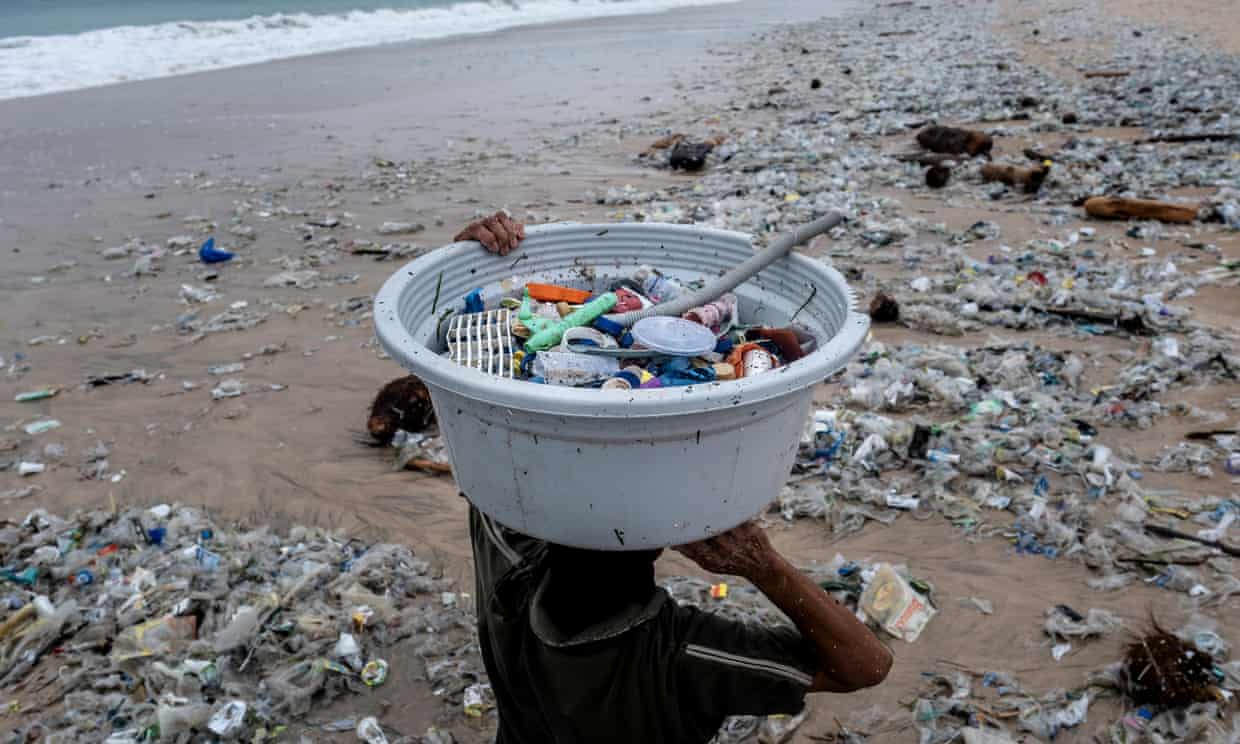
A woman collects recyclable plastics washed up on the beach in Bali, Indonesia. Photograph: Agung Parameswara/Getty Images


Twenty companies are responsible for producing more than half of all the single-use plastic waste in the world, fuelling the climate crisis and creating an environmental catastrophe, new research reveals.

Among the global businesses responsible for 55% of the world’s plastic packaging waste are both state-owned and multinational corporations, including oil and gas giants and chemical companies, according to a comprehensive new analysis.

The Plastic Waste Makers index reveals for the first time the companies who produce the polymers that become throwaway plastic items, from face masks to plastic bags and bottles, which at the end of their short life pollute the oceans or are burned or thrown into landfill.

It also reveals Australia leads a list of countries for generating the most single-use plastic waste on a per capita basis, ahead of the United States, South Korea and Britain.

ExxonMobil is the greatest single-use plastic waste polluter in the world, contributing 5.9m tonnes to the global waste mountain, concludes the analysis by the Minderoo Foundation of Australia with partners including Wood Mackenzie, the London School of Economics and Stockholm Environment Institute. The largest chemicals company in the world, Dow, which is based in the US, created 5.5m tonnes of plastic waste, while China’s oil and gas enterprise, Sinopec, created 5.3m tonnes.

Eleven of the companies are based in Asia, four in Europe, three in North America, one in Latin America, and one in the Middle East. Their plastic production is funded by leading banks, chief among which are Barclays, HSBC, Bank of America, Citigroup and JPMorgan Chase.

Barclays Bank lent more than $3bn to single-use plastics polymer producers
Total value of loans adjusted for share of business from SUP polymer production. January 2011 to December 2020
$bn
1
2
3
Barclays $3.1bn
HSBC 3.1
Bank of America 2.9
Citigroup 2.8
JPMorgan Chase 2.7
Mitsubishi UFJ Financial 2.1
SMBC Group 1.5
Mizuho Financial 1.5
UniCredit 1.1
Crédit Agricole 1.0
Guardian graphic | Source: KPMG
The enormous plastic waste footprint of the top 20 global companies amounts to more than half of the 130m metric tonnes of single-use plastic thrown away in 2019, the analysis says.

Single-use plastics are made almost exclusively from fossil fuels, driving the climate crisis, and because they are some of the hardest items to recycle, they end up creating global waste mountains. Just 10%-15% of single-use plastic is recycled globally each year.

The analysis provides an unprecedented glimpse into the small number of petrochemicals companies, and their financial backers, which generate almost all single-use plastic waste across the world.

Al Gore, the environmentalist and former US vice-president, said the groundbreaking analysis exposed how fossil fuel companies were rushing to switch to plastic production as two of their main markets – transport and electricity generation – were being decarbonised.

“Since most plastic is made from oil and gas – especially fracked gas – the production and consumption of plastic are becoming a significant driver of the climate crisis,” said Gore.

“Moreover, the plastic waste that results – particularly from single-use plastics – is piling up in landfills, along roadsides, and in rivers that carry vast amounts into the ocean.”

The plastic waste crisis grows every year. In the next five years, global capacity to produce virgin polymers for single-use plastics could grow by more than 30%.

By 2050 plastic is expected to account for 5%-10% of greenhouse gas emissions.

“An environmental catastrophe beckons: much of the resulting single-use plastic waste will end up as pollution in developing countries with poor waste management systems,” the report’s authors said. “The projected rate of growth in the supply of these virgin polymers … will likely keep new, circular models of production and reuse ‘out of the money’ without regulatory stimulus.”

The report said the plastics industry across the world had been allowed to operate with minimal regulation and limited transparency for decades. “These companies are the source of the single-use plastic crisis: their production of new ‘virgin’ polymers from oil, gas and coal feedstocks perpetuates the take-make-waste dynamic of the plastics economy.”

The report said this undermines the shift to a circular economy, including the production of recycled polymers from plastic waste, reusing plastic and using substitute materials. Just 2% of single-use plastic was made from recycled polymers in 2019.

“Plastic pollution is one of the greatest and most critical threats facing our planet,” said Dr Andrew Forrest AO, chairman of the Minderoo Foundation. “The current outlook is set to get worse and we simply cannot allow these producers of fossil fuel-derived plastics to continue as they have done without check. With our oceans choking and plastic impacting our health, we need to see firm intervention from producers, governments and the world of finance to break the cycle of inaction.”

Saturday, March 24, 2018

2854. The ‘Great Pacific Garbage Patch’ Is Ballooning, 87,000 Tons of Plastic and Counting


By Livia Albeck-Ripka, The New York Times, March 22, 2018
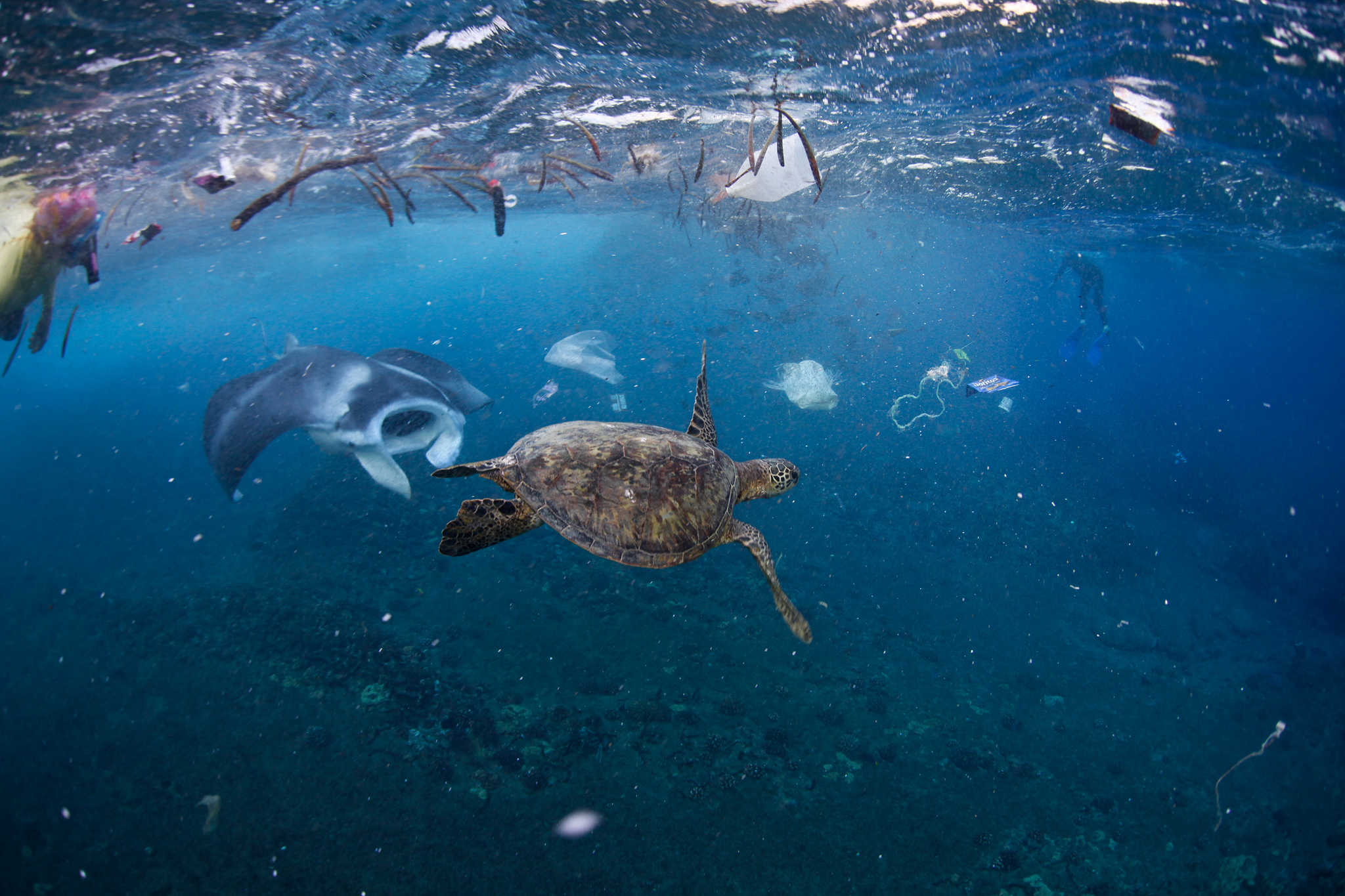
Plastics kill ocean life like turtles. 
In the Pacific Ocean between California and Hawaii, hundreds of miles from any major city, plastic bottles, children’s toys, broken electronics, abandoned fishing nets and millions more fragments of debris are floating in the water — at least 87,000 tons’ worth, researchers said Thursday.

In recent years, this notorious mess has become known as the Great Pacific Garbage Patch, a swirling oceanic graveyard where everyday objects get deposited by the currents. The plastics eventually disintegrate into tiny particles that often get eaten by fish and may ultimately enter our food chain.

Researchers said nets made up a surprising proportion of the waste they identified.

study published Thursday in the journal Scientific Reports quantified the full extent of the so-called garbage patch: It is four to 16 times bigger than previously thought, occupying an area roughly four times the size of California and comprising an estimated 1.8 trillion pieces of rubbish. While the patch was once thought to be more akin to a soup of nearly invisible microplastics, scientists now think most of the trash consists of larger pieces. And, they say, it is growing “exponentially.”

“It’s just quite alarming, because you are so far from the mainland,” said Laurent Lebreton, the lead author of the study and an oceanographer with the Ocean Cleanup Foundation, a nonprofit that is developing systems to remove ocean trash and which funded the study. “There’s no one around and you still see those common objects, like crates and bottles.”

In the late summer of 2015, Mr. Lebreton and his colleagues measured the amount of plastic debris in the patch by trawling it with nets and flying overhead to take aerial photographs. Though they also found glass, rubber and wood, 99.9 percent of what the researchers pulled out of the ocean was plastic.

They also recovered a startling number of abandoned plastic fishing nets, Mr. Lebreton said. These “ghost nets” made up almost half of the total weight of the debris. (One explanation is the patch’s proximity to fishing grounds; another is that fishing material is designed to be resilient at sea and stays intact longer than other objects.)

“We found a few unexpected objects,” Mr. Lebreton said. “Among them were plastic toys, which I found really sad, as some of them may have come from the tsunami in Japan,” he added, referring to the 2011 disaster that sent millions of tons of debris into the ocean.

The researchers also fished out a ’90s-era Game Boy cover, construction-site helmets and a toilet seat, as well as a number of objects with Japanese and Chinese inscriptions. Other objects, Mr. Lebreton said, had “little bite marks from fish.”

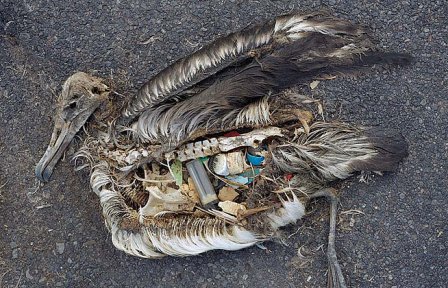
Some sea turtles caught near the patch were eating so much plastic that it made up around three-quarters of their diet, according to the foundation.

The garbage patch is not exactly a “patch”
After its discovery in the late ’90s, the Great Pacific Garbage Patch took on an image in the popular imagination akin to an island or even a seventh continent made of trash. That myth was debunked, and the patch became understood as more like a region that looked like the rest of the ocean to the naked eye, but was polluted with tiny microplastics.

However the new study says that the microplastics, while still a problem, account for just 8 percent of the mass of the patch. Until now, most of the sampling used an ocean trawl designed to pick up small particles, and therefore, Mr. Lebreton said, underestimated the number of larger pieces of debris floating in the sea, like bottles, buoys and fishing nets.
“Most of the mass is actually large debris, ready to decompose into microplastic,” Mr. Lebreton said.

Still, “it’s not an island,” Mr. Lebreton said. “It’s very scattered.” (A visual model, however, shows how the debris is condensed in one area in the ocean.)

"I think the name ‘patch’ is a little bit confusing,” said Nancy Wallace, the director of the National Oceanic and Atmospheric Administration’s Marine Debris Program, who was not involved in the study. Describing it that way, she said, gave the wrong impression that it “would be easy to go pick it up.”

There may still be time to act
The worry is that, within a few decades, the larger pieces of debris could break up into microplastics, which are much harder to remove from the ocean. “It’s like a ticking time bomb,” said Joost Dubois, a spokesman for the Ocean Cleanup Foundation.

The foundation says it would be almost impossible to remove the plastic already in the patch by traditional methods, like nets attached to boats. Instead, the group has developed a mechanical system that floats through the water and concentrates the plastics into denser areas that can then be collected by boats and taken back to shore to be recycled.

The foundation plans to launch the first such system this summer from Alameda, Calif.
Thursday, July 20, 2017

2665. The Immense, Eternal Footprint Humanity Leaves on Earth: Plastics

By Tatiana Schlossberg, The New York Times, July 19, 2017
13 metric million tons of plastics enter the oceans each year.
If human civilization were to be destroyed and its cities wiped off the map, there would be an easy way for future intelligent life-forms to know when the mid-20th century began: plastic.

From the 1950s to today, 8.3 billion metric tons of plastic have been produced, with around half of it made since 2004. And since plastic does not naturally degrade, the billions of tons sitting in landfills, floating in the oceans or piling up on city streets will provide a marker if later civilizations ever want to classify our era. Perhaps they will call this time on Earth the Plastocene Epoch.

new study in Science Advances published Wednesday offered the first analysis of all mass-produced plastics ever manufactured: how much has been made, what kind and what happens to the material once it has outlived its use.

Roland Geyer, the lead author of the study, said, “My mantra is that you can’t manage what you don’t measure, and without good numbers, you don’t know if we have a real problem.”
The authors, who come from the University of California, Santa Barbara, the University of Georgia and the Sea Education Association in Woods Hole, Mass., used plastic production data from a variety of sources to make their estimates.

Their findings suggest that staggering amounts of near-eternal litter is present in the environment — the oceans, landfills and freshwater and terrestrial ecosystems — and the numbers are quite likely to increase, with 12 billion metric tons accumulating in landfills or in the environment by 2050. (One metric ton is 1.1 short tons, the measure more commonly used in the United States.)

Scientists estimate that five million to 13 million metric tons of plastic enter the ocean each year, according to previous studies. New data suggests contamination in rivers and streams, as well as on land, is increasingly common, with most of the pollution in the form of microscopic pieces of synthetic fiberslargely from clothing.

The primary explanation for the rocketing rise in plastic is its use in packaging, which accounted for about 42 percent of nonfiber plastic production in 2015. Building and construction is the next largest plastic-consuming sector; it used 19 percent of nonfiber plastic that year.

The authors estimate that packaging, which is typically used for less than a year, made up 54 percent of the nonfiber plastic that was thrown away in 2015.

Most of the plastic that has been made is no longer in use — about 6.3 billion metric tons of plastic have been thrown away since 1950. About 12 percent of that has been incinerated, which is the only way to permanently dispose of plastic; 9 percent has been recycled, which only delays final disposal; and 60 percent — about 4.9 billion metric tons — is in landfills or scattered in the environment.

In Europe, 30 percent of nonfiber plastic is recycled, compared to 9 percent in the United States. Europe also burns more plastic — about 40 percent of its nonfiber plastic waste — while the U.S. incinerates around 16 percent. China recycles about 25 percent and burns about 30 percent of its plastic waste. The authors estimate that recycling, disposal and incineration rates in the rest of the world are probably similar to those in the United States.
Dr. Geyer cautioned that recycling was not a cure-all for global plastic pollution. He said the sole benefit of recycling was to reduce the amount of new plastic being produced, adding, “We don’t understand very well the extent to which recycling reduces primary production.”

The features that have made plastic so important in the global market are the same ones that make it such a pervasive pollutant: durability and resistance to degradation.

Dr. Geyer said there was not enough information on what the long-term consequences of all this plastic and its disposal would be. “It accumulates so quickly now and it doesn’t biodegrade, so it just gets added to what’s already there.”

“Once we start looking, I think we’ll find all sorts of unintended consequences,” he added. “I’d be very surprised to find out that it is a purely aesthetic problem.”

Sunday, April 3, 2016

2256. World’s First Plastic Fishing Company Wants to Rid the Oceans of Plastic Pollution

By Lorraine Chow, EcoWatch, April 1, 2016

The premise behind the Amsterdam-based venture Plastic Whale is beautifully simple. First, the company fishes out plastic bottles and other debris from the city’s numerous canals. Second, when enough bottles are collected, the plastic is transformed into material to make a boat. Third, the new boat is used to fish for more plastic bottles—to make more boats. Genius.
plasticwhaleboat
Plastic Whale captures debris and plastic waste from Amsterdam’s many canals. Thousands of discarded plastic bottles are repurposed into building materials for the company’s boats and even bottle caps are used to create a colorful mosaic for the boat’s floor. The company then uses the boats to fish for more trash to make more boats. Photo credit: Facebook/courtesy photos
The goal of Plastic Whale—which describes itself as the world’s first plastic fishing company—is to rid the world’s waters of plastic pollution. With an estimated 8 million tons of plastic trashentering our waterways annually, Plastic Whale is going to need a lot of boats.
Founder and captain Marius Smit, however, is up for the ambitious task. He tells EcoWatch that he not only envisions a world of plastic-free waters but also a world where people understand that everyday trash, such as plastic bottles, can be transformed into “a valuable raw material.”
Since its 2010 launch, the company has fished more than 50,000 plastic bottles and more than 10,000 kilos of various waste from the canals of Amsterdam, according to Smit.
Today, the company offers businesses and individuals plastic fishing tours on its total fleet of seven boats, all made from plastic bottles. One of its newest boats—created in partnership with Interface, the world’s largest carpet tile manufacturer—is made from more than 7,000 plastic bottles. As it turns out, the light and buoyant plastic from PET bottles make great boat building blocks.
Smit took the time to answer a few of EcoWatch’s questions via email:
EcoWatch: Besides boats, what else does your company do with the captured trash? 
Smit: All our boats are made from recycled Amsterdam canal plastic (plastic we fished from our canals). We use the bottle caps to create beautiful mosaics on the floors of our boats. Also, we started a new company WasteBoards, which makes unique skateboards from bottle caps.
EcoWatch: What is the most important thing you tell your Plastic Whale boat riders?
Smit: Obviously we tell them about the problem of plastic soup. But another important issue we tell them is that plastic should not be regarded as valueless waste, but as valuable raw material. We do this by creating beautiful design boats and unique skateboards; products that amaze and appeal to people. The root of the problem, as we see it, is that people regard plastic as a disposable. We try to change people’s perceptions.
EcoWatch: Have you seen a reduction in plastic waste or other debris in the waters?
Smit: It is quite hard to say, because the problem of plastic waste is quite enormous and we have more than 100 kilometers of canals in Amsterdam. Some people say that since we exist the problem has diminished, but I will not claim that. However, we can show the heaps of waste that we have fished from the canals. Without us, a large part would have ended up at sea.
plasticwhale
EcoWatch: What inspired you to launch Plastic Whale?
Smit: Twelve years ago I was traveling the world for a year with my girlfriend. We visited beautiful and remote places. And everywhere we came, we saw plastic waste. One day we were staying on a pristine little beach on the North side of Borneo, near Kota Kinabalu. The weather was bad with a lot of on-land wind. When we arrived at the beach it was flooded with plastic debris. I was in shock, because North of Borneo there is nothing but sea for hundreds of miles. That’s when I was first introduced to the plastic soup phenomenon. And I decided that I wanted to do something about it.
When I came home, however, I got frustrated because I did not know where and how to start, because I was a loner. After a few years social media came up. All of a sudden I could connect with people all over the planet with the same mission, ideas or frustration as mine. I was inspired by JFK’s 1961 speech during which he portrayed a man on the moon, which had to be there before the end of the decade. At the time this challenge was impossible but relevant. And mostly, the clear vision of a man standing on the moon excited people. That combination of factors created cohesion and innovative spur. I came to the conclusion that today, because of social media, you don’t have to be called JFK anymore to create a following, but you have to create your own “man on the moon.”
So in 2011 I published my “man on the moon” via social media: “I want to build a boat made from plastic waste, yet I have never driven a boat let alone built one. So please help me!” It worked. Within weeks I was traveling through Holland to talk to people and organizations who wanted to help me.
Two years ago we presented our first boat (made from recycled Amsterdam Canal Plastic) and now we have a fleet of seven boats. We are a fast-growing company: the first professional plastic fishing company in the world.
Team vissers lichter
Captain Marius Smit (center) and his Plastic Whale team.
EcoWatch: Why is fighting plastic waste important to you? What is your ultimate goal with the company?
Smit: Our ultimate goal is to make the world’s waters plastic-free. We won’t claim that we will just achieve that by ourselves, because the problem is simply to huge and complex. But we do want to make a positive contribution towards the solution. Before I started Plastic Whale I had a marketing position, which meant, in my view, getting people to buy things they really didn’t need. During my travels I decided that I wanted to get out of the office, to keep on traveling, leading an adventurous life and contributing something concrete and positive to the world. When I encountered the problem of plastic soup I realized that I had to do something about it. Now I have managed to create a company and a living for my colleagues and myself whilst we add something positive to the world.