Showing posts with label Plastics in oceans. Show all posts

Monday, April 4, 2022

3580. Microplastics and climate crisis

By Sabrina Imbler, The New York Times, April 3, 2022

Credit...Agung Parameswara/Getty Images

As long as there has been marine life, there has been marine snow — a ceaseless drizzle of death and waste sinking from the surface into the depths of the sea.

The snow begins as motes, which aggregate into dense, flocculent flakes that gradually sink and drift past the mouths (and mouth-like apparatuses) of scavengers farther down. But even marine snow that is devoured will most likely be snowfall once more; a squid’s guts are just a rest stop on this long passage to the deep.

Although the term may suggest wintry whites, marine snow is mostly brownish or grayish, comprising mostly dead things. For eons, the debris has contained the same things — flecks from plant and animal carcasses, feces, mucus, dust, microbes, viruses — and transported the ocean’s carbon to be stored on the seafloor. Increasingly, however, marine snowfall is being infiltrated by microplastics: fibers and fragments of polyamide, polyethylene and polyethylene terephthalate. And this fauxfall appears to be altering our planet’s ancient cooling process.

Every year, tens of millions of tons of plastic enter Earth’s oceans. Scientists initially assumed that the material was destined to float in garbage patches and gyres, but surface surveys have accounted for only about one percent of the ocean’s estimated plastic. A recent model found that 99.8 percent of plastic that entered the ocean since 1950 had sunk below the first few hundred feet of the ocean. Scientists have found 10,000 times more microplastics on the seafloor than in contaminated surface waters.

Marine snow, one of the primary pathways connecting the surface and the deep, appears to be helping the plastics sink. And scientists have only begun to untangle how these materials interfere with deep-sea food webs and the ocean’s natural carbon cycles.

“It’s not just that marine snow transports plastics or aggregates with plastic,” Luisa Galgani, a researcher at Florida Atlantic University, said. “It’s that they can help each other get to the deep ocean.”

The sunlit surface of the sea blooms with phytoplankton, zooplankton, algae, bacteria and other minuscule life, all feeding on sunbeams or one another. As these microbes metabolize, some produce polysaccharides that can form a sticky gel that attracts the lifeless bodies of tiny organisms, small shreds of larger carcasses, shells from foraminifera and pteropods, sand and microplastics, which stick together to form larger flakes. “They are the glue that keeps together all the components of marine snow,” Dr. Galgani said.

Marine snowflakes fall at different rates. Smaller ones have a more languid descent — “as slow as a meter a day,” said Anela Choy, a biological oceanographer at Scripps Institution of Oceanography at the University of California, San Diego. Bigger particles, such as dense fecal pellets, can sink quicker. “It just skyrockets to the bottom of the ocean,” said Tracy Mincer, a researcher at Florida Atlantic University.

Plastic in the ocean is constantly being degraded; even something as big and buoyant as a milk jug will eventually shed and splinter into microplastics. These plastics develop biofilms of distinct microbial communities — the “plastisphere,” said Linda Amaral-Zettler, a scientist at the Royal Netherlands Institute for Sea Research, who coined the term. “We sort of think about plastic as being inert,” Dr. Amaral-Zettler said. “Once it enters the environment, it’s rapidly colonized by microbes.”

Microplastics can host so many microbial hitchhikers that they counteract the natural buoyancy of the plastic, causing their raft to sink. But if the biofilms then degrade on the way down, the plastic could float back up, potentially leading to a yo-yoing purgatory of microplastics in the water column. Marine snow is anything but stable; as flakes free-fall into the abyss, they are constantly congealing and falling apart, rent by waves or predators.

“It’s not as simple as: Everything’s falling all the time,” said Adam Porter, a marine ecologist at the University of Exeter in England. “It’s a black box in the middle of the ocean, because we can’t stay down there long enough to work out what’s going on.”

To explore how marine snow and plastics are distributed in the water column, Dr. Mincer has begun to sample deeper waters with a dishwasher-size pump full of filters that dangles on a wire from a research boat. The filters are arranged from big mesh to small to filter out fish and plankton. Running these pumps for 10 hours at a stretch has revealed nylon fibers and other microplastics distributed throughout the water column below the South Atlantic subtropical gyre.

But even with a research boat and its expensive and unwieldy equipment, an individual piece of marine snow is not easily retrieved from deep water in the actual ocean. The pumps often disturb the snow and scatter fecal pellets. And the flakes alone offer little insight into how fast some snows are sinking, which is vital to understanding how long the plastics linger, yo-yo or sink in the water column before settling on the seafloor.

“Is it decades?” Dr. Mincer asked. “Is it hundreds of years? Then we can understand what we’re in here for, and what kind of problem this really is.”


To answer these questions, and work within a budget, some scientists have made and manipulated their own marine snow in the lab.

In Exeter, Dr. Porter collected buckets of seawater from a nearby estuary and loaded the water into continuously rolling bottles. He then sprinkled in microplastics, including polyethylene beads and polypropylene fibers. The constant churning, and a squirt of sticky hyaluronic acid, encouraged particles to collide and stick together into snow.

“We obviously don’t have 300 meters of a tube to make it sink,” Dr. Porter said. “By rolling it, what you’re doing is you’re creating a never-ending water column for the particles to fall through.”

After the bottles rolled for three days, he pipetted out the snow and analyzed the number of microplastics in each flake. His team found that every type of microplastic they tested aggregated into marine snow, and that microplastics such as polypropylene and polyethylene — normally too buoyant to sink on their own — readily sank once incorporated into marine snow. And all the marine snow contaminated with microplastics sank significantly faster than the natural marine snow.


Dr. Porter suggested that this potential change of the speed of the snow could have vast implications for how the ocean captures and stores carbon: Faster snowfalls could store more microplastics in the deep ocean, whereas slower snowfalls could make the plastic-laden particles more available to predators, potentially starving food webs deeper down. “The plastics are a diet pill for these animals,” said Karin Kvale, a carbon cycle scientist at GNS Science in New Zealand.


In experiments in Crete, with funding from the European Union’s Horizon 2020 research program, Dr. Galgani has tried mimicking marine snow on a larger scale. She dropped six mesocosms — huge bags that each contained nearly 800 gallons of seawater and recreated natural water movement — in a large pool. Under these conditions, marine snow formed. “In the field, you mostly make observations,” Dr. Galgani said. “You have so little space and a limited system. In the mesocosm, you are manipulating a natural system.”

Dr. Galgani mixed microplastics into three mesocosms in an attempt to “recreate a sea and maybe a future ocean where you can have a high concentration of plastic,” she said. The mesocosms laden with microplastics produced not just more marine snow but also more organic carbon, as the plastics offered more surfaces for microbes to colonize. All this could seed the deep ocean with even more carbon and alter the ocean’s biological pump, which helps regulate the climate.

“Of course, it’s a very, very big picture,” Dr. Galgani said. “But we have some signals that it can have an effect. Of course, it depends on how much plastic there is.”

To understand how microplastics might travel through deep-sea food webs, some scientists have turned to creatures for clues.

Every 24 hours, many species of marine organism embark on a synchronized migration up and down in the water column. “They do the equivalent of a marathon every day and night,” Dr. Choy said. Guilherme V.B. Ferreira, a researcher at the Rural Federal University of Pernambuco in Brazil, wondered: “Is it possible they are transporting the plastics up and down?”

Dr. Ferreira and Anne Justino, a doctoral student at the same university, collected vampire squids and midwater squids from a patch of the tropical Atlantic. They found a plethora of plastics in both species: mostly fibers, but also fragments and beads.


This made sense for midwater squids, which migrate toward the surface at night to feed on fish and copepods that eat microplastics directly. But vampire squids, which live in deeper waters with fewer microplastics, had even higher levels of plastic, as well as foam, in their stomachs. The researchers hypothesize that the vampire squids’ primary diet of marine snow, especially meatier fecal pellets, may be funneling plastics into their bellies.

“It’s very concerning,” Ms. Justino said. Dr. Ferreira said: “They are one of the most vulnerable species for this anthropogenic influence.”

Ms. Justino has excavated fibers and beads from the digestive tracts of lanternfish, hatchetfish and other fish that migrate up and down in the mesopelagic, 650 to 3,300 feet down. Some microbial communities that settle on microplastics can bioluminesce, drawing in fish like a lure, said Dr. Mincer.

In the Monterey Bay Canyon, Dr. Choy wanted to understand if certain species of filter feeders were ingesting microplastics and transporting them into food webs in deeper water. “Marine snow is one of the major things that connects food webs across the ocean,” she said.


Dr. Choy zeroed in on the giant larvacean Bathochordaeus stygius. The larvacean resembles a tiny tadpole and lives inside a palatial bubble of mucus that can reach up to a meter long. “It’s worse than the grossest booger you’ve ever seen,” Dr. Choy said. When their snot-houses become clogged from feeding, the larvaceans move out and the heavy bubbles sink. Dr. Choy found that these palaces of mucus are crowded with microplastics, which are funneled to the deep along with all their carbon.

Giant larvaceans are found across the world’s oceans, but Dr. Choy emphasized that her work was focused on the Monterey Bay Canyon, which belongs to a network of marine protected areas and is not representative of other, more polluted seas. “It’s one deep bay on one coast of one country,” Dr. Choy said. “Scale up and think about how vast the ocean is, especially the deep water.”


Individual flakes of marine snow are small, but they add up. A model created by Dr. Kvale estimated that in 2010, the world’s oceans produced 340 quadrillion aggregates of marine snow, which could transport as many as 463,000 tons of microplastics to the seafloor each year.

Scientists are still exploring exactly how this plastic snow is sinking, but they do know for sure, Dr. Porter said, that “everything eventually sinks in the ocean.” Vampire squids will live and die and eventually become marine snow. But the microplastics that pass through them will remain, eventually settling on the seafloor in a stratigraphic layer that will mark our time on the planet long after humans are gone.

Monday, January 20, 2020

3307. There's Literally a Million Times More Microplastics in Oceans Than We Realized

By George Dvorsky, Gizmodo, December 3, 2019

If you pulled 1,000 liters (264 gallons) of water out of the ocean, how many small bits of plastic would you expect to find? Ten pieces? One hundred pieces? How about 8.3 million pieces of what researchers call “mini-microplastic.” Such is the finding of an alarming new study.
The amount of microplastic in our ocean—that is, pieces of plastic measuring smaller than 5 millimeters—is a million times greater than previously estimated, according to new research published in the science journal Limnology and Oceanography Letters
“For years we’ve been doing microplastics studies the same way (by) using a net to collect samples,” said Brandon in a press release. “But anything smaller than that net mesh has been escaping.”
Indeed, as independent research from 2015 pointed out, thousands of trawls done between 1971 and 2013—all with the same kind of net—were only able to capture plastics larger than 333 micrometers in size, or one-third of a millimeter. So while these nets were small enough to filter plankton, they were subsequently too big to capture the smallest plastic particles, known as mini-microplastics.
“I saw these published size ranges and thought, we are under-sampling this smaller range. There’s a big knowledge gap,” said Brandon.
With this deficiency in mind, Brandon and her colleagues developed a new technique to detect and measure the volume of mini-microplastics in seawater. Salps—tiny, gelatinous filter-feeding invertebrates— were key to the updated approach were. These barrel-shaped creatures swim at depths above 2,000 meters (6,500 feet) and they often link together to form long chains that, through their combined efforts, helps them to swim faster. To swim and filter-feed on plankton, salp pump water through their bodies with pulsed contractions.
The Scripps researchers figured the stomachs of salps might be a place where mini-microplastics accumulate. To that end, samples of both surface seawater and salp specimens were pulled from the California Current, the North Pacific subtropical gyre (also known as the Great Pacific Garbage Patch), and an in-between ocean zone.
Back at the lab, the scientists used a special fluorescent microscope to illuminate—both literally and figuratively—microplastic particles found in the samples. As the Scripps press release points out, “plastic self-illuminates when exposed to multiple wavelengths of light.” This method allowed them to document pieces as small as 10 micrometers, which is thinner than the width of human hair. The researchers also analyzed seawater collected from 2009 to 2017 for their analysis.
Disturbingly, every salp studied had mini-microplastics in their stomach, a finding that even surprised the researchers. Given the quick turnaround time of the salps’ digestive system—between 2 to 7 hours—the scientists expected their stomachs to be relatively clean. Such was not the case.
“The thing that truly surprised me the most was that every salp, regardless of year collected, species, life stage, or part of the ocean collected, had plastic in its stomach,” Brandon wrote in an email to Earther. “A species having 100 percent ingestion rates is quite extraordinary, and devastating for the foodweb that eats salps.”
Translating these findings into an estimate, the researchers concluded that, on average, 8.3 million pieces of mini-microplastics can be found in a typical cubic meter (35 cubic feet or the aforementioned 1,000 liters) of ocean water. That runs in stark contrast to the previous estimate of 10 fragments per cubic meter.
“This study may be one of the first to estimate the abundance of the smallest mini‐microplastics in surface seawater, which are consistently under‐sampled,” wrote the authors in the study. The findings show plastic concentrations were up to seven orders of magnitude higher than earlier studies, highlighting the “previously unquantified significance of mini‐microplastics in marine debris counts.”
Of course, quantity is different than total volume.
“The quantity is one million times more numerically, but when you multiply the quantity times volume, the volume of the larger pieces is still much higher,” said Brandon. This distinction matters, she said, depending on what kind of animal you are. Smaller creatures like salps and small plankton will tend to eat more of the tiny bits of plastic while larger plankton and small fish are more likely to be impacted by bigger pieces of plastic.
That salps are accumulating so much plastic is a serious concern. The tiny creatures are likely providing a transportation mechanism for microplastics to reach the bottom of the deep ocean through their digestive processes and sinking feces, and by virtue of this, into the food chain down below. And because salps are regularly consumed by marine animals such as sea turtles, rockfish, and king crab—of which the latter two are regularly consumed by humans—these mini-microplastics might eventually find their way to our dinner plates, and ultimately our bodies.
Microplastics are harmful to marine organisms and ecosystems, but their effect on human health remains unclear. That said, the U.S. National Institutes of Health (NIH) says we should probably be worried, though:
“There is scientific uncertainty about the hazards of microplastic issues. There is concern that microplastics could have adverse health effects on humans as they move through the marine food web. Microplastics both absorb and give off chemicals and harmful pollutants. Plastic’s ingredients or toxic chemicals absorbed by plastics may build up over time and stay in the environment. It is not known if you can be exposed to these pollutants by eating contaminated seafood.”
Most of the microplastics observed in the new study were collected from regions close to shore, which suggests the source is runoff pollution from land. Microplastic waste comes from a variety of sources, including synthetic microfibers found in clothing and tiny spherules in toothpaste and skincare products. Over time, much of this plastic, whether big or small, breaks down into smaller and smaller pieces, but they linger in the environment for extended periods of time. They cannot be removed by wastewater treatment, and much of this waste ends up in our oceans.
“The results were very surprising in terms of how high our numbers were, but also not that surprising, when you think about how plastic breaks down,” said Brandon. “Every large piece breaks down into thousands, maybe millions of tiny pieces, so there should be millions more [of the] tiniest pieces. It actually makes sense compared to some modeled degradation simulations.”
In terms of how scientists could further validate these results, Brandon offered a few suggestions. She told Earther researchers could “sample more samples of water in other ocean basins and more salps and similar filter-feeding plankton,” and adopt her team’s fluorescence microscopy method and start hunting for small microplastics. In addition, scientists could “fine-tune this microscopy method with more specialized fluorescence filters for specific plastics so we know abundances of plastic types as well.”
Governments and other top officials need to enact legislation to limit the use of products that contribute to microplastic pollution, but there are things you can do as well, such as not using products that contain microplastics, avoiding single-use plastics, using paper bags, recycling, and, of course, not throwing plastic waste into any body of water. After all, it may just end up back in your body anyways.

Saturday, March 24, 2018

2854. The ‘Great Pacific Garbage Patch’ Is Ballooning, 87,000 Tons of Plastic and Counting


By Livia Albeck-Ripka, The New York Times, March 22, 2018
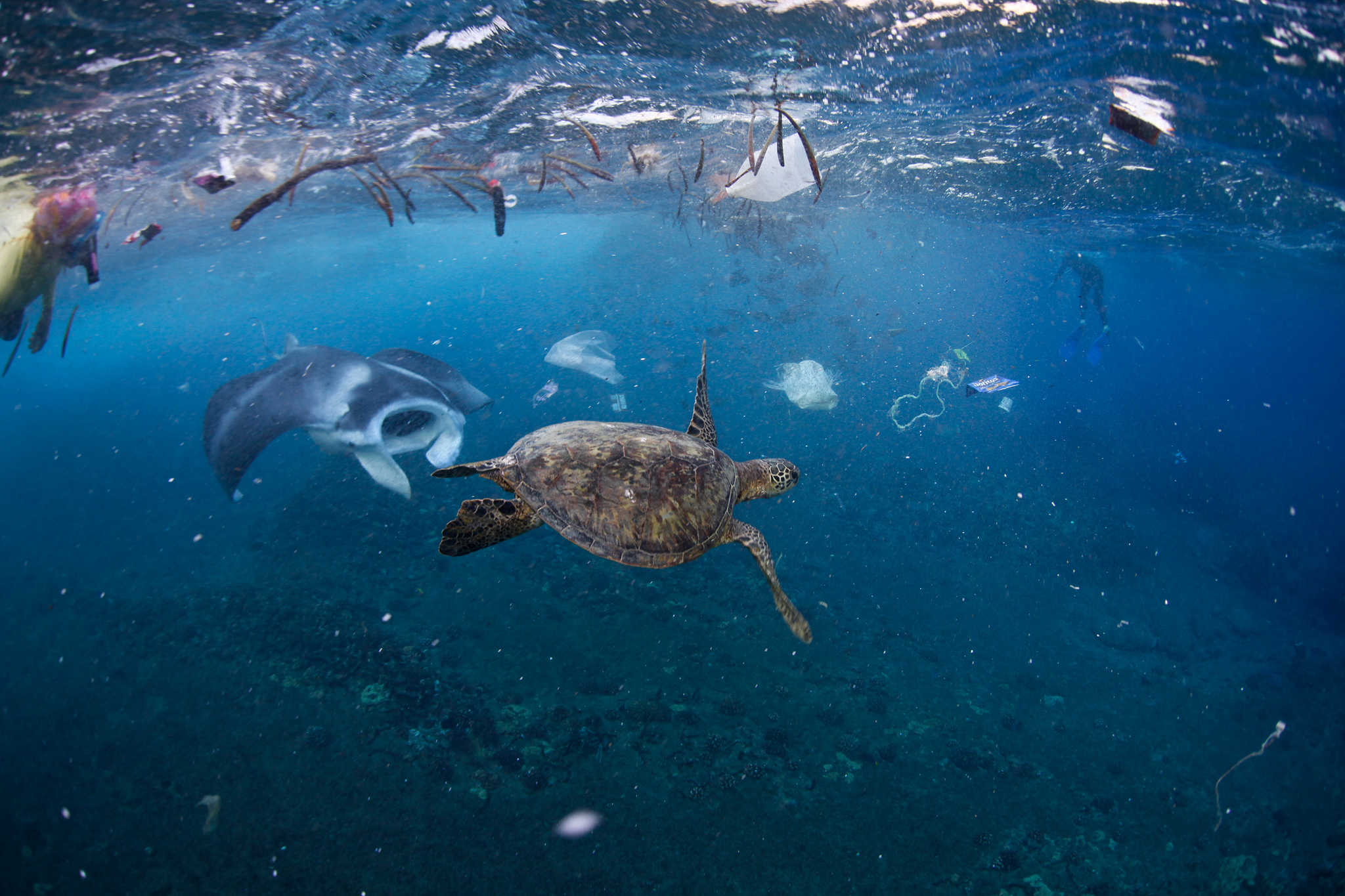
Plastics kill ocean life like turtles. 
In the Pacific Ocean between California and Hawaii, hundreds of miles from any major city, plastic bottles, children’s toys, broken electronics, abandoned fishing nets and millions more fragments of debris are floating in the water — at least 87,000 tons’ worth, researchers said Thursday.

In recent years, this notorious mess has become known as the Great Pacific Garbage Patch, a swirling oceanic graveyard where everyday objects get deposited by the currents. The plastics eventually disintegrate into tiny particles that often get eaten by fish and may ultimately enter our food chain.

Researchers said nets made up a surprising proportion of the waste they identified.

study published Thursday in the journal Scientific Reports quantified the full extent of the so-called garbage patch: It is four to 16 times bigger than previously thought, occupying an area roughly four times the size of California and comprising an estimated 1.8 trillion pieces of rubbish. While the patch was once thought to be more akin to a soup of nearly invisible microplastics, scientists now think most of the trash consists of larger pieces. And, they say, it is growing “exponentially.”

“It’s just quite alarming, because you are so far from the mainland,” said Laurent Lebreton, the lead author of the study and an oceanographer with the Ocean Cleanup Foundation, a nonprofit that is developing systems to remove ocean trash and which funded the study. “There’s no one around and you still see those common objects, like crates and bottles.”

In the late summer of 2015, Mr. Lebreton and his colleagues measured the amount of plastic debris in the patch by trawling it with nets and flying overhead to take aerial photographs. Though they also found glass, rubber and wood, 99.9 percent of what the researchers pulled out of the ocean was plastic.

They also recovered a startling number of abandoned plastic fishing nets, Mr. Lebreton said. These “ghost nets” made up almost half of the total weight of the debris. (One explanation is the patch’s proximity to fishing grounds; another is that fishing material is designed to be resilient at sea and stays intact longer than other objects.)

“We found a few unexpected objects,” Mr. Lebreton said. “Among them were plastic toys, which I found really sad, as some of them may have come from the tsunami in Japan,” he added, referring to the 2011 disaster that sent millions of tons of debris into the ocean.

The researchers also fished out a ’90s-era Game Boy cover, construction-site helmets and a toilet seat, as well as a number of objects with Japanese and Chinese inscriptions. Other objects, Mr. Lebreton said, had “little bite marks from fish.”

Some sea turtles caught near the patch were eating so much plastic that it made up around three-quarters of their diet, according to the foundation.

The garbage patch is not exactly a “patch”
After its discovery in the late ’90s, the Great Pacific Garbage Patch took on an image in the popular imagination akin to an island or even a seventh continent made of trash. That myth was debunked, and the patch became understood as more like a region that looked like the rest of the ocean to the naked eye, but was polluted with tiny microplastics.

However the new study says that the microplastics, while still a problem, account for just 8 percent of the mass of the patch. Until now, most of the sampling used an ocean trawl designed to pick up small particles, and therefore, Mr. Lebreton said, underestimated the number of larger pieces of debris floating in the sea, like bottles, buoys and fishing nets.
“Most of the mass is actually large debris, ready to decompose into microplastic,” Mr. Lebreton said.

Still, “it’s not an island,” Mr. Lebreton said. “It’s very scattered.” (A visual model, however, shows how the debris is condensed in one area in the ocean.)

"I think the name ‘patch’ is a little bit confusing,” said Nancy Wallace, the director of the National Oceanic and Atmospheric Administration’s Marine Debris Program, who was not involved in the study. Describing it that way, she said, gave the wrong impression that it “would be easy to go pick it up.”

There may still be time to act
The worry is that, within a few decades, the larger pieces of debris could break up into microplastics, which are much harder to remove from the ocean. “It’s like a ticking time bomb,” said Joost Dubois, a spokesman for the Ocean Cleanup Foundation.

The foundation says it would be almost impossible to remove the plastic already in the patch by traditional methods, like nets attached to boats. Instead, the group has developed a mechanical system that floats through the water and concentrates the plastics into denser areas that can then be collected by boats and taken back to shore to be recycled.

The foundation plans to launch the first such system this summer from Alameda, Calif.

Sunday, April 3, 2016

2256. World’s First Plastic Fishing Company Wants to Rid the Oceans of Plastic Pollution

By Lorraine Chow, EcoWatch, April 1, 2016

The premise behind the Amsterdam-based venture Plastic Whale is beautifully simple. First, the company fishes out plastic bottles and other debris from the city’s numerous canals. Second, when enough bottles are collected, the plastic is transformed into material to make a boat. Third, the new boat is used to fish for more plastic bottles—to make more boats. Genius.
plasticwhaleboat
Plastic Whale captures debris and plastic waste from Amsterdam’s many canals. Thousands of discarded plastic bottles are repurposed into building materials for the company’s boats and even bottle caps are used to create a colorful mosaic for the boat’s floor. The company then uses the boats to fish for more trash to make more boats. Photo credit: Facebook/courtesy photos
The goal of Plastic Whale—which describes itself as the world’s first plastic fishing company—is to rid the world’s waters of plastic pollution. With an estimated 8 million tons of plastic trashentering our waterways annually, Plastic Whale is going to need a lot of boats.
Founder and captain Marius Smit, however, is up for the ambitious task. He tells EcoWatch that he not only envisions a world of plastic-free waters but also a world where people understand that everyday trash, such as plastic bottles, can be transformed into “a valuable raw material.”
Since its 2010 launch, the company has fished more than 50,000 plastic bottles and more than 10,000 kilos of various waste from the canals of Amsterdam, according to Smit.
Today, the company offers businesses and individuals plastic fishing tours on its total fleet of seven boats, all made from plastic bottles. One of its newest boats—created in partnership with Interface, the world’s largest carpet tile manufacturer—is made from more than 7,000 plastic bottles. As it turns out, the light and buoyant plastic from PET bottles make great boat building blocks.
Smit took the time to answer a few of EcoWatch’s questions via email:
EcoWatch: Besides boats, what else does your company do with the captured trash? 
Smit: All our boats are made from recycled Amsterdam canal plastic (plastic we fished from our canals). We use the bottle caps to create beautiful mosaics on the floors of our boats. Also, we started a new company WasteBoards, which makes unique skateboards from bottle caps.
EcoWatch: What is the most important thing you tell your Plastic Whale boat riders?
Smit: Obviously we tell them about the problem of plastic soup. But another important issue we tell them is that plastic should not be regarded as valueless waste, but as valuable raw material. We do this by creating beautiful design boats and unique skateboards; products that amaze and appeal to people. The root of the problem, as we see it, is that people regard plastic as a disposable. We try to change people’s perceptions.
EcoWatch: Have you seen a reduction in plastic waste or other debris in the waters?
Smit: It is quite hard to say, because the problem of plastic waste is quite enormous and we have more than 100 kilometers of canals in Amsterdam. Some people say that since we exist the problem has diminished, but I will not claim that. However, we can show the heaps of waste that we have fished from the canals. Without us, a large part would have ended up at sea.
plasticwhale
EcoWatch: What inspired you to launch Plastic Whale?
Smit: Twelve years ago I was traveling the world for a year with my girlfriend. We visited beautiful and remote places. And everywhere we came, we saw plastic waste. One day we were staying on a pristine little beach on the North side of Borneo, near Kota Kinabalu. The weather was bad with a lot of on-land wind. When we arrived at the beach it was flooded with plastic debris. I was in shock, because North of Borneo there is nothing but sea for hundreds of miles. That’s when I was first introduced to the plastic soup phenomenon. And I decided that I wanted to do something about it.
When I came home, however, I got frustrated because I did not know where and how to start, because I was a loner. After a few years social media came up. All of a sudden I could connect with people all over the planet with the same mission, ideas or frustration as mine. I was inspired by JFK’s 1961 speech during which he portrayed a man on the moon, which had to be there before the end of the decade. At the time this challenge was impossible but relevant. And mostly, the clear vision of a man standing on the moon excited people. That combination of factors created cohesion and innovative spur. I came to the conclusion that today, because of social media, you don’t have to be called JFK anymore to create a following, but you have to create your own “man on the moon.”
So in 2011 I published my “man on the moon” via social media: “I want to build a boat made from plastic waste, yet I have never driven a boat let alone built one. So please help me!” It worked. Within weeks I was traveling through Holland to talk to people and organizations who wanted to help me.
Two years ago we presented our first boat (made from recycled Amsterdam Canal Plastic) and now we have a fleet of seven boats. We are a fast-growing company: the first professional plastic fishing company in the world.
Team vissers lichter
Captain Marius Smit (center) and his Plastic Whale team.
EcoWatch: Why is fighting plastic waste important to you? What is your ultimate goal with the company?
Smit: Our ultimate goal is to make the world’s waters plastic-free. We won’t claim that we will just achieve that by ourselves, because the problem is simply to huge and complex. But we do want to make a positive contribution towards the solution. Before I started Plastic Whale I had a marketing position, which meant, in my view, getting people to buy things they really didn’t need. During my travels I decided that I wanted to get out of the office, to keep on traveling, leading an adventurous life and contributing something concrete and positive to the world. When I encountered the problem of plastic soup I realized that I had to do something about it. Now I have managed to create a company and a living for my colleagues and myself whilst we add something positive to the world.

Sunday, February 15, 2015

1737. Humans Are Putting 8 Million Metric Tons of Plastic in the Oceans — Annually

By Chris Mooney, The Washington Post, February 12, 2015

Late last  year we learned that, thanks to human beings, the oceans are carrying at least 5 trillion pieces of floating plastic — or nearly 700 pieces per human alive on the planet. In weight, that’s some 250,000 tons of the stuff.
But new research suggests that even that haul is probably a serious underestimate. In a paper published this week in the journal Science, Jenna Jambeck of the University of Georgia and a group of colleagues tried to estimate the total amount of plastic going into the oceans annually from 192 coastal countries, whose total population is 6.4 billion. People in these countries within 50 kilometers of the coast, the study estimates, produced 99.5 million metric tons of plastic waste in 2010 — and 31.9 of those million tons, the study estimates, were in some way mismanaged.
Thus, the authors calculate, each year about 4.8 million to 12.7 million metric tons of plastic are entering the oceans — for a midpoint figure of around 8 million metric tons. This is vastly higher than the number cited above — and moreover, it’s an annual number.
“It’s much larger than what they’re finding in the water,” says Jambeck. “But of course, as you know, they only can count what they find, and they only can find where they look.”
Here’s an infographic, courtesy of the researchers, that takes you through the process of measuring global plastic production, refining the estimate down to plastic waste in coastal regions, and then eventually estimating how much plastic winds up in the oceans (and how much we measure at the surface):
So what does 8 million metric tons of plastic actually mean? And is there any way to state such a gigantic figure in human terms?
“It’s five bags filled with plastic for every foot of coastline in the world,” says Jambeck.
So, why is so much of this stuff getting into the ocean? The reason, the paper asserts, boils down to a massive global waste management problem. The countries estimated to have the greatest mismanagement issues for plastic waste tend to be developing nations — China, Indonesia, the Philippines, Vietnam — with large and growing coastal populations, where waste management hasn’t kept pace with the population explosion.
“Sixteen of the top 20 producers are middle-income countries, where fast economic growth is likely occurring but waste management infrastructure is lacking,” notes the paper.
In other words, this is not just a lot of plastic bags getting swept up by wind and deposited at sea. “You have, from the random plastic bag blows to … they pretty much dispose of it right there on the coastline, right there on the bank of a river,” says Jambeck. “That’s the variability that you might find.”
The United States comes in 20th on the global plastic dumping list. While this country does have advanced waste processing, it also has a very large coastal population. (The top 20 countries contribute 83 percent of the world’s total mismanaged plastic, the study estimates.)
Ocean plastic has many consequences. It can kill fish and birds through entrainment or strangulation and can also be ingested by marine creatures and enter into the food chain, where it may have many unknown effects.
This is not a new issue to the global plastics industry. A group of plastics associations from various countries recently released a declaration on the matter, outlining a number of potential solutions to the problem and noting that “plastics do not belong in the world’s oceans and should not be littered — plastics should be responsibly used, reused, recycled and finally recovered for their energy value.”
The Science paper also has a forward projection: The plastic problem is expected to get worse.  By 2025, U.S. mismanaged plastic waste is expected to grow by 22 percent, and in the five biggest countries for the problem, it’s expected to double.
“We will not reach a global ‘peak waste’ before 2100,” notes the paper.