Showing posts with label Philosophy of history. Show all posts

Sunday, November 13, 2022

3612. On the Concept of History

By Walter Benjamin, 1940

Walter Benjamin

I

It is well-known that an automaton once existed, which was so constructed that it could counter any move of a chess player with a counter-move and thereby assure itself of victory in the match. A puppet in Turkish attire, water pipe in mouth, sat before the chessboard, which rested on a broad table. Through a system of mirrors, the illusion was created that this table was transparent from all sides. In truth, a hunchbacked dwarf who was a master chess player sat inside, controlling the hands of the puppet with strings. One can envision a corresponding object to this apparatus in philosophy. The puppet called “historical materialism” is always supposed to win. It can do this with no further ado against any opponent so long as it employs the services of theology, which, as everyone knows, is small and ugly and must be kept out of sight.

II

“Among the most noteworthy characteristics of human beings,” says Lotze, “belongs... next to so much self-seeking in individuals, the general absence of envy of each present in relation to the future.” This reflection shows us that the picture of happiness which we harbor is steeped through and through in the time which the course of our own existence has conferred on us. The happiness which could awaken envy in us exists only in the air we have breathed, with people we could have spoken with, with women who might have been able to give themselves to us. The conception of happiness, in other words, resonates irremediably with that of resurrection [Erloesung: transfiguration, redemption]. It is just the same with the conception of the past, which makes history into its affair. The past carries a secret index with it, by which it is referred to its resurrection. Are we not touched by the same breath of air that was among that which came before? is there not an echo of those who have been silenced in the voices to which we lend our ears today? have not the women, who we court, sisters who they do not recognize anymore? If so, then there is a secret protocol [Verabredung: also appointment] between the generations of the past and that of our own. For we have been expected upon this earth. For it has been given us to know, just like every generation before us, a weak messianic power on which the past has a claim. This claim is not to be settled lightly. The historical materialist knows why.

III

The chronicler, who recounts events without distinguishing between the great and small, thereby accounts for the truth that nothing which has ever happened is to be given as lost to history. Indeed, the past would fully befall only a resurrected humanity. Said another way: only for a resurrected humanity would its past, in each of its moments, be citable. Each of its lived moments becomes a citation a l'ordre du jour [order of the day] – whose day is precisely that of the Last Judgment.

IV

Secure at first food and clothing, and the kingdom of God will come to you of itself. – Hegel, 1807

The class struggle, which always remains in view for a historian schooled in Marx, is a struggle for the rough and material things, without which there is nothing fine and spiritual. Nevertheless, these latter are present in the class struggle as something other than mere booty, which falls to the victor. They are present as confidence, as courage, as humor, as cunning, as steadfastness in this struggle, and they reach far back into the mists of time. They will, ever and anon, call every victory which has ever been won by the rulers into question. Just as flowers turn their heads towards the sun, so too does that which has been turn, by virtue of a secret kind of heliotropism, towards the sun which is dawning in the sky of history. To this most inconspicuous of all transformations, the historical materialist must pay heed.

V

The true picture of the past whizzes by. Only as a picture, which flashes its final farewell in the moment of its recognizability, is the past to be held fast. “The truth will not run away from us” – this remark by Gottfried Keller denotes the exact place where historical materialism breaks through historicism’s picture of history. For it is an irretrievable picture of the past, which threatens to disappear with every present, which does not recognize itself as meant in it.

VI

To articulate what is past does not mean to recognize “how it really was.” It means to take control of a memory as it flashes in a moment of danger. For historical materialism, it is a question of holding fast to a picture of the past, just as if it had unexpectedly thrust itself, in a moment of danger, on the historical subject. The danger threatens the stock of tradition as much as its recipients. For both, it is one and the same: handing itself over as the tool of the ruling classes. In every epoch, the attempt must be made to deliver tradition anew from conformism which is on the point of overwhelming it. For the Messiah arrives not merely as the Redeemer; he also arrives as the vanquisher of the Anti-Christ. The only writer of history with the gift of setting alight the sparks of hope in the past is the one who is convinced of this: that not even the dead will be safe from the enemy if he is victorious. And this enemy has not ceased to be victorious.

VII

Think of the darkness and the great cold
In this valley, which resounds with misery.
– Brecht, Threepenny Opera

Fustel de Coulanges recommended to the historian that if he wished to reexperience an epoch, he should remove everything he knows about the later course of history from his head. There is no better way of characterizing the method with which historical materialism has broken. It is a procedure of empathy. Its origin is the heaviness at heart, the acedia, which despairs of mastering the genuine historical picture, which so fleetingly flashes by. The theologians of the Middle Ages considered it the primary cause of melancholy. Flaubert, who was acquainted with it, wrote: “Peu de gens devineront combien il a fallu être triste pour ressusciter Carthage.” [Few people can guess how despondent one has to be in order to resuscitate Carthage.] The nature of this melancholy becomes clearer once one asks the question, with whom does the historical writer of historicism actually empathize. The answer is irrefutably with the victor. Those who currently rule are, however the heirs of all those who have ever been victorious. Empathy with the victors thus comes to benefit the current rulers every time. This says quite enough to the historical materialist. Whoever until this day emerges victorious marches in the triumphal procession in which today’s rulers tread over those who are sprawled underfoot. The spoils are, as was ever the case, carried along in the triumphal procession. They are known as the cultural heritage. In the historical materialist, they have to reckon with a distanced observer. For what he surveys as the cultural heritage is part and parcel of a lineage [Abkunft: descent] which he cannot contemplate without horror. It owes its existence not only to the toil of the great geniuses, who created it, but also to the nameless drudgery of its contemporaries. There has never been a document of culture which is not simultaneously one of barbarism. And just as it is itself not free from barbarism, neither is it free from the process of transmission, in which it falls from one set of hands into another. The historical materialist thus moves as far away from this as measurably possible. He regards it as his task to brush history against the grain.

VIII

The tradition of the oppressed teaches us that the “emergency situation” in which we live is the rule. We must arrive at a concept of history that corresponds to this. Then it will become clear that the task before us is the introduction of a real state of emergency; and our position in the struggle against Fascism will thereby improve. Not the least reason that the latter has a chance is that its opponents, in the name of progress, greet it as a historical norm. – The astonishment that the things we are experiencing in the 20th century are “still” possible is by no means philosophical. It is not the beginning of knowledge, unless it would be the knowledge that the conception of history on which it rests is untenable.

IX

My wing is ready to fly
I would rather turn back
For had I stayed mortal time
I would have had little luck.
– Gerhard Scholem, “Angelic Greetings”

There is a painting by Klee called Angelus Novus. An angel is depicted there who looks as though he were about to distance himself from something which he is staring at. His eyes are opened wide, his mouth stands open and his wings are outstretched. The Angel of History must look just so. His face is turned towards the past. Where we see the appearance of a chain of events, he sees one single catastrophe, which unceasingly piles rubble on top of rubble and hurls it before his feet. He would like to pause for a moment so fair [verweilen: a reference to Goethe’s Faust], to awaken the dead and to piece together what has been smashed. But a storm is blowing from Paradise, it has caught itself up in his wings and is so strong that the Angel can no longer close them. The storm drives him irresistibly into the future, to which his back is turned, while the rubble heap before him grows sky-high. That which we call progress is this storm.

X

The objects that the monastic rules assigned to monks for meditation had the task of making the world and its drives repugnant. The mode of thought that we pursue today comes from a similar determination. It has the intention, at a moment wherein the politicians in whom the opponents of Fascism had placed their hopes have been knocked supine and have sealed their downfall by the betrayal of their own cause, of freeing the political child of the world from the nets in which they have ensnared it. The consideration starts from the assumption that the stubborn faith in the progress of these politicians, their trust in their “mass basis” and finally their servile subordination into an uncontrollable apparatus have been three sides of the same thing. It seeks to give an idea of how dearly it will cost our accustomed concept of history, to avoid any complicity with that which these politicians continue to hold fast to.

XI

The conformism which has dwelt within social democracy from the very beginning rests not merely on its political tactics, but also on its economic conceptions. It is a fundamental cause of the later collapse. There is nothing which has corrupted the German working-class so much as the opinion that they were swimming with the tide. Technical developments counted to them as the course of the stream, which they thought they were swimming in. From this, it was only a step to the illusion that the factory-labor set forth by the path of technological progress represented a political achievement. The old Protestant work ethic celebrated its resurrection among German workers in secularized form. The Gotha Program [dating from the 1875 Gotha Congress] already bore traces of this confusion. It defined labor as “the source of all wealth and all culture.” Suspecting the worst, Marx responded that human being, who owned no other property aside from his labor-power, “must be the slave of other human beings, who... have made themselves into property-owners.” Oblivious to this, the confusion only increased, and soon afterwards Josef Dietzgen announced: “Labor is the savior of modern times... In the... improvement... of labor... consists the wealth, which can now finally fulfill what no redeemer could hitherto achieve.” This vulgar-Marxist concept of what labor is, does not bother to ask the question of how its products affect workers, so long as these are no longer at their disposal. It wishes to perceive only the progression of the exploitation of nature, not the regression of society. It already bears the technocratic traces which would later be found in Fascism. Among these is a concept of nature which diverges in a worrisome manner from those in the socialist utopias of the Vormaerz period [pre-1848]. Labor, as it is henceforth conceived, is tantamount to the exploitation of nature, which is contrasted to the exploitation of the proletariat with naïve self-satisfaction. Compared to this positivistic conception, the fantasies which provided so much ammunition for the ridicule of Fourier exhibit a surprisingly healthy sensibility. According to Fourier, a beneficent division of social labor would have the following consequences: four moons would illuminate the night sky; ice would be removed from the polar cap; saltwater from the sea would no longer taste salty; and wild beasts would enter into the service of human beings. All this illustrates a labor which, far from exploiting nature, is instead capable of delivering creations whose possibility slumbers in her womb. To the corrupted concept of labor belongs, as its logical complement, that nature which, as Dietzgen put it, “is there gratis [for free].”

XII

We need history, but we need it differently from the spoiled lazy bones in the garden of knowledge.
– Nietzsche, On the Use and Abuse of History for Life

The subject of historical cognition is the battling, oppressed class itself. In Marx it steps forwards as the final enslaved and avenging class, which carries out the work of emancipation in the name of generations of downtrodden to its conclusion. This consciousness, which for a short time made itself felt in the “Spartacus” [Spartacist splinter group, the forerunner to the German Communist Party], was objectionable to social democracy from the very beginning. In the course of three decades it succeeded in almost completely erasing the name of Blanqui, whose distant thunder [Erzklang] had made the preceding century tremble. It contented itself with assigning the working-class the role of the savior of future generations. It thereby severed the sinews of its greatest power. Through this schooling the class forgot its hate as much as its spirit of sacrifice. For both nourish themselves on the picture of enslaved forebears, not on the ideal of the emancipated heirs.

XIII

Yet every day our cause becomes clearer and the people more clever.
– Josef Dietzgen, Social Democratic Philosophy

Social democratic theory, and still more the praxis, was determined by a concept of progress which did not hold to reality, but had a dogmatic claim. Progress, as it was painted in the minds of the social democrats, was once upon a time the progress of humanity itself (not only that of its abilities and knowledges). It was, secondly, something unending (something corresponding to an endless perfectibility of humanity). It counted, thirdly, as something essentially unstoppable (as something self-activating, pursuing a straight or spiral path). Each of these predicates is controversial, and critique could be applied to each of them. This latter must, however, when push comes to shove, go behind all these predicates and direct itself at what they all have in common. The concept of the progress of the human race in history is not to be separated from the concept of its progression through a homogenous and empty time. The critique of the concept of this progress must ground the basis of its critique on the concept of progress itself.

XIV

Origin is the goal [Ziel: terminus].
– Karl Kraus, Worte in Versen I [Words in Verse]

History is the object of a construction whose place is formed not in homogenous and empty time, but in that which is fulfilled by the here-and-now [Jetztzeit]. For Robespierre, Roman antiquity was a past charged with the here-and-now, which he exploded out of the continuum of history. The French revolution thought of itself as a latter day Rome. It cited ancient Rome exactly the way fashion cites a past costume. Fashion has an eye for what is up-to-date, wherever it moves in the jungle [Dickicht: maze, thicket] of what was. It is the tiger’s leap into that which has gone before. Only it takes place in an arena in which the ruling classes are in control. The same leap into the open sky of history is the dialectical one, as Marx conceptualized the revolution.

XV

The consciousness of exploding the continuum of history is peculiar to the revolutionary classes in the moment of their action. The Great Revolution introduced a new calendar. The day on which the calendar started functioned as a historical time-lapse camera. And it is fundamentally the same day which, in the shape of holidays and memorials, always returns. The calendar does not therefore count time like clocks. They are monuments of a historical awareness, of which there has not seemed to be the slightest trace for a hundred years. Yet in the July Revolution an incident took place which did justice to this consciousness. During the evening of the first skirmishes, it turned out that the clock-towers were shot at independently and simultaneously in several places in Paris. An eyewitness who may have owed his inspiration to the rhyme wrote at that moment:

Qui le croirait! on dit,
qu'irrités contre l'heure
De nouveaux Josués
au pied de chaque tour,
Tiraient sur les cadrans
pour arrêter le jour.

[Who would've thought! As though
Angered by time’s way
The new Joshuas
Beneath each tower, they say
Fired at the dials
To stop the day.]

XVI

The historical materialist cannot do without the concept of a present which is not a transition, in which time originates and has come to a standstill. For this concept defines precisely the present in which he writes history for his person. Historicism depicts the “eternal” picture of the past; the historical materialist, an experience with it, which stands alone. He leaves it to others to give themselves to the whore called “Once upon a time” in the bordello of historicism. He remains master of his powers: man enough, to explode the continuum of history.

XVII

Historicism justifiably culminates in universal history. Nowhere does the materialist writing of history distance itself from it more clearly than in terms of method. The former has no theoretical armature. Its method is additive: it offers a mass of facts, in order to fill up a homogenous and empty time. The materialist writing of history for its part is based on a constructive principle. Thinking involves not only the movement of thoughts but also their zero-hour [Stillstellung]. Where thinking suddenly halts in a constellation overflowing with tensions, there it yields a shock to the same, through which it crystallizes as a monad. The historical materialist approaches a historical object solely and alone where he encounters it as a monad. In this structure he cognizes the sign of a messianic zero-hour [Stillstellung] of events, or put differently, a revolutionary chance in the struggle for the suppressed past. He perceives it, in order to explode a specific epoch out of the homogenous course of history; thus exploding a specific life out of the epoch, or a specific work out of the life-work. The net gain of this procedure consists of this: that the life-work is preserved and sublated in the work, the epoch in the life-work, and the entire course of history in the epoch. The nourishing fruit of what is historically conceptualized has time as its core, its precious but flavorless seed.

XVIII

“In relation to the history of organic life on Earth,” notes a recent biologist, “the miserable fifty millennia of homo sapiens represents something like the last two seconds of a twenty-four hour day. The entire history of civilized humanity would, on this scale, take up only one fifth of the last second of the last hour.” The here-and-now, which as the model of messianic time summarizes the entire history of humanity into a monstrous abbreviation, coincides to a hair with the figure, which the history of humanity makes in the universe.

(Addendum)

A

Historicism contents itself with establishing a causal nexus of various moments of history. But no state of affairs is, as a cause, already a historical one. It becomes this, posthumously, through eventualities which may be separated from it by millennia. The historian who starts from this, ceases to permit the consequences of eventualities to run through the fingers like the beads of a rosary. He records [erfasst] the constellation in which his own epoch comes into contact with that of an earlier one. He thereby establishes a concept of the present as that of the here-and-now, in which splinters of messianic time are shot through.

B

Surely the time of the soothsayers, who divined what lay hidden in the lap of the future, was experienced neither as homogenous nor as empty. Whoever keeps this in mind will perhaps have an idea of how past time was experienced as remembrance: namely, just the same way. It is well-known that the Jews were forbidden to look into the future. The Torah and the prayers instructed them, by contrast, in remembrance. This disenchanted those who fell prey to the future, who sought advice from the soothsayers. For that reason the future did not, however, turn into a homogenous and empty time for the Jews. For in it every second was the narrow gate, through which the Messiah could enter. 

Thursday, May 9, 2019

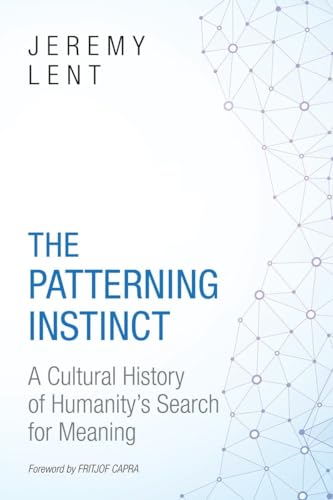
3241. Excerpt from The Patterning Instinct: Can We Transform Our Society for a Flourishing Future?

By Jeremy Lent, Resilience, May 9, 2019


The Patterning Instinct Format: Hardcover: LENT, JEREMY R.Resilience editor's note: Excerpted from the final two chapters of Jeremy Lent’s award-winning book, The Patterning Instinct: A Cultural History of Humanity’s Search for Meaning, (Prometheus, 2017) which explores the different ways cultures have patterned meaning into the cosmos, and reveals how various worldviews arose and shaped the course of history. The book uncovers the hidden foundations of our modern unsustainable worldview, and offers a potential vision for a more harmonious future. Jeremy is founder of the nonprofit Liology Institute, dedicated to fostering an integrated worldview that could enable humanity to flourish sustainably on the earth. More info: jeremylent.com.


Ideological lock-in

The reasons our civilization continues hurtling towards a precipice are multi-layered. There are some readily identifiable factors; underpinning these are certain structural characteristics of our global system that lock in our current momentum; and underlying these are cognitive frames –  mostly concealed – that form the basis for our collective behavior. Each of these layers must be addressed to make a meaningful course correction.

The easily identifiable forces propelling humanity on its current course are the special interests that gain financially and politically – at least, in the short-term – from continued economic growth and use of fossil fuels. Hundreds of millions of dollars are spent annually in political lobbying and funding for those who deny the threat of anthropogenic climate change. They currently exert enough power over the U.S. legislative process to thwart meaningful legislation at the national level.

However, even without these special interests, some structural characteristics of our global system make it very difficult to change direction. One of these is known as technological lock-in: the fact that, once a technology is widely adopted, an infrastructure is built up around it, making change prohibitively expensive. A frequently cited example is the QWERTY keyboard, which was originally designed for its inefficiency, in an attempt to slow down the rate of typing and therefore prevent early typewriter keys from hitting each other. More efficiently laid out keyboards can double typing speeds, and yet it has been impossible for them to make inroads because everyone is used to the older, inefficient design. In the case of fossil fuels, an obvious example of technological lock-in is the network of gas stations for vehicles with conventional engines. Any new electric car technology has an uphill battle to create a competing network, even if its vehicles offered equivalent performance.

These technological challenges can be overcome with enough investment. A far greater obstacle to meaningful change is financial lock-in: the financial infrastructure underlying the fossil fuel-based economy. Fossil fuel corporations are valued primarily on the basis of their proven coal, oil and gas reserves. However, for the world to keep global warming to 2 degrees, the oil companies could only use about one fifth of their reserves. These corporations would experience drastic declines in market value if the world were to make a serious commitment to rein in global warming. Given the overriding corporate objective of maximizing financial returns, their executives have a powerful incentive to steer the public debate away from this issue.

Beyond the narrow interests of the fossil fuel industry, the entire capitalist economy is founded on perpetual growth. In aggregate, world stock markets are valued on the same growth assumptions that predict a quadrupling of the global economy by mid-century. Business leaders fret that if a concerted attempt were made to reduce this growth trajectory, it might lead to a spiraling decline in valuations, possibly even to the collapse of the capitalist system. Additionally, in the arena of geopolitical rivalry, the power of a nation relative to others is substantially based on economic strength. Leaders fear that if their nation unilaterally chose to reduce its own growth to a more sustainable level, this would reduce its ability to protect its national interests.

This self-defeating collective dynamic, known in economics as the “tragedy of the commons,” highlights a crucial flaw in capitalist ideology: the notion that it is inevitably beneficial for society when each person seeks to maximize his own gain. Underlying this notion is an even more fundamental defect of classical economic theory: the assumption that nature is inexhaustible. When the framework of modern economics was developed in the 18th century, it seemed reasonable to view natural resources as unlimited because, for all intents and purposes, they were. Economists therefore treated minerals, trees, and water as commodities to be sold at a price that was simply the cost of extracting and marketing them. As we’ve seen, the experience of the past fifty years has proven that assumption to be wrong. In the words of systems theorist Kenneth Boulding: “Anyone who believes exponential growth can go on forever in a finite world is either a madman or an economist.”

In spite of this obvious and fundamental flaw, classical economic theory continues to be used around the world as the driving force for decisions made by corporations, policy makers and governments. How can that be? Environmental historian J. R. McNeill offers an explanation: “When an idea becomes successful, it easily becomes even more successful: it gets entrenched in social and political systems, which assists in its further spread. It then prevails even beyond the times and places where it is advantageous to its followers.” This is another form of lock-in: ideological. “Big ideas,” McNeil observes, “all became orthodoxies, enmeshed in social and political systems, and difficult to dislodge even if they became costly.”

Humanity’s search for meaning

Our modern world is the result of the runaway success of one of the most powerful cognitive patterns in history. Capitalism triumphed over competing ideologies with its seductive precept that by selfishly pursuing their own financial gain, each person was contributing to the greater benefit of society. With the advent of consumerism, capitalism instilled an intoxicating new purpose into people’s lives, promising them that their feelings of emptiness, meaninglessness or alienation could be cured through the possession and conspicuous use of manufactured goods. No matter that the “cure” was only temporary: through hard work and dedication, one could earn more money to purchase even more goods, thus stepping on to the hedonic treadmill.

This pattern has become so embedded into the global construction of meaning that most people accept it without question. Those fortunate enough to possess more money than others gain more in the short-term on the treadmill of temporary satisfaction. However, the ultimate beneficiaries are not human at all, but rather the conceptual creations called corporations, which exist collectively to transform the human experience and the natural world into the monetized economy, regardless of the ultimate effect on humanity as a whole.

How did this cognitive pattern achieve such success? We’ve seen that, beginning with the “mind-cure” movement of the late nineteenth century, a consumption-based ideology served to redress a lack of meaning in people’s lives, replacing an inner void resulting from the uniquely Western mode of dualistic cognition with the consumerist frenzy of capitalism.

In more integrative patterns of cognition, such as traditional Chinese thought or indigenous cultures, a person’s relationship to their community and the natural world satisfied the drive of their patterning instinct to find meaning in life. In the prescientific Christian era, as in Islamic civilization, the belief in a transcendent God infused meaning into people’s lives, even though it led to the bifurcated experience that continues to cause so much suffering. However, in our mainstream modern value system, the separation from the desacralized natural world – created by the Greeks, systematized by Christianity and endorsed by science – is complete.

Where does this leave us? Is there a way our civilization can somehow be steered to achieve a sustainable path for humanity’s future – a path where progress might mean something other than re-engineering humanity and consuming the earth?

The Great Transformation

In order to navigate toward a future of sustainable flourishing, the economic system driving our current trajectory would need to be transformed, along with its underlying values: the pursuit of never-ending material growth and the glorification of humanity’s conquest of nature. Could such a drastic transformation of our global system really take place in the foreseeable future?

A Great Transformation would need to be founded on a worldview that could enable humanity to thrive sustainably on the earth into the future. In place of root metaphors such as nature as a machine and conquering nature, the new worldview would be based on the emerging systems view of life, recognizing the intrinsic interconnectedness between all forms of life on earth, and seeing humanity as embedded integrally within the natural world.

Three core values emerge from this worldview. The first is an emphasis on quality of life rather than material possessions. In place of the global obsession with defining progress in terms of economic output and material wealth, we would begin to prioritize progress in the quality of our lives, both individually and in society at large. Secondly, we would base political, social and economic choices on a sense of our shared humanity, emphasizing fairness and dignity for all rather than maximizing for ourselves and our parochially defined social group. Finally, we would build our civilization’s future on the basis of environmental sustainability, where the flourishing of the natural world is a foundational principle for humanity’s major decisions.

The movement for a shared humanity

It may sound impossibly idealistic that the view of humanity as a sharing community could form the basis for a worldwide shift in ideology, but many historical examples show how powerful this vision can be. The abolitionist movement of the 19th century succeeded in putting an end to slavery, which had previously been seen as integral to the global economy. In more recent decades, movements have fought for the preservation of the natural world. When Rachel Carson published her exposé of the indiscriminate use of pesticides in 1962, her solitary stand was denounced as hysterical and unscientific. Only eight years later, at the first Earth Day in 1970, twenty million Americans marched to protect the environment, and by 1990 two hundred million people in 141 countries across the world were demonstrating for the earth.

What’s more, the values of the Great Transformation are already held by large segments of the world’s population. Environmental activist Paul Hawken has estimated that there are more than a million organizations worldwide, both large and small, engaged in humanitarian causes. This dispersed and unstructured grouping of concerned citizens constitutes, in his mind, “the largest social movement in all of human history.”

The potential impact of this social movement is increased by the power of the internet to amplify each individual group’s effectiveness through its networked connectivity. Hawken points to Metcalfe’s Law, which states that the usefulness of a network grows exponentially when its connections grow arithmetically. In this way, the collective action of small groups of individuals can potentially become a global force to countervail the massive corporate networks that currently dominate global civilization. The global culture emerging from the internet offers humanity a view of itself as an interconnected whole, inviting people to see themselves as part of a web of life encompassing the entire world.

The ease with which the internet transmits ideas across the world means that, when the time comes, the transformation of global consciousness could occur at a speed which might surprise everyone. It is part of our evolved human nature to stick together with our group’s attitudes or opinions, even when a changing situation leaves those attitudes out of date, which can frequently cause social rigidity and political inertia. When thought leaders emerge offering new ways of thinking, they gradually attract increasing numbers of people until a tipping point is reached, when the “stickiness” that kept people attached to their old pattern of thinking is superseded by the pull of the new ideas. All of a sudden, the gradual shift in ideas becomes an avalanche when those who are most comfortable sticking together find themselves in a rush to join in the new way of thinking. In the age of the internet, this tipping point can conceivably be reached much more rapidly than in the past.

Choosing our future

What would the latter part of this century look like if our global civilization took the path of a Great Transformation? It’s likely we’d see a reorganized United Nations, with powers to enforce a more responsible approach to our global commons, such as the oceans, the atmosphere and the environment. When corporations and governments make investment decisions, they’d explicitly factor the externalities of the natural world into their cost/benefit analyses. While there would still be massive income inequality between rich and poor nations, that gap would be decreasing as a result of economic structures based on fairness rather than untrammeled exploitation. And the flourishing of the natural world would be given a high priority in global decision making. There might even be an enforceable UN Declaration of the Rights of Nature, putting the natural world on the same legal standing as humanity.

It’s a relay race against time in which every one of us is part of the team. What is ultimately required is a shift towards a new way of finding meaning from our existence. Many visionaries and deep thinkers today recognize the need for a new global consciousness, based on an underlying and all-infusing sense of connectedness. The meaning we derive must arise from our connectedness if we are to succeed in sustaining our civilization into the distant future: connectedness within ourselves, to other humans, and to the entire natural world.

Sunday, January 12, 2014

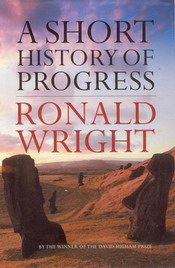
1275. Book Review: A Short History of Progress

By Kamran Nayeri, January 12, 2014


The world is in crisis and a growing body of literature registers increasing awareness and concern about how to address it. 

This literature is typically divided into the genre that deal with economic, that is capitalist, crisis and the environmental/ecological literature that focuses on the ecosphere. 

Capitalist reformers and socialists focus on the economic crisis because the former aim to maintain and improve the system and the latter hope to replace it with some form of socialism, usually discussed without any organic relations to the ecosphere.  Environmentalists who focus on the problem of the ecosphere usually do not consider it in organic relation with the capitalist economy and society. Thus, the mainstream environmentalist movement aims to reform the capitalist system to address the crisis of the ecosphere.  

Some currents who call themselves ecological socialists and ecological anarchists view the crisis of society and the anthropogenic crisis of nature as one crisis. However, for the most part, these currents view the environmental crisis as a by-product of the modern era either because of the logic of the capitalist system or because of the industrial society.  However, it is true and revealing that civilizations before the industrial capitalist society also experienced crisis and collapse.  Thus, in addition to the mode of production specific analysis of the crisis, we need historical, indeed transhistorical study of such crises.  

Ronald Wright’s A Short History of Progress (2004) provides a highly enlightening such study and should be read by all who want to tackle the crisis of our world today. The book was first presented as part of the prestigious Massey Lectures series (for an audio version of the lectures click here). Wright's intellectual background is in archaeology, history, linguistics, anthropology and comparative culture and has written among other things about New World civilizations. 

The central thesis of A Short History of Progress Wright is that our modern predicament is as old as civilization itself, a 5,000-year experiment we have participated in but never really controlled. Further, in his view only by understanding the patterns of achievements and disaster that humanity has repeated around the world since the Stone Age, can we recognize the experiment's inherent dangers, and, with luck and wisdom, shape its outcome.  

Wright begins with a discussion of the question of “where are we going?” and focuses on what he correctly calls the mythology of progress.  As he notes the idea of progress is linked to the rise of science and technology about three centuries ago. Earlier societies did not view history as progressive except perhaps in a moral sense.

Further, Wright argues for the repeated cases of “progress trap” that have resulted in the ecological collapse of many civilizations.  For an example of “progress trap” Wright cites the advances in weaponry. Originally advantageous to human society, modern weapons have come to pose an existential threat to humanity with the development of nuclear devices.  A fair portion of the book is given to the discussion of such “progress traps” and the consequent collapse of civilizations. He discusses Sumer, Rome, the Maya, and Easter Islands that within roughly a thousand years exhausted their natural limits and collapsed. He also discusses two civilizations—Egypt and China—where advantageous local conditions in the form of additional topsoil brought in by water and wind respectively have resulted in a 3,000-year history for each of them. 

Clearly, Wright sees his work in continuity with the archeologist Joseph A. Tainter’s The Collapse of Complex Societies (1990). Tainter examines civilizations of the past to find common patterns leading to their collapse (for a video presentation of the book click here). His thesis is that the costs of complex societies eventually outstrip their benefits causing common crisis patterns before they collapse.  Tainter gives such patterns names such as the Runaway Train, the Dinosaur, and the House of Cards. In his study, these patterns often work together to bring about the collapse.  Like Tainter, Wright argues that the collapse of earlier civilizations resulted in localized disasters but in today’s globalized economy the collapse will annihilate all or most of the world’s population. So, the stakes are much higher. I would add that the “collateral damage” to the rest of life forms on Earth is similarly much more widespread and drastic. 

A Short History of Progress includes much enlightening detail and a number of secondary theses that speak to other current debates. For example, Wright expresses a dim view of our species. The “progress trap” is not limited to civilization as Wright points to cases where forager bands armed with better weapons drove some megafauna to extinction (p. 31).  Also, he argues that our species has systematically eliminated rival humanoids, including the Neanderthal. On some of these Wright is on less firm grounds as the prehistory of our species is still not entirely clear. Recent research suggests that some Homo sapiens sapiens may actually interbred with others humanoid species, including the Neanderthal. Thus, the argument that we have eliminated all others is too one-sided and simplistic.

Still, Wright views the “progress trap” becoming more dangerous with a larger scope for more serious damage as we get closer to the current civilization.  Thus, his view stands in contradiction to more recent arguments by Steven Pinker (The Better Angels of Our Nature: Why Violence Has Declined, 2011) who argues that modern times, especially since World War II is the most peaceful in the history of our species and by Jared Diamond (The World Until Yesterday, 2012) who argues forager societies have been more violent than class societies, including present-day capitalist society.   

The key weakness in Wright’s book lays in his exclusion of the role played by modes of production in crisis and the collapse of civilizations. Thus, he closes his insightful book with the advice to reform the world capitalist system that has brought us the current crisis of society and nature with “long-term thinking”: 

“The reform that is needed is not anti-capitalist, anti-American, or even deep environmentalist; it is simply the transition from short-term to long-term thinking. From recklessness and excess to moderation and the precautionary principle.” (p. 131).  

To be sure, long-term thinking is essential for sustainable living as the Great Law of the Iroquois has it: think about the seventh generation after you when making decisions.  However, Wright chooses no only to ignore a wealth of knowledge gained from literature that critically analyzes the capitalist system, in particular the one Marx initiated, but also the uninterrupted history of short-term thinking that is part of the logic of unceasingly accumulation and growth for private profit. 

Perhaps part of the problem rests in Wright’s assumption that humanity cannot continue to exist without the current capitalist civilization.

“For all it cruelties, civilization is precious, an experiment worth continuing. It is also precarious: as we climbed the ladder of progress, we kicked out the rungs below. There is no going back without catastrophe.” (p. 34).

But how about going forward? For all the insight Wrights offers in his A Short History of Progress, the book does not tackle the Anthropocene (which was so named by Paul Crutzen and Eugene Stoermer in 2000) that is at the very least as old as the capitalist civilization since the English Industrial Revolution. A long-term thinking capitalist machine is an oxymoron and Wright’s trust in forging a forward-thinking capitalist ruling class has no basis in his own book or in anything we know from the theory and history of the rise, expansion and secular crisis of the capitalist civilization. 

Further, short-term thinking that worries Wright seems to be present, though certainly with increasing frequency, larger scope and severity, across the entire history he tells of our species. Nowhere does he ask if it is a natural trait of our species.  As Wright correctly observes, our species is increasingly shaped by culture rather than nature. Could we perhaps not call for a new culture--in the very same broad sense that he borrows from anthropology--that would include socioeconomic forms of organization that would support among other things the long-term thinking he rightly considers important

In a recent essay, Economics, Socialism and Ecology: A Critical Outline (2013) reviewing our very long history (history and prehistory), I have argued that alienation from nature is probably the key factor that explains the crisis of civilization, including the current crisis of global capitalist system. In my view, the transition from the cosmological worldview of the foragers that was ecocentric  to the anthropocentrism (human-centered worldview) that perhaps both the cause and consequence of the Agricultural Revolution brought with it alienation from nature. The class societies that arose on the bedrock of agriculture--a mode of production that is based on domestication not just of other species but also of ourselves and initiated the impossible quest for control and domination of nature--institutionalized anthropocentrism. Alienation from nature prepared the ground for social alienation and stratification of society in so many ways, hence seemingly eternal conflict of human societies within and between them for the past 10,000 years.  The "progress trap" that Wright so lucidly documents in A Short History of Progress would them appear as a systematic attempt to control nature, including our own species, with science and technology.  

Perhaps what is called for is not a call for just "long-term thinking," although that is certainly necessary, but a return to ecocentric world views similar to our forager ancestors and building a worldwide movement to go beyond the capitalist world system to an ecological socialist future where thinking long term will be part of our culture of peaceful coexistence with ourselves and with the rest of nature.