By Kate Dooley and Doreen Stabinsky, Science for the People, Summer 2018
In signing the Paris Agreement on climate change, countries committed to hold the rise in global temperature to less than a 2°C increase above pre-industrial levels and, further, to aim for keeping the global temperature increase to a 1.5°C limit. Agreeing to stay below this threshold reflects a collective understanding that the impacts of a 2°C temperature rise are, to say the least, undesirable. There is much less of a collective understanding of how to aim for a 1.5°C temperature limit—what options do we have for reducing ongoing emissions and even possibly removing the greenhouse gases (GHG) already present in the atmosphere?
Science gives us a better understanding of the causes and impacts of climate change on our environment, but the scientific gaze is often limiting, providing technical solutions to the “climate problem,” while obscuring underlying politics and political-economic relations. Under the Paris Agreement, nations committed to preventing dangerous global warming through balancing sources (for example, the burning of fossil fuels) and sinks (such as forests, grasslands, and oceans, which take up and store carbon) of human-caused emissions. The idea is that if we take out of the atmosphere as much carbon dioxide (CO2) as we emit, overall CO2 emissions will zero out by the middle of the century. Emissions from the burning of fossil fuels (sources) would be balanced with “sequestration,” through storing carbon dioxide in trees and grasslands, or capturing and liquefying emitted carbon dioxide and burying it underground.
Any land-based technical solutions would require large areas of land. Depending on the choice of technologies, lands currently used to provide food and livelihoods for nomadic livestock herders, small-scale agriculturalists, and forest peoples could be at risk for repurposing toward climate mitigation. Communal and smallholder lands in the global South are often considered “degraded” or “unused” lands by governments or international agencies classifying land-use. Such labels facilitate and legitimize the takeover of “degraded” lands by those with greater power. The lack of secure tenure and land ownership makes these populations vulnerable to dispossession or displacement by the consumptive desires of the wealthy of the world, most of whom live in the global North. This is not the first instance where land in the global South has been seen as central to climate solutions–Amazon forests have long been considered important as “the lungs of the planet.” Such discursive and material framings pose that for the global good of climate mitigation, land and forest resources will need to be protected and uses reassigned, regardless of who might currently inhabit or use those lands for their livelihoods.
Climate-focused integrated assessment models (IAMs) combine economic and social assumptions (i.e., rates of GDP and population growth) with observations from earth-system models to identify options that reduce GHG emissions over the century. These options are combined with policy to drive emission reductions in energy use, in the production of goods and industry, and from the agriculture and land-use sectors. IAMs are most frequently used to identify options that minimize the economic costs of climate solutions. In constructing the assumptions behind these IAMs, obviously political choices are obscured behind the curtain of modeling expertise, which has led to solutions with an outsized reliance on land for climate mitigation in the current generation of models. The risks to the people whose lives and livelihoods depend on these lands are rarely considered, and the proposed solutions risk failing to actually address the climate crisis.
Pulling back the curtain of modeling expertise
The concept of scientific co-production illuminates how knowledge is developed and legitimized at the science-policy interface and offers insights into how viewing problems such as climate change through a technocratic lens might obscure important relations of power, rights, and choices about who might shoulder the burdens of climate change mitigation.
As far back as the late 1990s, scholars questioned the policy-usefulness of climate models. They argued that the dominance of models in climate policy input obscures political choices that deserve wider debate. There is now an established body of literature critiquing this technocratic and global framing of climate change, devoid of people and impacts. Epistemic and cultural biases persist in the process that develops and legitimizes knowledge into policy on climate. The economists, engineers and natural scientists, as well as scientists with developed country affiliations, form an epistemic community influencing the climate solutions considered legitimate in the Intergovernmental Panel on Climate Change (IPCC) assessments of climate science and policy solutions.
More recent critiques have focused on the IAMs themselves. IAMs were originally designed to answer exploratory questions such as, “what climate outcomes will future emissions produce?” The question has now shifted from showing what levels of emissions (and hence warming) different future development scenarios would result in, to determining what cost-effective technology choices and policies are required to achieve a specific warming “target.” It is this process of singling out particularly cost-effective technologies that leads to model conclusions that rely primarily on land as a key mitigation solution.
IAMs represent a negotiated and constructed model of scientific knowledge that scientists and legislators use to provide answers to questions that advance policymaking. This work relies on maintaining sharp boundaries between facts and values that create a perception of scientific neutrality and justify the political acceptability of the results.
Yet researchers examining the co-production between science and policy in the context of IAM modeling and identification of mitigation options have shown that the perception of model-based knowledge as “objective science” lends significant authority to outcomes that might otherwise be more critically debated and contested, such as the large-scale use of bioenergy with carbon capture and storage (BECCS). Indeed, the emergence of BECCS as the go-to climate solution has been pinned to the IAM epistemic community, without serious engagement with social scientists, ecologists, or bioenergy experts. In contrast, including assumptions in models related to broader societal objectives, such as food security, are considered value judgments, which would risk undermining the purported scientific objectivity and hence political credibility of cost-optimization climate models.
Models, Mitigation Options, and Land Use
IAMs offer what some call “magical thinking” to reach the 2°C and 1.5°C temperature targets: assuming that large volumes of CO2 can and will be removed from the atmosphere in the second half of the century.
Bioenergy with carbon capture and storage (BECCS), a form of geoengineering, is the favored removal technology included in the model inputs. Bioenergy refers to the use of crops to produce energy when burned, such as wood chips from the forests in Louisiana being shipped to the UK to create electricity in the Drax power station. Carbon capture and storage is the process of stripping CO2 from the waste gases at the time of combustion and then compressing it into a liquid for long-term underground storage. Theoretically, the BECCS process removes some amount of CO2 from the atmosphere that has been converted to plant material through the process of photosynthesis. Putting BECCS technology in place on a planetary scale would require the planting of extensive areas of land for bioenergy crops, over a billion hectares at the upper end of estimates.
Most IAM scenarios that achieve the 2°C and 1.5°C targets conclude that removals will be achieved predominantly through “land-based sequestration” measures such as BECCS or forest plantations, which would require appropriating extensive areas of land. These conclusions, as described above, depend on the model inputs–BECCS and afforestation are the only carbon removal options used in most models. Meaning most IAMs overlook other activities that may remove carbon from the atmosphere, with greater co-benefits and/or fewer negative impacts on societal objectives such as food security.
Other land-based carbon removal options include protecting and restoring forest ecosystems or sequestering carbon in soils by protecting permanent grasslands, adding organic material such as compost, or reducing the frequency of tilling (although with this method there is a significant risk of reversals the next time soils are tilled). Any option that requires large amounts of biomass—a term used for any biological material that serves as feedstock for a mass production process such as burning—potentially means a large land requirement. Agricultural wastes and residues, such as residues left after crop harvest, or municipal waste, could be used for BECCS feedstock to avoid the negative impacts that come with increased demand for land, but as residue supply is limited, the scale of carbon removal that can be achieved from residue use alone is also much lower than what is required.
To achieve high levels of bioenergy production for BECCS, models free up large amounts of land from food and feed production for the production of energy crops, using optimistic assumptions for increased agricultural productivity, reduced food waste, and shifts to less meat-intensive diets.The median value of bioenergy demand in IAM scenarios that would keep temperature rise below 2°C would require a 50% increase in global harvest of biomass, for all purposes, by 2050. Many scenarios compatible with 1.5°C require a doubling of global cropland for bioenergy production, with potential losses of around a quarter of current pastureland (Fig. 1).
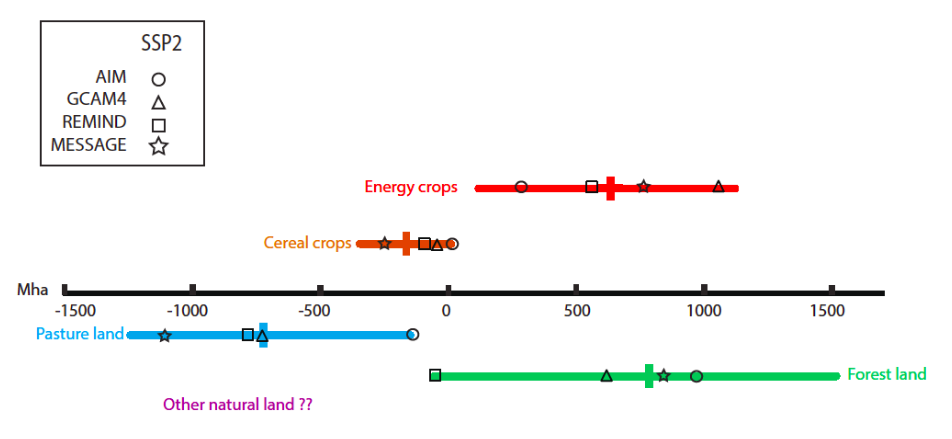
Figure 1: Scale of land use change in modeled 1.5°C pathways (SSPx-1.9 in 2100 relative to 2010). Mha = million hectares (Data from Rogelj et al., 2018). Note that the scenarios suggest that positive and large amounts land for the production of energy crops and forestland are needed for carbon sequestration (bars to the right of 0), while significant reductions are seen in land devoted to cereal crops and pasture land (bars to the left of 0).
Information on the impact of 1.5°C scenarios on natural lands (land that is not designated as permanent cropland, forest or pastureland, outside of ice and desert lands) is not available, but 2°C scenarios show that loss of natural lands is on the same scale as loss of pastureland–at up to a billion hectares. Land-use change on this scale, driven by demand for bioenergy, raises significant concerns for food security and biodiversity.
The political economy of land use in an era of climate urgency
Land availability for BECCS or other forest plantations becomes a technical problem for modelers to solve through assumptions of future increases in production efficiencies or reductions in livestock consumption while obscuring potential political questions about where “spare” lands for climate mitigation might actually be found. Gibbs and Salmon note that the true extent and availability of so-called “degraded” lands—land available for other uses—is subject to high uncertainties, with wide disagreement in their extent and spatial distribution, pointing out that “even a precise map of the physical area of degraded land would significantly overestimate its potential by neglecting its myriad social, environmental, and political constraints”. One of the greatest risks posed by large-scale land-use change for energy crops and forest plantations is the risk of increasing land-tenure insecurity and violent conflict in situations of nonexistent land-rights and poor land-sector governance.
Remaining below 2°C or 1.5°C will require an extraordinary effort in reducing emissions. Recent studies have generally found that the required emissions reductions necessary to meet the 1.5°C temperature target, without resorting to BECCS or other large-scale carbon removal, necessitates meeting all of the most optimistic assumptions, including behavior change to reduce consumption, a shift to healthier diets, massively scaled-up renewable energy deployment with reduced energy demand, and low population growth. In these scenarios, some level of carbon removal is still required, albeit at lesser scales, which can generally be achieved through natural solutions such as protecting and restoring forest ecosystems. This highlights the importance of setting a course for the most ambitious emissions reductions possible in the near term, in order to limit reliance on CO2 removal.
The risks inherent in relying on large-scale future removals for addressing the climate crisis
The result of this fetishism of scientific and technical inputs into the climate debate could have profound consequences and raises particular risks. Reliance on future performance of large-scale removal technologies, however, poses a different class of risks, one that may result in greater warming than relying only on conventional mitigation options aimed at preventing carbon from entering the atmosphere. Relying on the presumption that we will be able to remove emissions in the future makes the task of not putting them in the atmosphere in the first place less urgent. While all mitigation options pose some level of risk that they will not deliver at the pace and scale expected, the risks of conventional mitigation options can be solved by changing technology options or behaviors. The risks of relying on future removals constitute a moral hazard,potentially locking us into much higher levels of future warming than intended if these removal technologies fail, forcing us to confront considerably higher social and ecological costs compared to reducing emissions now. Taking on these risks of delayed action may substantially undermine society’s mitigation efforts in the long-term.
Based on the scale of land-use involved, proposals for large-scale reliance on land-based removal technologies pose clear and significant risks to sustainable development. At the same time, there is unexplored potential for synergies between climate mitigation in the land sector and the achievement of sustainable development goals (SDGs). Options for removing carbon from the atmosphere that are based on “natural” solutions and ecosystem restoration have been put forward, as well as initial assessments of the synergies between these options and SDGs.
Socially conscious models
“The Paris agreement shows where we want to go—the brave new world of a balanced carbon budget—but not how to get there. For now, action should focus on urgent emissions reductions and not on an unproven ‘emit now, remove later’ strategy. But the unwelcome truth is that, unless a lot more effort is made to cut emissions, significant CO2 removal will need to begin around 2020, with up to 20 gigatons of CO2 extracted each year by 2100 to keep the global temperature increase ‘well below 2 °C.’
Is that feasible? What environmental risks and constraints are involved? We need to know.” (Williamson 2016)
Integrated assessment models, and the scientific and policy communities that create and use them, also attempt to show us where we want to go and how we might get there. To our collective detriment, through processes that prioritize technical knowledge and scientific authority, they obscure the critical questions Williamson raises above. In the context of integrated assessment models being used to inform future mitigation pathways, closer negotiation between knowledge producers and knowledge users could lead to a more informative set of mitigation scenarios by allowing for a more critical interrogation of the value-based and ethical choices inherent in any scenario-building exercise. We call this ‘purposeful modeling’, embodying a reflexive approach to the co-production of scientific knowledge and better accounting for real-world constraints.
Are the levels of BECCS and afforestation proposed by the models feasible? What environmental—as well as social and political—risks, constraints, and choices are involved? Who might be dispossessed by the conversion of their “degraded” lands for the urgent need to sequester excess atmospheric carbon dioxide? Modelers must develop effective ways to incorporate these questions into their analyses, and more importantly, the broader climate/science policy community has to critically constrain when, how, and why models are used. These are extremely important questions that we must face as we urgently consider how to stop climate change—questions that models cannot answer.
References