Showing posts with label Octopus. Show all posts

Friday, November 6, 2020

3441. On Being an Octopus: Diving Deep in Search of the Human Mind

 By David Godfrey-Smith, Boston Review, June 3, 2013
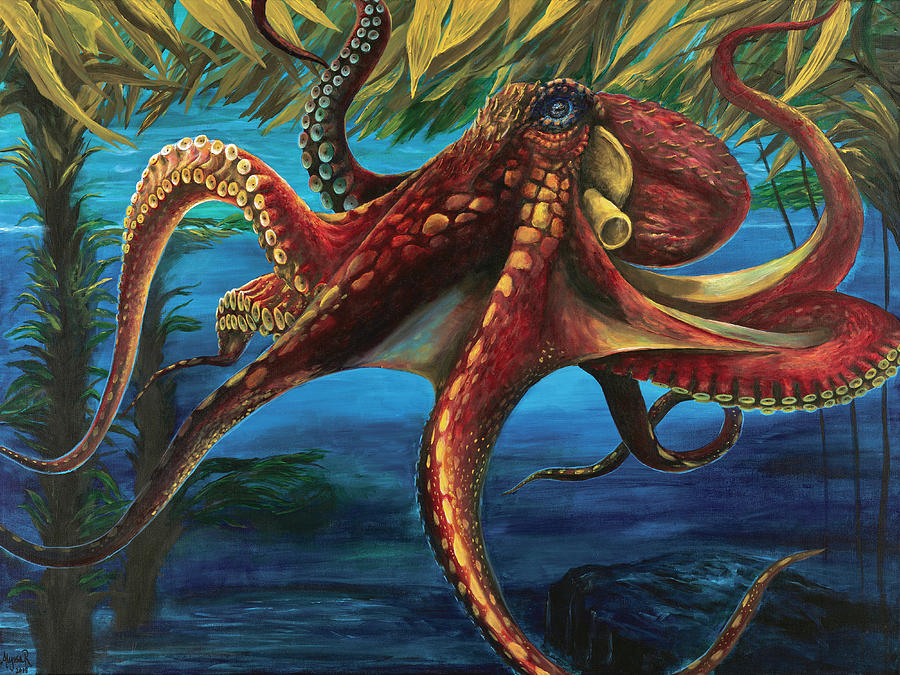


If octopuses did not exist, it would be necessary to invent them. I don’t know if we could manage this, so it’s as well that we don’t have to. As we explore the relations between mind, body, evolution, and experience, nothing stretches our thinking the way an octopus does.

In a famous 1974 paper, the philosopher Thomas Nagel asked: What is it like to be a bat? He asked this in part to challenge materialism, the view that everything that goes on in our universe comprises physical processes and nothing more. A materialist view of the mind, Nagel said, cannot even begin to give an explanation of the subjective side of our mental lives, an account of what it feels like to have thoughts and experiences. Nagel chose bats as his example because they are not so simple that we doubt they have experiences at all, but they are, he said, “a fundamentally alien form of life.”

Bats certainly live lives different from our own, but evolutionarily speaking they are our close cousins, fellow mammals with nervous systems built on a similar plan. If we want to think about something more truly alien, the octopus is ideal. Octopuses are distant from us in evolutionary terms, have a nervous system of very different design, and bodies with no bones and little fixed shape at all. What is it like to be an octopus? The question is intrinsically interesting and, beyond that, provides a good way to chip away at the problem Nagel raised for a materialist understanding of the mind.

*.    *.    *

How do we approach questions about “what it’s like” to be something or someone? One way of asking these questions makes them impossible to answer regardless of what minds might be made of. In this interpretation, to ask what it’s like to be a bat or an octopus is to ask for a description, given from a third-person point of view, that encapsulates the animal’s experience itself. But having an experience will always be different from having a description of it. This will be true if we are biochemical machines and true also if there is a soul-like extra ingredient in the world. A gap between a first-person and a third-person point of view arises either way.

Descriptions are not completely powerless, though, in helping us get a grip on what the experience of another might be like. What a description can do, often very effectively, is prompt memories and guide the imagination—it can elicit memories of experiences that one has actually had and guide the construction of variations on these memories. Whenever one person describes an important experience to another, we rely on this sort of use of memory and imagination. It is more difficult if someone or something cannot talk, cannot offer a usable description in their own words. Then if we want to get a sense of what their experience might feel like, we must draw on information about their other forms of behavior and about how their senses and nervous systems work. If what is going on in them can be mapped onto what is going on in us when we have an experience that we know firsthand, we can say something about what an experience is like for them. Doing this does rely on the assumption that there is a systematic relation between how things feel and what goes on in the nervous system—just as listening to what someone says requires the assumption that real experiences lies behind her words.

The biologist Richard Dawkins offered a reply to Nagel’s challenge about bats in his 1986 book The Blind Watchmaker. One of the main differences between bats and ourselves, emphasized by Nagel, is bats’ use of sonar, sound pulses, for navigation. Nagel said that this was unlike any sense that we possess, and we cannot reach bat experience by imagining ourselves to have a more elaborate form of hearing. Dawkins replied that the use of sound in both human hearing and bat sonar is an incidental matter. Instead, using sonar as a bat would feel similar to the way seeing feels for us. We should not imagine sonar as upgraded hearing, but as modified seeing.

Dawkins based this claim on what sonar does for a bat. An animal that uses sonar constructs an internal model of the location of objects in space on the basis of stimuli from its environment. The information made available by sonar is not exactly the same as that made available by vision, and the resulting internal models will certainly differ, but, Dawkins argues, the feel of vision results from the way it enables you to make your way through the world, and that gives us some indication of what it feels like to navigate with sonar. This argument does not require that the same parts of the brain be used for each sense. Strikingly though, a 2011 brain-imaging study by Lore Thaler and her colleagues found that blind humans with some natural ability to echolocate using mouth-clicks were using parts of their brains normally dedicated to vision to process the clicks.

To work out what it might feel like to be another animal, we have to find some way to justify mappings between what goes on inside that animal and experiences that we can, through memory and imagination, partly conjure in ourselves. We do the same thing with humans who have different capacities and backgrounds from our own. Nagel accepted this claim about the human case but added that the more biologically distant the subject whose experiences we are inquiring into, “the less success one can expect with this enterprise.” I agree that the more distant the subject, the more difficult the project becomes. But who’s to say that success must remain elusive? On to the octopus.

*.    *.   *

An octopus has neurons, more or less like those of other animals, and many of them are organized into a brain. This brain evolved on an evolutionary path far removed from our own. All animals have common ancestors if we go back far enough in time, and the pattern of relatedness between different animal species takes the rough form of a tree, the “tree of life.” Our common ancestor with octopuses lies back near the beginning of the evolution of complex animals, perhaps 600 million years ago. That ancestor was a small, simple, marine animal—probably a flattened worm. Its many descendants include, on one branch, humans and the other animals with backbones (dolphins, bats, birds), and on another branch, a huge range of invertebrate animals, including the octopus.

The octopus’s evolutionary path from the ancestral worm is unusual among the invertebrates because it led, as our path did, to a large nervous system. A common octopus has around 500 million neurons. That is many fewer than we have, but it is in the same range as a dog’s brain, which has 600 million or so. The octopus, along with some of its cephalopod cousins, is an independent experiment in the evolution of a large nervous system, the only such experiment outside the vertebrates.

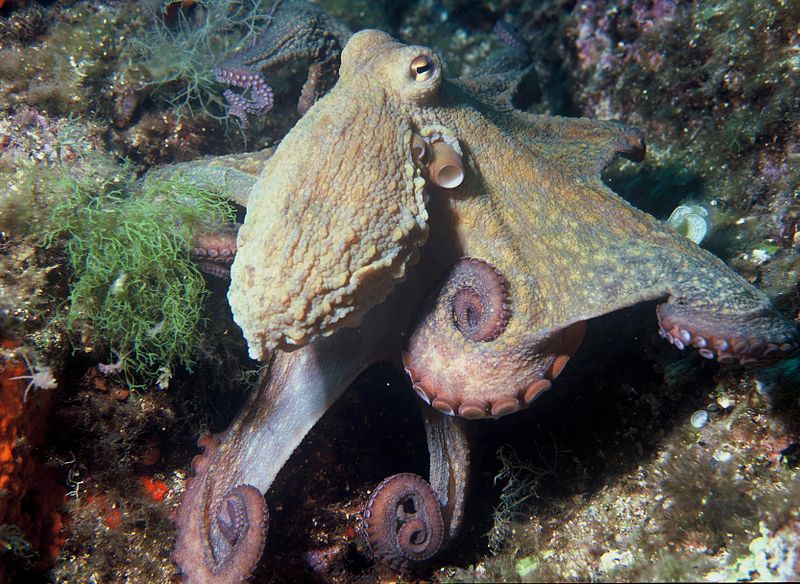
The result is an animal that is curious and a problem-solver. Some octopuses carry pairs of coconut half-shells around to reconstruct as spherical shelters. Octopuses can recognize (and take a disliking to) individual human keepers in aquariums. They learn the layout of their environment and hunt on long loops that take them reliably back to a den. Octopuses have eyes built on a “camera” design like ours, with a lens focusing an image. They also have sensitive chemical sensors in their suckers—they taste the world as they touch it. When watching their eyes, it is natural to think that perhaps octopuses are a bit like us, just with more arms and no bones. Like other animals, they use their senses to track what is going on around them and to guide action. Would being an octopus be so different from being a bat, or any other animal with fine-tuned senses and a complex nervous system?

Underneath the skin, though, octopuses have an organization that takes them even further from us than they appear on the outside. Invertebrates generally have less centralized, more “distributed” nervous systems than vertebrates such as us. Octopuses are mollusks (like oysters and clams), and their nervous systems are organized in part into ganglia, little knots of nerve cells, with links between the knots. Most mollusks do not have much of a central brain. Starting out from a molluskan layout of this kind, evolution increased the size of the octopus nervous system enormously. The outcome of this process was uncovered in the mid-twentieth century, especially by John Z. Young and Martin Wells, working at the Naples Zoological Station in Italy. They found a number of surprises, some of which had consequences for all of biology. In 1936 Young described nerve cells in squid that are vastly larger than those of other animals, so big that electrodes could be inserted directly into them to measure their electrical activity. Work on those neurons became the basis for our understanding of how all nerve cells function.

Young, Wells, and their colleagues found that the octopus nervous system has three main parts. One is a central brain, which is a squashing-together of many expanded ganglia. There are also two optic lobes, large structures directly behind each eye. But most of the neurons—about two-thirds of them—are not in the head at all, but in the arms themselves. The connections between the central brain and this more peripheral nervous system also seemed to these researchers to be quite slim. An octopus’s arms are packed with sensors responding to touch and chemistry, and the arms have enormous flexibility, able to bend in any direction at any point. So there is a lot going on in the arms, but the connections between arms and brain are apparently restricted to a narrow channel. From these anatomical facts and some experiments on behavior, the early researchers inferred that the arms have a good degree of independence from the central brain. They do their own sensing and their own responding. As Roger Hanlon and John Messenger summarized it in their 1996 book Cephalopod Behavior, the arms seemed “curiously divorced” from the brain, at least with respect to the control of basic motions.

This disrupts a first round of guesses about what it might be like to be an octopus. Working from our understanding of their senses and the way they live their lives, it’s natural to first imagine that the experience of an octopus is visually rich (though apparently in black-and-white) and augmented with elaborate chemical sensing. Everything touched by the arms is tasted. We can imagine something about what it might be like to live in this bright and tasty world. But then we realize that this line of thought might be fundamentally mistaken, as it assumes that an octopus is the same kind of psychological unit that a person is. It assumes that the locus of octopus experience is a psychological self, though perhaps a simple one, where the senses converge to generate a feeling of how the world is. This picture might be wrong because an octopus is not organized as we are. Vision certainly feeds into the central brain, but each arm also contains shorter arcs between sensing and action.

This organization of the animal’s control systems is the most difficult barrier to working out what octopus experience might be like. The best work I know of that bears on these issues is coming out of Benny Hochner’s laboratory at Hebrew University in Jerusalem. In a 2011 study from Hochner’s lab, Tamar Gutnick and her colleagues published a paper that looked at whether an octopus could guide a single arm along a complex maze-like path to a specific location to get food. The task was set up in such a way that the octopus could not merely let the arm’s sensors follow a chemical gradient to the food, as the arm had to leave the water at one point to reach the target location. But the maze walls were transparent and the target location could be seen. To solve the problem the octopus had to guide its arm through the maze with vision. Although it took a while, all but one of the octopuses in the experiment learned to get an arm through to the food. The study also noted, though, that when octopuses are doing well with this task, the arm finding the food does what looks like its own local exploration at various stages, crawling and feeling around. There may be a mixture of two forms of control here: central control of the arm’s general path and fine-tuning of the search by the arm itself. Another possibility is that, by means of attention of some kind, the octopus is exerting control over all the details of movements that might usually be more autonomous.

Suppose that the “mixed-control” option, which Hochner tends to favor as an interpretation, is right. What would octopus experience be like? A range of partial analogies can be drawn with the human case. I visited Hochner’s lab with another philosopher, Laura Franklin-Hall, who wondered: Would an octopus experience its arms more as parts of its environment than as straightforward parts of itself? The arms would not be experienced entirely as environment, because they can be centrally controlled to some extent—they are less “divorced” from the brain than earlier researchers suspected. But once an arm has been sent in a certain direction, to some extent it is on its own. An analogy might be drawn with actions such as blinking or breathing. These are activities that normally happen involuntarily, but through attention you can assert control over them. The analogy is imperfect because although breathing is normally involuntary, when you do intervene to do it voluntarily, the control can be very fine-grained. In that case, attention is used to take over what is normally an automatic process. In the octopus, if the mixed-control interpretation is right, central guidance of the movements is never complete, and the peripheral system always has its say. Expressed too anthropomorphically, you would send an arm out deliberately and hope the local fine-tuning goes right.

Action by an octopus, then, would mix elements that are usually distinct in animals like us. When we act, the border between self and environment is usually fairly clear. When we move an arm, the arm can be controlled both in its general path and in the details. You can then watch your arm move, but what you are watching are the consequences of choices, or perhaps of habits that are the remnants of earlier choices. Various other things in the environment are not under your direct control at all, though they can be moved indirectly by manipulating them with your limbs. Uncontrolled movement by an object around you is usually a sign that it is not part of you at all (with partial exceptions for knee-jerk reflexes and the like). If you were an octopus, these distinctions would be blurred. Your arms would move in a way that is a mix of the centrally and peripherally controlled. To some extent you would guide them, and to some extent you would just watch them go.

One might wonder whether the guided action seen in the Gutnick experiment is a normal behavior for an octopus or instead something entirely artificial. When searching for food, an octopus often puts all its arms around or under a rock and seems to just let them roam. If the experimental behavior is unusual, that would not make the work uninteresting. The fact that the octopus can solve the problem—can pull itself together in this way—would still be significant. However, the behaviors in the experiment may not be that unnatural in any case. I once saw an octopus searching for food at a boulder underneath which a large shark was resting. The octopus held its body well back and stretched one arm under the boulder, very long and straight, and seemed to watch its path closely.

There is also a more directly skeptical response to these ideas about octopus experience and the self-environment relationship. I’ve assumed up to this point that it makes sense to think that an octopus could have a feeling of agency, a feeling that tracks the difference between what it is controlling and what is merely happening. But perhaps this is so sophisticated a form of experience that it is beyond any non-human animal? Although animals do act, perhaps they cannot feel that they are doing so; the contrast between actions and other events would not be apparent to them.

For at least some animals, this is probably not true: they may indeed have awareness of a distinction between events they cause and those they do not. This has been the topic of a number of interesting recent experiments. In these studies chimps or monkeys first learn to play simplified video games, moving virtual objects by using a joystick, trackball, or another controller, trying to get certain objects to meet or collide and, in some cases, trying to get other objects to avoid collision. They then perform tasks of these kinds while another “distracter” object moves on the screen in similar ways to the object they are controlling. The objects then freeze and the chimps’ second task—the one the experiment is set up to study—is to indicate which object was moving under their control.

In a 2011 study by Takaaki Kaneko and Masaki Tomonaga, chimps did well on a task of this kind. They guided an object toward a moving target and then picked it out from a distracter whose motions were those of an object that had been guided by a chimp on an earlier trial. It’s reasonable to wonder if chimps are a special case here, but Justin Couchman has done a related series of experiments on rhesus monkeys. Couchman’s experiment had the monkeys doing a harder task than the chimps were faced with, and one of his four monkeys clearly mastered it.

Every report of this kind I have read raises interesting further puzzles. Kaneko and Tomonaga ran an additional experiment in which the chimps were controlling neither icon as it moved. Instead they were watching a recording of an entire earlier trial. Moving the trackball had no effect on any object. As expected, the chimps did better at choosing the right object when they were actually controlling it. But surprisingly, they did not do too badly—performed better than chance—even when neither object was under their control. How is this possible? What does it even mean to get the “right” answer when neither object is being controlled? The “right” object was the one that had been controlled in the earlier trial when it was recorded. The object being controlled at that time will tend to follow the target more closely than the object that had been a distracter in that trial. This difference in apparent goal-directedness might lead the chimps to be more inclined to choose that object. Given this, it is important that the chimps made better choices when they had real control of one of the objects.

Nothing like these experiments has been tried in octopuses, as far as I know, and a chimp or a monkey is a very different animal from an octopus. But the experiments certainly tell against the idea that awareness of agency is beyond all non-human animals.

Some philosophers working within a broadly materialist framework are opposed to asking questions about “what it’s like” to have a particular kind of mind. They regard this way of setting up the issues as misguided. I think these questions are good ones, as long as they are asked in a way that does not doom them to unanswerability from the start. The divide between first-person and third-person points of view is real regardless of what minds are made of. Knowing how an animal’s body and brain are put together does not put you into a state that is similar to what is going on inside that animal, so in that sense no description can tell you “what it’s like to be” that animal. Getting a sense of what it feels like to be another animal—bat, octopus, or next-door neighbor—must involve the use of memory and imagination to produce what we think might be faint analogues of that other animal’s experiences. This project can be guided by knowledge of how the animal is put together and how it lives its life. When the animal is as different from us as an octopus, the task is certainly difficult, but it is one worth undertaking. Doing so is part of the attempt to strike a balance between treating our minds as too private and mysterious to make scientific sense of at all, and treating them as less private and mysterious than they really are.

Friday, April 15, 2016

2276. Inky the Octopus Escapes From a New Zealand Aquarium

By Dan Bilefsky, The New York Times, April 13, 2016
Inky the octopus at National Aquarium of New Zealand in Napier. CreditNational Aquarium of New Zealand 
It was an audacious nighttime escape.
After busting through an enclosure, the nimble contortionist appears to have quietly crossed the floor, slithered through a narrow drain hole about six inches in diameter and jumped into the sea. Then he disappeared.
This was no Houdini, but rather a common New Zealand octopus called Inky, about the size of a soccer ball.
The breakout at the National Aquarium of New Zealand in Napier, which has captured the imagination of New Zealanders and made headlines around the world, apparently began when Inky slipped through a small gap at the top of his tank.
Octopus tracks suggest he then scampered eight feet across the floor and slid down a 164-foot-long drainpipe that dropped him into Hawke’s Bay, on the east coast of North Island, according to reports in New Zealand’s news media.
The aquarium’s keepers noticed the escape when they came to work and discovered that Inky was not in his tank. A less independence-minded octopus, Blotchy, remained behind.
The aquarium’s manager, Rob Yarrall, told Radio New Zealand that employees had searched the aquarium’s pipes after discovering Inky’s trail, to no avail.
The escape happened several months ago, but it only recently came to light. “He managed to make his way to one of the drain holes that go back to the ocean, and off he went,” Mr. Yarrall said. “Didn’t even leave us a message.”
Photo
Photographs with notes showing the path Inky may have taken in escaping his tank at the National Aquarium of New Zealand in Napier.CreditNational Aquarium of New Zealand 
Inky’s escape surprised few in the world of marine biology, where octopuses are known for their strength, dexterity and intelligence.
Alix Harvey, an aquarist at the Marine Biological Association in England, noted that octopuses, members of a class of marine animals including squid and cuttlefish called Cephalopoda, have shown themselves to be adept at escaping through spaces as small as a coin, constrained only by their beaks, the only inflexible part of their bodies.
Ms. Harvey said that octopuses had also been documented opening jars and sneaking through tiny holes on boats, and that they could deflect predators by spraying an ink that lingers in the water and acts as a decoy. Some have been seen hauling coconut shells to build underwater shelters.
“Octopuses are fantastic escape artists,” she said. “They are programmed to hunt prey at night and have a natural inclination to move around at night.”
She continued, “They have a complex brain, have excellent eyesight, and research suggests they have an ability to learn and form mental maps.”
Ms. Harvey recalled one octopus at a British aquarium that escaped nightly from his tank, slithered to a nearby tank to snack on fish for dinner, and went home.
Octopuses’ intelligence, she said, was partly an evolutionary response to their habitation in complex environments such as coral reefs, in which the animals need to hide from predators and sneak up on their prey.
Inky is not the first octopus to attract the spotlight. In the summer of 2010, Paul, an octopus in Germany, gained worldwide attention when he appeared to correctly pick the winning team in all seven of Germany’s games at the World Cup in South Africa — a feat that inspired a song. He has been immortalized in Oberhausen, Germany, with a six-foot plastic replica of him clutching a soccer ball.

Friday, October 23, 2015

2060. Searching for the Mind: The Octopus

By Jon Lieff, Searching for the Mind, September 6, 2015

The octopus has advanced intelligence despite 500 million years of separate evolution from mammals, birds, insects and reptiles. Octopus ancestors are, perhaps, the first intelligent beings on Earth. Recent research is beginning to describe their very unusual talents, behavior and brain, as well as their unique genetic makeup. The fact that such an intelligent creature has no bones or spine has upended theories of animal intelligence.
This post will describe recent research about their unique brain and its similarities and differences from humans. It shows a unique genetic expansion of genes that, somewhat differently, built the human brain. Both brains have different building blocks and molecular signaling cascades but similar hierarchical structure to analyze data. 

Octopus Unique Intelligent Behavior

Octopuses are masters of getting through mazes and can solve advanced problems. They spread cultural information, mimic others and communicate using colors, patterns and flashing. They pick up coconut shell halves, carry them along and if threatened, flip them over their head to conceal themselves. Before their discovery of coconuts, they used shells. With two shells, they see through a small opening slit between the two halves. 
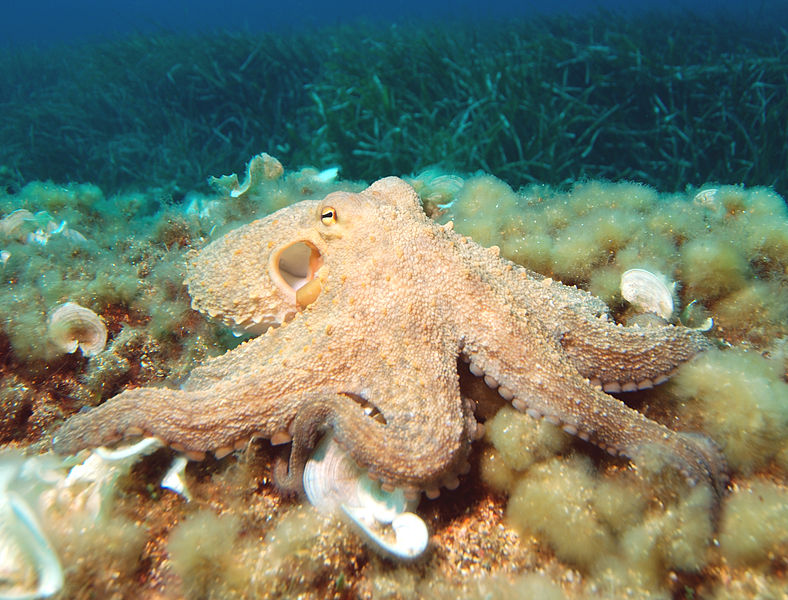
PD Octopus_vulgaris_2They can change their appearance with camouflage, so they can hide in plain sight near a wide variety of plants and corral, as well as mimicking other creatures. This is important for protection since they don’t have teeth or claws. They have advanced spatial learning, navigational abilities and use creative predatory techniques. Octopuses manipulate objects as well as the human hand and can escape from almost anything. They learn and can solve complex problems like crows.
Octopuses adapt to being captured in several days, unlike many other animals. The change is from a fearful animal to almost pet like—friendly and very alert about all that is occurring nearby. Octopuses respond rapidly to rewards and are extremely curious and responsive. They focus on any new object they see. When experimental probes are done in the nervous system, they rapidly recover and regenerate missing tissue. Octopuses are extremely and rapidly adaptive. They learn by watching others, do tricks with visual discrimination and they remember exactly for weeks. Their brain uses the same circuits for social learning and for other memory.
The octopus has very unusual abilities that make it unique among intelligent animals, such as camouflage and control and regeneration of eight flexible arms, each with thousands of suckers. Two of their relatives—squid and cuttlefish—are, also, unusually intelligent. Their eyes are like a camera with a lens, iris and retina. They have large unique brains and closed blood circulation with three hearts.

Recent Octopus Genetic Information Alters Theory of the Evolution of Intelligence

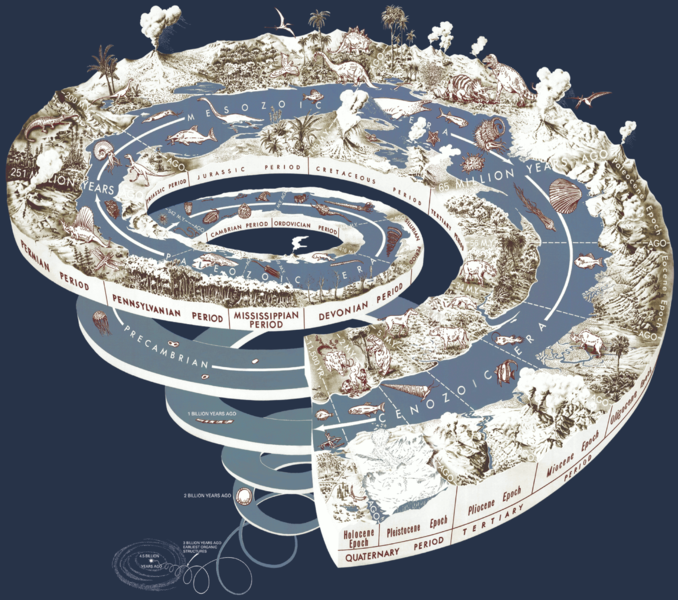
PD Geological_time_spiralNew research shows the unique evolutionary path octopus traveled to great intelligence. A previous post showed the unique brain structures for the crow. Both the crow and the octopus separated from mammals in evolution hundreds of millions of years ago and took very separate paths to building brains. Crows evolved through a line that led to dinosaurs; the octopus came from a line that separated in the Cambrian to become cephalopods. Mammals grew from amphibians, and reptiles and built their own brains. A previous post showed that lizards are very intelligent also with different brains. Insects with tiny brain are also extremely intelligent (see posts on beesants, and termites). Despite having no common ancestor all of these lines developed very high intelligence. Brains developed completely independently but have some surprising similarities in the neuronal organization.
In fact, although all these brains show different building blocks, chemical pathways and brain structures; they have a similar hierarchical organization.

Octopus History

From Albert kok
From Albert kok
The cephalopods separated from the ancestors of intelligent creatures 500 million years ago. They separated from the line of nautilus and arose as predators 400 million years ago. Nautilus had precursors of neurons very early; nautilus, also, has advanced memory, learning and spatial awareness, but less than the octopus. Very intelligent squid separated from the octopus in evolution 270 million years ago. The octopus rapidly evolved large brains 65 million years ago while competing with fish and reptiles.
Advanced cognitive traits started in the octopus hundreds of million years ago, much earlier than mammals. The octopus brain design is like snails with the gut in the center and the brain around it. Others in the larger octopus family (mollusks) have chains of nervous ganglia. But in the cephalopods, they formed a central nervous system. Surprisingly, learning and memory in the octopus are similar to mammals and both have similar neuroplasticity.
Advanced motor and sensory capacities, rapid learning and memory, very good vision, and efficient flexible arms allowed competition with fish, amphibians and reptiles, even without claws or other weapons. It was their unique talents that allowed them to compete with dangerous powerful creatures. They developed camera eyes similar to vertebrates, but which operate differently. They developed very complex mechanisms for instantaneous camouflage.

The Octopus Brain

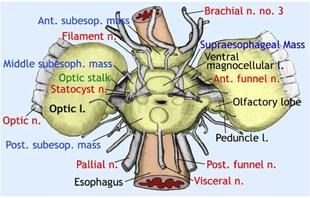
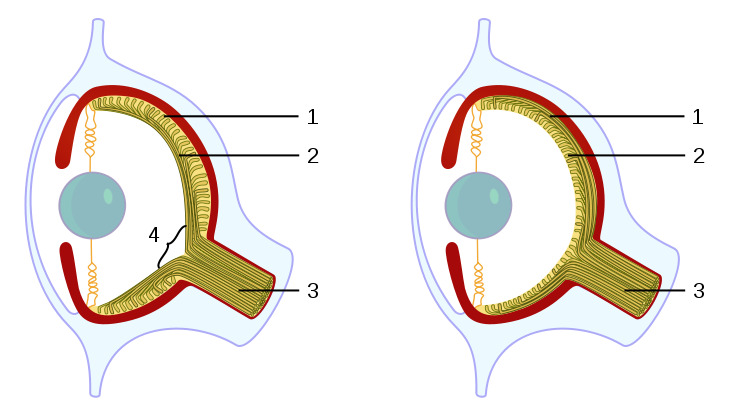
ventriThe octopus brain is similar in relative weight with vertebrates—larger than reptiles and fish, smaller than mammals and birds. It has 500 million neurons, which is similar to a dog, six times more than a mouse. 
The octopus brain is split into two halves and then into many lobes with particular functions. These lobes are folded, which increases the surface areas and connections. Some regions have very small neurons where large numbers can be packed into a small compartment. Also, the distance between them is very short, which increases processing speeds.
The Vertical Lobe (VL) is the seat of learning and memory and is organized like the human hippocampus with many sensory inputs at right angles to the small neurons that process the information. These have a large amount of connections, which converges in fewer outputs (the peduncle) that is like the cerebellum in controlling movement. Like the human cerebellum, they have many thin fibers lined up together. Synapses have less proteins and no myelin. 
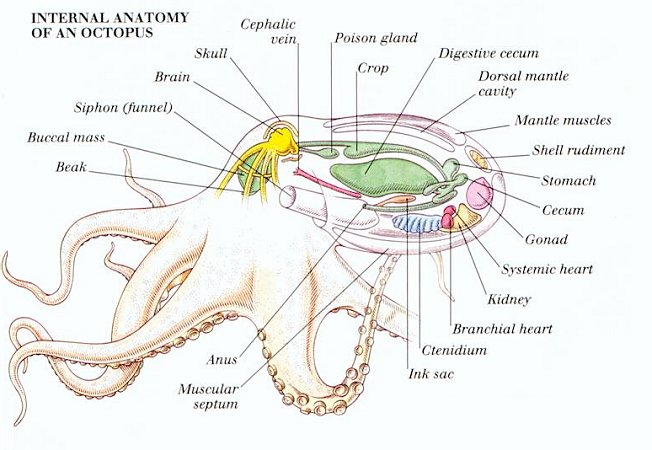
The brain is divided into three parts, each with a hierarchy. The central brain, surrounded by cartilage, has 50 million neurons and surrounds the gut. The vision brain (with 150 million neurons) and the eight arm brains (with a total of 300 million distributed neurons) are outside of the central nervous system.
The CNS looks slightly like the mammal brain with 40 lobes each consisting of outer gray matter and inner white matter. Studies of the human brain now find hubs that are highly locally connected and then globally between hubs (using myelin for rapid long distance communication). The octopus brain occurred by shortening connections of ganglia (other cephalopod structures) to speed up computation with no myelin. 
From Caerbannog Octopus and Vertebrate
From Caerbannog
Octopus and Vertebrate
The octopus optic lobe has three cortical layers like the human retina. It is striking that the way octopus process light is very different yet the regions of synthesis of data are similar. Octopus light receptor cells increase membrane potential, while humans decrease potential (hyperpolarize). The molecular cascades are quite different.
One region looks like the human cerebellum with granular cells and thin parallel fibers. This region behaves like a cerebellum, also, taking sensory input of vision and gravitation while controlling motor movement. The hierarchy is similar in the integration of vision and gravitation timing—eye-motor coordination. The vertical lobe (VL) in the brain’s center looks like the hippocampus both in architecture and in function for memory and learning.
A possible conclusion is that it is not the specific building blocks but the organization that leads to or allows the expression of intelligence. 

Octopus Lobes for Learning

21The octopus brain is even more specific than mammals in the location of learning and memory—the ventral lobe or VL. When the VL is removed, octopus behaved quite normally. Stimulation of the VL produced no movements. The VL deficits are only in memory and learning—it doesn’t remember when shocks will occur in an experiment. The VL is important for learning from observation of others and all long-term memory. The VP has two layers with glutamate transmission and then acetylcholine. Both layers have short and long neuroplasticity.
The VL has 2 types of mono-polar neurons, where 25 million very small interneurons connect with 65,000 very large neurons. Only the large neurons send axons from the VL. There are only two inputs to the VL with 1.8 million axons from the medial superior frontal (MSF) lobe. MSF integrates sensory information like the human thalamus, and once integrated, data goes to the VL in a special circuit between the VL grey and white matter. Just like the hippocampus (pyramidal versus Shaffer cells), the VL tracts are perpendicular to the MSF circuit. These MSF connect with the 25 million VL interneurons.
The VL (with 25 million neurons) and the sub frontal lobe (with 5 million neurons) comprise most of the CNS (total 40 million). These contain the smallest neurons in the brain, making the large number of neurons very close and efficient. The VL, also, has folded gyri like the human brain making the surface area greater. These two regions are quite different from all other brain locations. 

Electro Physiological Studies

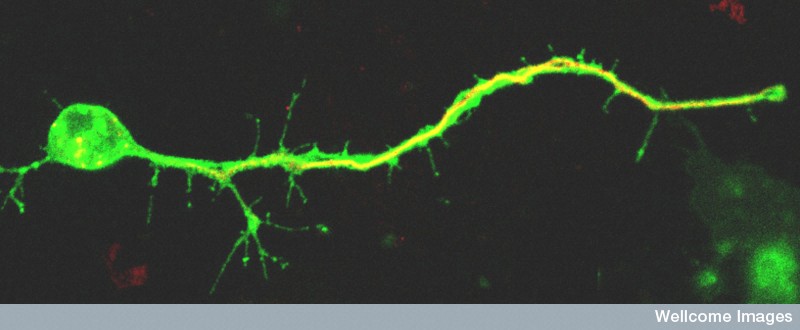
B0004748 Drosophila neuron Credit: Guy Tear. Wellcome Images images@wellcome.ac.uk http://wellcomeimages.org Drosophila neuron Confocal micrograph 2003 Published: - Copyrighted work available under Creative Commons by-nc-nd 4.0, see http://wellcomeimages.org/indexplus/page/Prices.html
Electric properties of VL neurons are surprisingly like mammal brains. The cell bodies are not excited. The axon and dendrite connections are similar. The region that integrates information and then fires an action potential is similar while not exactly the same.
The VL shows long-term potentiation neuroplasticity. The responses are similar to glutamate AMPA responses in humans. Other neurotransmitters are similar (such as kynurenate). They are not similar to the human NMDA mechanism. However, NMDA currents are found in the chromatophore (discussed later as the mechanism for camouflage). The LTP is similar to the hippocampus CA3 region. Serotonin is involved in short-term neuroplasticity in the VL. Nitric oxide is involved in memory and learning. Acetylcholine is involved in visual learning.
The types of neurotransmitters, cell structure, and membranes are different, but the network hierarchy, wiring, and neuroplasticity are similar. 

Unique Octopus Genetics Build a Brain

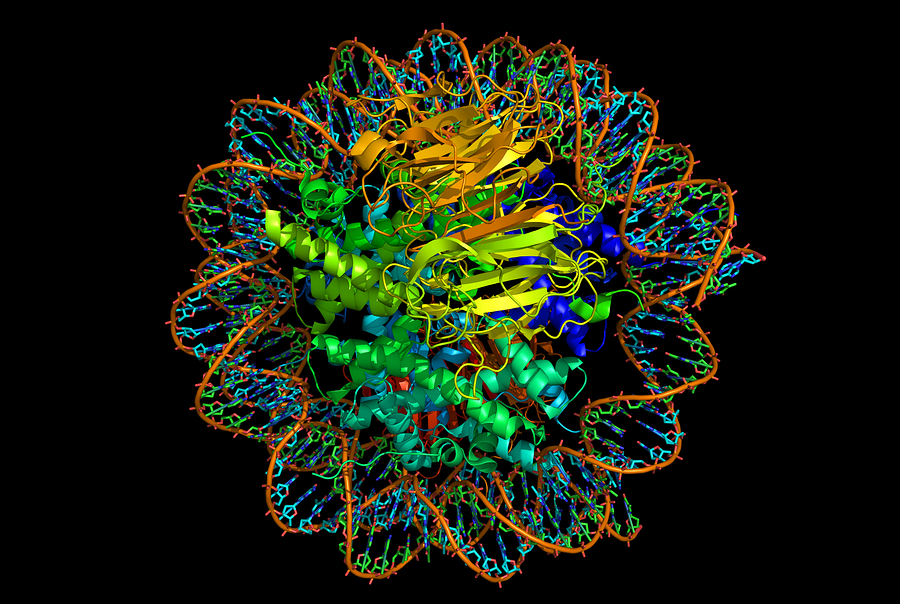
A high resolution ray-traced model of a nucleolus. Isolated on black.
Octopuses have the most genes of any invertebrate (2.7 billion bases) and more protein coding genes (33,000) than humans (20,000). Their genome is unusual and confusing. This week it was mapped for the first time in detail.
It is six times larger than any other invertebrate and has 28 chromosomes (double other invertebrates). 45% of octopus genome consists of repetitive elements with jumping genes. The great expansion caused by jumping genes occurred at 25 and 50 million years ago. Very telling is the fact that octopus has many gene networks (called protocadherin genes discussed below) that are involved in mammals’ complex brain networks, which occurred despite hundreds of million years of separation in evolution. These allow great capacity to process information.
The large recent genetic study demonstrates very rapid expansion of important gene families intermittently over millions of years, but not for the reasons that were expected. They found no whole genome duplications, which was previously assumed. 
From Todium
From Todium
One very important gene family in mammals that was expanded in octopuses in unique new ways is the protocadherins that are very significant for brain development. A second expansion occurred in the genes that control C2Hs zinc-finger factors, significant for for transcription. Others genes that were greatly expanded are interleukin 17 like genes, and G protein coupled receptors. 
Instead of duplications, it was the complex effects of jumping genes as well as extreme amount of RNA alterations and editing that made large numbers of proteins for neuronal signaling and other unique functions in skin, brain and suckers. 
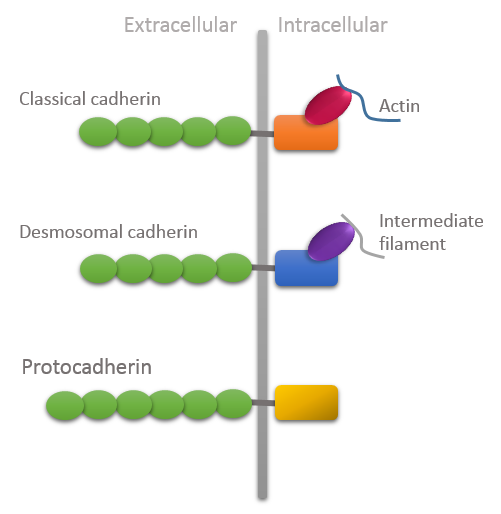
A large number of new protocadherin genes clusters (168) were found as opposed to around 20 in the related oysters. Protocadherin molecules attach cells together to build a brain including forming specific types of synapses. Some vertebrates, also, have expanded these genes with complex RNA splicing, rather than with jumping genes or gene duplication. This expansion of adhesion molecules occurred completely independently in both cephalopods and vertebrates.
Even between squid and octopus, they arose independently, since they diverged over 200 million years ago. The octopus genes expanded 135 million years ago. Some of these expanded gene clusters, then, were duplicated and altered to create more clusters. In both cephalopods and vertebrates, these genes are vital for the development of a complex central nervous system.
I10-82-octopusThe way the octopus brain was built emphasizes regulating short-range circuits, using the many different new protocadherin genes. Octopus brains use many small neurons with massive local connectivity. This highlighting of short range rather than massive long-range circuits is determined by the small axons, which because they are thin and close do not need myelin for rapid communication. The different protocadherin expansions determined the center of learning and memory in the VL. This intelligence is similar to mammals despite different protocadherin gene clusters making different proteins. 
The genes making zinc transcription factors, also, have many expanded clusters—1800 genes using multiple exons. This is compared to 600 in mammals, where they are the second largest population of genes. Octopus clusters make very specific patterns of transcripts used in the embryo and particularly brain development. They, also, counteract jumping genes.
Other significant findings reveal genes of neurotransmission and of guidance for axons. The same gene family that makes mammals synaptic structures is found in octopuses. Octopuses, also, have greatly expanded genes for transportation of vesicles that hold neurotransmitters—sialins (see post on vesicles)
Octopuses have genes similar to nicotinic acetylcholine receptors. But, they don’t function as receptors, but rather as suction devices for the suckers. They have chemoreceptors that are similar to vertebrates (GPCR with 330 genes).
From Henryhartley
From Henryhartley
Octopus genes for chromatophore skin, suckers and the CNS are unique from the expansions listed above. 
Human brain evolution was highly dependent on increased alternate RNA splicing (see post). In the octopus, brain development was highly dependent on the multiple effects of jumping genes and extensive editing of messenger RNA. Both produce many new unique proteins. The set of transcription factors and signaling pathways are similar in octopus and vertebrates.

Messenger RNA editing

Octopuses may have the most extreme RNA editing of any animal and therefore can rapidly create new proteins. This occurred throughout evolution, but recent research shows how they use it currently, for adaptation to temperature and great ocean depths. It is not clear why they have this unique genetic capacity. 
The octopus doesn’t maintain one temperature, but has changing temperatures (poikilotherm). These changes alter neuron functions such as action potentials. With cool temperatures, both sodium and potassium channels slow down, but potassium more so. Near freezing, potassium channels open 14 times slower and close 60 times slower. With RNA editing (at locus I321V) the rate doubled for closing of potassium channels bringing the rates together.
Recently, another 100 editing sites were found in messenger RNAs that have dramatic effects on starvation, heat stress and learning. The very cold Antarctica octopus edited nine RNA sites that altered the amino acid structure of the potassium channel.

Octopus Innovations

Octopuses have hundreds of completely novel genes for camouflage and prehensile arms with suckers that feel, grasp and sense chemicals. Their arms completely regenerate. Octopus, also, have a unique jet propulsion system and camera like eyes. They, also, have three hearts. Circulation is based on copper not iron. When severed, an arm can still withdraw from danger. There are many genes that have not been seen before. Some are related to tasting with suckers and seeing color from their skin. Smart suckers can be regenerated including the entire arm.

Camouflage

From Jacopo Werther
From Jacopo Werther
Octopuses have photosensitive cells (opsins) in their skin that can determine colors of their close surroundings (similar to rhodopsin in the retina). In evolution it appears that one mollusc developed this protein in the skin and then later the octopus and other cephalopods adapted this to help with camouflage. These colors are used to determine camouflage, not the eye, which sees very accurately but not in color. 
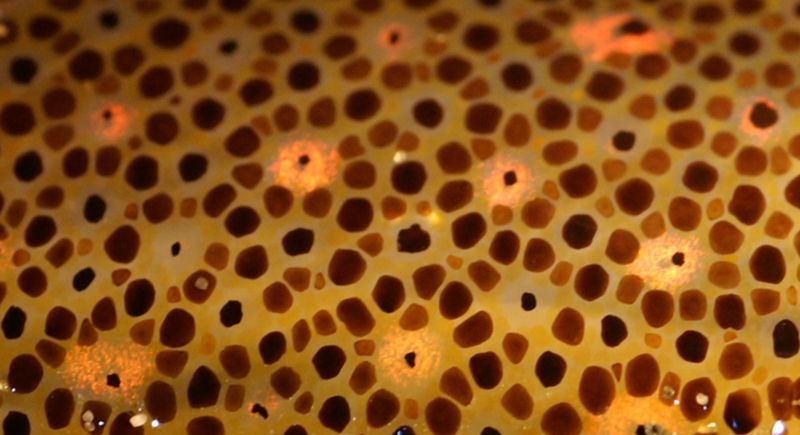
  • Instantaneous camouflage is triggered by a complex efficient nervous system. In milliseconds, they alter sacs that hold different colored pigments called chromatophoresThis changes their patterns and colors to adapt to different under sea environments. The sacs shrink and enlarge changing the overall color. They change the texture, color and shape of skin.
  • Another camouflage mechanism involves irridophores that reflect light to create similarity to objects nearby.
  • A third mechanism uses leucophores that provide a definite background using white cells.
  • Another mechanism includes special muscles that make special textures that are, also, similar to the environment.
Camouflage is an important strategy for defense since they have no teeth, claws or shell. They developed camouflage to such an extent that they can survive in any situation. 

Suckers

From Opponent
From Opponent
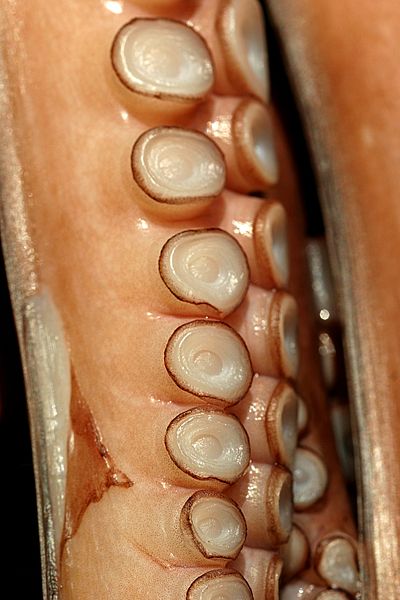
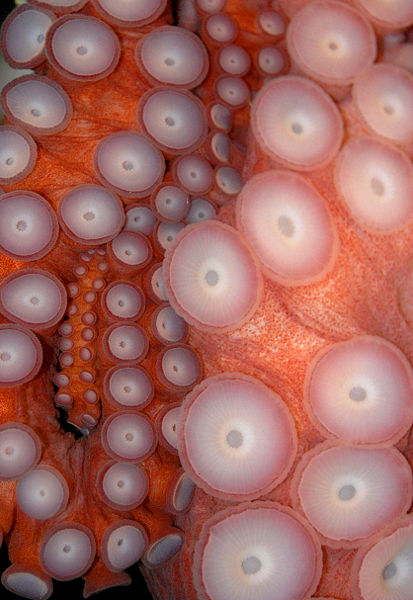
Suckers are quite independent. They move, sense (taste) and grasp independently, forming a very tight seal under water even on rough surfaces. Although soft as a jellyfish the attachment is incredibly strong using a cavity at the top with flexible sides making pressure. They have many grooves that are used to make a seal on rough irregular surfaces. The top is stiff (acetabular protuberance) while the sides and edges (infundibulum) are soft. Both stiff and elastic parts make a unique suction that becomes stiffer once contact is secure and with more pressure.

Severed Arms

From Albert kok
From Albert kok
Arms do some cognitive work for the octopus. Even when severed they react. They use their arms by putting them in dangerous situations they cannot see, such as under rocks and in crevices, where they can encounter claws, teeth, sharps and chemical. They can stretch to twice the length (females three times). Arms are made from material like the human tongue that can bend and stretch with the same volume. The third left arm is the longest used most often for reaching. Third right arm delivers the sperm without much stretch.
Octopuses regrow arms, but unlike starfish, a severed arm doesn’t grow a new octopus. Somehow, acetylcholine signaling is involved in regrowth and when completed the arm is as good as the old one. At three days, a knob is formed with undifferentiated cells. Other signals trigger a hook at two weeks with blood vessels and many stem cells. By one month these features disappear and the new arm is finished in three months. Acetylcholine is in the nerves but not much in the arm until three weeks. A large amount appears as the new suckers and chromatophores are built. Gradually there is less acetylcholine after a month.

Complex Behavior

Octopuses exhibit very complex behavior, both individually and in groups. When angry, they gather up armfuls of debris and throw this at others using their jet propulsion siphons to propel the debris by directing the jet under its arms. Usually siphons are used for travel. They use the jet to clean their homes of sand and dirt, as well as intruding fish.
From Nhobgood
From Nhobgood
Previous research mainly found octopus as isolative. But, recently societies of crowded octopuses have been found. In this situation, some of them are cooperative and even kiss beak to beak (the only other creature than humans to do this are cuttlefish and squid). But, also fights break out. Boxing, as well as throwing, has been observed recently. 
Octopuses have been observed moving toward a shrimp. With one arm tapping on its back, the shrimp rushes away into other octopus arms.
One species has been observed in groups up to forty. Mating in this group can occur by them living together for several days with no fighting. They can have rough sex grabbing each other sucker to sucker and kiss face to face.
In mating of some species, the male stretches out its special arm with sperm, which often breaks off and stays with the female. Sometimes the female then kills and eats the male. They usually only mate once. The social type mates many times over months. Many females stay with their eggs to such an extent that they can starve to death protecting them. Another species mate further while with the eggs.
When captured, octopuses adapt, but don’t like it if there isn’t enough activities. They are adept at opening twist off pill bottles, but, also, the more complex child proof. They can rapidly figure out advanced puzzles as do crows and primates.

The Uniquely Talented and Intelligent Octopus

From Llez
From Llez
Octopuses have advanced intelligence and probably are the first very intelligent creatures on earth despite evolving separately from mammals, birds, insects and reptiles for 500 million years. They appeared before the first fish. Their intelligence does not appear to be related to complex social groups (as had been one of the many assumptions of the origin of intelligence in mammals.) In fact, four distinct evolutionary lines among mollusks, without vertebrae, independently developed central nervous systems. 
The completely independent development of capacities is called convergent evolution. How can such completely different creatures all develop a central nervous system and high intelligence? It is often said that it was in competition with fish, amphibians and reptiles that octopus rapidly developed a complex large brain the size of a dog. How can this occur? 
It cannot only be, only, from random mutations. How can any reasonable person think that this is an accident for the appearance of high intelligence in so many lines that developed from small non-intelligent creatures after five hundred million years of separate evolution? 
From Jnpet
From Jnpet
There are unique genetic events that occurred that stimulated rapid changes with many new proteins. In humans it was alternative RNA splicing (see post) and in the octopus it was adapting jumping genes and editing its own RNA. But, there has to be a path to higher intelligence and similar brain structures for all these to follow. 
In humans pruning of synapses and neuroplasticity occurs with mental usage. Isn’t it reasonable to suppose that these processes are, also, related to the inherent mind of the creature searching for greater and greater capacities—the interaction of mind with the organism, with their cells, organelles, and molecules?
- See more at: http://jonlieffmd.com/blog/the-uniquely-talented-and-intelligent-octopus#sthash.LlWQwFny.dpuf