Showing posts with label Obesity. Show all posts

Saturday, February 9, 2019

3182. The Global Synamic of Obesity, Undernutrition, and Climate Change: The Lancet Commission Report

By Prof Boyd A Swinburn, MD Vivica I Kraak, PhD Prof Steven Allender, PhDVincent J Atkins Phillip I Baker, PhDJessica R Bogard, PhDHannah BrinsdenAlejandro CalvilloProf Olivier De Schutter, PhDRaji DevarajanProf Majid Ezzati, FMedSciProf Sharon Friel, PhDShifalika Goenka, PhDRoss A Hammond, PhDProf Gerard Hastings, PhDProf Corinna Hawkes, PhDMario Herrero, PhDProf Peter S Hovmand, PhDProf Mark Howden, PhDLindsay M Jaacks, PhDAriadne B Kapetanaki, PhDMatt Kasman, PhDProf Harriet V Kuhnlein, PhDProf Shiriki K Kumanyika, PhDProf Bagher Larijani, MDTim Lobstein, PhD Michael W Long, PhDVictor K R Matsudo, MDSusanna D H Mills, PhDGareth Morgan, PhDAlexandra Morshed, Patricia M Nece, JDProf An Pan, PhDDavid W PattersonGary Sacks, PhDMeera Shekar, PhDGeoff L SimmonsWarren Smit, PhDAli Tootee, PhDStefanie Vandevijvere, PhDWilma E Waterlander, PhDLuke Wolfenden, PhDProf William H Dietz, MD, The Lancet, January 29, 2019 
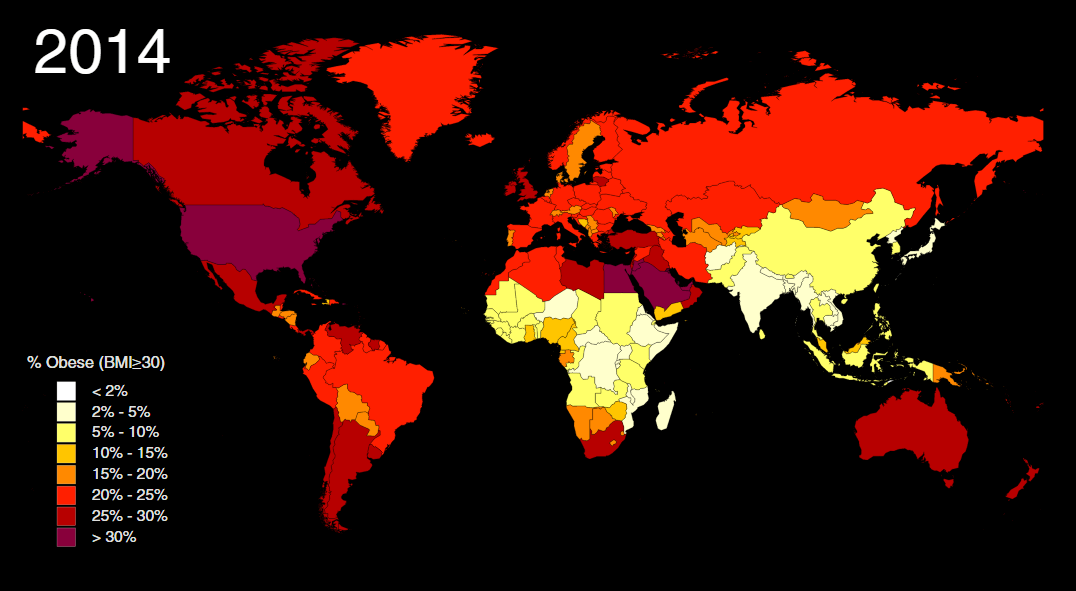
Geography of obesity

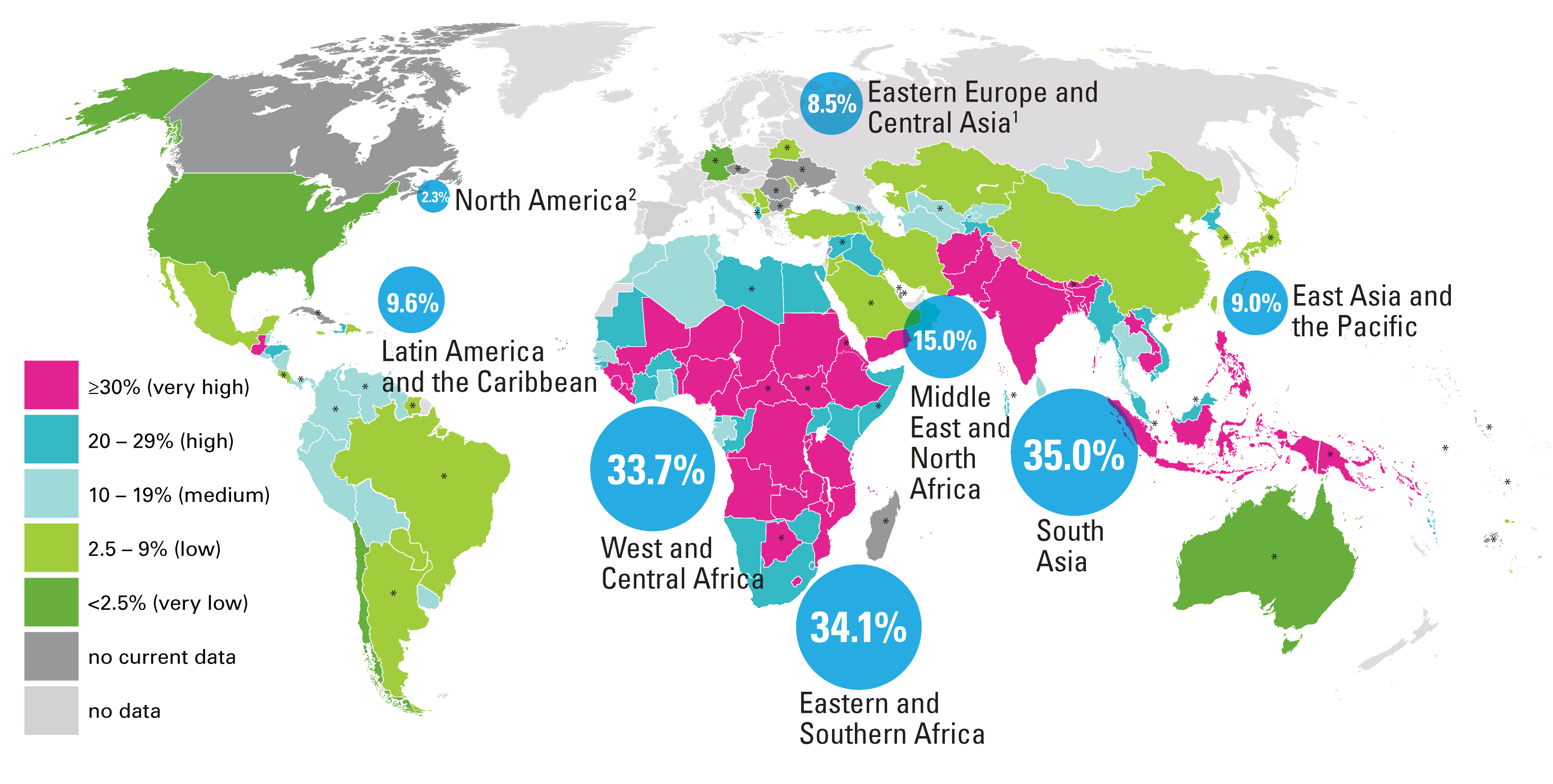
Geography of malnutrition


Abstract. Malnutrition in all its forms, including obesity, undernutrition, and other dietary risks, is the leading cause of poor health globally. In the near future, the health effects of climate change will considerably compound these health challenges. Climate change can be considered a pandemic because of its sweeping effects on the health of humans and the natural systems we depend on (ie, planetary health). These three pandemics—obesity, undernutrition, and climate change—represent The Global Syndemic that affects most people in every country and region worldwide. They constitute a syndemic, or synergy of epidemics, because they co-occur in time and place, interact with each other to produce complex sequelae, and share common underlying societal drivers. This Commission recommends comprehensive actions to address obesity within the context of The Global Syndemic, which represents the paramount health challenge for humans, the environment, and our planet in the 21st century.

For the full text click here

Monday, June 12, 2017

2629. More Than 10 Percent of World’s Population Is Obese, Study Finds

By Matt Richtel, The New York Times, June 12, 2017

More than 10 percent of the world’s population is now obese, a marked rise over the last 30 years that is leading to widespread health problems and millions of premature deaths, according to a new study, the most comprehensive research done on the subject.

Published Monday in The New England Journal of Medicine, the study showed that the problem had swept the globe, including regions that have historically had food shortages, like Africa.

The study, compiled by the Institute for Health Metrics and Evaluation at the University of Washington and funded by the Gates Foundation, looked at 195 countries, essentially the world’s population, finding that rates of obesity at least doubled in 73 countries — including Turkey, Venezuela, and Bhutan — from 1980 to 2015, and “continuously increased in most other countries.”

Analyzing some 1,800 data sets from around the world, researchers found that excess weight played a role in four million deaths in 2015, from heart disease, diabetes, kidney disease and other factors. The per capita death rate was up 28 percent since 1990 and, notably, 40 percent of the deaths were among people who were overweight but not heavy enough to be classified as obese.

The study defined obese as a body mass index of 30 or higher and overweight as a B.M.I. from 25 to 29.

By those measures, nearly 604 million adults worldwide are obese and 108 million children, the authors reported. Obesity rates among children are rising faster in many countries than among adults.

In the United States, 12.5 percent of children were obese, up from 5 percent in 1980. Combining children and adults, the United States had the dubious distinction of having the largest increase in percentile points of any country, a jump of 16 percentage points to 26.5 percent of the overall population.

A range of nutrition scientists, including ones who differ significantly on some issues in the field, uniformly praised the breadth, depth and quality of the study, and the significance of its message.

“Its global implications are huge,” said Barry Popkin, a professor of nutrition at the University of North Carolina. He echoed others in saying the findings tend to also affirm smaller, more regional studies.

“This study shows what we know: No country in the globe has reduced overweight or obesity levels. This is astounding given the huge health and economic costs linked with overweight and obesity.”

The study largely did not go deeply into the causes of obesity, but the authors said the growing accessibility of inexpensive, nutrient-poor packaged foods was probably a major factor and the general slowdown in physical activity was probably not.

“The change in physical activity preceded the global increase in obesity,” said Dr. Ashkan Afshin, assistant professor at the Institute for Health Metrics and Evaluation and lead author of the study.

“We have more processed food, more energy-dense food, more intense marketing of food products, and these products are more available and more accessible,” he added. “The food environment seems to be the main driver of obesity.”

Others agreed on the availability of poor diet, noting that such food can often be the most accessible and affordable.

“What people eat is the key factor in whether they become obese or not,” said Adam Drewnowsk, director of the Center for Public Health Nutrition at the University of Washington, who was not affiliated with the study, which he deemed “brilliant work by the best people in the business.”

He said getting people healthy food was easier said than done.

“It is all very nice to talk about the need to eat less unhealthy foods and more healthy foods,” he said. But “unhealthy foods cost less; healthier foods often cost more. People eat what they can afford.”

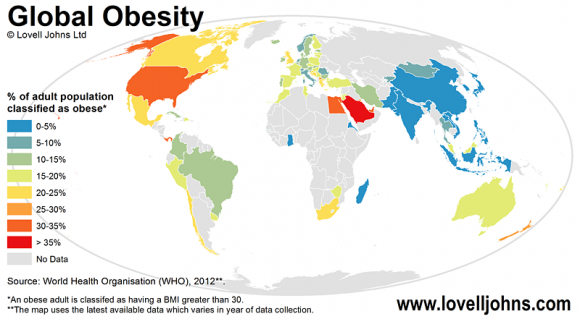
The research characterized the growth of obesity in two ways, one that looked at countries that had the biggest leap in percentage points. After the United States, other countries with particularly significant jumps in percent of the population who are obese included Saudi Arabia, Algeria, and Egypt.

But other countries had rates that rose much faster, even though they remained lower as an overall percent of the population. Broadly, the fastest rises were found in Latin America, Africa, and China.

In China, for example, less than 1 percent of the population was obese in 1980, but now more than 5 percent is, a fivefold increase. The rise in childhood obesity in China roughly paralleled that overall change.

Three countries in Africa — Burkina Faso, Mali, and Guinea-Bissau — had the fastest growth. Burkina Faso, the country with the fastest growth in the world in obesity, began in 1980 with around one-third of a percent of its population as obese. Its rate rose to nearly 7 percent of the population.

“The future health and economic burden facing all these countries is immense,” Dr. Popkin said.

Regarding the overall health implications of the study, one point made by the researchers is that there is a good news/bad news pattern emerging. The good news is that the disease burden caused by obesity is actually falling in some of the wealthiest nations. In the United States, the death rates associated with obesity fell from 63 per 100,000 in 1990 (the baseline year for this measure) to 61 per 100,000 people, reflecting medications that deal with the effects of obesity, like hypertension.

The bad news is those remedies are not available in developing countries or are available only to the wealthiest people, leading to growing rates of associated deaths and without a clear solution.

“Most of the obese people are dying because of cardiovascular disease and diabetes,” said Dr. Afshin, lead author of the study. That has been somewhat mitigated in the United States “and other developed nations” with the use of drugs.

“But we cannot have all people on drugs,” he said. “Ideally, we want to go to the root causes and address the problem of overeatin.

To date, he said, no country “has been able to control the food environment, which seems to be the main driver of obesity.”

Tuesday, August 11, 2015

1977. Coca-Cola Funds Scientists Who Shift Blame for Obesity Away From Bad Diets

By Anahad O'Conner, The New York Times, August 9, 2015


Coca-Cola, the world’s largest producer of sugary beverages, is backing a new “science-based” solution to the obesity crisis: To maintain a healthy weight, get more exercise and worry less about cutting calories.

The beverage giant has teamed up with influential scientists who are advancing this message in medical journals, at conferences and through social media. To help the scientists get the word out, Coke has provided financial and logistical support to a new nonprofit organization called the Global Energy Balance Network, which promotes the argument that weight-conscious Americans are overly fixated on how much they eat and drink while not paying enough attention to exercise.

“Most of the focus in the popular media and in the scientific press is, ‘Oh they’re eating too much, eating too much, eating too much’ — blaming fast food, blaming sugary drinks and so on,” the group’s vice president, Steven N. Blair, an exercise scientist, says in a recent video announcing the new organization. “And there’s really virtually no compelling evidence that that, in fact, is the cause.”

Health experts say this message is misleading and part of an effort by Coke to deflect criticism about the role sugary drinks have played in the spread of obesity and Type 2 diabetes. They contend that the company is using the new group to convince the public that physical activity can offset a bad diet despite evidence that exercise has only minimal impact on weight compared with what people consume.

This clash over the science of obesity comes in a period of rising efforts to tax sugary drinks, remove them from schools and stop companies from marketing them to children. In the last two decades, consumption of full-calorie sodas by the average American has dropped by 25 percent.

“Coca-Cola’s sales are slipping, and there’s this huge political and public backlash against soda, with every major city trying to do something to curb consumption,” said Michele Simon, a public health lawyer. “This is a direct response to the ways that the company is losing. They’re desperate to stop the bleeding.”

Coke has made a substantial investment in the new nonprofit. In response to requests based on state open-records laws, two universities that employ leaders of the Global Energy Balance Network disclosed that Coke had donated $1.5 million last year to start the organization.

Since 2008, the company has also provided close to $4 million in funding for various projects to two of the organization’s founding members: Dr. Blair, a professor at the University of South Carolina whose research over the past 25 years has formed much of the basis of federal guidelines on physical activity, and Gregory A. Hand, dean of the West Virginia University School of Public Health.

Records show that the network’s website, gebn.org, is registered to Coca-Cola headquarters in Atlanta, and the company is also listed as the site’s administrator. The group’s president, James O. Hill, a professor at the University of Colorado School of Medicine, said Coke had registered the website because the network’s members did not know how.

“They’re not running the show,” he said. “We’re running the show.”

Coca-Cola’s public relations department repeatedly declined requests for an interview with its chief scientific officer, Rhona Applebaum, who has called attention to the new group on Twitter. In a statement, the company said it had a long history of supporting scientific research related to its beverages and topics such as energy balance.

“We partner with some of the foremost experts in the fields of nutrition and physical activity,” the statement said. “It’s important to us that the researchers we work with share their own views and scientific findings, regardless of the outcome, and are transparent and open about our funding.”

Dr. Blair and other scientists affiliated with the group said that Coke had no control over its work or message and that they saw no problem with the company’s support because they had been transparent about it.

But as of last week, the group’s Twitter and Facebook pages, which promote physical activity as a solution to chronic disease and obesity while remaining largely silent on the role of food and nutrition, made no mention of Coca-Cola’s financial support. So far, the social media campaign has failed to gain much traction: As of Friday, the group had fewer than 1,000 followers on Twitter.

The group’s website also omitted mention of Coke’s backing until Dr. Yoni Freedhoff, an obesity expert at the University of Ottawa, wrote to the organization to inquire about its funding. Dr. Blair said this was an oversight that had been quickly corrected.

“As soon as we discovered that we didn’t have not only Coca-Cola but other funding sources on the website, we put it on there,” Dr. Blair said. “Does that make us totally corrupt in everything we do?”

Coke’s involvement in the new organization is not the only example of corporate-funded research and advocacy to come under fire lately. The American Society for Nutrition and the Academy of Nutrition and Dietetics have been criticized by public health advocates for forming partnerships with companies such as Kraft Foods, McDonald’s, PepsiCo and Hershey’s. Dietitians have also faced criticism for taking payments from Coke to present the company’s soda as a healthy snack.

Critics say Coke has long cast the obesity epidemic as primarily an exercise problem. “The message is that obesity is not about the foods or beverages you’re consuming, it’s that you’re not balancing those foods with exercise,” Dr. Freedhoff of the University of Ottawa said.

Now, public health advocates say, Coca-Cola is going a step further, recruiting reputable scientists to make the case for them.

Dr. Hill, the nonprofit’s president, is a co-founder of the National Weight Control Registry, a long-term study of people who have lost weight, and has served on committees for the World Health Organization and the National Institutes of Health. The American Society for Nutrition refers to him as “a leader in the fight against the global obesity epidemic.”

Barry M. Popkin, a professor of global nutrition at the University of North Carolina at Chapel Hill, said Coke’s support of prominent health researchers was reminiscent of tactics used by the tobacco industry, which enlisted experts to become “merchants of doubt” about the health hazards of smoking.

Marion Nestle, the author of the book “Soda Politics” and a professor of nutrition, food studies and public health at New York University, was especially blunt: “The Global Energy Balance Network is nothing but a front group for Coca-Cola. Coca-Cola’s agenda here is very clear: Get these researchers to confuse the science and deflect attention from dietary intake.”

Funding from the food industry is not uncommon in scientific research. But studies suggest that the funds tend to bias findings. A recent analysis of beverage studies, published in the journal PLOS Medicine, found that those funded by Coca-Cola, PepsiCo, the American Beverage Association and the sugar industry were five times more likely to find no link between sugary drinks and weight gain than studies whose authors reported no financial conflicts.

On its website, the new nonprofit promises to be “the voice of science” in discussions about healthy lifestyles and contends that the concept of energy balance provides “a new science-based framework” for achieving a stable body weight.

The group says there is “strong evidence” that the key to preventing weight gain is not reducing food intake — as many public health experts recommend — “but maintaining an active lifestyle and eating more calories.” To back up this contention, the group provides links to two research papers, each of which contains this footnote: “The publication of this article was supported by The Coca-Cola Company.”

In March, Dr. Hill, Dr. Blair, and Dr. Hand announced the creation of the organization in an editorial in the British Journal of Sports Medicine. They argued that the public and many scientists largely overlooked physical inactivity as a cause of obesity. They said they were creating the Global Energy Balance Network to raise awareness “about both sides of the energy balance equation.”

The editorial contained a disclosure that the group had received an “unrestricted education gift” from Coca-Cola.

In response to a request made under the state Freedom of Information Act, the University of South Carolina disclosed that Dr. Blair had received more than $3.5 million in funding from Coke for research projects since 2008.

The university also disclosed that Coca-Cola had provided significant funding to Dr. Hand, who left the University of South Carolina last year for West Virginia. The company gave him $806,500 for an “energy flux” study in 2011 and $507,000 last year to establish the Global Energy Balance Network.

It is unclear how much of the money, if any, ended up as personal income for the professors.

“As long as everybody is disclosing their potential conflicts and they’re being managed appropriately, that’s the best that you can do,” Dr. Hand said. “It makes perfect sense that companies would want the best science that they can get.”

The group’s president, Dr. Hill, also has financial ties to Coca-Cola. The company last year gave an “unrestricted monetary gift” of $1 million to the University of Colorado Foundation. In response to a request made under the Colorado Open Records Act, the university said that Coca-Cola had provided the money “for the purposes of funding” the Global Energy Balance Network.

Dr. Hill said he had sought money from Coke to start the nonprofit because there was no funding available from his university. The group’s website says it is also supported by a few universities and ShareWIK Media Group, a producer of videos about health. Dr. Hill said that he had also received a commitment of help from General Mills, as well as promises of support from other businesses, which had not formally confirmed their offers.

He said he believed public health authorities could more easily change the way people eat by working with the food industry instead of against it.

On its website, the group recommends combining greater exercise and food intake because, Dr. Hill said, “ ‘Eat less’ has never been a message that’s been effective. The message should be ‘Move more and eat smarter.’ ”

He emphasized that weight loss involved a combination of complex factors and that his group’s goal was not to play down the role of diet or to portray obesity as solely a problem of inadequate exercise.

“If we are out there saying it’s all about physical activity and it’s not about food, then we deserve criticism,” he said. “But I think we haven’t done that.”

But in news releases and on its website, the group has struck a different tone.

“The media tends to blame the obesity epidemic on our poor eating habits,” one recent news release states. “But are those french fries really the culprit? Dr. Steve Blair explains that you shouldn’t believe everything you see on TV.”

In the news release, Dr. Blair suggests that sedentary behavior is a bigger factor.

Most public health experts say that energy balance is an important concept, because weight gain for most people is about calories in vs. calories out. But the experts say research makes it clear that one side of the equation has a far greater effect.

While people can lose weight in several ways, many studies suggest that those who keep it off for good consume fewer calories. Growing evidence also suggests that maintaining weight loss is easier when people limit their intake of high glycemic foods such as sugary drinks and other refined carbohydrates, which sharply raise blood sugar.

Physical activity is important and certainly helps, experts say. But studies show that exercise increases appetite, causing people to consume more calories. Exercise also expends far fewer calories than most people think. A 12-ounce can of Coca-Cola, for example, contains 140 calories and roughly 10 teaspoons of sugar. “It takes three miles of walking to offset that one can of Coke,” Dr. Popkin said.

In one of the most rigorous studies of physical activity and weight loss, published in the journal Obesity, scientists recruited 200 overweight, sedentary adults and put them on an aggressive exercise program. To isolate the effects of exercise on their weight, the subjects were instructed not to make any changes in their diets.

Participants were monitored to ensure they exercised five to six hours a week, more than double the 2.5 weekly hours of exercise recommended in federal guidelines. After a year, the men had lost an average of just 3.5 pounds, the women 2.5. Almost everyone was still overweight or obese.

“Adding exercise to a diet program helps,” said Dr. Anne McTiernan, the lead author of the study and a researcher at the Fred Hutchinson Cancer Center in Seattle. “But for weight loss, you’re going to get much more impact with diet changes.”

But much like the research on sugary drinks, studies of physical activity funded by the beverage industry tend to reach conclusions that differ from the findings of studies by independent scientists.
Last week, the Pennington Biomedical Research Center in Louisiana announced the findings of a large new study on exercise in children that determined that lack of physical activity “is the biggest predictor of childhood obesity around the world.”
The news release contained a disclosure: “This research was funded by The Coca-Cola Company.”

Kelly D. Brownell, dean of the Sanford School of Public Policy at Duke, said that as a business, Coke “focused on pushing a lot of calories in, but then their philanthropy is focused on the calories out part, the exercise.”

In recent years, Coke has donated money to build fitness centers in more than 100 schools across the country. It sponsors a program called “Exercise is Medicine to encourage doctors to prescribe physical activity to patients. And when Chicago’s City Council proposed a soda tax in 2012 to help address the city’s obesity problem, Coca-Cola donated $3 million to establish fitness programs in more than 60 of the city’s community centers.
The initiative to tax soda ultimately failed.

“Reversing the obesity trend won’t happen overnight,” Coca-Cola said in an ad for its Chicago exercise initiative. “But for thousands of families in Chicago, it starts now, with the next push-up, a single situp or a jumping jack.”
Monday, May 19, 2014

1418. Always Hungry? Here Is Why

By David S. Ludwig and Mark. I. Friedman, The New York Times, May 16, 2014

For most of the last century, our understanding of the cause of obesity has been based on immutable physical law. Specifically, it’s the first law of thermodynamics, which dictates that energy can neither be created nor destroyed. When it comes to body weight, this means that calorie intake minus calorie expenditure equals calories stored. Surrounded by tempting foods, we overeat, consuming more calories than we can burn off, and the excess is deposited as fat. The simple solution is to exert willpower and eat less.
The problem is that this advice doesn’t work, at least not for most people over the long term. In other words, your New Year’s resolution to lose weight probably won’t last through the spring, let alone affect how you look in a swimsuit in July. More of us than ever are obese, despite an incessant focus on calorie balance by the government, nutrition organizations and the food industry.
But what if we’ve confused cause and effect? What if it’s not overeating that causes us to get fat, but the process of getting fatter that causes us to overeat?
The more calories we lock away in fat tissue, the fewer there are circulating in the bloodstream to satisfy the body’s requirements. If we look at it this way, it’s a distribution problem: We have an abundance of calories, but they’re in the wrong place. As a result, the body needs to increase its intake. We get hungrier because we’re getting fatter.
It’s like edema, a common medical condition in which fluid leaks from blood vessels into surrounding tissues. No matter how much water they drink, people with edema may experience unquenchable thirst because the fluid doesn’t stay in the blood, where it’s needed. Similarly, when fat cells suck up too much fuel, calories from food promote the growth of fat tissue instead of serving the energy needs of the body, provoking overeating in all but the most disciplined individuals.
We discuss this hypothesis in an article just published in JAMA, The Journal of the American Medical Association. According to this alternative view, factors in the environment have triggered fat cells in our bodies to take in and store excessive amounts of glucose and other calorie-rich compounds. Since fewer calories are available to fuel metabolism, the brain tells the body to increase calorie intake (we feel hungry) and save energy (our metabolism slows down). Eating more solves this problem temporarily but also accelerates weight gain. Cutting calories reverses the weight gain for a short while, making us think we have control over our body weight, but predictably increases hunger and slows metabolism even more.
Consider fever as another analogy. A cold bath will lower body temperature temporarily, but also set off biological responses — like shivering and constriction of blood vessels — that work to heat the body up again. In a sense, the conventional view of obesity as a problem of calorie balance is like conceptualizing fever as a problem of heat balance; technically not wrong, but not very helpful, because it ignores the apparent underlying biological driver of weight gain.
This is why diets that rely on consciously reducing calories don’t usually work. Only one in six overweight and obese adults in a nationwide survey reports ever having maintained a 10 percent weight loss for at least a year. (Even this relatively modest accomplishment may be exaggerated, because people tend to overestimate their successes in self-reported surveys.) In studies by Dr. Rudolph L. Leibel of Columbia and colleagues, when lean and obese research subjects were underfed in order to make them lose 10 to 20 percent of their weight, their hunger increased and metabolism plummeted. Conversely, overfeeding sped up metabolism.
For both over- and under-eating, these responses tend to push weight back to where it started — prompting some obesity researchers to think in terms of a body weight “set point” that seems to be predetermined by our genes.
But if basic biological responses push back against changes in body weight, and our set points are predetermined, then why have obesity rates — which, for adults, are almost three times what they were in the 1960s — increased so much? Most important, what can we do about it?
As it turns out, many biological factors affect the storage of calories in fat cells, including genetics, levels of physical activity, sleep and stress. But one has an indisputably dominant role: the hormone insulin. We know that excess insulin treatment for diabetes causes weight gain, and insulin deficiency causes weight loss. And of everything we eat, highly refined and rapidly digestible carbohydrates produce the most insulin.
By this way of thinking, the increasing amount and processing of carbohydrates in the American diet has increased insulin levels, put fat cells into storage overdrive and elicited obesity-promoting biological responses in a large number of people. Like an infection that raises the body temperature set point, high consumption of refined carbohydrates — chips, crackers, cakes, soft drinks, sugary breakfast cereals and even white rice and bread — has increased body weights throughout the population.
One reason we consume so many refined carbohydrates today is because they have been added to processed foods in place of fats — which have been the main target of calorie reduction efforts since the 1970s. Fat has about twice the calories of carbohydrates, but low-fat diets are the least effective of comparable interventions, according to several analyses, including one presented at a meeting of the American Heart Association this year.
A recent study by one of us, Dr. Ludwig, and his colleagues published in JAMA examined 21 overweight and obese young adults after they had lost 10 to 15 percent of their body weight, on diets ranging from low fat to low carbohydrate. Despite consuming the same number of calories on each diet, subjects burned about 325 more calories per day on the low carbohydrate than on the low fat diet — amounting to the energy expended in an hour of moderately intense physical activity.
Another study published by Dr. Ludwig and colleagues in The Lancet in 2004 suggested that a poor-quality diet could result in obesity even when it was low in calories. Rats fed a diet with rapidly digesting (called high “glycemic index”) carbohydrate gained 71 percent more fat than their counterparts, who ate more calories over all, though in the form of slowly digesting carbohydrate.
These ideas aren’t entirely new. The notion that we overeat because we’re getting fat has been around for at least a century, as described by Gary Taubes in his book “Good Calories, Bad Calories.” In 1908, for example, a German internist named Gustav von Bergmann dismissed the energy-balance view of obesity, and hypothesized that it was instead caused by a metabolic disorder that he called “lipophilia,” or “love of fat.”
But such theories have been generally ignored, perhaps because they challenge entrenched cultural attitudes. The popular emphasis on calorie balance reinforces the belief that we have conscious control over our weight, and that obesity represents a personal failure because of ignorance or inadequate willpower.
In addition, the food industry — which makes enormous profits from highly processed products derived from corn, wheat and rice — invokes calorie balance as its first line of defense. If all calories are the same, then there are no bad foods, and sugary beverages, junk foods and the like are fine in moderation. It’s simply a question of portion control. The fact that this rarely works is taken as evidence that obese people lack willpower, not that the idea itself might be wrong.
UNFORTUNATELY, existing research cannot provide a definitive test of our hypothesis. Several prominent clinical trials reported no difference in weight loss when comparing diets purportedly differing in protein, carbohydrate and fat. However, these trials had major limitations; at the end, subjects reported that they had not met the targets for complying with the prescribed diets. We wouldn’t discard a potentially lifesaving cancer treatment based on negative findings, if the research subjects didn’t take the drug as intended.
There are better ways to do this research. Studies should provide participants with at least some of their food, to make it easier for them to stick to the diets. Two studies that did this — one by the Direct Group in 2008 and the other by the Diogenes Project in 2010 — reported substantial benefits associated with the reduction of rapidly digestible carbohydrate compared with conventional diets. We need to invest much more in this research. With the annual economic burden of diabetes — just one obesity-related complication — predicted to approach half a trillion dollars by 2020, a few billion dollars for state-of-the-art nutrition research would make a good investment.
If this hypothesis turns out to be correct, it will have immediate implications for public health. It would mean that the decades-long focus on calorie restriction was destined to fail for most people. Information about calorie content would remain relevant, not as a strategy for weight loss, but rather to help people avoid eating too much highly processed food loaded with rapidly digesting carbohydrates. But obesity treatment would more appropriately focus on diet quality rather than calorie quantity.
People in the modern food environment seem to have greater control over what they eat than how much. With reduced consumption of refined grains, concentrated sugar and potato products and a few other sensible lifestyle choices, our internal body weight control system should be able to do the rest. Eventually, we could bring the body weight set point back to pre-epidemic levels. Addressing the underlying biological drive to overeat may make for a far more practical and effective solution to obesity than counting calories.

David S. Ludwig directs the New Balance Foundation Obesity Prevention Center at Boston Children’s Hospital and is a professor of pediatrics at Harvard Medical School. Mark I. Friedman is vice president of research at the Nutrition Science Initiative.