Showing posts with label Nicaragua. Show all posts

Friday, July 24, 2026

3704. Daniel Ortega, President of Nicaragua, Says He Will Not Hold Any More Elections

By Tiago Rogero, The Guardian, July 20, 2026 

Daniel Ortega made the announcement on Sunday during the official ceremony
marking the 47th anniversary of the 1979 Sandinista revolution. Photo: Cesar Preze/El 19 Digital/Afp/Getty Images

Nicaragua’s long-serving president, Daniel Ortega, has said the country will hold no further elections to prevent the opposition from coming to power.

The 80-year-old authoritarian leader, who has been in office since 2007, also said he would work with the congress he controls to pass new laws that would “build a wall” against the opposition.

Ortega made the announcement on Sunday during the official ceremony marking the 47th anniversary of the 1979 Sandinista revolution, in which he helped overthrow the brutal dictatorship of Anastasio Somoza.

Although his administration and that of his wife and “co-president”, Rosario Murillo, had already been marked by the steady erosion of democracy in the Central American country, many are describing his announcement as a significant rhetorical escalation.

“With this decision, Ortega and Murillo have sealed the country’s transition to a full-fledged family dictatorship,” said Tiziano Breda, Latin America senior analyst at the NGO Armed Conflict Location and Event Data.

During a speech in front of thousands of state employees who, according to local media, had been coerced into attending, Ortega said: “There will be no more elections here so that they [the opposition parties] can try to seize the government, seize power.”

The president, who had not appeared in public for 61 days, added: “We will work with the National Assembly and the relevant institutions on laws, because we need laws that build a wall, a barrier, against the coup plotters and the traitors who sell out their country.”

The elections were due to take place next year, but Ortega gave no details on whether they would be canceled or whether the opposition would be barred from taking part – something that has already happened in practice. During the 2021 campaign, his regime outlawed parties and jailed all opposition presidential hopefuls.

Breda said: “Ortega and Murillo are evidently afraid of the idea that the slightest political opening could create the conditions for dissent to manifest and threaten their grip on power, possibly suggesting that their already feeble domestic support is further falling.

“Therefore, instead of staging a rigged election, they have opted to eliminate electoral competition altogether.”

Last year, Ortega pushed through a series of constitutional reforms that included extending the presidential term from five to six years and promoting his wife, then vice-president, to the position of “co-president”. The US refers to their administration as the “Murillo-Ortega dictatorship”.

During his speech, the Nicaraguan president criticised the US over the January operation that abducted the Venezuelan dictator Nicolás Maduro: “With all their power, they stormed the presidential palace, where Nicolás and his wife, Cilia [Flores], were. They killed the entire security detail there – most of them were Cubans – and took them away to imprison them in the US. It is monstrous.”

The president said preventing the opposition from returning to power was necessary to protect the country from the “coup plotters” who, he claimed, had been behind the nationwide protests of 2018 – when, according to organisations including the UN, his regime carried out a violent crackdown that killed more than 350 people, wounded hundreds, jailed thousands and forced nearly 1 million Nicaraguans into exile.

Recently, the UN, the US, human rights organisations and 30 former Ibero-American presidents have directly blamed Ortega and Murillo for the death of the Indigenous leader and four-term congressman Brooklyn Rivera, 73, who spent nearly three years “unjustly imprisoned” by the regime, the US state department said.

According to organisations including Human Rights Watch, there are about 50 political prisoners in the country. The regime has stripped 546 people of their citizenship and shut down more than 5,600 non-governmental organisations, 29 universities and 58 media outlets.


Tuesday, August 14, 2018

2998. A Massacre, Not a Coup: A Response to Misinformation on Nicaragua

By Mary Ellsberg, Pulse, August 3, 2018
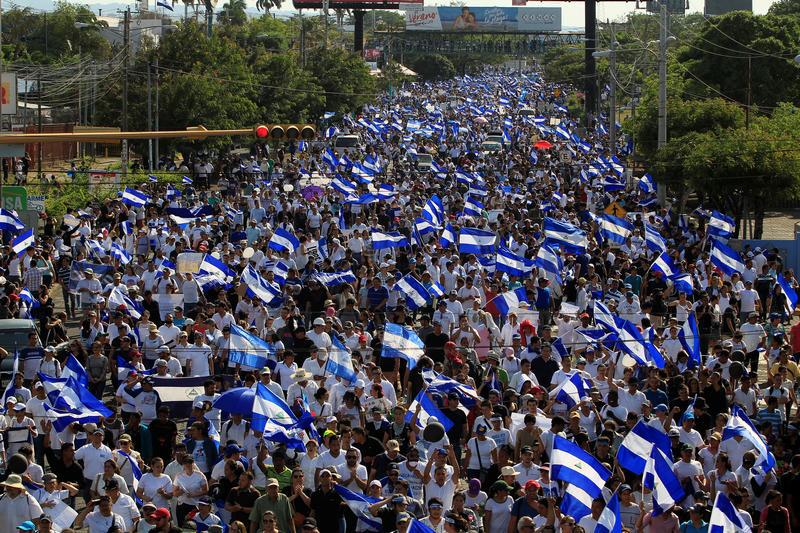
Mass protests against the Ortega government in Managua on April 23, 2018.
For the past 3 months, progressive websites and journals have run articles that paint a picture of the crisis in Nicaragua that is dangerously misleading.  Many of these articles have been circulated among people on the left who were in solidarity with Nicaragua and the FSLN during the 1970s and 1980s but haven’t kept up with what has happened over the last 30 years—particularly since 2007, when Daniel Ortega returned to the Presidency and has been there since. I’d like to take a moment to correct some misconceptions about the current crisis in Nicaragua.

I will first say that I consider myself a Sandinista, as do many of my friends and colleagues who are currently resisting the Ortega/Murillo regime, and I have spent most of my life working for peace and social justice in Nicaragua.

I went to Nicaragua in 1979 and lived there for 20 years after the Sandinista victory. I participated in the Literacy Crusade in Native Languages. During the war, I worked for the Nicaraguan Ministry of Health on the Caribbean Coast. I have been involved with the women’s movement in Nicaragua for almost 30 years, and launched research on domestic violence that was used to pass the first domestic violence law in 1996. I have been an outspoken critic of US intervention in Central America, and other unjust policies, both abroad and at home.

Since moving back to the US, I travel to Nicaragua several times a year and recently carried out a two-year study on domestic violence, interviewing 1,500 community women, women’s rights activists, and dozens of government officials, including police, judges and health providers.

Many articles on the current crisis that have been published on leftist websites such as popularresistance.org or Grayzone Project reproduce the talking points of the Ortega/Murillo government: they insist that the opposition is almost already defeated; they are all “coup mongers” (golpistas) made up of US-funded oligarchs and have no popular backing; the majority of the violence is carried out by opposition protesters; and the dozens of young men were killed by snipers who were either mysterious “third party provocateurs,” or “neighborhood self-defense groups” – with no ties to the police or the army. They have referred to the current crisis as an “upside down class war.”


In fact, what is happening in Nicaragua is a massacre.

The first claim, that the opposition has been defeated and consists of exclusively right-wing oligarchs is patently false. This photo shows gigantic peaceful demonstrations in Managua, which make the FSLN demonstration two days prior (which state employees were required to attend) look like Trump’s inauguration crowd compared to Obama’s. The next day Managua was emptied out in support of the national strike called by the oppositionThis hardly looks like the work of a tiny group of bloodsucking parasites, as Rosario Murillo has called them. Indeed, it would take much more than $700,000, which, Grayzone states is the amount the NED has channeled into Nicaraguan non-governmental organizations to mobilize hundreds of thousands of protesters onto the streets, and get them to stop their economic activities and stay home the next day. There is no other plausible motive other than their belief that Ortega and Murillo are behind the repression and must go.

The next idea floated by the government, that masked men and snipers appearing all over the country, and by all accounts, responsible for a huge proportion of the murders, are a mysterious third party, is ridiculous. It might have been plausible, if Nicaraguans didn’t all have cell phones, weren’t filming everything and posting it onto social media (the government insists the photos are fake).

Last week, social media has filmed huge caravans with dozens of state and police-owned trucks with masked men, including police, waving guns and shooting into the air. Jacinto Suarez, the External Relations Secretary of the FSLN acknowledged that many of these men are retired Sandinista combatants that were recruited to help repress the demonstration. Even Daniel Ortega, after countless denials of the existence of para-police forces, recently admitted that they were “voluntary police.”

The Popular Resistance Article links to a video clip that supposedly shows a weapon cache found in a church. In fact, it is actually part of a Univision news story showing the masked thugs beating the Cardinal and Bishops of Managua, including the Papal Nuncio in the Basilica of Diriamba, outside of Managua. Since this could potentially result in an international incident, they also stole many of the cameras of journalists filming. Fortunately, several still got through.
The police were outside the church and hundreds more masked men were crowding around the outside: although no weapons were found, the church was desecrated and first aid materials and church benches were burned.

At the insistence of Nicaraguan civil society, the government allowed the Inter-American Human Rights Commission (IACHR) to investigate the situation in Nicaragua.

The report was presented at the OAS Assembly on June 30.  It’s worth pausing for a moment on the IACHR Report because it is a truly extraordinary document. The Commission interviewed over 1000 individuals, including family members of those killed, released prisoners, government officials, and other witnesses, and it reviewed hundreds of hours of video recordings, and documents, as well as forensic reports. The report found:

“The repression on the part of the Government of Nicaragua in response to the protests has resulted in a serious human rights crisis. In particular, the IACHR finds excessive use of force by the police, para-police forces, and groups of armed third persons. This is reflected in more than 212 persons losing their lives as of June 20, as well as in the number of persons wounded and detained arbitrarily, which as of June 6 came to 1,337 and 507 persons respectively, according to the records of the IACHR. Despite the Commission’s call for an immediate cessation of the state repression, it has not stopped. To the contrary, the repressive response has worsened in recent weeks, further accentuating the crisis.”

The Ortega government’s accusation that investigors did not interview pro-government forces,is simply false. The government was given a draft of the report before it was presented, and all of their comments and denials were incorporated.  It details all of the government’s accusations of violence towards state actors:

“It has come to the attention of the IACHR that private individuals and groups of civilians have attacked the public security forces, strike groups and individuals and media outlets sympathetic to the government. According to figures provided by the State, from April 18 to June 6, 2018, at least 5 police officers have lost their lives and 65 have been injured in the context of the protests.”

It also acknowledged the government’s report of 100 acts of violence by non-state actors, including 40 burning incidents or damages to property; 29 kidnappings; 33 robberies of government property (mostly vehicles); 17 violent deaths of individuals linked to the government and the FSLN; and 13 attacks on public officials.

The problem is that these claims by the government, which tries to present itself as a victim, pale next to the hundreds of complaints lodged and investigated by the IACHR that involved excessive use of force by the police and paramilitary forces. During the first four days of the demonstrations, 49 young men were killed by gun-shot wounds. Of these, 32 were shot in the eyes, heads, neck and chest, all lethal spots indicating an intention to kill. The downward trajectory of the bullet wounds indicated the use of snipers. During the same period 9 young men were wounded by rubber bullets shot directly into their eyes. During the same period 2 policemen died as a result of attacks using firearms.

There was also ample evidence of refusal to provide medical attention, by police stationed inside the hospitals either preventing the wounded from entering or threatening doctors who tried to treat the wounded. The first documented instance of this was a 15-year-old boy named Álvaro Manuel Conrado Dávila, who was shot in the neck while carrying water to help the students. He was denied medical care at the Cruz Azul (public) hospital and was taken to a second hospital where he subsequently died. In the hospital of Leon, medical students who tried to treat wounded demonstrators were evicted from the hospital; they set up makeshift field hospitals in private homes. Therefore the actual number of wounded is likely much higher; the figures in the report were compiled by hospital records and do not include those who were denied care, or who were afraid to go to the hospital.
One of the more nefarious acts that has not received much attention is that family members of the victims were required to sign a document waving their right to file a complaint to be able to withdraw the corpse or obtain a death certificate. 

Some of the documents were actually drafted at Police Stations and specifically state that the relatives release the police from any responsibility in the death. No autopsy was performed in most cases, and death certificates were signed based on documents without a personal inspection by the Institute of Forensic Medicine. In other complaints the medical certificates were falsified, noting causes of death such as suicide, heart attacks or traffic accidents, even in the case of gunshot wounds. These false documents have been subsequently used by the government to accuse the IACHR of inflating their numbers by including deaths that had nothing to do with the conflict.

While they haven’t been given full access to many sites, including the jails, much of the violence has happened while the Commission, and the OAS-sponsored Interdisciplinary Group of Independent Experts (GIEI), were in Nicaragua,  witnessing it first-hand.

GIEI members are distinguished human rights experts, including Claudia Paz y Paz, the Guatemalan Attorney General who prosecuted Efraín Rios Montt, and who can hardly be considered an imperialist tool.

At the OAS special sessions held last week to present the second report of the IACHR, Executive Secretary Paulo Abrao noted that the violence has escalated in the month since the first report was presented in June, and there are now close to 300 verified deaths, most of whom are civilians killed in state-sponsored violence by the police or paramilitary forces. 

Nicaraguan Chancellor Denis Moncada denounced the report’s findings and although he admitted that “it is hard to say how many deaths there have been,” he pointed out that many of civilians killed were Sandinistas – including Angel Gahona, the journalist shot by a sniper in Bluefields while reporting on the protests. This may be true, but it doesn’t mean they were killed by the opposition. A huge number of the protesters are people who historically identified with the FSLN and who were horrified by the government’s brutal response. Although two young men have been arrested for the murder, Gahona’s family is convinced he was killed by the police. It even appears that some police among the dead were having second thoughts about participating in the repression. The mother of policeman Faber Lopez, said that her son had tried to leave the police and was told that if he did, the whole family would be killed. One week later he was killed during an attack on protesters.

The government has attempted to blame some of the most horrendous crimes on the protesters, such as an entire family that was burned alive in Managua. Multiple witnesses and the only surviving family members say that armed masked men connected to the police tried to get onto the roof of the three-story building to set up a sniper’s nest. When the family refused to let them in, they set the house ablaze.

The economic and social progress in the last years by the Ortega regime is being lauded, but again, it needs to be clarified. Although poverty was reduced overall, a study showed that income inequality actually increased from 2009 to 2014, indicating that the wealthy oligarchs are the ones who most benefited from the government’s economic policies. Most of the funds for social programs (the part that did not go into funding FSLN electoral campaigns, and wasn’t funneled into party members’ bank accounts) was funded through more than 3.5 billion dollars in soft loans from Venezuela with petroleum money. Although the loans were made to a mixed business venture called Albanisa and never accounted for in the national budget, the economic crisis in Venezuela has meant the end of subsidies to the social programs in Nicaragua.

These articles also imply that the U.S. is a major funder of the women’s movement, which is false. In fact, the Global Gag Rule prohibits US funding to any international organizations that promote safe abortions. And, while the Sandinista-led Parliament abolished therapeutic abortions in 2006, even in the case of rape or a risk to the mother’s life, the women’s movement has continued to demand that safe procedures be restored.

Nicaragua has the largest, most diverse women’s movement in the world. Although it was started by Sandinista women, it has not been linked to any political party since the 1990s, particularly after Daniel Ortega’s stepdaughter, Zoilamerica Narvaez, disclosed that he had been raping her since she was a child. Her case was ignored in the country because as an ex-president and member of Parliament, Ortega had immunity from prosecution—although it was looked into by the Inter-American Human Rights Commission in 2000 (the case was eventually closed in 2002, when the Nicaraguan government accepted the IACHR’s recommendation to reach an amicable agreement with Narvaez). She had a very credible claim, which was an open secret among high-level Sandinistas, who swept the accusations under the carpet in order to regain power. No wonder Ortega doesn’t like the IACHR. Many experts consider that a combination of impunity for sexual offenders (starting with Ortega), and the abortion ban has contributed to Nicaragua’s soaring rates of adolescent pregnancy, among the highest in Latin America.

Increasing women’s access to justice and services for gender-based violence has long been a key goal for the women’s movement in Nicaragua. I carried out a prevalence study of domestic violence in Nicaragua in 1995, which was used as the basis for the first domestic violence law in 1996. We found that 50% of women had been beaten or raped by their partner, one of the highest figures in Latin America, despite the apparently progressive discourse of the Sandinista revolution. During the 90s and the beginning of the 2000s, the women’s movement achieved enormous progress in raising awareness around domestic violence, and improving laws and services for survivors of violence. Once Ortega and Murillo took over the government, programs such as the specialized police stations for women and children were systematically dismantled. Rosario Murillo has explicitly promoted “family values” over women’s rights and put new processes in place that make it more difficult for survivors to report violence or obtain justice. The recent follow-up study we just completed in Nicaragua shows that, although there was a decline in levels of domestic violence over a twenty-year period, there is almost nothing left of the original programs that were set up through the efforts of the women’s movement. As a result, women human rights defenders were already concerned that domestic violence and femicides were on the rise again, even before the current crisis.

This brings us to the issue of U.S. support for the opposition. The only evidence of US support to opposition groups was reported by the Grayzone project, estimating that $700,000 in 2017 had been granted through the National Endowment for Democracy to a handful of Nicaragua NGOs, totaling $4.4 million over 4 years. Since this relatively paltry sum does not fit the Ortega propaganda machine’s narrative of massive US funding for a right-wing coup, the amount was adjusted upwards to $500 million dollars, with absolutely no evidence to back it up.

It is true that the opposition is extremely diverse, which reflects many different agendas—including the business community. But this is not unique in Nicaraguan history. When the FSLN overthrew Somoza in 1979, they benefited from a broad-based coalition that included business interests and oligarchs in the Reconstruction Government, a strategy that validated Ortega’s Tercerista branch of the party.  The fact that today’s opposition is so diverse and includes social movements from all political ideologies should tell us about Ortega’s and Murillo’s lack of support: a recent Cid Gallup poll found that nearly 70% of the Nicaragua people thinks Ortega and Murillo should go. After the repression of the last three months, the current regime has zero credibility.

On July 13th, police and paramilitary forces attacked UNAN, the national public university, which students have occupied for the last few months. When some left the university to find refuge in a nearby church, government forces surrounded it and shot at them in a 15-hour siege. The police closed all the roads to UNAN and refused to let ambulances evacuate the wounded. During this time, the students were sending messages via Facebook, begging for help and saying goodbye to their parents. Hundreds of people came by foot and cars in the middle of the night to hold a peaceful vigil for the students in front of the police roadblocks. 

Coincidentally, Joshua Partlow, a Washington Post reporter, was trapped in the church with the wounded students and wrote a harrowing account of the experience.  

As a result of the UNAN attacks and multiple brutal “clean up” operations carried out by the police and paramilitaries to clear the roadblocks in time for the 39th anniversary of Liberation Day, the Ortega regime is becoming increasingly isolated internationally. Currently, 49 countries, including the European Union and the Organization of American States, have condemned the state-sponsored violence in Nicaragua. Rupert Colville, spokesperson for the United Nations High Commissioner for Human Rights (OHCHR), criticised the new anti-terrorism law approved by the Parliament on July 9, for using “a very broad definition of terrorism, which raises concerns that it could be used against people taking part in protests.” In fact, this is exactly what is happening now, as the crisis enters a new phase where protesters are being tracked down and arrested under the charge of terrorism.

Significantly, some of Ortega’s closest allies, such as Jose Mujica, the former President of Uruguay, have also finally turned their backs on him.  Only three weeks ago, on July 5 Mujica called for international leftists to stand with Ortega against right-wing forces. One week later, he admitted he had been wrong, and that it was now time for Ortega to leave. Similarly, Noam Chomsky, who had been silent until recently, has also advised Ortega to call for early elections.

Ortega’s claims to have vanquished the opposition notwithstanding, this crisis is far from over. Ultimately, Ortega’s insistence on retaining power, even if elections were moved up to next year (which he refuses to do), means more bloodshed for Nicaraguans. This is why progressives need to show solidarity with the authentic resistance movement, which includes the women’s movement, most student groups, environmentalists, and the anti-canal farmers movement.

It is monstrous and heartbreaking to think that Ortega and Murillo could be murdering their own people just to stay in power. Having worked for the Ministry of Health during the 80s, I would never have believed a few months ago that protesters could die because the public hospitals refused to admit them, or that doctors could be dismissed or jailed for treating them. But that is exactly the point.

What is happening right now is monstrous.

Ortega and Murillo could end the massacre immediately by disarming the paramilitary forces, bringing those guilty of crimes against humanity to justice, and engaging in good faith national dialogue. Those of us on the left should be able to be to adapt to changed realities: none of us wants a return to a right-wing government in Nicaragua, and we should continue to oppose U.S. intervention. But that doesn’t mean we must accept the status quo or the ruthless abuse of power. Our solidarity should be with the Nicaraguan people, who are being killed, not with a political party. Otherwise, this bloodbath can only get worse.

Sunday, April 29, 2018

2897. From a Revolutionary to a Capitalist Politician: Daniel Ortega's Crisis

By Jon Lee Anderson, The New Yorker, April 27, 2018
Thousands marched in Managua on Monday, April 23, against repression and the Ortega-Murillo government.  Photo: Carlos Herrera /confidencial. 

Nearly forty years since a popular insurrection toppled Nicaragua’s right-wing dictator Anastasio Somoza Debayle, the Central American nation has once again been engulfed by political unrest, and appears to be on the brink of momentous change.

The present convulsion began earlier this month, after President Daniel Ortega proposed a change to the country’s social-security provisions that would have forced taxpayers to pay more for the program while simultaneously cutting payouts to beneficiaries. Nicaragua is one of the poorest countries of Latin America, and public reaction to this change was furious and swift, with demonstrators taking to the streets to protest. The government’s ensuing response was as ill-considered as it was cruel. Police around the country fired live ammunition to break up the protests; as many as sixty people are believed to have died in the chaos that followed, including Ángel Gahona, a young reporter who was shot in the head while conducting a Facebook Live report in the streets of the Caribbean coastal town of Bluefields.

As the civilian deaths mounted, Rosario Murillo—Ortega’s wife, Vice-President, and spokesperson—issued a stream of belittling comments, calling the protesters “bloodsuckers,” “criminals,” and “vampires.” This only raised the ire of many thousands of ordinary Nicaraguans, and, just as happened in the late nineteen-seventies, when the dictator Somoza tried to stamp out dissent with harsh measures, the sentiments on the street have only hardened.

By Sunday, Ortega backtracked on his social-security measure, but his unapologetic remarks on the matter were so casual as to seem offhand, and, in any case, the damage was done. In the street, people continued to chant “Ortega, Somoza, son la misma cosa” (“Ortega and Somoza are the same thing”), and not only have the protesters refused to disperse but many of them are now calling for Ortega to step down.

It’s clear now that, for all their pragmatic backpedalling on the social-security bill, Ortega and Murillo’s long time in power, and their near-total control of Nicaragua’s public institutions, have left them out of touch with the feelings of many of their countrymen. Ortega initially rose to power after the 1979 Sandinista revolution, when he was known as a Marxist firebrand, and he served as the country’s strongman President until 1990, when he ceded power after losing elections. He returned to the Presidency, in 2006, after dropping his Marxist tag, allying himself with former politicos and enemies that included Nicaragua’s corporate class and its archconservative Catholic archbishop, and declaring himself a belated follower of Jesus Christ. In the years since, Ortega and his wife have steadily consolidated their power, eliminating their opponents through a canny combination of economic co-option and, when necessary, outright repression.

In addition to the executive branch of government, Ortega and Murillo dominate Nicaragua’s Congress and judiciary. The couple’s children, in turn, run the family’s business empire via a web of public-relations firms and media companies that functions as the government’s communications department. The Ortega-Murillo regime, in other words, exists in an echo chamber.

There are many historical ironies to be found in Nicaragua’s crisis, not least the fact that, forty years ago, Ortega was a young revolutionary who convinced many Nicaraguans (and news consumers around the world) that he was part of a righteous campaign against Somoza, whose father and brother had previously ruled the country in a dynastic reign that stretched back to 1933. The group Ortega headed, called the Frente Sandinista de Liberación Nacional, or F.S.L.N., was a guerrilla army, inspired and supported by Fidel Castro’s regime in Cuba. Upon seizing power, the Sandinistas immediately aligned themselves with the Soviet Union and embarked on an effort to help bring other guerrillas to power in El Salvador, Guatemala, and other countries. While Ronald Reagan was President, Nicaragua became a front in the Cold War, which, eventually, thanks to the C.I.A.-backed Contra war against Ortega’s regime, led to the economic devastation of Nicaragua and the collapse of the Sandinistas’ hold on power.

Another irony is the fact that, just as it was at the end of the Somoza regime, the leading voices of dissent and custodians of press freedom in Nicaragua are the handful of media outlets owned by the Chamorro family. It was the January, 1978, assassination of Pedro Joaquín Chamorro Cardenal, the owner and editor of the country’s main newspaper, La Prensa, that sparked the anti-Somoza insurrection. Chamorro’s widow, Violeta, was a member of the original Sandinista group that took power after Somoza’s overthrow. But she joined the opposition to Ortega after he turned the government into a Marxist regime. And when he lost power, in 1990, it was Violeta who succeeded him.

Today, La Prensa remains a Chamorro family property, and it is the only daily newspaper in the country that stands in opposition to the government. Arguably the only other independent Nicaraguan media outlet of note is Confidencial, an online publication whose small team of reporters has taken on the Ortega government with uncommon valor. The editor-in-chief of Confidencial is Carlos Fernando Chamorro—one of the sons of Pedro Joaquín and Violeta Chamorro. Last week, in a parallel to the Somoza-era closure and censure of La Prensa, Confidencial declared that its Web site had been the target of a cyberattack and taken down for a crucial number of hours during the protests; to its staff, there seemed little doubt that Ortega’s people were behind the sabotage. “In the protests forty years ago, when Somoza cracked down on the press, the ‘journalism of the catacombs’ was born—people would read the news in church courtyards,” Carlos told me this week. “Now, thanks to social media, the people have defeated the censors and the attempts to create an official version of events. Once again, journalists are on the front lines.”

It can seem as if the cast of the country’s current political drama is the same one that took part in the 1979 uprising, with the players simply inhabiting different roles. In the nineteen-seventies, at the time of his murder, Pedro Joaquín Chamorro’s assistant was a young woman named Rosario Murillo—Ortega’s future wife and the country’s current Vice-President. After the overthrow of Somoza, a young writer named Sergio Ramírez Mercado served as Ortega’s Vice-President for five years. Ramírez eventually broke with Ortega, and, at the height of last week’s riots, Ramírez, now the undisputed grand old man of Nicaraguan letters, was in Madrid to receive the prestigious Cervantes Prize for his lifetime of literary output. During the ceremony, Ramírez dedicated the prize, which was bestowed upon him by King Felipe and Queen Letizia of Spain, “to the memory of the protesters being assassinated in the streets.”

Part of what makes the recent protests in Nicaragua so notable is that, amid a collapse of the political left across Latin America that is under way, Ortega was beginning to look like the Great Survivor. Venezuela’s Hugo Chávez is dead, and his bumbling successor, Nicolás Maduro, presiding over a disintegrating country. Brazil’s once wildly popular leader, Luiz Inácio Lula da Silva, is in prison. In Cuba, the Castro era is over, at least in terms of sanguineous inheritance. For now, only Bolivia’s Evo Morales and Ortega remain in power out of the original club of hard-core “Pink Tide” izquierdistas. (In Argentina, as well, where the husband-and-wife team of Néstor and Cristina Kirchner played at leftist politics for over a decade, a right-of-center capitalist, Mauricio Macri, is now in charge. And in Ecuador, the Chávez protégé Rafael Correa, an outspoken anti-American, has been replaced by his less confrontational former Vice-President, Lenín Moreno, who appears to have seen the writing on the wall and is reëstablishing good relations with the United States.)

The unrest of the past week appears to have inched Ortega close to the exit door. This is an outcome that he and Murillo did not expect, and they may not yet believe it to be a real possibility. In their televised appearances over the past week, Ortega and Murillo have been shown in safe settings in the Presidential complex, surrounded by a handful of loyal ministers and generals. They have worn the mild and uncomprehending expressions of people who seem genuinely unaware of the reality outside their privileged circle of influence. They have reminded me of Nicolae and Elena Ceaușescu, who believed themselves to be the anointed custodians of the destiny of the Romanian people until that fateful evening in December 1989, when the cheers of a crowd turned to boos, and would not stop. The look of incomprehension, and then terrified awareness, on the Ceaușescus’ faces as the booing grew more audible was the moment at which their dictatorship ended. Within a few days of that speech, the Ceașescus were shot to death by a hastily convened firing squad. As in so many violent overthrows in history, the men who executed them had been regime loyalists—outwardly, at least.