Showing posts with label Native American history. Show all posts

Wednesday, July 6, 2016

2365. Fear of Native Americans and Enslaved Africans and American Indepedence

By Robert G. Parkinson, The New York Times, July 4, 2016

Binghamton, N.Y. — FOR more than two centuries, we have been reading the Declaration of Independence wrong. Or rather, we’ve been celebrating the Declaration as people in the 19th and 20th centuries have told us we should, but not the Declaration as Thomas Jefferson, Benjamin Franklin and John Adams wrote it. To them, separation from Britain was as much, if not more, about racial fear and exclusion as it was about inalienable rights.

The Declaration’s beautiful preamble distracts us from the heart of the document, the 27 accusations against King George III over which its authors wrangled and debated, trying to get the wording just right. The very last one — the ultimate deal-breaker — was the most important for them, and it is for us: “He has excited domestic insurrections amongst us, and has endeavored to bring on the inhabitants of our frontiers, the merciless Indian savages, whose known rule of warfare is an undistinguished destruction of all ages, sexes and conditions.” In the context of the 18th century, “domestic insurrections” refers to rebellious slaves. “Merciless Indian savages” doesn’t need much explanation.

In fact, Jefferson had originally included an extended attack on the king for forcing slavery upon unwitting colonists. Had it stood, it would have been the patriots’ most powerful critique of slavery. The Continental Congress cut out all references to slavery as “piratical warfare” and an “assemblage of horrors,” and left only the sentiment that King George was “now exciting those very people to rise in arms among us.” The Declaration could have been what we yearn for it to be, a statement of universal rights, but it wasn’t. What became the official version was one marked by division.

Upon hearing the news that the Congress had just declared American independence, a group of people gathered in the tiny village of Huntington, N.Y., to observe the occasion by creating an effigy of King George. But before torching the tyrant, the Long Islanders did something odd, at least to us. According to a report in a New York City newspaper, first they blackened his face, and then, alongside his wooden crown, they stuck his head “full of feathers” like “savages,” wrapped his body in the Union Jack, lined it with gunpowder and then set it ablaze.

The 27th and final grievance was at the Declaration’s heart (and on Long Islanders’ minds) because in the 15 months between the Battles of Lexington and Concord and independence, reports about the role African-Americans and Indians would play in the coming conflict was the most widely discussed news. And British officials all over North America did seek the aid of slaves and Indians to quell the rebellion.

A few months before Jefferson wrote the Declaration, the Continental Congress received a letter from an army commander that contained a shocking revelation: Two British officials, Guy Carleton and Guy Johnson, had gathered a number of Indians and begged them to “feast on a Bostonian and drink his blood.” Seizing this as proof that the British were utterly despicable, Congress ordered this letter printed in newspapers from Massachusetts to Virginia.

At the same time, patriot leaders had publicized so many notices attacking the November 1775 emancipation proclamation by the governor of Virginia, Lord Dunmore, that, by year’s end, a Philadelphia newspaper reported a striking encounter on that city’s streets. A white woman was appalled when an African-American man refused to make way for her on the sidewalk, to which he responded, “Stay, you damned white bitch, till Lord Dunmore and his black regiment come, and then we will see who is to take the wall.”

His expectation, that redemption day was imminent, shows how much those sponsored newspaper articles had soaked into everyday conversation. Adams, Franklin and Jefferson were essential in broadcasting these accounts as loudly as they could. They highlighted any efforts of British agents like Dunmore, Carleton and Johnson to involve African-Americans and Indians in defeating the Revolution.

Even though the black Philadelphian saw this as wonderful news, the founders intended those stories to stoke American outrage. It was a very rare week in 1775 and 1776 in which Americans would open their local paper without reading at least one article about British officials “whispering” to Indians or “tampering” with slave plantations.

So when the crowd in Huntington blackened the effigy’s face and stuffed its head with feathers before setting it on fire, they were indeed celebrating an independent America, but one defined by racial fear and exclusion. Their burning of the king and his enslaved and native supporters together signified the opposite of what we think of as America. The effigy represented a collection of enemies who were all excluded from the republic born on July 4, 1776.

This idea — that some people belong as proper Americans and others do not — has marked American history ever since. We like to excuse the founders from this, to give them a pass. After all, there is that bit about everyone being “created equal” in this, the most important text of American history and identity. And George Washington’s army was the most racially integrated army the United States would field until Vietnam, much to Washington’s chagrin.

But you wouldn’t know that from reading the newspapers. All the African-Americans and Indians who supported the revolution — and lots did — were no match against the idea that they were all “merciless savages” and “domestic insurrectionists.” Like the people of Huntington, Americans since 1776 have operated time and time again on the assumption that blacks and Indians don’t belong in this republic. This notion comes from the very founders we revere this weekend. It haunts us still.

Robert G. Parkinson, an assistant professor of history at Binghamton University, is the author of “The Common Cause: Creating Race and Nation in the American Revolution.”

Sunday, November 30, 2014

1665. American's Founding Myths: On the Genocide of Native Americans

By Roxanne Dunbar-Ortis, Jacobin, November 27, 2014

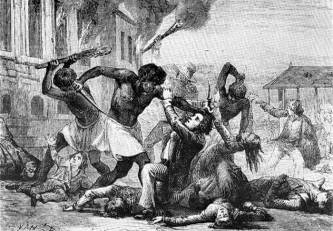
“Enlightened and Christian Warfare in the 19th Century–Massacre of Indian Women and Children in Idaho” published in “Frank Leslie’s Illustrated,” August 1868.


Under the crust of that portion of Earth called the United States of America — “from California . . . to the Gulf Stream waters” — are interred the bones, villages, fields, and sacred objects of American Indians. They cry out for their stories to be heard through their descendants who carry the memories of how the country was founded and how it came to be as it is today.

It should not have happened that the great civilizations of the Western Hemisphere, the very evidence of the Western Hemisphere, were wantonly destroyed, the gradual progress of humanity interrupted and set upon a path of greed and destruction. Choices were made that forged that path toward destruction of life itself—the moment in which we now live and die as our planet shrivels, overheated. To learn and know this history is both a necessity and a responsibility to the ancestors and descendants of all parties.

US policies and actions related to indigenous peoples, though often termed “racist” or “discriminatory,” are rarely depicted as what they are: classic cases of imperialism and a particular form of colonialism—settler colonialism. As anthropologist Patrick Wolfe writes, “The question of genocide is never far from discussions of settler colonialism. Land is life — or, at least, land is necessary for life.

The history of the United States is a history of settler colonialism — the founding of a state based on the ideology of white supremacy, the widespread practice of African slavery, and a policy of genocide and land theft. Those who seek history with an upbeat ending, a history of redemption and reconciliation, may look around and observe that such a conclusion is not visible, not even in utopian dreams of a better society.

That narrative is wrong or deficient, not in its facts, dates, or details but rather in its essence. Inherent in the myth we’ve been taught is an embrace of settler colonialism and genocide. The myth persists, not for a lack of free speech or poverty of information but rather for an absence of motivation to ask questions that challenge the core of the scripted narrative of the origin story.

Woody Guthrie’s “This Land Is Your Land” celebrates that the land belongs to everyone, reflecting the unconscious manifest destiny we live with. But the extension of the United States from sea to shining sea was the intention and design of the country’s founders.
“Free” land was the magnet that attracted European settlers. Many were slave owners who desired limitless land for lucrative cash crops. After the war for independence but before the US Constitution, the Continental Congress produced the Northwest Ordinance. This was the first law of the incipient republic, revealing the motive for those desiring independence. It was the blueprint for gobbling up the British-protected Indian Territory (“Ohio Country”) on the other side of the Appalachians and Alleghenies. Britain had made settlement there illegal with the Proclamation of 1763.

In 1801, President Jefferson aptly described the new settler-state’s intentions for horizontal and vertical continental expansion, stating, “However our present interests may restrain us within our own limits, it is impossible not to look forward to distant times, when our rapid multiplication will expand itself beyond those limits and cover the whole northern, if not the southern continent, with a people speaking the same language, governed in similar form by similar laws.”

Origin narratives form the vital core of a people’s unifying identity and of the values that guide them. In the United States, the founding and development of the Anglo-American settler-state involves a narrative about Puritan settlers who had a covenant with God to take the land. That part of the origin story is supported and reinforced by the Columbus myth and the “Doctrine of Discovery.”

The Columbus myth suggests that from US independence onward, colonial settlers saw themselves as part of a world system of colonization. “Columbia,” the poetic, Latinate name used in reference to the United States from its founding throughout the nineteenth century, was based on the name of Christopher Columbus.

The “Land of Columbus” was—and still is—represented by the image of a woman in sculptures and paintings, by institutions such as Columbia University, and by countless place names, including that of the national capital, the District of Columbia. The 1798 hymn “Hail, Columbia” was the early national anthem and is now used whenever the vice president of the United States makes a public appearance, and Columbus Day is still a federal holiday despite Columbus never having set foot on any territory ever claimed by the United States.

To say that the United States is a colonialist settler-state is not to make an accusation but rather to face historical reality. But indigenous nations, through resistance, have survived and bear witness to this history. The fundamental problem is the absence of the colonial framework.

Settler colonialism, as an institution or system, requires violence or the threat of violence to attain its goals. People do not hand over their land, resources, children, and futures without a fight, and that fight is met with violence. In employing the force necessary to accomplish its expansionist goals, a colonizing regime institutionalizes violence. The notion that settler-indigenous conflict is an inevitable product of cultural differences and misunderstandings, or that violence was committed equally by the colonized and the colonizer, blurs the nature of the historical processes. Euro-American colonialism had from its beginnings a genocidal tendency.

The term “genocide” was coined following the Shoah, or Holocaust, and its prohibition was enshrined in the United Nations convention adopted in 1948: the UN Convention on the Prevention and Punishment of the Crime of Genocide.

The convention is not retroactive but is applicable to US-indigenous relations since 1988, when the US Senate ratified it. The terms of the genocide convention are also useful tools for historical analysis of the effects of colonial- ism in any era. In the convention, any one of five acts is considered genocide if “committed with intent to destroy, in whole or in part, a national, ethnical, racial or religious group”:

killing members of the group;
causing serious bodily or mental harm to members of the group; deliberately inflicting on the group conditions of life
calculated to bring about its physical destruction in whole or in part;
imposing measures intended to prevent births within the group;
forcibly transferring children of the group to another group.

Settler colonialism is inherently genocidal in terms of the genocide convention. In the case of the British North American colonies and the United States, not only extermination and removal were practiced but also the disappearing of the prior existence of indigenous peoples—and this continues to be perpetuated in local histories.

Anishinaabe (Ojibwe) historian Jean O’Brien names this practice of writing Indians out of existence “firsting and lasting.” All over the continent, local histories, monuments, and signage narrate the story of first settlement: the founder(s), the first school, first dwelling, first everything, as if there had never been occupants who thrived in those places before Euro-Americans. On the other hand, the national narrative tells of “last” Indians or last tribes, such as “the last of the Mohicans,” “Ishi, the last Indian,” and End of the Trail, as a famous sculpture by James Earle Fraser is titled.

From the Atlantic Ocean to the Mississippi River and south to the Gulf of Mexico lay one of the most fertile agricultural belts in the world, crisscrossed with great rivers. Naturally watered, teeming with plant and animal life, temperate in climate, the region was home to multiple agricultural nations. In the twelfth century, the Mississippi Valley region was marked by one enormous city-state, Cahokia, and several large ones built of earthen, stepped pyramids, much like those in Mexico. Cahokia supported a population of tens of thousands, larger than that of London during the same period.

Other architectural monuments were sculpted in the shape of gigantic birds, lizards, bears, alligators, and even a 1,330-foot-long serpent. These feats of monumental construction testify to the levels of civic and social organization. Called “mound builders” by European settlers, the people of this civilization had dispersed before the European invasion, but their influence had spread throughout the eastern half of the North American continent through cultural influence and trade.

What European colonizers found in the southeastern region of the continent were nations of villages with economies based on agriculture and corn the mainstay. This was the territory of the nations of the Cherokee, Chickasaw, and Choctaw and the Muskogee Creek and Seminole, along with the Natchez Nation in the western part, the Mississippi Valley region.

To the north, a remarkable federal state structure, the Haudenosaunee Confederacy — often referred to as the Six Nations of the Iroquois Confederacy — was made up of the Seneca, Cayuga, Onondaga, Oneida, and Mohawk Nations and, from early in the nineteenth century, the Tuscaroras. This system incorporated six widely dispersed and unique nations of thousands of agricultural villages and hunting grounds from the Great Lakes and the St. Lawrence River to the Atlantic, and as far south as the Carolinas and inland to Pennsylvania.

The Haudenosaunee peoples avoided centralized power by means of a clan-village system of democracy based on collective stewardship of the land. Corn, the staple crop, was stored in granaries and distributed equitably in this matrilineal society by the clan mothers, the oldest women from every extended family. Many other nations flourished in the Great Lakes region where now the US-Canada border cuts through their realms. Among them, the Anishinaabe Nation (called by others Ojibwe and Chippewa) was the largest.

In the beginning, Anglo settlers organized irregular units to brutally attack and destroy unarmed indigenous women, children, and old people using unlimited violence in unrelenting attacks. During nearly two centuries of British colonization, generations of settlers, mostly farmers, gained experience as “Indian fighters” outside any organized military institution.

Anglo-French conflict may appear to have been the dominant factor of European colonization in North America during the eighteenth century, but while large regular armies fought over geopolitical goals in Europe, Anglo settlers in North America waged deadly irregular warfare against the indigenous communities.

The chief characteristic of irregular warfare is that of the extreme violence against civilians, in this case the tendency to seek the utter annihilation of the indigenous population. “In cases where a rough balance of power existed,” observes historian John Greniew, “and the Indians even appeared dominant—as was the situation in virtually every frontier war until the first decade of the 19th century—[settler] Americans were quick to turn to extravagant violence.”

Indeed, only after seventeenth- and early- eighteenth-century Americans made the first way of war a key to being a white American could later generations of ‘Indian haters,’ men like Andrew Jackson, turn the Indian wars into race wars.” By then, the indigenous peoples’ villages, farmlands, towns, and entire nations formed the only barrier to the settlers’ total freedom to acquire land and wealth. Settler colonialists again chose their own means of conquest. Such fighters are often viewed as courageous heroes, but killing the unarmed women, children, and old people and burning homes and fields involved neither courage nor sacrifice.

US history, as well as inherited indigenous trauma, cannot be understood without dealing with the genocide that the United States committed against indigenous peoples. From the colonial period through the founding of the United States and continuing in the twenty-first century, this has entailed torture, terror, sexual abuse, massacres, systematic military occupations, removals of indigenous peoples from their ancestral territories, and removals of indigenous children to military-like boarding schools.

Once in the hands of settlers, the land itself was no longer sacred, as it had been for the indigenous. Rather, it was private property, a commodity to be acquired and sold. Later, when Anglo-Americans had occupied the continent and urbanized much of it, this quest for land and the sanctity of private property were reduced to a lot with a house on it, and “the land” came to mean the country, the flag, the military, as in “the land of the free” of the national anthem, or Woody Guthrie’s “This Land Is Your Land.”

Those who died fighting in foreign wars were said to have sacrificed their lives to protect “this land” that the old settlers had spilled blood to acquire. The blood spilled was largely indigenous.

Tuesday, October 14, 2014

1590. The Real Christopher Columbus

By Howard Zinn, Jacobin, October 13, 2014

Artist's imagination of Indian chief informing his tribe of the arrival of strangers on ships - Credit: United States Library of Congress


Arawak men and women, naked, tawny, and full of wonder, emerged from their villages onto the island’s beaches and swam out to get a closer look at the strange big boat. When Columbus and his sailors came ashore, carrying swords, the Arawaks ran to greet them, brought them food, water, gifts. He later wrote of this in his log:
They brought us parrots and balls of cotton and spears and many other things, which they exchanged for the glass beads and hawks’ bells. They willingly traded everything they owned…They do not bear arms, and do not know them, for I showed them a sword, they took it by the edge and cut themselves out of ignorance. They would make fine servants … with fifty men we could subjugate them all and make them do whatever we want.
These Arawaks of the Bahama Islands were much like Indians on the mainland, who were remarkable (European observers were to say again and again) for their hospitality, their belief in sharing. These traits did not stand out in the Europe of the Renaissance, dominated as it was by the religion of popes, the government of kings, the frenzy for money that marked Western civilization and its first messenger to the Americas, Christopher Columbus.
The information that Columbus wanted most was: Where is the gold? He had persuaded the king and queen of Spain to finance an expedition to the lands, the wealth, he expected would be on the other side of the Atlantic—the Indies and Asia, gold and spices. For, like other informed people of his time, he knew the world was round and he could sail west in order to get to the Far East.
Spain was recently unified, one of the new modern nation-states, like France, England, and Portugal. Its population, mostly poor peasants, worked for the nobility, who were 2 percent of the population and owned 95 percent of the land. Like other states of the modern world, Spain sought gold, which was becoming the new mark of wealth, more useful than land because it could buy anything.
There was gold in Asia, it was thought, and certainly silks and spices, for Marco Polo and others had brought back marvelous things from their overland expeditions centuries before. Now that the Turks had conquered Constantinople and the eastern Mediterranean, and controlled the land routes to Asia, a sea route was needed. Portuguese sailors were working their way around the southern tip of Africa. Spain decided to gamble on a long sail across an unknown ocean.
In return for bringing back gold and spices, they promised Columbus 10 percent of the profits, governorship over newfound lands, and the fame that would go with a new title: Admiral of the Ocean Sea. He was a merchant’s clerk from the Italian city of Genoa, part-time weaver (the son of a skilled weaver), and expert sailor. He set out with three sailing ships, the largest of which was the Santa Maria, perhaps 100 feet long, and thirty-nine crew members.
Columbus would never have made it to Asia, which was thousands of miles farther away than he had calculated, imagining a smaller world. He would have been doomed by that great expanse of sea. But he was lucky. One-fourth of the way there he came upon an unknown, uncharted land that lay between Europe and Asia—the Americas. It was early October 1492, and thirty-three days since he and his crew had left the Canary Islands, off the Atlantic coast of Africa. Now they saw branches and sticks floating in the water. They saw flocks of birds.
These were signs of land. Then, on October 12, a sailor called Rodrigo saw the early morning moon shining on white sands, and cried out. It was an island in the Bahamas, the Caribbean Sea. The first man to sight land was supposed to get a yearly pension of 10,000 maravedis for life, but Rodrigo never got it. Columbus claimed he had seen a light the evening before. He got the reward.
So, approaching land, they were met by the Arawak Indians, who swam out to greet them. The Arawaks lived in village communes, had a developed agriculture of corn, yams, cassava. They could spin and weave, but they had no horses or work animals. They had no iron, but they wore tiny gold ornaments in their ears.
This was to have enormous consequences: it led Columbus to take some of them aboard ship as prisoners because he insisted that they guide him to the source of the gold. He then sailed to what is now Cuba, then to Hispaniola (the island which today consists of Haiti and the Dominican Republic). There, bits of visible gold in the rivers, and a gold mask presented to Columbus by a local Indian chief, led to wild visions of gold fields.
Columbus’s report to the Court in Madrid was extravagant. He insisted he had reached Asia (it was Cuba) and an island off the coast of China (Hispaniola). His descriptions were part fact, part fiction:
Hispaniola is a miracle. Mountains and hills, plains and pastures, are both fertile and beautiful … There are many spices, and great mines of gold and other metals …
The Indians, Columbus reported, “are so naive and so free with their possessions that no one who has not witnessed them would believe it. When you ask for something they have, they never say no. To the contrary, they offer to share with anyone…” He concluded his report by asking for a little help from their Majesties, and in return he would bring them from his next voyage “as much gold as they need … and as many slaves as they ask.”
Because of Columbus’s exaggerated report and promises, his second expedition was given seventeen ships and more than twelve hundred men. The aim was clear: slaves and gold. From his base on Haiti, Columbus sent expedition after expedition into the interior. They found no gold fields, but had to fill up the ships returning to Spain with some kind of dividend.
In the year 1495, they went on a great slave raid, rounded up 1,500 Arawak men, women, and children, put them in pens guarded by Spaniards and dogs, then picked the 500 best specimens to load onto ships. Of those 500, 200 died en route.
Too many of the slaves died in captivity. And so Columbus, desperate to pay back dividends to those who had invested, had to make good his promise to fill the ships with gold. In the province of Cicao on Haiti, where he and his men imagined huge gold fields to exist, they ordered all persons fourteen years or older to collect a certain quantity of gold every three months. When they brought it, they were given copper tokens to hang around their necks. Indians found without a copper token had their hands cut off and bled to death.
The Indians had been given an impossible task. The only gold around was bits of dust garnered from the streams. So they fled, were hunted down with dogs, and were killed. When it became clear that there was no gold left, the Indians were taken as slave labor on huge estates, known later as encomiendas. They were worked at a ferocious pace, and died by the thousands. By the year 1515, there were perhaps 50,000 Indians left. By 1550, there were 500. A report of the year 1650 shows none of the original Arawaks or their descendants left on the island.
The chief source — and, on many matters the only source — of information about what happened on the islands after Columbus came is Bartolome de las Casas, who, as a young priest, participated in the conquest of Cuba. For a time he owned a plantation on which Indian slaves worked, but he gave that up and became a vehement critic of Spanish cruelty. Las Casas transcribed Columbus’s journal and, in his fifties, began a multi-volume History of the Indies.
In book two of his History of the Indies, Las Casas (who at first urged replacing Indians by black slaves, thinking they were stronger and would survive, but later relented when he saw the effects on blacks) tells about the treatment of the Indians by the Spaniards. After a while, Spaniards refused to walk any distance. They “rode the backs of Indians if they were in a hurry” or were carried on hammocks by Indians running in relays. “In this case they also had Indians carry large leaves to shade them from the sun and others to fan them with goose wings.”
Total control led to total cruelty. The Spaniards “thought nothing of knifing Indians by tens and twenties and of cutting slices off them to test the sharpness of their blades.” The Indians’ attempts to defend themselves failed. So, Las Casas reports, “they suffered and died in the mines and other labors in desperate silence, knowing not a soul in the world to whom they could turn for help.” He describes their work in the mines:
… mountains are stripped from top to bottom and bottom to top a thousand times; they dig, split rocks, move stones, and carry dirt on their backs to wash it in the rivers, while those who wash gold stay in the water all the time with their backs bent so constantly it breaks them.
After each six or eight months’ work in the mines, which was the time required of each crew to dig enough gold for melting, up to a third of the men died. While the men were sent many miles away to the mines, the wives remained to work the soil, forced into the excruciating job of digging and making thousands of hills for cassava plants.
Thus husbands and wives were together only once every eight or ten months and when they met they were so exhausted and depressed on both sides … they ceased to procreate. As for the newly born, they died early because their mothers, overworked and famished, had no milk to nurse them … Some mothers even drowned their babies from sheer desperation….in this way, husbands died in the mines, wives died at work, and children died from lack of milk.,.and in a short time this land which was so great, so powerful and fertile … was depopulated,
When he arrived on Hispaniola in 1508, Las Casas says, “there were 60,000 people living on this island, including the Indians; so that from 1494 to 1508, over three million people had perished from war, slavery, and the mines. Who in future generations will believe this? I myself writing it as a knowledgeable eyewitness can hardly believe it…”
What Columbus did to the Arawaks of the Bahamas, Cortes did to the Aztecs of Mexico, Pizarro to the Incas of Peru, and the English settlers of Virginia and Massachusetts to the Powhatans and the Pequots. They used the same tactics, and for the same reasons — the frenzy in the early capitalist states of Europe for gold, for slaves, for products of the soil, to pay the bondholders and stockholders of the expeditions, to finance the monarchical bureaucracies rising in Western Europe, to spur the growth of the new money economy rising out of feudalism, to participate in what Karl Marx would later call “the primitive accumulation of capital.” These were the violent beginnings of an intricate system of technology, business, politics, and culture that would dominate the world for the next five centuries.
How certain are we that what was destroyed was inferior? Who were these people who came out on the beach and swam to bring presents to Columbus and his crew, who watched Cortes and Pizarro ride through their countryside? What did people in Spain get out of all that death and brutality visited on the Indians of the Americas? As Hans Koning sums it up in his book Columbus: His Enterprise:
For all the gold and silver stolen and shipped to Spain did not make the Spanish people richer. It gave their kings an edge in the balance of power for a time, a chance to hire more mercenary soldiers for their wars. They ended up losing those wars anyway, and all that was left was a deadly inflation, a starving population, the rich richer, the poor poorer, and a ruined peasant class.

Thus began the history of the European invasion of the Indian settlements in the Americas. That beginning is conquest, slavery, death. When we read the history books given to children in the United States, it all starts with heroic adventure — there is no bloodshed — and Columbus Day is a celebration.