By George Novack (William F. Warde), Fourth International, December 1940
The ideological development of every social movement has followed the course determined by the material conditions of its existence. The evolution of scientific thought under proletarian auspices has been the opposite of that under bourgeois auspices. This difference in development grew out of the different social necessities which confronted the two revolutionary classes in the first stages of their careers.
The main line of bourgeois thought advanced from the natural to the social sciences. The earliest bourgeois philosophers were primarily concerned with promoting man’s knowledge of nature after the long sleep of the middle ages. They had no interest in reforming society along bourgeois lines. They devised new intellectual methods for increasing man’s power over nature rather than for decreasing the power of man over man.
Lord Bacon, the progenitor of English empiricism, deliberately turned his back upon the religious controversies, in which great political struggles then first manifested themselves, to investigate the workings of nature. Descartes, the founder of modern rationalism, opposed to the sterile “speculative” philosophy of the schoolmen his own “practical philosophy,” which would make mankind “masters and possessors of nature” and enable them to “enjoy without any trouble the fruits of the earth and all its comforts.” Newton gave a classical form to physics a century and a half before Ricardo performed the same task for bourgeois economics.
Material Causes of Intellectual Evolution
This order of development was not accidental. The principal task of the bourgeoisie at that period was to augment the productive forces, thereby increasing their own wealth and power. The scientific thought of the proletarian movement, on the other hand, has progressed from the social to the natural sciences. This, too, was not without sufficient reason. The urgent job of the proletariat under capitalist domination was less to increase the productive forces of society, as the bourgeoisie was compelled to do under feudal rule, than to free the already highly developed productive forces from the dead hand of capitalist ownership and control.
This explains why Marxism, the scientific method of the revolutionary proletarian movement, concentrated attention in the first phase of its activity upon the solution of historical, social and economic problems. Practical necessity dictated that the most pressing theoretical problems in the sphere of social phenomena be solved first. Although the theory of dialectical materialism was essentially a universal system of thought, embracing both nature and society, its detailed application to the theoretical problems of the natural sciences had to be postponed for later consideration.
Marx, Engels, and Natural Science
The creators of dialectical materialism were keenly conscious of the gaps in their theoretical work. Marx looked forward to writing a handbook of dialectics after he had completed Capital. In the latter years of his life Engels made a comprehensive study of mathematics and the natural sciences with the aid of reconstructing their theoretical foundations with the aid of the materialist dialectics just as he and Marx had previously revolutionized social science.
“Marx and I,” he wrote in the second preface to Anti-Duehring, “were pretty well the only people to rescue conscious dialectics from German idealist philosophy and apply it in the materialist conception of nature and history. But a knowledge of mathematics and natural science is essential to a conception of nature which is dialectical and at the same time materialist. Marx was well versed in mathematics, but we could only partially, intermittently and sporadically keep up with the natural sciences. For this reason, when I retired from business and transferred my home to London, thus enabling myself to give the necessary time to it, I went through as complete as possible a ‘moulting,’ as Liebig calls it, in mathematics and the natural sciences, and spent the best part of eight years on it.”
Anti-Duehring was the first fruit of this work; Dialectics of Nature the last. While Anti-Duehring remains the best exposition of the philosophy of dialectical materialism, the Dialectics of Nature, despite its fragmentary character, must now be read as its indispensable supplement. Engels could not finish this work owing to the tremendous labor involved in editing and publishing Capital (here is direct evidence of the interference of social science with the advancement of natural science!) and to other tasks connected with the revolutionary movement. The present volume consists of six more or less completed chapters together with a sheaf of disconnected notes and separate articles.
Although it has taken over sixty years for Engels’ manuscript to appear in English, it arrives at an opportune moment. Here is one more means for educating those students who have felt the need of delving deeper into the theoretical bases of Marxism and of answering those critics who have demanded to know how the doctrines and methods of dialectical materialism can be applied to the problems of natural science. Doubtless, the new school of petty-bourgeois revisionists, whose disdain for Marxist theory is surpassed only by their ignorance of it, will attach little more positive value to these writings than did their predecessor, Edward Bernstein, who held the manuscript for many decades after Engels’ death without seeing any necessity for publishing it. But every serious student of Marxist thought will rejoice that these keys to an understanding of the materialist dialectic have finally become accessible.
What Engels Seeks to Demonstrate
In the Dialectics of Nature Engels aimed to demonstrate that the processes of nature obey the same general laws of motion as social and intellectual processes. As he wrote in Anti-Duehring, Engels surveyed mathematics and the natural sciences to convince himself “that amid the welter of innumerable changes taking place in nature, the same dialectical laws are in operation as those which in history govern the apparent fortuitousness of events; the same laws as those which similarly form the thread running through the history of the development of human thought and gradually rise to consciousness in the mind of man ...” and which were first formulated by Hegel in mystical form before Marx and Engels refashioned them into the materialist dialectic.
In the Introduction, Engels presents a critical review of the development of natural science on its theoretical side. He explains how and why this first period in the rebirth of natural knowledge was dominated by the viewpoint of the absolute immutability of nature. The fixed stars and our own solar system, the earth and its fauna and flora were considered to be eternally the same. There was no place in such a scheme of things for the idea of universal evolution.
This outlook, which prevailed in all branches of natural science until well into the 19th century, began to be undermined in one science after another by the internal development of the sciences themselves. In astronomy, by the Kant-Laplace hypothesis of the evolution of the solar system from a nebula; in geology, by Lyell’s conception of the successive transformations of the earth s surface; in physics, by the formulation of the mechanical theory of heat and by the law of the conservation of energy; in chemistry, by Mendeleyeff’s discovery of the periodic arrangement of the elements; and in biology by Darwin’s theory of the origin of species. This series of discoveries gave rise to a new scientific conception of nature, the theory of universal evolution, “the view that the whole of nature, from the smallest element to the greatest, from grains of sand to suns, from protista to men, has its existence in eternal coming into being and passing away, in ceaseless flux, in unresting motion and change.”
The full consequences of these revolutionary developments in the separate sciences, which shattered the old picture of an immutable nature, were slow to realize themselves in the conscious thought of individual natural scientists and in genial scientific theory. Practising scientists, who accepted the results and pursued the methods of the evolutionary standpoint in their special department of activity, clung to the old metaphysical ways of thinking in other fields of thought and in their general conceptions.
The Dialectical Theory of Evolution
Meanwhile the new and higher stage of natural knowledge demanded a theoretical system and a method of thought appropriate to itself. The old mechanical system of nature with its unchangeable laws and elements and its metaphysical mode of thought operating with inflexible and exclusive categories no longer sufficed.
It was a philosopher rather than a scientist who provided natural science with the intellectual means for its emancipation from the old outlook and for the construction of a new one. Just as Descartes had outlined the mechanical system of nature, so Hegel formulated the first systematic conception of the whole natural, social and spiritual world as a continuous process of development.
In his dialectical logic Hegel attempted to give a rational form and evolve a rational method out of the many-sided, contradictory processes of evolution. The laws of his dialectic are nothing but the most general laws of motion and change in nature, society and human thought. These laws were originally conceived by Hegel in idealist fashion as mere laws of thought. But, as Marx and Engels subsequently demonstrated in their materialist version of dialectical logic, the dialectical laws are conceptual formulations of objective material realities.
Three Laws of Dialectics
Engels discusses three principal laws of dialectics: the law of the transformation of quantity into quality, and vice versa; the law of the interpenetration of opposites; and the law of the negation of the negation. He takes the experimental results of the individual sciences, sifts and synthesizes them, to show that these dialectical laws are really laws of development in nature and therefore valid for theoretical natural science.
The first law signifies that “in nature, in a manner exactly fixed for each individual case, qualitative changes can only occur by the quantitative addition or subtraction of matter or motion (so-called energy).” In the second chapter Engels indicates precisely how this law operates by numerous examples taken from the exact sciences of mechanics, physics, and chemistry where accurately measurable and traceable quantitative variations are directly linked with the production of qualitative differences. In physics, it has since been ascertained, there exists a continuous series of rays from radio to cosmic rays in which quantitative variations in wavelength manifest themselves in determinable qualitative differences. This same law is equally clearly observable in chemistry where the properties of bodies are altered in concordance with their changed quantitative composition. Engels cites the allotropic forms of elements, the nitrogen oxide compounds, the homologous series of carbon compounds, and the periodic arrangement of the elements according to their atomic weights; modern chemists could add many more examples.
The second law of the dialectic asserts that everything has a self-contradictory character, containing within itself its own opposite. The bi-polar essence of all things manifests itself in change, which is a process of alteration, or transformation of something from its original state through a series of intermediate variations into its opposite. Engels brings forward this law of the interpenetration of opposites in the third chapter where he investigates the most important of scientific problems, the basic forms of motion.
The Nature of Motion
All natural knowledge is based upon the study of material movement of one kind or another. A correct conception of motion is therefore absolutely indispensable to natural science. What is motion? Motion, says Engels, is a contradictory combination of attraction and repulsion. All the various forms of motion arise out of the interplay between these two opposing phases of its being. Wherever and whenever motion occurs throughout nature, these polar opposites will be found inseparably united. This dialectical definition of motion already implicitly contains the empirically discovered physical law of the conservation of energy. For, if each individual attraction is compensated for by a corresponding repulsion somewhere else, then the sum of all attractions in the universe must be equal to the sum of all repulsions.
Motion consists of the concrete unity of attraction and repulsion. Through their interaction with one another, and their transmutation into one another, the diverse modes of motion in nature are produced. The universal interplay of attraction and repulsion can be seen in the simplest kind of motion, mechanical motion, which consists of a change of place on the part of any body. Since motion is always relative, change of place requires the interaction of at least two bodies to manifest itself. When two bodies act upon each other so that a change of place of one or both of them results, this change of place can consist only of an approach or separation. But the movement of one body toward another involves the overcoming of the repulsion that separates them, and vice-versa. Moreover, the attraction of one body to another involves its repulsion from a third body. Thus all change of place necessarily entails the reciprocal action of attraction and repulsion and their replacement by one another.
The mechanical movements of masses on the earth’s surface can be resolved into the centripetal force of gravitation and counteracting centrifugal forces. The same interpenetration of attraction and repulsion is displayed in the mutual movements of the heavenly bodies, as in the dynamic equilibrium maintained between the earth and sun. If the earth were not bound to the sun by attraction, it would leave the solar system and fly off into space. If the sun, on the other hand, did not exert constant repulsion in the form of radiant energy upon the earth and keep it at a distance, this planet would long ago have fallen into its flaming mass and become absorbed.
Every mode of motion in nature from the lowest to the highest, from simple mechanical motion to complicated organic behavior, embraces and arises out of the simultaneous action and reaction of attraction and repulsion. Motion is in fact nothing but the most general expression for the manifold series of forms in which these polar opposites manifest themselves.
The Dialectical Definition of Motion
Engels employs this dialectical, two-sided, comprehensive definition of motion to criticize and to correct the one-sided conceptions of the nature of motion prevailing in Newtonian physics. The Newtonians erred in making attraction, or gravitation, the fundamental form of motion in nature. They thereby disregarded the equally important role of its opposite, repulsion, overlooking in particular the transformations of the one phase of motion into the other. Engels undertakes an analysis of the concepts of force, energy, and work in the writings of Helmholtz, the great nineteenth-century German physicist, to demonstrate how this neglect of the essentially bipolar character of motion introduced confusion and perpetuated error in physical theory.
Since Engels wrote, the fact that motion embraces both attraction and repulsion has been strikingly verified by the electronic theory of matter, the physical theory of relativity, and, as Haldane points out, by recent developments in the astronomical theory of the spiral nebulae. In the principles of the new “wave mechanics” the dialectical law of the interpenetration of opposites has just scored a great victory over the old mechanical conceptions.
This triumph is all the more definitive because it has been so long and consciously resisted by the physicists themselves. When first they found that electronic phenomena exhibited the properties of both waves and particles, they were profoundly perplexed by this contradiction, which could not be reconciled nor explained by the sundered categories of mechanical theory. Subatomic theory became deadlocked. After much pondering, the most daring physicists have now at last concluded that in the subatomic world waves and particles can no longer be considered absolute opposites; that they can be united in a single entity; that they can possess the same properties; and that, under certain conditions, they can be transformed into one another.
The Negation of the Negation
The law of the negation of the negation, which Hegel used as the fundamental law for the construction of his whole system of thought, has a far wider sphere of application in the system of nature. This law really expresses the fundamental form of development in nature.
The opposing forces at work in every single thing bring, about constant changes in its constitution. These changes accumulate in quantity until, at a certain determinate stage in the process of development, a distinct qualitative transformation or leap occurs. The thing loses its original identity and passes over into its opposite.
But the evolutionary process does not halt at the point of simple negation. The new form of material existence is no less self-contradictory than the old and subject to the same internal restlessness. The first negation in turn undergoes self-differentiation and division until it, too, passes into its own opposite and thereby becomes negated. The final result of this process is called the negation of the negation, a synthetic unity which has discarded the transitional forms but preserved within itself the essential content of both sides of the contradictory whole.
All the transformations of material motion studied by natural science exemplify the working of this law of the negation of the negation in physical reality. Engels employs the law to clarify the interconnections between mechanical and molecular motion, or heat.
Mechanical into Molecular Motion
All the various forms of motion are generated, as we have said, through the interplay of attraction and repulsion and their conversion into one another. But in each specific mode of motion one or the other extreme is predominant. Pure mechanical motion is essentially a form of attraction. Although repulsion is necessarily present in all cases of mechanical motion, it exists in a negative or passive state. The active role is played by attraction.
As a form of attraction, mechanical motion is the negation of repulsion. But it contains within itself the possibility of transformation into its opposite. This dialectical development actually occurs in nature through the contact or collision of one body with another. In the resultant friction or impact, part of the pure mechanical motion of the masses is destroyed and reappears in the form of internal molecular motion, or heat. The heat produced by the application of brakes is an everyday instance of this phenomenon.
Heat, however, which agitates and separates the molecules of solid bodies, is a form of repulsion. In the case of heat, repulsion comes forward as the active, and attraction recedes into the passive, side of the material process. The conversion of mechanical motion into heat is therefore a negation of the negation, a reversion of the material motion to the original state of repulsion, but on a higher level of development.
Dialectics of Scientific Discovery
The law of the negation of the negation is manifested, not only in the physical process of the conversion of mechanical motion into heat, but also in the history of its discovery. Mankind long ago actually converted mechanical motion into heat, first by the instinctive act of rubbing the body with the hands to keep it warm, and then by making fire from friction. But this negation of the original positive form of mechanical motion was only the first step in the dialectics of the process. In order to complete the development, mankind had to reverse the process and convert heat into mechanical motion.
This second stage, the negation of the negation, was realized only after many thousands of years through the invention of the steam-engine, which is an apparatus for converting heat into useable mechanical motion. In this instance historical human practice in the realm of technology provides proof of the logical law of the negation of the negation.
Here also is proof that “the dialectics of the brain is only the reflection of the form of motion of the real world, both in nature and history.” The law of the negation of the negation would not have forced its way into conscious thought unless it had already been operative in physical processes and in social life.
Mechanics Versus Dialectics
Yet, as Engels points out, even after the problem of converting mechanical motion into heat and heat back again into mechanical motion had been solved in human practice, natural scientists failed to formulate this fact in a completely correct or comprehensive theoretical fashion. At first they regarded heat, like electricity, as a special kind of imponderable substance rather than as a mode of material motion. Then, when they recognized heat as a mode of motion, both in the restricted law of the mechanical equivalent of heat and in the general law of the conservation of energy, they expressed the inter-relations between these two modes of motion exclusively from the one-sided standpoint of quantity.
But mechanical and molecular motion are not only quantitatively but qualitatively related. They are different forms of the same material motion. Dialectical materialism shows its superiority to the mechanical viewpoint because, in addition to comprehending the quantitative identity between the two forms of motion, formulated by the law of the quantitative equivalence of motion through all its changes of form, it also explains their qualitative diversity and the manner of their mutual metamorphoses.
Dialectical materialism has a different conception of the main task of natural science than the exponents of the mechanical school whose ideas have prevailed in natural scientific thought since Descartes and Newton. The mechanicians, who were preoccupied with studying the laws of the passage of bodies through space, believed that the goal of science was to reduce all other forms of material motion into the elementary form of mechanical motion, to resolve the higher modes of motion into the lower, the more complex into the simple. Thus, in the introduction to his Principia, Newton wrote:
“It would be desirable to deduce from the elements of mechanics the remaining phenomena of nature.”
This conception of the ultimate aim of natural science coincided with that relatively primitive level of technology and industry which was principally concerned with utilizing and exploiting machines in which one aspect of mechanical movement (potential energy) was transformed into another (kinetic energy). Scientific thought revolved within the same narrow circle as scientific practice, generalizing the changes within one single simple form of motion, mechanical transposition.
Hand in hand with the tremendous advances in technology and large-scale industry during the past two centuries, scientists have discovered, investigated, and put to work many other kinds of material motion, thermal, electro-magnetical, chemical, and so on. They have especially applied themselves to studying the interconnections and transformations of these modes of motion into one another. Scientists now know that, while these other forms of motion are always bound up with real mechanical motion, they cannot be reduced to it without obliterating their specific characteristics. The laws of physiology, or society, or thought, although based upon the fundamental laws of nature, cannot simply be “deduced from the elements of mechanics,” as Newton anticipated.
On all sides the laws governing mechanical motion are seen to have their limits; they have lost their sovereign status. [1] The expansion of technical, industrial, and purely scientific practice has widened the theoretical horizon of science far beyond the old mechanical ideal, presenting an immensely broader view of its task which dialectical materialism has not only recognized but best formulated.
The Dialectical Conception of Science
This new conception is epoch-making. In contrast to the mechanical standpoint, dialectical materialism regards the task of science to be, not the reduction of all modes of motion into one, but the study of the main forms of material motion in their natural sequence, dialectical interconnections, and transformations into one another.
The forms of motion range all the way from the crude mechanical motion of masses to the complex activity of thought in the human brain. In the course of material evolution all these different modes of motion, mechanical, molecular, atomic, electronic, chemical, thermal, organic, social, and intellectual, have developed one out of the other through the interplay of attraction and repulsion, the original contradictory essence of motion. They constitute an inter-related, hierarchical series, each one of which is naturally linked with the others, and capable, under proper material conditions, of being converted into one another.
This conception provides for the first time a sound material basis for the systematic classification of the sciences. Each individual science either analyses a separate form of motion (chemistry) or the interconnections between several forms of motion (electro-chemistry). The essential order of the sciences corresponds to the order of the generation of the various forms of motion in nature and their dialectical transition into one another. Thus dialectical materialism introduces a new principle of order to replace the confusion and anarchy which has reigned in scientific thought since the bankruptcy of the old mechanical system. All the diverse departments of human knowledge from astronomy to logic are correlated into one vast synthesis.
Part of the material in the Dialectics of Nature, as of any treatise on natural knowledge written over sixty years ago, has been rendered obsolete by the subsequent progress of the physical sciences. This is particularly true of the chapter on electricity in which the greatest advances have been made in the past half-century. Yet there is remarkably little chaff in these pages. Engels’ observations were pointed in the right direction and have in many instances been confirmed by the further researches of the physical sciences. Each discussion of a specific question is of enduring value as an example of the way to use the concepts of materialist dialectics as instruments of critical thought in the natural as well as in the social sciences.
The Task That Awaits Us
The task of delineating the dialectical character of natural events, which Engels set for himself and failed to finish, still waits to be accomplished. Despite the wealth of materials provided by recent revolutionary developments within the natural sciences, that task stands at approximately the point where Engels left it. The theoreticians of the post-Marxian period – Bernstein, Kautsky, Adler, etc. – possessing the same hostility or indifference toward the philosophy of dialectical materialism as our contemporary anti-dialecticians, had neither the equipment nor incentive to do anything along this line. Lenin’s Materialism and Empiric-Criticism and his notebooks on Hegel’s logic made possible a renaissance of the philosophy of Marxism and cleared a path for the extension of its ideas and methods to the problems confronting physical science.
It was to be hoped that, when the Bolsheviks commanded state power in Russia, their scientific leaders and academies would undertake this task on a collective, as well as an individual, basis. Under Lenin’s sponsorship promising beginnings were made. But these were cut short by the reaction. Unalloyed Marxist thought, banished from politics, could hardly be expected to extend its roots into the subsoil of nature or to flourish freely for any length of time under the baneful shadow of Stalin’s regime. Consequently, Marxism shrivelled from a vigorously growing ideological movement into a sterile scholasticism.
The Stalinists might preserve some relics of past Marxist thought as the medieval schoolmen preserved the writings of Aristotle or as they themselves mummified Lenin’s body: to exhibit the decaying glories of the past while violating their spirit in the present. For this reason we owe the publication of Dialectics of Nature to them. In science as in society remnants of the heritage of the October Revolution are here and there embedded within Stalinism; some good can still emanate from this abomination: a contradiction which will doubtless horrify the anti-dialecticians. But under Stalinist auspices there cannot be any consistent or fruitful development of the science of dialectical materialism.
In this domain of thought, as in all others, the forces of the Fourth International are obliged to carry forward the tasks left unfinished by their Marxist forerunners. In the philosophical works of Marx and Engels, and now in the Dialectics of Nature, they will find the main trails already blazed for them.
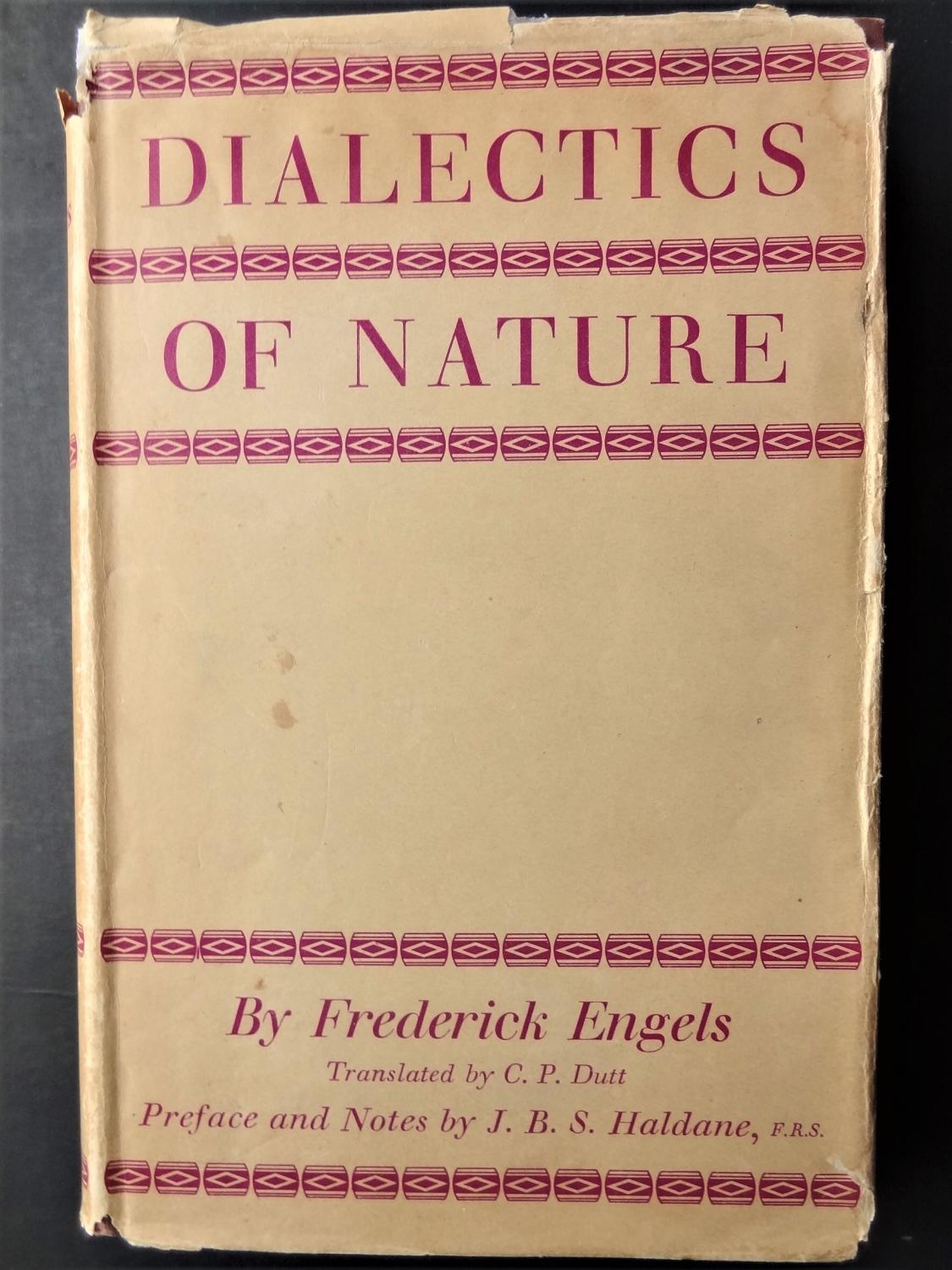
Dialectics of Nature by Frederick Engels, Translated by C.P. Dutt
Preface and Notes by J.B.S. Haldane, FRS 383 pages. International Publishers, New York, 1940. $2.50.
Footnote
1. See, for example, The Evolution of Physics by Einstein and Infeld, especially the section on The Decline of the Mechanical View.