Showing posts with label Marxian theory. Show all posts

Tuesday, March 18, 2025

3665. Development and the Future of Humanity

By Kamran Nayeri, March 18, 2025



Editor's Note: This essay is a free translation from an article I published in Critique of Political Economy (نقد اقتصاد سیاسی), a socialist website edited by Parviz Sedaghat, in Iran on March 10, 2025. The essay is based on a presentation I was invited to give to an online meeting of Left Co-Thinking (هم گرایی چپ) on "Development and Ecosystems" on January 29, 2025. I would like to thanks all of them for providing me with a forum to share my ideas on these questions and to extented my critical appraisal of the Marxist theory in light of the problems of the 21th century. KN 


The Context and Content of the Development Discussion

Economic growth is the rate of increase in GDP in a country or group of countries over a given time frame usually a year. For example, Africa's economic growth from 2013 to 2023 was 2.3 percent, in Europe it was just 1 percent, and in North America it was 1.2 percent. As a result, Africa grew faster than Europe and America during this period. But it is commonly agreed that the economy is more developed in Europe and North America. Economic development is the transformation of the structure of the economy. In the process of development, a country usually move from its traditional economy, which is mainly based on agriculture, to an industrial economy, and finally to an economy in which the service sector becomes larger than the agricultural and industrial sectors. As the service sector grows, the growth of labor productivity slows down because of slower economic growth as the service sector does not lend itself to automation as well as manufacturing.

Recent discussions of economic development began with the collapse of colonialism after World War II, which led to the independence of dozens of countries, and has been largely sidelined after the collapse of the Soviet Union and the rise of neoliberalism.

Among the central issues of this discussion were the concept and causes of economic backwardness and how to develop and industrialize. In this discussion، the role of the world market was prominent which in the 1950s and 1960s led to the establishment  of the Dependency School of dependence which includes a set of national and socialist theories of underdevelopment  and dependent development.  Politically, the Dependency School led to Third Worldism, which focused on colonialism and imperialism as the cause of underdevelopment. It entailed support for national, anti-colonial, and anti-imperialist revolutions. These theories were in line with the growth of nationalism in Latin America, Africa, the Middle East, and Asia in the 1950s and 1960s. 

In the context of the Cold War between Western imperialism and the Soviet Union and the creation of a bipolar world, Third Worldism led to the establishment of the non-aligned movement that encompassed 120 countries. The climax of this movement was in 1979, when Fidel Castro was elected as its president and demanded a New World Order, whose political and economic content was unclear. With the collapse of the Soviet Union in 1991 and the temporary polarization of the world, this movement subsided. 

One of the most prominent examples of dependency theories is the Terms of Trade theory of the Argentine nationalist economist Raul Prebisch who considered backwardness to be due to the inappropriate ratio of the price index of export goods to the price index of imported goods. Arghiri Emmanuel proposed the theory of unequal exchange   that Maintained relatively high wages in industrialized countries cause distortion in value and price of goods in the world market in a way that transferred socially necessary labor (value) from underdeveloped countries to industrialized countries. Paul Baran proposed argued that monopoly capital was the reason for backwardness. 

W. Arthur Lewis, an economist born in San Lucia, who was awarded the Nobel Prize in Economics, showed in the essay "Economic Development with Unlimited Supply of Labor" (1954) that economic growth is accelerated and development is possible by creating jobs in the industrial sector because of its far higher productivity of labor than in traditional agriculture. Nicholas Kaldor, Hungarian economist who immigrated to England, proposed his theory of cumulative causation in which he underscores the importance of the industrial sector in technical change and innovation, hence economic development and growth.

The tension between these theories and dependency theories, such as those of Emmanuel and Baran, that provided an explanation for backwardness based on Marxist economics, was critically considered by other Marxist economists. Elizabeth Dore criticizes Dependency School and its Marxist supporters as follows: 

"The distinguishing feature of all Dependency writers is that they treat the social and economic development of underdeveloped countries as largely influenced by external forces, namely, the domination of these countries by other and more powerful countries. This leads dependency theorists to adopt a circulationist approach. They posit that underdevelopment can be explained in terms of relations of domination in exchange, almost to the exclusion of the analysis of the forces and relations of production (Dore 1983, p. 115).”

In his book Imperialism: The Pioneer of Capitalism (1980), Bill Warren rejects the "Marxist" theories of dependency and enumerates the development and industrialization in some backward countries. 

As Baran had argued that monopoly capital, that is imperialism, is the source of backwardness, Warren who marshals empirical evidence of development and industrialization in some of these countries, argues that the problem is in Lenin’s theory imperialism.  However, both Baran and Warren were mistaken about Lenin’s theory. Lenin, who defines imperialism by the export of capital, writes: "The export of capital to these countries affects and greatly accelerates the development of capitalism. (Lenin, 1916, emphasis added). However, the monopoly capital theory beginning with Hilferding, through Lenin and Bukharin, to Sweezy are based on a mistaken reading of Marx’s Capital, particularly Marx’s concept of free competition. They assumed Marx held neoclassical theory of perfect competition. Moreover, Lenin's book on imperialism is not about the question of development and backwardness, but about the economic causes of the First World War, which he considered to be an imperialist war. 

Uneven and compound development theories about late development and industrialization have more explanatory power. Alexander Gerchenkron, a professor of economic history at Harvard University who had studied economic development and industrialization in Germany and Tsarist Russia, proposed the theory of relative backwardness and industrialization. Gerchenkron has shown that industrialization in Germany has been done with the help of banks and in Russia with the help of the state by copying the latest methods of industrial production available at the time. As a result, he predicted that this pattern would be repeated itself in late development and industrialization. His prediction has been confirmed especially in the case of South Korea (Amsden 1992) and China. 

Ernst Mandel has argued that the pursuit of surplus profits encourages industrial capital to contribute to the development of relatively backward countries, which is in line with Gerchenkron’s and Lenin's theories. 

I have also studied eight prominent development theorists: W. Arthur Lewis (Development  with an Unlimited Supply of Labor), Raul Prebish (terms of trade), Arghiri Emmanuel (Unequal Exchange), Paul Baran (Monopoly Capital), Stephen Himmer (Internationalization of capital and uneven development), Nicholas Kaldor (cumulative causation), Alexander Gerchenkron (Relative backwardness and Industrialization), and Ernst Mendel (search for surplus profits and uneven development), I have thus synthesized a general theory of uneven and combined late capitalist development (Nayeri 1991/2023). By "late" I mean entry into the path of capitalist development after the consolidation of the world capitalist market due to generalized commercial sea transport, means of communication, and finance at the end of the nineteenth century. 

Theoretical Background of Development Theories 

Attention to economic development began in Europe with mercantilism in the 15th-18th centuries, beginning at the end of the Renaissance and continued until the beginning of modernity. The goal of mercantilism was to increase exports and reduce imports to increase the country's current account. One of the tools of mercantilism was to increase foreign exchange reserves through a positive trade balance, especially due to the sale of finished products. Mercantilists required for government intervention and regulation and thus proposed strengthening the state against other rival states. Tariffs, especially on industrial goods, were among the mercantilist policies to protect domestic production. In foreign policy, mercantilism was accompanied by colonialism, and the transfer of wealth from the periphery to the developing capitalist countries in Europe. 

The physiocrats, a group of French economists including François Quesnay and Anne Robert Jacques Turgot believed that wealth came from agriculture. They opposed state intervention in the economy and considered farmers to be the engine of the economy.

These were followed by the English political economists with their integration of the idea of value created by labor in the process of capitalist production and division of labor to enhance labor productivity as the engine of growth. 

All these schools of economic thought were influenced by the key idea of Enlightenment.  

The Age of Enlightenment 

The intellectual movement in Europe in the 17th and 18th centuries around issues such as the existence of God, reasoning, nature, and humanism led to a revolution in art, philosophy, and politics. At the center of this movement was the substitution of reason for faith and dignity of people above the Church and the court. The goal of knowledge was freedom and happiness. The dominance of the Church over social life was weakened through humanism, the Renaissance, and the Protestant Reformation accompanied by the Scientific Revolution in the 16th and 17th centuries. The latter established a mechanical view of nature instead of paganism which viewed nature as fully alive (Merchant 1982; Nayeri, 2021). Francis Bacon, René Descartes, and Isaac Newton were among the scientists and philosophers of this new mechanical view of nature, which paved the way for the plundering of wealth from it for the primitive accumulation of capital, and for ongoing capital accumulation (ibid.). Carolyn Merchant, historian of science and eco-feminist writes in her masterpiece The Death of Nature, Women, Ecology, and the Scientific Revolution:

“Disorderly, active nature was soon forced to submit to the questions and experimental techniques of the new science. Francis Bacon (1561–1626), a celebrated ‘father of modern science,’ transformed tendencies already extant in his own society into a total program advocating the control of nature for human benefit. Melding together a new philosophy based on natural magic as a technique for manipulating nature, the technologies of mining and metallurgy, the emerging concept of progress and a patriarchal structure of family and state, Bacon fashioned a new ethic sanctioning the exploitation of nature (Merchant 1982, p. 164, my emphasis).”

Merchant views science as a “methodology for manipulating nature which became a significant undertaking during the latter half of the seventeenth century.” (see endnote 4, Merchant, 1980, p. 186)  

The Age of Enlightenment led to modernity, which was accompanied by individualism, scientific and rationalist explanations, the emergence and expansion of bureaucracy, urbanization, nation-states, and the expansion of anthropocentric industrial capitalist civilization and its globalization. 

Science and technology have been pillars of subjugation of nature yet in the Enlightenment discourse they are the measure of social progress. This line of thinking has been central to the socialist theory of Marx and Engels and its development to the present day. Merchant criticizes the idea of management of nature central to Scientific Revolution and bourgeois idea of progress but even today's ecosocialists continue to use it as a central part of their plan for the future of humanity (for a critique of one such ecosocialist see Nayeri 2015). 

As I have documented it (Nayeri, 2023), the anthropocentric industrial capitalist civilization, that is, the actually existing modernity, has created the climate crisis that threatens humanity and most other life on Earth. The same can be shown in the case of other existential crises: The Sixth Extinction, ongoing pandemics, and nuclear annihilation. 

Marx's socialism, on the one hand, pursues the goal of eliminating alienation from nature and social alienation, and on the other hand, affirms rationalism of the Enlightenment and its idea of progress based on science and technology while criticizing bourgeois individualism (Therborn 1996; Browning 2011). Historical materialism, which is Marx’s and Engels’s theory of society and history, considers the transformation of the mode of production and consequently the relations of production to be based on the development of productive forces, and considers socialism on the basis of the highest level of expansion of productive forces which of course will serve the proletariat in the transition to socialism (Nayeri, 2023). Even if this vision for the future of humanity becomes a reality, the result will be an anthropocentric industrial socialist civilization. Would there be any doubt that such a society will continue to fuel existential ecological crises and human alienation from nature and social alienation? 

Is it not astonishing that the socialist movements in Asia, the Middle East, Africa, and Latin America have accepted these theories, all of which are rooted in the European Enlightenment and modernity, without questioning and criticism? Didn’t Marx and Engels in Manifesto of the Communist Party (1848) write approvingly:

The bourgeoisie, by the rapid improvement of all instruments of production, by the immensely facilitated means of communication, draws all, even the most barbarian, nations into civilization. The cheap prices of commodities are the heavy artillery with which it batters down all Chinese walls, with which it forces the barbarians’ intensely obstinate hatred of foreigners to capitulate. It compels all nations, on pain of extinction, to adopt the bourgeois mode of production; it compels them to introduce what it calls civilization into their midst, i.e., to become bourgeois themselves. In one word, it creates a world after its own image.

The bourgeoisie has subjected the country to the rule of the towns. It has created enormous cities, has greatly increased the urban population as compared with the rural, and has thus rescued a considerable part of the population from the idiocy of rural life. Just as it has made the country dependent on the towns, so it has made barbarian and semi-barbarian countries dependent on the civilised ones, nations of peasants on nations of bourgeois, the East on the West.”

Of course, there are “Marxists” who attempt to “defend” Marx from the charge of European centrism.(Anderson 2022). However, is there any doubt that such views expressed by Marx and Engels derive directly from the Enlightenment thinking on humanism, history, and progress of nations? Are these views also expressed by a section of Social Democracy in of the Second International that argued European colonialism has a progressive historical role and proposed adoption of socialist colonial policies (Lenin 1907). 

Didn't Nietzsche (see Klaire, n.d.), Tolstoy (In War and Peace; Moran, 2024), and Gandhi (Perrett 2015) critique modernity?  Non-Marxist thinkers (e.g., see Ronald 2004; for a review see Nayeri in 2014) have also criticized the central idea of progress.

Getting back to the theories of capitalist development, Adam Smith (1776) in The Wealth of Nations argued for accumulation of capital, hence capitalist development, through division of labor. Still, in his The Theory of Moral Sentiments (1759) Smith throw light one the feelings of individuals and the need for a theory of ethics. While criticizing political economy, Marx himself identified wealth not by accumulation of use-value, but by expansion of free time. Still, in Marx's theory of socialism free time is made possible by increasing productivity of labor based on greater division of labor. This runs counter with Marx’s view of socialism as a self-managed society of direct produced producers (Nayeri 2025). The more industrialized and complex a society, the heavier would  the weight of bureaucrats and technocrats be which undermine the potential for socialist democracy. 

The revolutions of the twentieth century that considered socialism as their goal took place in the periphery of the capitalist world market and were immediately confronted with the need for economic development and industrialization. Today, these countries openly pursue a capitalist economy, or at least a market economy controlled by the Communist Party (Nayeri, 2024). There can be no doubt that these countries also are contributing to the existential crises caused by the anthropocentric industrial capitalist civilization. 

As de-alienation and human development are central concerns in Marx’s view of socialism, let us turn to Native American culture for some clues.

Human Development and De-Alienation from Nature

The philosophy of life among Native American thinkers is fundamentally different from the attitude of modernity. Of course, the cultures of different groups of Indians are different, but they are all derived from ecocentrism of hunter-gatherers in which life is consciously linked to the rest of the ecosystem. Let us consider the philosophic outlook of John Fire Lame Deer (1976). In his conversations with Richard Erdoes, Lame Deere (1903-1976) who was the holy man of Sioux nation explained  his philosophy of life. Erdoes then edited and published it as a book at the time of Lame Deer death. Lame Deer contrasts their view of life with those of white culture. Native American culture is built around concrete symbols. Sitting by the fire where a pot of soup is being cooked, Lame Deer says:

"I'm an Indian. I think about ordinary, common things like this pot.  The boiling water comes from the rain cloud. It represents the sky. The fire comes from the sun that warms us all-men, animals, tress. The meat stands for the four-legged creatures, our animal brothers who gave [us] themselves so we should live. The steam is living breath. It was water; now it goes up to the sky and becomes a cloud again. These things are sacred. Looking at the pot full of good soup, I am thinking now, in this simple manner, Wakan Tanka [sacred spirit] takes care of me. We Sioux spend a lot of time thinking about everyday things, which in our mind are mixed up with the spiritual. We see in the world around us many symbols that teach us the meaning of life. We have a saying that the white man sees so little, he must see with only one eye. We see a lot that you no longer notice. You could notice if you wanted but you are usually too busy. We Indians live in a world of symbols and images where the spiritual and the commonplace are one. To you, symbols are just words, spoken or written in a book. To us they are part of nature, rain, stones, trees, animals, even little insects like ants and grasshoppers. We try to understand them not with the head but with the heart, and we need no more than a hint to give us meaning (Lame Deer and Erdoes 1972, pp. 96-97).”

Lame Deer refers to the slang used by radicalized white youth in the 1960s when they called their parents and those who believed in the dominant culture in society as "straight." In the same way, he says that white culture is a square rectangle. Everything from buildings to furniture and tools has sharp corners that are good for mass production. In Native Indian culture everything is round as they are in nature. 

Biologists Heather Leying and Brett Weinstein (2022), in their book A Hunter-Gatherer Guide for the 21st Century: Evolution and the Challenges of Modern Life provide an evolutionary overview of human history and argue that human brain was formed during the 2.5 million years of evolution of our ancestors to deal with the challenges of their time as hunter-gatherers. However, our brain has not evolved since modernity got underway to prepare us for the   modern life, especially in the period since the Industrial Revolution. 

They explore the problems caused by this lack of adaptation in various areas such as medicine, food, sleep, sex and sexuality, child-rearing and family relationships, schooling, puberty, culture, and awareness. Incidentally, one of the issues they touch upon is the evolution of the symbols of the living environment, which are round in Native American culture and square and rectangular in modern culture. The first is the pattern of nature, and the second is the pattern of mass production. They illustrate this with the Muller-Lyer illusion in Figure 1. 

<----->      >-----<

Figure 1

Modern humans usually find the two parts shown to have different length. This is attributed to the error of vision. Leying and Weinstein (ibid., pp. 39-40) point out that people who live in hunter-gatherer societies easily perceive that each part of the above figure to be of equal length. In other words, modern humans have a poorer sense of sight compared to their ancestors. It has been known that modern human senses have changed along with the development of the anthropocentric industrial capitalist civilization. In fact, the shape of modern human brain has changed since the emergence of Homo sapiens 300,000 years ago (Neubauer, Hublin and Gunz 2018) and the brain size has probably decreased by 13% in the last 100,000 years (Fox-Skelly 2024). Of course, these findings must not be surprising since  we know that the brains of all domesticated animals have shrunk and changed because the challenges of domesticated life are different from that of wildlife (Scott, 2017: pp. 80-81). By domesticating other creatures, we humans have also domesticated ourselves and lost the capabilities of our ancestors (Barker 2006, pp. 38-39). 

As a result, civilization, especially anthropocentric industrial capitalist civilization, has deprived us of some capabilities. 

Development and the Future of Humanity

Getting back to economic development, in recent years new models have been proposed with a sustainable development strategy that incorporates economic growth of all social groups along with environmental protection. Two examples are the donut economy and the circular economy. Kate Rawort’s (2017) donut economy is a detailed explanation of a donut-shaped diagram. In the inner circle, the basic needs of human beings are stipulated, and in the outer circle of donut, there are ecological boundaries such as drinking water, climatic conditions, the health of species, and the ozone layer, which the economy and society should not exceed. Rawort does not have a specific critique of capitalism, although she does have a critique of some aspects of the history of economic thought. She views economic growth with skepticism and may even be inclined to a stationary state economy model. If so, she can be considered among the degrowth thinkers. In that case, my critique of the degrowth movement will also apply to donut economics (Nayeri, 2021). 

The fundamental problem with theories of sustainable development is the lack of a radical critique of the existing social system that has created the existential crises of the 21st century. If my argument above is correct, this system, which I consider to be the anthropocentric industrial capitalist civilization, is rooted in modernity and its values, including the idea of progress relying on science and technology to accumulate wealth and power. This manner of specifying the problem is at the same time a critique of the Marxist view, which sees the root of the crisis in capitalism as essentially an economic system and sees the way out of the crisis as socialism as a continuation of modernity under the guidance of the working class. 

Some socialist thinkers such as Max Horkheimer and Theodor Adorno (1947) have criticized the ideas of the Enlightenment, arguing that modernity, instead of the emancipation of humanity, has led  to the emergence of fascism, Stalinism, industrialized culture, and consumer society. Of course, we must add to this list colonialism, imperialism, Zionism, and existential ecological crises. 

Imperialism and fascism in Germany and Italy strengthened each other in the creation and control of colonies in Africa (for Germany see Schilling 2015; for Italy see Zucci 2019-2020) Perry Anderson (1983) has argued that historical materialism is insufficient to answer the existential crises threatening life on Earth, that is, they go beyond classes and class struggle. I suggest we must have a new philosophy of life in which humanity is viewed as a small part of Mother Nature and must return to nature through a process of de-alienation from nature and undoing of social alienation. 

To better understand the difference between my view and Marxist's attitudes focused on modes of production, forces of production, and relations of production toward ecological crises, let consider the recent wildfires in Los Angeles. There is no debate about the causes of the fires and the extent of the massive damage caused by them. Drought caused by climate change has been unprecedented in the Los Angeles area. California has two seasons dry and rainy. The dry season begins in May and usually ends when the first rain comes in November. But in 2024, it didn't rain inLos Angeles region. The first rain came after the fires were put down in late January 2025. Santa Ana winds, which are hot, dry, fast-moving, blow from September to May. If a spark that usually has a human origin, such as a lit cigarette butt or electrical sparks, ignites a bush, the risk of spreading the fire is high. These are the reasons why the fire started. But why all this damage? The Greater Los Angeles is the largest county in the United States, with a population of 9,663,345. The city of Los Angeles has a population of 3,820,914, with a density of 8,300 people per square mile, but the population density of the suburbs continues to be high to a radius of 20 miles, at 2,000 people per square mile. This population density is a major reason for the high rate of damage. 

There is no doubt about the growing risk of the climate crisis, and the causes of its emergence and intensity. Top on the list of contributors to global warming and climate crisis is continued and increasing use of fossil fuels. The United States has the highest per capita emissions of carbon dioxide (CO2) in the world at 14.6 tons per person in 2022. This is six times the global average. And, Los Angeles is the world’s most congested city; Los Angeles residents sit in their cars five days each year in traffic that does not move with their car engine pumping CO2 into the atmosphere. 

As a result, the way of life of Los Angeles residents has contributing to the recent fires and the extent wildfires and their massive damage. Will the people living in Los Angeles County and local and national officials learn the lessons from this tragedy to prepare for a better future? The answer, unfortunately, is no. All the evidence suggests Los Angeles is being rebuilt on the same basis it has been founded on. 

Thus, it is clear that Los Angeles residents are more committed to the culture they are accustomed to than to a better and safer future for themselves and the rest of humanity. Of course, Los Angeles wildfires represent only a small part of the climate crisis which attracted worldwide media coverage because Los Angeles is large city in the United States both of which are iconic examples of the anthropocentric industrial capitalist civilization. Few people know that Bangladesh, with a population density of 1,350 people per square kilometer and a low per capita income of $2,793 in 2023, is one third submerged in floods every year during the monsoon season, which has been exacerbated by the climate crisis. 

As a result, the people of the United States and Los Angeles are directly responsible for the Bangladesh floods. Yet, not only they not taking individual responsibility to change their way of life to address the crisis, there is not sign that they are engaged in any protest against the actions of the new president, Donald Trump, who on his first day in office withdrew the United States from the Paris climate accord and lifted bans on the exploration, extraction, refining and sale of oil and gas. 

Ecocentric Socialism

In contrast to Marx's socialism, which was based on nineteenth-century materialism and his philosophical anthropology, which defined the nature of man as a set of social relations formed around the mode of production and his theory of history in which only humans have agency, Ecocentric Socialism is based on animistic materialism stemming from the worldviews of our hunter-gatherer ancestors and the latest knowledge in fields such as biology, anthropology, and anthropology, archeology which have established humanity as inseparable part of life on Earth and the rest of existence. Therefore, its theory of history extends at least 2.5 million years ago when the Homo genus emerged or 3.8 to 4.3 billion years ago when life emerged on Earth, or as Big History has it to the origins of the universe.  In this view of history, all being have agency in interrelationship with all others animate and inanimate beings (remember life itself emerged from non-organic matter!). Therefore, human history is a tiny part of natural history, and without understanding this, it cannot be analyzed and interpreted to solve social and ecological crises. The goal of Ecocentric Socialism, even more than Marx's socialism, is to eliminate alienation, especially alienation from nature (which provides the basis for social alienation). However, Marx has no explanation for the root causes of alienation his explanation of alienation in the capitalist mode of production. Ecocentric Socialism traces the origin of alienation to alienation from nature that began with the advent of farming 12,000 years ago. The farmer domesticated some plants and animals to organize the farm as an artificial ecosystem protected from wild nature. As a result, control and domination of nature became the pillar of farming and civilized society (that is how the idea of management of nature emerged). 

Ecocentric Socialism is a combined socialist and cultural revolution. A socialist revolution is needed to go beyond capital while at the same time a cultural revolution is required to replace the anthropocentric with ecocentrism. 

On the economic level Ecocentric Socialism envisions deindustrialization and degrowth in the overdeveloped  core of world capitalism in North America, Western Europe, China, and other countries that have and are largely capitalistically industrializing.  In the countries of the South there is a need for economic development to meet the human development needs of large masses of the population in a way that would do no harm to the ecosystem and ecosphere. 

At the same time, economies across the world should decentralize as much as possible as self-sufficient local economes run by the producers and for human development consistent with modest comforts of life. This requires a large reduction in the multiplicity of products while expanding production in the areas of education, health, housing, and culture. Along with the empowerment of women, democratic family planning, and increasing ecological awareness, the human population must be reduced from the current eight billion in a few generations less than one billion people.

As Harvard biologist and conservationist E. O. Wilson (2016; Nayeri 2017) proposed and even identified, at least half of the planet's soil and water surface should be immediately set aside as natural reserves closed to human interventions of any sort. 

In previous essays, I have presented social forces and strategy and tactics for Ecocentric Socialism and for the case of United States outlined an action program (Nayeri, 2018; Nayeri, 2017; Nayeri, 2020). Four essential aspects are the dismantling of all power relations, voluntary simplicity, a culture of being as opposed to the culture of having, and the need to  develop a love for nature as the source of all beauties in life. 

References:

Amsden, Alice. Asia’s Next Giant: South Korea and Late Industrialization. 1992.

Anerson, Kevin. “No, Karl Marx Was not Eurocentric.” Jacobin, July 19, 2022.

Anderson, Perry. In the Track of Historical Materialism. 1983.

Barker, Graeme. The Agricultural Revolution in Prehistory. Oxford: Oxford University Press, 2006.

Browning, Gary, “Marx and Modernity,” in Global Theory from Kant to Hardt and Negri. pp. 61-81. 2011.

Feyerabend, Paul. Against Method: Outline of an Anarchistic Theory of Knowledge. 1975.

Fox-Skelly, Jasmin. “The Mystery Over Why Human Brains Have Shrunk Over Time.” BBC.

Heying, Heather and Bret Weinstein. A Hunter-Gatherer Guide to the 21st Century: Evolution and the Challenges of Modern Life. 2022.

Horkheimer, Max and Theodore W. Adorno. Dialectics of Enlightenment. 1947.

Keller, Douglas. “Modernity and Its Discontents: Nietzsche’s Critique.” No date.

Lenin, V.I. The International Socialist Congress in Stuttgart.” Proletary, 1907.

Marx, Karl and Friedrich Engels. Manifesto of the Communist Party. 1848.

Moran, John P. A Prophet of Modern Delusions: Tolstoy’s Critique of Modernity. 2024.

Nayeri, Kamran. “Book Review: A Short History of Progress.” January 12, 2014.

_____________.The Anthropocentric Industrial Capitalist Civilization and Ecological Crises.” Our Place in the World: A Journal of Ecosocialism, April 1, 2023..

_____________. “On Michael Löwy’s Ecosocialism.” Our Place in the World: A Journal of Ecosocialism, June 6, 2015.

_____________. “How to Stop the Sixth Extinction: A Critical Assessment of E. O. Wilson’s Half-Earth.” Our Place in the World: A Journal of ecosocialism. June 20, 2017.

_____________. “The Case for Ecocentric Socialism.” Our Place in the World: A Journal of Ecosocialism. July 4, 2021.

_____________.On Degrowth.” Our Place in the World: A Journal of Ecosocialism. July 22, 2021.

_____________. “The Cuban Revolution and Other Socialist Revolutions of the Twentieth Century: A Reassessment.” Our Place in the World: A Journal of Ecosocialism. October 16, 2024.

Neubauer, Simon, Jean-Jacques Hublin, Philipp Gunz. “The Evolution of Modern Human Brain Shape.” Science Advances. January 24, 2018.

Perrett, Roy W. “Gandhi, Morality, and Modernity.” Journal of Gandhian Studies. No. 2, volume 4, December 2015.

Scott, James C. Against the Grain: A Deep History of the Earliest States. 2017.

Schilling, Britta. “German Postcolonialism in Four Dimensions: A Historical Perspective.” Post-Colonial Studies, 18(4), pp. 427–۴۳۹.

Smith, Adam. Theory of Moral Sentiments. 1759.

___________. An Inquiry into the Nature and Causes of the Wealth of Nations. ۱۷۷۶.

Therborn, Göran, “Dialectics of Modernity: On Critical Theory and the Legacy of Twentieth-Century Marxism.” New Left Review. January-February 1996.

Wilson, E. O. Half-Earth: Our Planet’s Fight for Life. ۲۰۱۶.

Wright, Ronald. A Short History of Progress. 2014.

Zocchi, Benedetta. “Italian Colonialism in the Making of National Consciousness: Representations of African Natives.” Storicamente, 15-16 (2019-2020), no. 7. 

Tuesday, March 10, 2020

3324. Marx and the Indigenous

By John Bellamy Foster, Brett Clark, Hannah Holleman, Monthly Review, February 1, 2020
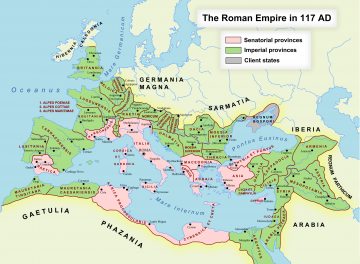
A map of the Roman Empire circa 117 AD. Mich of the areas outside the empire was considered to be inhabited by barbarians. 
The “turn toward the indigenous” in social theory over the last couple of decades, associated with the critique of white settler colonialism, has reintroduced themes long present in Marxian theory, but in ways that are often surprisingly divorced from Karl Marx’s critique of capitalism, colonialism, and imperialism.1 Part of the reason for this disconnection is that the current discussions of settler colonialism have evolved out of traditions in postmodernist and postcolonial cultural theory that are distant from historical materialism.2 However, a deeper explanation for the gulf between current scholarly work on settler colonialism and Marxism is associated with the claims of some left critics that Marx’s work is characterized by the following: (1) a crude developmentalism and economic determinism; (2) a pro-colonialist stance; (3) a teleological conception of progress; and (4) Prometheanism or extreme productivism in relation to the environment.3 Such charges are often employed to cast historical materialism as irrelevant or even hostile to contemporary indigenous struggles and perspectives.
In Red Skin, White Masks, Glen Sean Coulthard provides a more nuanced view of Marx and the indigenous, engaging the latter’s critique of “so-called primitive accumulation.” Coulthard insists that “Marx’s theoretical frame” in this respect can be seen as extremely “relevant to a comprehensive understanding of settler-colonialism and Indigenous resistance,” but that this requires that classical historical materialism “be transformed in conversation with the critical thought and practices of Indigenous peoples themselves.” Specifically, he seeks to transcend what he takes to be Marx’s mistaken views (1) that such expropriation is confined to the formative stages of capitalism, rather than constituting an ongoing process; (2) that there is an unilinear developmentalist logic to be equated with progress; and (3) that the environment is to be treated as constituting a free gift, such that the land is not seen as exploited, only people are.4
Taking these criticisms seriously, we return to the classical foundations of Marxian theory in order to ascertain where—if anywhere—the analysis went wrong, what can be usefully derived from it, and how to construct (or reconstruct) a Marxian critique of colonialism relevant to contemporary struggles. Through this assessment, we believe, the strengths of the classical historical-materialist argument will become evident.
Returning to Marx as a starting point is crucial in order to develop a materialist critique of capitalism and colonialism. Nevertheless, there is no such thing in historical materialism as a fixed orthodoxy. Rather, Marxism from the beginning has been shaped by vernacular revolutionary traditions. As a philosophy of praxis geared not simply to understanding the world but also changing it, historical materialism can least of all afford to be suprahistorical or to neglect the lessons of national and popular struggles.5 “Orthodoxy” in Marxism, as Georg Lukács famously said, “refers exclusively to method.”6 It is thus the materialist, historical, and dialectical method of classical Marxism that constitutes the necessary point of departure with which to engage in the critique of colonialism, including settler colonialism, today.

Colonialism and Expropriation

Coulthard contends in Red Skin, White Masks that Marx’s theory of expropriation as a historical condition of capitalist development is primarily concerned with “the perpetual separation of workers from the means of production” and not with the colonial relation in and of itself. Similarly, we are told that Marx’s discussion of “The Modern Theory of Colonialism” in the final chapter of volume 1 of Capital was dedicated simply to establishing his theory of wage labor and capital by pointing to the necessity of capital removing workers from the land, indicating an overall lack of concern with colonialism. Building on these criticisms, Coulthard suggests that the critique should shift from a focus mainly on the capital relation to one that also highlights the colonial relation, thereby overcoming Marx’s one-sidedness in this respect.7
Yet, in chapter 31 of Capital, “The Genesis of the Industrial Capitalist,” Marx already points to the need to consider the colonial relation as underlying the capital relation. Indeed, he is crystal clear on this issue:
The discovery of gold and silver in America, the extirpation, enslavement and entombment in mines of the indigenous population of that continent, the beginnings of the conquest and plunder of India, and the conversion of Africa into a preserve for the commercial hunting of blackskins, are all things which characterize the dawn of the era of capitalist production. These idyllic proceedings are the chief moments of primitive accumulation.8
Hence, for Marx it is not the various enclosures of the commons in England, discussed in the early chapters of part VIII of Capital on “So-Called Primitive Accumulation,” that constituted the chief moments of primary expropriation and the genesis of the industrial capitalist, but rather the plunder of the entire world outside of Europe, centering on the “extirpation, enslavement and entombment in mines of the indigenous population,” encompassing the robbery of the precious metals, the lands, and the bodies of the indigenous.9 Moreover, the English white settler colonies receive specific criticism for the horrors they inflicted:
The treatment of the indigenous population was, of course, at its most frightful in plantation-colonies set up exclusively for the export trade, such as the West Indies, and in rich and well-populated countries, such as Mexico and India, that were given over to plunder. But even in the colonies properly so called [or, settler colonies—in Spanish colono/a means settler] the Christian character of primitive accumulation was not belied. In 1703 those sober exponents of Protestantism, the Puritans of New England by decrees of their assembly set a premium of £40 on every Indian scalp and every captured redskin; in 1720, a premium of £100 was set on every scalp; in 1744, after Massachusetts Bay had proclaimed a certain tribe as rebels, the following prices were laid down: for a male scalp of 12 years and upwards, £100 in new currency, for a male prisoner £105, for women and children prisoners £50, for the scalps of women and children £50. Some decades later, the colonial system took its revenge on the descendants of the pious pilgrim fathers, who had grown seditious in the meantime. At English instigation, and for English money, they were tomahawked by the redskins. The British Parliament proclaimed bloodhounds and scalping as “means that God and Nature had given into its hand.”10
It did not miss Marx’s notice that the price of scalps was equivalent to the price of prisoners, meaning genocide not slavery was the object. In this way, Marx stressed that the chief goal in the English settler colonies in North America was the absolute “extirpation” of the indigenous population. Indeed, as William Howitt explained in Colonization and Christianity: A Popular History of the Treatment of the Natives by the Europeans in All Their Colonies (1838), which Marx first studied in 1851, the white settler colonialism of the nascent United States was aimed at the extermination and removal of the Native American tribes. Here, Howitt quoted Abbé Raynal’s statement that the goal of the English and French was “to extirpate” the Native Americans.11 Howitt also described “the exterminating campaigns of General Jackson,” quoting Andrew Jackson’s declaration on March 27, 1814, during his military campaign against the Southern tribes, that he was “determined to exterminate them.” The Native American peoples, Howitt observed, “were driven into waste, or to annihilation.” Writing at the time of the Trail of Tears and the massive removal of the Native Americans of the Southeast, Howitt concluded with the words:
Nothing will be able to prevent the final expatriation of these southern tribes: they must pass the Mississippi till the white population is swelled sufficiently to require them to cross the Missouri; there will then remain but two barriers between them and annihilation—the rocky mountains and the Pacific Ocean. Whenever we hear now of those tribes, it is of some fresh act of aggression against them—some fresh expulsion of a portion of them—and of melancholy Indians moving off towards the western wilds.12
During the time he was writing Capital, Howitt’s book was Marx’s chief source on the colonial treatment not only of Native Americans but of indigenous populations around the world. Nevertheless, at the same time in which he encountered Howitt, Marx also studied William Prescott’s History of the Conquest of Mexico (1843) and History of the Conquest of Peru (1847), and Thomas Fowell Buxton’s The African Slave Trade and Its Remedy (1840), along with various works on India.13 In the 1850s, he closely scrutinized Herman Merivale’s Lectures on Colonization and Colonies (1841).14 In 1853, he read Thomas Stamford Raffles’s History of Java (1817), on which Howitt had also relied for his treatment of Java.15 This was followed by studies of numerous additional works on slavery, referred to in Capital.
Howitt’s Colonization and Christianity was more than five hundred pages long and included separate chapters on the treatment of the indigenous by colonial powers in various regions around the world, with twelve chapters devoted to how the Spanish and Portuguese conducted themselves in relation to Native populations in the New World, three to the English settler colonists and the indigenous in North America, two on “The Treatment of the Indians in the United States,” five on the English in India, one on the English in the Cape colony in South Africa, one each on the Dutch in India and Indonesia (Java) and the Dutch in Australia and the islands of the Pacific, and one on the French in their colonies. All told, Colonization and Christianity was the greatest compendium on the global atrocities of colonialism written in its time, containing copious detail, often relying on commercial and government reports. As Marx wrote: “W. Howitt, a man who specializes in being a Christian, says of the Christian colonial system, ‘The barbarities and desperate outrages of the so-called Christian race, throughout every region of the world, and upon every people they have been able to subdue, are not to be paralleled by those of any other race, however fierce, however untaught, and however reckless of mercy and of shame, in any age of the earth.'”16
Given that Marx was concerned with the role that the colonial expropriation of indigenous land and peoples played in the genesis of the industrial capitalist, he focused his treatment particularly on the Dutch and the English, as the two countries that had led the way in the development of industrial capitalism. With respect to the Dutch, Marx noted that in 1648, at the zenith of its power, Holland was in almost total control of the East Indian trade. In Capital, he concentrated particularly on the Dutch role in Java as detailed by Raffles’s History (drawing, however, primarily on passages that had been highlighted in Howitt’s Colonization and Christianity). Here the role of organized “man-stealers,” consisting of “the thief, the interpreter and the seller,” all systematically engaged in “stealing men” who were then forced into chains, hidden away in secret prisons, and dragged to the waiting slave ships, was carefully depicted. As Marx noted, “Banjuwangi, a province of Java, numbered over 80,000 inhabitants in 1750 and only 18,000 in 1811. That,” he exclaimed in bitter irony, “is peaceful commerce!” On the basis of its colonial expropriation, Marx argued, the “total capital” of the Dutch Republic rose to the point in the mid–seventeenth century that it probably exceeded that of all the rest of Europe put together.17
But the colonial barbarity of Dutch capitalism was to be exceeded in scale in the eighteenth and nineteenth centuries by the English. Marx, following Howitt, explained that the British governor of the East India Company insisted on its “exclusive monopoly” in the trade of tea, as well as trade with China and Europe. But favored Company officials were able to control the monopolies of salt, opium, betel, and other commodities, dominating the coastal trade. “Great fortunes sprang up like mushrooms in a day,” based on some of the most vicious forms of expropriation in the period.18 Relying on Howitt as his source, Marx wrote: “Between 1769 and 1770 the English created a famine by buying up all the rice and refusing to sell it again, except at fabulous prices.”19 In a footnote, he added: “In the year 1866 more than a million Hindus died of hunger in the province of Orissa alone. Nevertheless, an attempt was made to enrich the Indian [colonial] treasury by the price at which the means of subsistence were sold to the starving people.”20
The plunder was enormous. “The treasures captured outside Europe by undisguised looting, enslavement and murder,” Marx wrote, “flowed back to the mother-country.” The colonial system “proclaimed the making of profit as the ultimate and sole purpose of mankind.” The slave trade, in particular, was to play a central role in the industrialization of England and the growth of cotton manufacturing. Counting the slave ships plying the Liverpool trade in the years leading up to the Industrial Revolution, Marx observed: “In 1730 Liverpool employed 15 ships in the slave trade; in 1751, 53; in 1760, 74; in 1770, 96; and in 1792, 132.”21
Marx ends his chapter on “The Genesis of the Industrial Capitalist” with the statement that “if money, according to Augier, ‘comes into the world with a congenital blood-stain on one cheek,’ capital comes dripping from head to toe, from every pore, with blood and dirt.”22 Reading this passage, it is impossible not to think also of the conclusion of Howitt’s Colonization and Christianity, which had influenced Marx to such an extraordinary degree:
It was not enough that the lands of all newly discovered regions were seized on by fraud or violence; it was not enough that their rightful inhabitants were murdered or enslaved; that the odious vices of people styling themselves the followers of the purest of beings should be poured like a pestilence into these new countries. It was not enough that millions on millions of peaceful beings were exterminated by fire, by sword, by heavy burdens, by base violence, by deleterious mines and unaccustomed severities—by dogs, by man-hunters, and by grief and despair—there yet wanted one crowning crime to place the deeds of Europeans beyond all rivalry in the cause of evil,—and that unapproachable abomination was found in the slave trade. They had seized on almost all other countries, but they could not seize on the torrid regions of Africa. They could not seize the land, but they seized the people.… They therefore determined to immolate them on the graves of the already perished Americans. To shed blood upon blood, to pile bones upon bones, and curses upon curses. What an idea is that!—the Europeans standing with the lash of slavery in their hands on the bones of exterminated millions in one hemisphere, watching with remorseless eyes their victims dragged from another hemisphere—tilling, not with their sweat, but with their heart’s blood, the soil which is, in fact, the dust of murdered generations of victims.… The whole history of European colonization is of a piece.23
Beyond extirpation and enslavement, Marx’s critique was focused on the extensive robbery that characterized the primary expropriation underlying the accumulation of capital in the mercantilist era and beyond, which was central to the development of capitalism. This expropriation was carried out in the white settler colonies through the genocide of the indigenous population and the import of slaves. Thus, there arose what Coulthard has called a “structured dispossession.”24 As the indigenous populations were removed, and as these territories were filled with white immigrants/settlers, the problem for capital eventually became one of the dispossession of the settlers as well.
Thus, with respect to the white settler colonies—once the original indigenous inhabitants of the soil had been annihilated or expatriated—a debate arose in which all the English classical political economists took part over the detrimental effects to capital of a high land/population ratio. This state of underpopulation in relation to the land, and thus the relative abundance of the latter, encouraged the direct working of the soil by a class of small farmers populated by the incoming immigrants, thus blocking the development of a propertyless proletariat needed for capitalist industrialization.25
Marx here focused on the work of Edward Gibbon Wakefield and other nineteenth-century proponents of “systematic colonization” in the English white settler colonies (principally the United States, Canada, Australia, and New Zealand). Wakefield insisted on the need for the state to generate high land prices through state land sales and land speculation so as to exclude new waves of immigrant settlers from immediately moving into the frontier and setting themselves up as subsistence farmers or small proprietors, forcing them rather into the position of proletarians.26 The fact that the indigenous hardly counted at all in such debates among the classical political economists on the English settler colonies was a reflection of the circumstance that by the 1830s the removal of Native Americans from the land was viewed as largely accomplished in North America, though it continued to advance with each Western movement; while the same process of removal of aboriginal populations was also well advanced in Australia and New Zealand.27
It was in this context of “the modern theory of colonialism” advocated by Wakefield and of the political economy of settler colonialism that Marx was to declare on the closing page of volume 1 of Capital:
We are not concerned here [at this logical point in the argument] with the condition of the colonies. The only thing that interests us is the secret discovered in the New World by the political economy of the Old World, and loudly proclaimed by it: that the capitalist mode of production and accumulation, and therefore capitalist private property as well, have for their fundamental condition the annihilation of that private property which rests on the labour of the individual himself; in other words, the expropriation of the worker.28
This should not be read, as Coulthard understandably does, as meaning that Marx was actually unconcerned with the realities of colonial institutions and the treatment of indigenous populations, since his other writings, including Capital itself, belie such an interpretation.29 Rather, Marx’s critique, based on Wakefield, suggested that the removal of the indigenous population from the land, to be replaced by small farmers, would lead eventually in the white settler colonies to the progressive expropriation of the small farmers too as a condition of the genesis of industrial capitalism.

Marx’s Investigations of Indigenous Natural Economies

In fact, Marx’s approach to colonialism and indigenous populations went far beyond the analysis of his contemporaries, including Howitt, who was chiefly concerned with the moral question of the “Christian” impact of the Western colonizers on the indigenous. Marx, in contrast, was much more deeply interested in the forms of property, production, exchange, gender, language, and material culture that had characterized indigenous nations around the globe prior to colonization. Thus, in relation to the Americas, his investigations were primarily devoted to the nature of pre-Columbian indigenous societies. This was evident from the importance that Prescott’s description of the Inca economy in History of the Conquest of Peru assumed in Marx’s thought, which he continually referred to in the Grundrisse and Capital as standing for the crucial category of the “natural economy,” that is, a developed, largely communal, pre-exchange or noncommodity economy.30 Under the Incas, an individual “had no power to alienate or to add to his possessions” with respect to the land, which was communally held and redistributed each year.31 In a discussion of surplus-generating societies, Marx was to refer in volume 3 of Capital to the “artificially developed communism of the Peruvians [Incas].”32
Although it has often been suggested that Marx and Frederick Engels exhibited a unilinear developmentalist perspective that saw capitalism as playing a historically progressive, if violent, role in its relation to noncapitalist societies, and thus in its colonial impositions on “the peoples without [written] history,” such ambivalent views with respect to colonialism did not extend past their thirties. By the end of the 1850s and before Marx wrote Capital, there was a decisive shift in emphasis in his and Engels’s writings toward the defense of indigenous, anticolonial struggles, exhibiting a strong concern for and a recognition of the lasting importance of noncapitalist cultural formations/modes of production. Much of the impetus for this shift in perspective was the growth of wars of anticolonial resistance emanating from the indigenous populations themselves, namely the Algerian revolt against French settler colonialism, led by Emir Abdelkader in the 1830s and ’40s; the Taiping Rebellion of 1850–64; the “Indian Mutiny” or what Marx called the “Sepoy Revolt” of 1857–59; the nationalist struggle in Ireland led by the Fenians in the 1860s and after; and the Zulu War against the British in 1879. In each of these cases, Marx and Engels were to take the side of the indigenous anticolonial forces.
To be sure, in an 1853 article on “The Future Results of British Rule in India” for the New York Daily Tribune, the thirty-five-year-old Marx, imbued with revolutionary optimism, had presented British colonialism, in Hegelian fashion, as an “unconscious tool of history,” representing, albeit in contradictory form, a universal forward movement within history in general. Nonetheless, his criticism of colonialism remained acute: “The profound hypocrisy and inherent barbarism of bourgeois civilization,” he wrote, “lies unveiled before our eyes, turning from its home, where it assumes respectable form, to the colonies, where it goes naked.” Changing historical conditions, moreover, were to allow Marx’s overall revolutionary critique of colonialism to emerge full fledged only four years later. In 1857, in a scathing response to British colonialism in light of what has been called the First Indian War of Independence, Marx supported the war for “national independence” organized by the “revolutionary league” that sought to throw the British out of India. British colonial rule, he argued, was based on “the principle of destroying nationality” through forcible destruction as well as other means. From that point on, the emphasis of his analysis was straightforwardly focused on the retrogression rather than “unconscious” progress associated with European colonial rule.33
In his last years, Marx set aside work on volumes 2 and 3 of Capital not just because of this direct identification with indigenous revolts, but also due to the enormous urgency with which he approached the study of noncapitalist societies and property forms. For Marx, the publication of Charles Darwin’s On the Origin of Species and the corresponding rise of anthropological studies delving into traditional, indigenous cultures and human prehistory, representing what has been called a “revolution in ethnological time,” raised the issue of a more complete, more revolutionary critique of capitalist society. It opened up the potential of a whole new radical understanding of the world with which to change it.34 It was in this period that he learned Russian in order to study that country’s populist literature and the obshchina or mir, the peasant village commune. Following the publication of volume 1 of Capital, Marx also expanded his ecological studies, primarily in relation to agriculture.35 Increasingly, though, his time was taken up by the almost desperate researches represented by his massive Ethnological Notebooks.36 For Marx, these studies included clues not only in relation to the past, but also the future.
Marx’s Ethnological Notebooks contained extracts (and interpolations) from the anthropological works of Lewis Henry Morgan, John Budd Phear, Henry Sumner Maine, and John Lubbock, excerpted in the period from 1880 to 1882. In 1879, he also excerpted the ethnological studies of the young Russian sociologist Maxim Kovalevsky—whom Marx himself had nurtured—from a book manuscript, Communal Landownership: The Causes, Course and Consequences of its Dissolution, that the author had sent to him. Along with these studies, Marx filled his notebooks with investigations of the Russian commune, Indian history, and world history. (Marx’s 1880–81 notes on world history from the works of Carlo Giuseppe Guglielmo Botta and Friedrich Christoph Schlosser, consisting of four excerpt notebooks, are around 1,700 pages long.)37 In 1880–81, he took down passages from James William B. Money’s Java; Or, How to Manage a Colony (1861). Marx and Engels also studied Hubert Howe Bancroft’s The Native Races of the Pacific States of North America (five volumes), with particular attention to the tribes of southeastern Alaska and the Pacific Northwest.38
Marx took very extensive interpolated extracts from Morgan’s masterwork Ancient Society, which was based on the latter’s studies of Native Americans in the United States (and particularly the Iroquois, on which Morgan had written a previous work, League of the Ho-De’-No-Sau-Nee, or Iroquois).39 Engels was later to compose his Origin of the Family, Private Property, and the State (1884) based on Morgan’s Ancient Society, Marx’s notes on Morgan, and other sources.40 In studying Morgan’s work, Marx—as indicated in his vertical lines on the pages of his notebooks emphasizing particular passages—focused first and foremost on: (1) the communal, consanguine (kinship-based) community, including its basis in the gens or clan, its democratic form, and relative equality of women; and (2) the associated communal property forms, constituting the natural economy with its noncommodity trade. Marx also paid attention to the crops cultivated and forms of agriculture.41 “All members of the Iroquois gens,” he wrote, drawing on Morgan, were “personally free, bound to defend each other’s freedom.”42
As Franklin Rosemont wrote in “Karl Marx and the Iroquois,”
On page after page Marx highlights passages wildly remote from what are usually regarded as the “standard themes” of his work. Thus we find him invoking the bell-shaped house of the coastal tribes of Venezuela; the manufacture of Iroquois belts “using fine twine made of filaments of elm and basswood bark”; “the Peruvian legend of Manco Capac and Mama Ocllo, children of the sun”; burial customs of the Tuscarora; the Shawnee belief in metempsychosis; “unwritten literature of myths, legends, and traditions”; the incipient sciences of the village Indians of the Southwest; the Popul Vuh, sacred book of the ancient Quiche Maya; the use of porcupine-quills in ornamentation; Indian games and “dancing [as a] form of worship.”43
In addition to copious notes on the Iroquois from Morgan, Marx also took detailed notes on the Delaware, Mohegan, Cree, Shawnee, Creek, Chickasaw, Choctaw, Cherokee, Seminole, Dakota, Pawnee, Fox, Blackfoot, and many other tribes. He was in all cases interested in the “practice of the arts” by the various Native American tribes/nations.44 Marx avoided a strictly unilinear notion of evolutionary development. Indeed, his studies were constantly focused on the reconstitution of ancient forms of indigenous, and noncapitalist, societies on a higher historical level, helped along by the persistence of earlier cultures/cultural forms.45 “Morgan’s lively account of the Iroquois,” Rosemont writes, “gave him [Marx] a vivid awareness of the actuality of indigenous peoples, and perhaps even a glimpse of the then-undreamed of possibility that such peoples could make their own contributions to the global struggle for human emancipation.”46
Indeed, Marx was entranced by Morgan’s contention that the ancient gens, as exemplified by the Iroquois, contained the communal nucleus to be reproduced on a higher plane of the associative society of the future. In Morgan’s words, as taken down and emphasized by Marx: “It [a higher plane of society] will be a revival, in a higher form, of the liberty, equality and fraternity of the ancient gentes [communal kinship society].”47 This resembled Marx’s earlier view, as stated in an 1868 letter to Engels, that it was necessary “to look beyond the Middle Ages into the primitive age of every people—and this corresponds to the socialist tendency, though these learned men [Georg Ludwig von Mauer, known for his studies of early German communal society, and Jakob Grimm, the philologist and cultural historian] have no idea they [the “primitive” communal forms] are connected with it [the socialist tendency]. And they are then surprised to find what is newest in what is oldest.”48
The same general historical logic is present in Marx’s excerpts on indigenous cultures in Latin America from Kovalevsky’s Communal Landownership. Here, Marx was particularly interested in indigenous communal production, the disintegration of this under the influence of the Spanish, and the subsequent forms of colonial domination.49 Thus, in his notes on the Spanish colonial treatment of indigenous Americans, Marx recorded (the italics in this case standing for his inserts): “The original Spanish policy of extermination of the redman. After pillage of the gold etc. that they found, the Indians are condemned to work in the mines. With the decline of the value of gold and silver, the Spanish turn to agriculture, make the Indians into slaves in order to cultivate land for them.”50
A similar searching inquiry into the effects of colonization on communal forms of production can be seen in Marx’s notes and writings with respect to Algeria and India. In his interpolated extracts from Kovalevsky on Algeria, Marx (via Kovalevsky) observed that “centuries of Arabic, Turkish, finally French rule, except in the most recent period…were unable to break up the consanguineal [kinship-based] organization and the principles of indivisibility and inalienability of land ownership.”51 Nevertheless,
The first concern of the French after the conquest of a part of Algeria was to declare the greatest part of the conquered territory to be (French) government property.… Louis-Philippe, as successor of the Imam…grabs not only the domanial property [landed estates], but also all land not under tillage, including the communal pastureforest, and uncultivated land.… In this way: on the one hand the former communal landowners  pressed down into the position of temporary occupants of government land; on the other hand  robbery by force of significant parts of the territory occupied by the clans, and planting thereon of European colonists.… The communal lands—under Louis Philippe—were placed at the free disposition of the military-civil administration set up in the colony.52
The French expropriation of the communal lands was made official by the infamous law of 1873, “which had finally established private property in land; every Arab could now dispose freely of the plot of ground set aside for him as private property; the result will be: the expropriation of the soil of the native population by European colonists and speculators.” There was no doubt for Marx or Kovalevsky that this constituted “direct robbery!” Marx writes in his notes: “The expropriation of the Arabs intended by the law: 1) in order to provide the French with as much land as possible; 2) by tearing away the Arabs from their natural bond to the soil to break the last strength of the clan unions thus being dissolved, and thereby, any danger of rebellion.”53
Kovalevsky and Marx argued that in order to seize the communal lands of the Algerians and turn them into private property, the French government promoted the idea that the monarch or colonial state was the rightful heir of all communal lands as well as forest and uncultivated lands—a policy also adopted by the English in India and most famously propagated by James Mill, with whose work Marx was very familiar.54
In an attempt to restore his health, Marx spent two months in Algiers in 1882, the year before his death and only a few years after taking down his extracts from Kovalevsky on Algeria. In his letters to his daughter Laura Lafargue, he indicted his admiration for Algerian Muslims for “the absolute equality in their social intercourse.… Nevertheless, they will go to rack and ruin WITHOUT A REVOLUTIONARY MOVEMENT.”55
In Marx’s extracts from Kovalevsky, we also find the observation that in Punjab, in northern India, “by ‘mortgaging’ or ‘alienation,’—sanctioned by law,—the English government works at dissolution…of the collective property of the peasants, their ultimate expropriation, the evolution of communal land into the private property of the usurer.”56 Commenting (via Kovalevsky) on the “robbery of communal and private property of the peasants,” Marx noted in his extract notebooks that this led to “a whole series of local uprisings of the peasants against the ‘landlords.'”57
Reflecting on the English colonial policy in India, Marx wrote in his “Draft Letters to Vera Zasulich” that “the suppression of communal land ownership was nothing but an act of English vandalism which drove the indigenous population backward rather than forward.”58 The English, he recognized, were to be distinguished from all previous occupiers of India for having not maintained irrigation, canals, dams, reservoirs, drainage systems, grain storage units, and other public infrastructure, thereby setting the stage for massive famines. In his notes in 1867 from a special report on the Orissa famine conducted for the House of Commons, Marx underscored that “the tendency of an increasing cultivation” had resulted in “the denudation of natural forests,” rendering “the seasons more severe, and floods more rapid and extensive.”59
In all of his various treatments of natural economies and indigenous cultural formations—most dramatically in the future importance of the Russian peasant commune or obshchina—Marx invariably saw such indigenous and noncapitalist societies as reflective of a long struggle for free human development, one which included the fight for survival of indigenous societies and control over their own lands and lives.
Drawing on Jacques Derrida’s Spectres of Marx and thus indirectly on Marx, Gerald Vizenor has underscored the concept of survivance in the face of terror and genocide as exemplifying the indigenous experience. “Native survivance is an active sense of presence over absence.… Survivance stories are renunciations of dominance, detractions, obtrusions, the unbearable sentiments of tragedy, and the legacy of victimry.… It is an active resistance and repudiation.”60

Marxism and the Indigenous

Most criticisms of Marxism for its lack of appreciation of indigenous cultures and struggles are nonspecific, merely attributing to historical materialism an economic and technological determinism, an uncritical commitment to developmentalism, an extreme promotion of ever greater production above all else (that is, productivism), and an emphasis on the proletariat at the expense of peasants and the indigenous. While these are definitely features of certain Marxist traditions, some of which have even played dominant roles, they hardly characterize the thought of Marx or Engels, or of critical revolutionary traditions of Marxism more generally.
To be sure, Engels adopted a somewhat tragic stance toward indigenous communities, praising them to an even greater extent than Marx, while sometimes writing as if their demise was inevitable due to the weaknesses of the tribal form of society that was trapped within its own limitations and had to give way to other forms of cultural organization, as already manifested in contradictory form in the Iroquois Confederacy.61 In contrast, Marx’s more nuanced approach was both more questioning of indigenous cultures—for example, exhibiting reservations with regard to claims of full gender equality among the Iroquois—and at the same time more open to the idea that indigenous cultures could persist and reconstitute themselves through historical struggles.62 Nevertheless, most of Marx’s writing in this respect, including his Ethnological Notebooks, remained unknown, and it was Engels’s tragic approach that prevailed in the Second International in the work of some of Marx’s heirs such as Paul Lafargue, Karl Kautsky, and Georgi Plekhanov, but in a much more technologically determinist and rigidly developmentalist form than can be attributed to Engels (much less Marx).63 Still, none of these epigones are today considered to be exemplary of classical Marxist thought. Of far more lasting significance are Rosa Luxemburg’s strong defenses of the indigenous and natural economies, V. I. Lenin’s insistence on the national self-determination of all peoples, and José Carlos Mariátegui’s rich weaving together of Marxism and Indigenismo—all of which pointed to a deeper critique of Eurocentric capitalist development.64
Not only has Marxism inspired national liberation movements throughout the periphery of the capitalist world economy, but beginning in the 1950s and stretching into the 1970s, there were major attempts to integrate Marxian theory with Native American struggles in the work of figures like Eleanor Burke Leacock, Patricia Albers, Bruce Johansen, Roberto Maestas, Lawrence David Weiss, Howard Adams, and others.65 As Johansen emphasized, Marxism itself, due to Marx and Engels’s study of the Iroquois via Morgan, owed much to indigenous cultures.66 More recently, the Movement Toward Socialism of the Bolivian Revolution drew much of its vitality from a vernacular revolutionary tradition rooted in both Marxism and Indigenismo.67
At present, there is a new flowering of work arising from both Marxist and indigenous revolutionary traditions. Coulthard’s breakthrough work in Red Skin, White Masks forges a rich synthesis between Marx, Frantz Fanon, and indigenous perspectives in his radical rejection of “the colonial politics of recognition.” Allan Greer’s brilliant depiction of Native American property forms and colonial dispossession in early modern North America in his Property and Dispossession is organically connected to the researches of figures such as Morgan, Marx, and Engels.68 Roxanne Dunbar-Ortiz offers a Marxist-indigenous analysis of how the founding of the United States and its ongoing expansion is rooted in “the ideology of white supremacy, the widespread practice of African slavery, and a policy of genocide and land theft.”69 In The Apocalypse of Settler Colonialism, Gerald Horne explains how genocide of indigenous peoples and the no less horrific development of chattel slavery were intertwined in the rise of capitalism’s system of world domination. Nick Estes provides an outstanding history of the centuries of indigenous resistance and revolutionary persistence, “burrow[ing]” like Marx’s mole as part of “the longer movement of history.”70 It should be noted that today’s widespread critique of settler colonialism was preceded by Marxian treatments of the subject within imperialism theory in the work of thinkers such as Marx, Engels, Luxemburg, Arghiri Emmanuel, Harry Magdoff, Dunbar-Ortiz, and Moshé Machover.71
In all of these works, stemming from historical materialism, there is an emphasis on forcible expropriation/dispossession of indigenous cultures as an ongoing process—one in which colonialism, rather than simply being an element of the past, continues to be integral to the capitalist domination of peoples and the land. Out of this flows an irrepressible resistance that takes many different forms, but nonetheless refuses to subside.

Conclusion: The Anticolonial/Anticapitalist Revolution

In Red Skins, White Masks, Coulthard argues “with respect to Marx that three issues must be addressed within his work to make his writings on colonialism relevant for analyzing the relationship between Indigenous peoples and liberal settler polities.” First, “Marx’s thesis on primitive accumulation must be stripped of its temporal character,” which limits it to the early stages of capitalist formation. Second, Marx’s argument “must be stripped of its normative developmentalist character.” Third, the Marxist approach to colonial capitalism must be rid of its association purely with force and violence and be seen rather in terms of the system’s “ability to produce forms of life that make settler-colonialism’s constitutive hierarchies seem natural.”72 Coulthard’s three issues are in fact conditions for any kind of viable historical-materialist analysis of indigenous experiences in settler colonial (or more broadly colonial and postcolonial) contexts. The foregoing argument should suggest that the called-for reconstruction and recovery of classical Marxian theory is already taking place.73
In this regard, it is important to note, as recent scholarship has demonstrated, that Marx did not have “a thesis of primitive accumulation” as such, but rather a critique of what he called “the nursery tale” of primary accumulation based on abstinence that characterized bourgeois economics, for which he substituted the concept of expropriation.74 Nor was Marx’s approach to expropriation temporally fixed. Rather, expropriation was seen as continually producing and reproducing the background conditions in which capital operated. Hence, in discussing the expropriation process in part VIII of volume 1 of Capital on “So-Called Primitive Accumulation,” Marx referred not just to the distant past but also to what for him was the present as history: the enclosures in Scotland in 1814–48 initiated by the Duchess of Sutherland, the conversion of sheep walks into deer forests (without trees) in the 1860s in England, and the famine in the province of Orissa, India, in 1866, resulting from English rule.75 In no way was such expropriation seen as confined to the preindustrial or early industrial age.
More important was Marx’s rejection of a simple, unilinear “normative developmentalist” perspective with respect to colonization. In his analysis of indigenous populations in the Americas, Africa, and Asia, particularly from the late 1850s on, he continually delved into the communal property forms and cultural and linguistic bases of these societies, with the idea that history was not simply linear. For him, colonialism itself was somewhat secondary because the indigenous cultural and property forms remained historically alive. It was on this basis that Marx and Engels from their late thirties on took the side of the various revolts of indigenous peoples throughout the world, defending their revolutions and recognizing that they represented something vital culturally and in terms of human community and property forms that went against the commodity economy of capitalism. Despite the tendency of Marx and Engels toward a “normative developmentalism” in their twenties, the ground had clearly shifted for them well before they left their thirties.
As Engels wrote in 1890, the original materialist conception of history was extended in Marx’s and his own later writings, since it was recognized that “the whole of history must be studied anew.” This included the history of the non-European world. In the words of sociologist Michael R. Krätke,
Marx gave no room to Euro-centrism; he considered world history in no way synonymous with “European history”.… He studied the history of Asia Minor, of the Near East and Middle East, the Islamic world, the Americas, and Asia (with three centres of focus: India, China, and Central Asia).… He studied the colonial history of the most important colonial powers, and indeed also the history of the countries colonized by the Europeans (North America, Latin America, Indonesia, North Africa).76
In all of this work, Marx moved away from a Eurocentric and developmentalist lens. His concern with settler colonialism reached into the history and culture of indigenous societies, identifying with their resistance, and seeing in their past (and present) the possibility of a broader world future.
The issue of how the colonial relation, once implanted, ideologically reinforces itself through “its ability to produce forms of life that make settler-colonialism’s constitutive hierarchies seem natural” is a realm in which Fanon, as Coulthard says, is a more useful guide than Marx.77 Yet, there is arguably only a short distance from Marx’s furious denunciations via Kovalevsky of French settler colonialism’s “Shameless!” manipulation and de-recognition of Islamic law to justify the expropriation of the “clan communal” land of the Algerian people, to Fanon’s sharp insistence—with the full force of the Algerian national liberation struggle of the 1950s before him (and with Hegel and Marx on his lips)—on a revolutionary alterity of recognition:
I ask that I be taken into consideration on the basis of my desire. I am not only here-now, locked in thinghood. I desire somewhere else and something else. I demand that an account be taken of my contradictory activity insofar as I pursue something other than life, insofar as I am fighting for the birth of a human world, in other words, a world of reciprocal recognitions.
He who is reluctant to recognize me is against me. In a fierce struggle I am willing to feel the shudder of death, the irreversible extinction, but also the possibility of impossibility.78

Notes

  1.  Kerstin Knopf, “The Turn Toward the Indigenous,” American Studies 60, no. 2/3 (2016): 179–200.
  2.  See Sagar Sanyal, “Marxism and Post-Colonial Theory,” Marxist Left Review 18 (2019).
  3.  See, for example, the essays in Ward Churchill, ed., Marxism and Native Americans (Boston: South End, 1999); Russell Lawrence Barsh, “Contemporary Marxist Theory and Native American Reality,” American Indian Quarterly 12, no. 3 (Summer 1988): 187–211; Glen Sean Coulthard, Red Skins, White Masks: Rejecting the Colonial Politics of Recognition (Minneapolis: University of Minnesota Press, 2014), 9–10.
  4.  Coulthard, Red Skin, White Masks, 6–15. For a very extensive response to the notion that the land was taken simply as a “free gift,” unrelated to exploitation/expropriation, in Marxian theory, see John Bellamy Foster and Brett Clark, The Robbery of Nature (New York: Monthly Review Press, 2020).
  5.  On Marx’s admonition against treating historical materialism as “suprahistorical,” see Karl Marx, “A Letter to the Editorial Board of Otechestvennye Zapiski,” in Late Marx and the Russian Road, ed. Teodor Shanin (New York: Monthly Review Press, 1983), 136.
  6.  Georg Lukács, History and Class Consciousness (Cambridge, MA: MIT Press, 1968), 1.
  7.  Coulthard, Red Skin, White Masks, 9–11.
  8.  Karl Marx, Capital, vol. 1 (London: Penguin, 1976), 915, emphasis added.
  9.  Marx, Capital, vol. 1, 871, 915; John Bellamy Foster and Brett Clark, “The Expropriation of Nature,” Monthly Review 69, no. 10 (2018): 1–27.
  10.  Marx, Capital, vol. 1, 917–18; William Howitt, Colonization and Christianity: A Popular History of the Treatment of the Natives by Europeans in All Their Colonies (London: Longman, Orme, Brown, Green, and Longmans, 1838), 346–49, 378–79. Like Marx, Engels used the term colonies proper to refer to “countries occupied by a European population,” particularly the United States, Canada, Australia, and the Cape colony in South Africa—a category for which settler colonialism is now commonly used. Engels also indicated that the white settler colonies would be the first to become independent from the mother country. See Karl Marx and Frederick Engels, Collected Works (New York: International Publishers, 1975), vol. 46, 322.
  11.  Howitt, Colonization and Christianity, 403–5.
  12.  Howitt, Colonization and Christianity, 403–4, 414. “Removal” of Native Americans, Merivale wrote in his chapter on “Savage Races,” representing the view of white settler colonialism, “is…inevitably, only a temporary remedy for permanent evils, and must be permanently repeated.” Herman Merivale, Lectures on Colonization and Colonies (London: Longman, Orme, Brown, Green, and Longmans, 1841), 508–9—citations here are to the second edition of 1861, reprinted by Oxford University Press in 1928.
  13.  William H. Prescott, History of the Conquest of Mexico/History of the Conquest of Peru (New York: Modern Library, no date [originally published separately in 1843/1847]); Thomas Fowell Buxton, The African Slave Trade and Its Remedy (London: John Murray, 1840); Hal Draper, ed., The Marx-Engels Glossary (New York: Schocken, 1986), 36, 167.
  14.  Karl Marx, Grundrisse (London: Penguin, 1973), 833.
  15.  Sir Thomas Stamford Raffles, The History of Java (in two volumes), 2nd ed. (London; John Murray, 1830).
  16.  Marx, Capital, vol. 1, 916.
  17.  Marx, Capital, vol. 1, 916, 918; Raffles, History of Java, vol. 2, xcvi–civ; Howitt, Colonization and Christianity, 194–201. In Capital, Marx appears to have relied on Howitt’s treatment of the Dutch in Java—which is based on Raffles’s History of Java—rather than on Raffles’s work directly (which Marx had read), since all the facts he refers to are cited in Howitt and with similar language.
  18.  For a critical history of the British East India Company, see Ramkrishna Mukherjee, The Rise and Fall of the East India Company (New York: Monthly Review Press, 1974).
  19.  Marx, Capital, vol. 1, 917; Howitt, Colonization and Christianity, 255–56, 268–71.
  20.  Marx, Capital, vol. 1, 917; Karl Marx and Frederick Engels, Marx/Engels Gesamtausgabe (MEGA), IV, 18 (Berlin: Walter de Gruyter, 2019), 670–74, 731; Mike Davis, Late Victorian Holocausts (London: Verso, 2001).
  21.  Marx, Capital, vol. 1, 918, 924–25; see also, Sven Beckert, Empire of Cotton (New York: Vintage, 2014).
  22.  Marx, Capital, vol. 1, 925–26.
  23.  Howitt, Colonization and Christianity, 501–3.
  24.  Coulthard, Red Skin, White Masks, 7.
  25.  See Donald Winch, Classical Political Economy and Colonies (Cambridge, MA: Harvard University Press, 1965); A. G. L. Shaw, Great Britain and the Colonies (London: Methuen and Co., 1970).
  26.  Merivale, Lectures on Colonization and Colonies, 387–89; Edward Gibbon Wakefield, ed., A View of the Art of Colonization (Oxford: Oxford University Press, 1814); Edward Gibbon Wakefield, ed., England and America(New York: Harper and Brothers, 1834).
  27.  “An Indigenous Timeline,” New South Wales Government, available at http://teachingheritage.nsw.edu.au; Moshé Machover calls this “exclusion colonisation” to emphasize the effects on the indigenous. See Moshé Machover, “Colonialism and the Natives,” Weekly Worker 1087 (2015).
  28.  Marx, Capital, vol. 1, 940.
  29.  Coulthard, Red Skin, White Masks, 10–11.
  30.  “The Struggle Against Natural Economy” is the title of a chapter of Rosa Luxemburg’s The Accumulation of Capital, which develops arguments with respect to the colonization of natural economies by Marx and Maxim Kovalevsky. See Rosa Luxemburg, The Accumulation of Capital (New York: Monthly Review Press, 1951), 368–85. On the concept of natural economy in Marx and Luxemburg, see Scott Cook, Understanding Commodity Economies (New York: Rowman and Littlefield, 2004), 114, 130–31, 151.
  31.  Prescott, History of the Conquest of Mexico/History of the Conquest of Peru, 756–57.
  32.  Karl Marx, Capital, vol. 2 (London: Penguin, 1978), 196, 226; Marx, Capital, vol. 3, (London: Penguin, 1981), 1017.
  33.  Sunti Kumar Ghosh, “Marx on India,” Monthly Review 35, no. 8 (January 1984): 39–53; Karl Marx and Frederick Engels, The First Indian War of Independence, 1857–1859 (Moscow: Progress Publishers, 1968), 20, 35, 47, 92–93, 140; Karl Marx, Notes on Indian History (664–1858) (Moscow: Progress Publishers, no date), 150; Marx and Engels, Collected Works, vol. 18, 60–70, 212–13; Frederick Engels, The Origin of the Family, Private Property, and the State (New York: International Publishers, 1970), 159–60. See also Kenzo Mohri, “Marx and ‘Underdevelopment,'” Monthly Review 30, no. 11 (April 1979): 32–42; Horace B. Davis, Nationalism and Socialism (New York: Monthly Review Press, 1967), 63–69; John Bellamy Foster, “Marx and Internationalism,” Monthly Review 52, no. 3 (July–August 2000): 11–13; Umberto Melotti, Marx and the Third World (London: Macmillan Press, 1977); Eric. R. Wolf, Europe and the People Without History (Berkeley: University of California Press, 1982). [¶]Although Engels in his twenties saw the French invasion of Algeria as leading to the progress of civilization, he moved away from this position in his late thirties, praising Abdelkader in his 1857 article for the New American Cyclopedia and arguing that “French supremacy” in Algeria was “illusory” in face of the independence and resistance of the Algerians. Marx and Engels, Collected Works, vol. 18, 60–70. [¶]Marx’s concept of the Asiatic mode of production, a term which he abandoned after 1859, was based on earlier classical political-economic writings by James Mill, John Stuart Mill, and Richard Jones that eventually evolved into a complex theory of the specificity of modes of production in Asia, particularly India, transcending the earlier notion that these societies were characterized by stagnation. Moreover, the very idea of an Asiatic mode of production, as developed by Marx, deviated from any unilinear theory of development, raising the issue of alternative paths. See Krader, The Asian Mode of Production, 5–7, 183, 292; John Bellamy Foster and Hannah Holleman, “Weber and the Environment,” American Journal of Sociology 117, no. 8 (2012): 1640–41.
  34.  On “the revolution in ethnological time,” see Thomas Trautmann, Lewis Henry Morgan and the Invention of Kinship (Berkeley: University of California Press, 1987), 35, 197, 220, 227, 264; John Bellamy Foster, Marx’s Ecology (New York: Monthly Review Press, 2000), 212–21. On Marx’s own response to the revolution in ethnological time, see Marx and Engels, Collected Works, vol. 42, 557.
  35.  See Kohei Saito, Karl Marx’s Ecosocialism (New York: Monthly Review Press, 2017).
  36.  Karl Marx, Ethnological Notebooks, ed. Lawrence Krader (Assen, Netherlands: Van Gorcum and Co., 1974). Much of what constituted Marx’s ethnological notebooks still remain to be published.
  37.  Karl Marx, “Excerpts from M. M. Kovalevsky,” appendix to Lawrence Krader, The Asiatic Mode of Production (Assen, Netherlands: Van Gorcum and Co., 1975); Peter Hudis, “Marx Among the Muslims,” Capitalism Nature Socialism 15, no. 4 (2004): 58; Michael R. Krätke “Marx and World History,” International Review of Social History 63 (2018): 91–125. The title to Kovalevsky’s work used in the text here follows the translation in James D. White, Karl Marx and the Origins of Dialectical Materialism (New York: St. Martin’s, 1996), 260. See also L. S. Gamayunov and R. A. Ulyanovsky, The Work of the Russian Sociologist M. M. Kovalevsky, “Communal Landholding, the Causes, Ways and Consequences of Its Disintegration,” and K. Marx’s Criticism of the Work (Moscow: Oriental Literature Publishing House, 1960).
  38.  Kevin B. Anderson, Marx at the Margins (Chicago: University of Chicago Press, 2010), 218–19. Marx, Ethnological Notebooks, 183, 431; Marx and Engels, Collected Works, vol. 46, 394–95; Hubert Howe Bancroft, The Native Races of the Pacific States of North America (five volumes, 1875), see especially vol. 1, 109; Engels, The Origin of the Family, Private Property and the State, 218.
  39.  Lewis Henry Morgan, Ancient Society (New York: World Publishing Co., 1963); Lewis Henry Morgan, League of the Iroquois (New York: Carol Communications, 1962). In League of the Iroquois, Morgan wrote: “It is no small crime against humanity to seize the firesides and the property of a whole community, without an equivalent, and without their will,” referring to the Ogden Land Company’s seizer of land of the Iroquois.
  40.  Engels, The Origin of the Family, Private Property, and the State, 71–73.
  41.  Lawrence Krader, introduction to Ethnological Notebooks, by Karl Marx, 24–28.
  42.  Marx, Ethnological Notebooks, 150. As Marx noted here, the Iroquois called themselves “People of the Long House” (168).
  43.  Franklin Rosemont, “Karl Marx and the Iroquois,” in Arsenal: Surrealist Subversion, by Nelson Algren et al. (Chicago: Black Swan, 1989), 205.
  44.  Marx, Ethnological Notebooks, 174–86.
  45.  Krader, introduction to Ethnological Notebooks, 14.
  46.  Rosemont, “Karl Marx and the Iroquois,” 207.
  47.  Marx, Ethnological Notebooks, 139.
  48.  Marx and Engels, Collected Works, vol. 42, 557–59.
  49.  Marx’s extensive correspondence with Kovalevsky was burned by Kovalevsky’s friend, the economist I. I. Ivanyukov, with whom they had been entrusted while Kovalevsky was on a trip abroad. Ivanyukov panicked, fearing that his house would be searched by the police and destroyed the letters—a fear that proved exaggerated. White, Karl Marx and the Intellectual Origins of Dialectical Materialism, 262.
  50.  Marx quoted in Kevin Anderson, Marx at the Margins, 221.
  51.  Marx, “Excerpts from M. M. Kovalevsky,” 400.
  52.  Marx, “Excerpts from M. M. Kovalevsky,” 406–7. Italics and brackets in the original.
  53.  Marx, “Excerpts from M. M. Kovalevsky,” 411–12.
  54.  Draper, ed., The Marx-Engels Glossary, 142. On James Mill’s distorted views on India, see Mukherjee, The Rise and Fall of the East India Company.
  55.  Karl Marx to Laura Lafargue, April 13, 1882, Collected Works, vol. 46, 242; Hudis, “Marx Among the Muslims,” 67; Raya Dunayevskaya, Rosa Luxemburg, Women’s Liberation, and Marx’s Philosophy of Revolution(Urbana, IL: University of Illinois Press, 1991), 191.
  56.  Marx, “Excerpts from M. M. Kovalevsky,” 410.
  57.  Marx, “Excerpts from M. M. Kovalevsky,” 387.
  58.  Karl Marx, “Draft Letters to Vera Zasulich,” in Late Marx and the Russian Road, 118.
  59.  Marx, “Excerpts from M. M. Kovalevsky,” 387; Marx and Engels, The First Indian War of Independence, 34–35; Marx and Engels, MEGA, IV, 18, 670–74; Marx, Capital, vol. 1, 650; Marx and Engels, Collected Works, vol. 46, 63–64.
  60.  Gerald Vizenor, “Aesthetics of Survivance,” in Survivance: Narratives of Native Presence, ed. Gerald Vizenor (Lincoln: University of Nebraska Press, 2008), 1, 11, 20–21; James Mackay, “Ghosts in the Gaps,” in Survivance, 256–57; Jacques Derrida, Spectres of Marx (London: Routledge, 2006), xviii. The issue of survivance points to the reality of the culturicide of indigenous nations, a process that goes hand in hand with genocide and persists as part of a continuing colonization. See especially James V. Fenelon, Culturicide, Resistance, and Survival of the Lakota (“Sioux Nation”) (New York: Garland, 1998).
  61.  See Engels, The Origin of the Family, Private Property, and the State, 159–60; David Bedford and Danielle Irving, The Tragedy of Progress: Marxism, Modernity and the Aboriginal Question (Halifax, Nova Scotia: Fernwood, 2001), 76–78. In principle, there was very little difference between Marx and Engels’s views, both of which hoped for the resistance, survival, and reconstitution of indigenous communal cultures.
  62.  Anderson, Marx at the Margins, 201–2, 226–30; Dunayevskaya, Rosa Luxemburg, Women’s Liberation, and Marx’s Philosophy of Revolution, 180–83; Rosemont, “Karl Marx and the Iroquois,” 205–6.
  63.  Maurice Bloch, Marxism and Anthropology (Oxford: Oxford University Press, 1983), 99–107.
  64.  Luxemburg, The Accumulation of Capital, 368–85; V. I. Lenin, The Right of Nations to Self-Determination (Moscow: Progress Publishers, 1975); José Carlos Mariátegui, José Carlos Mariátegui: An Anthology, ed. Harry E. Vanden and Marc Becker (New York: Monthly Review Press, 2011); Samir Amin, Eurocentrism (New York: Monthly Review Press, 2009).
  65.  Eleanor Leacock, introduction to Morgan, Ancient Society, Ii–Ixx; Leacock, Myths of Male Dominance (New York: Monthly Review Press, 1982); Patricia C. Albers, “Autonomy and Dependency in the Lives of Dakota Women,” Review of Radical Political Economics 17, no. 3 (1985): 109–34; Bruce Johansen and Roberto Maestas, Wasi’chu: The Continuing Indian Wars (New York: Monthly Review Press, 1979); Lawrence David Weiss, The Development of Capitalism in the Navajo Nation: A Political-Economic History (Minneapolis: MEP Publications, 1984); Howard Adams, Prison of Grass (Saskatoon: Fifth House, 1989); Bedford and Irving, The Tragedy of Progress. For recent related contributions on racial capitalism and the settler colonialism, see Roxanne Dunbar-Ortiz, An Indigenous Peoples’ History of America (Boston: Beacon, 2014); Gerald Horne, The Apocalypse of Settler Colonialism (New York: Monthly Review Press, 2018). On the resurgence of Marxian-related scholarship on Native Americans in anthropology in the 1950s to ’70s, see Patricia C. Albers, “Labor and Exchange in American Indian History” in A Companion to American Indian History, ed. Philip J. Deloria and Neal Salisbury (Oxford: Blackwell, 2004), 269–86; Samuel W. Rose, “Marxism and Mode of Production in the Anthropology of Native North America,” Focaal Blog, November 17, 2015.
  66.  Johansen, Wasi’chu, 33.
  67.  Álvaro García Linera, “Indianismo and Marxism: The Missed Encounter of Two Revolutionary Principles,” MR Online, January 31, 2008.
  68.  Allan Greer, Property and Dispossession: Natives, Empires and Land in Early Modern America (Cambridge: Cambridge University Press, 2018).
  69.  Dunbar-Ortiz, An Indigenous Peoples’ History of America, 2; Gerald Horne, The Apocalypse of Settler Colonialism, 7–18.
  70.  Nick Estes, Our History Is the Future: Standing Rock versus the Dakota Access Pipeline, and the Long Tradition of Indigenous Resistance (New York: Verso, 2019), 18.
  71.  Arghiri Emmanuel, “White Settler Colonialism and the Myth of Investment Imperialism,” New Left Review 73 (1972): 35–57; Harry Magdoff, Imperialism: From the Colonial Age to the Present (New York: Monthly Review Press, 1978), 19–20; Roxanne Dunbar-Ortiz, “Aboriginal People and Imperialism in the Western Hemisphere,” Monthly Review 44, no. 4 (September 1992): 1–13; Machover, “Colonialism and the Natives.”
  72.  Coulthard, Red Skin, White Masks, 151–52.
  73.  This relates as well to a fourth issue that Coulthard raises with regard to Marx and ecology. Here, he refers (though recognizing dissenting interpretations) to the notion that “Marx’s perspectives on nature adhered to an instrumental rationality that placed no intrinsic value on the land or nature itself and that this subsequently led him to uncritically champion an ideology of productivism and unsustainable economic progress.” Coulthard, Red Skin, White Masks, 13–14. However, research in Marxian ecology over at least the last twenty years has definitively disproven such mistaken myths regarding Marx’s theory with the result that much of the best Marxian work theory and practice is proceeding in the same direction as Coulthard himself. On this issue, see Paul Burkett, Marx and Nature (New York: St. Martin’s, 1999); Foster, Marx’s Ecology; John Bellamy Foster, Brett Clark, and Richard York, The Ecological Rift (New York: Monthly Review Press, 2010); Saito, Karl Marx’s Ecosocialism; Hannah Holleman, Dust Bowls of Empire (New Haven: Yale University Press, 2018); and Foster and Clark, The Robbery of Nature.
  74.  Marx, Capital, vol. 1, 871, 874. Marx referred to “so-called primary accumulation,” emphasizing that it was not accumulation at all that was being referred to, but expropriation of titles or claims to land, property, and even bodies—that is, robbery. Nor was it to be seen as “primitive”—a mistranslation, better rendered as primary. See John Bellamy Foster, Brett Clark, and Hannah Holleman, “Capitalism and Robbery,” Monthly Review 71, no. 7 (December 2019): 1–5.
  75.  Marx, Capital, vol. 1, 891–92, 894, 917.
  76.  Krätke, “Marx and World History,” 104.
  77.  Coulthard, Red Skin, White Masks, 152.
  78.  Marx, “Excerpts from M. M. Kovalevsky,” 407; Frantz Fanon, Black Skin, White Masks (New York: Grove, 2008), 191–98. The passage from Fanon here is taken from the section entitled “The Black Man and Hegel.” The epigraph that opens the following chapter is by Marx.