Showing posts with label Maoism. Show all posts

Sunday, December 16, 2018

3127. Film Review: Dead Souls

By Bilge Ebiri, The New York Times, December 13, 2018
Gao Guifang in “Dead Souls,” a Wang Bing documentary about Mao’s prison camps.CreditCreditGrasshopper Film/Icarus Films

“Nobody wants to talk about it. And most are dead.” That’s how one subject describes the legacy of the re-education camps that supposed “rightists” were sent to in the 1950s and ’60s in Mao Zedong’s China. Filmed over more than a decade, the director Wang Bing’s monumental, more than eight-hour documentary, “Dead Souls,” seeks to fill an important part of the historical record through extended interviews with about a dozen aging survivors of Jiabiangou, a complex of three work camps in northwest China where conditions were particularly dire.

Why were they there? These men and women were found guilty of thought crimes at a time when the Communist Party wanted to consolidate power and achieve a deluded form of ideological purity. As one interviewee notes, even the slightest inappropriate comment could get you sent away. But just as often, the accused were merely victims of party infighting. Several admitted that they spent years trying to find out why they had been accused.

Avoiding archival footage or insights from outside “experts,” Wang gives these survivors and their memories the stage. He lets the camera run as his subjects speak at length about the horrific things they saw and the comrades they buried — or, in many cases, didn’t get a chance to. Living in mud huts and caves, provided with increasingly meager food rations as the camps swelled in size, the majority of prisoners died of illness and starvation; in many cases, they were eaten by those still alive, while others were left for the wolves.
Many of these interviews were conducted in 2005 and 2006 as the director researched his 2010 narrative film, “The Ditch,” which perhaps accounts for the simplicity of his framing — the camera is often fixed, the lighting functional. Some will find this approach artless, but it has a certain hypnotic quality. These subjects speak for 30 or 40 minutes at a time, and our eyes may catch little details and patterns: the way an individual grabs his knee or scratches his face. Even the modest settings — a floral cushion here, a scattered piece of clothing or unmade bed there — give us a sense of the texture of these lives. In some cases, the little particulars are so absorbing that we might ignore what the interviewee is actually saying. (At one point, Wang even seems to lean into this idea, cutting away to one man’s wife in another room, taking her medicine, as the husband drones on in the background.)

Wang does occasionally reach beyond this basic, fixed-camera interview style. We see the funeral for one man, as his grown son wails about his parents’ fate and the injustices they suffered. Some interviews, clearly shot later, display more cinematic verve, with Wang filming heated conversations by survivors and panning among them. At one particularly poignant moment, we see a letter from a detainee who died at the camp — a nod, perhaps, to the many thousands who didn’t make it out alive. (Among the 3,200 prisoners at Jiabiangou alone, only about 500 survived.)

Despite its intense running time and disturbing subject matter, “Dead Souls” does not seek a complete accounting. In fact, it’s partly about the inability to convey the full horror of these experiences. Wang visits the sites of the camps, in the Gobi Desert, including a mass grave, but they are now just vast, empty stretches of dirt and dust, with a few scattered bones. Only once do we see what these camps in Gansu province actually looked like — in a photo one guard shares near the end of the film — and it’s clear that for Wang, the truth lies just out of reach, somewhere in the imagined space between the dry facts of history and these haunted memories.

Monday, October 1, 2018

3038. Not Learning From the New Communist Movement

By Louis Proyect, The Unrepentant Marxist, October 1, 2018
Max Elbaum, author of “Revolution in the Air”
There’s an interview with Max Elbaum on Jacobin today titled “Learning from the New Communist Movement” that is mostly unobjectionable. As I pointed out in a review of Max’s “Revolution in the Air” in 2002, “I strongly recommend this recently published Verso book to anybody trying to make sense of the state of the left today. While focused on the "New Communist Movement" of the 70s and 80s (that I prefer to call Maoist), the lessons Elbaum draws are applicable to all vanguard party-building projects including those of the Trotskyist movement that I participated in.”
Clearly, there is an affinity between Jacobin/DSA and the Maoist movement that Elbaum belonged to and chronicled in this book. With both the DSA and the “New Communist Movement” of yore recycling the politics of the Popular Front, you might even wonder why it took so long for them to have a friendly chat. Max was a leader of the Line of March (LOM) in the 1970s, a Maoist group founded by Irwin Silber, the film critic of the now-defunct American radical newsweekly The Guardian.
The LOM had a most peculiar political agenda. They wanted to either convince the CPUSA to return to its glorious past or carry out that task themselves. Whatever complaints they had about the CPUSA, being embedded in the Democratic Party was not one of them.
In the early 80s, I was active in the New York chapter of the Committee in Solidarity with the People of El Salvador (CISPES_ that was mostly made up of political independents like me but had some LOM and Communist Workers Party (CWP) playing an important role as well. The is best known for its ultraleft strategy in North Carolina that played into the hands of the KKK. As two important trends in the New Communist Movement, they both were very active in Democratic Party campaigns involving Black progressives who were the Bernie Sanders and Alexandria Ocasio-Cortez of the day: Harold Washington, who would be elected mayor of Chicago, and Jesse Jackson.
In 1984, CISPES passed a motion that its members would work closely with Jackson’s Rainbow Coalition. Still allergic to anything connected to the Democratic Party, I began to wind my CISPES activism down. Micah Uetricht, the Jacobin assistant editor who conducted the interview with Elbaum, uses his words to stigmatize people like me: “Planting the banners and waiting in a left-wing stronghold for people to come to us will not cut it.” The full exchange appears below:
Micah Uetricht: In the book, you quote Vladimir Lenin: “Politics begin where the masses are, not where there are thousands, but where there are millions.”  Then you write that revolutionaries must not “accept marginal status as a permanent fact of life — much less a mindset that glorifies marginality as a sign of true revolutionary faith. … Planting the banners and waiting in a left-wing stronghold for people to come to us will not cut it.”
When I read that, I think of the critiques of mass campaigns like Medicare for All or for politicians like Bernie Sanders and Alexandria Ocasio-Cortez, which have shown that they can bring the idea of socialism to mass numbers of people who have never heard this term before. Some of those critiques are valid, like the worry that engaging too heavily in electoral politics will water down DSA’s radical politics to the point that the organization ceases to advance a bold socialist vision. But most of them seem more rooted in people clinging to that “pure” marginality — at a moment when socialism has an opportunity to become a truly mass movement. The opportunity to reach the “millions” that Lenin references is here, but orienting a leftist organization in that direction involves ditching some of the habits of glorifying marginality.
Max Elbaum: I think the Bernie campaign, the insurgent campaigns, the way people are learning to speak to large numbers who are envisioning moving the country as a whole — all of that is extremely positive. Politics is a matter of looking at the balance of forces and where the masses are at and intervening in a way that moves the needle. We have to speak to the majority and build a majoritarian movement.
We’re obviously a long way from a majority of the United States not just supporting fundamental change and an alternative to capitalism but taking steps and risks to make that happen. That’s not going to come about by offering only a maximalist program and trying to move in one leap from where we are now to that maximalist program.
It’s certainly legitimate and necessary to realize there’s uneven development in society — you’re going to have an advanced guard, what Lenin called the “conscious element.” That’s the point of having a socialist organization where people are united on the long-range goal. But it works in different layers. It has its immediate base and its periphery, and it works in coalition with outside forces.
So, I think that the purist tendencies, the ones that are critical of anything that is less than their total vision of what a revolutionary socialist program would be, are self-defeating. Because you never break out of the margins.
The idea that you just plant the flag and everyone will come to you if you have the correct line has never worked. That’s not how politics works. Politics is addition — you need to get more people on your team.
The Left has been marginal for a long time in the United States. For some people, that’s their comfort zone. When you mix it up in broad mass politics, there’s always a danger that you compromise some key principle and fall down a slippery slope. Those are real dangers. But every successful movement for radical reform or revolution has to engage in those broad mass politics. There’s no other way to build a majoritarian movement from where we are now to a majoritarian movement for socialism.
With all due respect to Max and Micah, it appears that the words “Politics begin where the masses are” do not appear in the Marxist Internet Archives. It seems to have about the same provenance as “The Capitalists will sell us the rope with which we will hang them.” None. In fact, the words attributed to Lenin could justify practically anything, including urging a vote for Hillary Clinton in 2016, as Max did.
The exchange between the hardened social democrat (or democratic socialist, whatever) and the hardened Eurocommunist is notable for leaving the words “Democratic Party” out. Instead, it frames the differences between “glorifying marginality” by “purist tendencies” and those who are involved with “electoral politics” like the DSA, the Communist Party and the Committees of Correspondence. You might even say that articles written for the People’s World and Jacobin in support of working to elect Democrats are virtually indistinguishable except for the fact that Jacobin articles tend to use the language of the graduate school rather than the AFL-CIO media bureau.
If Jacobin had decided to ask tough questions rather than the kind that Charlie Rose would feed to Henry Kissinger or Bill Gates, they would have brought up Jesse Jackson’s campaigns. For all practical purposes, the Rainbow Coalition was the Sandernista movement of its day with volunteers being drawn from various Maoist sects rather than the social democracy, which was pretty marginal at the time.
Just as Jacobin authors kid themselves into believing that Sanders, Ocasio-Cortez et al might eventually break with the Democrats as Lincoln did with the Whigs, you heard the same thing in 1984 and 1988. Most leftists thought there was a realistic possibility that the Rainbow Coalition could turn into a new third party when Jackson had as much of an intention of leading such a break as Sanders does today. You can understand how this would be even more unlikely this would be for Sanders since he enjoys the perks of being an elected Senator.
Thirty years ago, Joanna Misnik wrote a pamphlet for Solidarity titled “The Rainbow and the Democratic Party— New Politics or Old?: A Socialist Perspective” that I highly recommend. It is written from the perspective of Lenin’s electoral strategy that has nothing in common with the exchange between Uetricht and Elbaum above. Instead of quoting non-existent words, they might have tried to grapple with Lenin’s polemics against the Mensheviks who advocating blocs with the Constitutional Democrats (Cadets), the Democratic Party of Czarist Russia.
Here is Misnik on the “Inside-Outside” strategy defended by the DSA:
The Rainbow includes a number of socialist and left organizations that hope the Coalition can ultimately precipitate a break from the Democrats in favor of a new anticapitalist political party. Groups such as the National Committee for Independent Political Action (NCIPA) typify the "inside-outside" strategy of the not-really Democrats in the Rainbow. They hold the position that the way to break the Democratic Party apart is to join it. They are urging people to register and vote Democrat!
"Inside-out" Rainbow activists are concerned about the decline of the movements for change during the past decade. They mistakenly identified the shift to the right of establishment politics as a rightward drift in the population at large. Sectors of the movement, buying into the idea that Reagan had a mandate, became fearful and hesitant. This timidity was fed by the collapse of the Black movement into the Democratic Party and the failure of the labor movement to mount a defense against concessions, plant closings, unemployment and the general effects of the recessionary economy.
The difficult political climate led to conclusions of the type offered by Rainbow leader Sheila Collins in her recently published The Rain­bow Challenge: the Jackson Campaign and the Future of U. S. Politics. Collins explains:
The election of Ronald Reagan in 1980 shocked many left activists into discovering the dialectical relationship between social movements and electoral institutions…. Electoral politics was no longer seen as a substitute for movement-building, but as a necessary complement. Although it was difficult to do both simultaneously, there was a growing realization that the two forms of political activity were dialectically related. (105-108)
This new "dialectic" for the ’80s is a high-toned way of sounding a retreat from what history has already taught. There isn’t a shred of evidence to support the idea that the Democratic Party, in or out of power, offers fundamental concessions to the locked-out when they loyally lock-in their votes in massive numbers. All successes in shifting the social relation of forces—from the rise of the CIO to the civil rights and anti-Vietnam war victories—have been the direct results of unruly mass movements playing outside the acceptable channels of U.S. two-party politics.
In the case of both labor in the 1930s and the social movements of the 1960s, it was precisely at the point when major sectors of these movements decided it was time to move "from protest to politics" and act as a pressure group within and around the Democratic Party than reforms began to slack off and eventually disappear. In fact, the brevity of these two periods of major change is due to this very co-optation. Unable to defeat capitalist control of the party from the inside and claim it as their own, the reformers were themselves beaten and became the reformed.
Left Rainbow advocates may argue that all this does not apply. After all, they have an organization separate and apart from the Democratic Party that enables them to resist absorption while they use the "tactic" of Jackson’s candidacy to build a new, integral progressive force. Unfortunately this is not the case.
The Rainbow has only one tactic, one focus that glues all its components together: Jackson’s race for the Democratic Party nomination. No other goals were established at the Raleigh convention. By definition, this subsumes the Rainbow into the Democratic Party and hands it over to those who want it to be nothing more than an army of foot soldiers for the Jackson Campaign Committee.
This problem is not something only those outside the Rainbow can perceive. The powerful New Jersey delegation to the Rainbow Con­vention led a well-received fight to democratize the notoriously top-down Rainbow structure. They were motivated by the fear that the Rainbow will be dictated to by official campaign structures, stunting its growth and threatening its ability to exist beyond `88. Some structural changes were made, such as adding state chairs to the all-powerful Board of Directors and halving the minimum number of members required to receive a local charter.
However, the Rainbow chartering system still requires a minimum membership in a third of a state’s congressional districts. Using the districts as its basic unit shapes the vote-getting operation. It is a foreign and unwieldy organizational structure for activists accustomed to city-wide mobilizing.

Wednesday, January 11, 2017

2538. Book Review: The Killing Wind: A Chinese County Descend into Madness During the Cultural Revolution

By Ian Johnson, The New York Review of Books, January 19, 2017

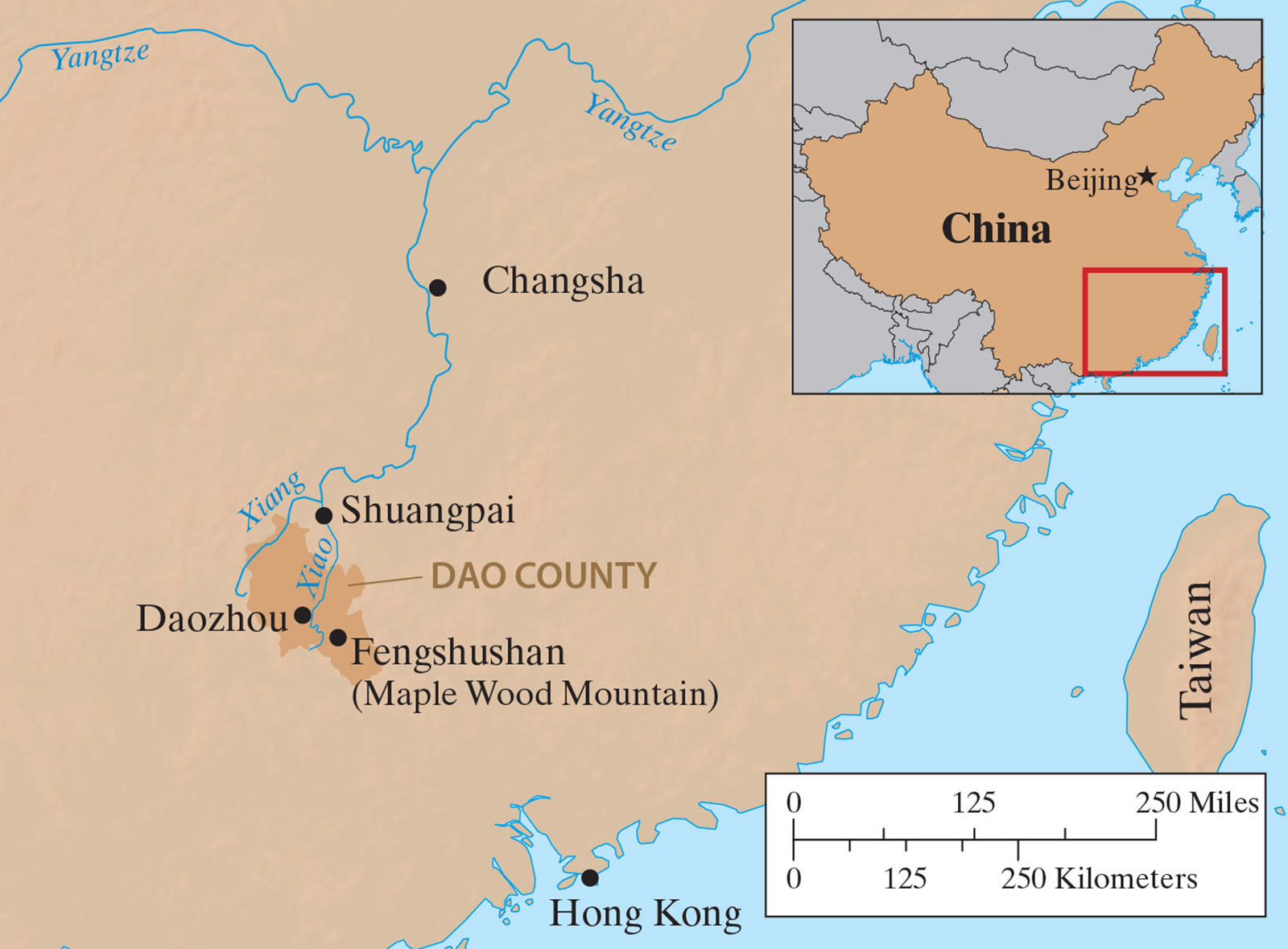
The Xiao River rushes deep and clear out of the mountains of southern China into a narrow plain of paddies and villages. At first little more than an angry stream, it begins to meander and grow as the basin’s sixty-three other creeks and brooks flow into it. By the time it reenters the mountains fifty miles to the north, it is big and powerful enough to carry barges and ferries.
Fifty years ago, these currents transported another cargo: bloated corpses. For several weeks in August and September 1967, more than nine thousand people were murdered in this region. The epicenter of the killings was Dao County (Daoxian), which the Xiao River bisects on its way north. About half the victims were killed in this district of four hundred thousand people, some clubbed to death and thrown into limestone pits, others tossed into cellars full of sweet potatoes where they suffocated. Many were tied together in bundles around a charge of quarry explosives. These victims were called “homemade airplanes” because their body parts flew over the fields. But most victims were simply bludgeoned to death with agricultural tools—hoes, carrying poles, and rakes—and then tossed into the waterways that flow into the Xiao.
In the county seat of Daozhou, observers on the shoreline counted one hundred corpses flowing past per hour. Children danced along the banks competing to find the most bodies. Some were bound together with wire strung through their collarbones, their swollen carcasses swirling in daisy chains downstream, their eyes and lips already eaten away by fish. Eventually the cadavers’ progress was halted by the Shuangpai dam where they clogged the hydropower generators. It took half a year to clear the turbines and two years before locals would eat fish again.
For decades, these murders have been a little-known event in China. When mentioned at all, they tended to be explained away as individual actions that spun out of control during the heat of the Cultural Revolution—the decade-long campaign launched by Mao Zedong in 1966 to destroy enemies and achieve a utopia. Dao County was portrayed as remote, backward, and poor. The presence of the non-Chinese Yao minority there was also sometimes mentioned as a racist way of explaining what happened: those minorities, some Han Chinese say, are only half civilized anyway, and who knows what they might do when the authorities aren’t looking?
All of these explanations are wrong. Dao County is a center of Chinese civilization, the birthplace of great philosophers and calligraphers. The killers were almost all Chinese who murdered other Chinese. And the killings were not random: instead they were acts of genocide aimed at eliminating a class of people declared to be subhuman. That class consisted of make-believe landlords, nonexistent spies, and invented insurrectionists. Far from being the work of frenzied peasants, the killings were organized by committees of Communist Party cadres in the region’s towns, who ordered the murders to be carried out in remote areas. To make sure revenge would be difficult, officials ordered the slaughter of entire families, including infants.
That we know the truth about Dao County is due to one person: a garrulous, stubborn, and emotional editor who stumbled over the story thirty years ago and decided that it was his fate to tell it. His name is Tan Hecheng and in December I set off for southern China to meet him.
Maple Wood Mountain, or Fengshushan, is a tribute to the development carried out by the dictatorship that runs China. When Tan first visited this village thirty years ago, it had no roads. A car drove him to a nearby town but he had to hike the remaining three miles up the mountain. The area was so poor that even a simple wristwatch was an unimaginable luxury, let alone electricity or running water.
Now, the path has been widened and surfaced with concrete slabs. As we picked our way up the mountain in our SUV, we passed a team of laborers expanding it into a paved road with guardrails. Electricity, water, and cell phone coverage were now givens. Many families sent their children to boarding schools in the nearby township, but for the very poor the state had provided a single-room schoolhouse. When we arrived, eleven children aged six to ten sat under Communist Party propaganda posters, learning math.
Behind the school was another monument to the all-powerful state: a stone stele with a couplet that read:
Father and Children, Rest in Peace
Those in this World, a Life of Peace 
Several other lines explained the meaning. They listed the names of the dead father and three children, and the person who erected the stele—the person still in this world who needed peace—their wife and mother, Zhou Qun.
As we stood there examining the tombstone, a change came over Tan. During the previous two days we had traveled tirelessly through the county as he tried to show us every major killing field and talk to as many survivors as possible. A boisterous sixty-seven-year-old with soft features and an unruly cowlick, he had an irrepressible gallows humor. Sometimes when we drove by a village, he would start to recount the details of who was bludgeoned or shot, but then cut himself short by shouting out: “Fuck, in this place they killed a lot of people!”
But on this ridge, in front of this tombstone, he suddenly slowed down as the memories of the past overcame him. He had been thirty-seven when he came here in 1986, a man who had lost his youth to Mao and his Cultural Revolution, and who finally had the assignment of a lifetime. He had been sent by a magazine to write about Dao County. A thirteen-hundred-person secret government commission had just investigated the killings and he had full access to its findings. But his article had been declared too pessimistic—the editors had wanted an upbeat piece on how the Communist Party had dealt with the past swiftly and fairly. In fact, he had realized that the truth had been buried. Justice had not been done. Only a tiny fraction of the killers had served jail time. And he knew then that his article would probably be killed.
Still he wrote it and gave it the name Xue zhi Shenhua, or Blood Myths. That title irritated me—these weren’t myths but facts that he had carefully reconstructed based on the commission’s thousands of pages of findings and documents, as well as his own months in the region. The English title, The Killing Wind, made more sense to me. People here still spoke of a “killing wind” that had blown through during the Cultural Revolution. I had asked him about the Chinese title a day or two earlier, but he only began to explain it here, in front of the tombstone.
“The title is not a way to soften the truth. The title doesn’t mean a myth in the sense of something half-true or rumored. What I meant was that some stories hit me with such force that they became mythic.” He pointed to the stone, crudely hewn from rock, the characters so cheaply and shallowly carved that they were already becoming illegible just four years after the monument was erected. “I cried only three times in the years I spent researching the massacre. One time was when I realized what had happened to Zhou Qun.”
On August 26, 1967, Mrs. Zhou and her three children were dragged out of bed by leaders of the village of Tuditang. She had been working there for several years as a primary school teacher but had always lived under a cloud. Her father had been a traffic policeman during the time the Nationalist government had ruled China, which was enough to make her a “counterrevolutionary offspring.” That meant her family had been categorized as a “black element”—along with landlords, wealthy farmers, rightists (anyone who had voiced complaints in the late 1950s), and capitalists (usually small shopkeepers), as well as the catch-all “bad elements” (former prostitutes, opium smokers, homosexuals, and others seen as guilty of deviant behavior).
China-Johnson-011917-scaled

For the previous eighteen years of Communist rule, black elements like Mrs. Zhou and her family had lived a marginal existence. The state had stripped them of their property. It had assigned them bad jobs with low pay or rocky plots of land to farm. And it had inundated China with a barrage of propaganda intended to convince many that black elements were dangerous, violent criminals who were barely human.
In the Cultural Revolution, Mao whipped up the propaganda another notch, declaring that enemies were readying a counterrevolution. In Dao County, stories began to fly that the black elements had seized weapons. The county government decided to strike preemptively and kill them. When village-level officials objected—many were related to the victims—more powerful leaders sent out “battle-hardened” squads of killers (often former criminals and hoodlums) to put pressure on locals to execute the undesirables. After the first deaths, locals were freed from moral constraints and usually acted spontaneously, even against family members.
This was not exceptional. Most accounts of the Cultural Revolution have focused on the Red Guards and urban violence. But a growing number of studies show that genocidal killings were widespread. Previously, we knew of cases of cannibalism in Guangxi province. But recent research, as well as in-depth case studies like Tan’s, show that the killings were widespread and systematic instead of being isolated, sensational events. One survey of local gazetteers shows that between 400,000 and 1.5 million people perished in similar incidents, meaning there were at least another one hundred Dao County massacres around this time.
Mrs. Zhou was tied up and frog-marched to a threshing yard next to the storehouse. Thirteen others were there too, including her husband, who had been seized a day earlier. The group was ordered to set off on a march. At the last moment, one of the leaders remembered that Mrs. Zhou and her husband had three children at home. They were rounded up and joined the rest on a five-mile midnight trek through the mountains.
Exhausted, the group ended up at Maple Wood Mountain at the very spot where we now stood. A self-proclaimed “Supreme People’s Court of the Poor and Lower-Middle Peasants” was formed out of the mob and immediately issued a death sentence to the entire group. The adults were clubbed in the head with a hoe and kicked into a limestone pit. Mrs. Zhou’s children wailed, running from adult to adult, promising to be good. Instead, the adults tossed them into the pit too.
Some fell down twenty feet to a ledge. Mrs. Zhou and one of her children landed alive on a pile of corpses on a higher ledge. When the gang heard their cries and sobs they tossed big rocks at the ledge until it collapsed, sending them down onto the others. Miraculously, all the family members survived. But as the days passed each of them died, until Mrs. Zhou was the last person in the pit with thirty-one corpses around her.
After a week, when an order from the Party had gone out to cease the killings, a few villagers from her hometown—which was not the village where she had been living—sneaked to the cave at night and rescued Mrs. Zhou. The village leadership from the town where she lived then recaptured her and debated killing her. Instead they tossed her in a pigsty and ordered the wardens not to feed her. But some courageous villagers tossed sweet potatoes into her cell at night and she survived another two weeks until a posse of villagers from her hometown freed her.
As Tan told us this story I thought back to the only other memorial in all of Dao County. It was erected by the son of a Chinese medical practitioner who was clubbed to death (his success as a doctor had made him prosperous and that made him a black element). The stele was similar to Mrs. Zhou’s. It just mentioned the facts and alluded to some sort of pain, without daring to be specific. The doctor’s stele stood alone in an empty field, surrounded by knee-high wild grass. It looked unremarkable until we approached it. There we saw something left behind by a mourner at a recent festival for the dead: two sabers, made for ritual use out of wood and silver foil, lying at the base of the monument, glinting in the sun.
On the fourth day of our stay, we drove up the Xiao River toward the Shuangpai dam. We had seen Mrs. Zhou earlier that morning. Now elderly but still very alert, she was unable to forget what had happened. She had remarried and had a daughter but the younger woman was unwilling to talk about the past, or even allow her mother to bring it up. This was not unusual for the victims’ offspring. Even though it was their parents who had suffered, the awful history seemed to cheapen or make hollow today’s world with its promise of prosperity and normalcy. The old victims and the dead were reminders of the past, and resented for it.
Along the way up toward the dam, Tan described what happened after his article was not published. He remained an editor at a state-run literary magazine but was kept on the margins. He was never promoted or allowed to attend conferences or become involved in competitions. But he kept at the subject of the killings, returning to Dao County and working on a definitive history. Eventually, he published his book in 2011 in Hong Kong and now we have the English version, abridged but not in a way that detracts from the overall story. It is masterfully translated by the team of Stacy Mosher and Guo Jian—the same who abridged and translated Yang Jisheng’s classic account of the Great Leap famine, Tombstone.
“You know, I can kiss ass as well as anyone,” Tan said as we made our way through the mountains. “I’m really good at it. In fact, I’m an excellent ass-kisser! I can tell people what they want to hear, and I can write an article in the way you want it. But I have a minimum moral standard: I can’t turn black into white. Somehow I just can’t do that.
“So when they said they wouldn’t publish it, I thought, ‘Okay, that’s your problem,’ but my life had changed and so I thought, ‘This is it. One way or another I will publish this.’”

Sunday, January 10, 2016

2156. An Outcry Help Topple a Mao Statue 120 Feet Tall

By Didi Kristen Tallow, The New York Times, Janaury 9, 2016
The 120-foot statue of Mao on Monday, as it was nearing completion in Tongxu County, China. Demolition began on Thursday, villagers said. Photo: Agence France-Presse — Getty Images.

ZHUSHIGANG, China — Just two days after images of a giant gold-colored statue of Mao in the bare fields of Henan Province spread across the Internet, the statue was gone — torn down apparently on the orders of embarrassed local officials.

Villagers said demolition teams arrived on Thursday morning, and by Friday morning, only a pile of rubble remained.

The 120-foot-tall statue, which local media reports said cost $465,000, had been under construction for months and was nearing completion when it began to attract attention.

Some commenters on social media denounced the extravagance of the colossus in a poor, rural part of China, where the money might have been better spent on education or health care. Several quoted from “Ozymandias,” Shelley’s meditation on the ruins of a monument to a long-forgotten autocrat (“Two vast and trunkless legs of stone stand in the desert. …”).

Others pointed out the historical irony of erecting the statue in one of the provinces worst hit by the famine caused by Mao Zedong’s Great Leap Forward.

It appears that the message was heard.

Public Security officials and groups of unidentified men in olive-green greatcoats brusquely turned away visitors and blocked road access to the site of the statue, outside the village of Zhushigang.

Villagers said the guards had been sent by officials of Tongxu County, which includes Zhushigang. They said they believed that the statue was torn down on orders from provincial officials.

A person answering the telephone at the Tongxu County government offices said he did not know anything about the demolition. He referred a caller to the county propaganda department, where the telephone went unanswered. Another person, who answered the telephone at the local Sunying Township, also said he had not heard of the demolition.

According to villagers and reports on online chat sites, the statue was the idea of a local businessman, Sun Qingxin, the head of the Lixing Group, a conglomerate that manufactures machinery and owns food-processing facilities, hospitals and schools. Mr. Sun paid for the statue, they said.

Mr. Sun is also the deputy chairman of the County People’s Congress Standing Committee, a powerful local position.

“He is crazy about Mao,” said a villager who identified himself as Mr. Wang, a potato farmer. “His factory is full of Maos.”

Two miles from the village, a guard outside the Lixing Group’s headquarters shooed away reporters, refused interview requests and ordered that no photographs be taken, warning that “cars of people will arrive and make trouble” if a reporter lingered.

Facing the factory entrance, inside the premises, was a 10-foot golden statue of Mao, standing in a traditional Chinese pavilion of cream stone.

Statues of Mao, the founder of the People’s Republic of China, were once ubiquitous in China, and many survive. President Xi Jinping has often praised Mao as a model for China today, saying Mao’s era was one when officials were selfless and honest.

But some of his policies were disastrous, including the forced agricultural collectivization and industrialization of the Great Leap Forward, which historians blame for a famine in which tens of millions of people died.

Still, a woman named Ms. Yang, 75, said several villagers cried when the statue was knocked down.

“Mao was our leader and ate bitterness for us,” she said.

On Friday, the site was shrouded in heavy fog, which was dense enough to close the nearby highway. A pile of debris and an orange crane were all that remained. Around the decay of that colossal wreck, boundless and bare, the brown and frosty fields stretched far away.